
Antenna Modeling software teaches you more about antennas
Antenna Modeling software …teaches you more about antennas …how to design better antennas …how to predict antenna performance …how to “tune” for performance …lets you try “what if…. ” Ken Konechy W 6 HHC 1
“What is Antenna Modeling? ” • it is NOT making tiny models • it is a computer program to predict and analyze antenna performance Ken Konechy W 6 HHC 2
“What is Antenna Modeling SW? ” • • Allows you to describe your antenna height Allows you choose construction materials Allows you to describe your ground conditions Allows you to analyze gain Allows you analyze impedance / SWR Allows you to predict “band-width” Allows you to plot directivity & front-to-back Ken Konechy W 6 HHC 3
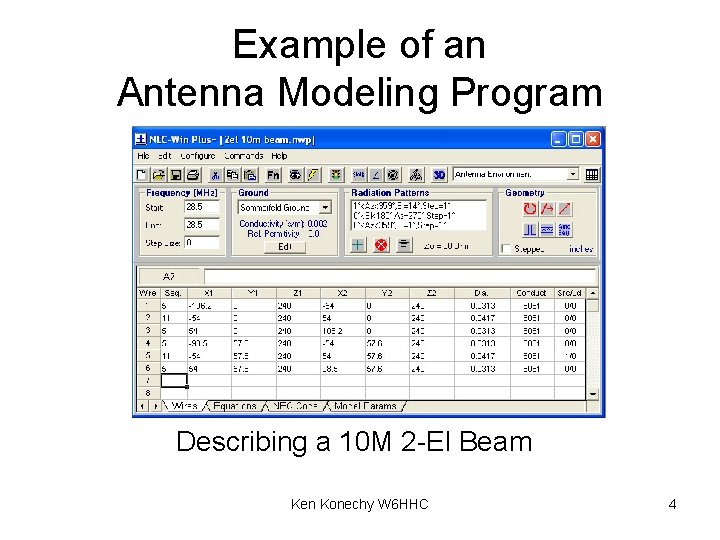
Example of an Antenna Modeling Program Describing a 10 M 2 -El Beam Ken Konechy W 6 HHC 4
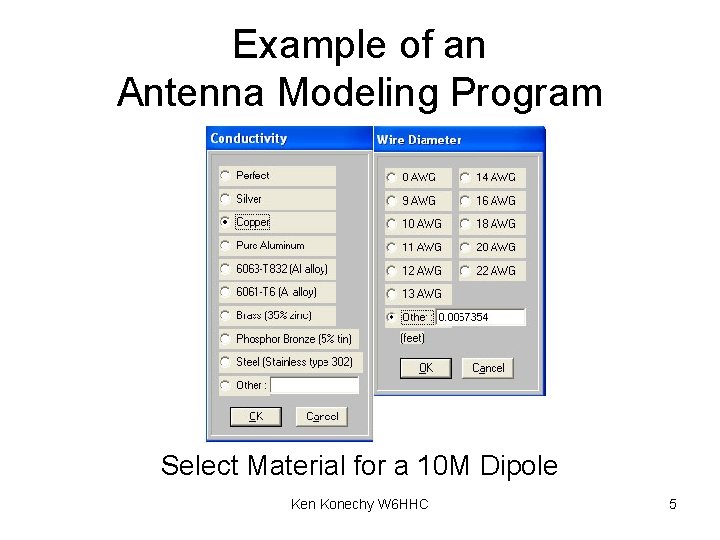
Example of an Antenna Modeling Program Select Material for a 10 M Dipole Ken Konechy W 6 HHC 5
Example of an Antenna Modeling Program • NO GROUND – “free space conditions” • PERFECT GROUND – “ The perfect world is simulated” • SOMMERFELD GROUND – “Choose many real conditions” • REAL GROUND – “Complex, allows nearby cliffs, hills, etc. ” Select “ground conditions” for a 10 M Dipole Ken Konechy W 6 HHC 6
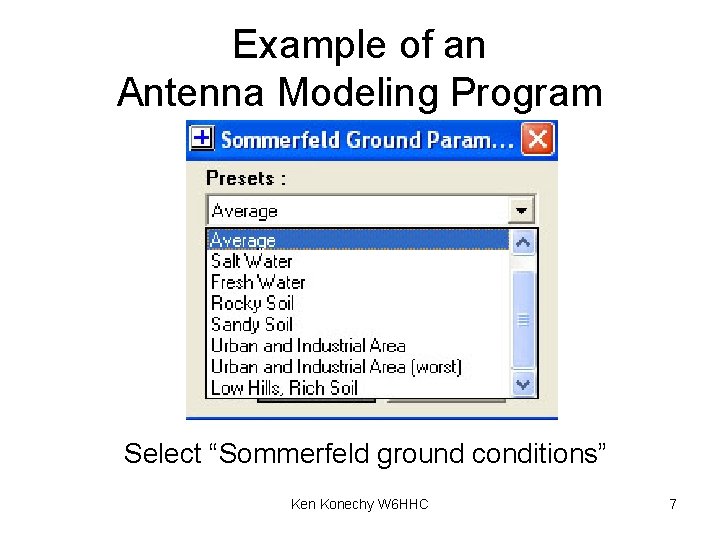
Example of an Antenna Modeling Program Select “Sommerfeld ground conditions” Ken Konechy W 6 HHC 7
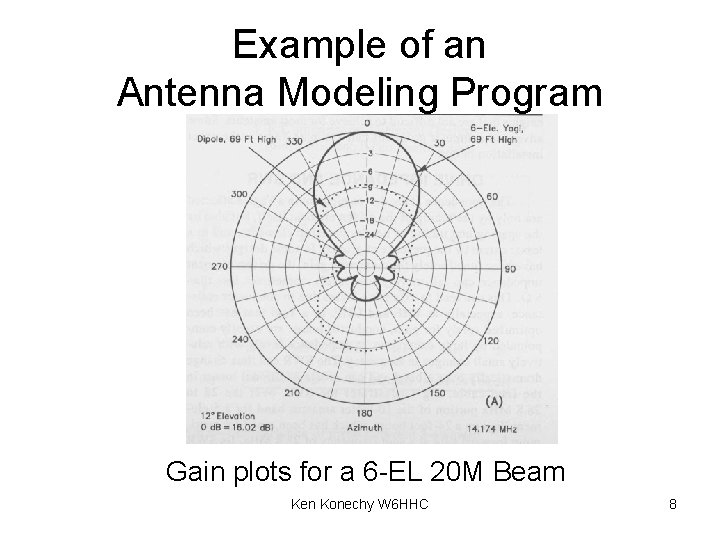
Example of an Antenna Modeling Program Gain plots for a 6 -EL 20 M Beam Ken Konechy W 6 HHC 8
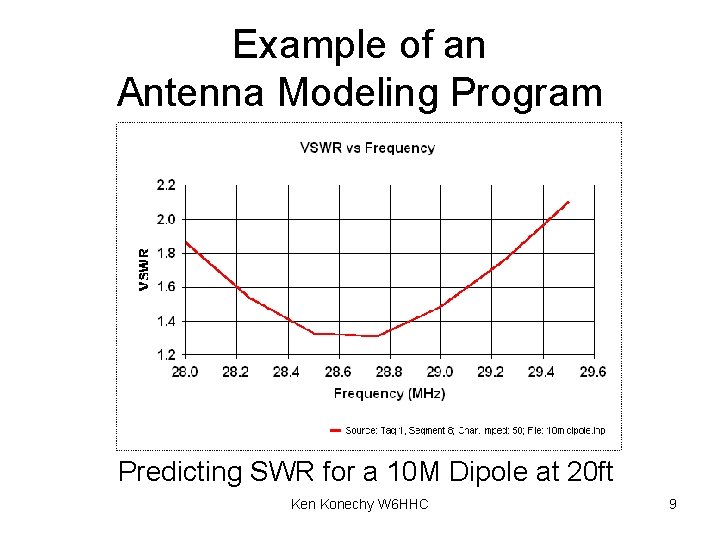
Example of an Antenna Modeling Program Predicting SWR for a 10 M Dipole at 20 ft Ken Konechy W 6 HHC 9
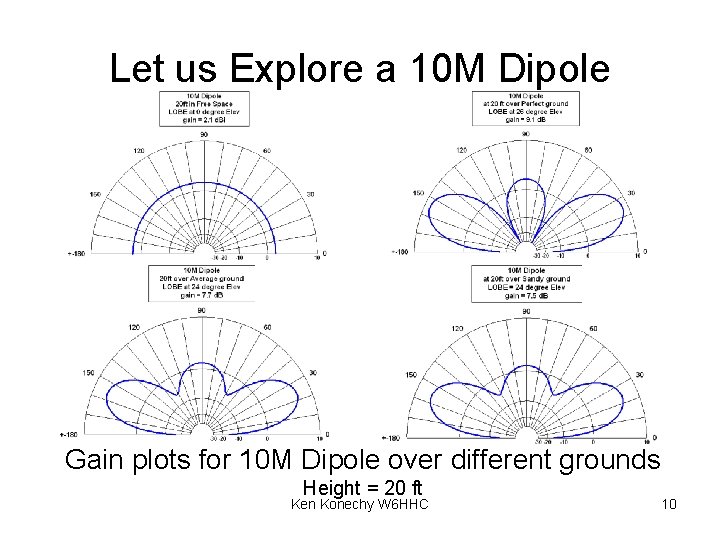
Let us Explore a 10 M Dipole Gain plots for 10 M Dipole over different grounds Height = 20 ft Ken Konechy W 6 HHC 10
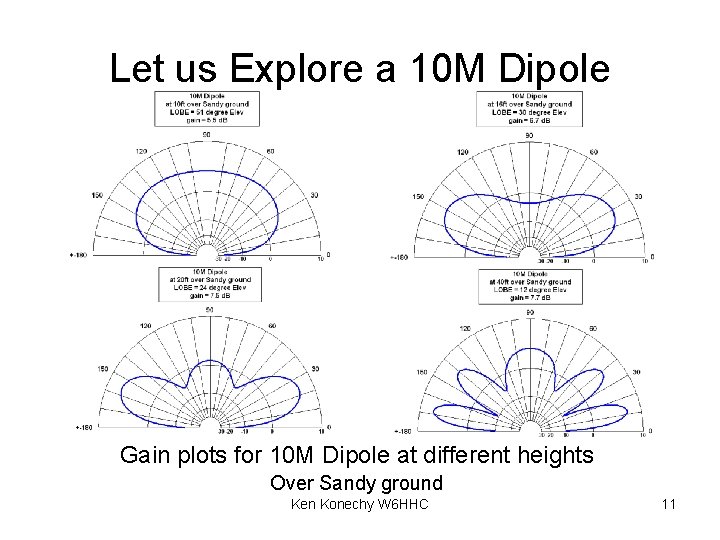
Let us Explore a 10 M Dipole Gain plots for 10 M Dipole at different heights Over Sandy ground Ken Konechy W 6 HHC 11
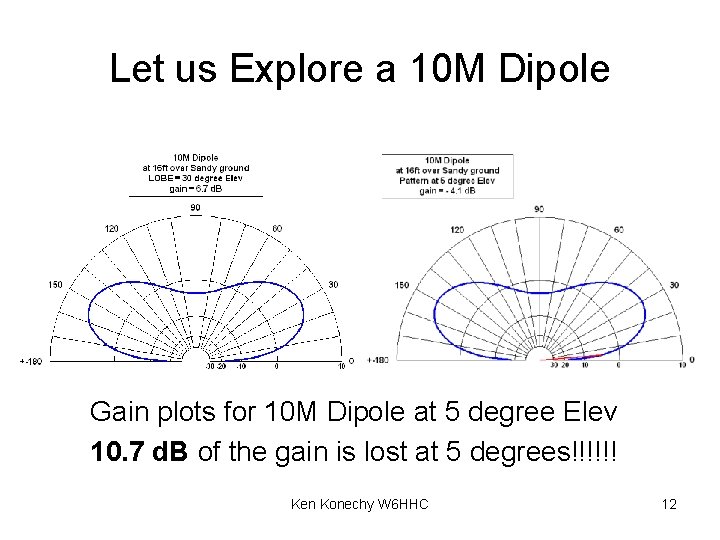
Let us Explore a 10 M Dipole Gain plots for 10 M Dipole at 5 degree Elev 10. 7 d. B of the gain is lost at 5 degrees!!!!!! Ken Konechy W 6 HHC 12
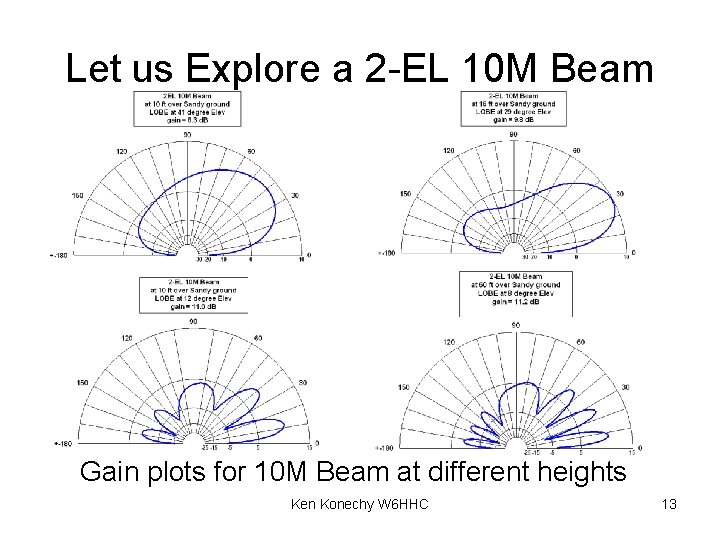
Let us Explore a 2 -EL 10 M Beam Gain plots for 10 M Beam at different heights Ken Konechy W 6 HHC 13
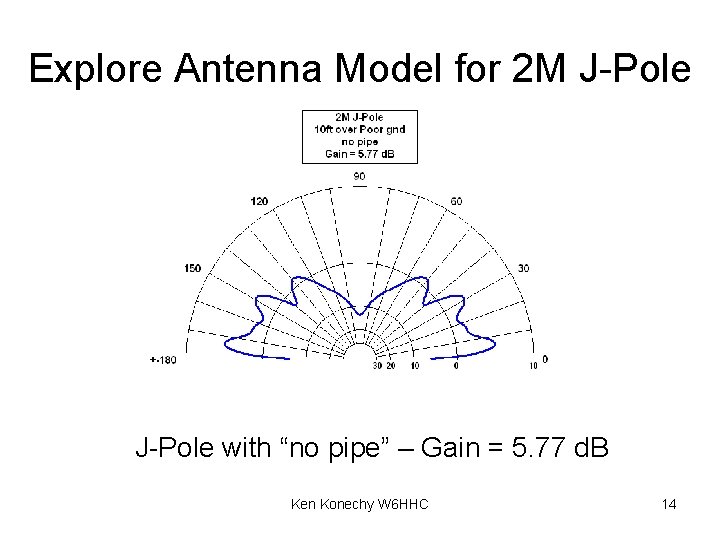
Explore Antenna Model for 2 M J-Pole with “no pipe” – Gain = 5. 77 d. B Ken Konechy W 6 HHC 14
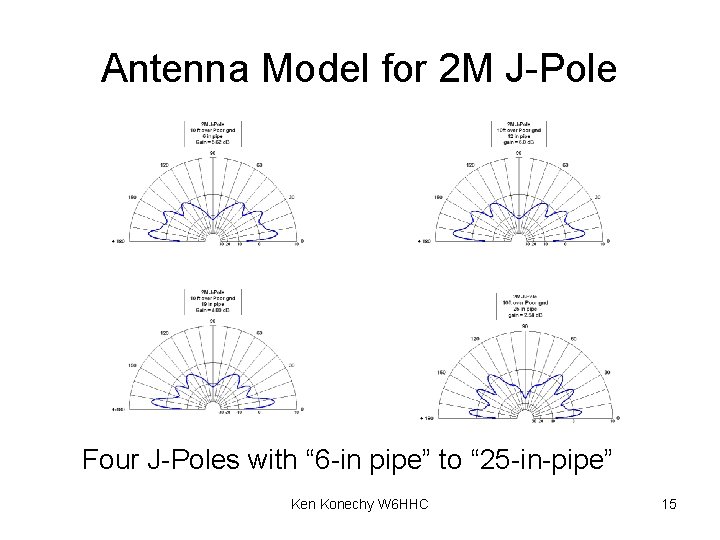
Antenna Model for 2 M J-Pole Four J-Poles with “ 6 -in pipe” to “ 25 -in-pipe” Ken Konechy W 6 HHC 15
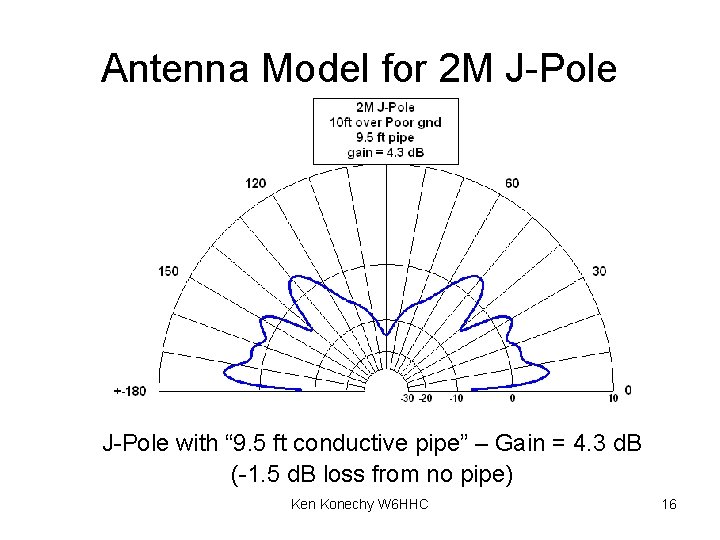
Antenna Model for 2 M J-Pole with “ 9. 5 ft conductive pipe” – Gain = 4. 3 d. B (-1. 5 d. B loss from no pipe) Ken Konechy W 6 HHC 16
Antenna Model for 2 M J-Pole • Last month we asked whether the length of support of J-Pole made difference? ? • Can it be longer than 6 inches? ? • The J-pole model showed that gain decreased when pole was 19 in, 25 in & 9. 5 ft • I have not yet tried whether grounding the support pole also has an impact on gain…I will now guess…”yes” Ken Konechy W 6 HHC 17
Different Antenna Modeling SW • NEC 2 – was designed by Lawrence Livermore Labs • Win-NEC-Plus – uses NEC 2 “core” SW with GUI - by L. B. Cebik, W 4 RNL - www. nittany-scientific. com • EZNEC - uses NEC 2 “core” software with GUI - by Roy Lewallen, W 7 EL - www. eznec. com • MINI-NEC – simplified NEC 2 to run on slow PCs - fairly obsolete, inaccurate Ken Konechy W 6 HHC 18
ARRL Class on Ant Modeling • • • If you want to learn how to use NEC 2 ARRL offers class beginning each month. On-line Internet class is 16 weeks long 3 hours per week On-line tutor for help and grading Cost $85 Ken Konechy W 6 HHC 19
Antenna Modeling software The End Any Questions? ? Ken Konechy W 6 HHC 20
- Slides: 20