
Antenna and Wave Propagation UnitIV Special Antennas Prepared


- Slides: 36
Antenna and Wave Propagation Unit-IV Special Antennas Prepared by, Dr. S. Senthil kumar Principal Tagore Institute of Engineering and Technology
Introduction p An antenna is an electrical conductor or system of conductors n n p Transmission - radiates electromagnetic energy into space Reception - collects electromagnetic energy from space In two-way communication, the same antenna can be used for transmission and reception
Radiation Patterns p Radiation pattern n n p Beam width (or half-power beam width) n p Graphical representation of radiation properties of an antenna Depicted as two-dimensional cross section Measure of directivity of antenna Reception pattern n Receiving antenna’s equivalent to radiation pattern
Types of Antennas p Isotropic antenna (idealized) n p Dipole antennas n n p Radiates power equally in all directions Half-wave dipole antenna (or Hertz antenna) Quarter-wave vertical antenna (or Marconi antenna) Parabolic Reflective Antenna
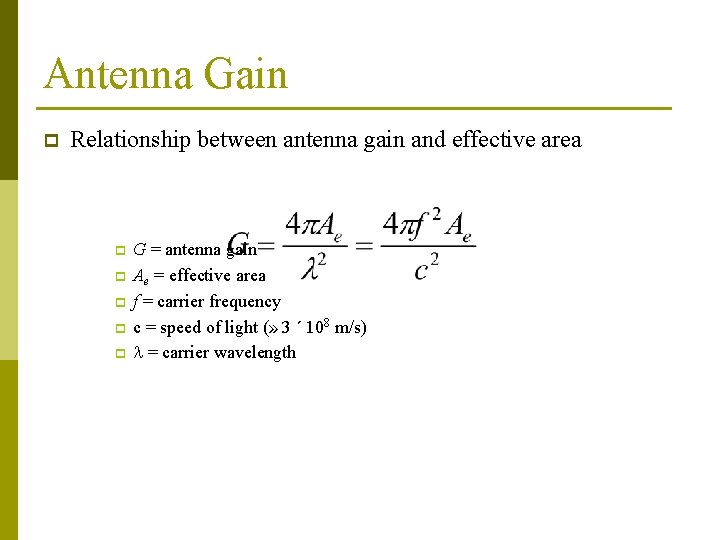
Antenna Gain p Antenna gain n p Power output, in a particular direction, compared to that produced in any direction by a perfect omnidirectional antenna (isotropic antenna) Effective area n Related to physical size and shape of antenna
Antenna Gain p Relationship between antenna gain and effective area p p p G = antenna gain Ae = effective area f = carrier frequency c = speed of light (» 3 ´ 108 m/s) = carrier wavelength
Propagation Modes Ground-wave propagation p Sky-wave propagation p Line-of-sight propagation p
Ground Wave Propagation
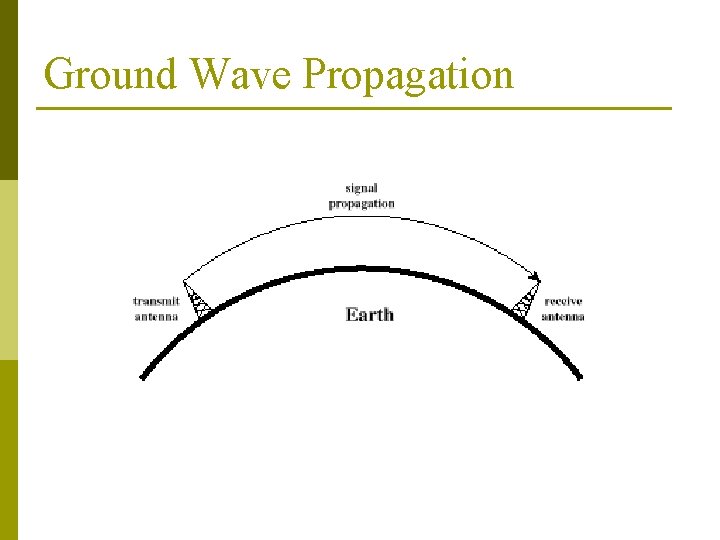
Ground Wave Propagation Follows contour of the earth p Can Propagate considerable distances p Frequencies up to 2 MHz p Example p n AM radio
Sky Wave Propagation
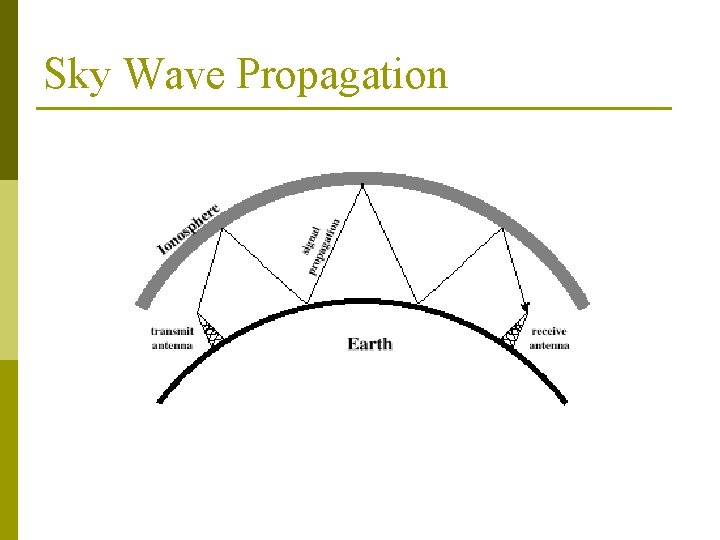
Sky Wave Propagation p p Signal reflected from ionized layer of atmosphere back down to earth Signal can travel a number of hops, back and forth between ionosphere and earth’s surface Reflection effect caused by refraction Examples n n Amateur radio CB radio
Line-of-Sight Propagation
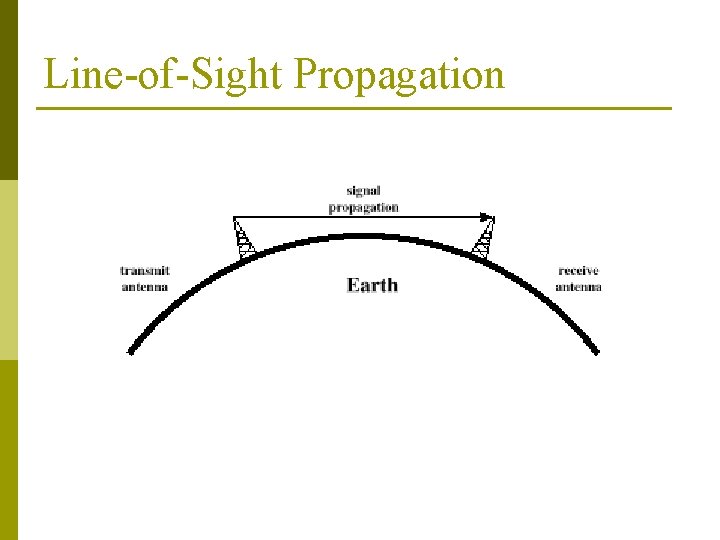
Line-of-Sight Propagation p Transmitting and receiving antennas must be within line of sight n n p Satellite communication – signal above 30 MHz not reflected by ionosphere Ground communication – antennas within effective line of site due to refraction Refraction – bending of microwaves by the atmosphere n n n Velocity of electromagnetic wave is a function of the density of the medium When wave changes medium, speed changes Wave bends at the boundary between mediums
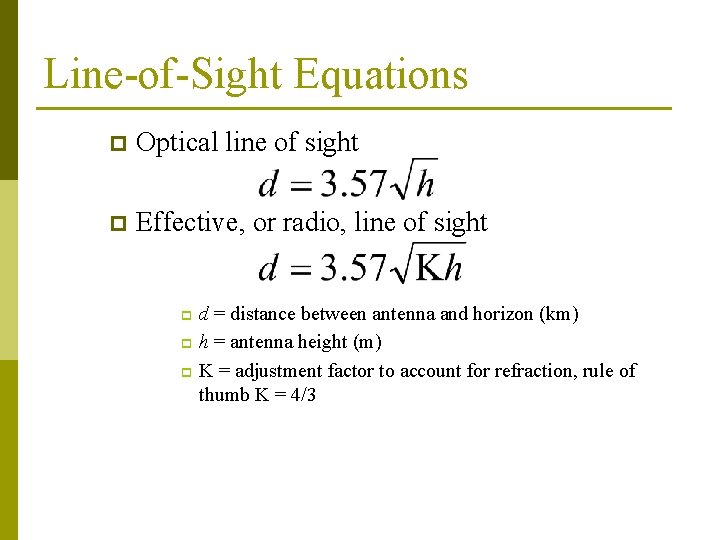
Line-of-Sight Equations p Optical line of sight p Effective, or radio, line of sight d = distance between antenna and horizon (km) p h = antenna height (m) p K = adjustment factor to account for refraction, rule of thumb K = 4/3 p
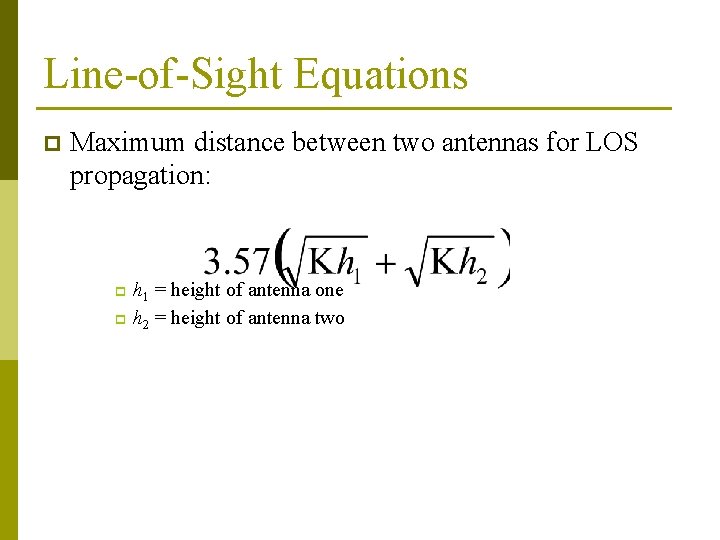
Line-of-Sight Equations p Maximum distance between two antennas for LOS propagation: h 1 = height of antenna one p h 2 = height of antenna two p
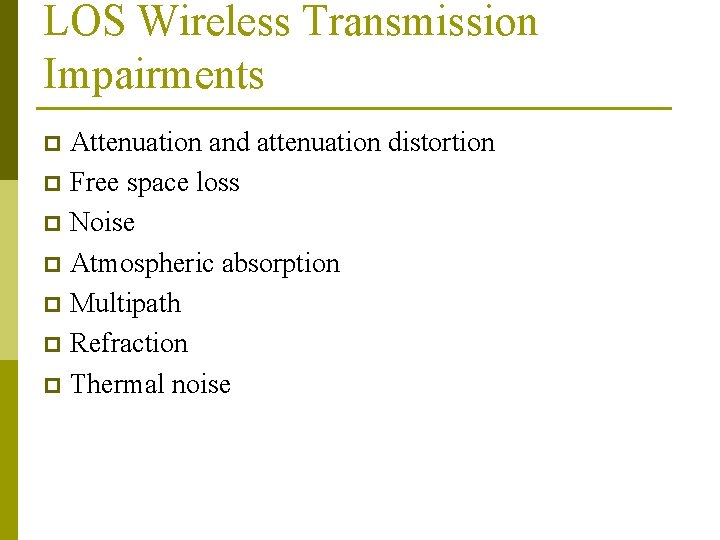
LOS Wireless Transmission Impairments Attenuation and attenuation distortion p Free space loss p Noise p Atmospheric absorption p Multipath p Refraction p Thermal noise p
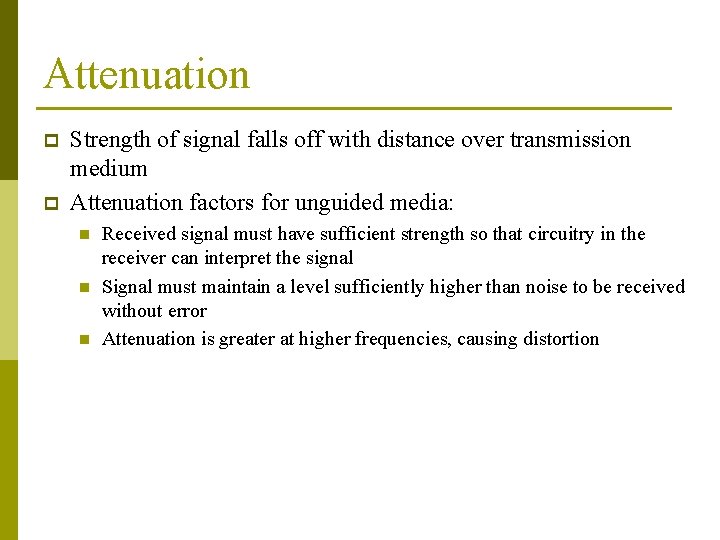
Attenuation p p Strength of signal falls off with distance over transmission medium Attenuation factors for unguided media: n n n Received signal must have sufficient strength so that circuitry in the receiver can interpret the signal Signal must maintain a level sufficiently higher than noise to be received without error Attenuation is greater at higher frequencies, causing distortion
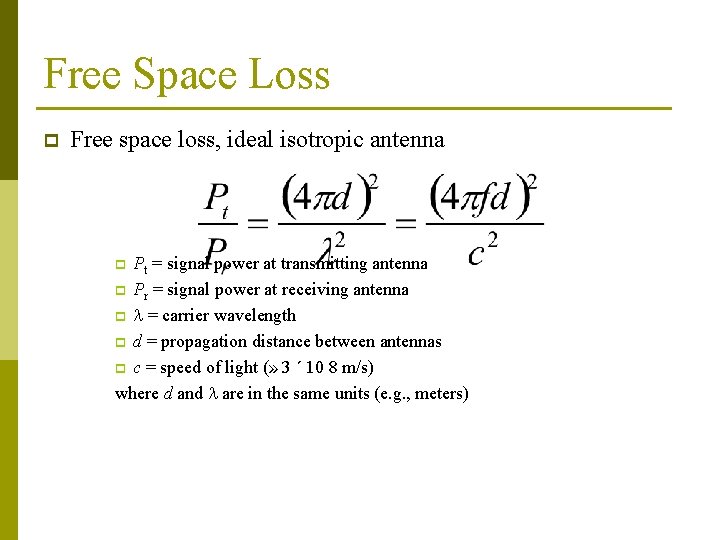
Free Space Loss p Free space loss, ideal isotropic antenna Pt = signal power at transmitting antenna p Pr = signal power at receiving antenna p = carrier wavelength p d = propagation distance between antennas p c = speed of light (» 3 ´ 10 8 m/s) where d and are in the same units (e. g. , meters) p
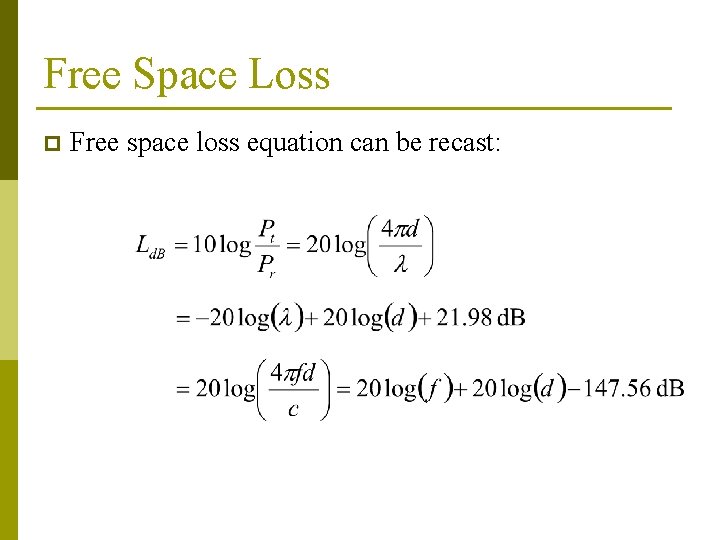
Free Space Loss p Free space loss equation can be recast:
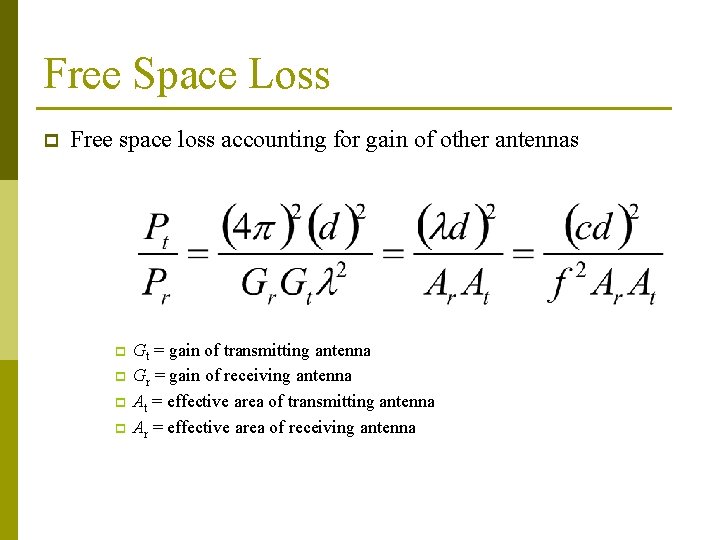
Free Space Loss p Free space loss accounting for gain of other antennas p p Gt = gain of transmitting antenna Gr = gain of receiving antenna At = effective area of transmitting antenna Ar = effective area of receiving antenna
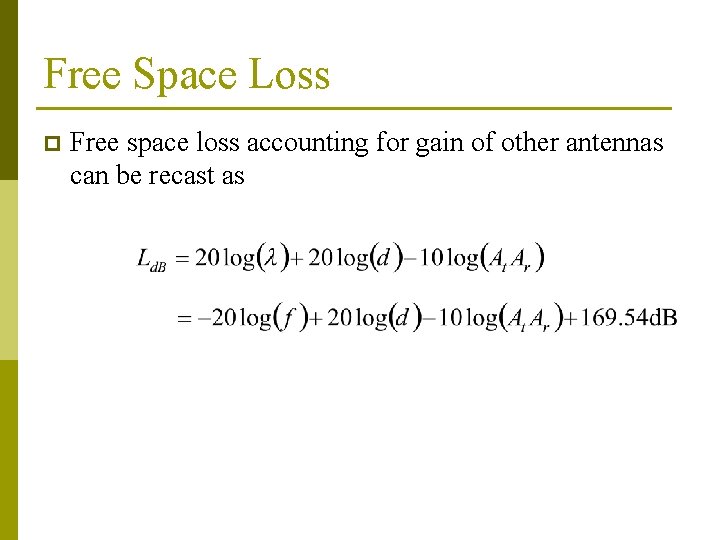
Free Space Loss p Free space loss accounting for gain of other antennas can be recast as
Categories of Noise Thermal Noise p Intermodulation noise p Crosstalk p Impulse Noise p
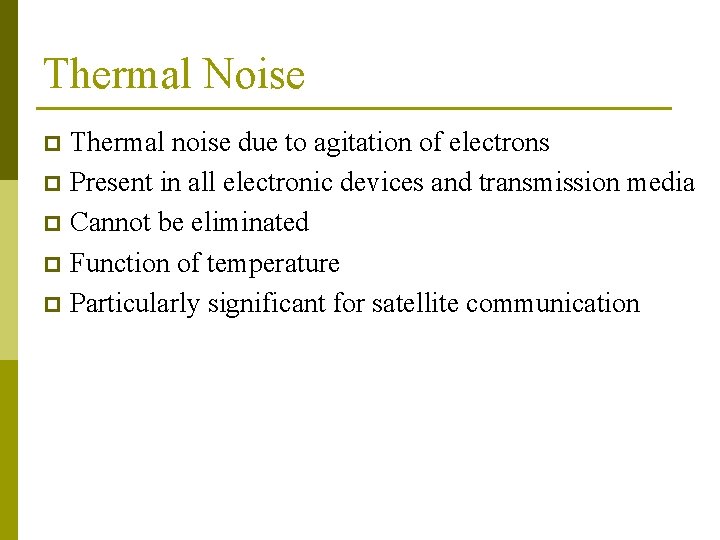
Thermal Noise Thermal noise due to agitation of electrons p Present in all electronic devices and transmission media p Cannot be eliminated p Function of temperature p Particularly significant for satellite communication p
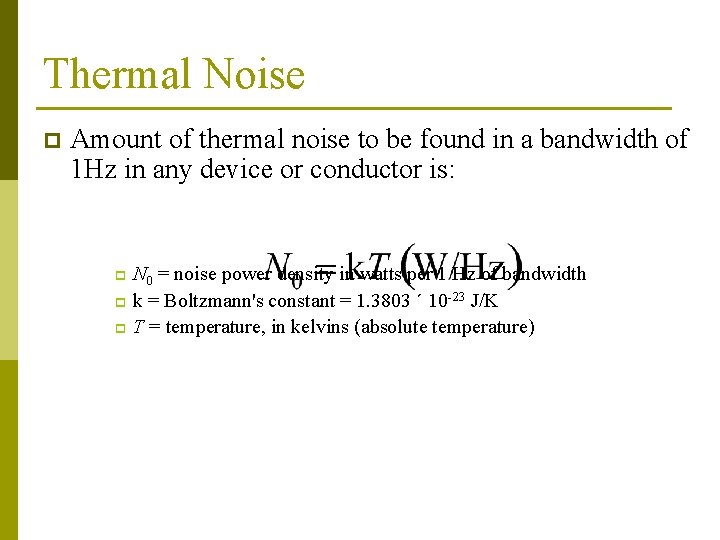
Thermal Noise p Amount of thermal noise to be found in a bandwidth of 1 Hz in any device or conductor is: N 0 = noise power density in watts per 1 Hz of bandwidth p k = Boltzmann's constant = 1. 3803 ´ 10 -23 J/K p T = temperature, in kelvins (absolute temperature) p
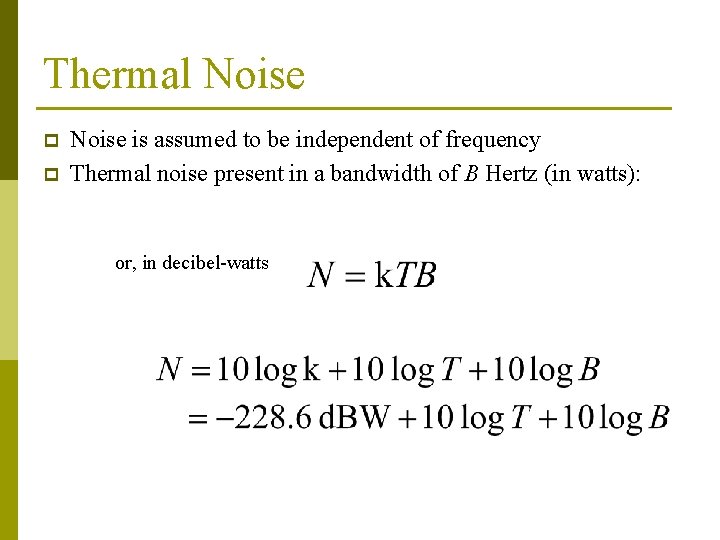
Thermal Noise p p Noise is assumed to be independent of frequency Thermal noise present in a bandwidth of B Hertz (in watts): or, in decibel-watts
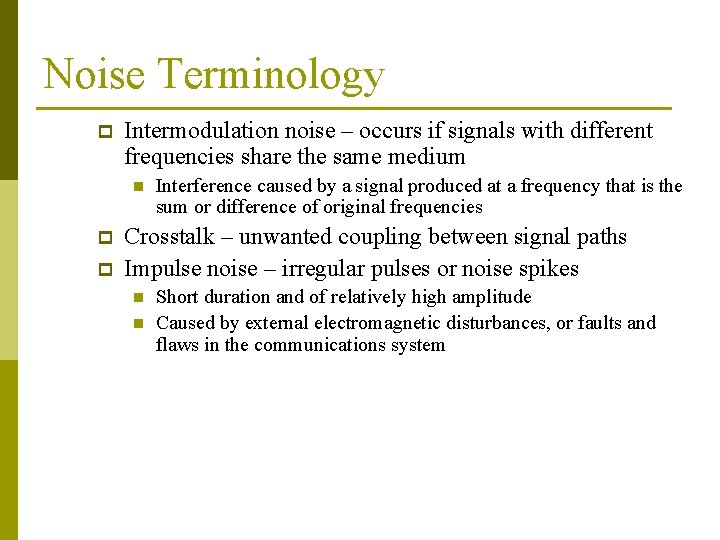
Noise Terminology p Intermodulation noise – occurs if signals with different frequencies share the same medium n p p Interference caused by a signal produced at a frequency that is the sum or difference of original frequencies Crosstalk – unwanted coupling between signal paths Impulse noise – irregular pulses or noise spikes n n Short duration and of relatively high amplitude Caused by external electromagnetic disturbances, or faults and flaws in the communications system
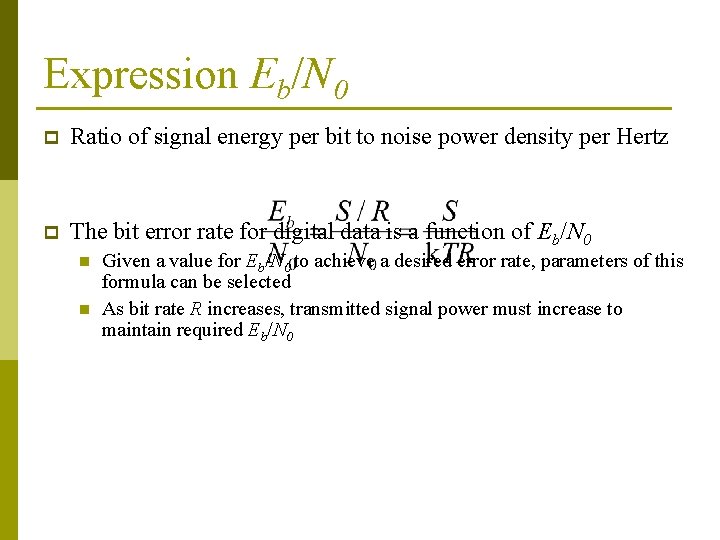
Expression Eb/N 0 p Ratio of signal energy per bit to noise power density per Hertz p The bit error rate for digital data is a function of Eb/N 0 n n Given a value for Eb/N 0 to achieve a desired error rate, parameters of this formula can be selected As bit rate R increases, transmitted signal power must increase to maintain required Eb/N 0
Other Impairments Atmospheric absorption – water vapor and oxygen contribute to attenuation p Multipath – obstacles reflect signals so that multiple copies with varying delays are received p Refraction – bending of radio waves as they propagate through the atmosphere p
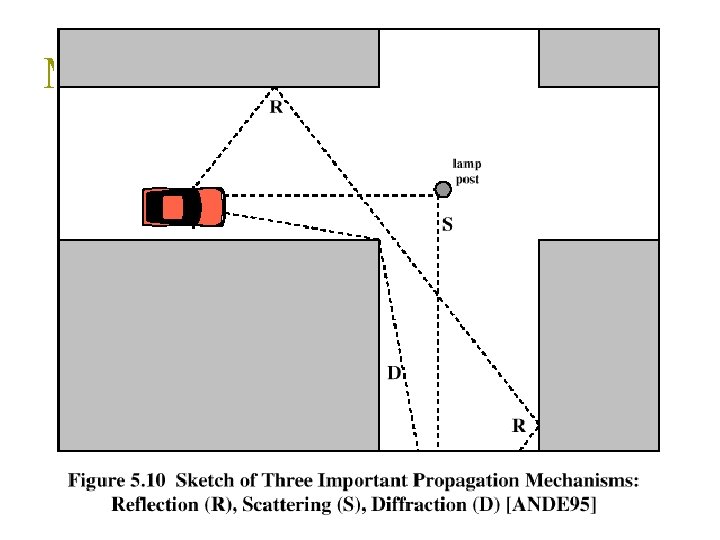
Multipath Propagation
Multipath Propagation p p p Reflection - occurs when signal encounters a surface that is large relative to the wavelength of the signal Diffraction - occurs at the edge of an impenetrable body that is large compared to wavelength of radio wave Scattering – occurs when incoming signal hits an object whose size in the order of the wavelength of the signal or less
The Effects of Multipath Propagation p Multiple copies of a signal may arrive at different phases n p If phases add destructively, the signal level relative to noise declines, making detection more difficult Intersymbol interference (ISI) n One or more delayed copies of a pulse may arrive at the same time as the primary pulse for a subsequent bit
Types of Fading Fast fading p Slow fading p Flat fading p Selective fading p Rayleigh fading p Rician fading p
Error Compensation Mechanisms Forward error correction p Adaptive equalization p Diversity techniques p
Forward Error Correction p Transmitter adds error-correcting code to data block n p Code is a function of the data bits Receiver calculates error-correcting code from incoming data bits n n If calculated code matches incoming code, no error occurred If error-correcting codes don’t match, receiver attempts to determine bits in error and correct
Adaptive Equalization p Can be applied to transmissions that carry analog or digital information n n p p p Analog voice or video Digital data, digitized voice or video Used to combat intersymbol interference Involves gathering dispersed symbol energy back into its original time interval Techniques n n Lumped analog circuits Sophisticated digital signal processing algorithms
Diversity Techniques p p Diversity is based on the fact that individual channels experience independent fading events Space diversity – techniques involving physical transmission path Frequency diversity – techniques where the signal is spread out over a larger frequency bandwidth or carried on multiple frequency carriers Time diversity – techniques aimed at spreading the data out over time