
Antenatal Breastfeeding Workshop Close and Loving Relationships begin

Antenatal Breastfeeding Workshop
Close and Loving Relationships begin during pregnancy Throughout pregnancy we encourage mothers to build a bond with their baby. This is the very basis of the responsive relationship from which responsive breastfeeding will flourish. We encourage things such as : • Talking to the baby • Signing the baby songs • Reading books • Responding to movements • Getting partners/ siblings involved • Its also lovely to give you bump a ‘nickname’ • • • The baby’s experiences and environment begins long before they make an entrance to the world. In their mother’s womb they get a taste for what life will be like on the outside as they hear her voice and the voices of family members. They also hear other sounds and can sense their mother’s moods and feelings. From around 20 weeks of pregnancy brain growth takes off increasing in size by 17 fold, creating over 200, 000 neurons per minute!
The Value of Breastmilk- Why not watch this video with your partner or grandparents to be? https: //www. youtube. com/watch? v=2 adr. IK we. ZTE
Developing loving relationships with your baby New babies have a strong need to be close to their parents, as this helps them to feel secure and loved. When babies feel secure, they release a hormone called oxytocin, which acts like a fertiliser for their growing brain, helping them to be happy babies and more confident children and adults. The following links provide more information: https: //www. unicef. org. uk/babyfriendly/baby-friendly-resources/breastfeedingresources/bre astfeeding-re lationships-early-days-video/ https: //www. unicef. org. uk/babyfriendly/baby-friendly-resources/relationship-buildingresources/importance-of-relationship-building-video/ https: //www. unicef. org. uk/babyfriendly/baby-friendly-resources/relationship-buildingresources/ewan-mcgregor-baby-i-love-you-video/

Collecting Colostrum Before the Birth Pregnant women start producing colostrum from around 20 weeks. Colostrum is the early milk you produce - often referred to as liquid gold, it is highly concentrated, full of protein and white blood cells that help your baby develop their own immune system and provide protection against infection. After the birth of your placenta, and as your baby suckles at the breast, the volume of breastmilk increases.
Collecting Colostrum Before the birth Many women find learning to hand express from late in their pregnancy a very useful skill. For more information on how to hand express watch the video below. https: //www. unicef. org. uk/babyfriendly/baby-friendly-resources/breastfeedingresources/hand-expression-video/
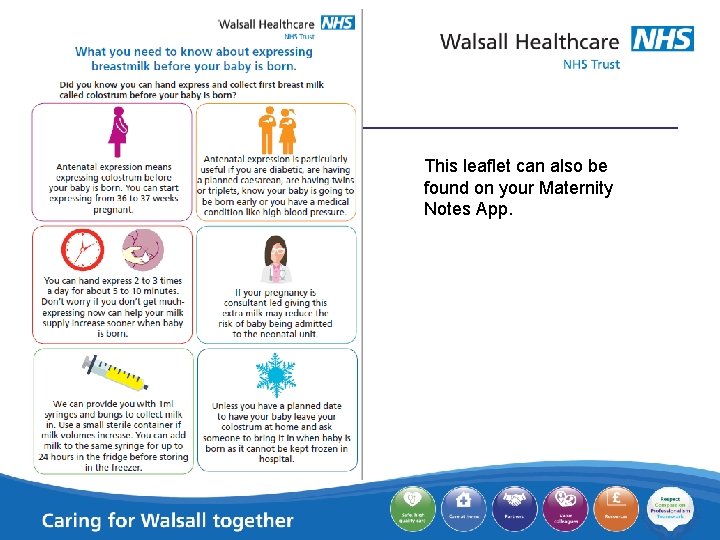
This leaflet can also be found on your Maternity Notes App.
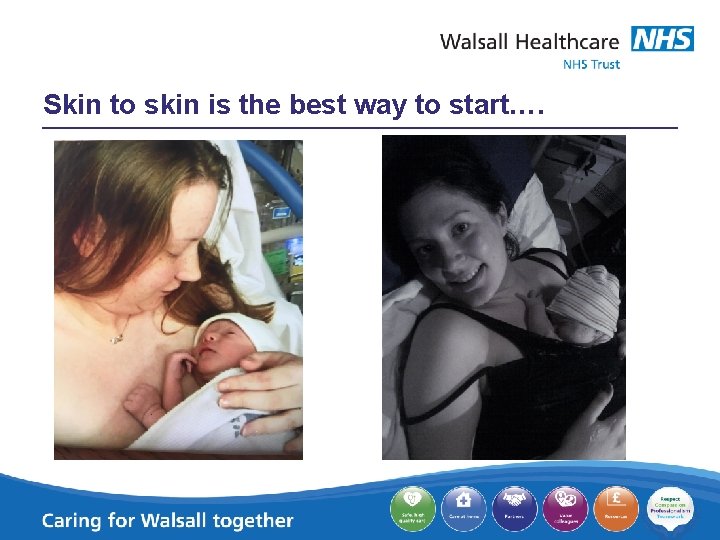
Skin to skin is the best way to start….
Skin to Skin contact Skin to skin helps babies adapt to life outside the womb and is important for supporting mothers to initiate breastfeeding and to develop a close, loving relationship with their baby. Skin to skin contact is where a baby is laid directly on their mother’s bare chest, both of them covered in a warm blanket, and left for at least an hour or until after the first feed. Skin to skin contact can also take place any time a baby needs comforting or calming and to help boost a mother’s milk supply. • Why is skin to skin contact important? – It calms and relaxes both mother and baby. – It regulates the baby’s heart rate and breathing, helping them to better adapt to life outside the womb. – It stimulates digestion and an interest in feeding. – It regulates temperature. – It enables colonisation of the baby’s skin with the mother’s friendly bacteria, thus providing protection against infection. – It stimulates the release of hormones to support breastfeeding and mothering https: //www. unicef. org. uk/babyfriendly/baby-friendly-resources/implementing-standardsresources/skin-to-skin-contact/
Skin to Skin However you plan to feed your baby, skin to skin after birth is a really good way for you to start to get to know each other. In the first few hours after birth, having uninterrupted skin to skin with your baby will help them to go through some important developmental stages.
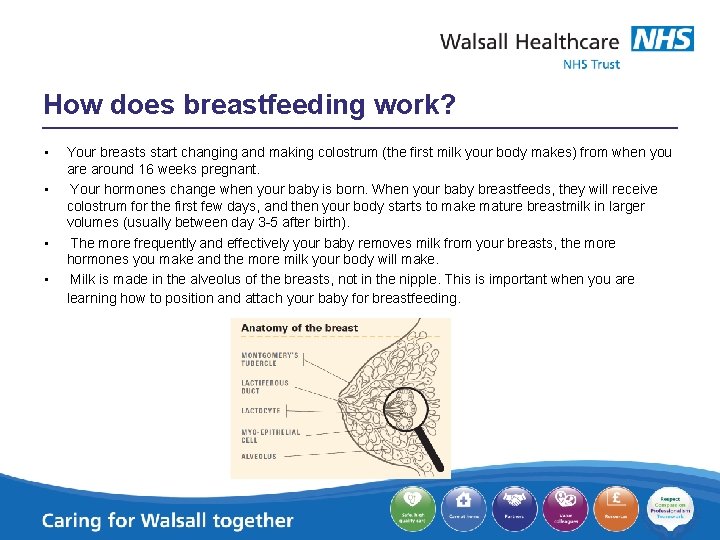
How does breastfeeding work? • • Your breasts start changing and making colostrum (the first milk your body makes) from when you are around 16 weeks pregnant. Your hormones change when your baby is born. When your baby breastfeeds, they will receive colostrum for the first few days, and then your body starts to make mature breastmilk in larger volumes (usually between day 3 -5 after birth). The more frequently and effectively your baby removes milk from your breasts, the more hormones you make and the more milk your body will make. Milk is made in the alveolus of the breasts, not in the nipple. This is important when you are learning how to position and attach your baby for breastfeeding.
Helping Your Baby to Attach to the Breast https: //globalhealthmedia. org/portfolioitems/attaching-your-baby-at-the-breast/
Helping your baby breastfeed well It is important that your baby attaches effectively at the breast, as this will help make sure they get enough milk. In turn, this helps to make sure that you have a good milk supply. A good latch also helps to protect a mother’s nipples from becoming sore. Please watch the following two videos: https: //www. unicef. org. uk/babyfriendly/baby-friendly-resources/breastfeedingresources/positioning-and-attachment-video/ https: //www. unicef. org. uk/babyfriendly/baby-friendly-resources/breastfeedingresources/ineffective-attachment/
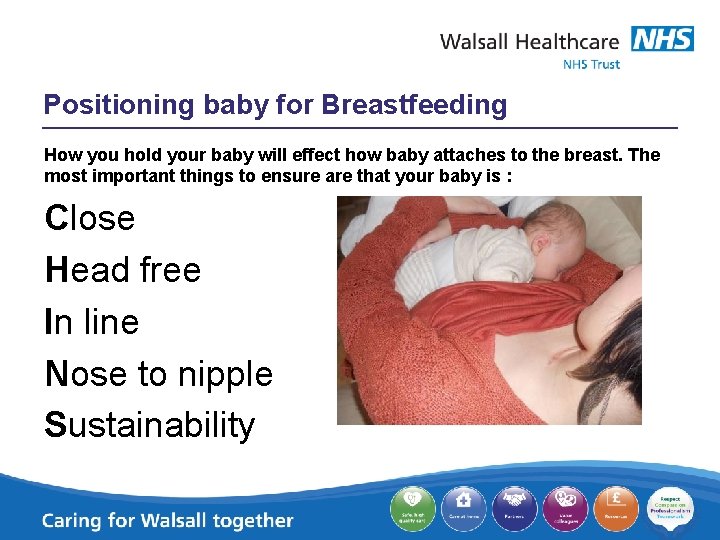
Positioning baby for Breastfeeding How you hold your baby will effect how baby attaches to the breast. The most important things to ensure are that your baby is : Close Head free In line Nose to nipple Sustainability
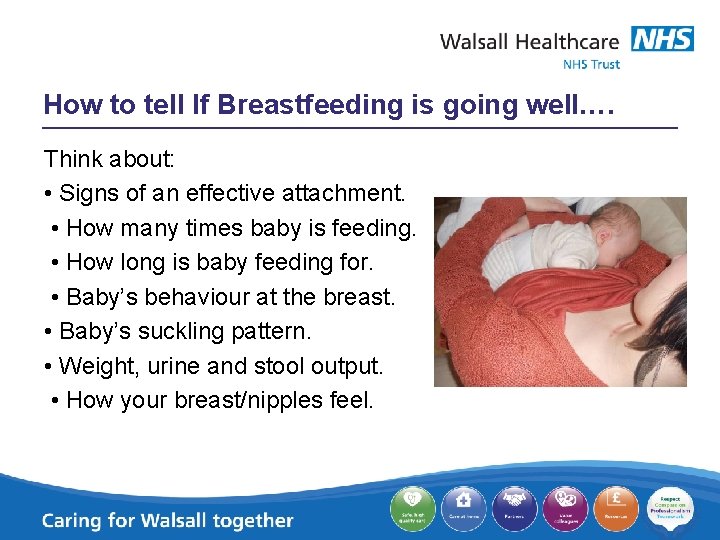
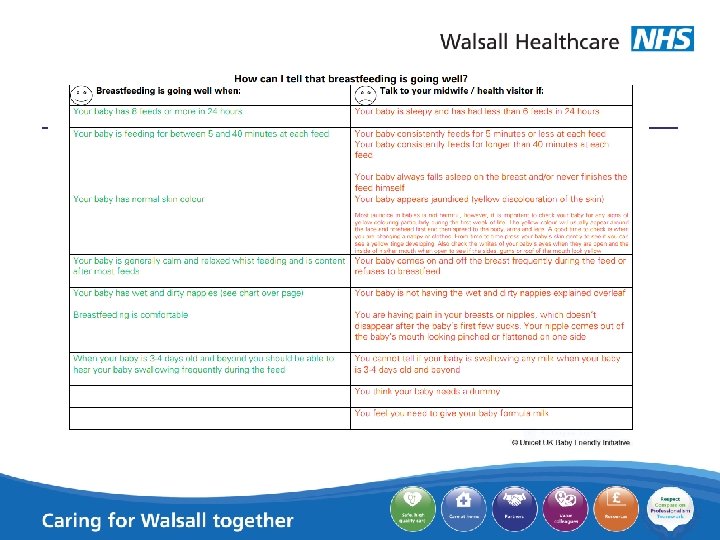
How to tell If Breastfeeding is going well…. Think about: • Signs of an effective attachment. • How many times baby is feeding. • How long is baby feeding for. • Baby’s behaviour at the breast. • Baby’s suckling pattern. • Weight, urine and stool output. • How your breast/nipples feel.
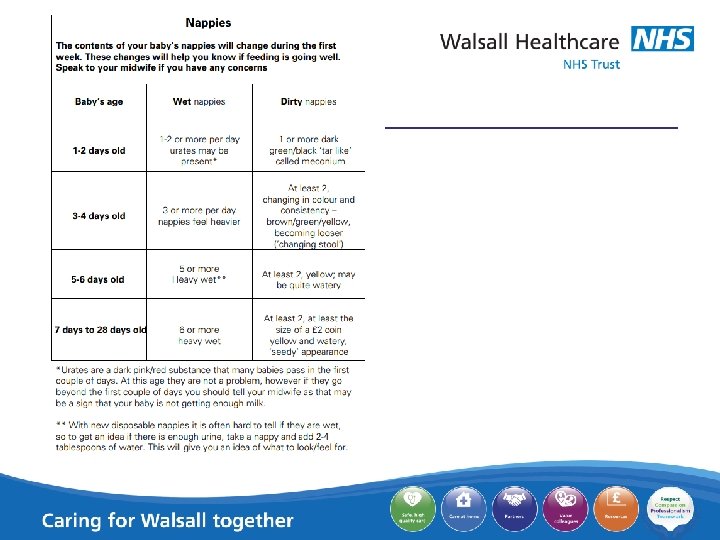
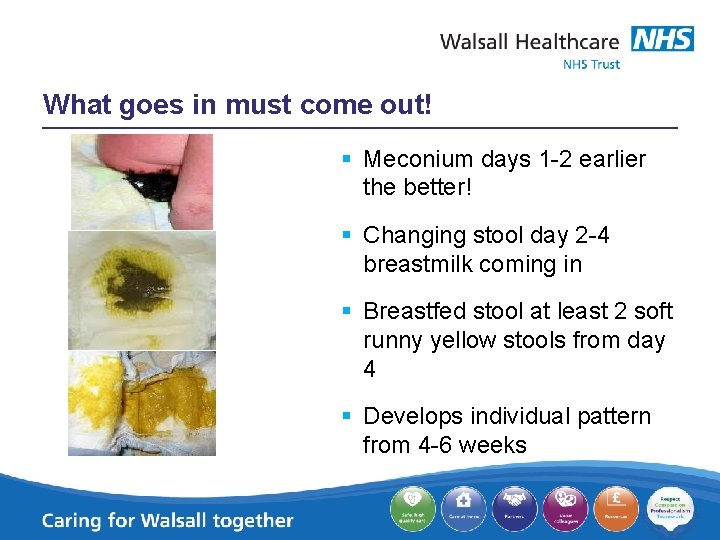
What goes in must come out! § Meconium days 1 -2 earlier the better! § Changing stool day 2 -4 breastmilk coming in § Breastfed stool at least 2 soft runny yellow stools from day 4 § Develops individual pattern from 4 -6 weeks
Close and Loving Relationships in the Early Postnatal Period Although food is a major reason why babies do breastfeed, it is not the only reason. It is important to be responsive to your baby's needs. Responsive breastfeeding means the mother is responding to her baby’s cues, as well as her own desire to feed her baby. Crucially, feeding responsively recognises that feeds are not just for nutrition, but also for love, comfort and reassurance between baby and mother. Feeding responsively is: • Responding to feeding cues (baby opening their eyes, rooting to suckle, putting hands to mouth). • Feeding when breasts feel full. • Feeding when baby needs comfort. • Feeding when mother and baby want to relax. Breastfed babies cannot be overfed or spoiled. “I use the breast for comfort, and then the nutrition just takes care of itself. ”

Useful videos to watch … https: //www. youtube. com/watch? v=Dagfg. Me. MSXI&list=PLofl. L gx. Nj. Bdyr 7 i 2 Zx-Arw. TEU 2 Pw. XWgf 4&index=1
Useful videos to watch … https: //www. youtube. com/watch? v=Brhq. Z 11 zos&list=PLofl. Lgx. Nj. Bdyr 7 i 2 Zx. Arw. TEU 2 Pw. XWgf 4&index=4
Supporting a Breastfeeding Mother https: //www. youtube. com/watch? v=03 y. Qs 9 t. Ae 3 c&list=PLofl. Lgx. N j. Bdyr 7 i 2 Zx-Arw. TEU 2 Pw. XWgf 4&index=2
Breastfeeding Support in Walsall • Here in Walsall we have the Walsall Infant Feeding Team who can be contacted by phone on tel: 01922 605248 Monday- Friday 9 -5 pm. • Please access the information on your Maternity Notes App in the ‘Leaflets’ section. There is a wealth of useful information and links.
Other Sources of Support • National Breastfeeding Helpline Tel: 0300 100 0212 www. nationalbreastfeedinghelpline. org. uk • Breastfeeding Network Helpline Tel: 0300 100 0210 www. breastfeedingnetwork. org. uk • La Leche League Helpline Tel: 0345 120 2918 www. laleche. org. uk/our-helpline-leaders/ • NCT Breastfeeding Helpline Tel: 0300 330 0700 www. nct. org. uk/baby-toddler/feeding/early-days/breastfeeding-support-nct • Association of Breastfeeding Mothers Helpline Tel: 0300 330 5453
Other Sources of Support Download the Best Beginnings Baby Buddy App for parents and parents to be https: //www. bestbeginnings. org. uk/baby-buddy Use the Start 4 Life Breastfeeding Friend Chatbot by opening Facebook and searching for "Start 4 Life Breastfeeding Friend" or by visiting the Start for Life - Breastfeeding website. https: //www. nhs. uk/start 4 life/baby/breastfeeding/extra-help-andsupport/facebook-messenger/ http: //iconcope. org/ Foreign Language Resources https: //www. unicef. org. uk/babyfriendly/baby-friendly-resources/foreignlanguage-resources/
- Slides: 25