
Antegrade Approach to CTOs Basic Techniques and Current
Antegrade Approach to CTOs: Basic Techniques and Current Success Rates Gerald S. Werner, MD, FESC, FACC, FSCAI Klinikum Darmstadt Gmb. H Darmstadt, Germany

Potential conflicts of interest Speaker’s name: Gerald S. Werner I have the following potential conflicts of interest to report: Research contracts Consulting Employment in industry Stockholder of a healthcare company Owner of a healthcare company Other(s) I do not have any potential conflict of interest

German reality: ALKK Register Elective PCI: 35 centers CTO No CTO Number of patients 749 9328 Fluoroscopy time [min] 13. 8 7. 5 <0. 001 Contrast volume [ml] 190 170 <0. 001 Ad hoc PCI [%] 73. 3 79. 3 <0. 001 TIMI III after PCI [%] 60. 5 98. 0 <0. 001 Successful PCI [%] 66. 4 97. 4 <0. 001 Stent use in successful PCI [%] Share of CTOs Multiple stents [%] Fluoro time Drug-eluting stent use [%] Success rate 93. 2 7. 4 % 46. 0 13. 8 min 35. 1 61 % 92. 7 n. s. 19. 3 <0. 001 35. 6 0. 80 Werner et al. Euro. Intervention 2010; 6: 361 -6 P

MAYO Clinic experience with CTOs Adapted from Prasad A et al. , JACC 2007

The Toyohashi experience Rathore S et al. JACC Cardiovasc Intervention 2009; 2: 489 -97

Success Antegrade vs Retrograde
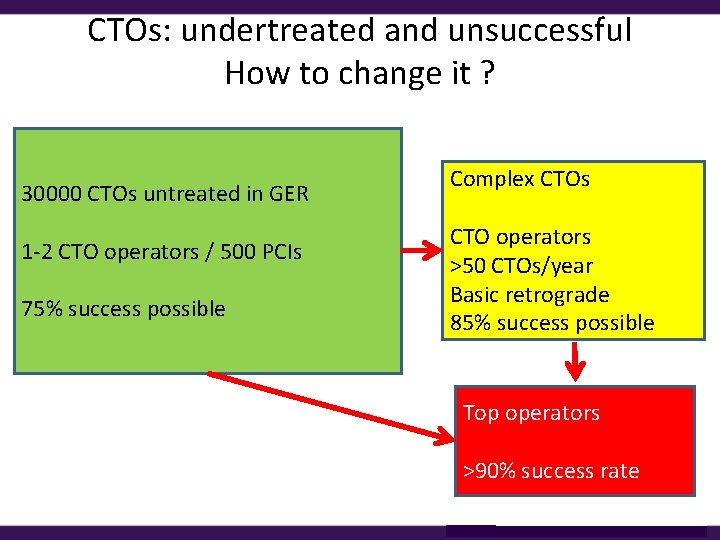
CTOs: undertreated and unsuccessful How to change it ? 30000 CTOs untreated in GER 1 -2 CTO operators / 500 PCIs 75% success possible Complex CTOs CTO operators >50 CTOs/year Basic retrograde 85% success possible Top operators >90% success rate
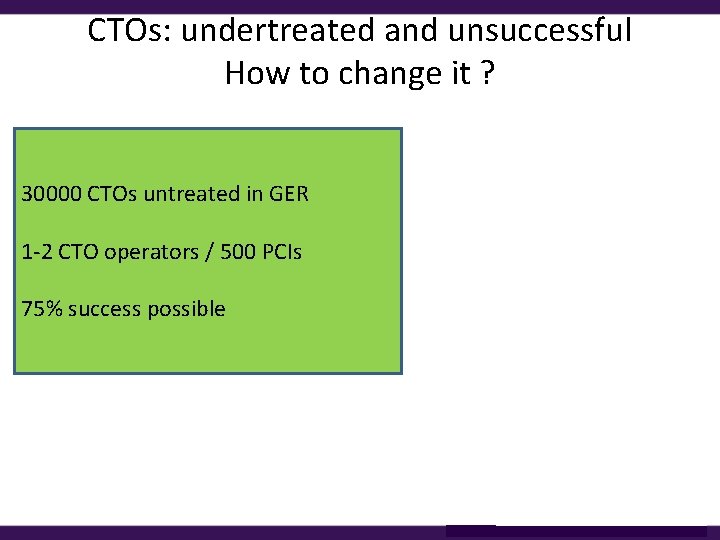
CTOs: undertreated and unsuccessful How to change it ? 30000 CTOs untreated in GER 1 -2 CTO operators / 500 PCIs 75% success possible
The deficit in treating CTOs • Basic techniques are not implemented in all cath labs – The need for dual injection during PCI of CTOs is not observed as a standard approach – The knowledge of modern guide wires and their dedicated use is not wide spread, and this variety often deters and confuses “new comers” – The rapid development of wire technology is often lost on the non-dedicated CTO operators
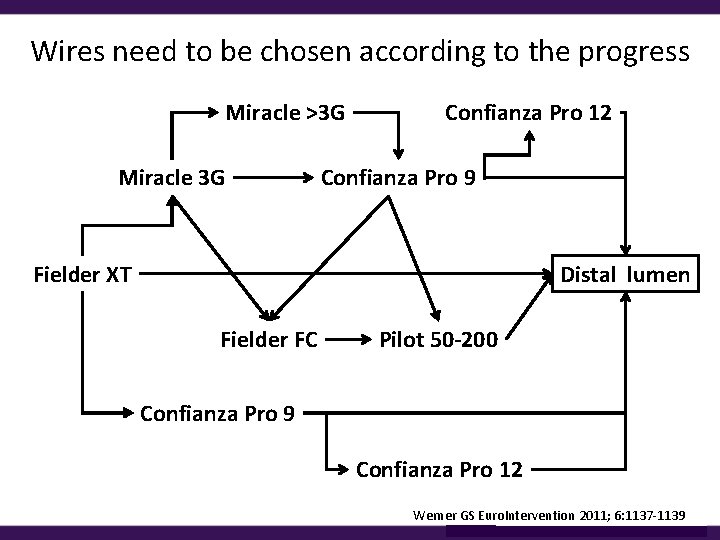
Wires need to be chosen according to the progress Miracle >3 G Miracle 3 G Confianza Pro 12 Confianza Pro 9 Fielder XT Distal lumen Fielder FC Pilot 50 -200 Confianza Pro 9 Confianza Pro 12 Werner GS Euro. Intervention 2011; 6: 1137 -1139

Penetration power of CTO wires Tip Stiffness (g) Miraclebros 12 (13. 0 g) Confianza Pro 12 (12. 4 g) Penetration Power (kg/in 2) 200 12 g 150 Confianza Pro 9 (9. 3 g) Miraclebros 6 (8. 8 g) Confianza Pro 9 (9. 3 g, ø. 009” tip, 146 kg/in 2) 9 g 100 6 g Miraclebros 4. 5 (4. 4 g) Miraclebros 3 (3. 9 g) Confianza Pro 12 (12. 4 g, ø. 009” tip, 195 kg/in 2) Miraclebros 6 (8. 8 g, ø. 0125” tip, 72 kg/in 2) 50 3 g Miraclebros 12 (13. 0 g, ø. 0125” tip, 106 kg/in 2) Miraclebros 4. 5 (4. 4 g, ø. 0125” tip, 36 kg/in 2) Miraclebros 3 (3. 9 g, ø. 0125” tip, 32 kg/in 2) Tip Diameter D Penetration Power = Tip Load / Tip Area Asahi tip diameters based on published data; information on file at Abbott Vascular

Progressive Approach The Progressive Approach: • Each guide wire is named and numbered according to its Penetration Power • • Penetration Power 200 Penetration power = Tip stiffness / Cross Sectional Area of GW tip Start with a wire of lower Penetration Power and “step up” as the case requires Progressive Step-up Approach PROGRESS 200 T PROGRESS 140 T 140 PROGRESS 120 100 PROGRESS 80 60 PROGRESS 40 20 Workhorse Wire 1 2 4 3 12 5 6
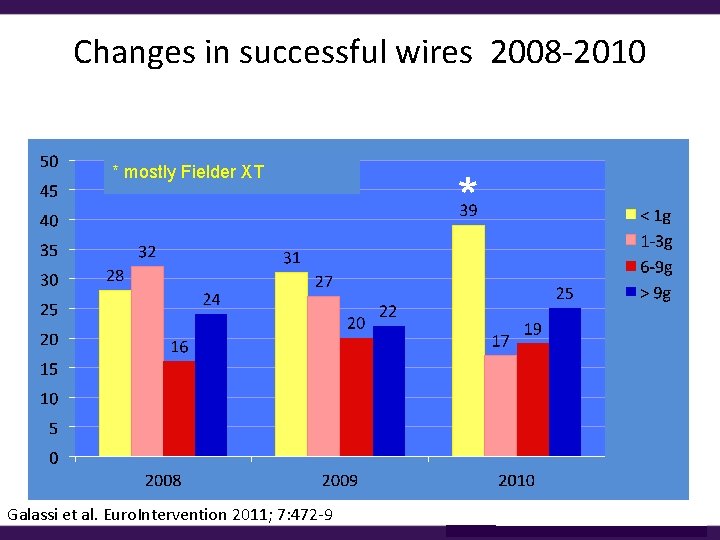
Changes in successful wires 2008 -2010 * mostly Fielder XT Galassi et al. Euro. Intervention 2011; 7: 472 -9 *

Fielder XT (ASAHI Intecc) Soft tissue tracking 16 cm polymer cover and hydrophilic coating tip 0, 009” PTFE 16 cm radio-paque coils 4 cm taper, distal 1 mm is 0, 009”

66 male, normal LVF, CCS 3 After a failed antegrade approach …
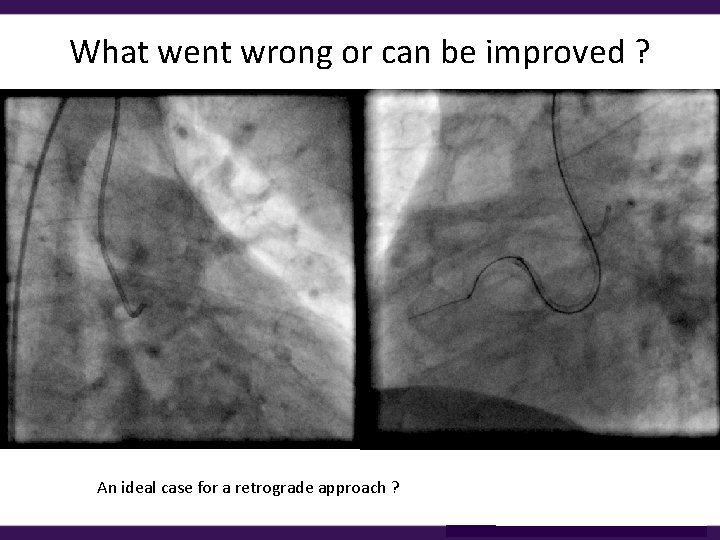
What went wrong or can be improved ? An ideal case for a retrograde approach ?

Soft wire (Fielder XT) with microcatheter (Fine. Cross)
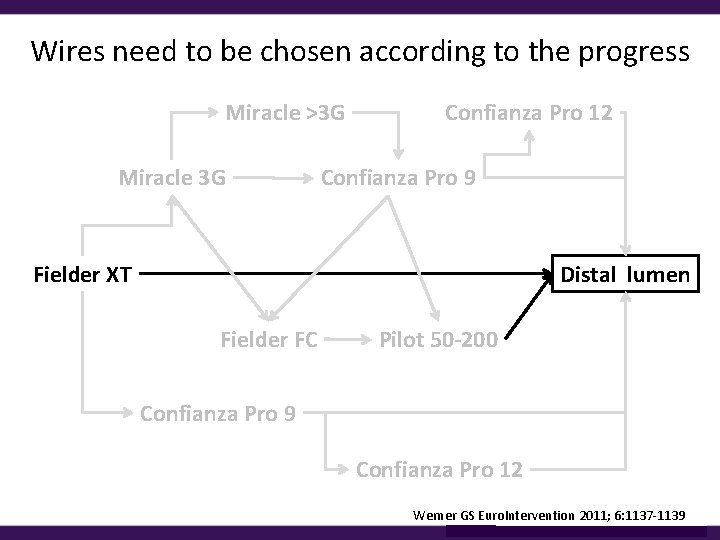
Wires need to be chosen according to the progress Miracle >3 G Miracle 3 G Confianza Pro 12 Confianza Pro 9 Fielder XT Distal lumen Fielder FC Pilot 50 -200 Confianza Pro 9 Confianza Pro 12 Werner GS Euro. Intervention 2011; 6: 1137 -1139
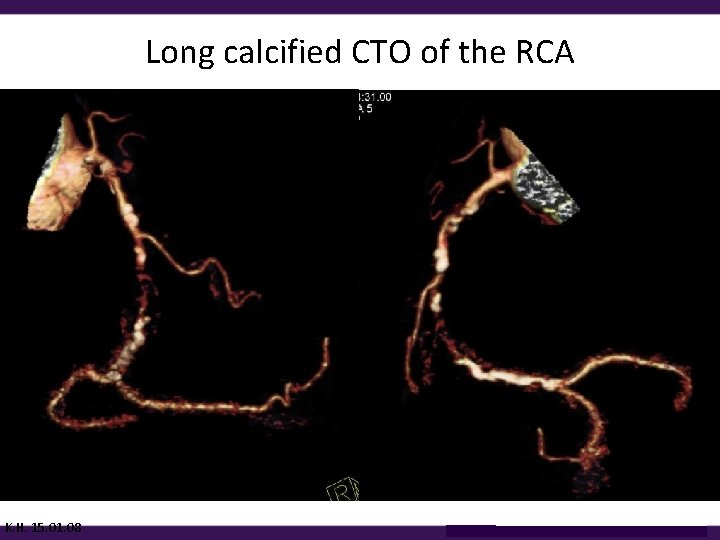
Long calcified CTO of the RCA K. H. 15. 01. 08

Soft tissue even within calcified CTOs Quick. Cross microcatheter with Whisper LS K. H. 15. 01. 08

Wire escalation
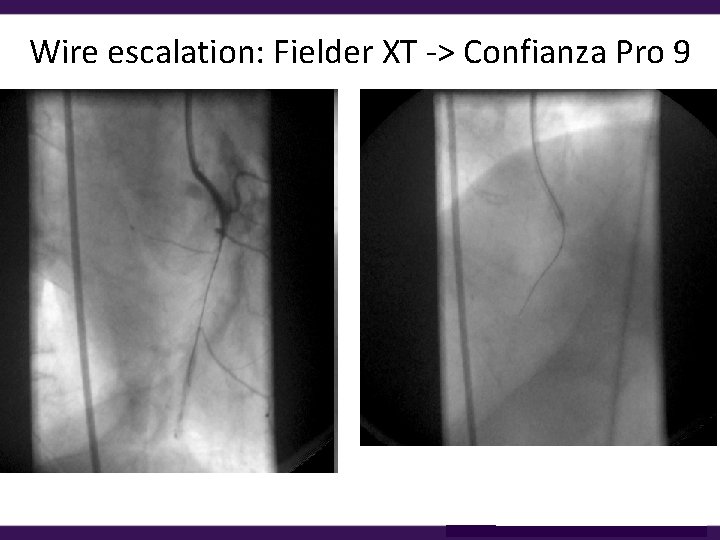
Wire escalation: Fielder XT -> Confianza Pro 9

Wires need to be chosen according to the progress Miracle >3 G Miracle 3 G Confianza Pro 12 Confianza Pro 9 Fielder XT Distal lumen Fielder FC Pilot 50 -200 Confianza Pro 9 Confianza Pro 12 Werner GS Euro. Intervention 2011; 6: 1137 -1139
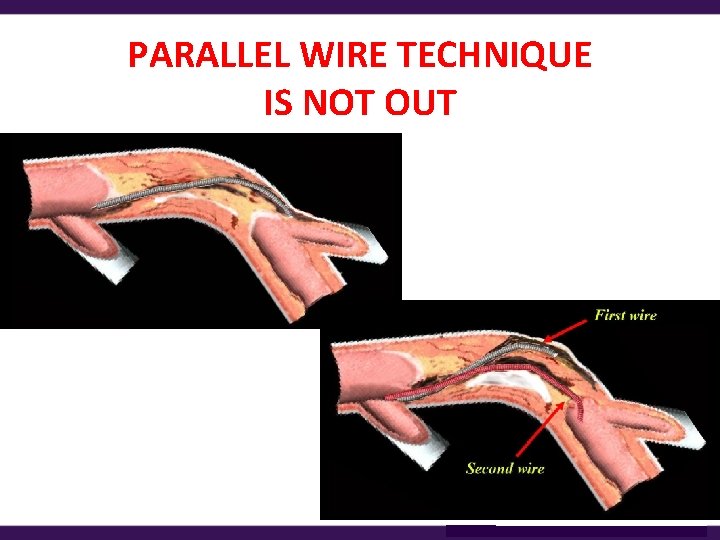
PARALLEL WIRE TECHNIQUE IS NOT OUT

MSCT coregistration
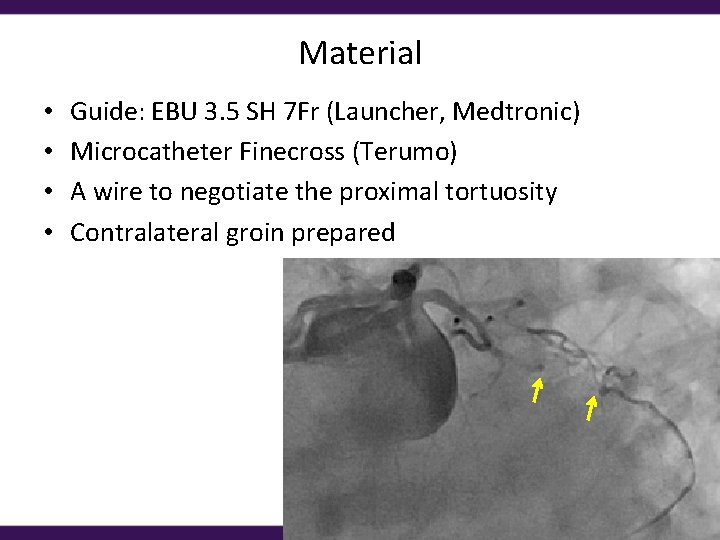
Material • • Guide: EBU 3. 5 SH 7 Fr (Launcher, Medtronic) Microcatheter Finecross (Terumo) A wire to negotiate the proximal tortuosity Contralateral groin prepared
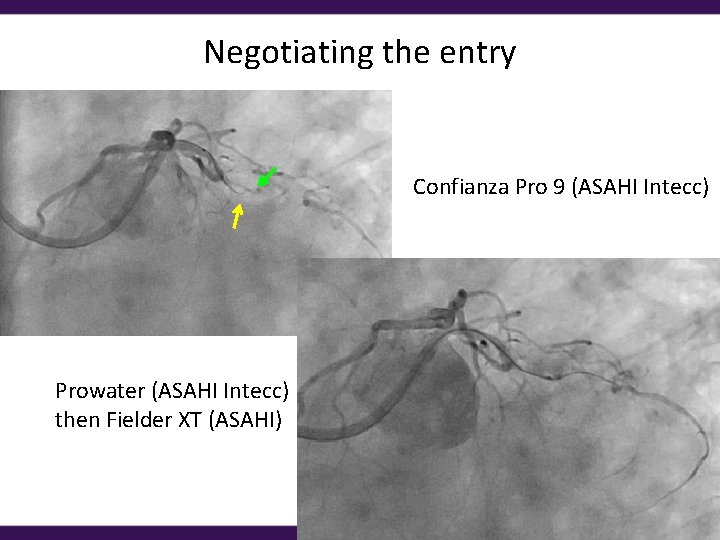
Negotiating the entry Confianza Pro 9 (ASAHI Intecc) Prowater (ASAHI Intecc) then Fielder XT (ASAHI)

Negotiating the entry
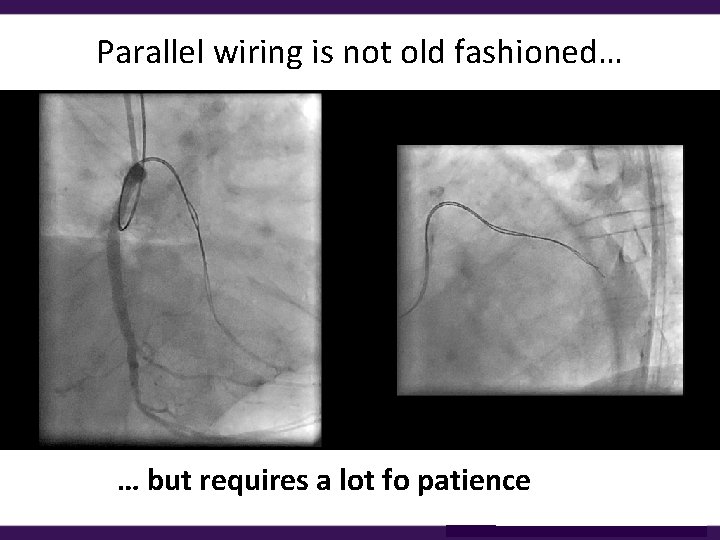
Parallel wiring is not old fashioned… … but requires a lot fo patience
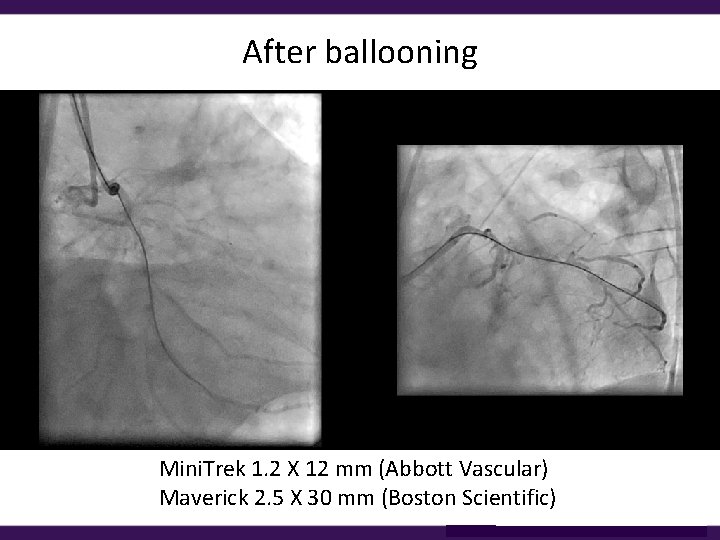
After ballooning Mini. Trek 1. 2 X 12 mm (Abbott Vascular) Maverick 2. 5 X 30 mm (Boston Scientific)

DES: Biomatrix Flex 2. 5 x 36 mm
The deficit in treating CTOs • Basic techniques are not implemented in all cath labs – The need for dual injection during PCI of CTOs is not observed as a standard approach – The knowledge of modern guide wires and their dedicated use is not wide spread outside of the CTO operators – The rapid development of wire technology is often lost on the non-dedicated CTO operators • Basic antegrade technique are successful in more CTOs than currently treated
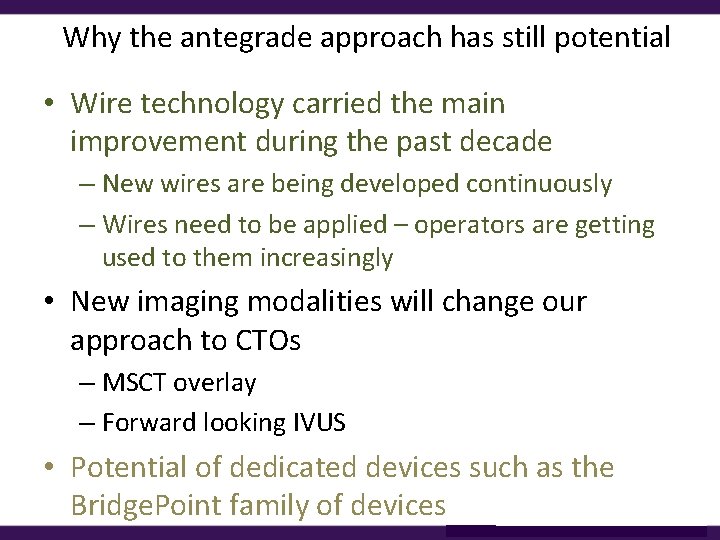
Why the antegrade approach has still potential • Wire technology carried the main improvement during the past decade – New wires are being developed continuously – Wires need to be applied – operators are getting used to them increasingly • New imaging modalities will change our approach to CTOs – MSCT overlay – Forward looking IVUS • Potential of dedicated devices such as the Bridge. Point family of devices
Welcome to … ›› 4 th Experts "Live" CTO Workshop 2012 Thank you September 20 - 21, 2012 London, UK www. eurocto. eu Course Director Carlo Di Mario London, UK Co-Directors Anthony Gershlick Leicester, UK David Hildick-Smith Brighton, UK Scientific Board Gerald S. Werner Darmstadt, Germany Nicolaus Reifart Bad Soden, Germany Alfredo R. Galassi Catania, Italy Hans Bonnier Brussels, Belgium George Sianos Thessaloniki, Greece Javier Escaned Madrid, Spain
- Slides: 34