
ANTE MORTEM INSPECTION Antemortem Inspection q Antemortem means
- Slides: 38
ANTE MORTEM INSPECTION
Ante-mortem Inspection q Ante-mortem means “before death” q Inspection of live animals and birds prior to being slaughtered q All livestock presented for slaughter must receive ante-mortem inspection
o This inspection is performed by a veterinarian or by a meat Inspector under veterinary supervision o Ante mortem examination should be done within 24 hours of slaughter and repeated if slaughter has been delayed by over a day
Concerns 1. Public health 2. Animal health 3. Animal welfare
Major objectives o To screen all animals destined to slaughter o To separate diseased and suspected animals for further detailed examination o To ensure that animals are properly rested and that proper clinical disease diagnosis and judgement, is obtained o To reduce contamination on the killing floor by separating the dirty animals and condemning the diseased animals if required by regulation
Contd… o To identify reportable animal diseases and to identify sick animals and those treated with antibiotics, chemotherapeutic agents, insecticides and pesticides o To make P. M. E. more efficient, accurate, less laborious o To detect diseases, whose identification difficult during P. M. E. o To ensure that injured animals or those with pain and suffering receive emergency slaughter and that animals are treated humanely
A/M inspection card o Owner's name o The number of animals in the lot and arrival time o Species and sex of the animal o The time and date of ante mortem inspection o Clinical signs and body temperature if relevant o Reason why the animal was held o Signature of inspector
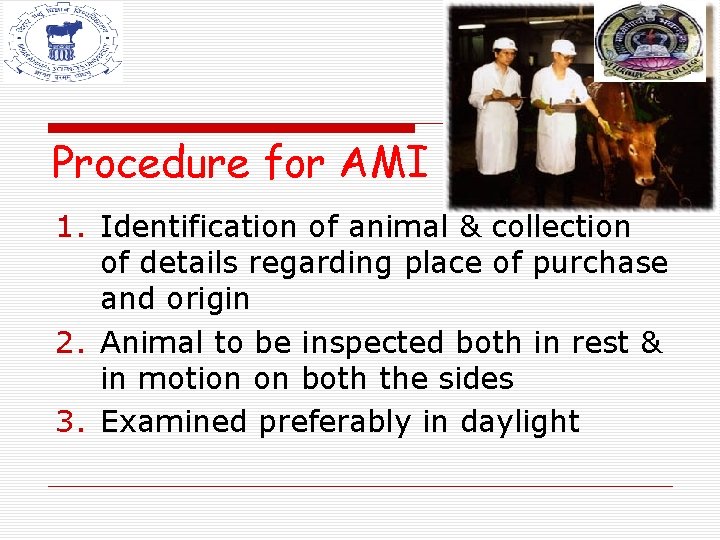
Procedure for AMI 1. Identification of animal & collection of details regarding place of purchase and origin 2. Animal to be inspected both in rest & in motion on both the sides 3. Examined preferably in daylight
Facilities required o Lairage o Identification of live animals o Isolation pen and a crush o Assistant staff
Abnormalities Respiration Behavior Gait Posture Structure and conformation Discharges or protrusions from body openings o Color o Odour o Temperature o o o
Abnormalities in respiration o Commonly refer to frequency of respiration o If the breathing pattern is different from normal the animal should be segregated as a Suspect o C/B/S/G; predominantly abdominal rarely costo-abdominal eg; roaring, snoring,
Abnormal gait o Animal is associated with pain in the legs, chest or abdomen or is an indication of nervous disease Ø slow wobble gait: septicemia diseases Ø Walking in circles: coenurosis, listeriosis , Ø Stiff gait : traumatic pericarditis
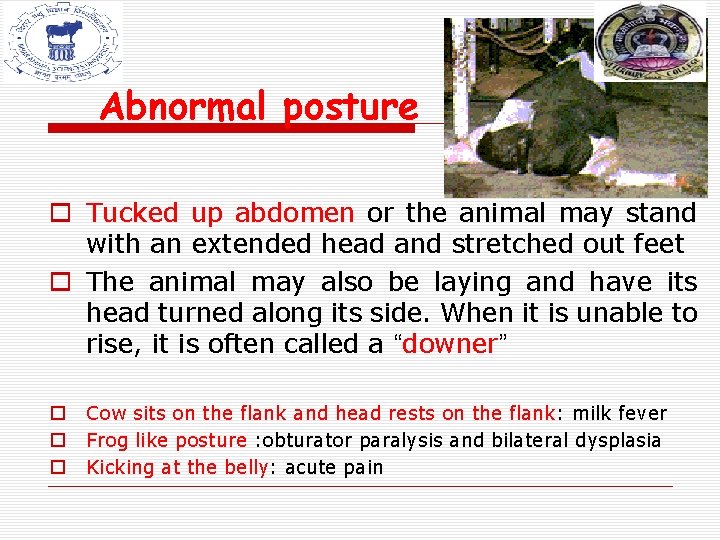
Abnormal posture o Tucked up abdomen or the animal may stand with an extended head and stretched out feet o The animal may also be laying and have its head turned along its side. When it is unable to rise, it is often called a “downer” o o o Cow sits on the flank and head rests on the flank: milk fever Frog like posture : obturator paralysis and bilateral dysplasia Kicking at the belly: acute pain
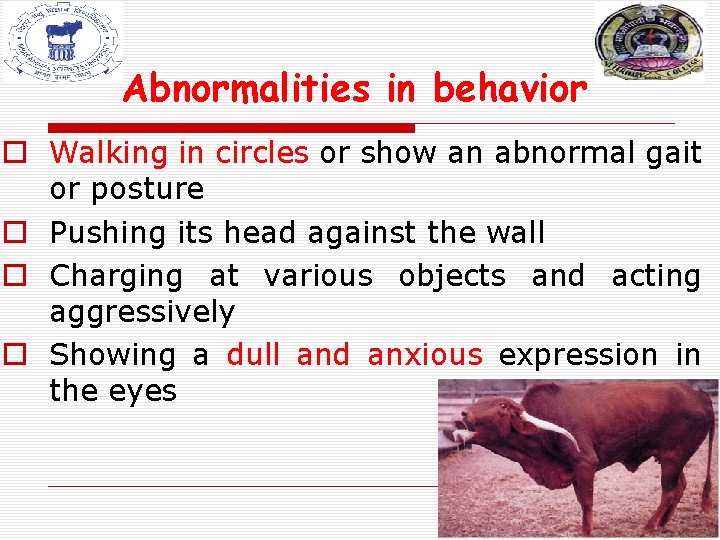
Abnormalities in behavior o Walking in circles or show an abnormal gait or posture o Pushing its head against the wall o Charging at various objects and acting aggressively o Showing a dull and anxious expression in the eyes
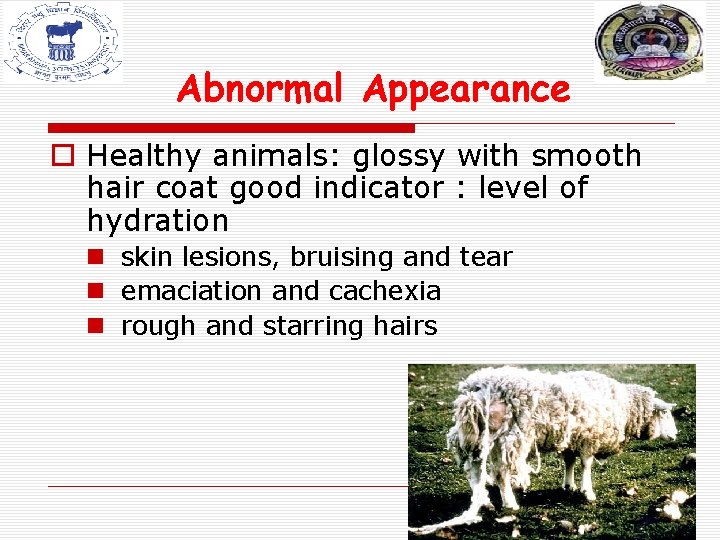
Abnormal Appearance o Healthy animals: glossy with smooth hair coat good indicator : level of hydration n skin lesions, bruising and tear n emaciation and cachexia n rough and starring hairs
Abnormalities in structure (conformation) o Swellings (abscesses) seen commonly in swine o Enlarged joints o Umbilical swelling (hernia or omphalo phlebitis) o Enlarged sensitive udder indicative of mastitis o Enlarged jaw (“lumpy jaw”) o Bloated abdomen
Abnormal discharges or protrusions o Discharges from the nose, excessive salivation: FMD, RP, o Ocular discharge : blue tongue, BVD , MD, o Protruding from the rectum (prolapsed rectum) or uterus o Protruding from the vagina (prolapsed uterus) o Growths on the eye and bloody diarrhea
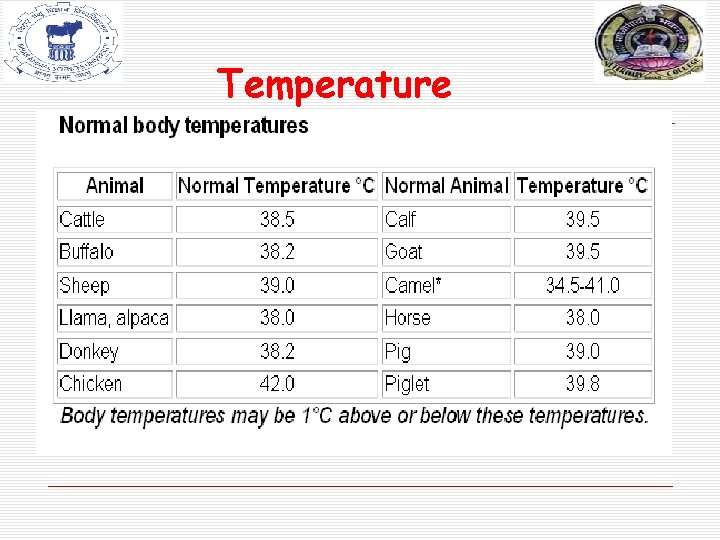
Temperature
Abnormalities in temperature Rise in temp – first indicator of communicable disease Moribund animals – subnormal temp Sheep – greatest daily fluctuation of temp Pigs - >41°C Cattle, sheep - > 40. 5°C to be isolated until temp falls or disease diagnosis is estab.
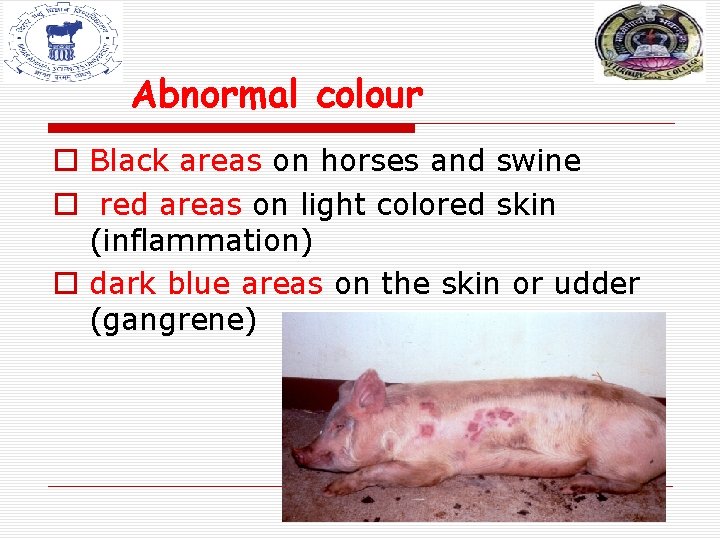
Abnormal colour o Black areas on horses and swine o red areas on light colored skin (inflammation) o dark blue areas on the skin or udder (gangrene)
Abnormal odour of an abscess: medicinal odour o Ketosis: stinkweed odour or acetone odour o putrid bronchitis: putrefactive odour
Ante-mortem Decesions o FIT for slaughter o Suspect/detained o Delayed/postponed o UNFIT for slaughter (Condemned)
Fit for slaughter o Free from the diseases and conditions, fit for human food, to be released for slaughter Suspect o Question whether the animal is affected by a disease or condition described in the regulations. o To segregate those animals with abnormal signs into the suspect pen for further observation
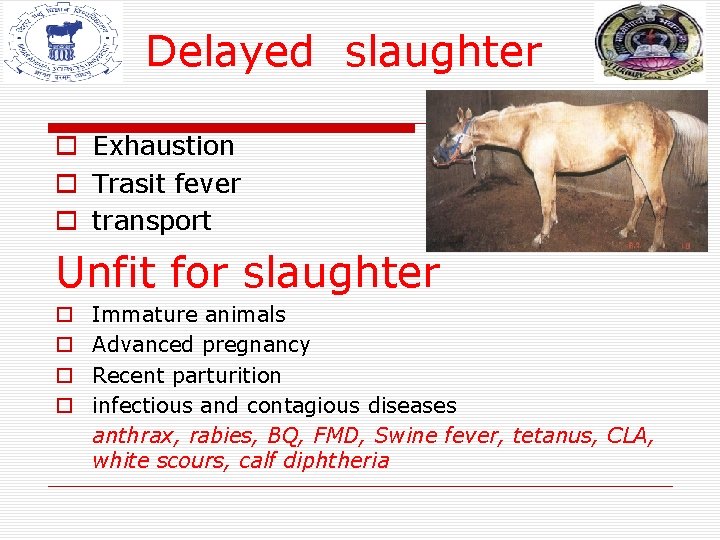
Delayed slaughter o Exhaustion o Trasit fever o transport Unfit for slaughter o o Immature animals Advanced pregnancy Recent parturition infectious and contagious diseases anthrax, rabies, BQ, FMD, Swine fever, tetanus, CLA, white scours, calf diphtheria
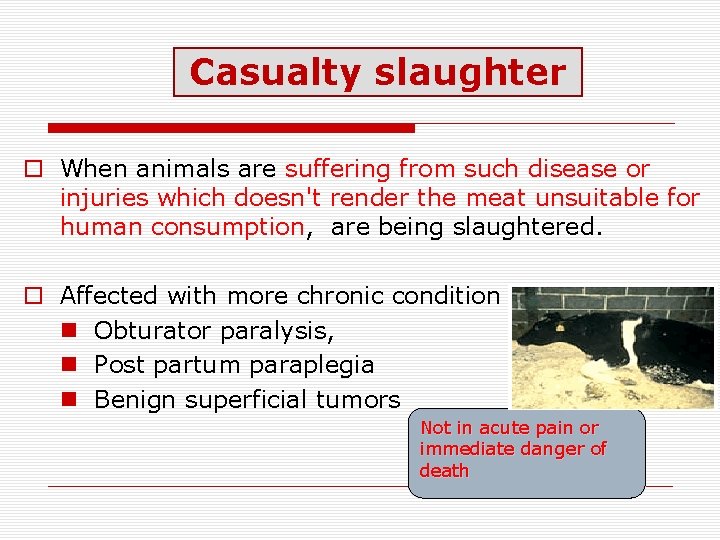
Casualty slaughter o When animals are suffering from such disease or injuries which doesn't render the meat unsuitable for human consumption, are being slaughtered. o Affected with more chronic condition n Obturator paralysis, n Post partum paraplegia n Benign superficial tumors Not in acute pain or immediate danger of death
On firm decision has to take ( by veterinarian), whether the animal is suitable for transport to nearby slaughter house. These animal must go through ante mortem inspection. Slaughtered immediately on arrival. Should be isolated from normal animal.
Emergency slaughter Acute pain or suffering from a condition where delay in slaughter contrary to animal welfare Animal is healthy, but requires on-farm emergency slaughter, owing perhaps to limb fracture, uncontrolled hemorrhage, injury causing severe pain, or distress or functional or physiological disorder, that animal may be humanely slaughtered on the farm to save it from pain and the carcass transferred to abattoir. Animals affected with extensive bruising or fractures, Bloat, uterine prolapse require emergency slaughter
Rules: Undergone ante-mortem inspection. The body of the animal has not been dressed. Animal accompanied to the by a veterinary certificate. Body of the animal should be transported to slaughter house in hygienic condition, within one hour of the slaughter In slaughterhouse post mortem inspection is done to confirm the oath in certificate.
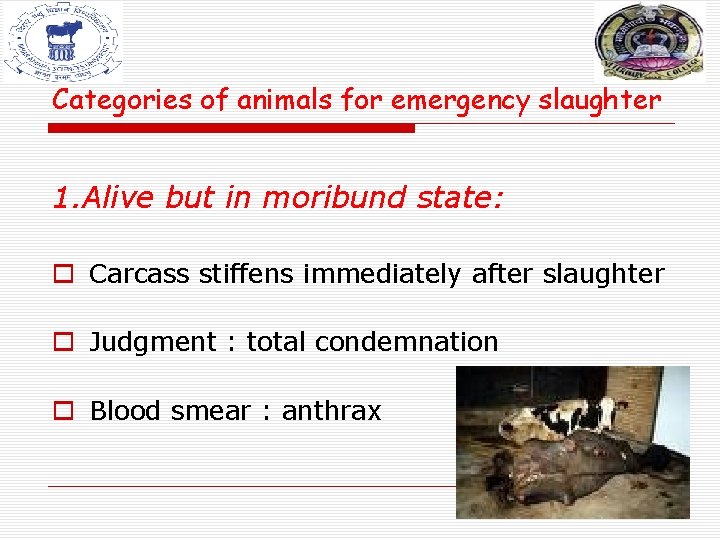
Categories of animals for emergency slaughter 1. Alive but in moribund state: o Carcass stiffens immediately after slaughter o Judgment : total condemnation o Blood smear : anthrax
Dead and uneviscerated o Blood smear ; anthrax o Coldness in extremities and tympanitis in cattle ; death has not been recent o Carcass of dead animals: unwholesome, liable to rapid decomposition and fit only for inedible rendering
Dead and eviscerated o Judgement is difficult o Carcass surface has a white appearance o Lack of proper setting o Cattle; flexion of the forelimbs with a brownish red coloration of flesh; slaughtered after a long illness
Judgement for carcass of emergency animal o It does not show any evidence of disease o Negative bacteriological test o Sets and looks normal in every way o Any sign of P. M. changes - condemned
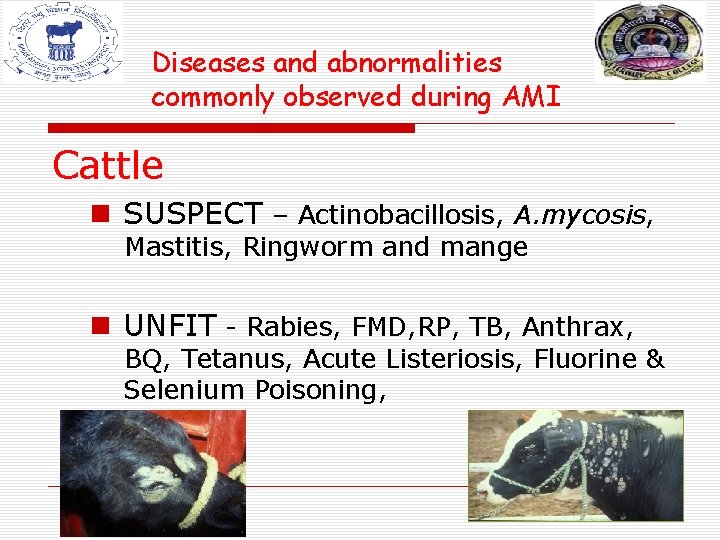
Diseases and abnormalities commonly observed during AMI Cattle n SUSPECT – Actinobacillosis, A. mycosis, Mastitis, Ringworm and mange n UNFIT - Rabies, FMD, RP, TB, Anthrax, BQ, Tetanus, Acute Listeriosis, Fluorine & Selenium Poisoning,
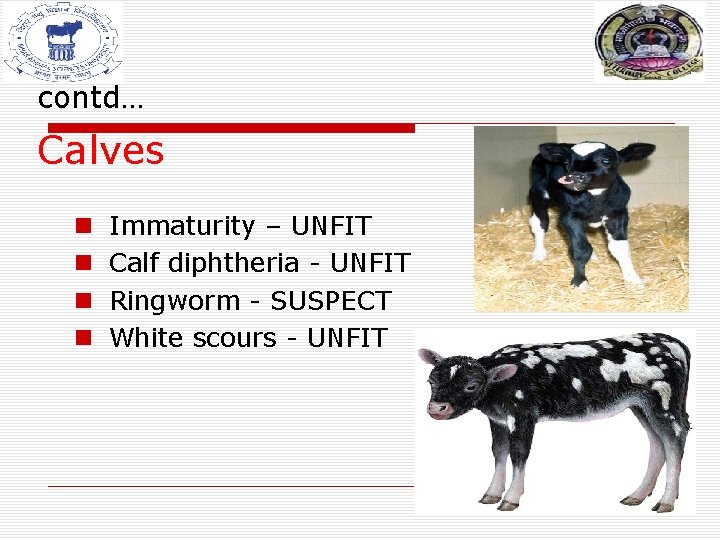
contd… Calves n n Immaturity – UNFIT Calf diphtheria - UNFIT Ringworm - SUSPECT White scours - UNFIT
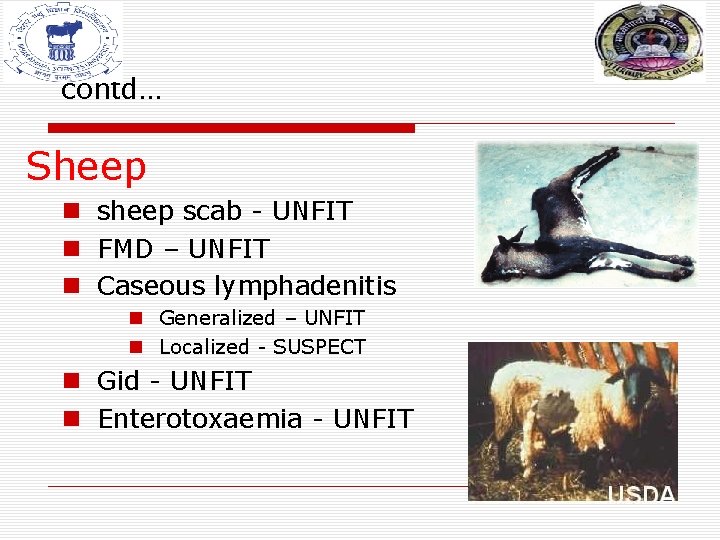
contd… Sheep n sheep scab - UNFIT n FMD – UNFIT n Caseous lymphadenitis n Generalized – UNFIT n Localized - SUSPECT n Gid - UNFIT n Enterotoxaemia - UNFIT
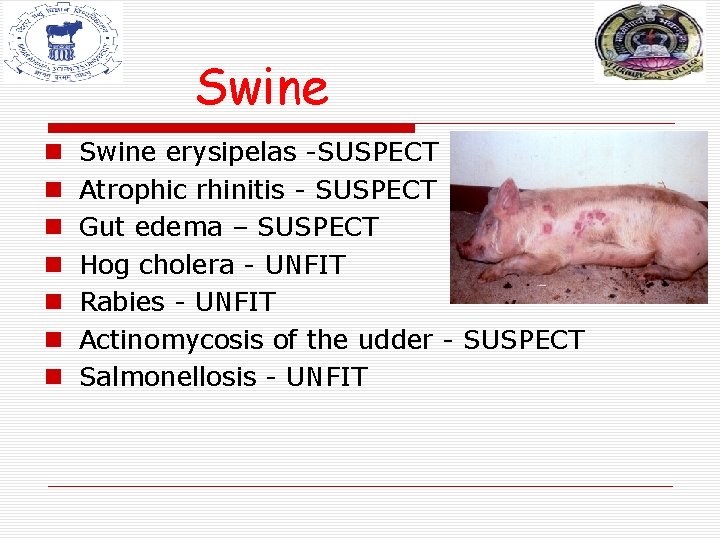
Swine n n n n Swine erysipelas -SUSPECT Atrophic rhinitis - SUSPECT Gut edema – SUSPECT Hog cholera - UNFIT Rabies - UNFIT Actinomycosis of the udder - SUSPECT Salmonellosis - UNFIT
Poultry n n n n Ornithosis – UNFIT Ranikhet disease - UNFIT CRD - SUSPECT IB – UNFIT (advanced stages) ILT - UNFIT (advanced stages) Infectious coryza - UNFIT (acute stages) Coccidiosis - UNFIT
THANKS Unit 1