
Answer the following questions in your book 1
Answer the following questions in your book… 1) The Battle of Qadesh took place in which modern day country? 2) In what year did the Battle of Qadesh take place? 3) Give two examples of things that got worse during the Bronze Age Collapse 4) Who did contemporaries blame for the Bronze Age Collapse? 5) Name one factor that lead to the Bronze Age Collapse 6) Name the Hittie King whose son was assassinated by Egyptians Challenge: How accurate (factually correct) do you believe the Egyptian sources on the Sea People are? Explain your answer
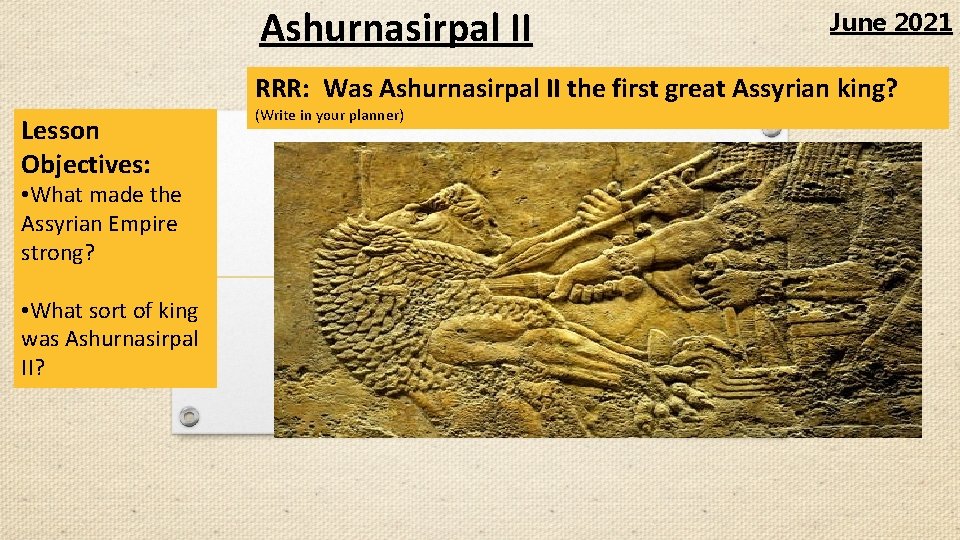
Ashurnasirpal II June 2021 RRR: Was Ashurnasirpal II the first great Assyrian king? Lesson Objectives: • What made the Assyrian Empire strong? • What sort of king was Ashurnasirpal II? (Write in your planner)
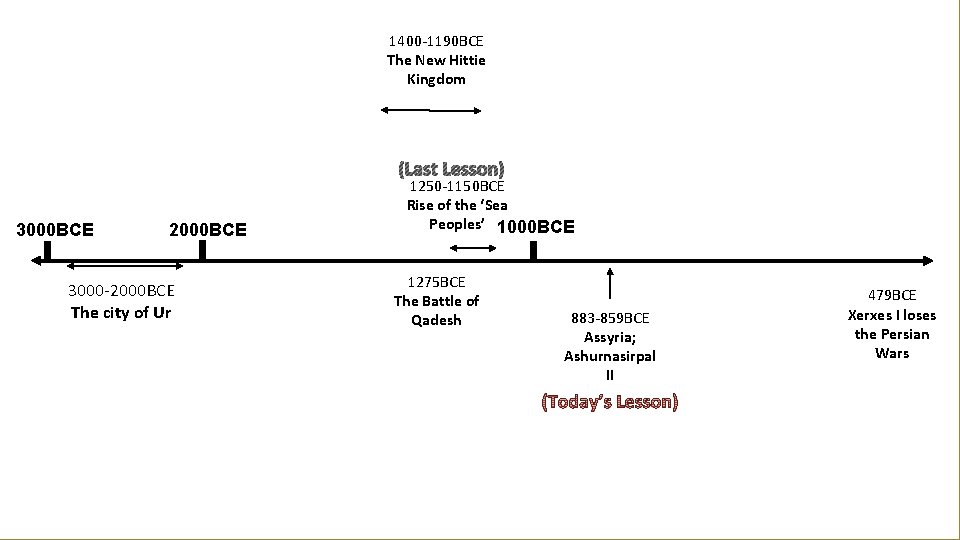
1400 -1190 BCE The New Hittie Kingdom (Last Lesson) 3000 BCE 2000 BCE 3000 -2000 BCE The city of Ur 1250 -1150 BCE Rise of the ‘Sea Peoples’ 1000 BCE 1275 BCE The Battle of Qadesh 883 -859 BCE Assyria; Ashurnasirpal II 479 BCE Xerxes I loses the Persian Wars
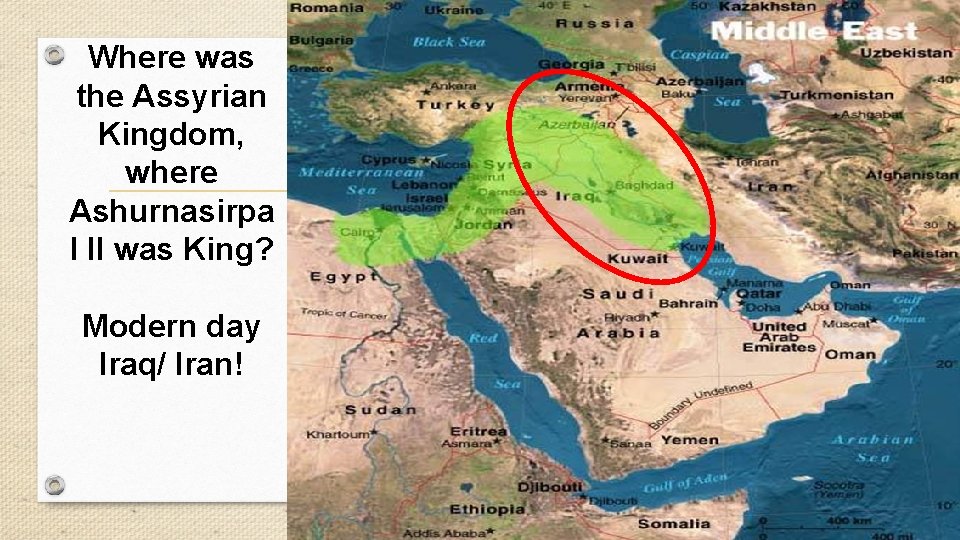
Where was the Assyrian Kingdom, where Ashurnasirpa l II was King? Modern day Iraq/ Iran!
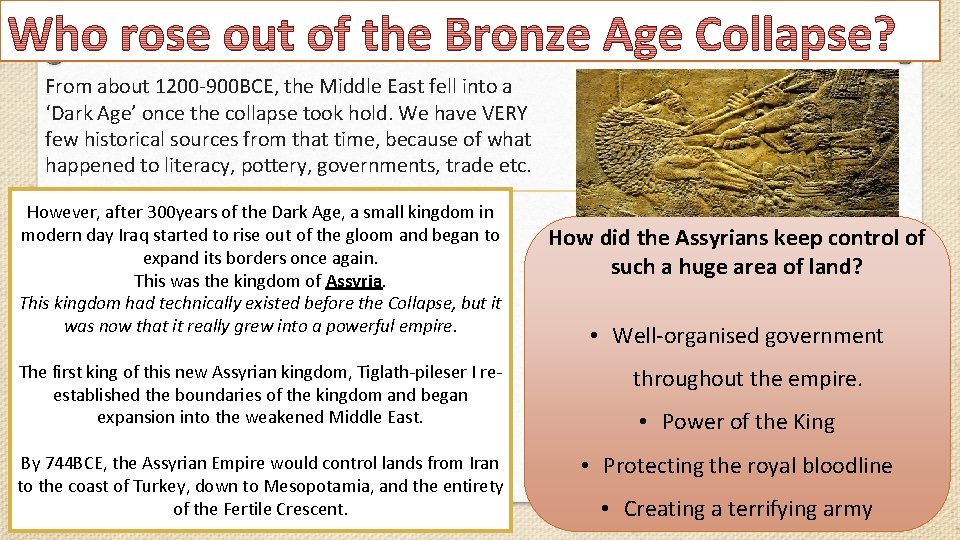
From about 1200 -900 BCE, the Middle East fell into a ‘Dark Age’ once the collapse took hold. We have VERY few historical sources from that time, because of what happened to literacy, pottery, governments, trade etc. However, after 300 years of the Dark Age, a small kingdom in modern day Iraq started to rise out of the gloom and began to expand its borders once again. This was the kingdom of Assyria. This kingdom had technically existed before the Collapse, but it was now that it really grew into a powerful empire. The first king of this new Assyrian kingdom, Tiglath-pileser I reestablished the boundaries of the kingdom and began expansion into the weakened Middle East. By 744 BCE, the Assyrian Empire would control lands from Iran to the coast of Turkey, down to Mesopotamia, and the entirety of the Fertile Crescent. How did the Assyrians keep control of such a huge area of land? • Well-organised government throughout the empire. • Power of the King • Protecting the royal bloodline • Creating a terrifying army
As we just learned, there were four key parts of the Assyrian empire that meant it was able to rise up out of the Dark Age and rule the Ancient Middle East. These were; • Well-organised government throughout the empire. • Power of the King • Protecting the royal bloodline • Creating a terrifying army TASK: using the info sheet on these four areas, complete the pyramid activity that will help you summarise the factors and explain why the Assyrian Empire was so strong. • Summaries of each factor can be brief, just 2 -4 sentences. • Think carefully about how each factor would work well with the one next to it. • Come to a conclusion overall, on why these four factors allowed the empire to keep control of the Middle East. CHALLENGE: Make new pairings of the four factors at the bottom of the sheet. – imagine the order they were typed in has been moved around. In your book, explain how these newly paired factors could work together to keep the empire strong. e. g. what if Royal Bloodlines and Local Government had been next to each other instead, how would they have worked together?
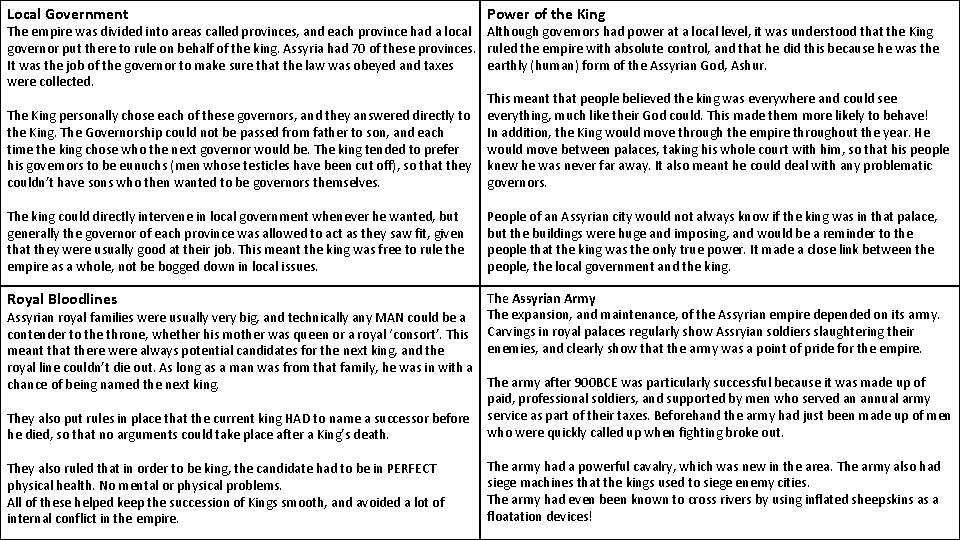
Local Government Power of the King The king could directly intervene in local government whenever he wanted, but generally the governor of each province was allowed to act as they saw fit, given that they were usually good at their job. This meant the king was free to rule the empire as a whole, not be bogged down in local issues. People of an Assyrian city would not always know if the king was in that palace, but the buildings were huge and imposing, and would be a reminder to the people that the king was the only true power. It made a close link between the people, the local government and the king. Royal Bloodlines The Assyrian Army The expansion, and maintenance, of the Assyrian empire depended on its army. Carvings in royal palaces regularly show Assryian soldiers slaughtering their enemies, and clearly show that the army was a point of pride for the empire. They also ruled that in order to be king, the candidate had to be in PERFECT physical health. No mental or physical problems. All of these helped keep the succession of Kings smooth, and avoided a lot of internal conflict in the empire. The army had a powerful cavalry, which was new in the area. The army also had siege machines that the kings used to siege enemy cities. The army had even been known to cross rivers by using inflated sheepskins as a floatation devices! The empire was divided into areas called provinces, and each province had a local Although governors had power at a local level, it was understood that the King governor put there to rule on behalf of the king. Assyria had 70 of these provinces. ruled the empire with absolute control, and that he did this because he was the It was the job of the governor to make sure that the law was obeyed and taxes earthly (human) form of the Assyrian God, Ashur. were collected. This meant that people believed the king was everywhere and could see The King personally chose each of these governors, and they answered directly to everything, much like their God could. This made them more likely to behave! the King. The Governorship could not be passed from father to son, and each In addition, the King would move through the empire throughout the year. He time the king chose who the next governor would be. The king tended to prefer would move between palaces, taking his whole court with him, so that his people his governors to be eunuchs (men whose testicles have been cut off), so that they knew he was never far away. It also meant he could deal with any problematic couldn’t have sons who then wanted to be governors themselves. governors. Assyrian royal families were usually very big, and technically any MAN could be a contender to the throne, whether his mother was queen or a royal ‘consort’. This meant that there were always potential candidates for the next king, and the royal line couldn’t die out. As long as a man was from that family, he was in with a The army after 900 BCE was particularly successful because it was made up of chance of being named the next king. paid, professional soldiers, and supported by men who served an annual army They also put rules in place that the current king HAD to name a successor before service as part of their taxes. Beforehand the army had just been made up of men who were quickly called up when fighting broke out. he died, so that no arguments could take place after a King’s death.
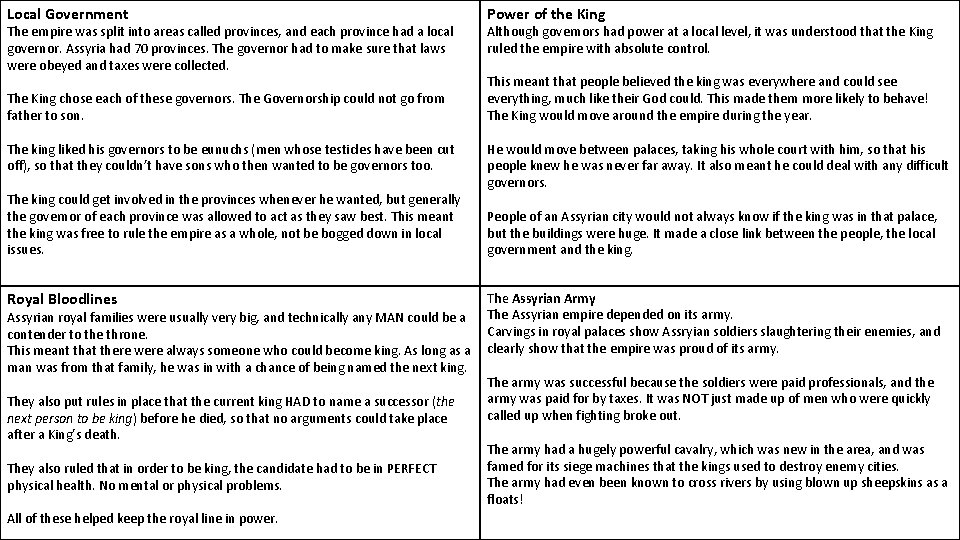
Local Government Power of the King The King chose each of these governors. The Governorship could not go from father to son. This meant that people believed the king was everywhere and could see everything, much like their God could. This made them more likely to behave! The King would move around the empire during the year. The empire was split into areas called provinces, and each province had a local governor. Assyria had 70 provinces. The governor had to make sure that laws were obeyed and taxes were collected. The king liked his governors to be eunuchs (men whose testicles have been cut off), so that they couldn’t have sons who then wanted to be governors too. The king could get involved in the provinces whenever he wanted, but generally the governor of each province was allowed to act as they saw best. This meant the king was free to rule the empire as a whole, not be bogged down in local issues. Royal Bloodlines Assyrian royal families were usually very big, and technically any MAN could be a contender to the throne. This meant that there were always someone who could become king. As long as a man was from that family, he was in with a chance of being named the next king. They also put rules in place that the current king HAD to name a successor (the next person to be king) before he died, so that no arguments could take place after a King’s death. They also ruled that in order to be king, the candidate had to be in PERFECT physical health. No mental or physical problems. All of these helped keep the royal line in power. Although governors had power at a local level, it was understood that the King ruled the empire with absolute control. He would move between palaces, taking his whole court with him, so that his people knew he was never far away. It also meant he could deal with any difficult governors. People of an Assyrian city would not always know if the king was in that palace, but the buildings were huge. It made a close link between the people, the local government and the king. The Assyrian Army The Assyrian empire depended on its army. Carvings in royal palaces show Assryian soldiers slaughtering their enemies, and clearly show that the empire was proud of its army. The army was successful because the soldiers were paid professionals, and the army was paid for by taxes. It was NOT just made up of men who were quickly called up when fighting broke out. The army had a hugely powerful cavalry, which was new in the area, and was famed for its siege machines that the kings used to destroy enemy cities. The army had even been known to cross rivers by using blown up sheepskins as a floats!
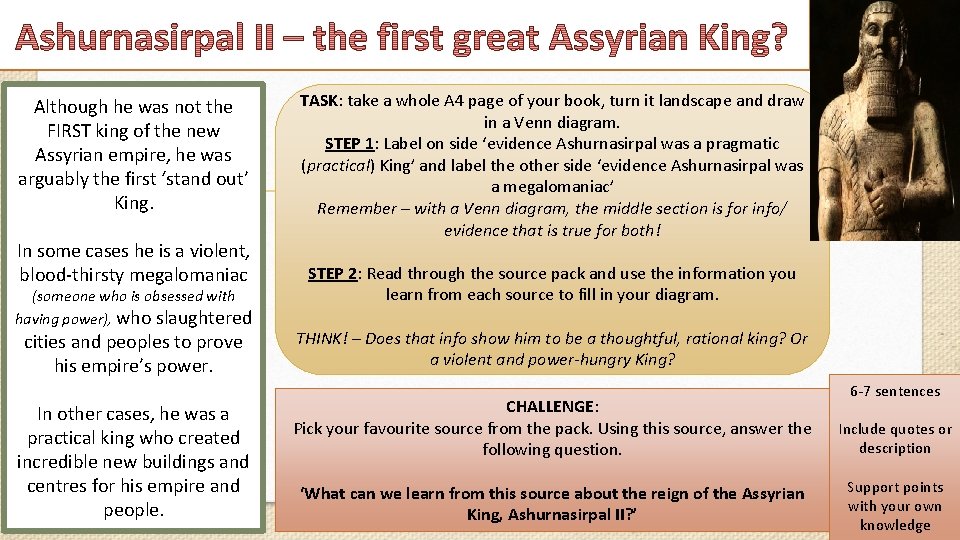
Although he was not the FIRST king of the new Assyrian empire, he was arguably the first ‘stand out’ King. In some cases he is a violent, blood-thirsty megalomaniac (someone who is obsessed with having power), who slaughtered cities and peoples to prove his empire’s power. In other cases, he was a practical king who created incredible new buildings and centres for his empire and people. TASK: take a whole A 4 page of your book, turn it landscape and draw in a Venn diagram. STEP 1: Label on side ‘evidence Ashurnasirpal was a pragmatic (practical) King’ and label the other side ‘evidence Ashurnasirpal was a megalomaniac’ Remember – with a Venn diagram, the middle section is for info/ evidence that is true for both! STEP 2: Read through the source pack and use the information you learn from each source to fill in your diagram. THINK! – Does that info show him to be a thoughtful, rational king? Or a violent and power-hungry King? CHALLENGE: Pick your favourite source from the pack. Using this source, answer the following question. ‘What can we learn from this source about the reign of the Assyrian King, Ashurnasirpal II? ’ 6 -7 sentences Include quotes or description Support points with your own knowledge
Ashurnasirpal was a pragmatic (practical) King Ashurnasirpal was a megalomaniac Both
What should a king be, to be ‘great’ here? Is Ashurnasirpal being that type of ‘great’? Write a final conclusion in your books – Was Ashurnasirpal the first great king of Assyria?
- Slides: 11