
Answer each question by using the correct new
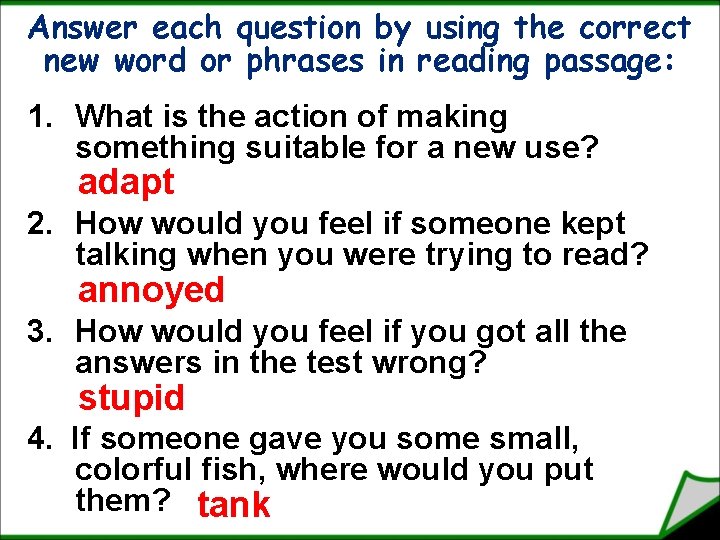
Answer each question by using the correct new word or phrases in reading passage: 1. What is the action of making something suitable for a new use? adapt 2. How would you feel if someone kept talking when you were trying to read? annoyed 3. How would you feel if you got all the answers in the test wrong? stupid 4. If someone gave you some small, colorful fish, where would you put them? tank
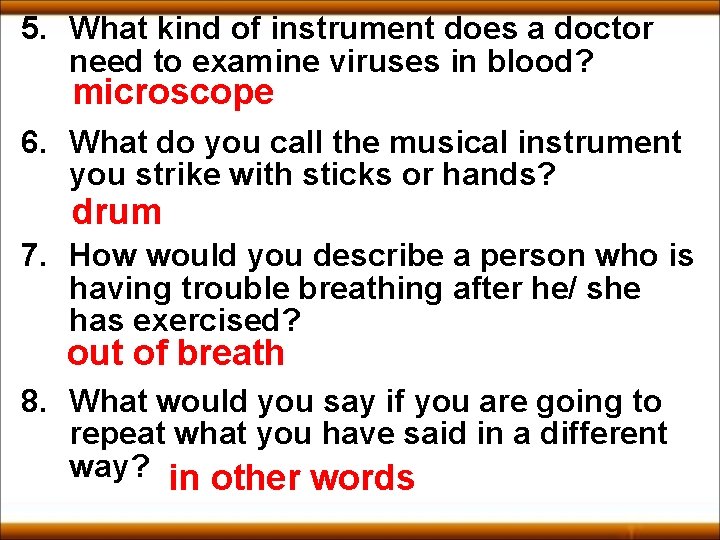
5. What kind of instrument does a doctor need to examine viruses in blood? microscope 6. What do you call the musical instrument you strike with sticks or hands? drum 7. How would you describe a person who is having trouble breathing after he/ she has exercised? out of breath 8. What would you say if you are going to repeat what you have said in a different way? in other words
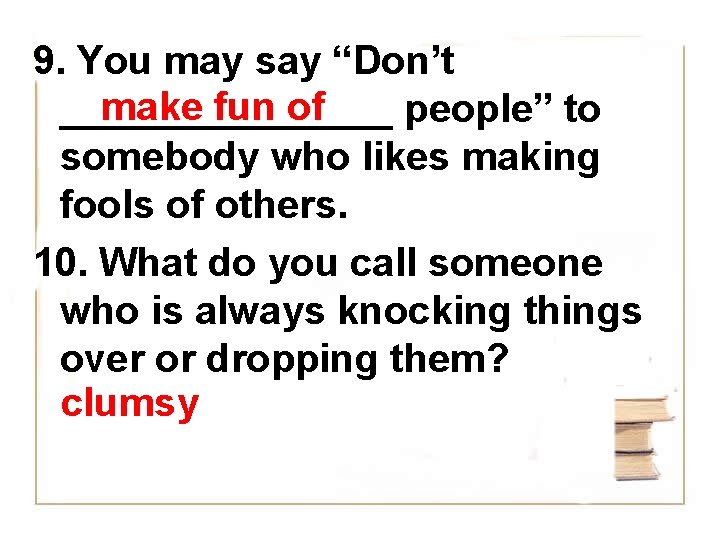
9. You may say “Don’t make fun of ________ people” to somebody who likes making fools of others. 10. What do you call someone who is always knocking things over or dropping them? clumsy
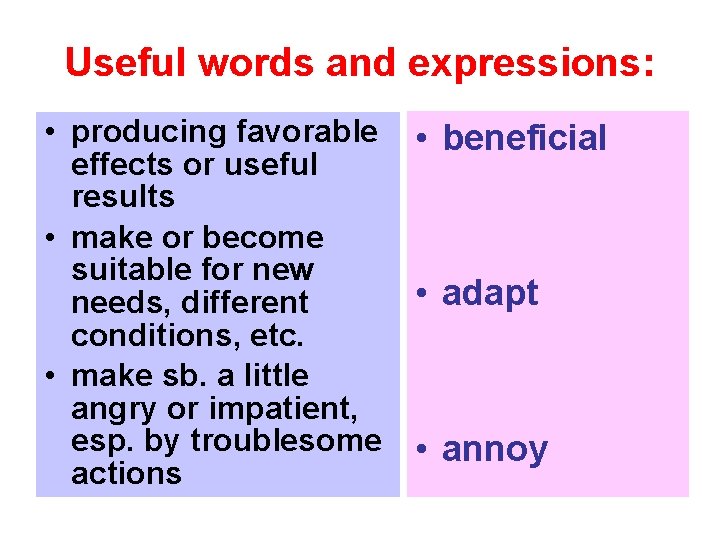
Useful words and expressions: • producing favorable effects or useful results • make or become suitable for new needs, different conditions, etc. • make sb. a little angry or impatient, esp. by troublesome actions • beneficial • adapt • annoy
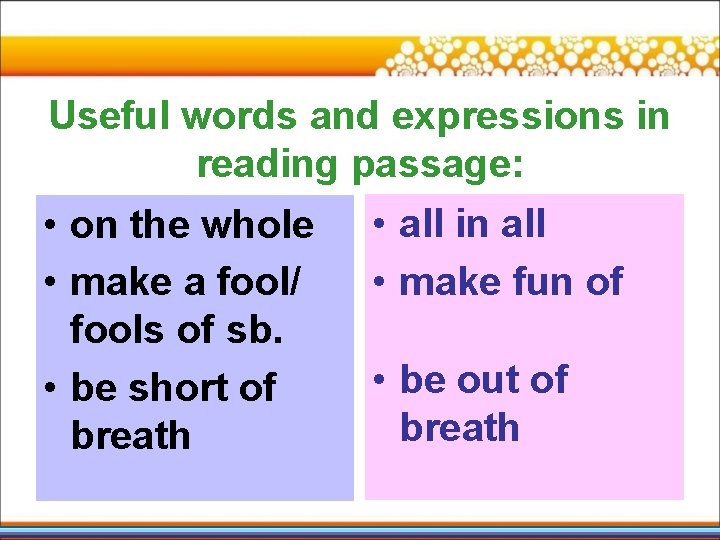
Useful words and expressions in reading passage: • on the whole • all in all • make fun of • make a fool/ fools of sb. • be out of • be short of breath
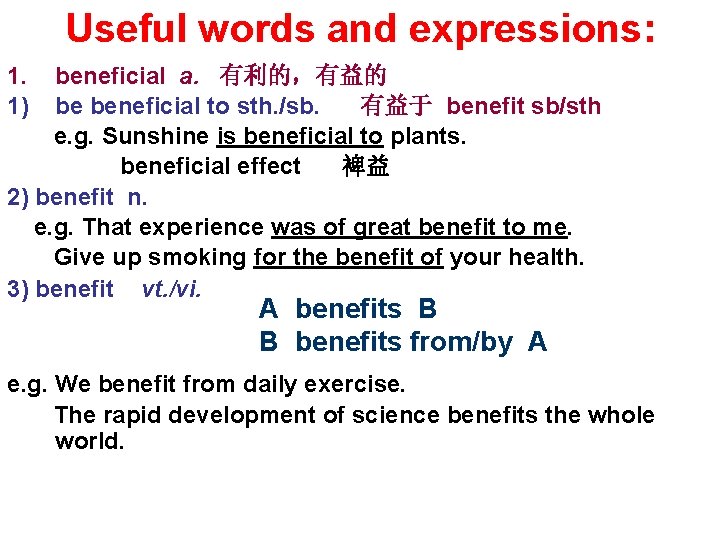
Useful words and expressions: 1. 1) beneficial a. 有利的,有益的 be beneficial to sth. /sb. 有益于 benefit sb/sth e. g. Sunshine is beneficial to plants. beneficial effect 裨益 2) benefit n. e. g. That experience was of great benefit to me. Give up smoking for the benefit of your health. 3) benefit vt. /vi. A benefits B B benefits from/by A e. g. We benefit from daily exercise. The rapid development of science benefits the whole world.
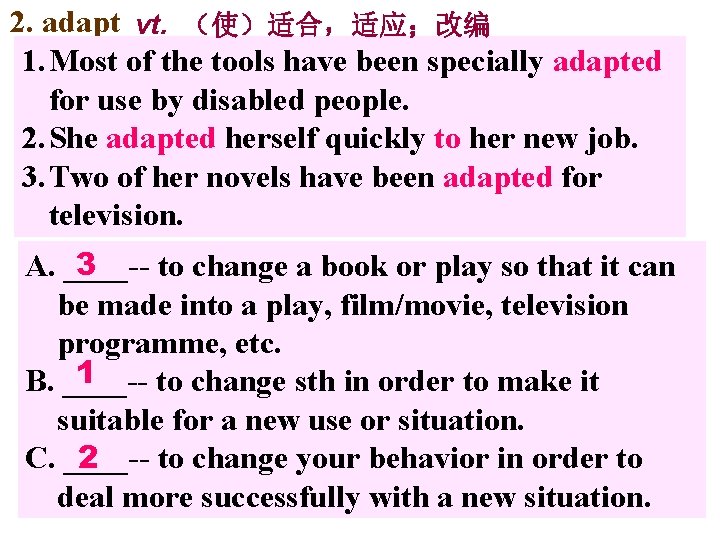
2. adapt vt. (使)适合,适应;改编 1. Most of the tools have been specially adapted for use by disabled people. 2. She adapted herself quickly to her new job. 3. Two of her novels have been adapted for television. 3 A. ____-to change a book or play so that it can be made into a play, film/movie, television programme, etc. 1 B. ____-to change sth in order to make it suitable for a new use or situation. 2 C. ____-to change your behavior in order to deal more successfully with a new situation.
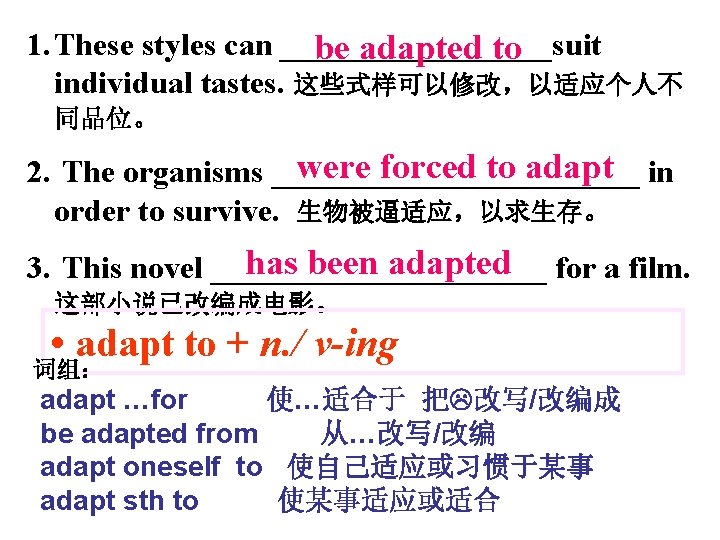
1. These styles can _________suit be adapted to individual tastes. 这些式样可以修改,以适应个人不 同品位。 were forced to adapt in 2. The organisms ____________ order to survive. 生物被逼适应,以求生存。 has been adapted for a film. 3. This novel ___________ 这部小说已改编成电影。 • adapt to + n. / v-ing 词组: adapt …for 使…适合于 把 改写/改编成 be adapted from 从…改写/改编 adapt oneself to 使自己适应或习惯于某事 adapt sth to 使某事适应或适合
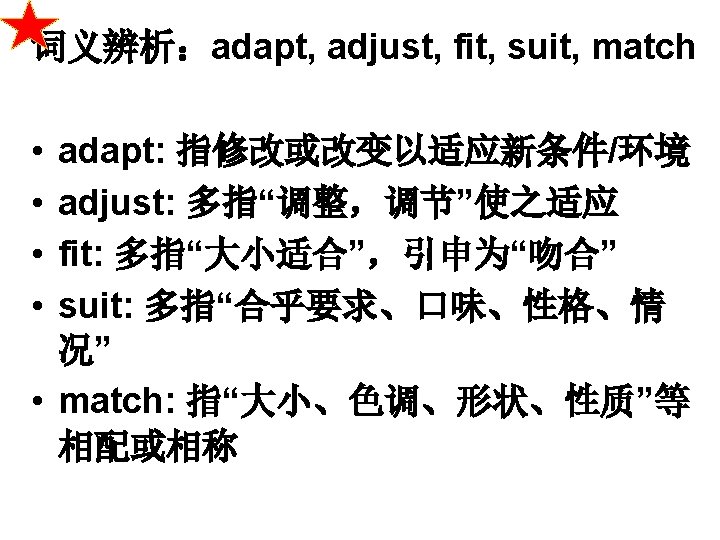
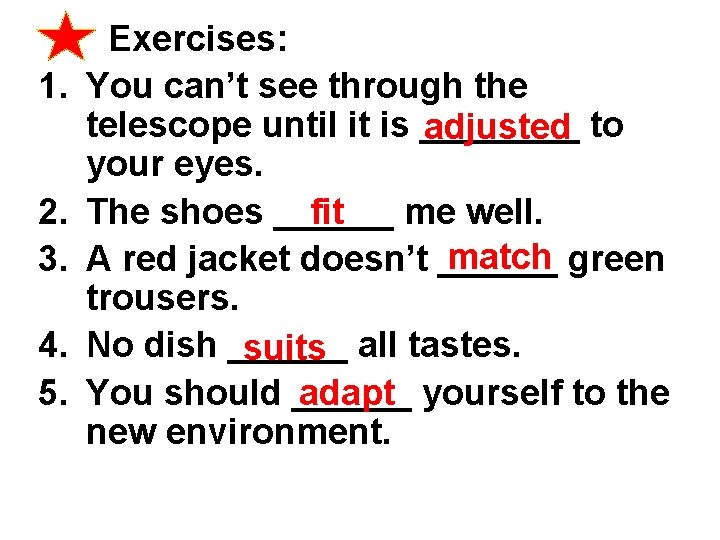
1. 2. 3. 4. 5. Exercises: You can’t see through the telescope until it is ____ adjusted to your eyes. The shoes ______ me well. fit match green A red jacket doesn’t ______ trousers. No dish ______ suits all tastes. You should ______ adapt yourself to the new environment.
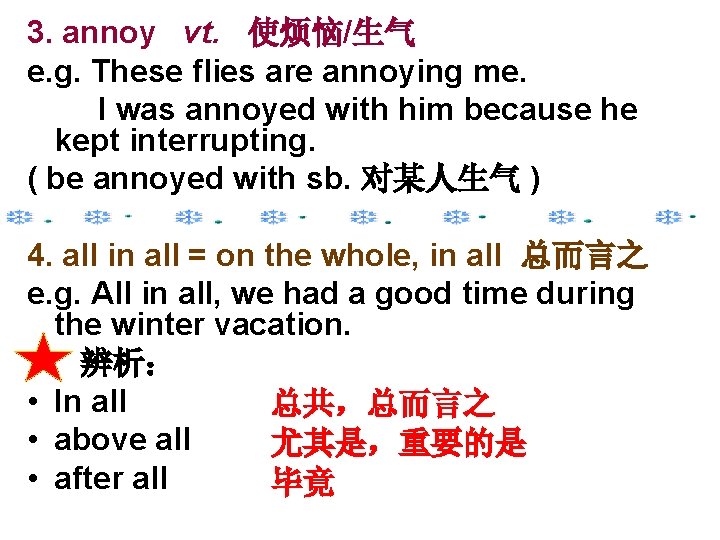
3. annoy vt. 使烦恼/生气 e. g. These flies are annoying me. I was annoyed with him because he kept interrupting. ( be annoyed with sb. 对某人生气 ) 4. all in all = on the whole, in all 总而言之 e. g. All in all, we had a good time during the winter vacation. 辨析: • In all 总共,总而言之 • above all 尤其是,重要的是 • after all 毕竟
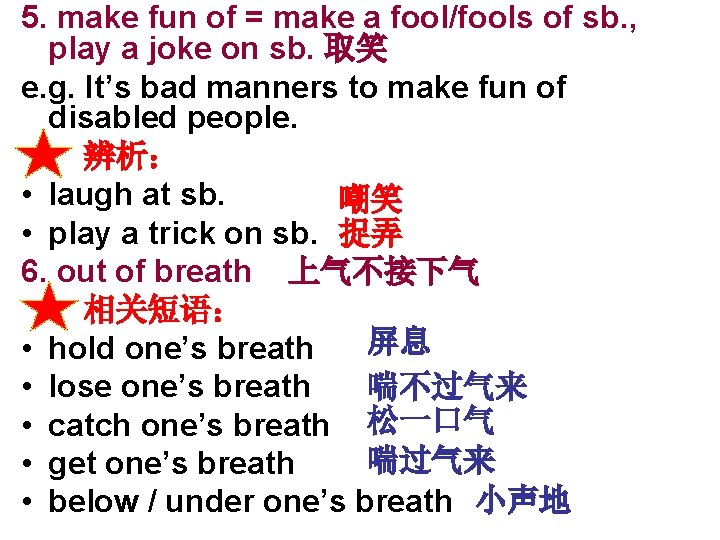
5. make fun of = make a fool/fools of sb. , play a joke on sb. 取笑 e. g. It’s bad manners to make fun of disabled people. 辨析: • laugh at sb. 嘲笑 • play a trick on sb. 捉弄 6. out of breath 上气不接下气 相关短语: 屏息 • hold one’s breath • lose one’s breath 喘不过气来 • catch one’s breath 松一口气 喘过气来 • get one’s breath • below / under one’s breath 小声地
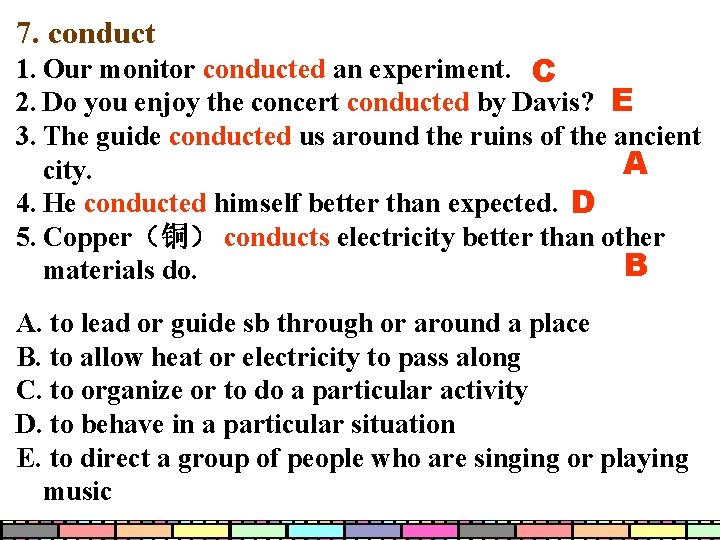
7. conduct 1. Our monitor conducted an experiment. C 2. Do you enjoy the concert conducted by Davis? E 3. The guide conducted us around the ruins of the ancient A city. 4. He conducted himself better than expected. D 5. Copper(铜) conducts electricity better than other B materials do. A. to lead or guide sb through or around a place B. to allow heat or electricity to pass along C. to organize or to do a particular activity D. to behave in a particular situation E. to direct a group of people who are singing or playing music
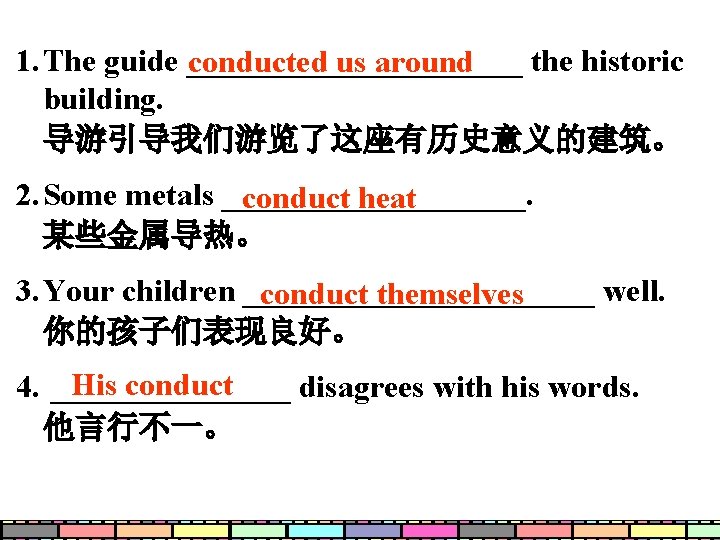
1. The guide ___________ the historic conducted us around building. 导游引导我们游览了这座有历史意义的建筑。 2. Some metals __________. conduct heat 某些金属导热。 3. Your children ___________ well. conduct themselves 你的孩子们表现良好。 His conduct 4. ________ disagrees with his words. 他言行不一。
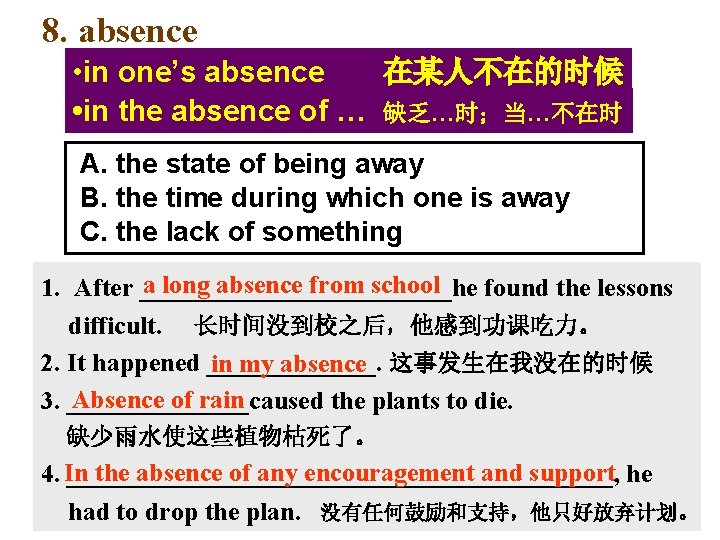
8. absence • in one’s absence 在某人不在的时候 • in the absence of … 缺乏…时;当…不在时 A. the state of being away B. the time during which one is away C. the lack of something a long absence from school 1. After ____________he found the lessons difficult. 长时间没到校之后,他感到功课吃力。 2. It happened _______. in my absence 这事发生在我没在的时候 Absence of rain 3. _______caused the plants to die. 缺少雨水使这些植物枯死了。 the absence of any encouragement and support he 4. In _____________________, had to drop the plan. 没有任何鼓励和支持,他只好放弃计划。
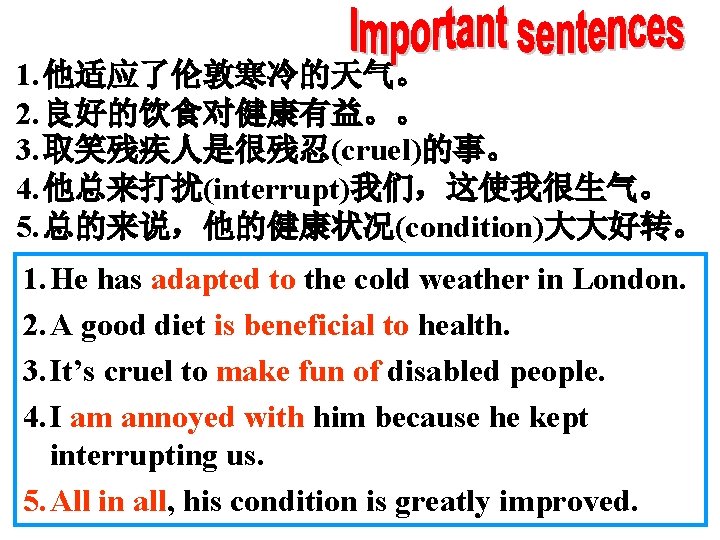
1. 他适应了伦敦寒冷的天气。 2. 良好的饮食对健康有益。。 3. 取笑残疾人是很残忍(cruel)的事。 4. 他总来打扰(interrupt)我们,这使我很生气。 5. 总的来说,他的健康状况(condition)大大好转。 1. He has adapted to the cold weather in London. 2. A good diet is beneficial to health. 3. It’s cruel to make fun of disabled people. 4. I am annoyed with him because he kept interrupting us. 5. All in all, his condition is greatly improved.
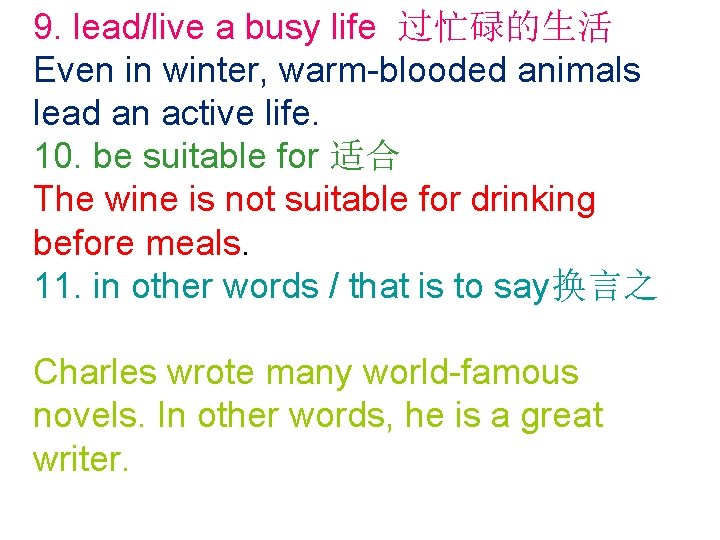
9. lead/live a busy life 过忙碌的生活 Even in winter, warm-blooded animals lead an active life. 10. be suitable for 适合 The wine is not suitable for drinking before meals. 11. in other words / that is to say换言之 Charles wrote many world-famous novels. In other words, he is a great writer.
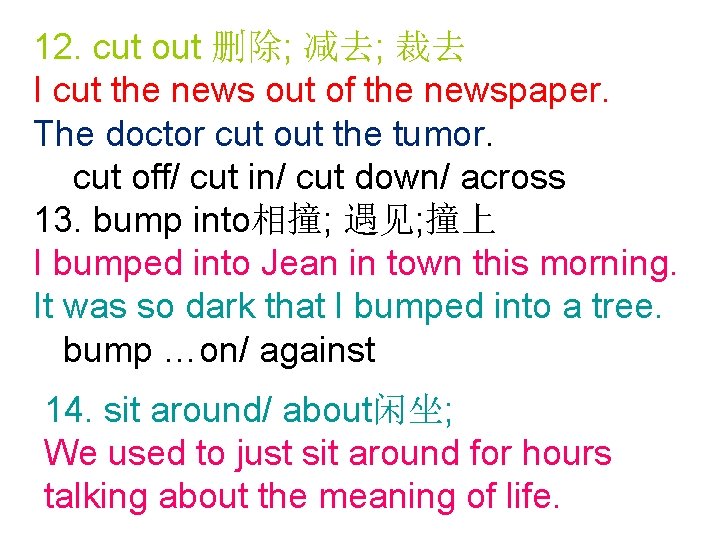
12. cut out 删除; 减去; 裁去 I cut the news out of the newspaper. The doctor cut out the tumor. cut off/ cut in/ cut down/ across 13. bump into相撞; 遇见; 撞上 I bumped into Jean in town this morning. It was so dark that I bumped into a tree. bump …on/ against 14. sit around/ about闲坐; We used to just sit around for hours talking about the meaning of life.
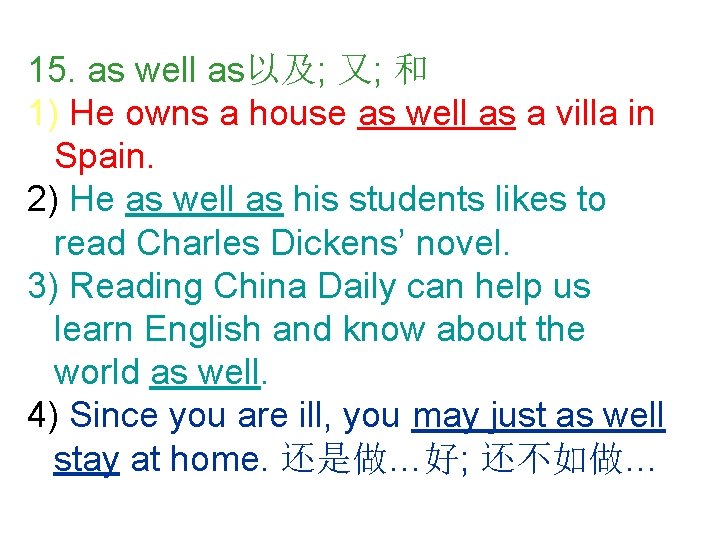
15. as well as以及; 又; 和 1) He owns a house as well as a villa in Spain. 2) He as well as his students likes to read Charles Dickens’ novel. 3) Reading China Daily can help us learn English and know about the world as well. 4) Since you are ill, you may just as well stay at home. 还是做…好; 还不如做…
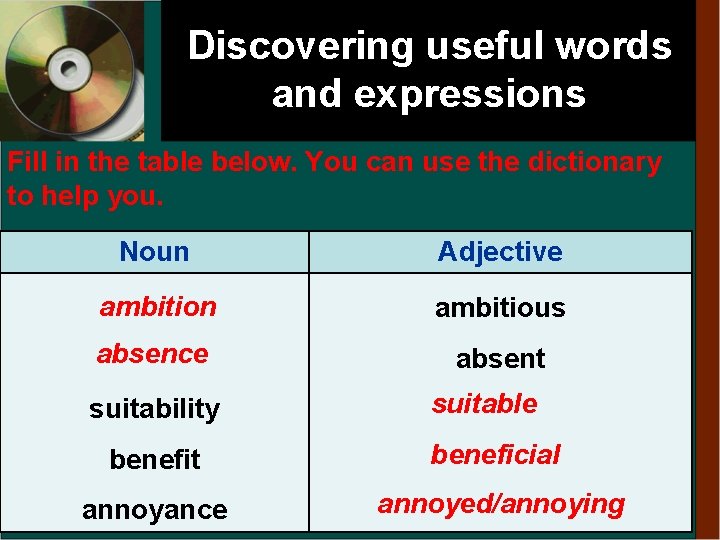
Discovering useful words and expressions Fill in the table below. You can use the dictionary to help you. Noun Adjective ambition ambitious absence absent suitability suitable benefit beneficial annoyance annoyed/annoying
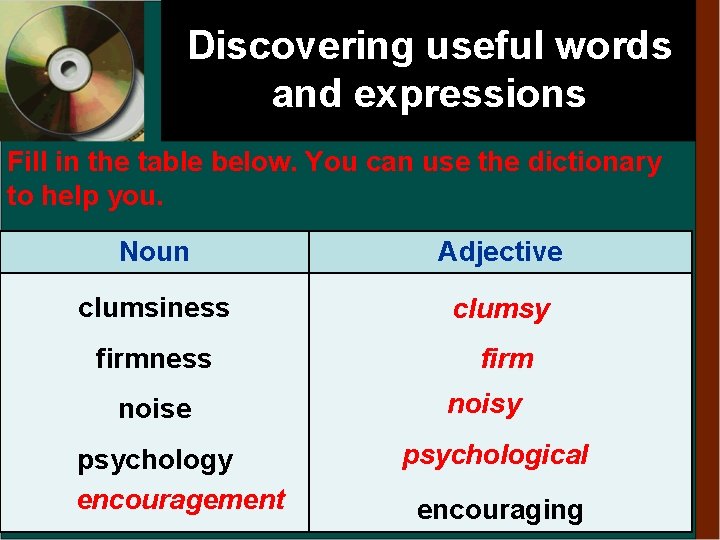
Discovering useful words and expressions Fill in the table below. You can use the dictionary to help you. Noun Adjective clumsiness clumsy firmness firm noise psychology encouragement noisy psychological encouraging
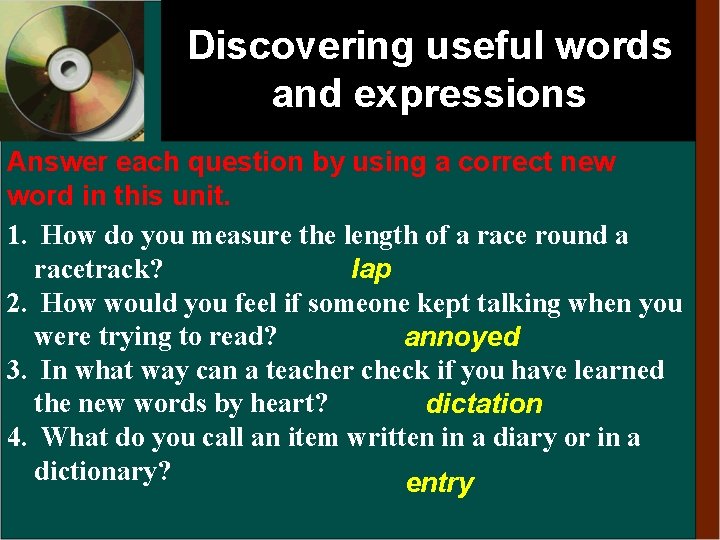
Discovering useful words and expressions Answer each question by using a correct new word in this unit. 1. How do you measure the length of a race round a racetrack? lap 2. How would you feel if someone kept talking when you were trying to read? annoyed 3. In what way can a teacher check if you have learned the new words by heart? dictation 4. What do you call an item written in a diary or in a dictionary? entry
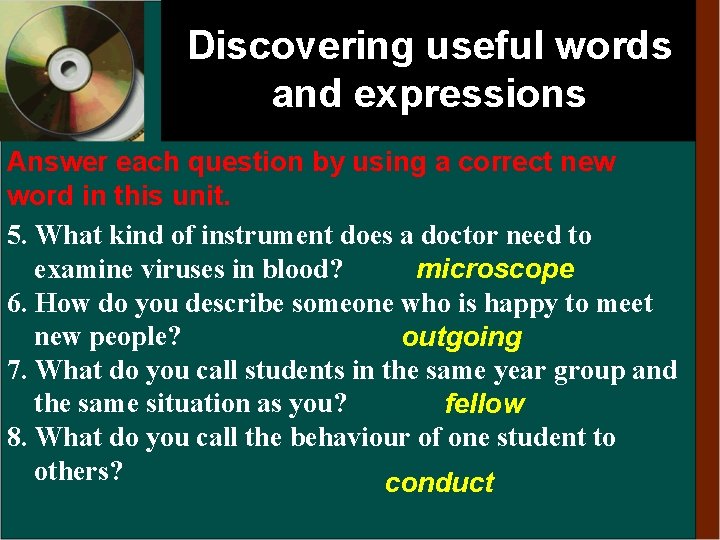
Discovering useful words and expressions Answer each question by using a correct new word in this unit. 5. What kind of instrument does a doctor need to examine viruses in blood? microscope 6. How do you describe someone who is happy to meet new people? outgoing 7. What do you call students in the same year group and the same situation as you? fellow 8. What do you call the behaviour of one student to others? conduct
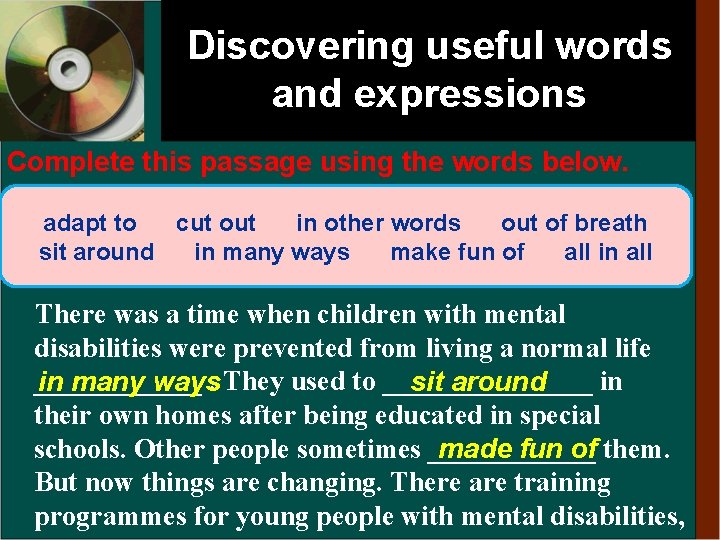
Discovering useful words and expressions Complete this passage using the words below. adapt to cut out in other words out of breath sit around in many ways make fun of all in all There was a time when children with mental disabilities were prevented from living a normal life ______ in in many ways. They used to ________ sit around their own homes after being educated in special schools. Other people sometimes ______ made fun of them. But now things are changing. There are training programmes for young people with mental disabilities,
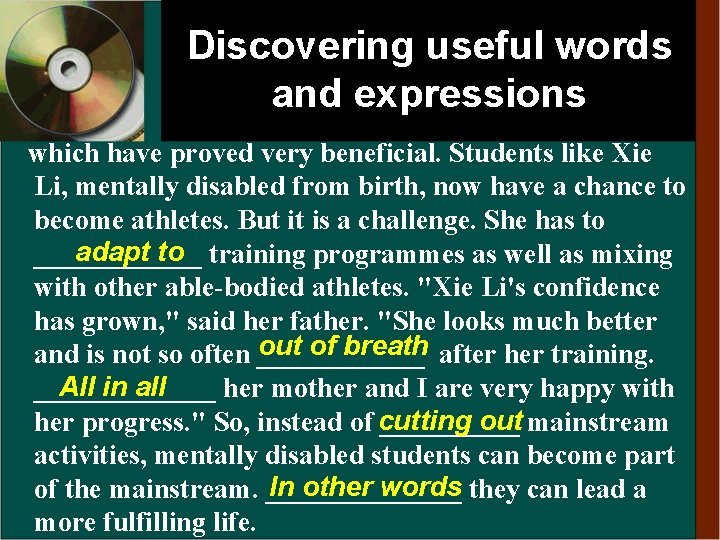
Discovering useful words and expressions which have proved very beneficial. Students like Xie Li, mentally disabled from birth, now have a chance to become athletes. But it is a challenge. She has to adapt to training programmes as well as mixing ______ with other able-bodied athletes. "Xie Li's confidence has grown, " said her father. "She looks much better out of breath after her training. and is not so often ______ All in all _______ her mother and I are very happy with out mainstream her progress. " So, instead of cutting _____ activities, mentally disabled students can become part In other words they can lead a of the mainstream. _______ more fulfilling life.

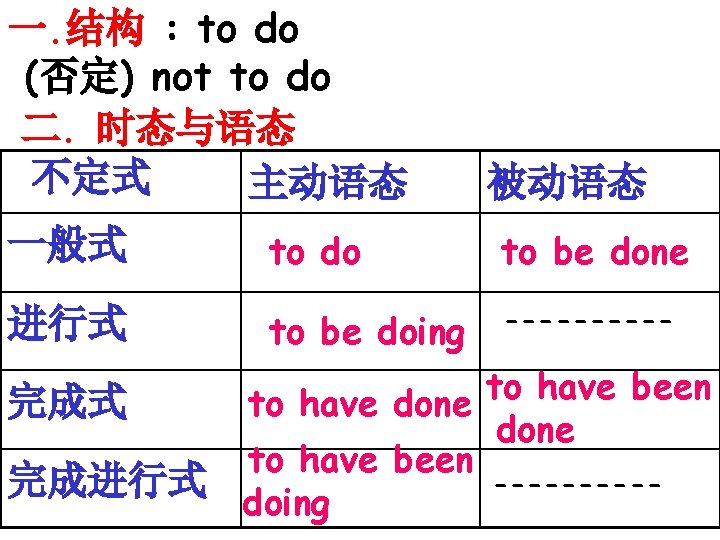
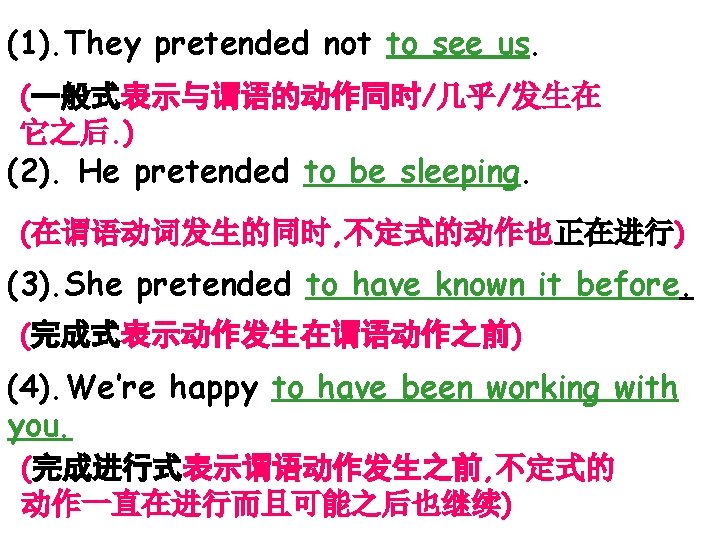
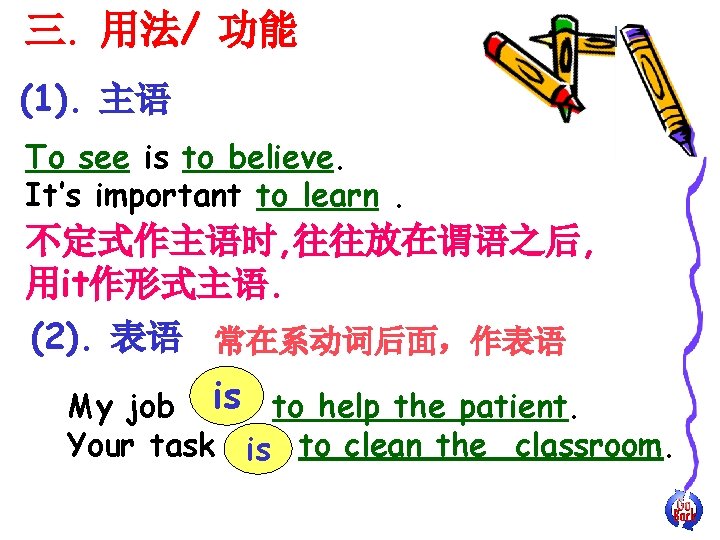
三. 用法/ 功能 (1). 主语 To see is to believe. It’s important to learn. 不定式作主语时, 往往放在谓语之后, 用it作形式主语. (2). 表语 常在系动词后面,作表语 My job is to help the patient. Your task is to clean the classroom.
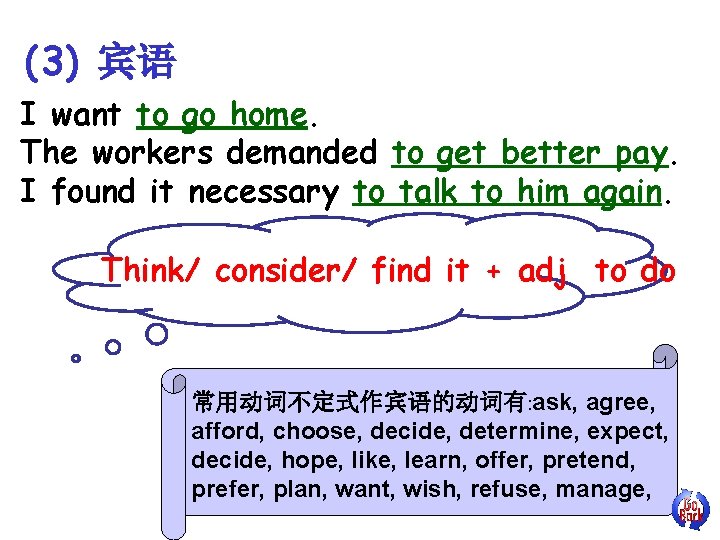
(3) 宾语 I want to go home. The workers demanded to get better pay. I found it necessary to talk to him again. Think/ consider/ find it + adj to do 常用动词不定式作宾语的动词有: ask, agree, afford, choose, decide, determine, expect, decide, hope, like, learn, offer, pretend, prefer, plan, want, wish, refuse, manage,
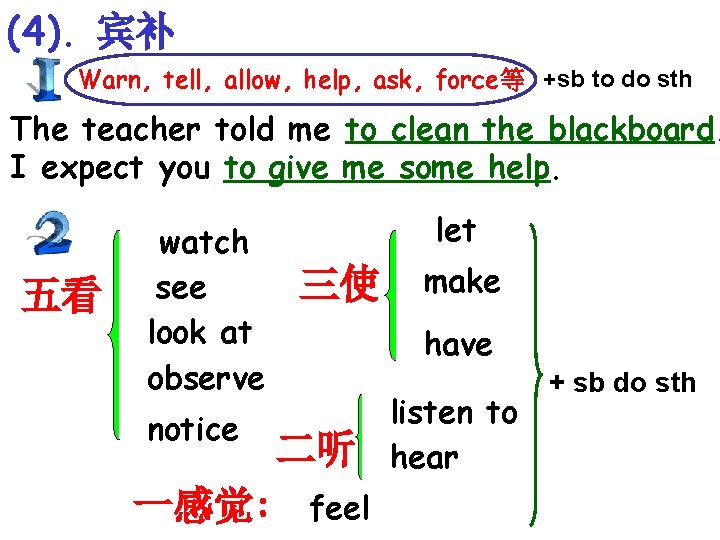
(4). 宾补 Warn, tell, allow, help, ask, force等 +sb to do sth The teacher told me to clean the blackboard. I expect you to give me some help. 五看 watch see look at observe notice 一感觉: let 三使 make have 二听 feel listen to hear + sb do sth
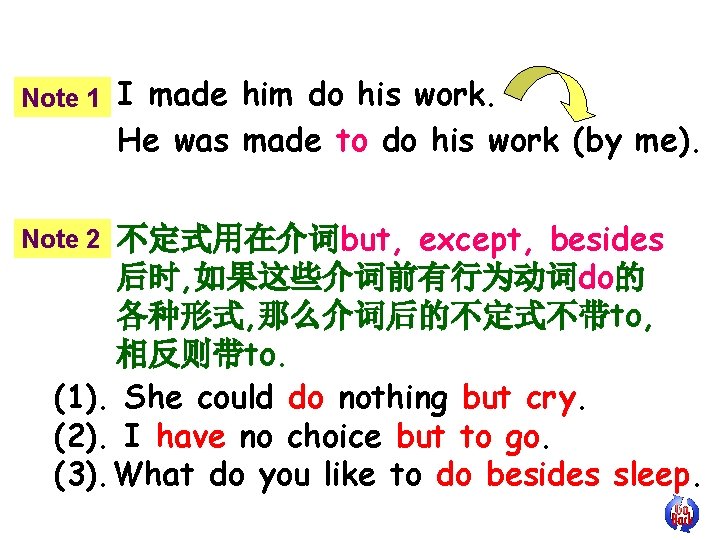
Note 1 I made him do his work. He was made to do his work (by me). 不定式用在介词but, except, besides 后时, 如果这些介词前有行为动词do的 各种形式, 那么介词后的不定式不带to, 相反则带to. (1). She could do nothing but cry. (2). I have no choice but to go. (3). What do you like to do besides sleep. Note 2
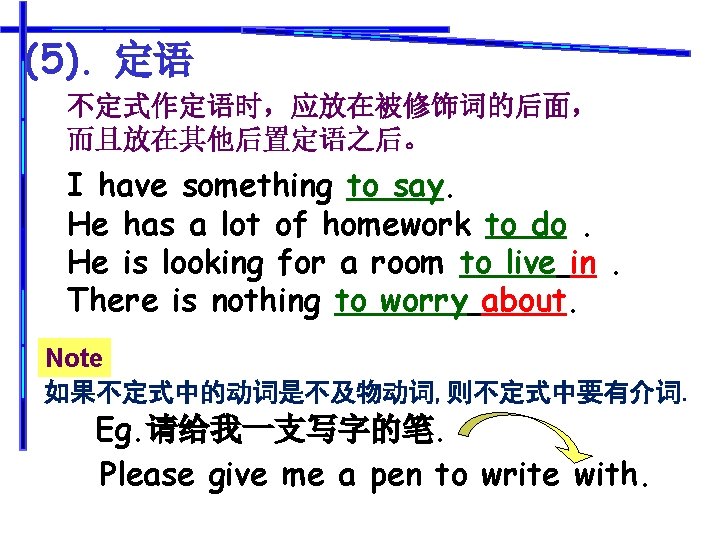
(5). 定语 不定式作定语时,应放在被修饰词的后面, 而且放在其他后置定语之后。 I have something to say. He has a lot of homework to do. He is looking for a room to live in. There is nothing to worry about. Note 如果不定式中的动词是不及物动词, 则不定式中要有介词. Eg. 请给我一支写字的笔. Please give me a pen to write with.
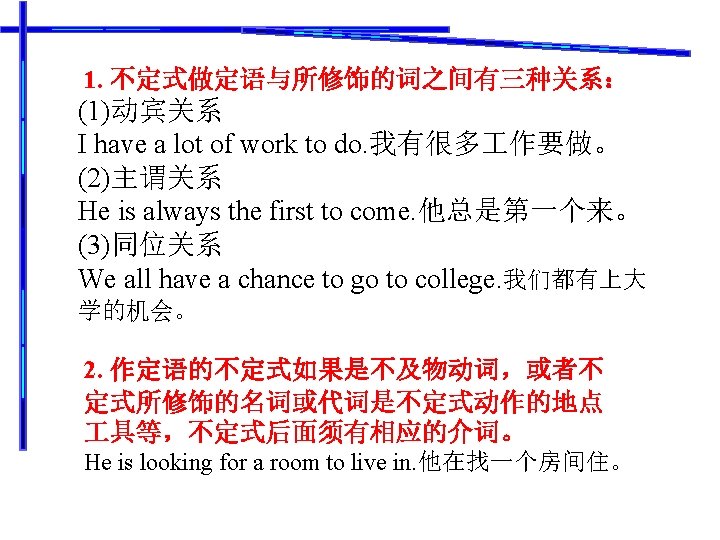
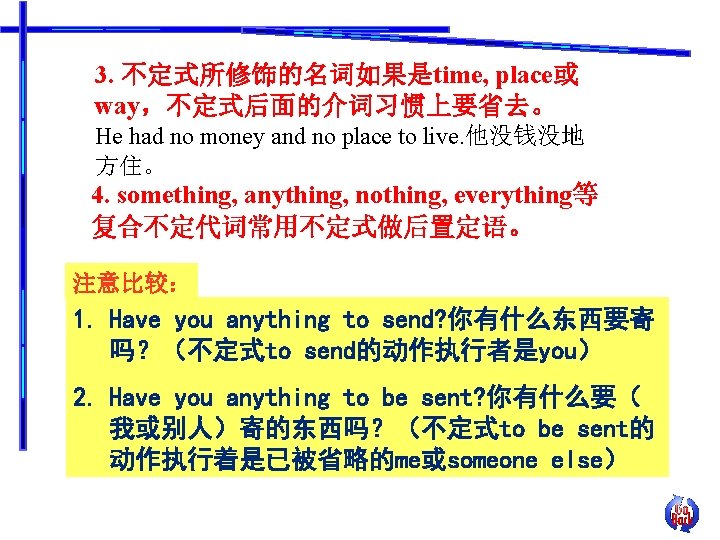
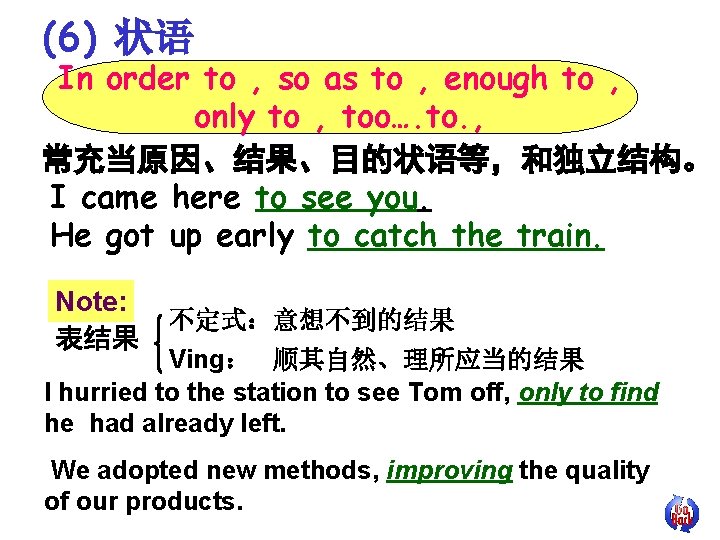
(6) 状语 In order to , so as to , enough to , only to , too…. to. , 常充当原因、结果、目的状语等,和独立结构。 I came here to see you. He got up early to catch the train. Note: 表结果 不定式:意想不到的结果 Ving: 顺其自然、理所应当的结果 I hurried to the station to see Tom off, only to find he had already left. We adopted new methods, improving the quality of our products.
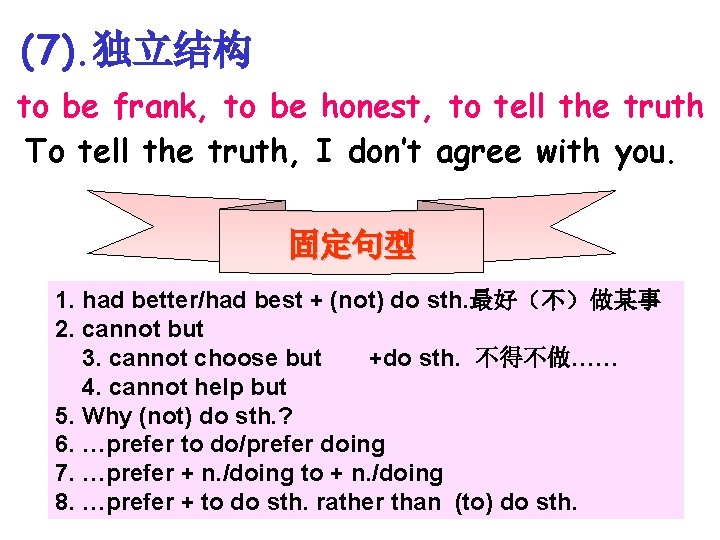
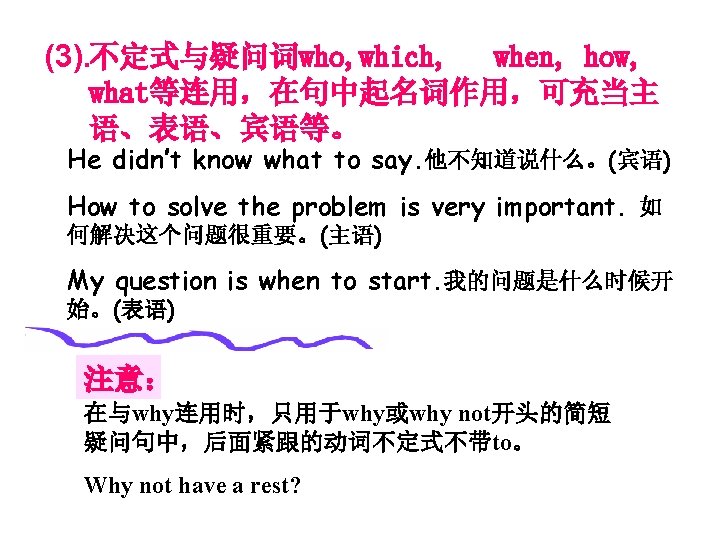
(7). 独立结构 to be frank, to be honest, to tell the truth To tell the truth, I don’t agree with you. 固定句型 1. had better/had best + (not) do sth. 最好(不)做某事 2. cannot but 3. cannot choose but +do sth. 不得不做…… 4. cannot help but 5. Why (not) do sth. ? 6. …prefer to do/prefer doing 7. …prefer + n. /doing to + n. /doing 8. …prefer + to do sth. rather than (to) do sth.
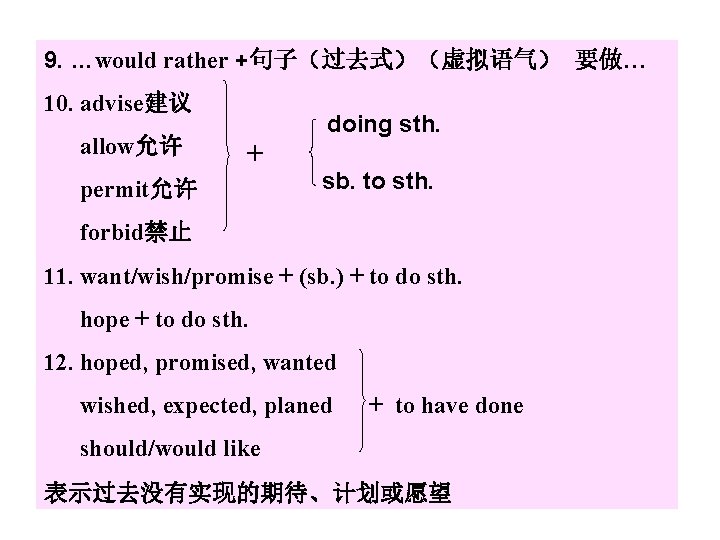
9. …would rather +句子(过去式)(虚拟语气) 要做… 10. advise建议 allow允许 + permit允许 doing sth. sb. to sth. forbid禁止 11. want/wish/promise + (sb. ) + to do sth. hope + to do sth. 12. hoped, promised, wanted wished, expected, planed + to have done should/would like 表示过去没有实现的期待、计划或愿望
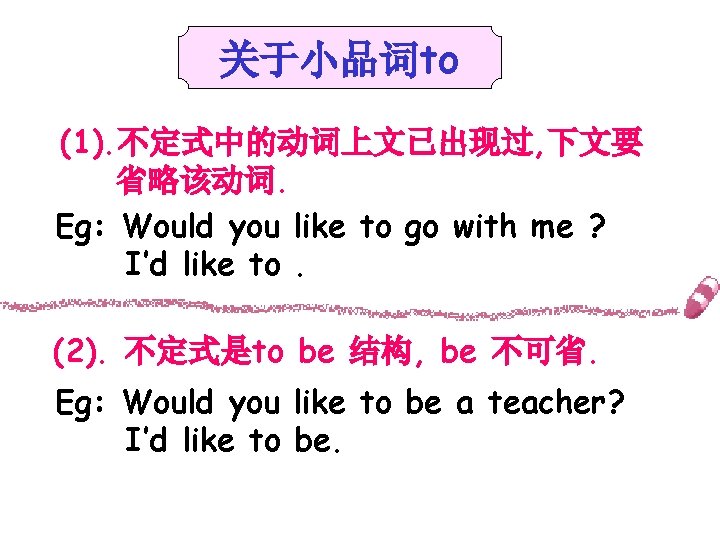
关于小品词to (1). 不定式中的动词上文已出现过, 下文要 省略该动词. Eg: Would you like to go with me ? I’d like to. (2). 不定式是to be 结构, be 不可省. Eg: Would you like to be a teacher? I’d like to be.
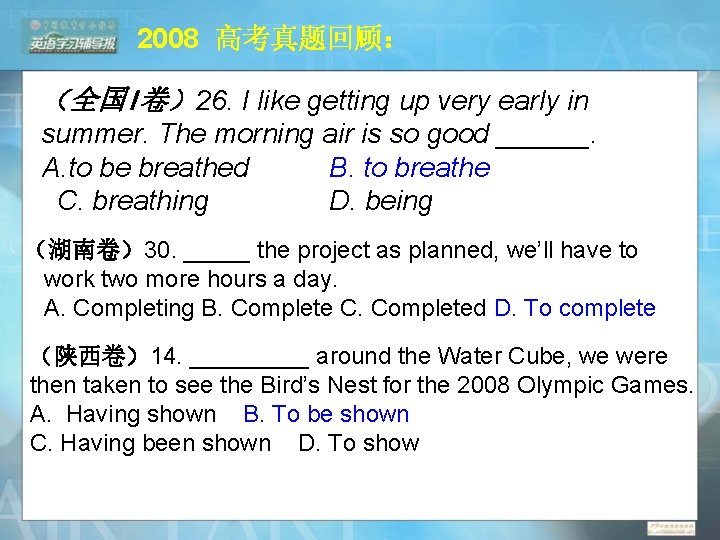
2008 高考真题回顾: (全国I卷)26. I like getting up very early in summer. The morning air is so good ______. A. to be breathed B. to breathe C. breathing D. being (湖南卷)30. _____ the project as planned, we’ll have to work two more hours a day. A. Completing B. Complete C. Completed D. To complete (陕西卷)14. _____ around the Water Cube, we were then taken to see the Bird’s Nest for the 2008 Olympic Games. A. Having shown B. To be shown C. Having been shown D. To show
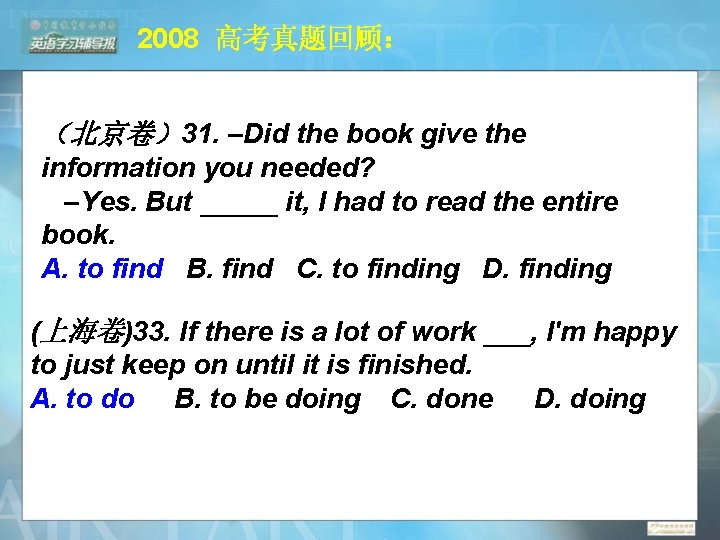
2008 高考真题回顾: (北京卷)31. –Did the book give the information you needed? –Yes. But _____ it, I had to read the entire book. A. to find B. find C. to finding D. finding (上海卷)33. If there is a lot of work ___, I'm happy to just keep on until it is finished. A. to do B. to be doing C. done D. doing
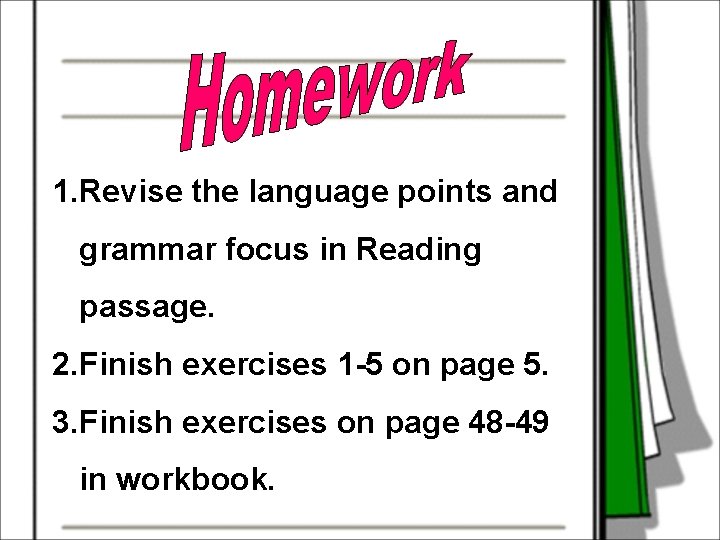
1. Revise the language points and grammar focus in Reading passage. 2. Finish exercises 1 -5 on page 5. 3. Finish exercises on page 48 -49 in workbook.
- Slides: 45