
ANSOFF MATRIX CONTENT o WHAT IS ANSOFF MATRIX


- Slides: 17
ANSOFF MATRIX
CONTENT o WHAT IS ANSOFF MATRIX? o UNDERSTANDING THE TOOL o HOW TO USE THE TOOL? o CRITICISMS o EXAMPLE o CONCLUSION
WHAT IS ANSOFF MATRIX? • The Ansoff Matrix is a strategic planning tool that provides a framework to help executives, senior managers, devise strategies for future growth. and marketers • It is named after Russian American Igor Ansoff, an applied mathematician and business manager, who created the concept .
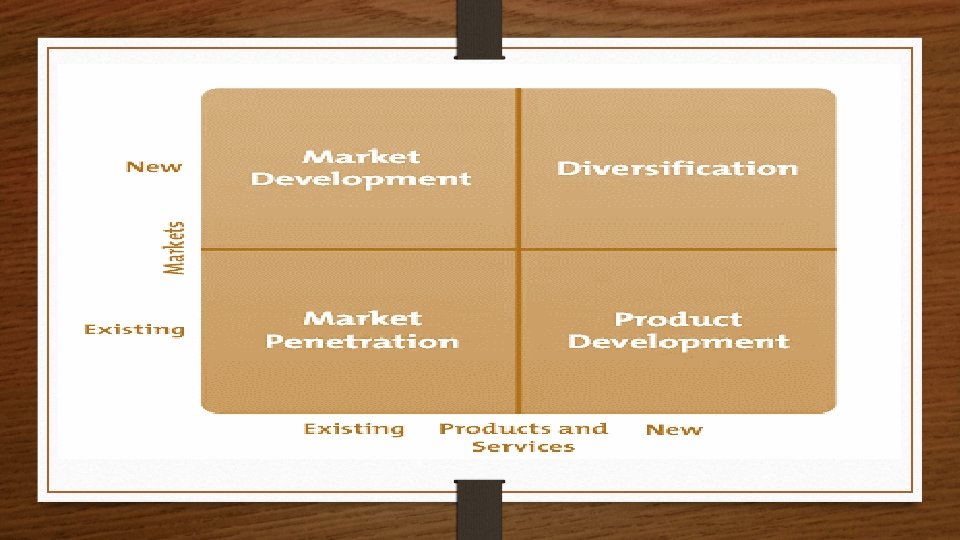
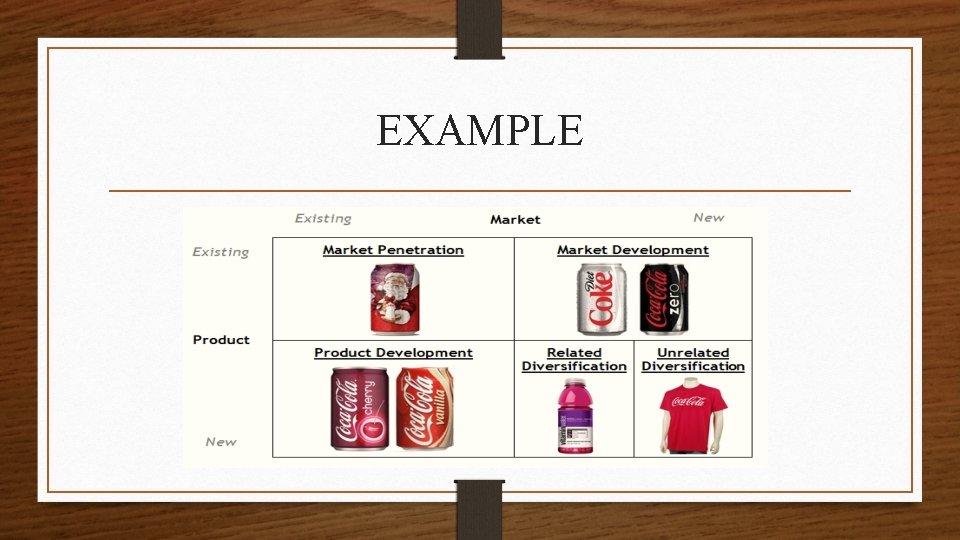
UNDERSTANDING THE TOOL • The Ansoff Matrix was developed by H. Igor Ansoff and first published in the Harvard Business Review in 1957, in an article titled "Strategies for Diversification. " It has given generations of marketers and business leaders a quick and simple way to think about the risks of growth. • Sometimes called the Product/Market Expansion Grid, the Matrix (see figure 1, below) shows four strategies you can use to grow. It also helps to analyze the risks associated with each one. The idea is that each time you move into a new quadrant (horizontally or vertically), risk increases.
HOW TO USE THE TOOL? Step 1: Analyze the strategies
MARKET PENETRATION In market penetration strategy, the organization tries to grow using its existing offerings (products and services) in existing markets. In other words, it tries to increase its market share in current market scenario. This involves increasing market share within existing market segments. This can be achieved by selling more products or services to established customers or by finding new customers within existing markets. Here, the company seeks increased sales for its present products in its present markets through more aggressive promotion and distribution. This can be accomplished by: • • Price decrease Increase in promotion and distribution support Acquisition of a rival in the same market Modest product refinements This is the least risky growth option.
MAEKET DEVELOPMENT STRATEGY In market development strategy, a firm tries to expand into new markets (geographies, countries etc. ) using its existing offerings and also, with minimal product/services development. This can be accomplished by: • Different customer segments • Industrial buyers for a good that was previously sold only to the households; • New areas or regions of the country • Foreign markets. This strategy is more likely to be successful where: • The firm has a unique product technology it can leverage in the new market • It benefits from economies of scale if it increases output • The new market is not too different from the one it has experience of • The buyers in the market are intrinsically profitable. This additional quadrant move increases uncertainty and thus increases the risk further.
PRODUCT DEVELOPMENT STRATEGY In product development strategy, a company tries to create new products and services targeted at its existing markets to achieve growth. This involves extending the product range available to the firm's existing markets. These products may be obtained by: • Investment in research and development of additional products; • Acquisition of rights to produce someone else's product; • Buying in the product and “badging” it as one’s own brand; • Joint development with ownership of another company who need access to the firm's distribution channels or brands. This also consists of one quadrant move so is riskier than Market penetration and a similar risk as Market development.
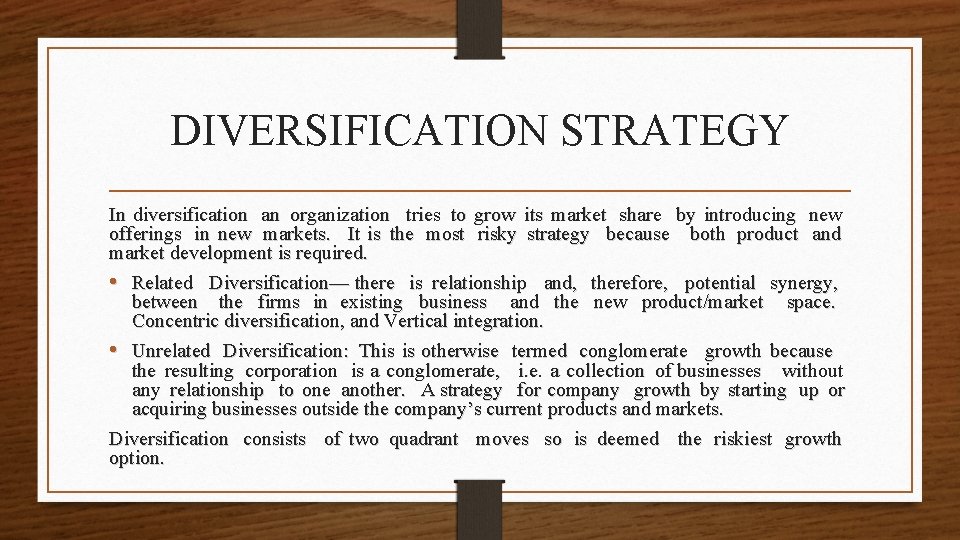
DIVERSIFICATION STRATEGY In diversification an organization tries to grow its market share by introducing new offerings in new markets. It is the most risky strategy because both product and market development is required. • Related Diversification— there is relationship and, therefore, potential synergy, between the firms in existing business and the new product/market space. Concentric diversification, and Vertical integration. • Unrelated Diversification: This is otherwise termed conglomerate growth because the resulting corporation is a conglomerate, i. e. a collection of businesses without any relationship to one another. A strategy for company growth by starting up or acquiring businesses outside the company’s current products and markets. Diversification consists of two quadrant moves so is deemed the riskiest growth option.
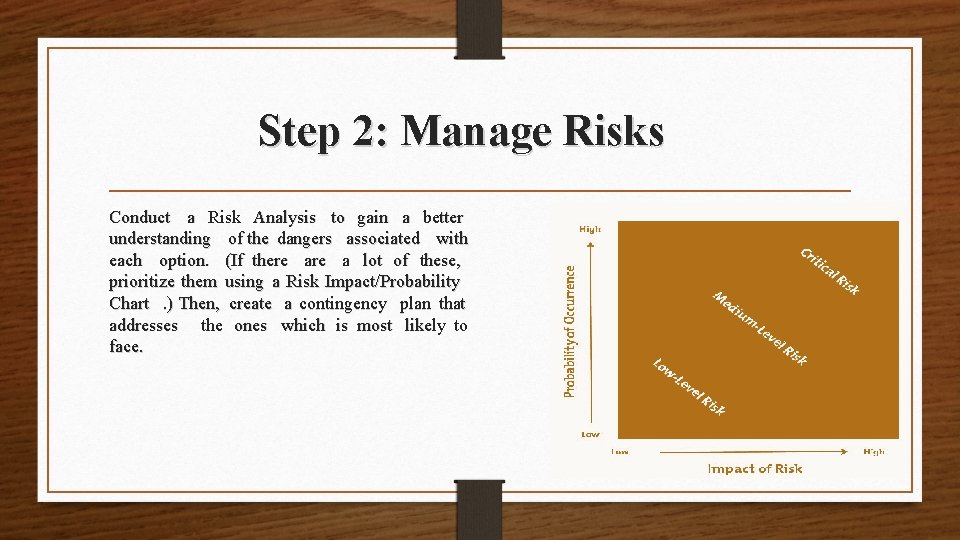
Step 2: Manage Risks Conduct a Risk Analysis to gain a better understanding of the dangers associated with each option. (If there a lot of these, prioritize them using a Risk Impact/Probability Chart. ) Then, create a contingency plan that addresses the ones which is most likely to face.
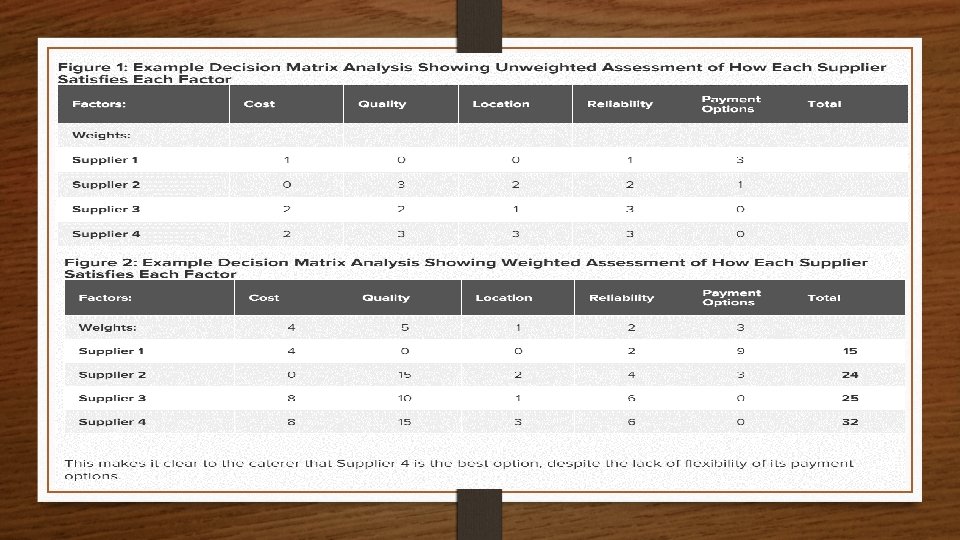
Step 3: Choose the Best Option By now, the organization will have an idea which option best suit its operations. It can make sure it really is the best one with one last step: use Decision Matrix Analysis to weigh up the different factors in each option, and make the best choice.
CRITICISMS Isolation challenges Used by itself, the Ansoff matrix could be misleading. It does not take into account the activities of competitors and the ability for competitors to counter moves into other industries. It also fails to consider the challenges and risks of changes to business-as-usual activities. An organization hoping to move into new markets or create new products (or both) must consider whether they possess transferable skills, flexible structures, and agreeable stakeholders. Logical consistency challenges The logic of the Ansoff matrix has been questioned. The logical issues pertain to interpretations about newness. If one assumes a new product really is new to the firm, in many cases a new product will simultaneously take the firm into a new, unfamiliar market. In that case, one of the Ansoff quadrants, diversification, is redundant. Alternatively, if a new product does not necessarily take the firm into a new market, then the combination of new products into new markets does not always equate to diversification, in the sense of venturing into a completely unknown business.
EXAMPLE
CONCLUSION As can be seen from the preceding discussion, it is imperative for firms to grow as otherwise their resources would not generate the returns needed for the firms to make profits as well as deliver value to their shareholders. Moreover, firms need to continually look for ways and means to increase their market share, which would help them create value for their stakeholders. This is the reason why the Ansoff Matrix has become so popular because it charts the strategies that the firms must follow in each option, which again is a combination of the firms’ current capabilities, and the possibility of new market led growth. In conclusion, the Ansoff Matrix is very relevant in these recessionary times as it can be applied by any firm wishing to either expand into newer markets or leverage its existing capabilities.
Thank you SINANA