
ANOVA GLM Repeated measures Jantien Donkers March 14

- Slides: 57
ANOVA (GLM- Repeated measures) Jantien Donkers March 14, 2005 Methodology & Statistics
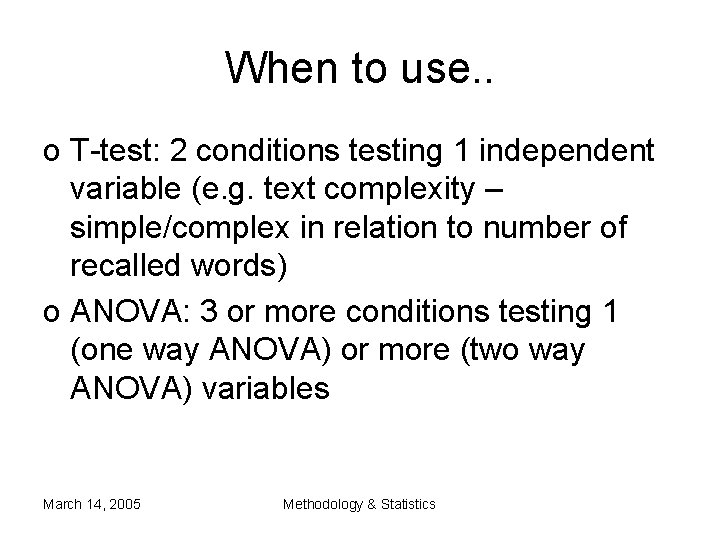
When to use. . o T-test: 2 conditions testing 1 independent variable (e. g. text complexity – simple/complex in relation to number of recalled words) o ANOVA: 3 or more conditions testing 1 (one way ANOVA) or more (two way ANOVA) variables March 14, 2005 Methodology & Statistics
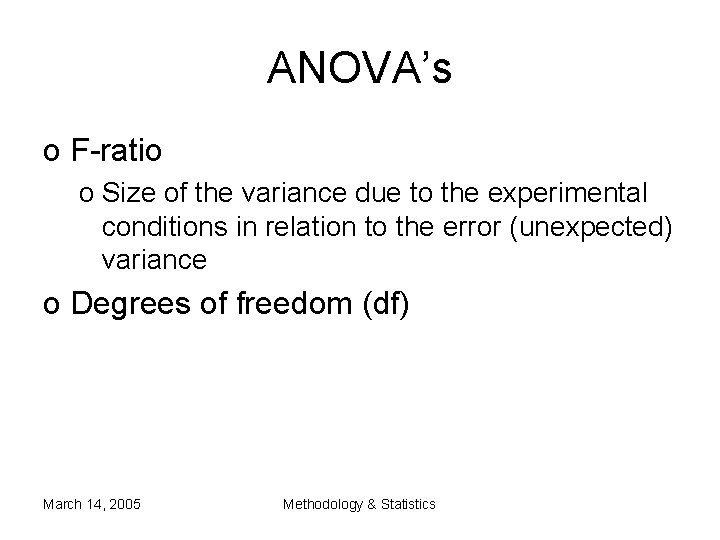
ANOVA’s o F-ratio o Size of the variance due to the experimental conditions in relation to the error (unexpected) variance o Degrees of freedom (df) March 14, 2005 Methodology & Statistics
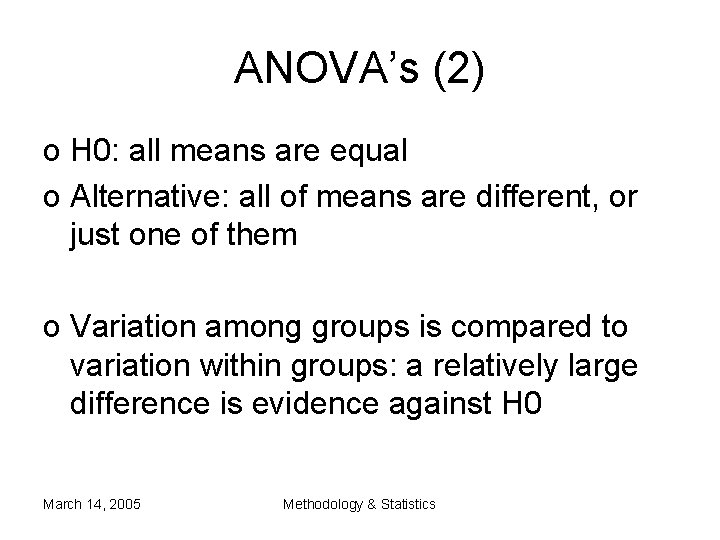
ANOVA’s (2) o H 0: all means are equal o Alternative: all of means are different, or just one of them o Variation among groups is compared to variation within groups: a relatively large difference is evidence against H 0 March 14, 2005 Methodology & Statistics
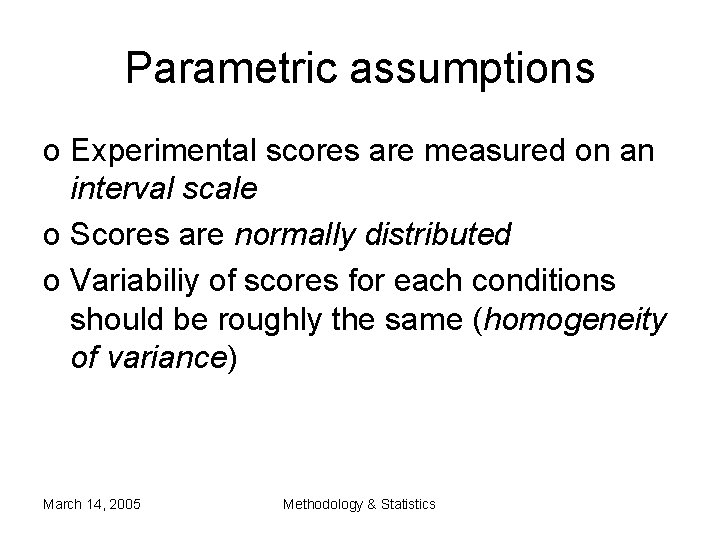
Parametric assumptions o Experimental scores are measured on an interval scale o Scores are normally distributed o Variabiliy of scores for each conditions should be roughly the same (homogeneity of variance) March 14, 2005 Methodology & Statistics
This experiment o 6 conditions testing 2 independent variables o Dependent variable: reading time March 14, 2005 Methodology & Statistics
This experiment (2) o a self-paced reading study in Dutch o “who” and “which” questions o specificity and structure March 14, 2005 Methodology & Statistics
Why? o In various research it is observed that “which” questions are more difficicult than “who” questions, but: o It has never been addressed why this is the case March 14, 2005 Methodology & Statistics
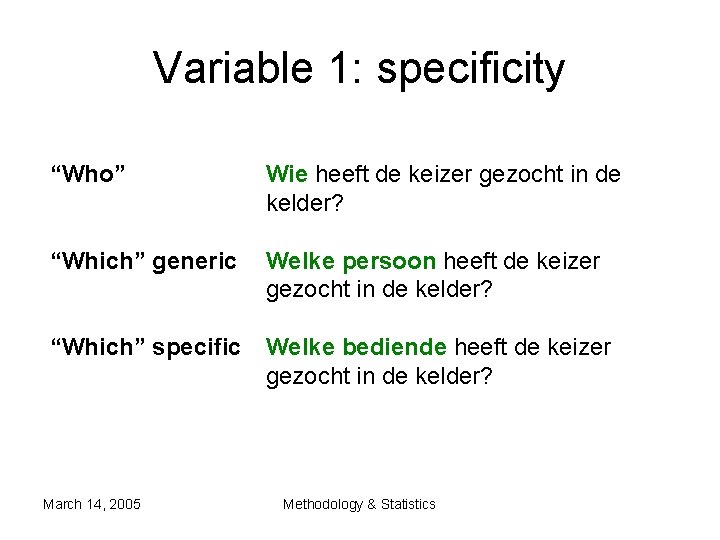
Variable 1: specificity “Who” Wie heeft de keizer gezocht in de kelder? “Which” generic Welke persoon heeft de keizer gezocht in de kelder? “Which” specific Welke bediende heeft de keizer gezocht in de kelder? March 14, 2005 Methodology & Statistics
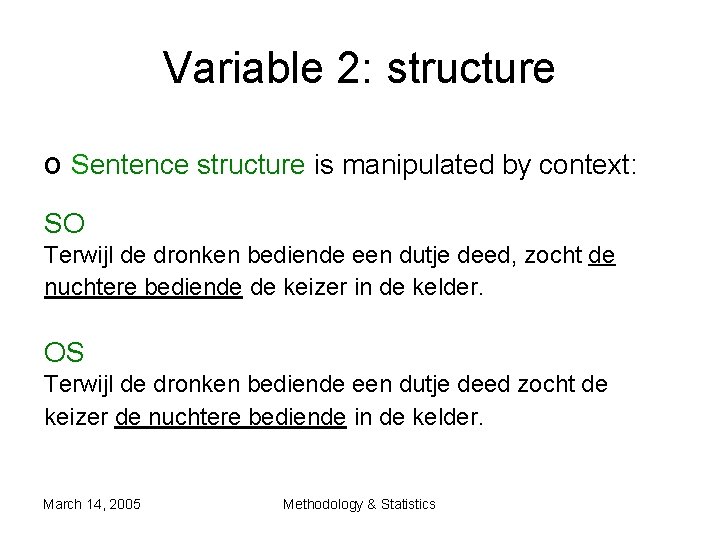
Variable 2: structure o Sentence structure is manipulated by context: SO Terwijl de dronken bediende een dutje deed, zocht de nuchtere bediende de keizer in de kelder. OS Terwijl de dronken bediende een dutje deed zocht de keizer de nuchtere bediende in de kelder. March 14, 2005 Methodology & Statistics
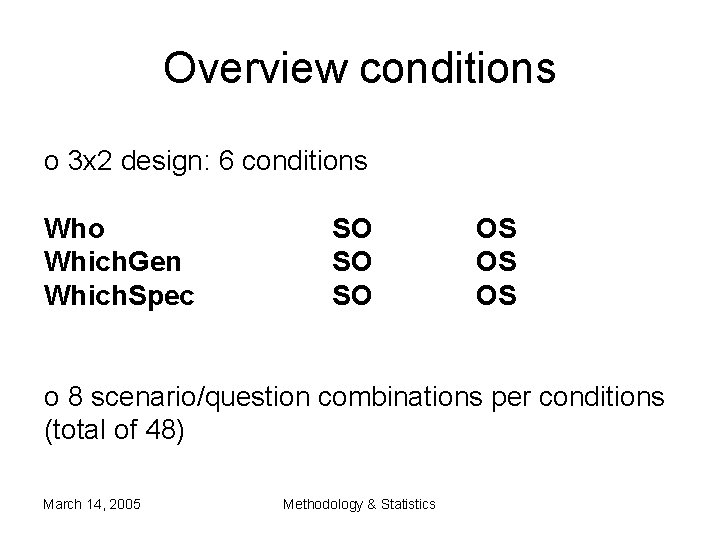
Overview conditions o 3 x 2 design: 6 conditions Who Which. Gen Which. Spec SO SO SO OS OS OS o 8 scenario/question combinations per conditions (total of 48) March 14, 2005 Methodology & Statistics
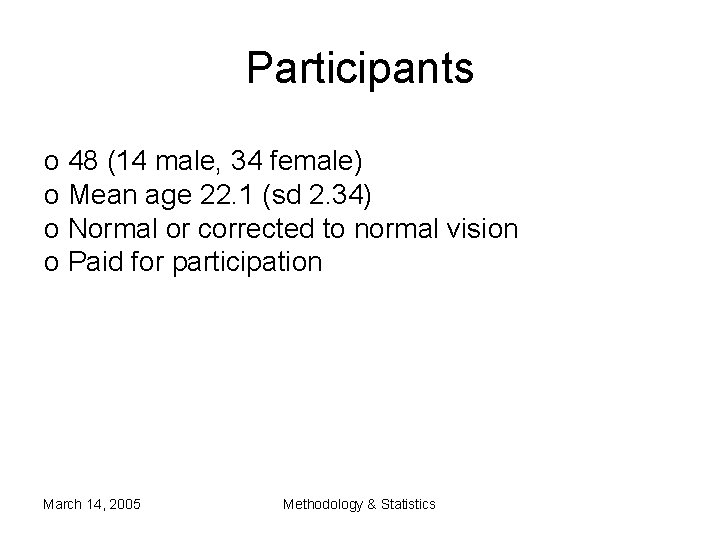
Participants o 48 (14 male, 34 female) o Mean age 22. 1 (sd 2. 34) o Normal or corrected to normal vision o Paid for participation March 14, 2005 Methodology & Statistics
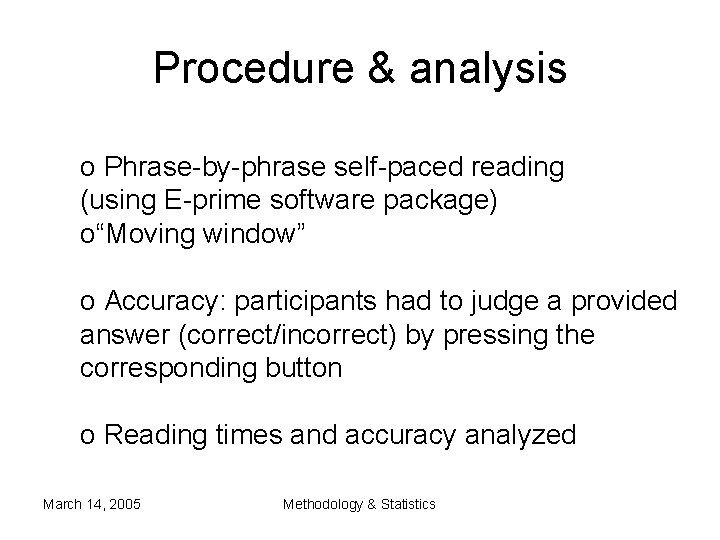
Procedure & analysis o Phrase-by-phrase self-paced reading (using E-prime software package) o“Moving window” o Accuracy: participants had to judge a provided answer (correct/incorrect) by pressing the corresponding button o Reading times and accuracy analyzed March 14, 2005 Methodology & Statistics
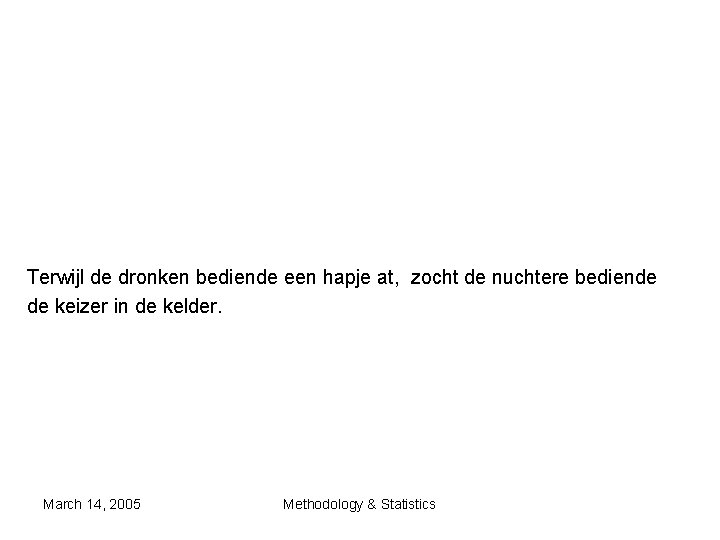
Terwijl de dronken bediende een hapje at, zocht de nuchtere bediende de keizer in de kelder. March 14, 2005 Methodology & Statistics
+ March 14, 2005 Methodology & Statistics
Wie March 14, 2005 Methodology & Statistics
heeft March 14, 2005 Methodology & Statistics
de keizer March 14, 2005 Methodology & Statistics
gezocht March 14, 2005 Methodology & Statistics
in de kelder? March 14, 2005 Methodology & Statistics
March 14, 2005 Methodology & Statistics
de nuchtere bediende March 14, 2005 Methodology & Statistics
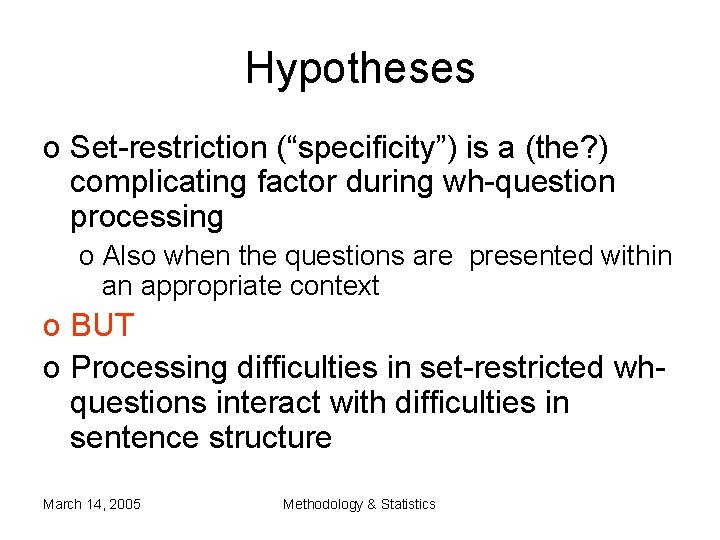
Hypotheses o Set-restriction (“specificity”) is a (the? ) complicating factor during wh-question processing o Also when the questions are presented within an appropriate context o BUT o Processing difficulties in set-restricted whquestions interact with difficulties in sentence structure March 14, 2005 Methodology & Statistics
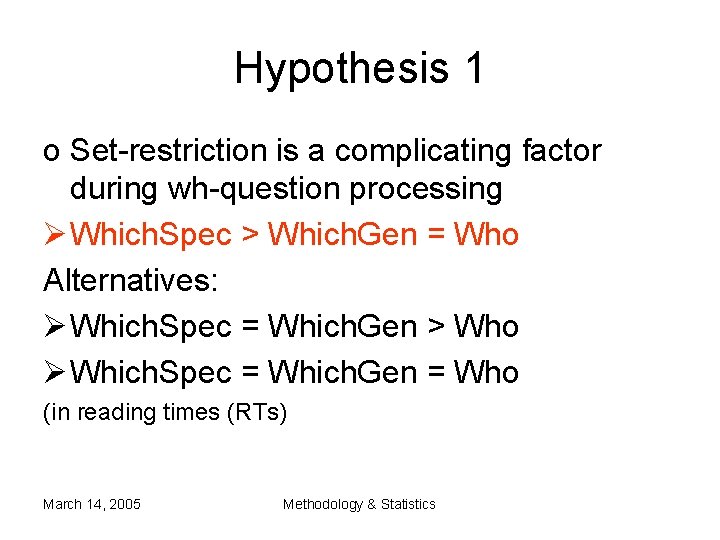
Hypothesis 1 o Set-restriction is a complicating factor during wh-question processing Ø Which. Spec > Which. Gen = Who Alternatives: Ø Which. Spec = Which. Gen > Who Ø Which. Spec = Which. Gen = Who (in reading times (RTs) March 14, 2005 Methodology & Statistics
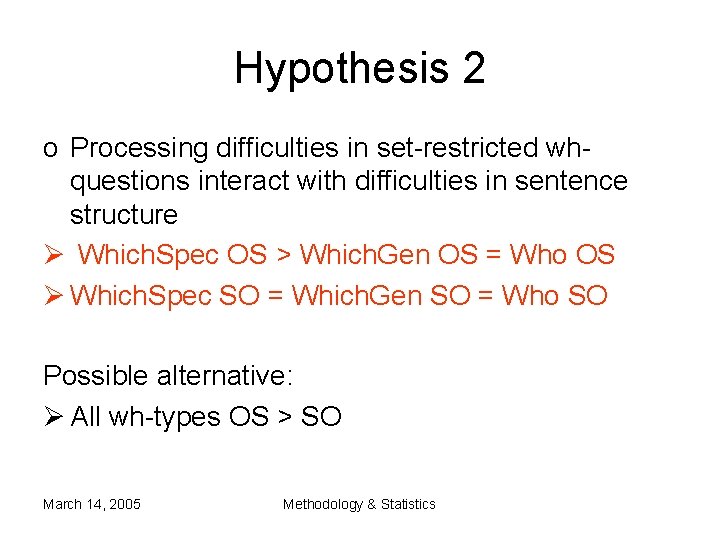
Hypothesis 2 o Processing difficulties in set-restricted whquestions interact with difficulties in sentence structure Ø Which. Spec OS > Which. Gen OS = Who OS Ø Which. Spec SO = Which. Gen SO = Who SO Possible alternative: Ø All wh-types OS > SO March 14, 2005 Methodology & Statistics
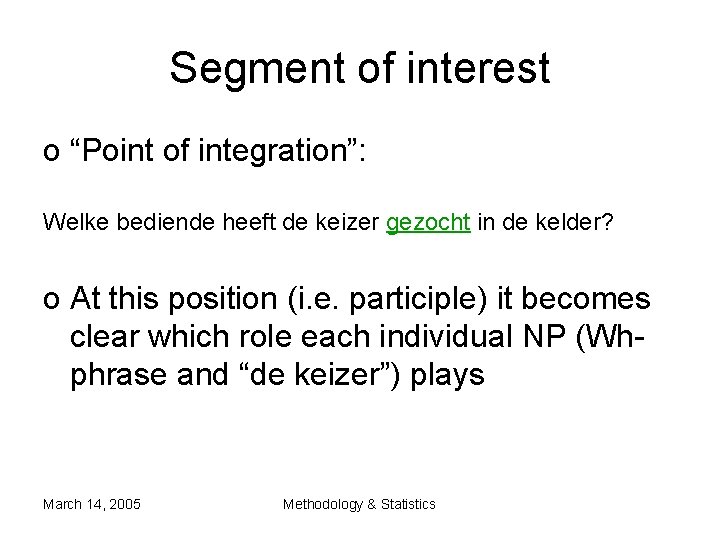
Segment of interest o “Point of integration”: Welke bediende heeft de keizer gezocht in de kelder? o At this position (i. e. participle) it becomes clear which role each individual NP (Whphrase and “de keizer”) plays March 14, 2005 Methodology & Statistics
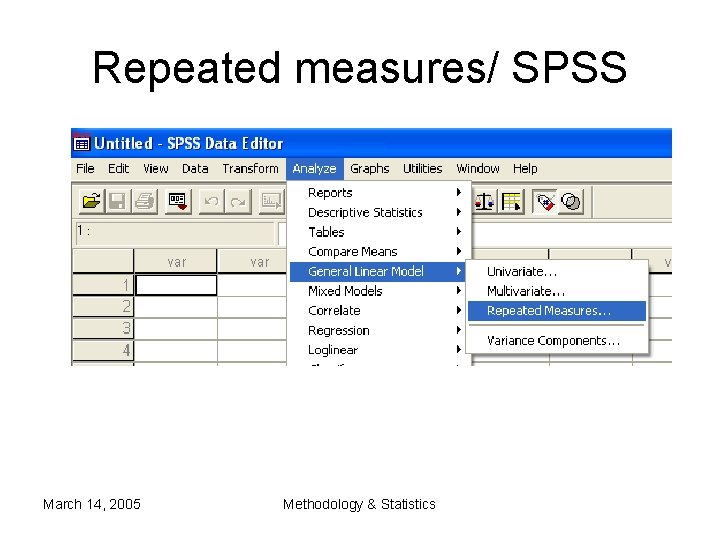
Repeated measures/ SPSS March 14, 2005 Methodology & Statistics
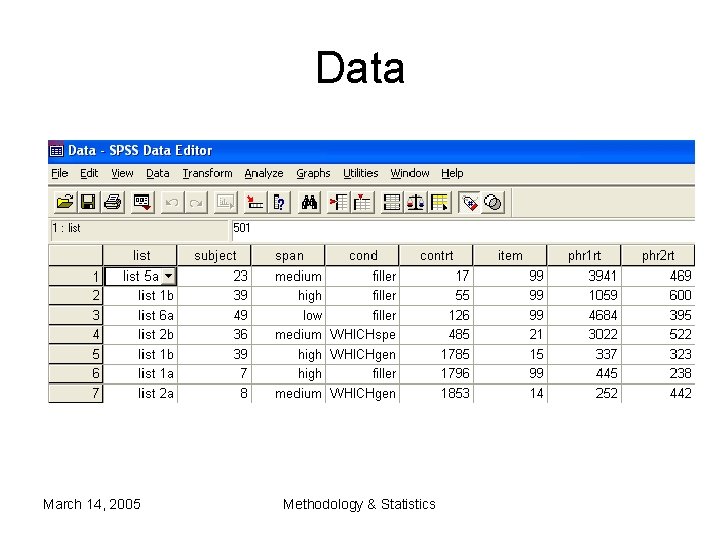
Data March 14, 2005 Methodology & Statistics
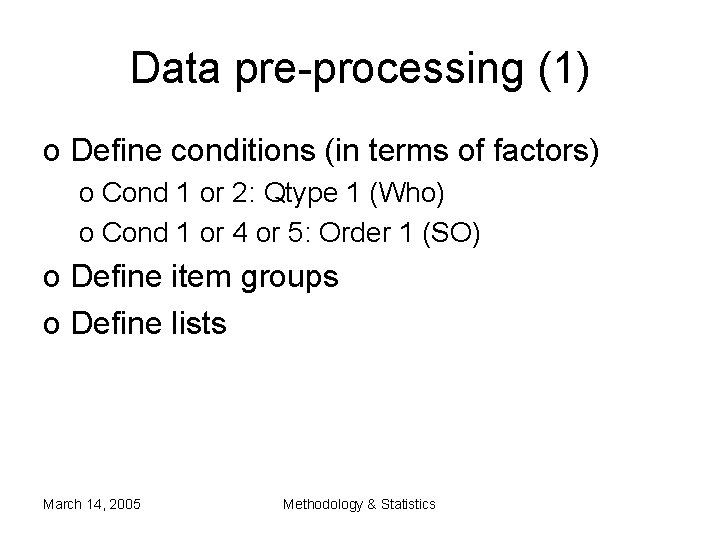
Data pre-processing (1) o Define conditions (in terms of factors) o Cond 1 or 2: Qtype 1 (Who) o Cond 1 or 4 or 5: Order 1 (SO) o Define item groups o Define lists March 14, 2005 Methodology & Statistics
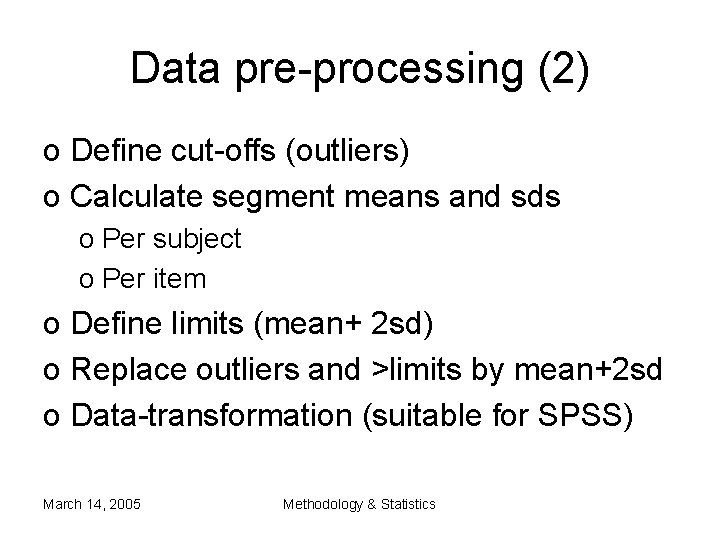
Data pre-processing (2) o Define cut-offs (outliers) o Calculate segment means and sds o Per subject o Per item o Define limits (mean+ 2 sd) o Replace outliers and >limits by mean+2 sd o Data-transformation (suitable for SPSS) March 14, 2005 Methodology & Statistics
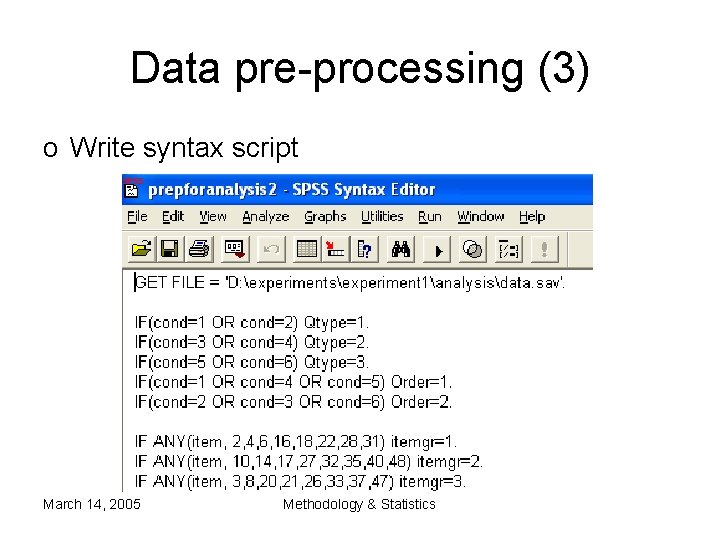
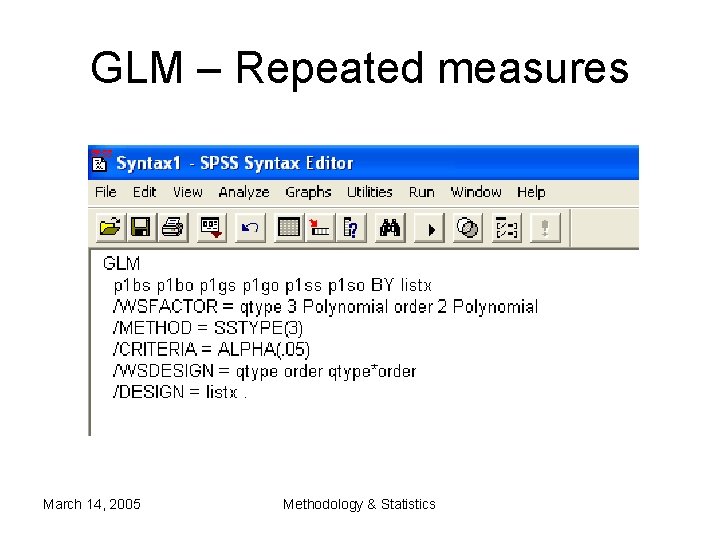
Data pre-processing (3) o Write syntax script March 14, 2005 Methodology & Statistics
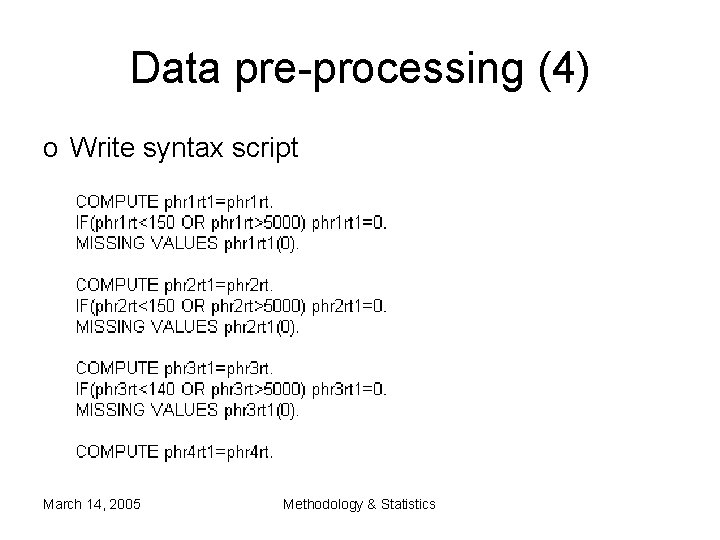
Data pre-processing (4) o Write syntax script March 14, 2005 Methodology & Statistics
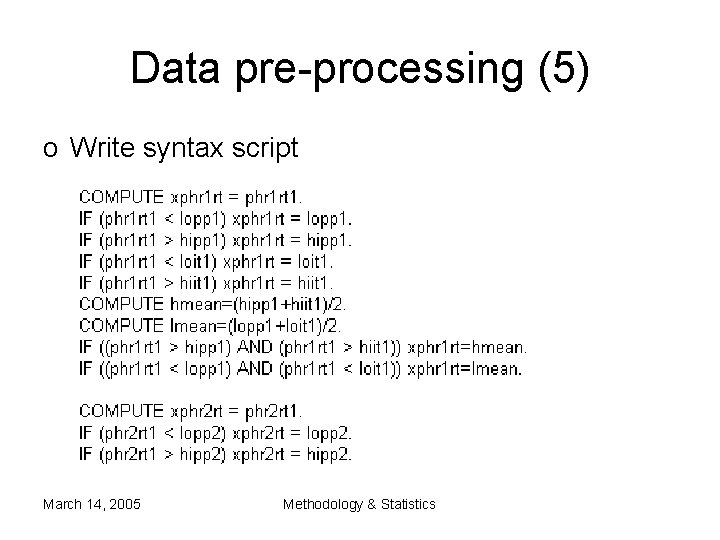
Data pre-processing (5) o Write syntax script March 14, 2005 Methodology & Statistics
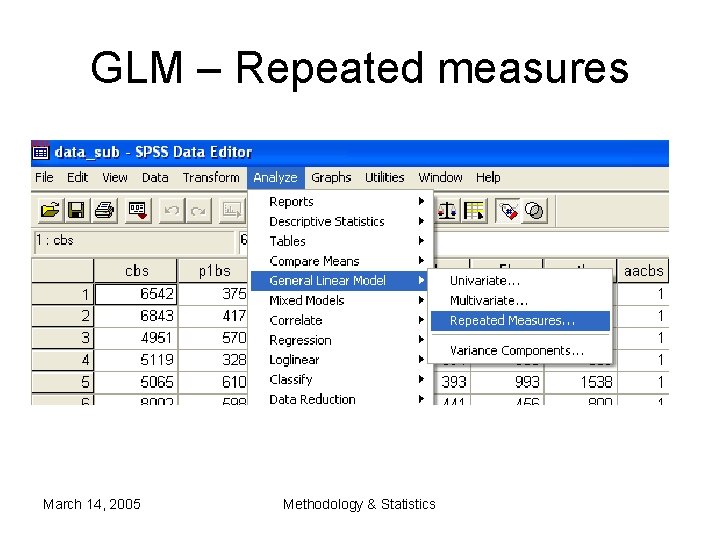
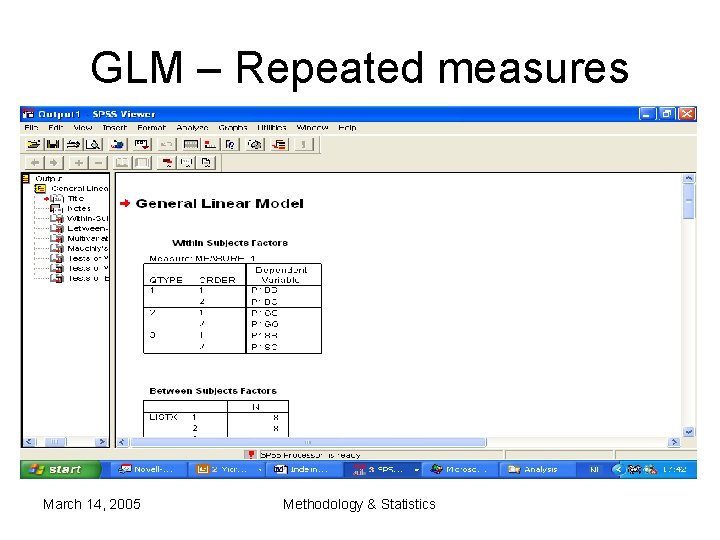
GLM – Repeated measures o SPSS data file with subject means o SPSS data file with item means March 14, 2005 Methodology & Statistics
GLM – Repeated measures March 14, 2005 Methodology & Statistics
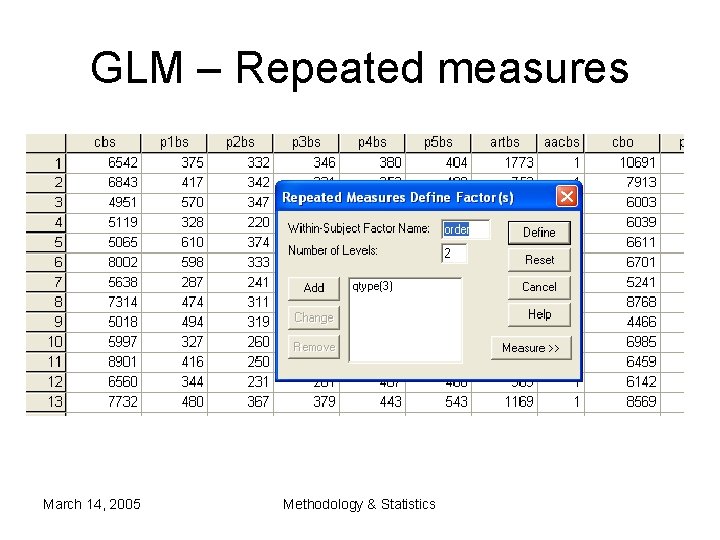
GLM – Repeated measures March 14, 2005 Methodology & Statistics
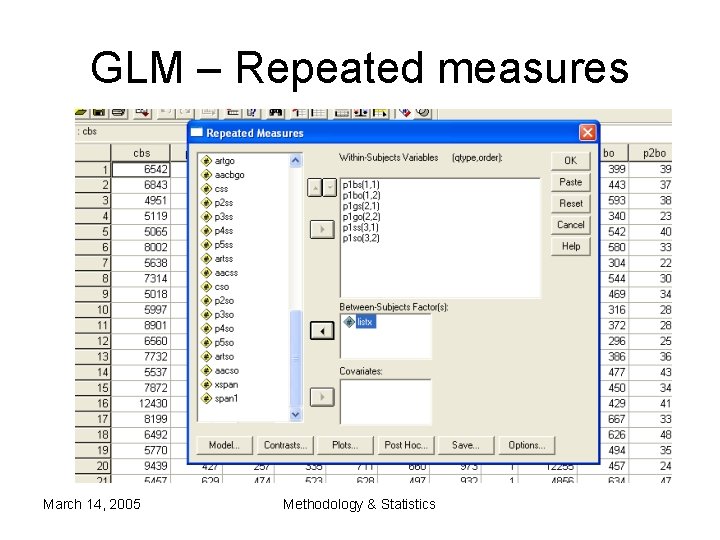
GLM – Repeated measures March 14, 2005 Methodology & Statistics
GLM – Repeated measures March 14, 2005 Methodology & Statistics
GLM – Repeated measures March 14, 2005 Methodology & Statistics
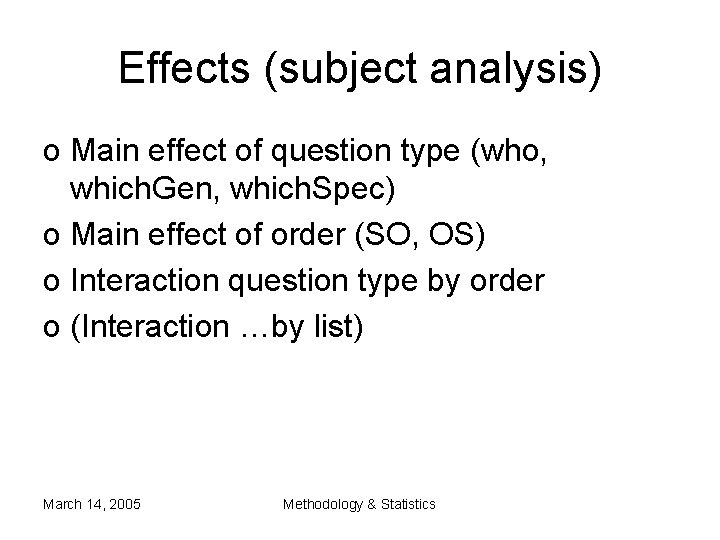
Effects (subject analysis) o Main effect of question type (who, which. Gen, which. Spec) o Main effect of order (SO, OS) o Interaction question type by order o (Interaction …by list) March 14, 2005 Methodology & Statistics
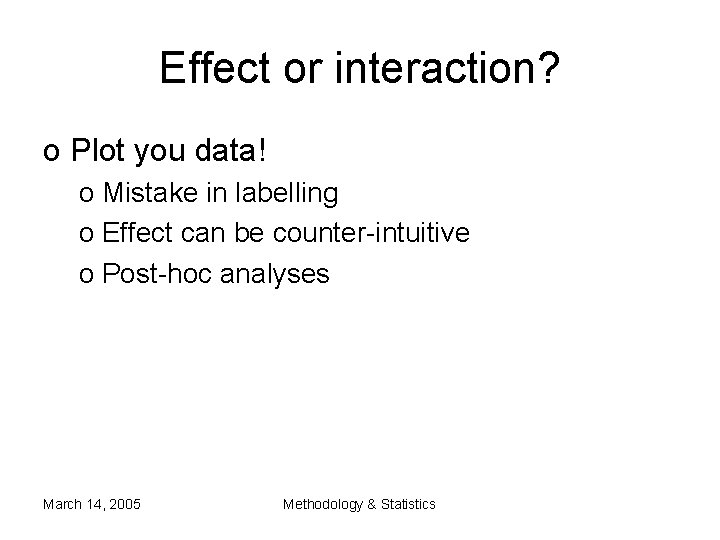
Effect or interaction? o Plot you data! o Mistake in labelling o Effect can be counter-intuitive o Post-hoc analyses March 14, 2005 Methodology & Statistics
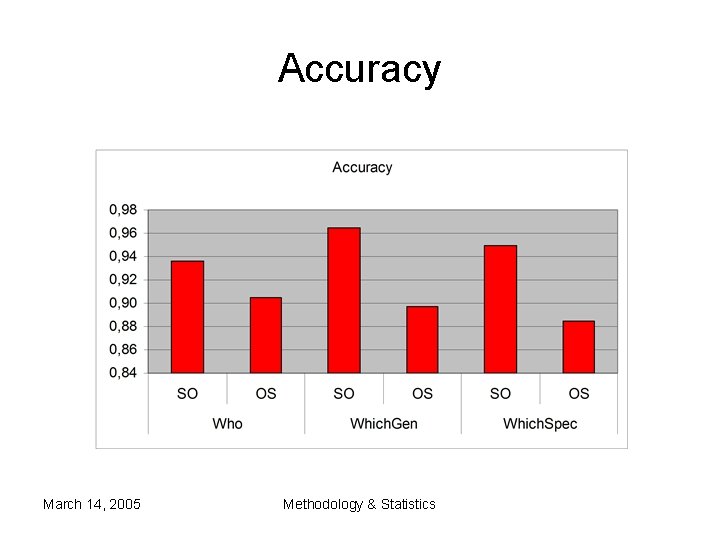
Accuracy March 14, 2005 Methodology & Statistics
Accuracy o The data suggest that answers following OS structures are more difficult to judge that those following SO questions. March 14, 2005 Methodology & Statistics
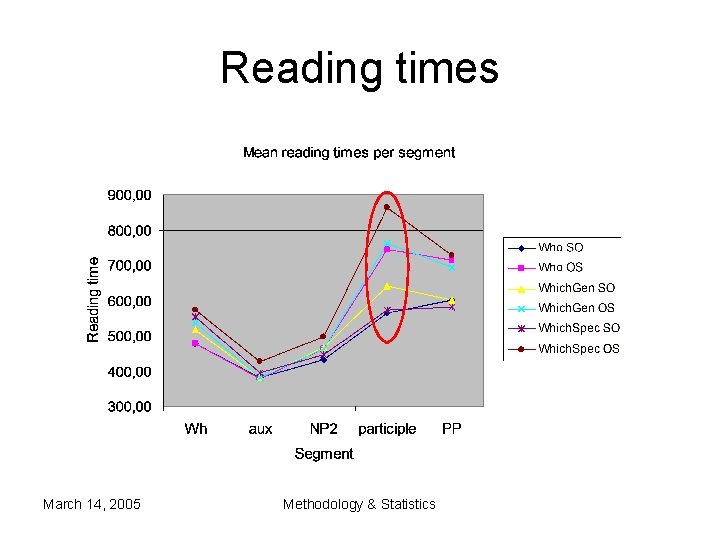
Reading times March 14, 2005 Methodology & Statistics
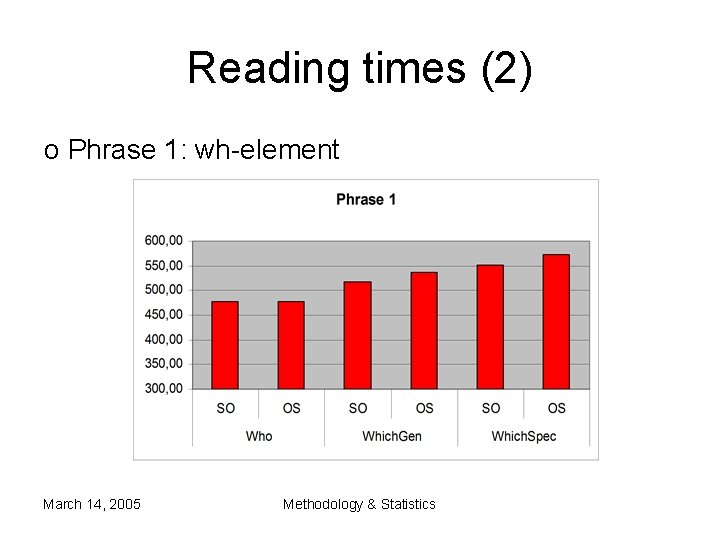
Reading times (2) o Phrase 1: wh-element March 14, 2005 Methodology & Statistics
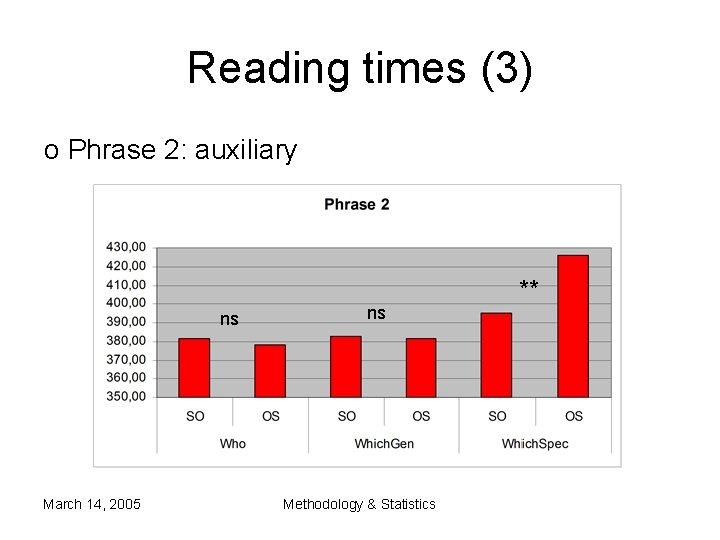
Reading times (3) o Phrase 2: auxiliary ** ns March 14, 2005 ns Methodology & Statistics
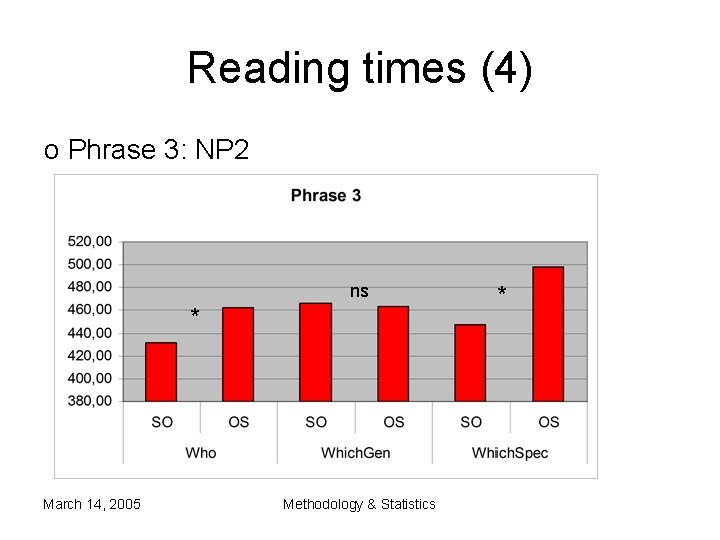
Reading times (4) o Phrase 3: NP 2 ns * March 14, 2005 Methodology & Statistics *
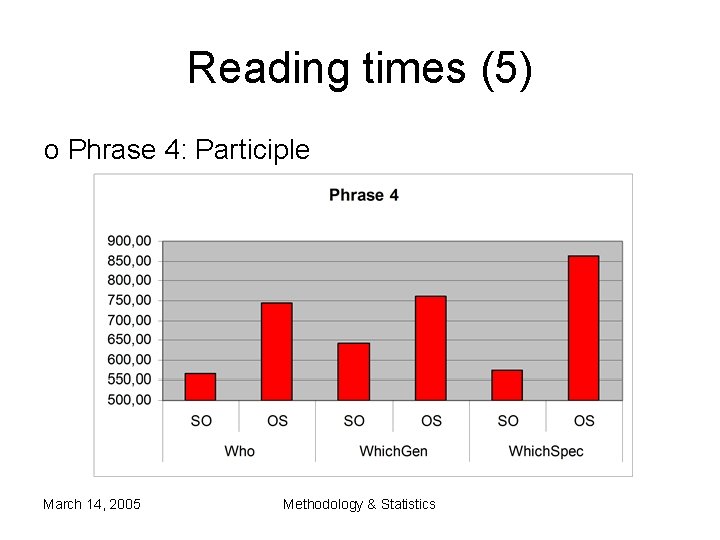
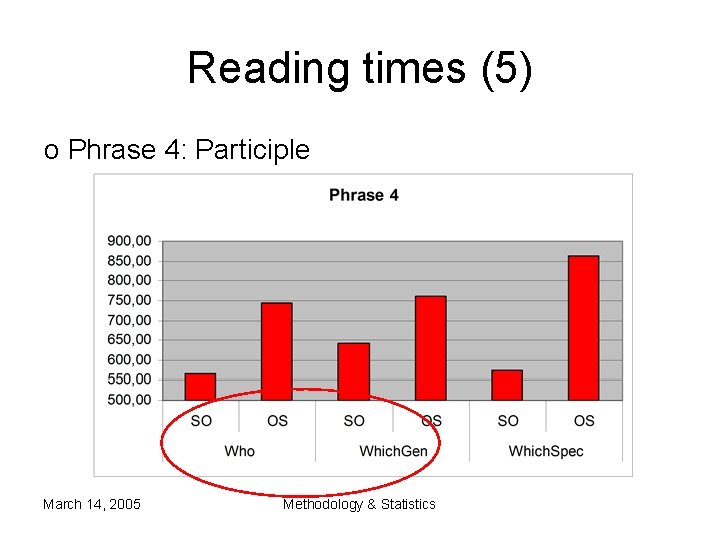
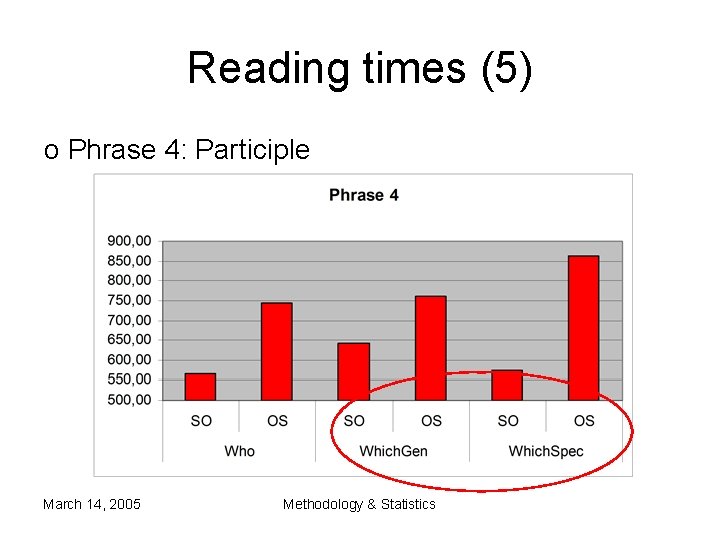
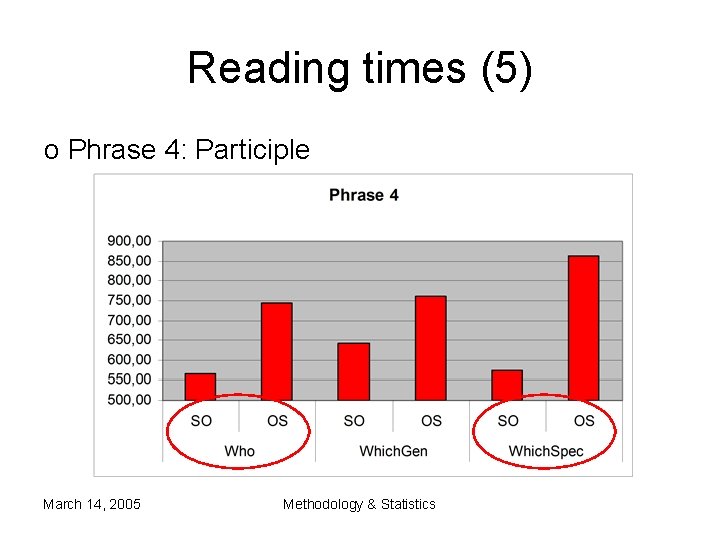
Reading times (5) o Phrase 4: Participle March 14, 2005 Methodology & Statistics
What do I want to know? o So the separate question types behave differently? o Is this connected to word order complexity? March 14, 2005 Methodology & Statistics
Reading times (5) o Phrase 4: Participle March 14, 2005 Methodology & Statistics
Reading times (5) o Phrase 4: Participle March 14, 2005 Methodology & Statistics
Reading times (5) o Phrase 4: Participle March 14, 2005 Methodology & Statistics
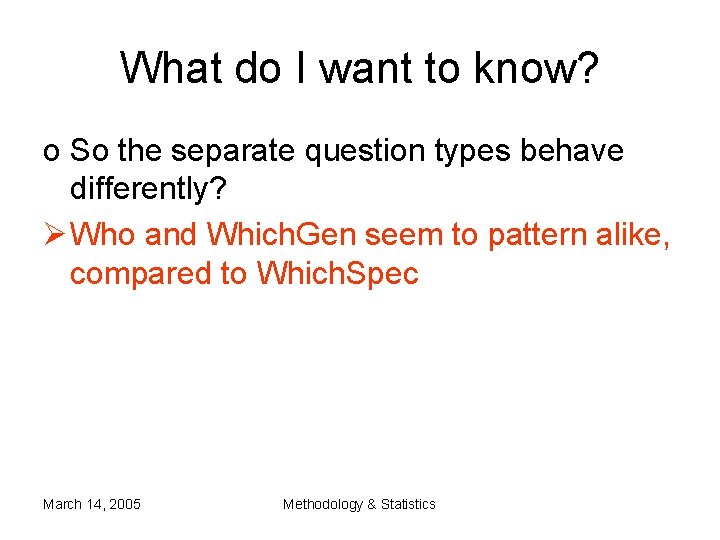
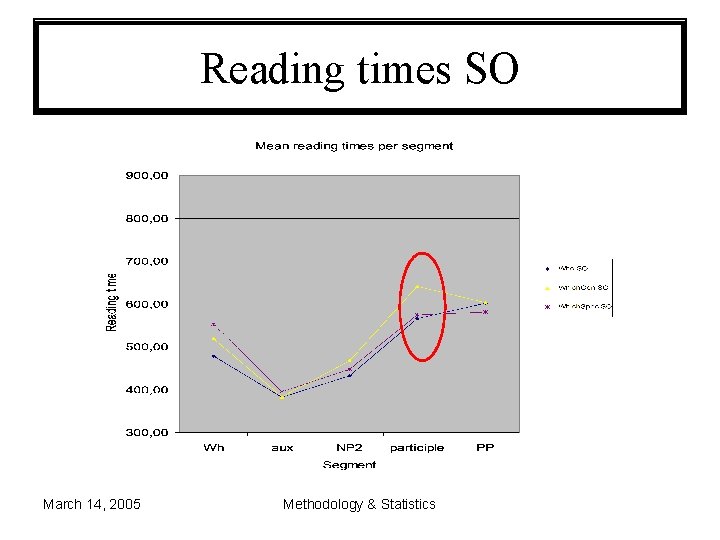
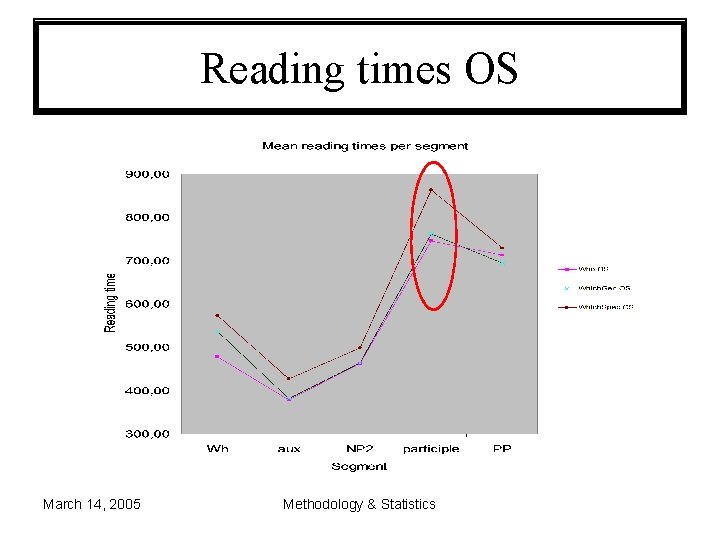
What do I want to know? o So the separate question types behave differently? Ø Who and Which. Gen seem to pattern alike, compared to Which. Spec March 14, 2005 Methodology & Statistics
Reading times SO March 14, 2005 Methodology & Statistics
Reading times OS March 14, 2005 Methodology & Statistics
What do I want to know? o Is a different pattern for the Which. Spec condition only connected to word order complexity? Ø The increased reading times for Which. Spec are confined to the OS structure-conditions. In SO conditions the average reading times were comparable. March 14, 2005 Methodology & Statistics
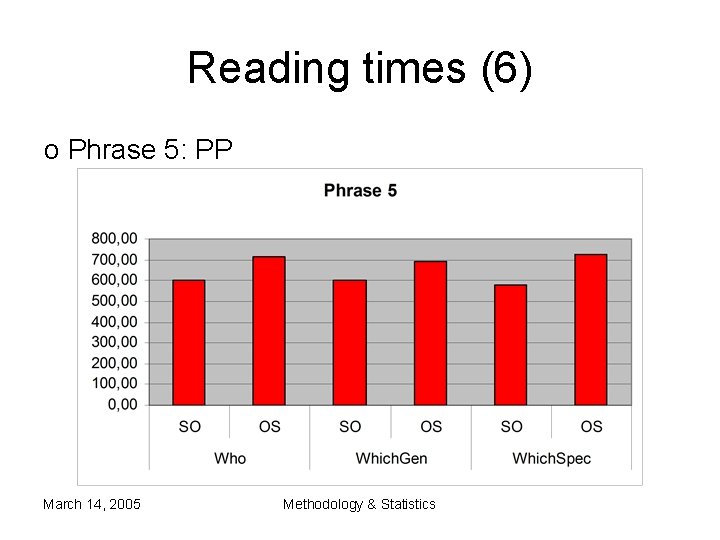
Reading times (6) o Phrase 5: PP March 14, 2005 Methodology & Statistics