
Another Randomized Algorithm Freivalds Algorithm for Matrix Multiplication
- Slides: 8
Another Randomized Algorithm Freivalds’ Algorithm for Matrix Multiplication
Randomized Algorithms • Quicksort makes effective use of random numbers, but is no faster than Mergesort or Heapsort. • Here we will see a problem that has a simple randomized algorithm faster than any known deterministic solution.
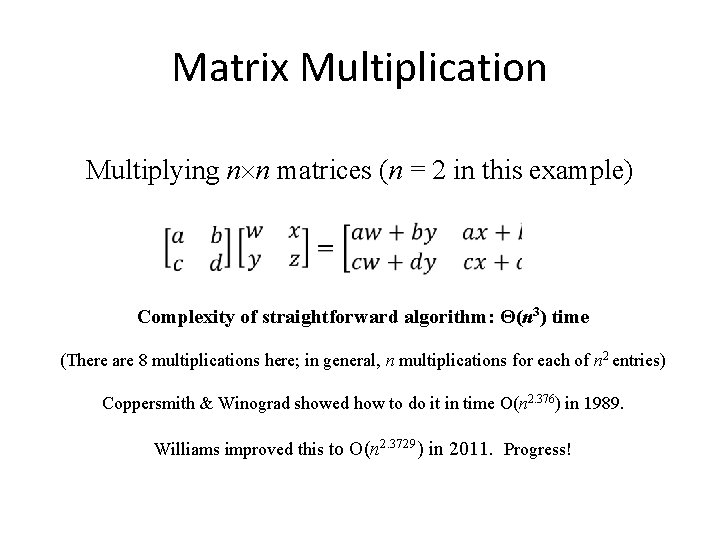
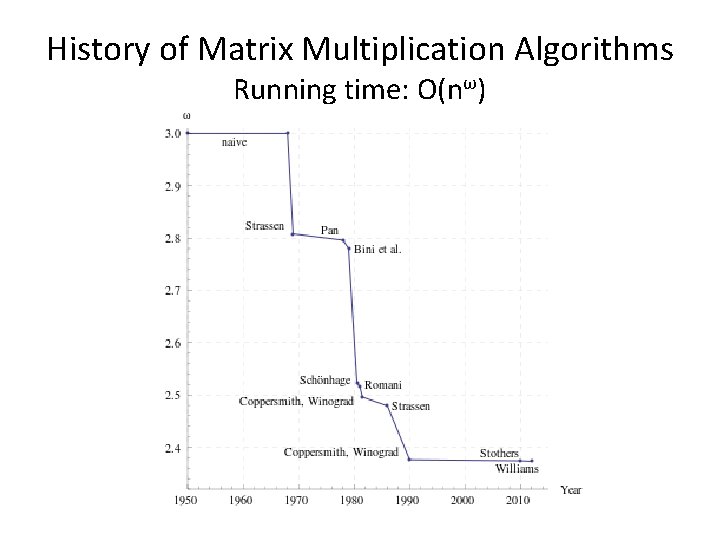
Matrix Multiplication Multiplying n n matrices (n = 2 in this example) • Complexity of straightforward algorithm: Θ(n 3) time (There are 8 multiplications here; in general, n multiplications for each of n 2 entries) Coppersmith & Winograd showed how to do it in time O(n 2. 376) in 1989. Williams improved this to O(n 2. 3729) in 2011. Progress!
History of Matrix Multiplication Algorithms Running time: O(nω)
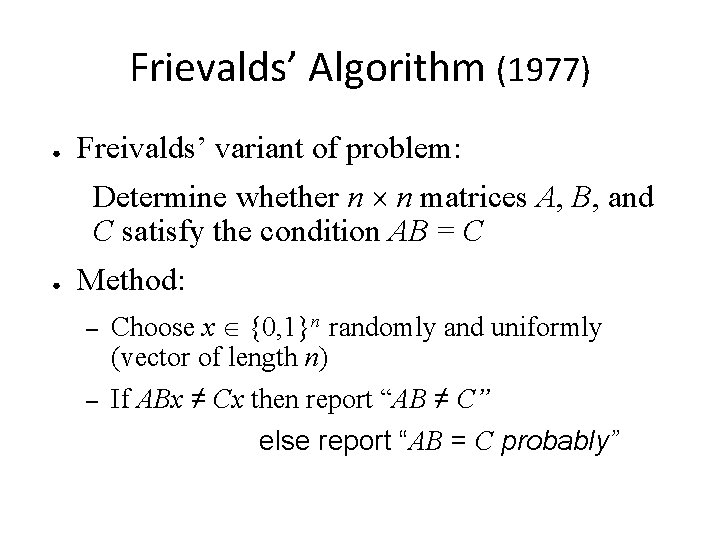
Frievalds’ Algorithm (1977) ● Freivalds’ variant of problem: Determine whether n n matrices A, B, and C satisfy the condition AB = C ● Method: – – Choose x {0, 1}n randomly and uniformly (vector of length n) If ABx ≠ Cx then report “AB ≠ C” else report “AB = C probably”
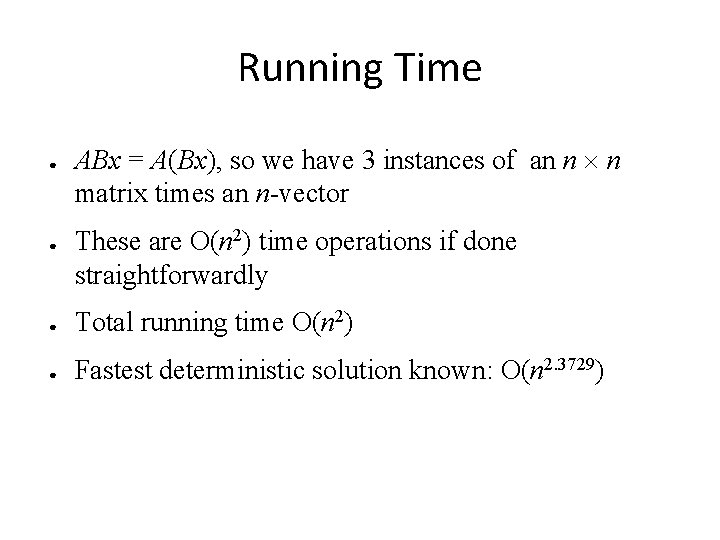
Running Time ● ● ABx = A(Bx), so we have 3 instances of an n n matrix times an n-vector These are O(n 2) time operations if done straightforwardly ● Total running time O(n 2) ● Fastest deterministic solution known: O(n 2. 3729)
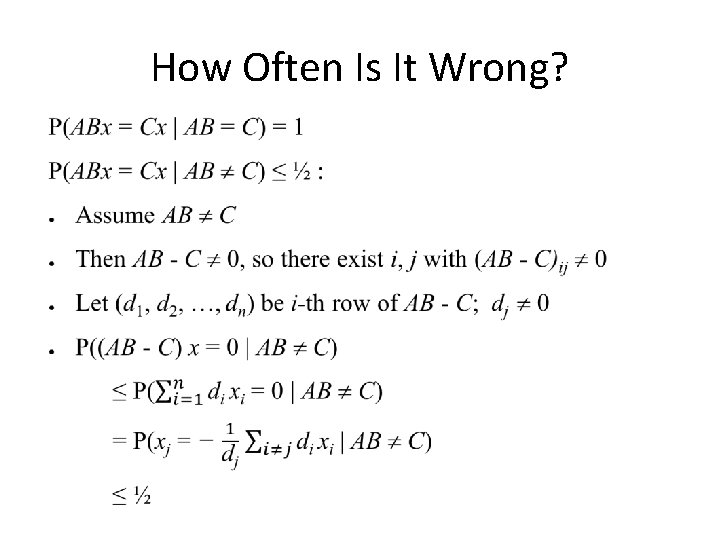
How Often Is It Wrong? •
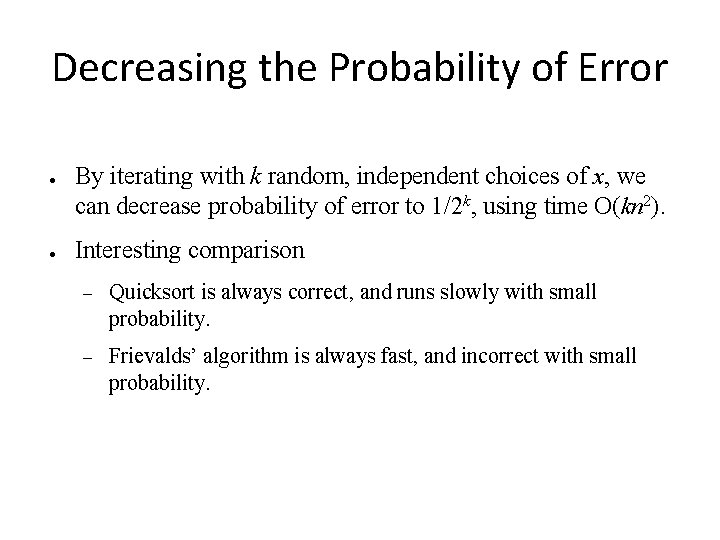
Decreasing the Probability of Error ● ● By iterating with k random, independent choices of x, we can decrease probability of error to 1/2 k, using time O(kn 2). Interesting comparison – Quicksort is always correct, and runs slowly with small probability. – Frievalds’ algorithm is always fast, and incorrect with small probability.