
Another Modular Focal Plane Part 1 Submodules Bruce
Another Modular Focal Plane: Part 1 – Sub-modules Bruce C. Bigelow University of Michigan Department of Physics 5/17/04
Focal Plane Sub-modules Motivations: § install/remove single detectors from “front” of FP § assemble detectors in modules of 3 x 3 Ø simplify assembly, integration, and test Ø reduce part counts, simplify part design Ø simplify part fabrication Ø individual module thermal control (Vis vs. IR) Ø optimize materials for detector packages (CTE) § local, discrete control of focal plane surface height § minimize mechanical mass § minimize thermal time constants § minimize gravity deflections for ground testing § maximize resonant frequencies 2
Focal Plane Sub-modules Requirements: § final focal plane flatness: +/- 25 microns § support different optimal temperatures for Vis and IR § detector temperature stability +/- 1 K § high stiffness – high first resonance 3

Focal Plane Sub-modules This talk: § sub-module designs § sub-module FEA 4
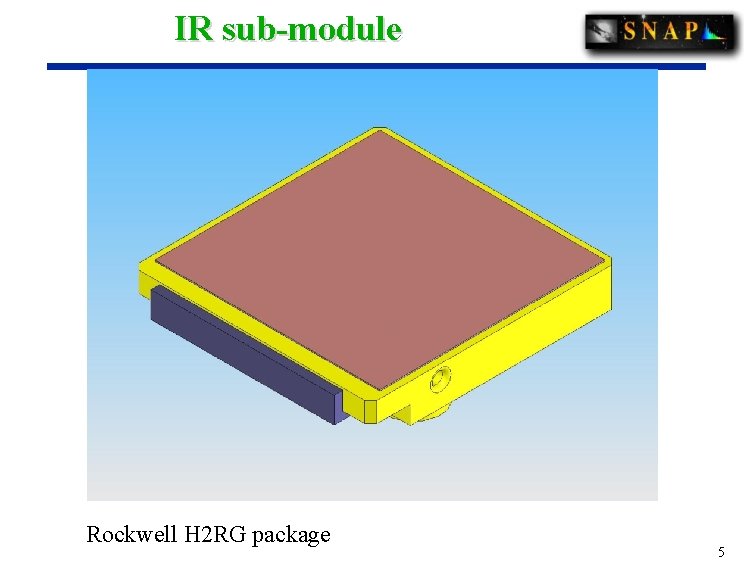
IR sub-module Rockwell H 2 RG package 5
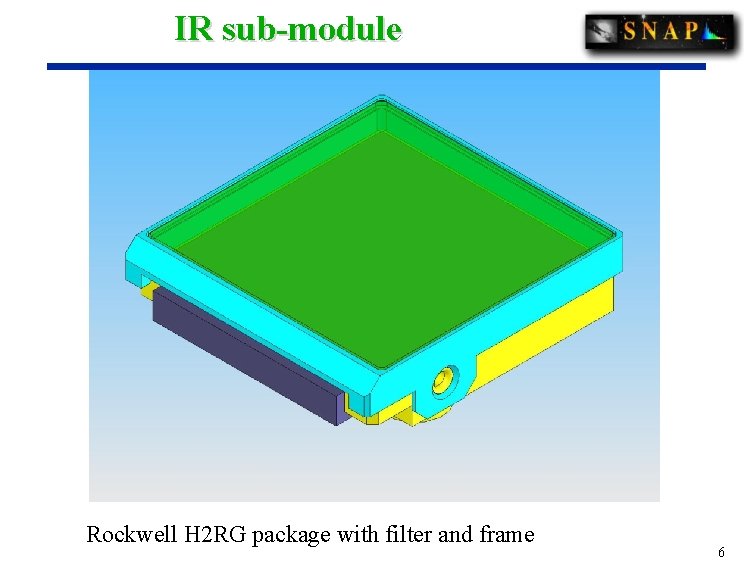
IR sub-module Rockwell H 2 RG package with filter and frame 6
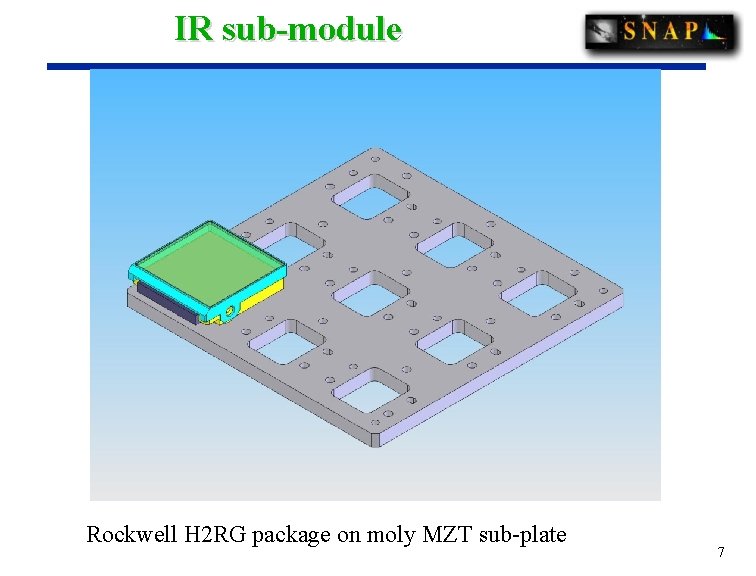
IR sub-module Rockwell H 2 RG package on moly MZT sub-plate 7
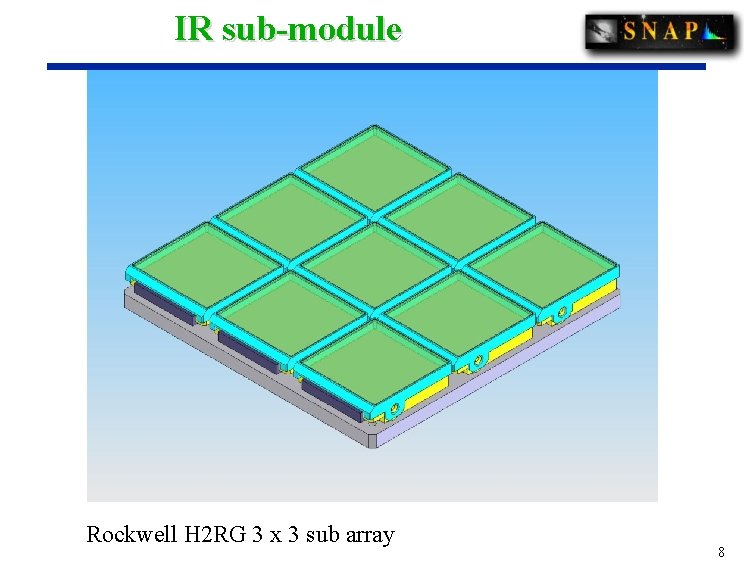
IR sub-module Rockwell H 2 RG 3 x 3 sub array 8
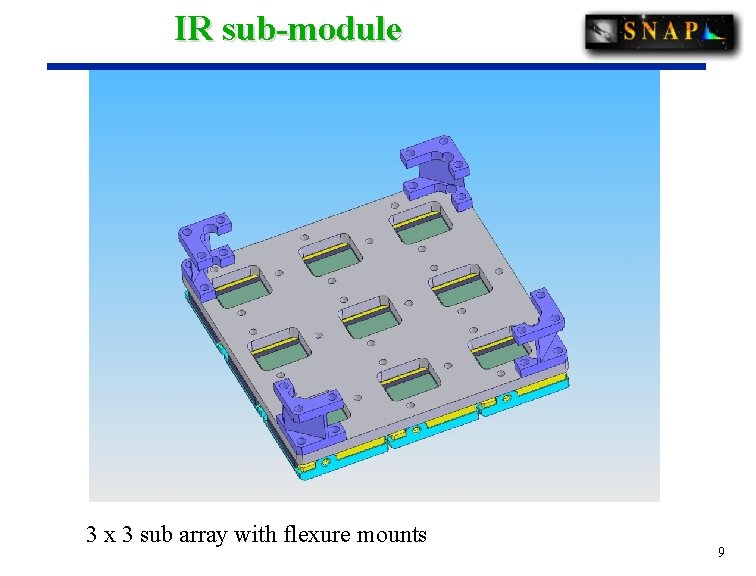
IR sub-module 3 x 3 sub array with flexure mounts 9
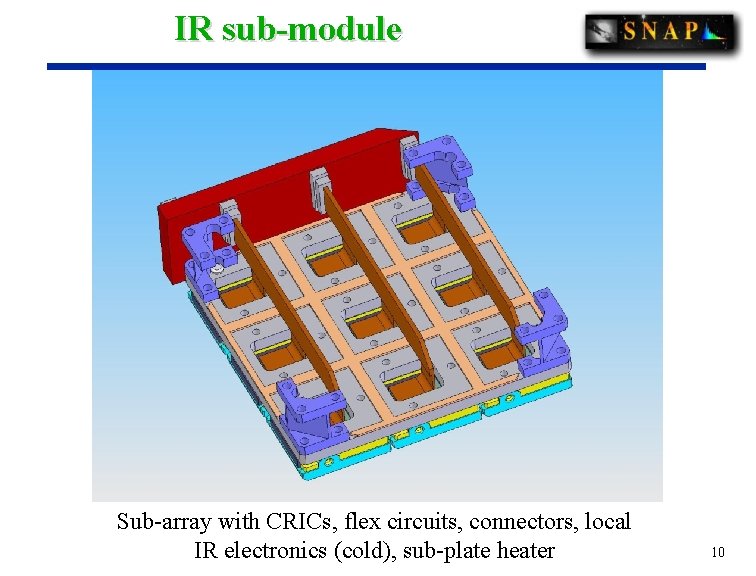
IR sub-module Sub-array with CRICs, flex circuits, connectors, local IR electronics (cold), sub-plate heater 10
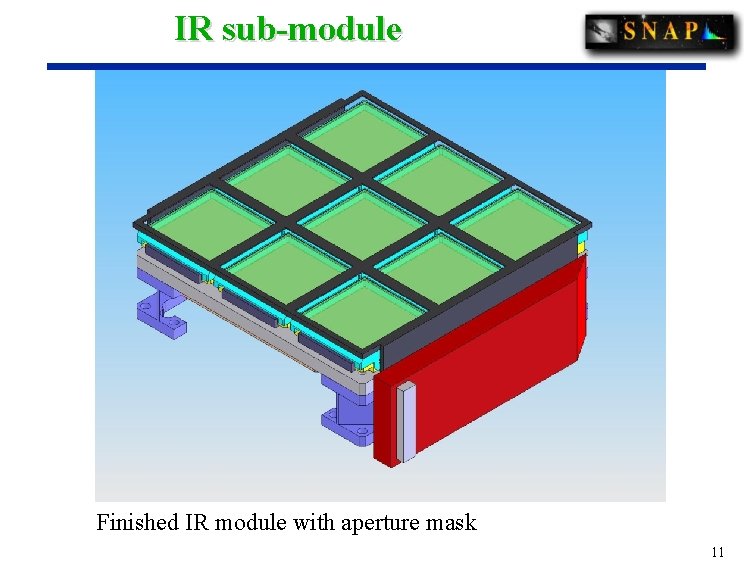
IR sub-module Finished IR module with aperture mask 11
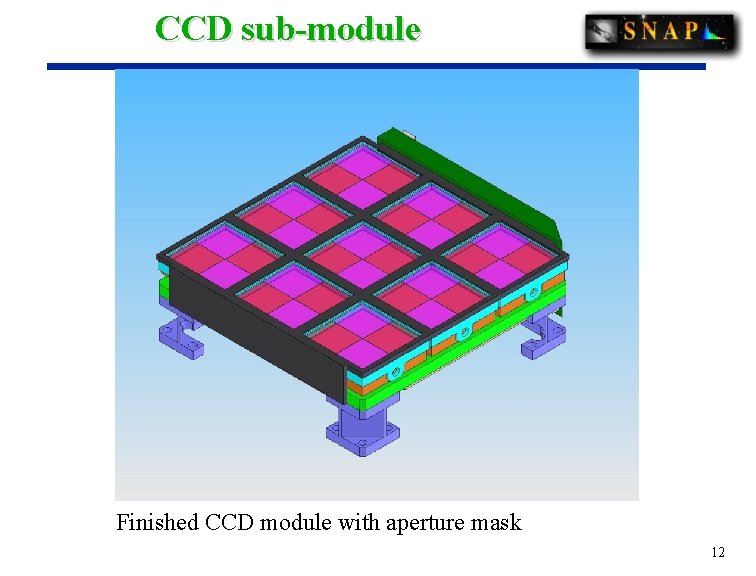
CCD sub-module Finished CCD module with aperture mask 12
Sub-module FEA FE Analyses: § Static analysis – gravity deflections Ø package mass modeled by doubling sub-plate density Ø moly packages and sub-plate, invar flexures Ø omit package cutouts, mounting holes, etc. Ø focal plane axis vertical and horizontal 13
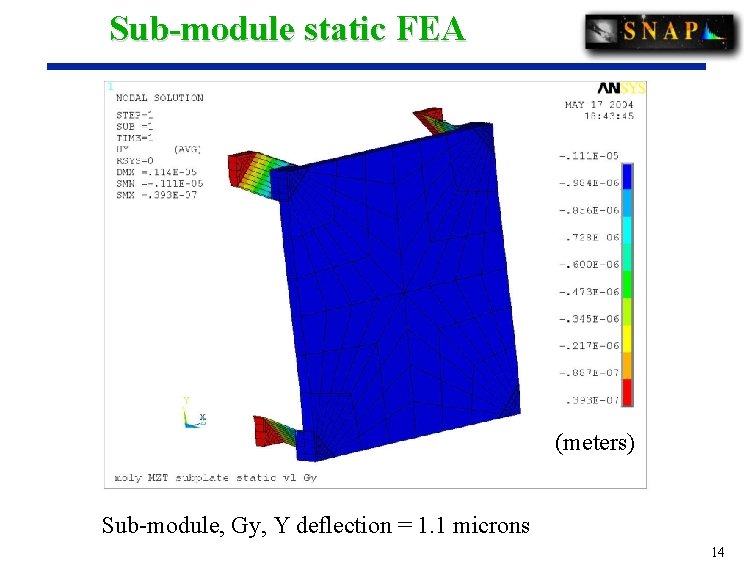
Sub-module static FEA (meters) Sub-module, Gy, Y deflection = 1. 1 microns 14
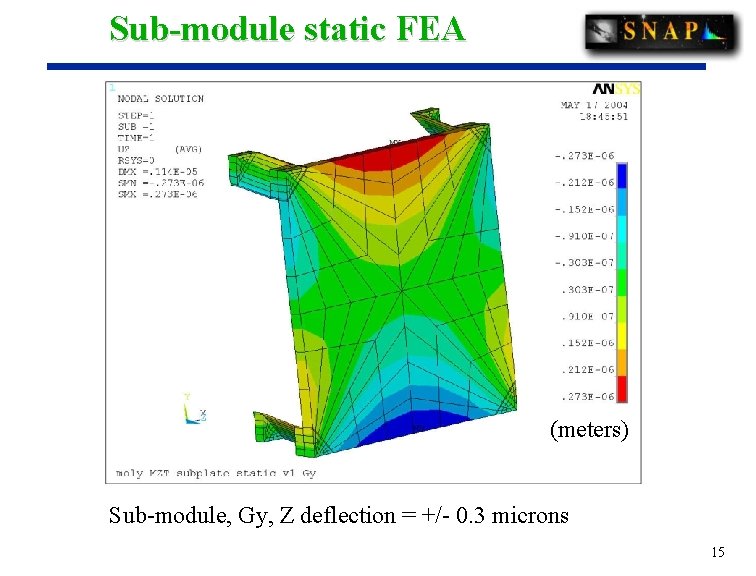
Sub-module static FEA (meters) Sub-module, Gy, Z deflection = +/- 0. 3 microns 15
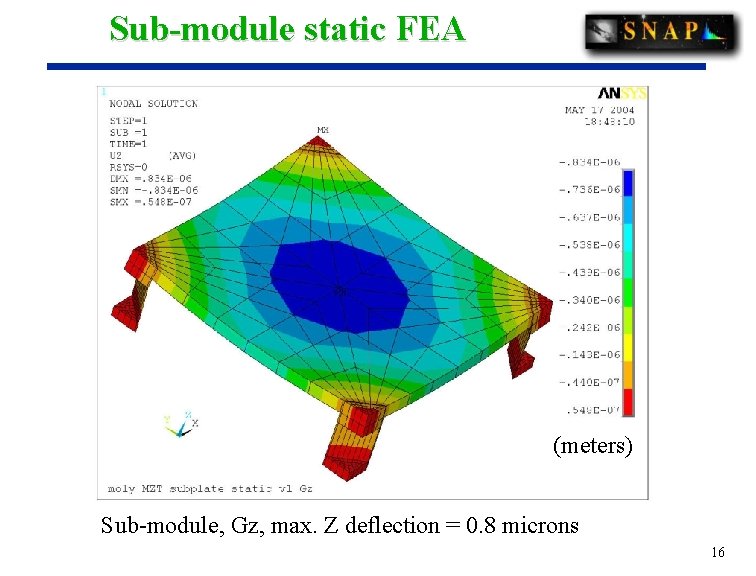
Sub-module static FEA (meters) Sub-module, Gz, max. Z deflection = 0. 8 microns 16
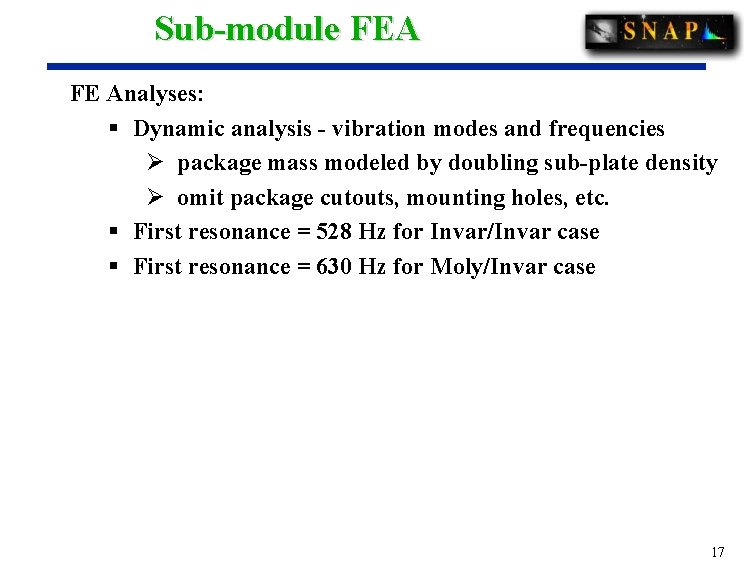
Sub-module FEA FE Analyses: § Dynamic analysis - vibration modes and frequencies Ø package mass modeled by doubling sub-plate density Ø omit package cutouts, mounting holes, etc. § First resonance = 528 Hz for Invar/Invar case § First resonance = 630 Hz for Moly/Invar case 17
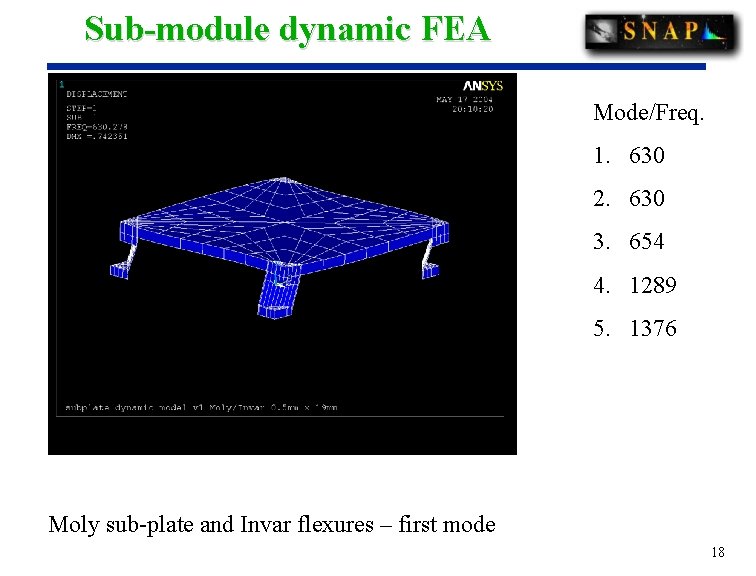
Sub-module dynamic FEA Mode/Freq. 1. 630 2. 630 3. 654 4. 1289 5. 1376 Moly sub-plate and Invar flexures – first mode 18
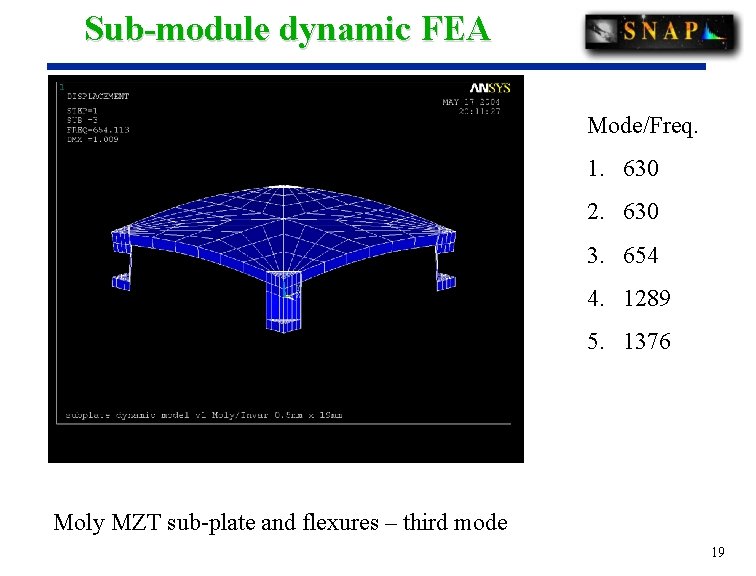
Sub-module dynamic FEA Mode/Freq. 1. 630 2. 630 3. 654 4. 1289 5. 1376 Moly MZT sub-plate and flexures – third mode 19
Sub-module thermal FEA § Thermal analysis – stress and distortion Ø omit package cutouts, mounting holes, etc. Ø omit package mass, stiffness Ø -160 K temperature shift Ø static, isothermal analysis Ø no effort yet to optimize flexure design Ø no effort yet to optimize stiffness of sub-plate 20
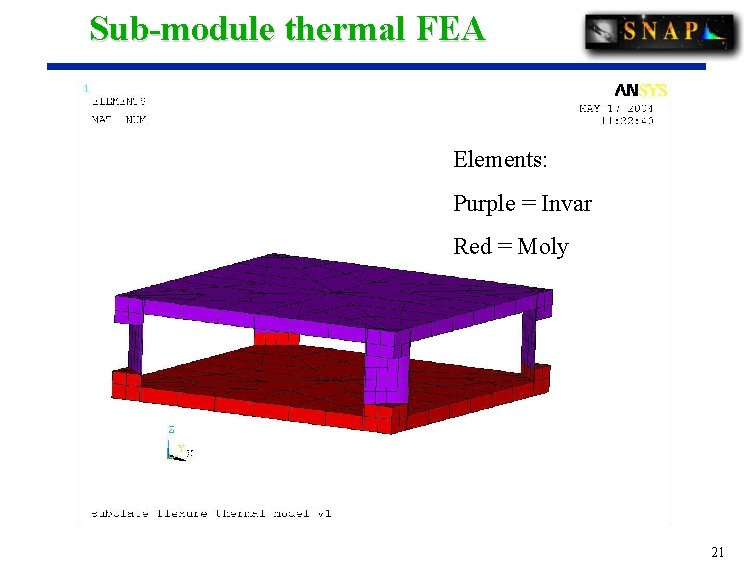
Sub-module thermal FEA Elements: Purple = Invar Red = Moly 21
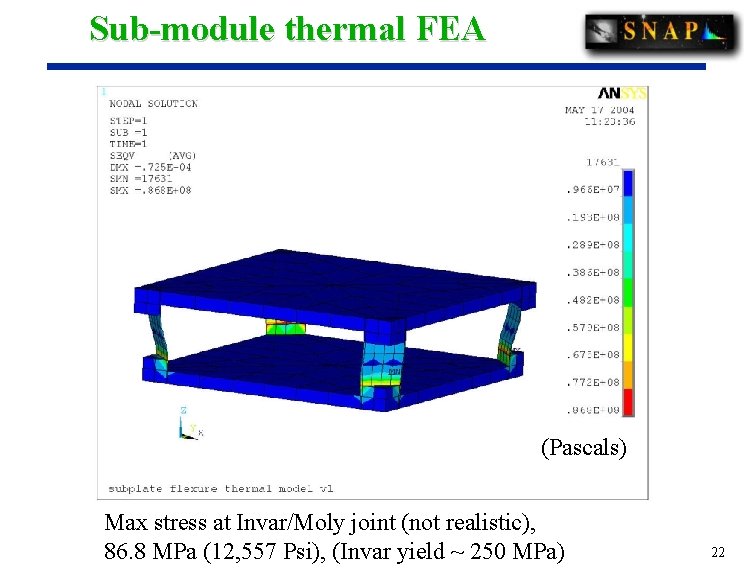
Sub-module thermal FEA Purple = (Pascals) invar Red = moly Max stress at Invar/Moly joint (not realistic), 86. 8 MPa (12, 557 Psi), (Invar yield ~ 250 MPa) 22
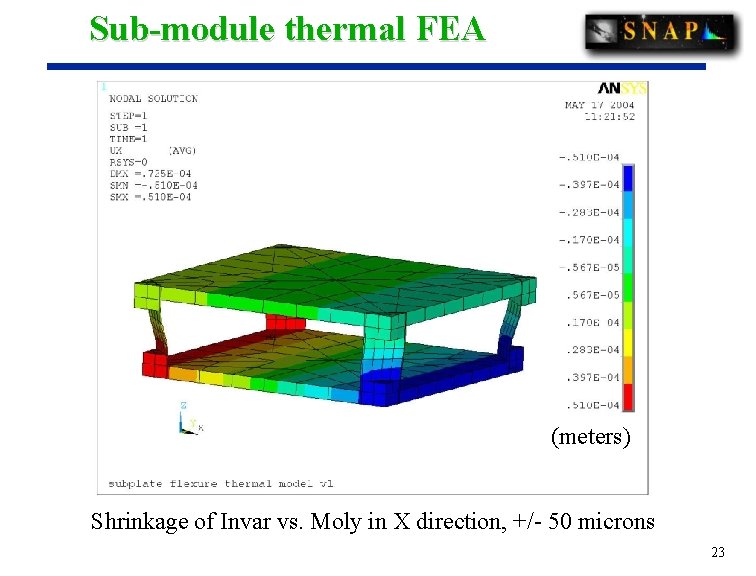
Sub-module thermal FEA (meters) Purple = invar Red = moly Shrinkage of Invar vs. Moly in X direction, +/- 50 microns 23
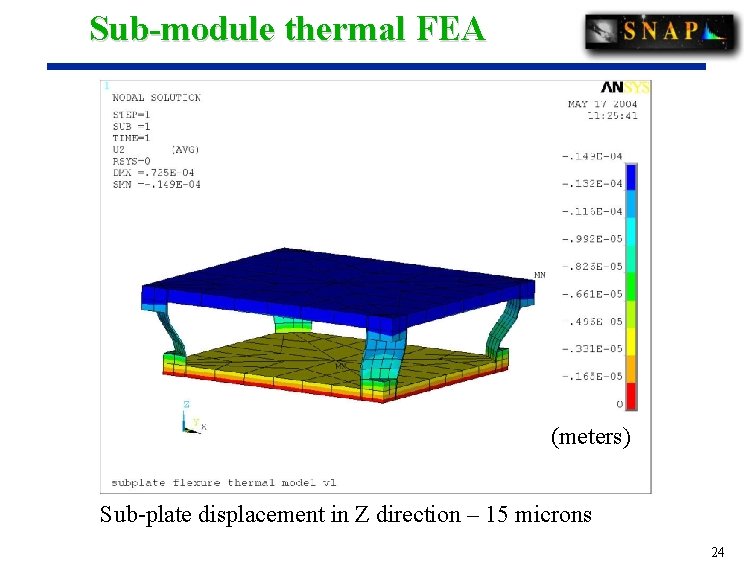
Sub-module thermal FEA (meters) Purple = invar Red = moly Sub-plate in Z direction – 15 microns Shrinkagedisplacement of Invar vs. Moly in X direction 24
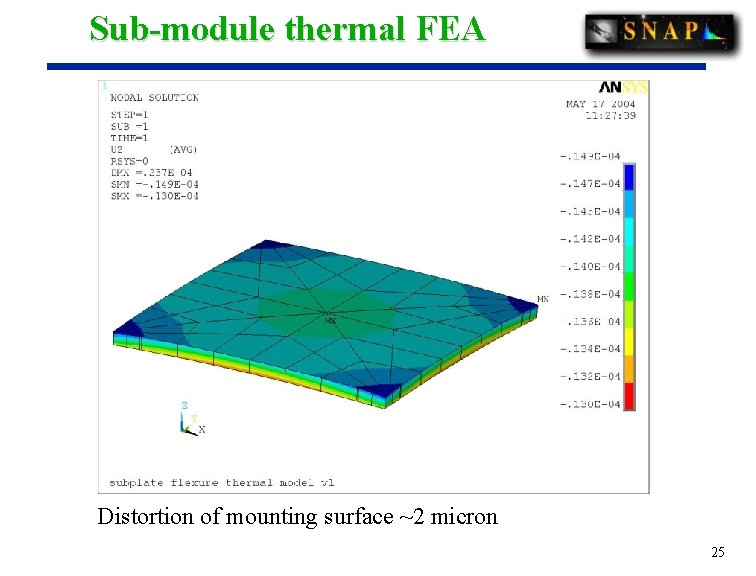
Sub-module thermal FEA (meters) Purple = invar Red = moly Sub-plate in Z direction – 15 microns Distortion of surface micron Shrinkagedisplacement ofmounting Invar vs. Moly in~2 X direction 25
FP sub-modules Conclusions: Ø sub-module designs for Vis and IR developed • detector packages • filters with mounts • sub-plate mounting flexures • electrical connectors, junction boxes Ø FEA demonstrates stiffness, high resonant freq. Ø FEA demonstrates acceptable thermal performance 26
- Slides: 26