
Another inheritance example Lets define a Student as
![An array of Persons using Person in main( ): int size = 10; Person[]](https://slidetodoc.com/presentation_image_h2/272917e0b94d097db566902866648bd0/image-2.jpg "An array of Persons using Person in main( ): int size = 10; Person[]")
- Slides: 14
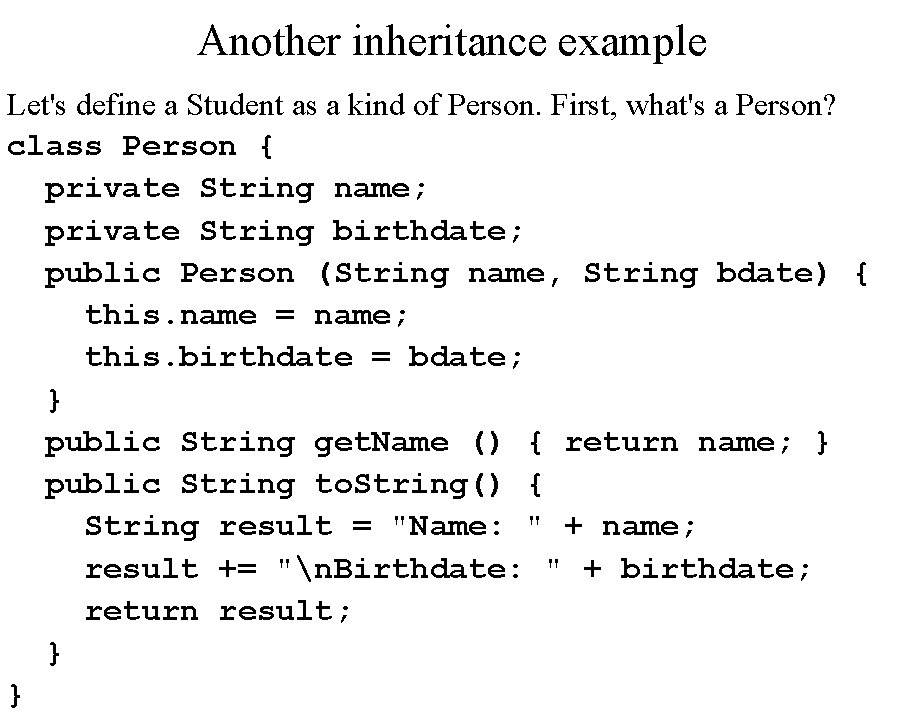
Another inheritance example Let's define a Student as a kind of Person. First, what's a Person? class Person { private String name; private String birthdate; public Person (String name, String bdate) { this. name = name; this. birthdate = bdate; } public String get. Name () { return name; } public String to. String() { String result = "Name: " + name; result += "n. Birthdate: " + birthdate; return result; } }
An array of Persons using Person in main( ): int size = 10; Person[] list = new Person[size]; for (int i = 0; i < list. length; i++) { String name = in. read. Line(); String bdate = in. read. Line(); list[i] = new Person(name, bdate); } for (int i = 0; i < list. length; i++) System. out. println(list[i]);
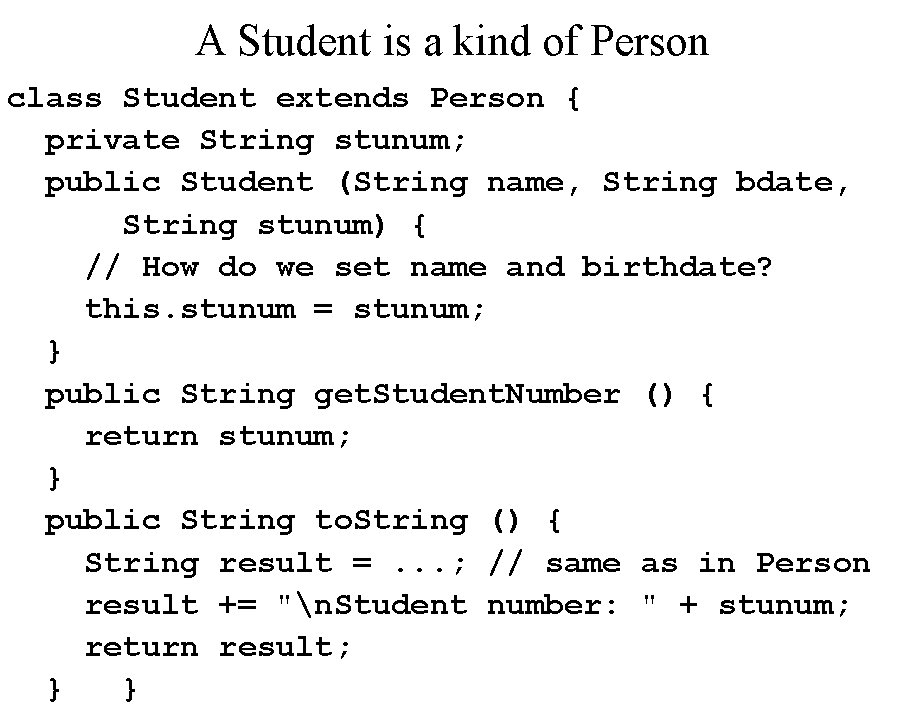
A Student is a kind of Person class Student extends Person { private String stunum; public Student (String name, String bdate, String stunum) { // How do we set name and birthdate? this. stunum = stunum; } public String get. Student. Number () { return stunum; } public String to. String () { String result =. . . ; // same as in Person result += "n. Student number: " + stunum; return result; } }
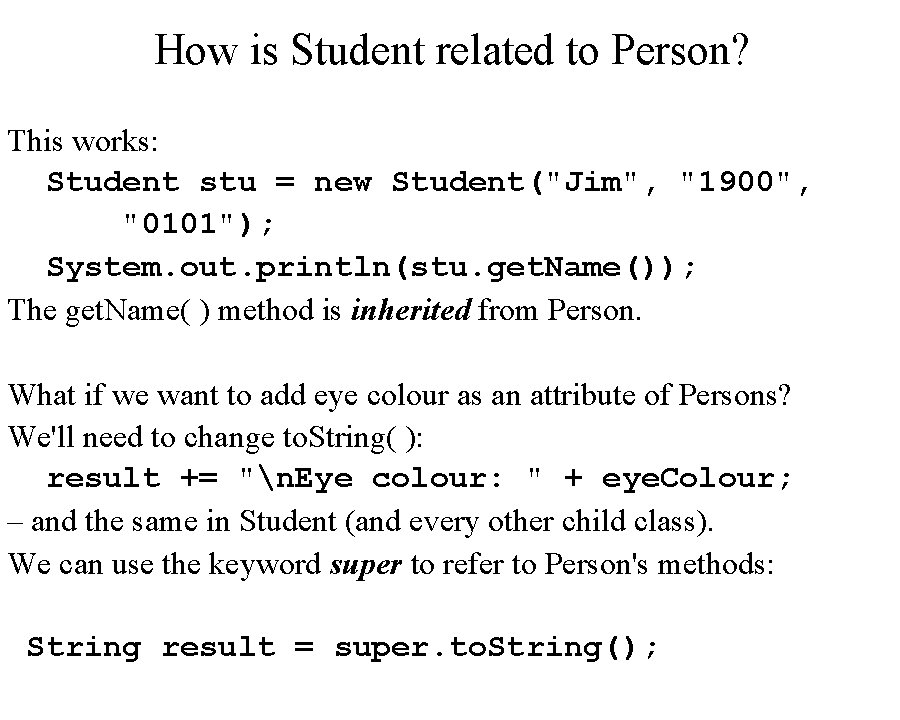
How is Student related to Person? This works: Student stu = new Student("Jim", "1900", "0101"); System. out. println(stu. get. Name()); The get. Name( ) method is inherited from Person. What if we want to add eye colour as an attribute of Persons? We'll need to change to. String( ): result += "n. Eye colour: " + eye. Colour; – and the same in Student (and every other child class). We can use the keyword super to refer to Person's methods: String result = super. to. String();
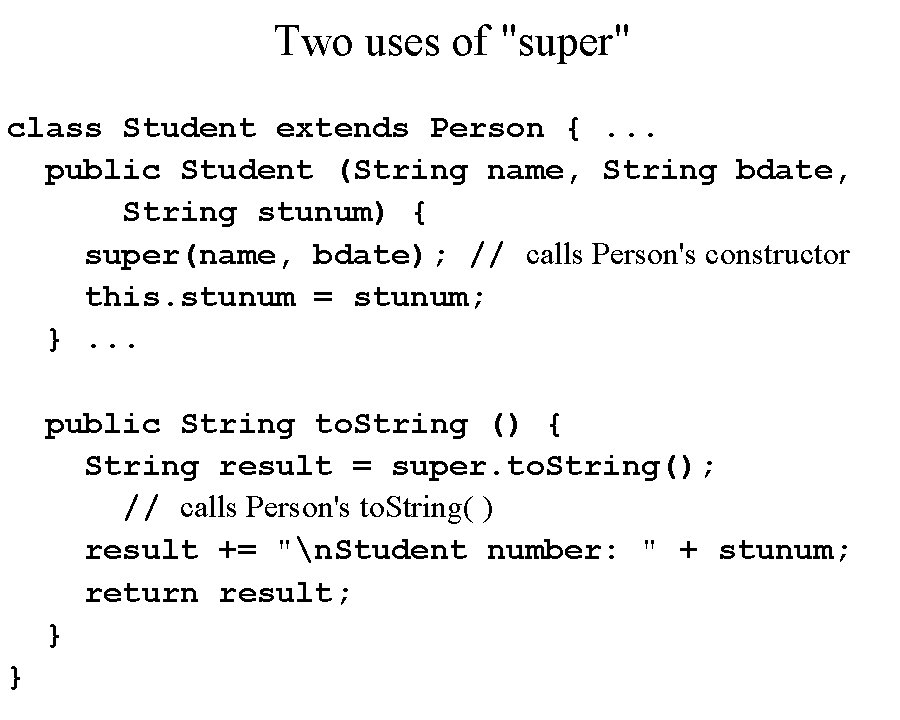
Two uses of "super" class Student extends Person {. . . public Student (String name, String bdate, String stunum) { super(name, bdate); // calls Person's constructor this. stunum = stunum; }. . . public String to. String () { String result = super. to. String(); // calls Person's to. String( ) result += "n. Student number: " + stunum; return result; } }
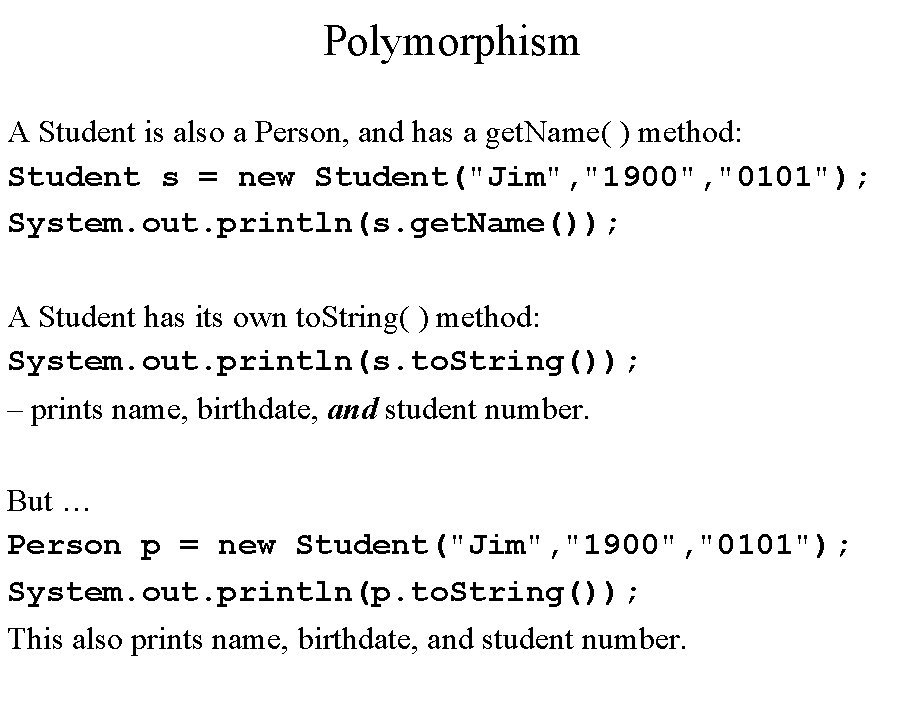
Polymorphism A Student is also a Person, and has a get. Name( ) method: Student s = new Student("Jim", "1900", "0101"); System. out. println(s. get. Name()); A Student has its own to. String( ) method: System. out. println(s. to. String()); – prints name, birthdate, and student number. But … Person p = new Student("Jim", "1900", "0101"); System. out. println(p. to. String()); This also prints name, birthdate, and student number.
Polymorphism Java finds the method belonging to the actual object.
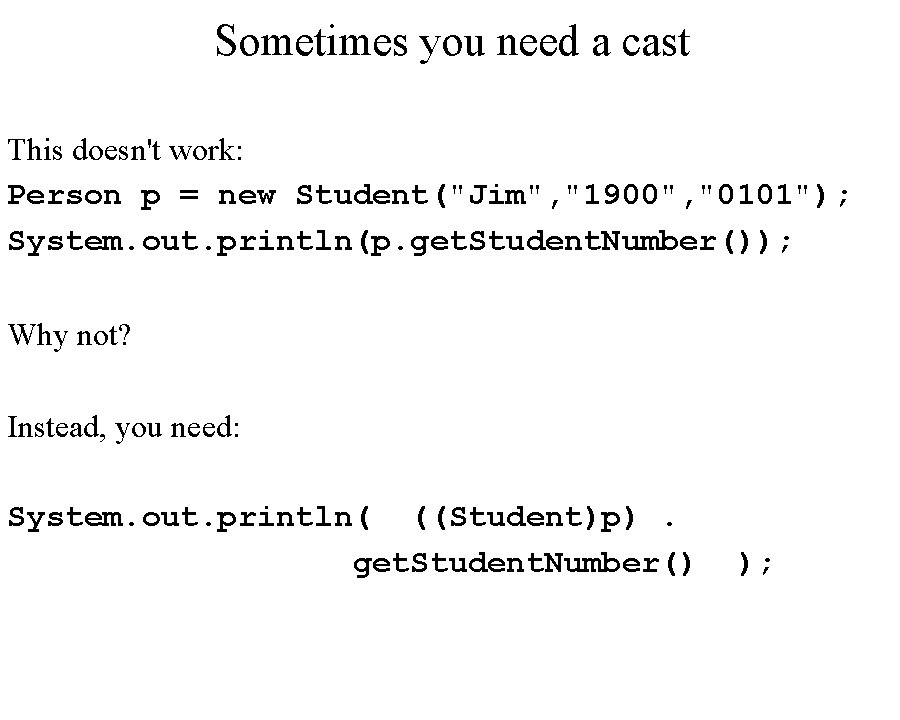
Sometimes you need a cast This doesn't work: Person p = new Student("Jim", "1900", "0101"); System. out. println(p. get. Student. Number()); Why not? Instead, you need: System. out. println( ((Student)p). get. Student. Number() );
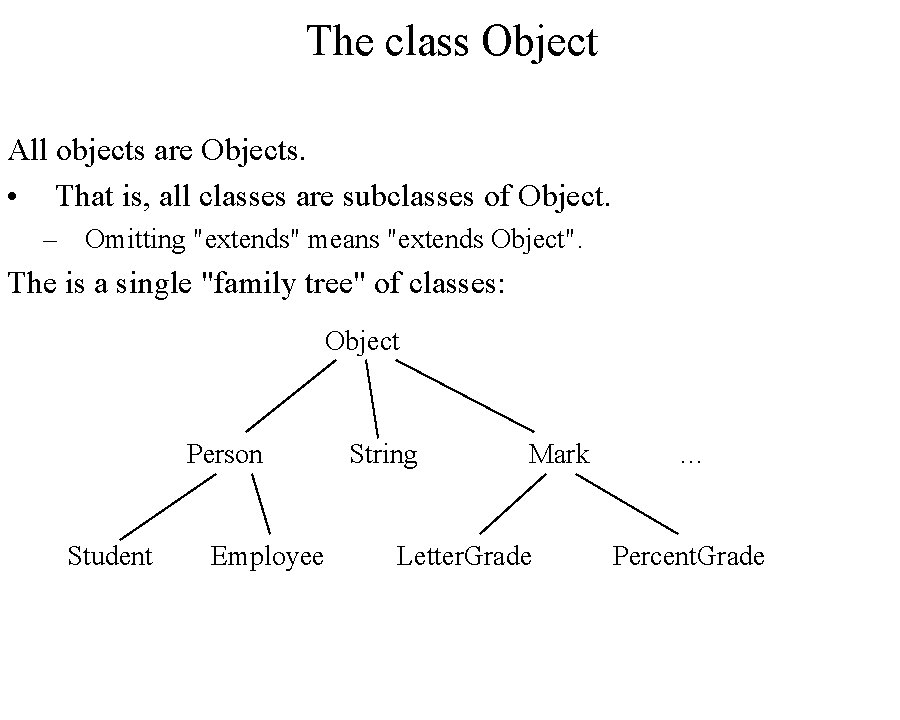
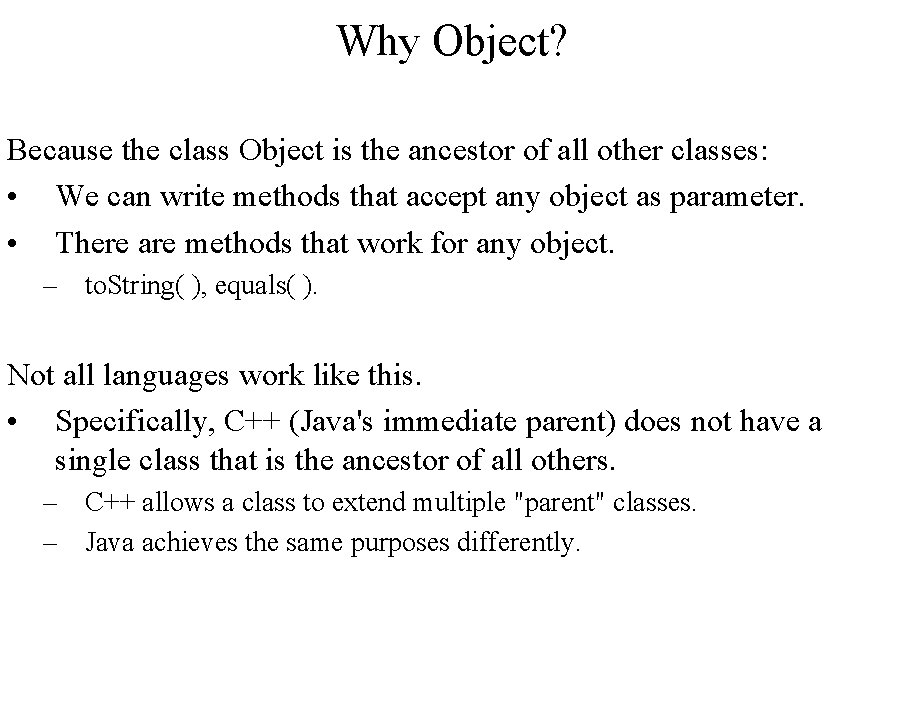
The class Object All objects are Objects. • That is, all classes are subclasses of Object. – Omitting "extends" means "extends Object". The is a single "family tree" of classes: Object Person Student Employee String Mark Letter. Grade … Percent. Grade
Why Object? Because the class Object is the ancestor of all other classes: • We can write methods that accept any object as parameter. • There are methods that work for any object. – to. String( ), equals( ). Not all languages work like this. • Specifically, C++ (Java's immediate parent) does not have a single class that is the ancestor of all others. – C++ allows a class to extend multiple "parent" classes. – Java achieves the same purposes differently.
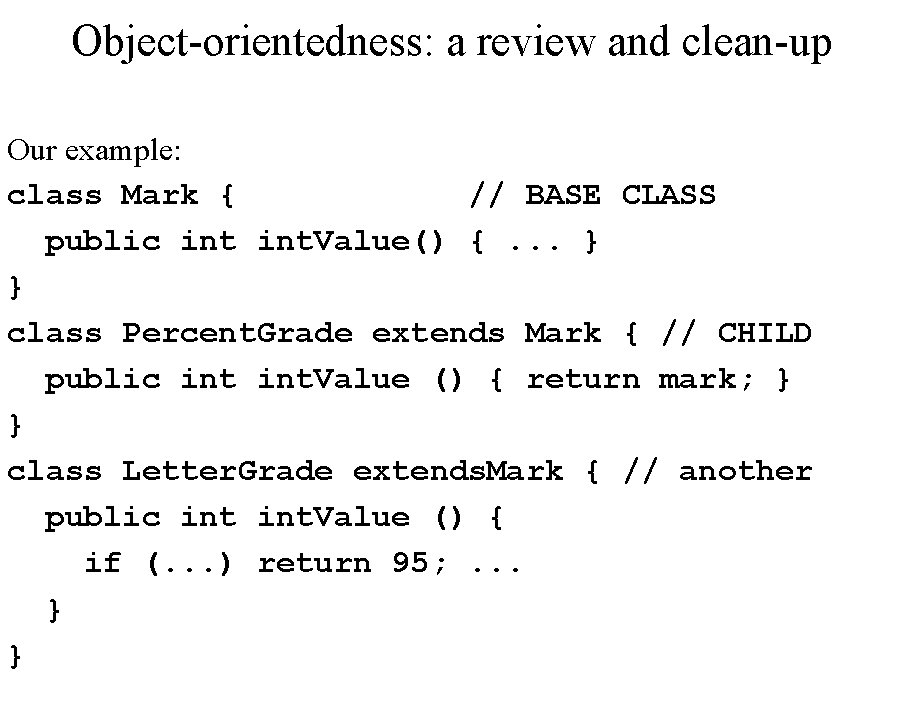
Object-orientedness: a review and clean-up Our example: class Mark { // BASE CLASS public int. Value() {. . . } } class Percent. Grade extends Mark { // CHILD public int. Value () { return mark; } } class Letter. Grade extends. Mark { // another public int. Value () { if (. . . ) return 95; . . . } }
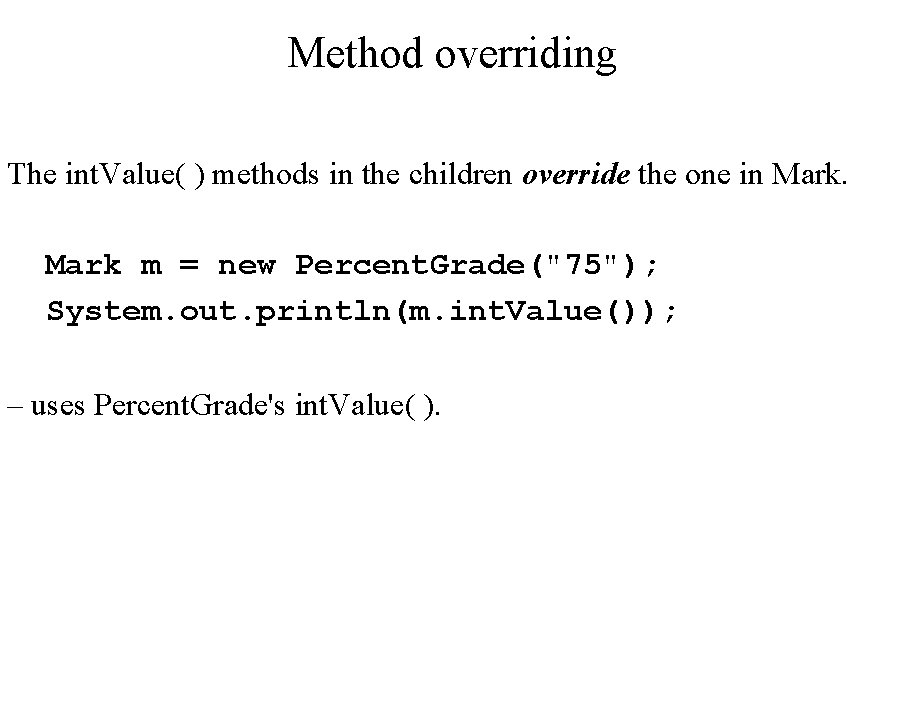
Method overriding The int. Value( ) methods in the children override the one in Mark m = new Percent. Grade("75"); System. out. println(m. int. Value()); – uses Percent. Grade's int. Value( ).
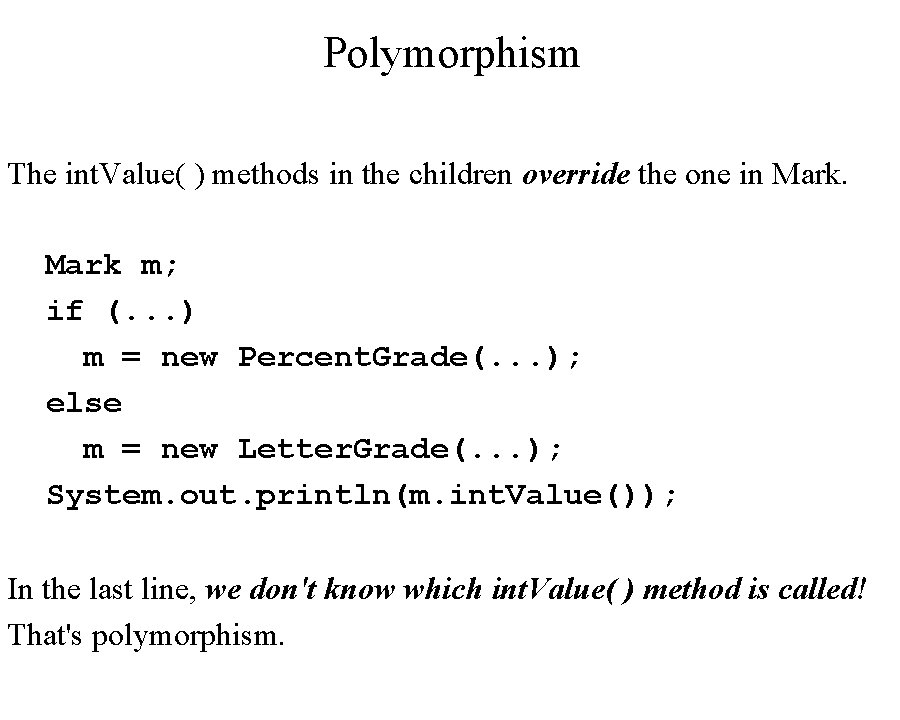
Polymorphism The int. Value( ) methods in the children override the one in Mark m; if (. . . ) m = new Percent. Grade(. . . ); else m = new Letter. Grade(. . . ); System. out. println(m. int. Value()); In the last line, we don't know which int. Value( ) method is called! That's polymorphism.
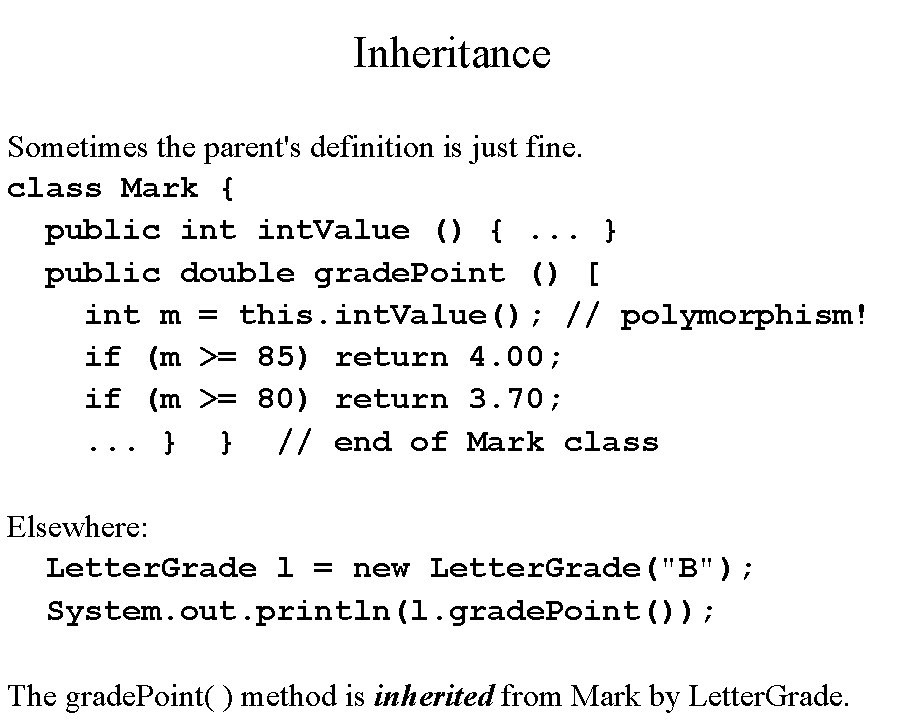
Inheritance Sometimes the parent's definition is just fine. class Mark { public int. Value () {. . . } public double grade. Point () [ int m = this. int. Value(); // polymorphism! if (m >= 85) return 4. 00; if (m >= 80) return 3. 70; . . . } } // end of Mark class Elsewhere: Letter. Grade l = new Letter. Grade("B"); System. out. println(l. grade. Point()); The grade. Point( ) method is inherited from Mark by Letter. Grade.