
Anorexia Nervosa A Case Study By Colleen Shank
Anorexia Nervosa: A Case Study By: Colleen Shank Sodexo Dietetic Intern April 30, 2014

Presentation of Anorexia Nervosa “Up to 24 million people of all ages and genders suffer from an eating disorder (anorexia, bulimia and binge eating disorder) in the U. S (The Renfrew Center Foundation for Eating Disorders)” “Only 35% of people that receive treatment for eating disorders get treatment at a specialized facility for eating disorders” (Noordenbox, 2002)
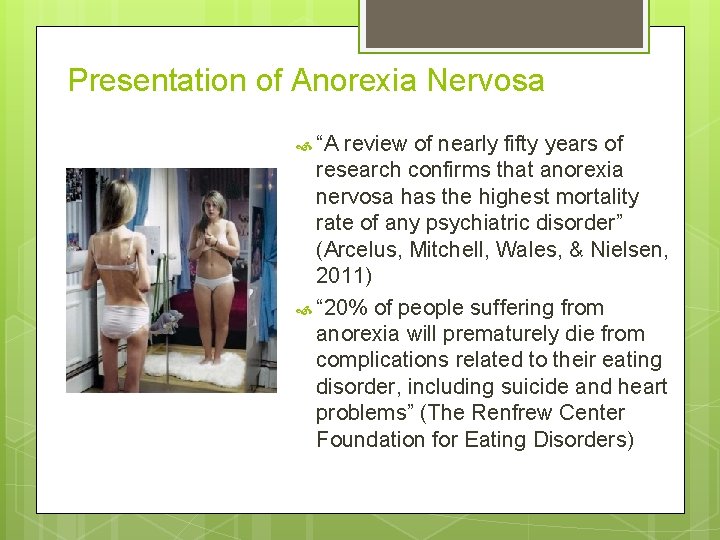
Presentation of Anorexia Nervosa “A review of nearly fifty years of research confirms that anorexia nervosa has the highest mortality rate of any psychiatric disorder” (Arcelus, Mitchell, Wales, & Nielsen, 2011) “ 20% of people suffering from anorexia will prematurely die from complications related to their eating disorder, including suicide and heart problems” (The Renfrew Center Foundation for Eating Disorders)
Presentation of Anorexia Nervosa Overview of how one may suffer from AN: q Body image distortion q Restrictive intake and or binging/purging q Excessive exercise q Severe weight loss q Fear of becoming fat q Physiological changes q Psychological changes
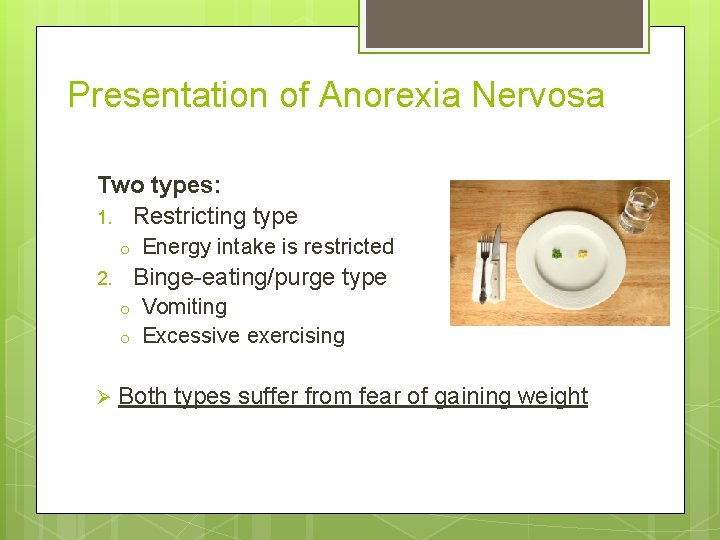
Presentation of Anorexia Nervosa Two types: 1. Restricting type o Binge-eating/purge type 2. o o Ø Energy intake is restricted Vomiting Excessive exercising Both types suffer from fear of gaining weight
Presentation of Anorexia Nervosa Diagnosis criteria: DSM-5 1. 2. 3. Restriction of energy intake relative to requirements leading to a significantly low body weight in the context of age, sex, developmental trajectory, and physical health. Intense fear of gaining weight or becoming fat, even though underweight. Disturbance in the way in which one's body weight or shape is experienced, undue influence of body weight or shape on self-evaluation, or denial of the seriousness of the current low body weight The Alliance for Eating Disorders
Presentation of Anorexia Nervosa Screening Tools: EDI-3 Eat-26 Can be given by health Care professionals Can be accessed online Can help assess risk Do not diagnose eating disorders Types of Questions: Gender, height, weight How often one feels, experiences, likes, or avoids certain things Avoiding foods when hungry, feeling guilty after eating, eat diet foods, etc. How often one partakes in certain behaviors Vomiting, binging, and exercising

Presentation of Anorexia Nervosa Physical Signs & Symptoms: Weight loss Tiredness Thinning hair Hair loss Dry skin Swelling of arms/legs Lanugo Intolerance to cold

Presentation of Anorexia Nervosa Internal Changes: Body systems are affected Examples: cardiovascular, neuroendocrine, renal, and gastrointestinal systems Slow heart rate Anemia Stomach gets smaller Constipation Dehydration Amenorrhea Osteoporosis Hypothermia Hypotension
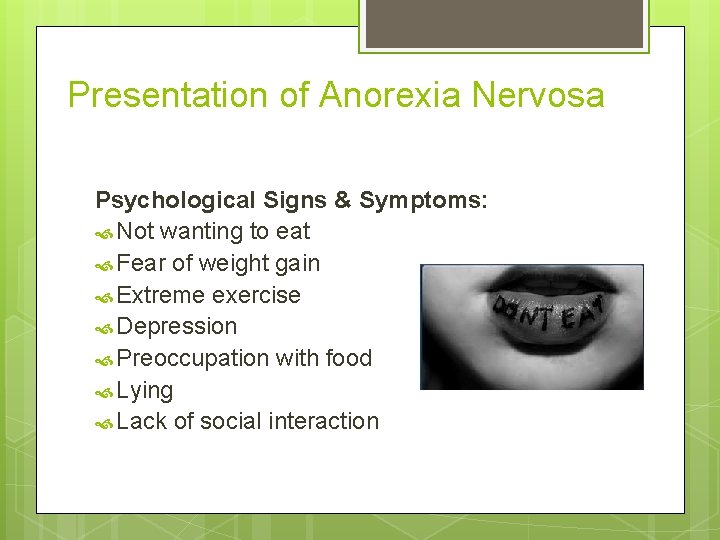
Presentation of Anorexia Nervosa Psychological Signs & Symptoms: Not wanting to eat Fear of weight gain Extreme exercise Depression Preoccupation with food Lying Lack of social interaction

Presentation of Anorexia Nervosa Tests/Labs: Height, weight, BMI Look at Heart Liver Kidneys Bones Thyroid Etc. Tests/Labs: CBC Electrolytes Total protein Minerals H/H Glucose B 12 Etc.

Presentation of Anorexia Nervosa Examples of Abnormalities: Abnormal lipoprotein profile Low zinc Low vitamin B-12 Alkalosis Low chloride and potassium Elevated bicarbonate Hypomagnesmia Hypophosphatemia Lymphocytosis Low resting metabolic rate Mitral valve prolapse
Presentation of Anorexia Nervosa Treatment: Requires a team Physician, Not Psychologist/Psychiatrist, RD all treatment plans are the same Everyone needs a treatment plan specific to them Inpatient, outpatient, both
Presentation of Anorexia Nervosa Treatment: Psychological One-on-one Group Family v Discover issues underlying Treatment: Psychological Different types of therapy CBT IPT SSCM Research?
Presentation of Anorexia Nervosa Treatment: Pharmacotherapy Not to treat AN specifically Used to treat underlying issues Antidepressants, antipsychotics Olanzapine, Fluoxetine, Prozac, Risperidone Research? Can drugs help improve weight gain?

Presentation of Anorexia Nervosa MNT: AND Position Paper “Nutrition intervention, including nutrition counseling by a registered dietitian, is an essential component of the team treatment of patients with anorexia nervosa, bulimia nervosa, and other eating disorders during assessment and treatment across the continuum of care”
Presentation of Anorexia Nervosa MNT: RDs Role Assess the patient Determine nutrition risks Define nutrition diagnosis Identify nutrition intervention Write nutrition prescription Define nutritional goals
Presentation of Anorexia Nervosa MNT: RD Assessment What is important to assess? Of course the RD will assess physical signs and symptoms but there are other things that should be included in their assessment of the patient Current dietary intake Present eating patterns History related to foods Nutrient deficiencies Supplement use Risk of refeeding syndrome
Presentation of Anorexia Nervosa Treatment: Current Guidelines Intake recommendations Calculating needs Kcal Starting point Increase by 100200 kcals Macronutrients CHO: 50 -55% PRO: 15 -20% Fat: 25 -30% Micronutrients? Weight gain Differences between in and out patient settings Increase in kcal needs
Presentation of Anorexia Nervosa Treatment: Refeeding Syndrome Refeeding a starved patient Clinical implications Low Mg, K, P Thiamine deficiency Must be aware of the affects Must follow protocol to help prevent refeeding Monitor electrolytes and fluids
Presentation of Anorexia Nervosa Treatment: Nutrition Support Need for nutrition support depends on needs of the patient PN should only be used when medically necessary
Presentation of C. H. Basics: Age: 56 Sex: Female Lives at home with her mother and sister Dates of hospital stay: January 15, 2014 February 14, 2014 Date transferred to Manor Care: February 14, 2014
Presentation of C. H. Hospital Stay: Dx: FTT secondary to malnutrition, Pancytopenia, Hypothermia related to malnutrition, Bradycardia related to hypothermia, and Hypotension related to dehydration PMH: Anorexia, Anemia
Presentation of C. H. Hospital Stay: Reason for going to ER: inability to ambulate and weakness Vital 1. 5 3 day calorie count Labs: BG 49, HGB 3. 7, Creatinine 0. 67, BUN 60 Per patient: Reported that weight loss started several months ago No menstruation anymore No diarrhea, blood in the stool Was on iron pill but stopped taking due to negative side effects Has struggled with weight since age 11
Presentation of C. H. Manor Care: Admit dx: FTT, (GERD), Refeeding Syndrome, Pancytopenia, and History of intussusception Her admission note states she was "in an anorexic and malnourished state" Admit weight 76. 6#, Height 62. 0”, BMI 14. 0 Stage 3 gluteal wound Left hip wound
Presentation of C. H. Manor Care: No smoking, drinking, drug use history February 18, 2014 AOA involved Mother and sister were not allowed to bring in food to patient
Presentation of C. H. Manor Care: Plan Physical and occupational therapy Continue current diet, supplements, folic acid, MVI, zinc, labs as scheduled Follow up with GI at the hospital as scheduled Wound: local care with santyl, daily dressing change/pressure relief, nutritional support
Presentation of C. H. Manor Care: Labs from February 21, 2014 Random glucose: 78 BUN: 12 Creat: 0. 40 K: 4. 2 NA: 136 AST: 21 ALT: 30 Alk phos: 66 Total bilirubin: 0. 3 Ca: 8. 9 Alb: 3. 6 Total pro: 6. 3 GFR: >60 WBC: 6. 6 RBC: 3. 96 L HGB: 9. 3 L HCT: 31. 3 L MCV: 79. 1 L MCH: 23. 4 L
Presentation of C. H. Manor Care: Medications Cholecalciferol 2000 unit po daily Heparin 5000 units SQ Folic acid 1 mg po daily MVI po daily Protonix 40 mg po daily Zinc sulfate 220 mg po daily As needed: Miralax, Colace, Tylenol, MOM, Dulcolax, v Ferrous liquid 220 g po daily (added at a later date 3 x/week)
Presentation of C. H. Manor Care: On admission was placed on gluten intolerance diet and enhanced food Prior Was No to RD assessment later changed to a regular diet history of Celiac Disease
Presentation of C. H. Manor Care: RD Assessment February 19, 2014 Current weight 77. 2#, BMI 14. 1 Interview Pt prefers “plain foods” Pt reports allergy to guar gum Consumption of meals 75 -100% Eats meals slowly (1 -1. 5 hours) No diarrhea, constipation, steatorrhea, communication, dental/oral, or functional problems noted
Presentation of C. H. Manor Care: RD Assessment Calculated needs (with IBW 110#: 35 kcal/kg = 1750 kcal/day 1. 5 g/kg pro= 75 g/day 30 m. L/kg fluid= 1500 m. L/day Diet order: Regular diet, Supplement TID No longer giving enhanced foods due to pt liking plain foods Recommendations: weekly CMP, CBC, P, Mg, LFTs, iron supplement
Presentation of C. H. Manor Care: Weekly weights 2/14/14 76. 6 # 2/18/14 77. 2 # 2/24/14 77. 6 # 3/4/14 82 #
Presentation of C. H. Manor Care: Med Options Assessment Mental health evaluation (2 visits) Main issue: AN Patient has difficulty with mood functioning, behavioral functioning, and lack of insight "I am not an anorexic" "I do eat- I like food but I have a difficult time keeping the weight on"
Presentation of C. H. Manor Care: My interaction with C. H Usual intake 3 meals per day (breakfast, lunch, and dinner) as well as snacks in between meals UBW: 110 -115# Since she has been sick she reports her weight has been 85 -90# States she does not usually keep track of weight Reports she could feel she was losing weight when she started getting sick v Reports when she was taking her iron pill that would help her gain weight
Update on C. H. Was d/c on March 4, 2014 D/c to home with mother and sister No further info on AOA Weight at d/c 82#
Sources Eating Disorder Statistics. ANAD. http: //www. anad. org. Accessed April 20, 2014. Get the Facts on Eating Disorders. NEDA. https: //www. nationaleatingdisorders. org. Accessed March 13, 2014. Anorexia Nervosa. National Association of Anorexia Nervosa and Associated Disorders. http: //www. anad. org/. Accessed March 13, 2014. Feeding and Eating Disorders. APAhttp: //www. dsm 5. org. Accessed March 13, 2014 DSM-5 Diagnostic Criteria. The Alliance for Eating Disorders. http: //www. allianceforeatingdisorders. com. Accessed March 19, 2014. The Eating Attitudes Test (EAT-26). Eat-26. http: //www. eat-26. com/. Accessed April 3, 2014. Mayo Clinic Staff. Anorexia Nervosa. Mayo Clinic. http: //www. mayoclinic. org. Updated January 5, 2012. Accessed March 19, 2014. Anorexia Nervosa. The New York Times. http: //www. nytimes. com. Reviewed March 18, 2013. Accessed April 3, 2014. Anorexia Nervosa Biochemical and Nutrient Issues. Academy of Nutrition and Dietetics Nutrition Care Manual. http: //www. nutritioncaremanual. org. Accessed April 3, 2014.
Treatment Basics. NEDA. https: //www. nationaleatingdisorders. org. Accessed April 4, 2014. Eating Disorders. How can a psychologist help someone recover? APA. https: //www. apa. org/. Revised October 2011. Accessed April 10, 2014. Le Grange, D. , Lock, J. Family-based Treatment of Adolescent Anorexia Nervosa: The Maudsley Approach. Maudsley Parents. http: //www. maudsleyparents. org/whatismaudsley. html. Accessed April 10, 2014. De. Angelis, T. Promising Treatments for anorexia and bulimia. Monitor on Psychology. March 2002; 33 (3): 38. http: //www. library. illinois. edu/learn/research/citation/ama. html. Accessed April 10, 2014. Schmidt U, Oldershaw A, Jichi F, et al. Out-patient psychological therapies for adults with anorexia nervosa: randomised controlled trial. The British Journal of Psychology. 2012, (201): 392 -399. DOI: 10. 1192/bjp. bp. 112078. Accessed April 10, 2014. Carter, F, Jordan, J, Mc. Intosh, V. V. W, et al. The long-term efficacy of three psychotherapies for anorexia nervosa: A randomized, controlled trial. Int. J. Eat. Disord. 2011; (44): 647– 654. DOI: 10. 1002/eat. 20879. Accessed April 10, 2014.
Yager J, Devlin M, Halmi K, et al. Guideline Watch: Practice Guideline for the Treatment of Patients with Eating Disorders. 3 rd ed. APA. 2012. http: //psychiatryonline. org/pdfaccess. Accessed April 10, 2014. Mickley D. Medication for Anorexia Nervosa and Bulimia Nervosa. Eating Disorders Recovery Today. 2004; 2(4). http: //www. eatingdisordersrecoverytoday. com. Accessed April 11, 2014. Attia E, Kaplan A, Walsh B, et al. Olanzapine versus placebo for out-patients with anorexia nervosa [Abstract]. Psychological Medicine. 2011; 41(10): 2177 -2182. DOI: http: //dx. doi. org/10. 1017/S 0033291711000390 Accessed April 11, 2014. Hagman J, Gralla J, Sigel E, et al. A Double-Blind, Placebo-Controlled Study of Risperidone for the Treatment of Adolescents and Young Adults with Anorexia Nervosa: A Pilot Study. JAACAP. 2011; 50(9): 915 -924. DOI: 10. 1016/j. jaac. 2011. 06. 009. Walsh T, Kaplan A, Attia E, et al. Fluoxetine After Weight Restoration in Anorexia Nervosa. A Randomized Controlled Trial. JAMA. 2006; 295(22): 2605 -2612. DOI: 10. 1001/jama. 295. 22. 2605. Ozier A, Henry B. Position of the American Dietetic Association: Nutrition Intervention in the Treatment of Eating Disorders. JADA. 2011; 111: 1236 -1241. http: //www. eatright. org/ Accessed April 11, 2014.
Waterhous T, Jacob M. Practice Paper of the American Dietetic Association: Nutrition Intervention in the Treatment of Eating Disorder. ADA. 2011; 11(8): 1261. http: //www. eatright. org/ Accessed April 10, 2014. Parent Toolkit. NEDA. 47. http: //www. nationaleatingdisorders. org/sites/default/files/Toolkits/parentto olkit/. Accessed April 11, 2014. Anorexia Nervosa Nutrition Prescription. Academy of Nutrition and Dietetics Nutrition Care Manual. http: //www. nutritioncaremanual. org. Accessed April 10, 2014. Schebendach J. Nutrition in Eating Disorders. In: Mahan LK, Escott. Stump S. Krause’s Food & Nutrition Therapy. St. Louis, MO; Saunders Elsevier; 2008: 563 -586. Anorexia Nervosa Nutrition Support. Academy of Nutrition and Dietetics Nutrition Care Manual. http: //www. nutritioncaremanual. org. Accessed April 11, 2014. Robb A, Silber T, Orrell- Valente J, Valadez-Meltzer A, et al. Supplemental Nocturnal Nasogastric Refeeding for Better Short-Term Outcome in Hospitalized Adolescent Girls With Anorexia Nervosa. Am J Psychiatry. 2002; 159: 1347 -1353. DOI: 10. 1176/appi. ajp. 159. 8. 1347. Accessed April 11, 2014.
- Slides: 40