
Anonymity on the Internet Presented by Randy Unger

Anonymity on the Internet Presented by Randy Unger
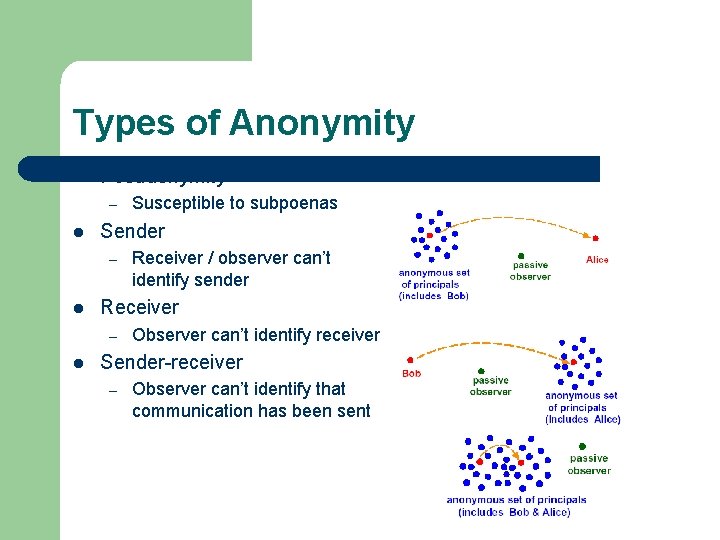
Types of Anonymity l Pseudonymity – l Sender – l Receiver / observer can’t identify sender Receiver – l Susceptible to subpoenas Observer can’t identify receiver Sender-receiver – Observer can’t identify that communication has been sent

Uses of Anonymity Positive l Free speech for political claims as well as non-political comments l engage in whistle-blowing l conduct commercial transactions l freedom from detection, retribution, and embarrassment l New York Times Co. vs. Sullivan, 1964 "an author's decision to remain anonymous. . . is an aspect of the freedom of speech protected by the First Amendment"
Uses of Anonymity Negative l Spam l Do. S l Illegal activity – anonymous bribery, copyright infringement, harassment, financial scams, disclosure of trade secrets
Assumptions l Weak attacker – – l Strong attacker – – l l Eavesdrops on first and last hop Can introduce messages here Eavesdrops on all links Can introduce messages anywhere Attacker has finite time, computing power Multiple users
Types of Attackers l Local eavesdropper – l Administrator – l Observes inbound and outbound messages on user’s computer Operator or group of operators of anonymizing systems attempting to foil their own system Remote attack – Observation at the remote end by eavesdropper or attack by the remote host
Attacks l Timing Attack, Volume Attack – l Flooding Attack – l Watches shape of traffic instead of content With batch size n, attacker sends n-1 messages Usage Pattern Attack – Consistent usage patterns leads to predictability
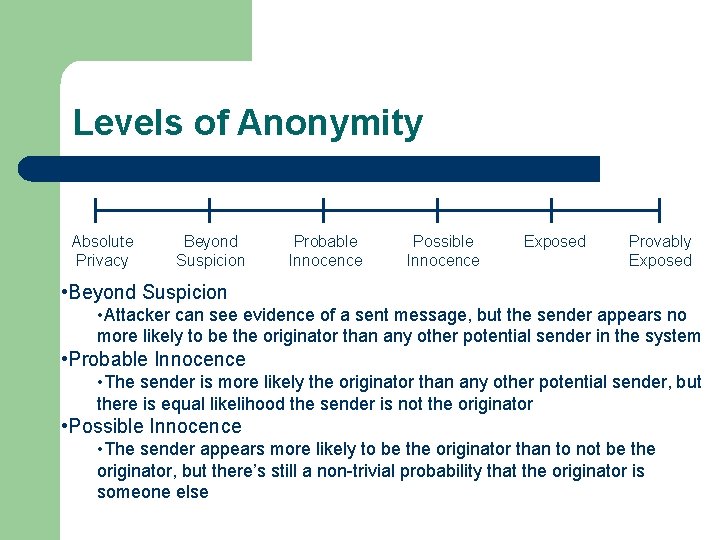
Levels of Anonymity Absolute Privacy Beyond Suspicion Probable Innocence Possible Innocence Exposed Provably Exposed • Beyond Suspicion • Attacker can see evidence of a sent message, but the sender appears no more likely to be the originator than any other potential sender in the system • Probable Innocence • The sender is more likely the originator than any other potential sender, but there is equal likelihood the sender is not the originator • Possible Innocence • The sender appears more likely to be the originator than to not be the originator, but there’s still a non-trivial probability that the originator is someone else
Capabilities l Latency, Bandwidth, Anonymity – l Pick 2 Human element – – Repetitive usage patterns make attacks easier Pizza effect
Proxy Anonymizers l l l Use trusted centralized servers Anonymous remailers - Helsingius Anonymizer. com Hides IP address - NAT Users not anonymous to proxy server Susceptible to traffic analysis
Mixes l l l Source routing chosen by user Shuffles order of packets Mix cascade consists of several mixes under separate operators Encrypted for each mix in the path Processes packets in batches Used to counter traffic analysis
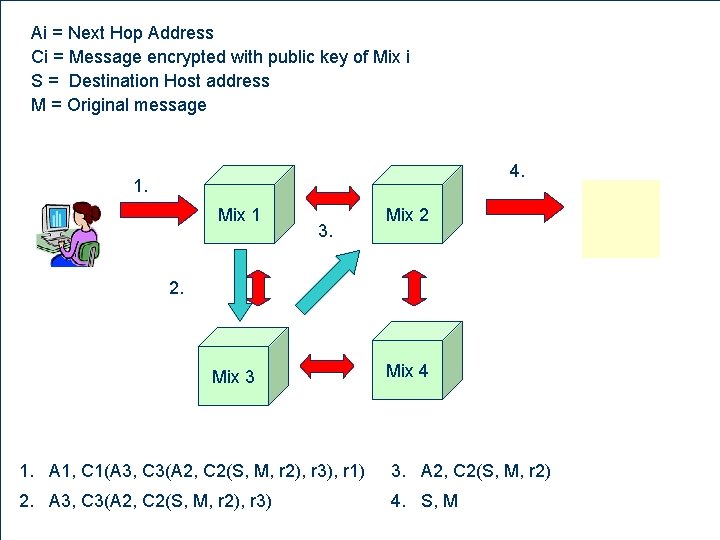
Ai = Next Hop Address Ci = Message encrypted with public key of Mix i S = Destination Host address M = Original message Mixes 4. 1. Mix 1 3. Mix 2 2. Mix 3 Mix 4 1. A 1, C 1(A 3, C 3(A 2, C 2(S, M, r 2), r 3), r 1) 3. A 2, C 2(S, M, r 2) 2. A 3, C 3(A 2, C 2(S, M, r 2), r 3) 4. S, M
Mixes l l l Fine for non real-time (email) Not sufficient for Vo. IP, video, web Mix waits to accumulate inputs to process as a batch (especially slow for low traffic)
Enhancements l l l Messages all the same length Buffers messages until several can be sent at once Dummy messages inserted – – l Between mixes and user Balance end to end throughput with anonymity – – Duration to wait for mixes to accumulate traffic Percentage of dummy traffic
P 5 l Decentralized – l l l Harder to attack Allows choice of tradeoff between anonymity / throughput Encrypted with public key of each node in route Nodes change packet order Fixed message size Users have broadcast map and route map Noise packets counter statistical traffic analysis
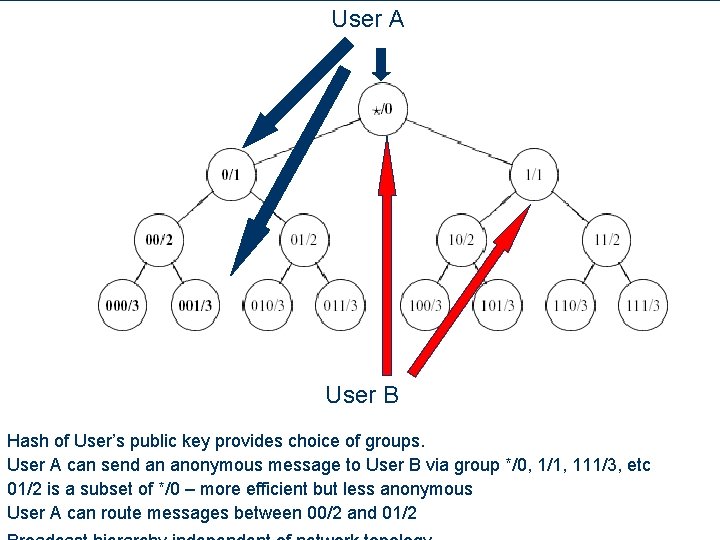
User A User B Hash of User’s public key provides choice of groups. User A can send an anonymous message to User B via group */0, 1/1, 111/3, etc 01/2 is a subset of */0 – more efficient but less anonymous User A can route messages between 00/2 and 01/2
P 5 l l Within a channel, P 5 functions as a mix cascade Between channels, P 5 provides greater anonymity per bandwidth – l l For 8192 users, 1. 5 Mbps provides 200 Kbps with 40% loss Resistant to Timing/Volume and Do. S attacks Susceptible to Flood Attack (Mob Attack) – User’s channel is flooded, prompting him to reveal more of his mask to gain efficiency, thereby reducing his anonymity
Conclusion l Costly to be anonymous – l Can not be completely anonymous anyway – l Tradeoff with throughput No protection from monitoring usage patterns Aside from this, practical anonymity can be achieved
- Slides: 18