
Annular air leaks in a liquid hydrogen storage
- Slides: 1
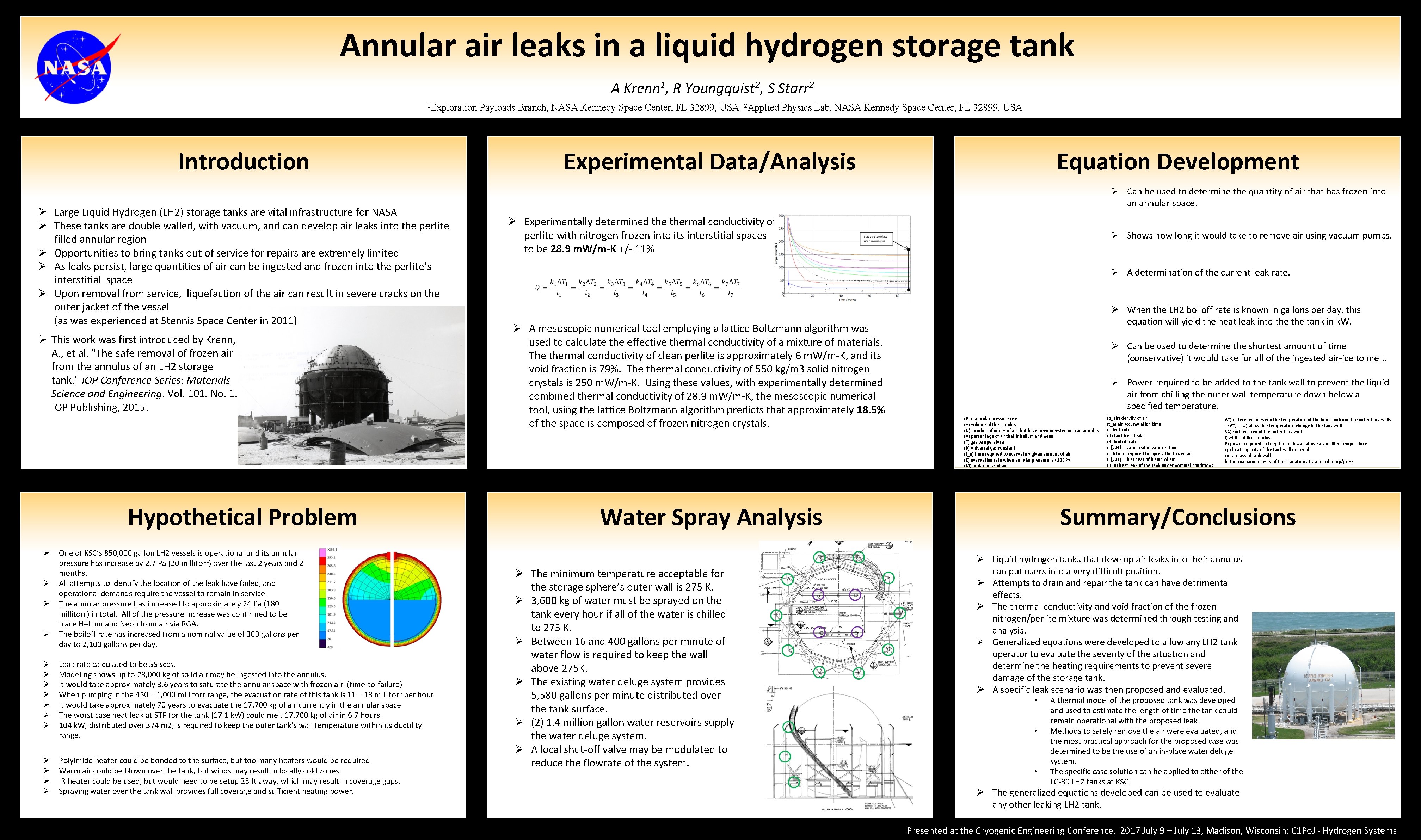
Annular air leaks in a liquid hydrogen storage tank A Krenn 1, R Youngquist 2, S Starr 2 1 Exploration Introduction Ø Large Liquid Hydrogen (LH 2) storage tanks are vital infrastructure for NASA Ø These tanks are double walled, with vacuum, and can develop air leaks into the perlite filled annular region Ø Opportunities to bring tanks out of service for repairs are extremely limited Ø As leaks persist, large quantities of air can be ingested and frozen into the perlite’s interstitial space Ø Upon removal from service, liquefaction of the air can result in severe cracks on the outer jacket of the vessel (as was experienced at Stennis Space Center in 2011) Ø This work was first introduced by Krenn, A. , et al. "The safe removal of frozen air from the annulus of an LH 2 storage tank. " IOP Conference Series: Materials Science and Engineering. Vol. 101. No. 1. IOP Publishing, 2015. Hypothetical Problem Ø Ø One of KSC’s 850, 000 gallon LH 2 vessels is operational and its annular pressure has increase by 2. 7 Pa (20 millitorr) over the last 2 years and 2 months. All attempts to identify the location of the leak have failed, and operational demands require the vessel to remain in service. The annular pressure has increased to approximately 24 Pa (180 millitorr) in total. All of the pressure increase was confirmed to be trace Helium and Neon from air via RGA. The boiloff rate has increased from a nominal value of 300 gallons per day to 2, 100 gallons per day. Ø Ø Ø Ø Leak rate calculated to be 55 sccs. Modeling shows up to 23, 000 kg of solid air may be ingested into the annulus. It would take approximately 3. 6 years to saturate the annular space with frozen air. (time-to-failure) When pumping in the 450 – 1, 000 millitorr range, the evacuation rate of this tank is 11 – 13 millitorr per hour It would take approximately 70 years to evacuate the 17, 700 kg of air currently in the annular space The worst case heat leak at STP for the tank (17. 1 k. W) could melt 17, 700 kg of air in 6. 7 hours. 104 k. W, distributed over 374 m 2, is required to keep the outer tank’s wall temperature within its ductility range. Ø Ø Polyimide heater could be bonded to the surface, but too many heaters would be required. Warm air could be blown over the tank, but winds may result in locally cold zones. IR heater could be used, but would need to be setup 25 ft away, which may result in coverage gaps. Spraying water over the tank wall provides full coverage and sufficient heating power. Payloads Branch, NASA Kennedy Space Center, FL 32899, USA 2 Applied Physics Lab, NASA Kennedy Space Center, FL 32899, USA Equation Development Experimental Data/Analysis Ø Can be used to determine the quantity of air that has frozen into an annular space. Ø Experimentally determined thermal conductivity of perlite with nitrogen frozen into its interstitial spaces to be 28. 9 m. W/m-K +/- 11% Ø Shows how long it would take to remove air using vacuum pumps. Ø A determination of the current leak rate. Ø A mesoscopic numerical tool employing a lattice Boltzmann algorithm was used to calculate the effective thermal conductivity of a mixture of materials. The thermal conductivity of clean perlite is approximately 6 m. W/m-K, and its void fraction is 79%. The thermal conductivity of 550 kg/m 3 solid nitrogen crystals is 250 m. W/m-K. Using these values, with experimentally determined combined thermal conductivity of 28. 9 m. W/m-K, the mesoscopic numerical tool, using the lattice Boltzmann algorithm predicts that approximately 18. 5% of the space is composed of frozen nitrogen crystals. Ø When the LH 2 boiloff rate is known in gallons per day, this equation will yield the heat leak into the tank in k. W. Ø Can be used to determine the shortest amount of time (conservative) it would take for all of the ingested air-ice to melt. Ø Power required to be added to the tank wall to prevent the liquid air from chilling the outer wall temperature down below a specified temperature. (P_r) annular pressure rise (V) volume of the annulus (N) number of moles of air that have been ingested into an annulus (A) percentage of air that is helium and neon (T) gas temperature (R) universal gas constant (t_e) time required to evacuate a given amount of air (E) evacuation rate when annular pressure is <133 Pa (M) molar mass of air (∆T) difference between the temperature of the inner tank and the outer tank walls (〖∆T〗_w) allowable temperature change in the tank wall (SA) surface area of the outer tank wall (l) width of the annulus (P) power required to keep the tank wall above a specified temperature (cp) heat capacity of the tank wall material (m_s) mass of tank wall (k) thermal conductivity of the insulation at standard temp/press Summary/Conclusions Water Spray Analysis Ø The minimum temperature acceptable for the storage sphere’s outer wall is 275 K. Ø 3, 600 kg of water must be sprayed on the tank every hour if all of the water is chilled to 275 K. Ø Between 16 and 400 gallons per minute of water flow is required to keep the wall above 275 K. Ø The existing water deluge system provides 5, 580 gallons per minute distributed over the tank surface. Ø (2) 1. 4 million gallon water reservoirs supply the water deluge system. Ø A local shut-off valve may be modulated to reduce the flowrate of the system. (ρ_air) density of air (t_a) air accumulation time (r) leak rate (H) tank heat leak (B) boil off rate (〖∆H〗_vap) heat of vaporization (t_l) time required to liquefy the frozen air (〖∆H〗_fus) heat of fusion of air (H_n) heat leak of the tank under nominal conditions Ø Liquid hydrogen tanks that develop air leaks into their annulus can put users into a very difficult position. Ø Attempts to drain and repair the tank can have detrimental effects. Ø The thermal conductivity and void fraction of the frozen nitrogen/perlite mixture was determined through testing and analysis. Ø Generalized equations were developed to allow any LH 2 tank operator to evaluate the severity of the situation and determine the heating requirements to prevent severe damage of the storage tank. Ø A specific leak scenario was then proposed and evaluated. • • • A thermal model of the proposed tank was developed and used to estimate the length of time the tank could remain operational with the proposed leak. Methods to safely remove the air were evaluated, and the most practical approach for the proposed case was determined to be the use of an in-place water deluge system. The specific case solution can be applied to either of the LC-39 LH 2 tanks at KSC. Ø The generalized equations developed can be used to evaluate any other leaking LH 2 tank. Presented at the Cryogenic Engineering Conference, 2017 July 9 – July 13, Madison, Wisconsin; C 1 Po. J - Hydrogen Systems