
Annuities Section 5 3 Introduction Lets say you
- Slides: 12
Annuities Section 5. 3
Introduction • Let’s say you want to save money to go on a vacation, or you want to save money now for your baby’s college education. • A strategy for saving a little bit of money in the present and having a big payoff in the future is called an annuity. • An annuity is an account in which equal regular payments are made. • There are two basic questions with annuities: – Determine how much money will accumulate over time given that equal payments are made. – Determine what periodic payments will be necessary to obtain a specific amount in a given time period.
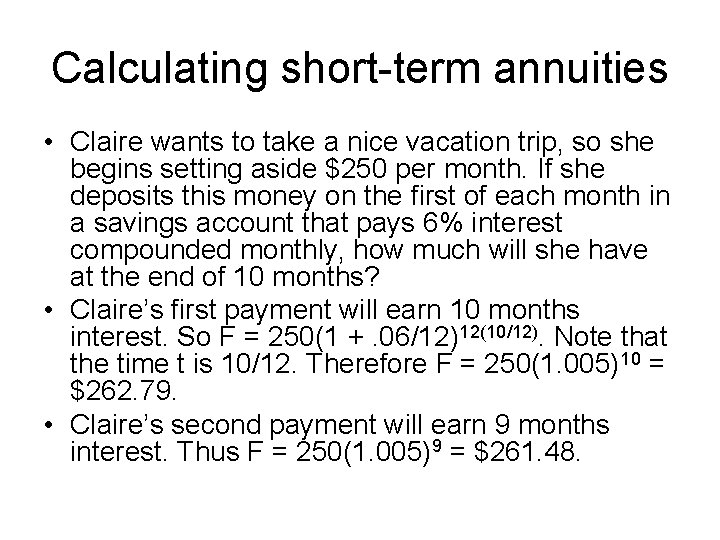
Calculating short-term annuities • Claire wants to take a nice vacation trip, so she begins setting aside $250 per month. If she deposits this money on the first of each month in a savings account that pays 6% interest compounded monthly, how much will she have at the end of 10 months? • Claire’s first payment will earn 10 months interest. So F = 250(1 +. 06/12)12(10/12). Note that the time t is 10/12. Therefore F = 250(1. 005)10 = $262. 79. • Claire’s second payment will earn 9 months interest. Thus F = 250(1. 005)9 = $261. 48.
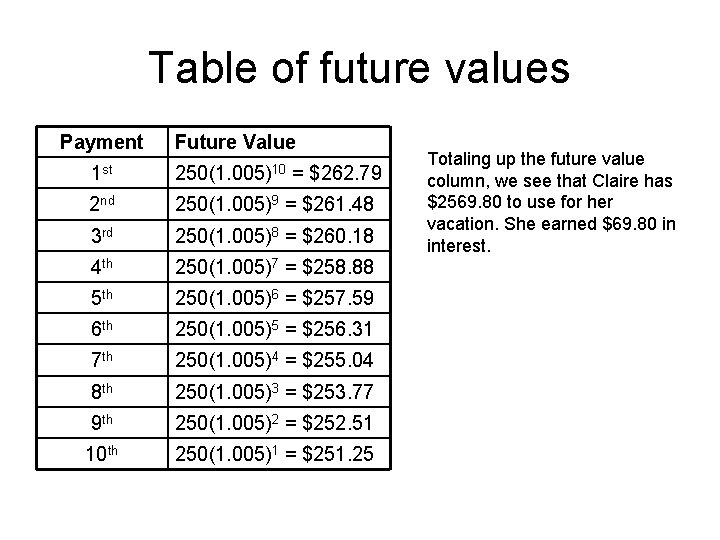
Table of future values Payment Future Value 1 st 250(1. 005)10 2 nd 250(1. 005)9 = $261. 48 3 rd 250(1. 005)8 = $260. 18 4 th 250(1. 005)7 = $258. 88 5 th 250(1. 005)6 = $257. 59 6 th 250(1. 005)5 = $256. 31 7 th 250(1. 005)4 = $255. 04 8 th 250(1. 005)3 = $253. 77 9 th 250(1. 005)2 = $252. 51 10 th 250(1. 005)1 = $251. 25 = $262. 79 Totaling up the future value column, we see that Claire has $2569. 80 to use for her vacation. She earned $69. 80 in interest.
Ordinary Annuity and Annuity Due • There are two types of annuity formulas. • One formula is based on the payments being made at the end of the payment period. This called ordinary annuity. • The annuity due is when payments are made at the beginning of the payment period. • We will derive the ordinary annuity formula first.
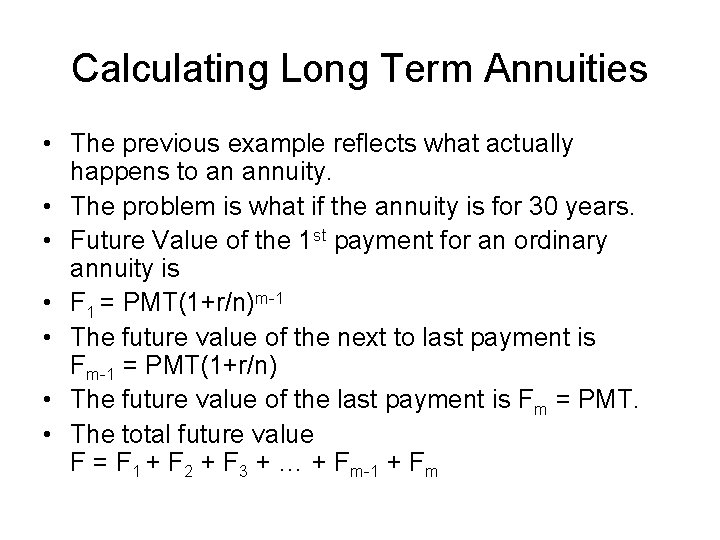
Calculating Long Term Annuities • The previous example reflects what actually happens to an annuity. • The problem is what if the annuity is for 30 years. • Future Value of the 1 st payment for an ordinary annuity is • F 1 = PMT(1+r/n)m-1 • The future value of the next to last payment is Fm-1 = PMT(1+r/n) • The future value of the last payment is Fm = PMT. • The total future value F = F 1 + F 2 + F 3 + … + Fm-1 + Fm
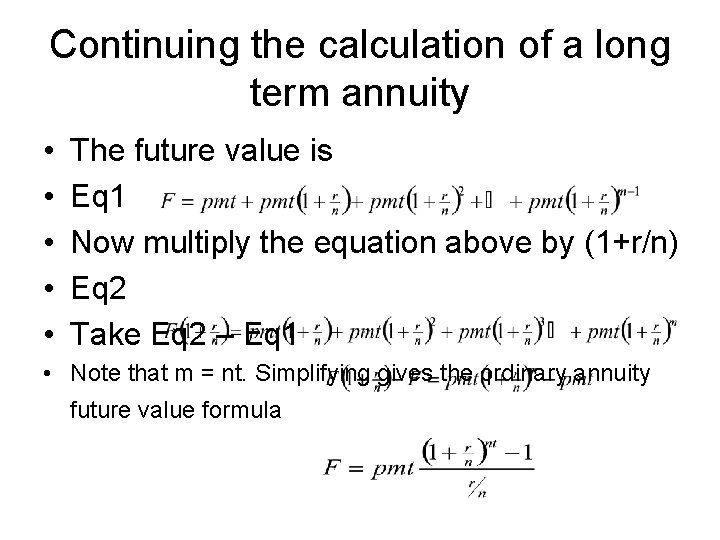
Continuing the calculation of a long term annuity • • • The future value is Eq 1 Now multiply the equation above by (1+r/n) Eq 2 Take Eq 2 – Eq 1 • Note that m = nt. Simplifying gives the ordinary annuity future value formula
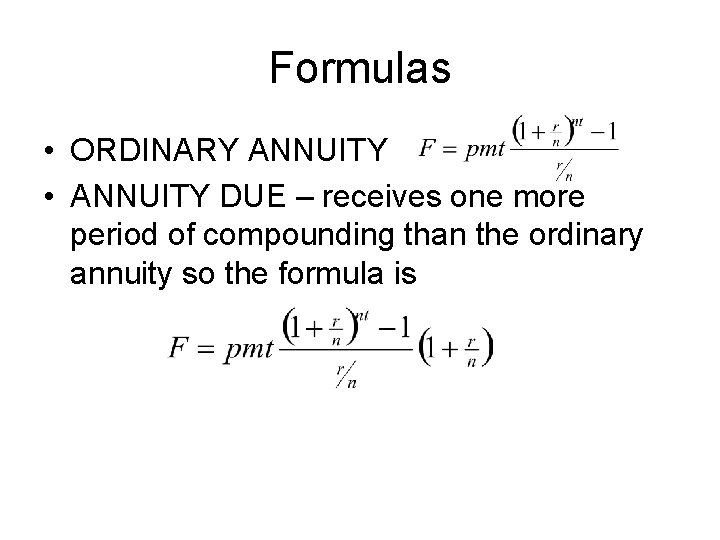
Formulas • ORDINARY ANNUITY • ANNUITY DUE – receives one more period of compounding than the ordinary annuity so the formula is
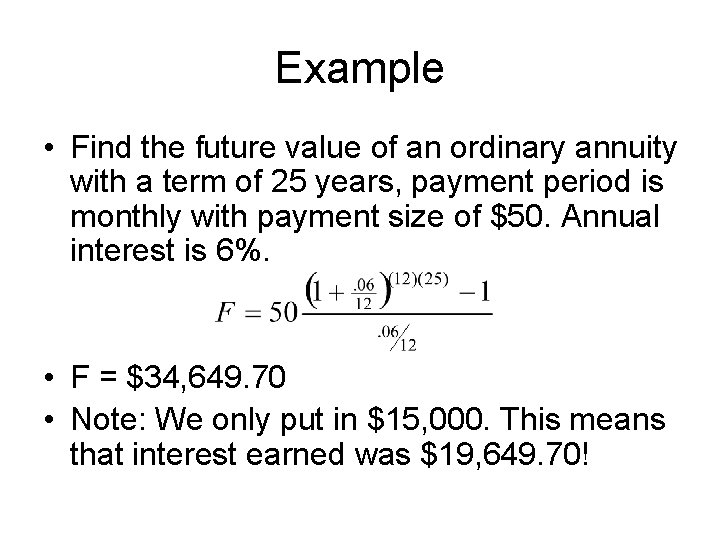
Example • Find the future value of an ordinary annuity with a term of 25 years, payment period is monthly with payment size of $50. Annual interest is 6%. • F = $34, 649. 70 • Note: We only put in $15, 000. This means that interest earned was $19, 649. 70!
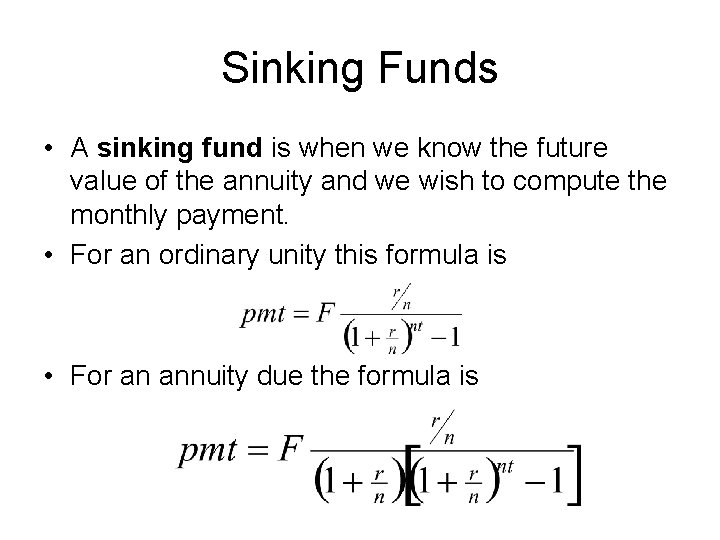
Sinking Funds • A sinking fund is when we know the future value of the annuity and we wish to compute the monthly payment. • For an ordinary unity this formula is • For an annuity due the formula is
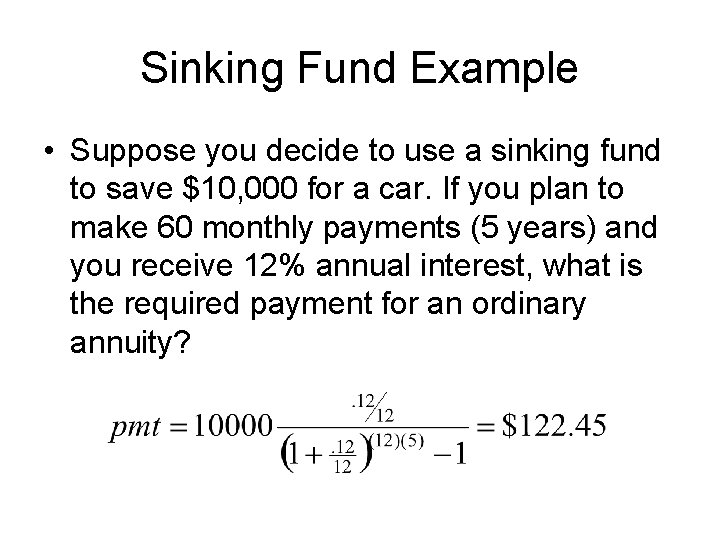
Sinking Fund Example • Suppose you decide to use a sinking fund to save $10, 000 for a car. If you plan to make 60 monthly payments (5 years) and you receive 12% annual interest, what is the required payment for an ordinary annuity?
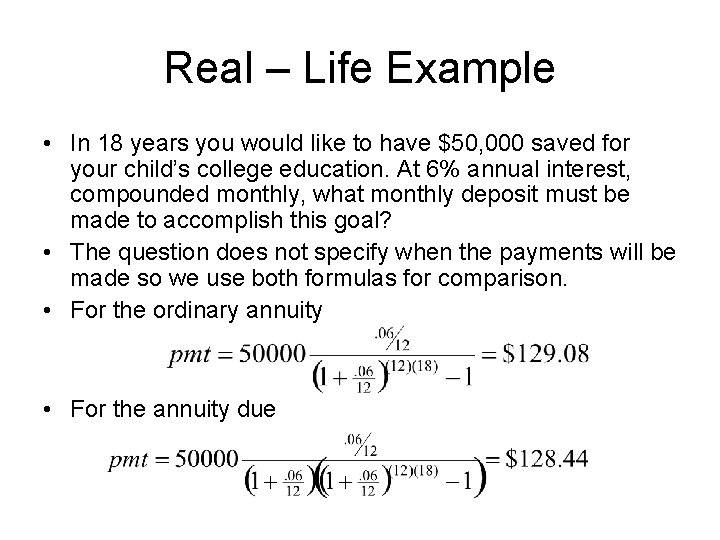
Real – Life Example • In 18 years you would like to have $50, 000 saved for your child’s college education. At 6% annual interest, compounded monthly, what monthly deposit must be made to accomplish this goal? • The question does not specify when the payments will be made so we use both formulas for comparison. • For the ordinary annuity • For the annuity due