
Annuities Objectives Identify the characteristics features and usage
Annuities Objectives Identify the characteristics, features, and usage of deferred annuities Identify the characteristics, features, and usage of immediate annuities Understand how to calculate immediate annuity payments. Understand how to calculate the exclusion ratio for immediate annuity payments. 1
Annuities: Introduction What is the risk that you “insure” with an annuity? Risk Of Old Age … basically, the risk of outliving income/wealth The annuity product transfers this risk to an insurer 2
What is an annuity? Financial Definition: A Stream Of Payments Through Time “Contracts providing for the systematic liquidation principal and interest in the form of a series of payments over a period of time” 3
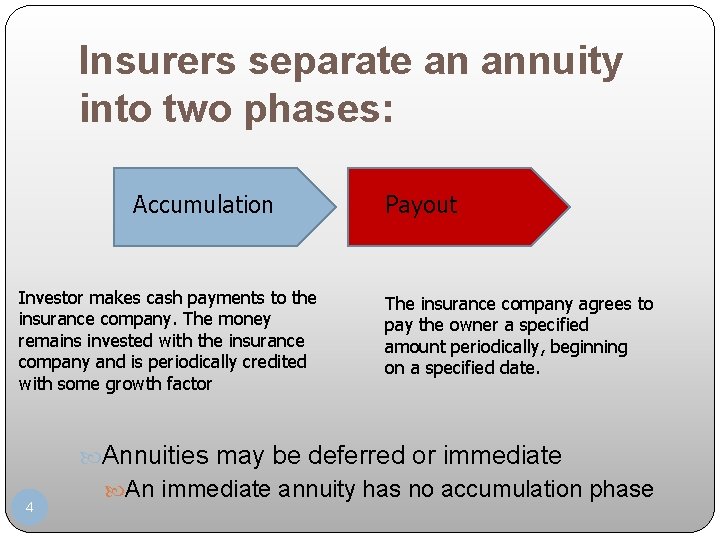
Insurers separate an annuity into two phases: Accumulation Investor makes cash payments to the insurance company. The money remains invested with the insurance company and is periodically credited with some growth factor Payout The insurance company agrees to pay the owner a specified amount periodically, beginning on a specified date. Annuities may be deferred or immediate 4 An immediate annuity has no accumulation phase
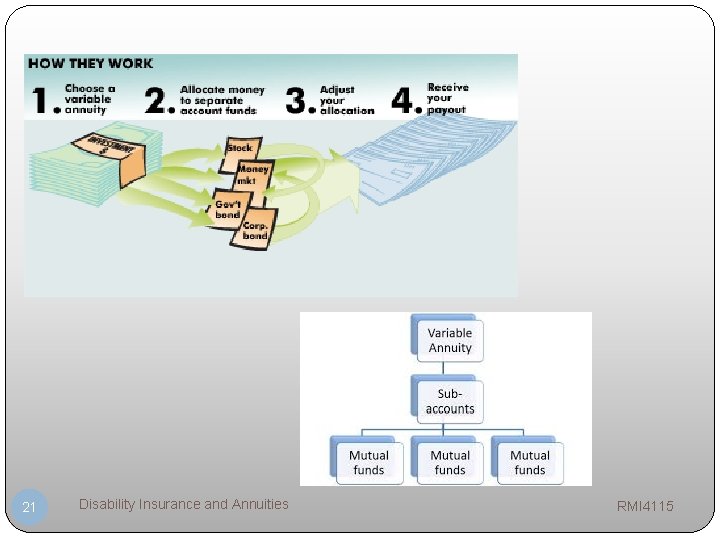
Types of Annuities – just the basics § Immediate annuity: Payout begins within one year of the date the contract is § § § § 5 established Deferred annuity: Payout begins more than one year of the date the contract is established Life annuity: Payouts will continue as long as the annuitant lives Fixed period annuity: Company promises a payout for a fixed or guaranteed period of time, independent of the survival of the annuitant Combination of life and fixed period payout: for example, the greater of ten years for the life of the annuitant Fixed annuity: Invested in the general fixed account of the insurance company Variable annuity: Invested in the separately managed sub-accounts selected by the annuity owner § Additional features § Guaranteed death benefits § Living benefits - company guaranteed benefits for owners or beneficiaries § That would be higher than actual investment performance would provide for Variable annuitization § Payments fluctuate depending on the investment performance of the underlying sub-accounts
Taxation of Annuities § Taxation is governed by IRC section 72 § Accumulation phase § Growth is tax deferred § Withdrawals during this phase are taxed on a LIFO basis § Withdrawals are considered to be withdrawals of growth first and principal second § Payout phase § A portion of each payout is considered a return of principal § A portion of each payout is considered interest or growth § Calculation of those portions (the exclusion ratio) depends on the principal invested, the period of the payout and an internal growth factor for the payout period 6
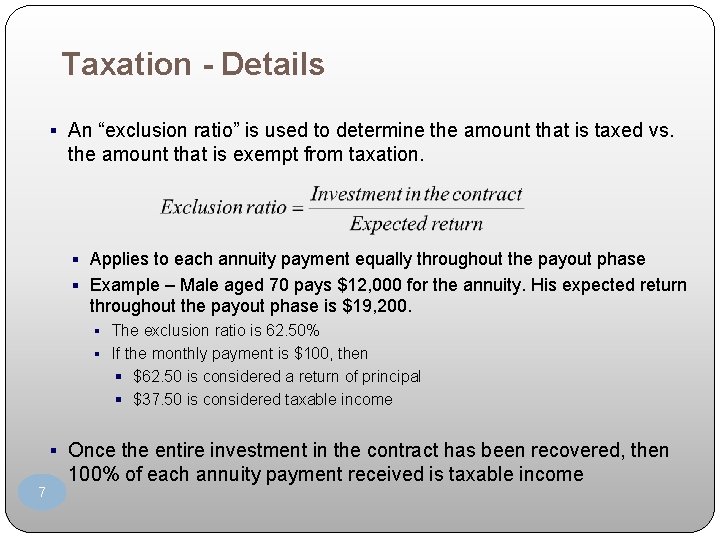
Taxation - Details § An “exclusion ratio” is used to determine the amount that is taxed vs. the amount that is exempt from taxation. § Applies to each annuity payment equally throughout the payout phase § Example – Male aged 70 pays $12, 000 for the annuity. His expected return throughout the payout phase is $19, 200. The exclusion ratio is 62. 50% § If the monthly payment is $100, then § $62. 50 is considered a return of principal § $37. 50 is considered taxable income § § Once the entire investment in the contract has been recovered, then 7 100% of each annuity payment received is taxable income
Taxation - Details § The expected return is the total amount the annuity owner should receive § Payments specified x life expectancy (or term certain if elected) § Life expectancy based on IRS Table V (single lives) or Table VI ( joint lives) § If annuitant dies before receiving the full amount guaranteed under a refund or period certain annuity § Balanced received will not be taxed (unless it exceeds the investment in the contract) § For joint and survivor annuities § Surviving owner excludes from income the same percentage of each payment that was excludible by the first annuitant § An income tax deduction may be available to the survivor owner to the extent inclusion of the annuity in the estate of the first annuitant generated 8 an estate tax (IRD)
Taxation - Details § Partial withdrawals are subject to income tax, e. g. , if the owner makes a partial withdrawal and takes a reduced annuity § If the owner takes a partial withdrawal & chooses same payments for different term § To the extent cash value exceeds investment in the contract, gain will be realized in the form of a taxable withdrawal of interest § Variable Annuities § No tax will be paid until the earlier of § Surrender of the contract § Withdrawals from the contract § Time that payments commence from the annuity § To obtain annuity treatment the underlying investments must be adequately diversified under IRS regulations 9
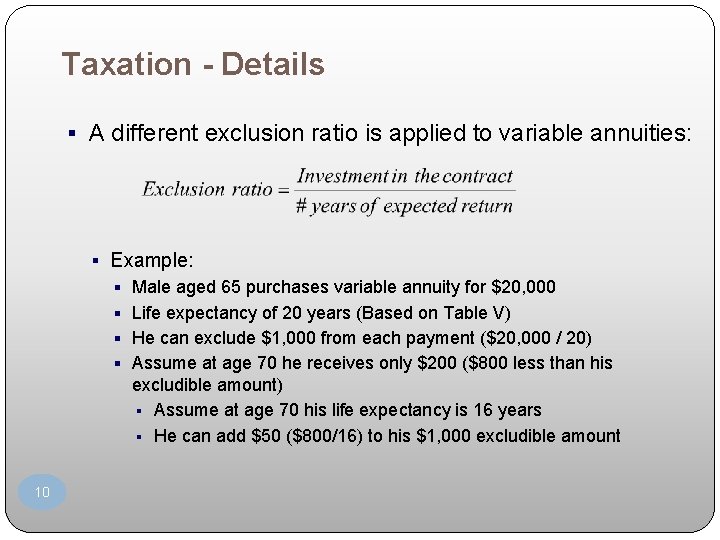
Taxation - Details § A different exclusion ratio is applied to variable annuities: § Example: § Male aged 65 purchases variable annuity for $20, 000 § Life expectancy of 20 years (Based on Table V) § He can exclude $1, 000 from each payment ($20, 000 / 20) § Assume at age 70 he receives only $200 ($800 less than his excludible amount) § Assume at age 70 his life expectancy is 16 years § He can add $50 ($800/16) to his $1, 000 excludible amount 10
Taxation - Details § If the annuitant dies before payments received equal cost § A loss deduction allowed for the amount of un-recovered investment, as an itemized deduction § Amounts payable under a deferred annuity at the death of annuitant § Partially taxable as ordinary income to the beneficiary § Equal to excess of death benefit over gross premiums § Dividends, loans, cash withdrawals and other amounts that are taken out before the annuity starting date are taxed as ordinary income to extend the cash value exceeds the investment in the contract § LIFO basis 11
Taxation - Details § Premature Distributions are subject to ordinary income tax plus a 10% penalty tax § 12 Tax applies to amount of distribution included in income § Penalty for premature distributions does not apply to: § Payments that are part of a substantial equal periodic payments made for life § Payments on or after age 59½ § Payments made on account of contracts owner disability § Payments from qualified retirement plans and IRA’s § Payments to beneficiary after death of annuitant § Distributions under an immediate annuity contract § Annuity purchased on the termination of certain qualified employer retirement plans § Payments allocable to investment in the contract before August 14 th, 1982
Taxation - Details § If annuitant dies before annuity starting date § Cash value must be distributed within 5 years of death or § Used within one year to provide for a life annuity or installments payments not longer than the beneficiaries life expectancy § If spouse is the beneficiary, spouse can elect to become the new owner of the contract instead § If an annuity contract is transferred by gift, tax deferral allowed on the inside build-up is terminated § Tax-free build-up is allowed only to “natural persons” § For non-natural persons – income is treated as ordinary income in the year received § Some exceptions include annuities received by the executor of a decedent, annuities held by a qualified retirement plan or IRA, Annuities purchased by an employer on termination of a qualified plan 13
When should one consider using an annuity? § When a person wants a retirement income that cannot be § § § 14 outlived When an individual wants a retirement income higher than their other conservative investments and is willing to have principal liquidated To avoid probate and pass a large sum of money by contract to an heir and reduce the possibility of a will contest When tax deferred growth is desired for an investment When an investor wants to be free of the responsibility of investing and managing assets As a supplement to an IRA
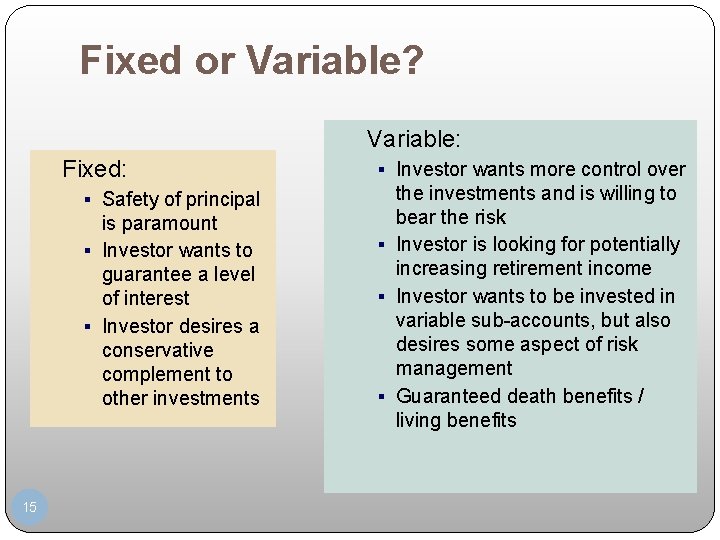
Fixed or Variable? Variable: Fixed: § Safety of principal is paramount § Investor wants to guarantee a level of interest § Investor desires a conservative complement to other investments 15 § Investor wants more control over the investments and is willing to bear the risk § Investor is looking for potentially increasing retirement income § Investor wants to be invested in variable sub-accounts, but also desires some aspect of risk management § Guaranteed death benefits / living benefits
Advantages of Annuities § Guarantees of safety, interest rates and lifelong income § Protects and preserves person’s cash reserves § Allows investment in the market while moderating risk § Client can “time” the receipt of income and shift it into lower tax § § 16 bracket years An annuity paying the same rate of interest as a taxable investment will result in a higher effective yield Underlying guarantees in variable annuities allow client to take on greater risk in the underlying investment options (equities, small market capitalizations, high yield bonds etc. ) while still maintaining a reasonable risk exposure Adjusted Gross Income (AGI) may be reduced in years where the annuity is held without withdrawals Lower taxable income may be recognized during the payout phase, due to partial recovery of basis associated with each payment
Disadvantages of Annuities § Receipt of lump sum could result in a significant tax burden § Income averaging may not be available § Cash flow received may not keep pace with inflation § A 10% penalty tax imposed on withdrawals prior to age 59 ½ § Growth in corporate-owned annuities is subject to taxation § Liquidation in the early years § Management, maintenance fees could prove expensive § Management fees and mortality charges could run from 1% to 2&1/2% of the value of the contract § Back end surrender charges § Investment earnings are taxed at owner’s ordinary income tax rate § Regardless of the source or nature of the return § Returns associated with long term capital appreciation do not enjoy the capital gains tax rate 17
Deferred Annuities Goal: Long-Term, Tax-Deferred Savings Premium types Investment Single (SPDA) Ongoing (FPA) Regular Flexible 18
Timely Advice from Consumer Reports The fixed-dollar, deferred annuity offers safety of principal and, often, outstanding long-term guaranteed rates that could be very valuable over 15 or 20 years, should market-interest rates go down. (If market-interest rates go up, the insurance company would probably credit higher rates. ) It is the only investment that can provide, at your option, the security of a monthly payment for life, regardless of how long you live. These features make annuities a good way to save for retirement. 19
Types Of Deferred Annuities Fixed No Acquisition Charge Investment growth based on interest earnings Mortality Charge Other Charges Variable No Acquisition Charge Multiple investment options Investment growth based on investment choices and performance Mortality Charge Other Charges 20
21 Disability Insurance and Annuities RMI 4115
Fees and Charges Administration/contract maintenance charge − These 22 charges cover the cost of maintaining the policy, including accounting and record-keeping. Contingent deferred sales charge (CDSC) − The CDSC pays for sales expenses such as commissions, promotions and sales materials. It is deducted from your cash value if you surrender (terminate) your contract before the end of your surrender charge period. Be sure to check the length of your surrender charge period when evaluating a contract to buy, since it can vary. Mortality and expense risk charge (M and E) − These charges compensate Nationwide for guaranteeing that annuity purchase rates and charges will not change, Disability Insuranceof andmortality Annuities RMI 4115 regardless rates or actual expenses.
Fees and Charges Premium tax − This tax reimburses Nationwide for any premium taxes levied by a state or other government entity. Short-term trading fees − These fees compensate the underlying mutual fund and its contract owners for the negative impact on fund performance that can result from frequent, short-term trading strategies. Underlying mutual fund expenses − These expenses are deducted from underlying mutual fund assets and pay for fund management distribution (12 b-1) fees and other expenses. 23 Disability Insurance and Annuities RMI 4115
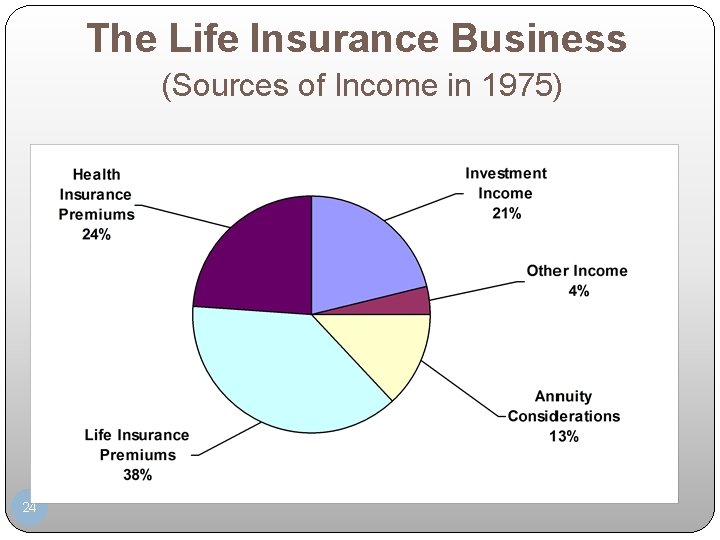
The Life Insurance Business (Sources of Income in 1975) 24
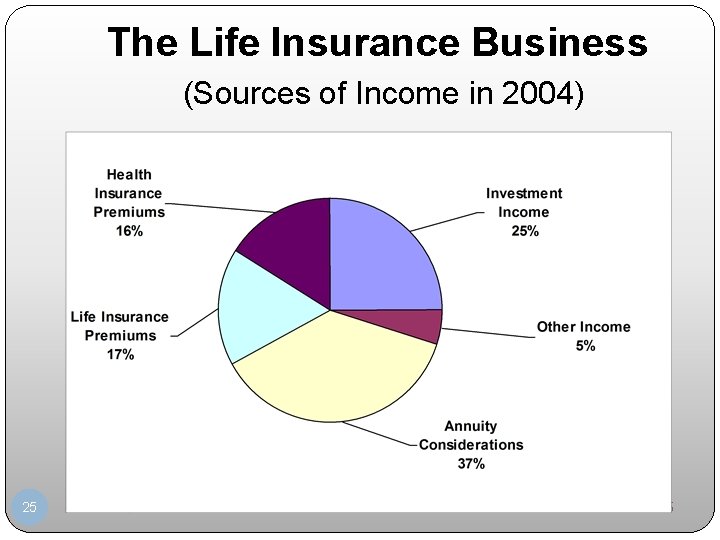
The Life Insurance Business (Sources of Income in 2004) 25 Disability Insurance and Annuities RMI 4115
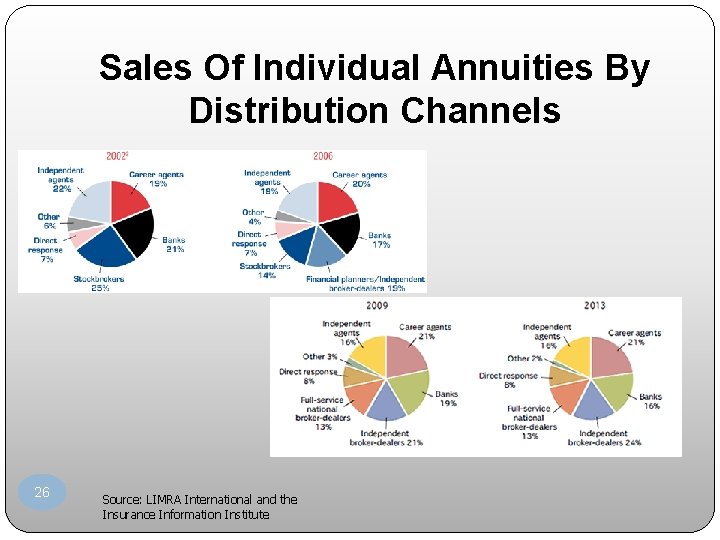
Sales Of Individual Annuities By Distribution Channels 26 Source: LIMRA International and the Insurance Information Institute
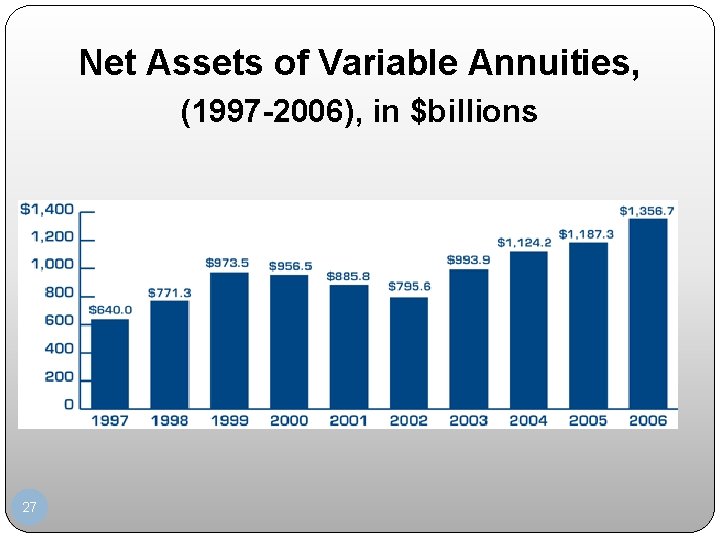
Net Assets of Variable Annuities, (1997 -2006), in $billions 27
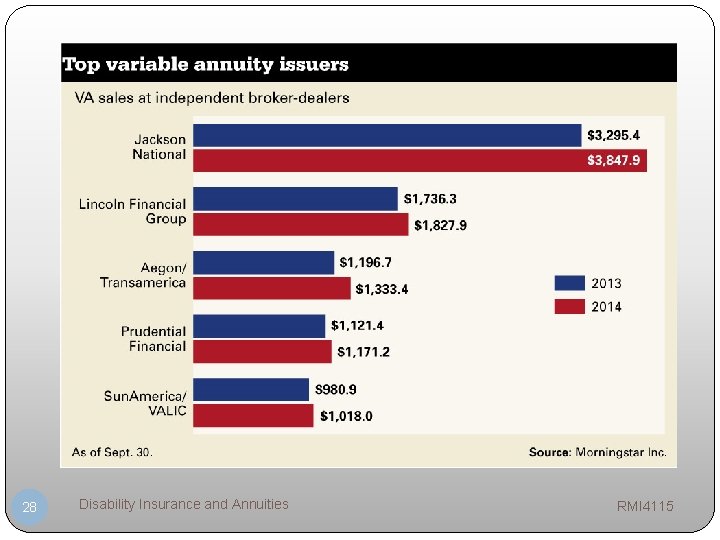
28 Disability Insurance and Annuities RMI 4115
29 Disability Insurance and Annuities RMI 4115
Individual Annuity Considerations (1997 -2003) 30
31 Disability Insurance and Annuities RMI 4115
32
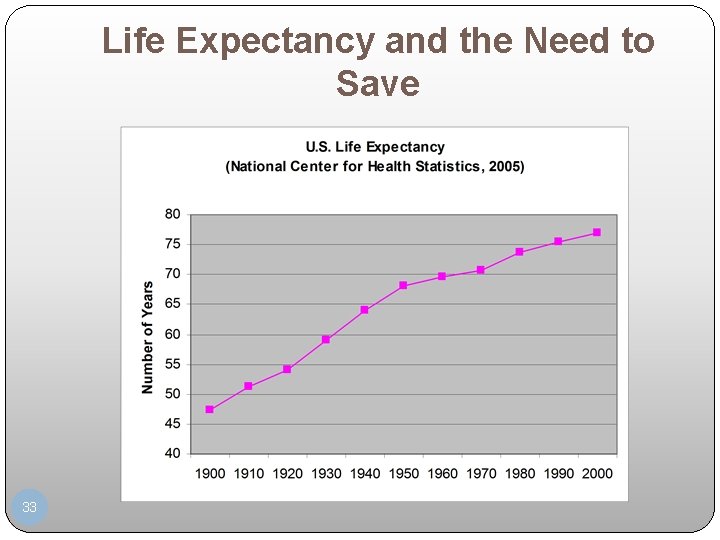
Life Expectancy and the Need to Save 33
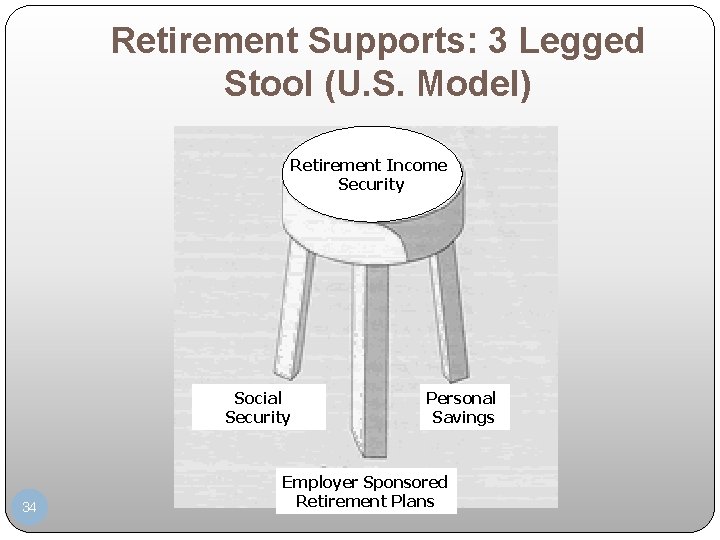
Retirement Supports: 3 Legged Stool (U. S. Model) Retirement Income Security Social Security 34 Personal Savings Employer Sponsored Retirement Plans
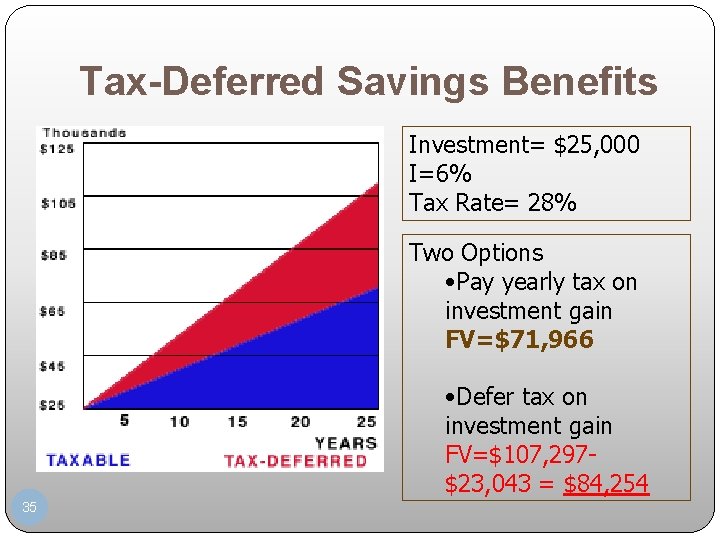
Tax-Deferred Savings Benefits Investment= $25, 000 I=6% Tax Rate= 28% Two Options • Pay yearly tax on investment gain FV=$71, 966 • Defer tax on investment gain FV=$107, 297$23, 043 = $84, 254 35
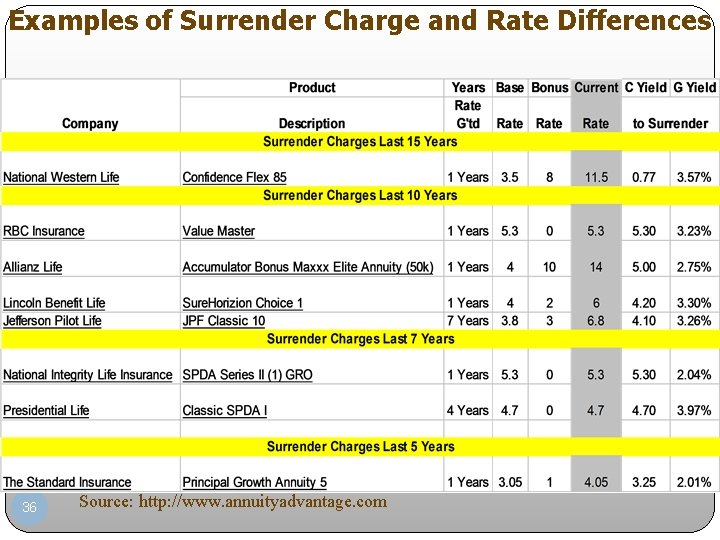
Examples of Surrender Charge and Rate Differences 36 Source: http: //www. annuityadvantage. com
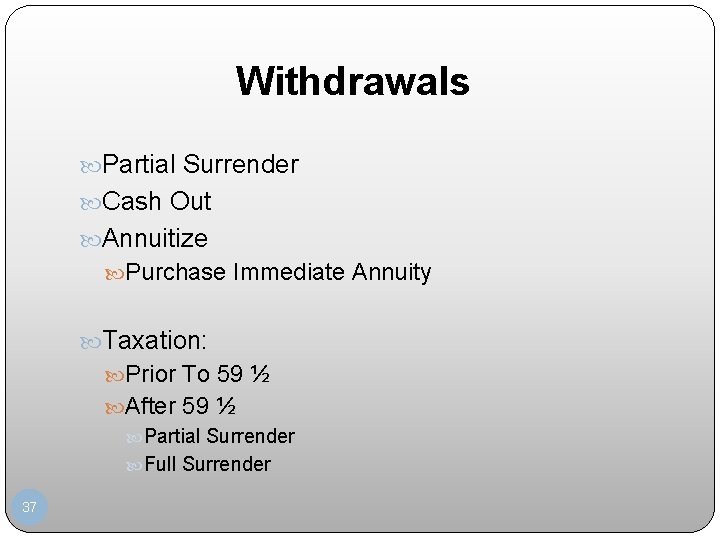
Withdrawals Partial Surrender Cash Out Annuitize Purchase Immediate Annuity Taxation: Prior To 59 ½ After 59 ½ Partial Surrender Full Surrender 37
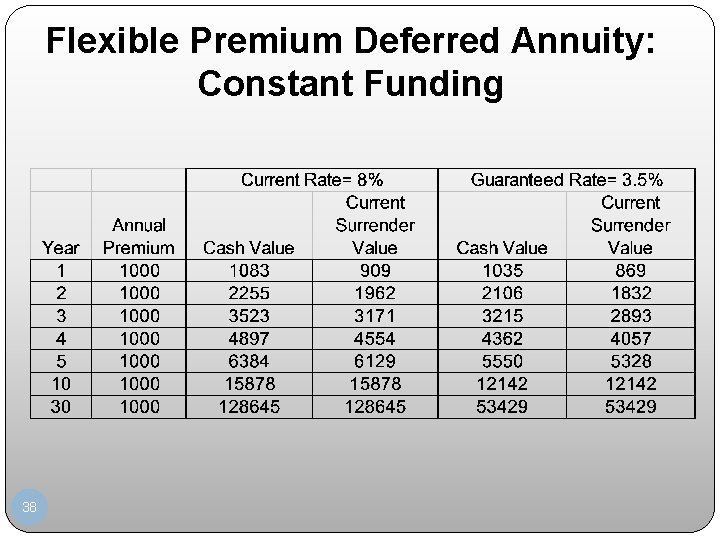
Flexible Premium Deferred Annuity: Constant Funding 38
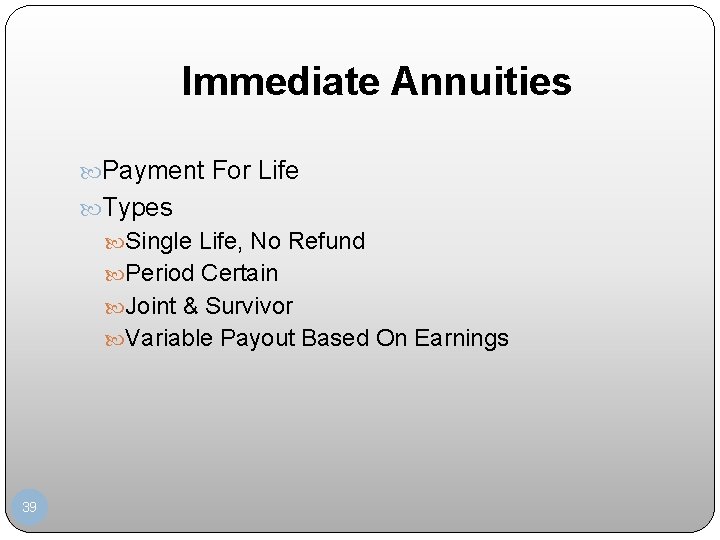
Immediate Annuities Payment For Life Types Single Life, No Refund Period Certain Joint & Survivor Variable Payout Based On Earnings 39
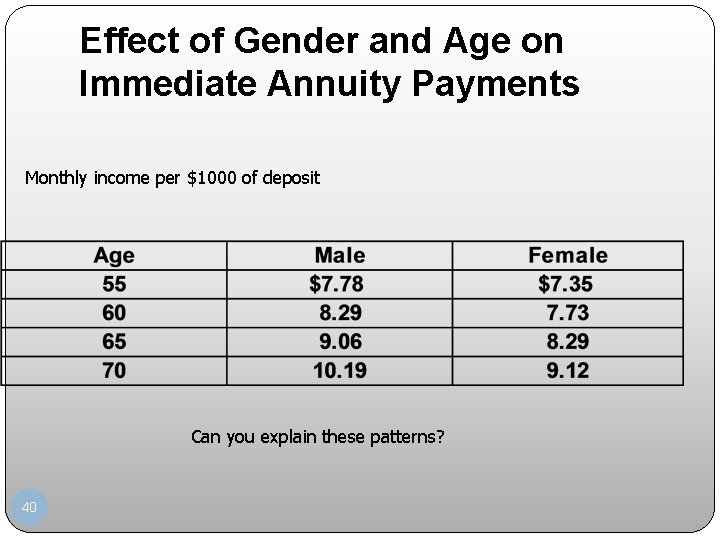
Effect of Gender and Age on Immediate Annuity Payments Monthly income per $1000 of deposit Can you explain these patterns? 40
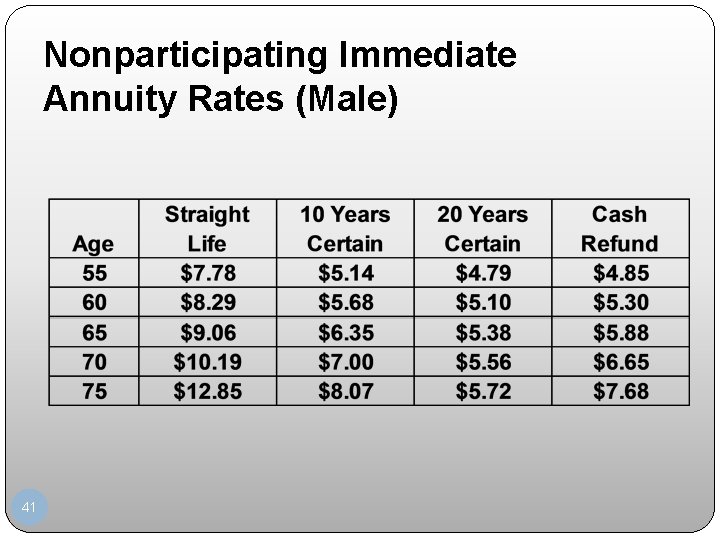
Nonparticipating Immediate Annuity Rates (Male) 41
How are Immediate Annuities Used? Retirement Benefits Supplemental Benefits Legal Awards (Structured Settlements) Parent/Handicapped Child Private Annuities 42
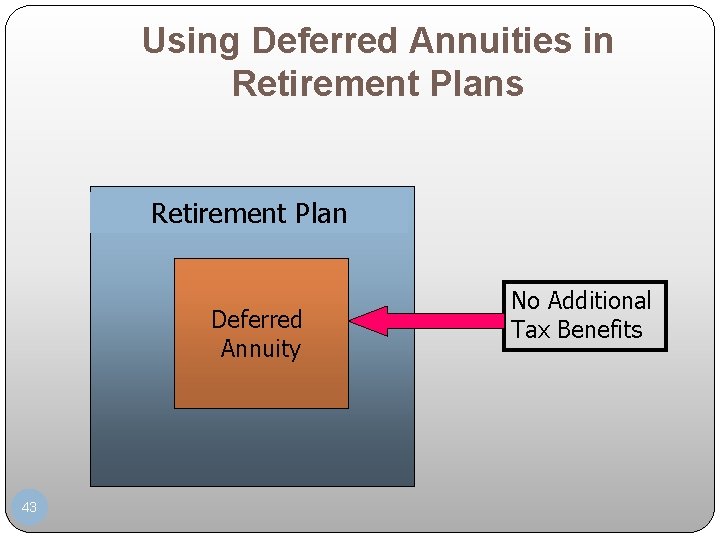
Using Deferred Annuities in Retirement Plans Retirement Plan Deferred Annuity 43 No Additional Tax Benefits
Alternatives to Annuities § Municipal bond funds § Income exempt from federal and some state income taxes § Money can be withdrawn without tax penalty § Disadvantage § Lack of guaranteed return § Potential for capital losses if interest rates rise and bonds sold before maturity § Single Premium Life Insurance § Tax free death benefit § Tax deferred growth of cash surrender values § Withdrawals & loans subject to LIFO taxation and 10% penalty if distribution occurred before age 59 ½
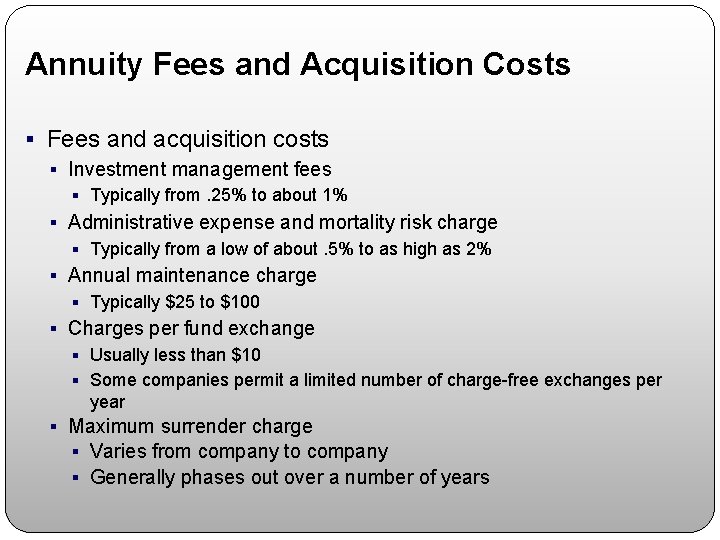
Annuity Fees and Acquisition Costs § Fees and acquisition costs § Investment management fees § Typically from. 25% to about 1% § Administrative expense and mortality risk charge § Typically from a low of about. 5% to as high as 2% § Annual maintenance charge § Typically $25 to $100 § Charges per fund exchange § Usually less than $10 § Some companies permit a limited number of charge-free exchanges per year § Maximum surrender charge § Varies from company to company § Generally phases out over a number of years
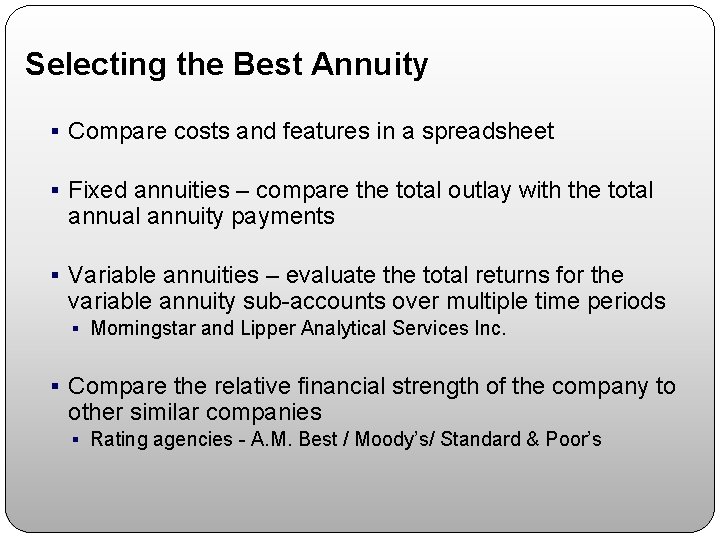
Selecting the Best Annuity § Compare costs and features in a spreadsheet § Fixed annuities – compare the total outlay with the total annuity payments § Variable annuities – evaluate the total returns for the variable annuity sub-accounts over multiple time periods § Morningstar and Lipper Analytical Services Inc. § Compare the relative financial strength of the company to other similar companies § Rating agencies - A. M. Best / Moody’s/ Standard & Poor’s
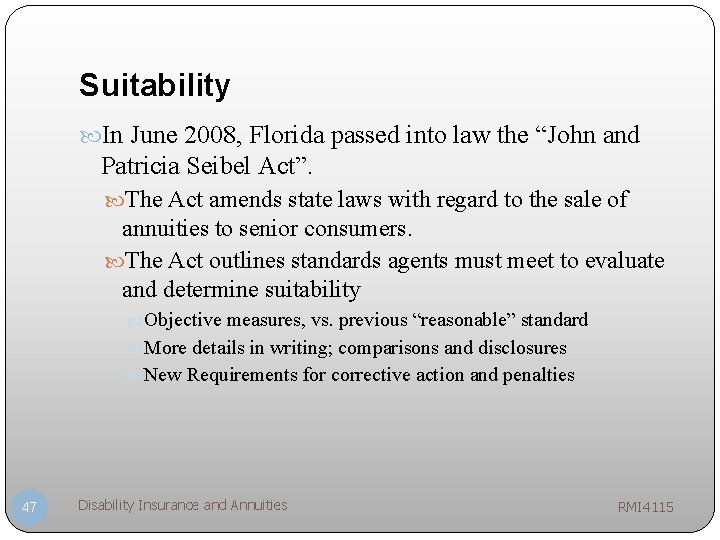
Suitability In June 2008, Florida passed into law the “John and Patricia Seibel Act”. The Act amends state laws with regard to the sale of annuities to senior consumers. The Act outlines standards agents must meet to evaluate and determine suitability Objective measures, vs. previous “reasonable” standard More details in writing; comparisons and disclosures New Requirements for corrective action and penalties 47 Disability Insurance and Annuities RMI 4115
- Slides: 47