
Annual USDA Civil Rights Training for Schools Participating
- Slides: 57
Annual USDA Civil Rights Training for Schools Participating in Special Milk Program (SMP)
Purpose of Civil Rights Training • Inform, educate, and support all staff who interact with Special Milk Program (SMP) applicants • Describe staff rights and responsibilities as administrators of SMPs • Instruct on general USDA civil rights requirements • Share resources and information available to assist in civil rights responsibilities
Federal Law Prohibits Discrimination of Protected Classes: • Sex • Race • Disability • Color • Age • National Origin
Protected Classes under Wisconsin State Law • Adds protections for persons with regard to religion, creed, ancestry, pregnancy, marital status, parental status, and sexual orientation • Adopts all other federal protected classes except for color
Protected Classes under Wisconsin State Law • All federal child nutrition programs, including SMP, operating in public school districts in Wisconsin must adopt both federal and state protected classes (private schools must only adopt federal)
Requirements of Public Notification • To inform community (especially underrepresented groups) that school participates in the SMP • To reach as many participants and those potentially eligible for free milk as possible
Requirements of Public Notification Must include: • • Eligibility Benefits and services (milk at no or low charge) Program availability (e. g. , location of school, delivery points, hours of service) Applicant rights and responsibilities *Only for Pricing with Free Milk Option programs Procedures for filing a complaint Nondiscrimination policies Any programmatic changes (e. g. , changing location of a milk service)
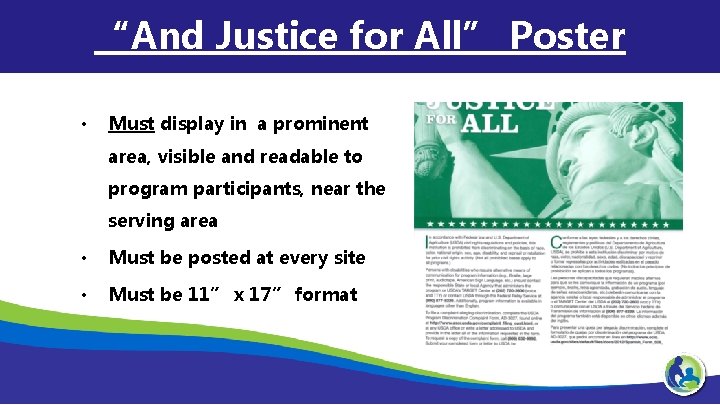
Methods of Public Notification • Post “And Justice for All” poster (required for all SMP pricing options) Includes the USDA’s nondiscrimination statement and lists the USDA contact information for filing a complaint of discrimination • Public Release (only for Pricing Plan with Free Milk Option programs) Inform the general public that school participates in the SMP and offers free milk • Other methods of public notification (optional) Bulletins, Letters/Leaflets/Brochures, Internet/Computer-based applications
“And Justice for All” Poster • Must display in a prominent area, visible and readable to program participants, near the serving area • Must be posted at every site • Must be 11” x 17” format
“And Justice for All” Posters • DPI provides posters to school free of charge • To order, call 608 -267 -9228
Public Release (Only for Pricing Plan with Free Milk programs) Required to send to media and grassroots organizations prior to or at the beginning of each school year: • Media (e. g. , local/community newspapers, radio, television) • Grassroots organizations that reach minority or under-represented groups (e. g. , churches, refugee/immigrant settlement services, laundromats, social service agencies, libraries, grocery stores, WIC offices, food pantries, senior centers, physician offices/clinics)
Public Release (Only for Pricing Plan with Free Milk programs) In addition, send the release to major employers contemplating or experiencing large layoffs and local unemployment offices, as applicable
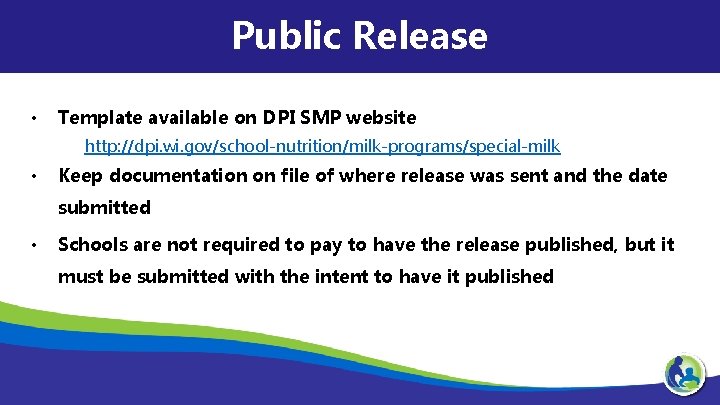
Public Release • Template available on DPI SMP website http: //dpi. wi. gov/school-nutrition/milk-programs/special-milk • Keep documentation on file of where release was sent and the date submitted • Schools are not required to pay to have the release published, but it must be submitted with the intent to have it published
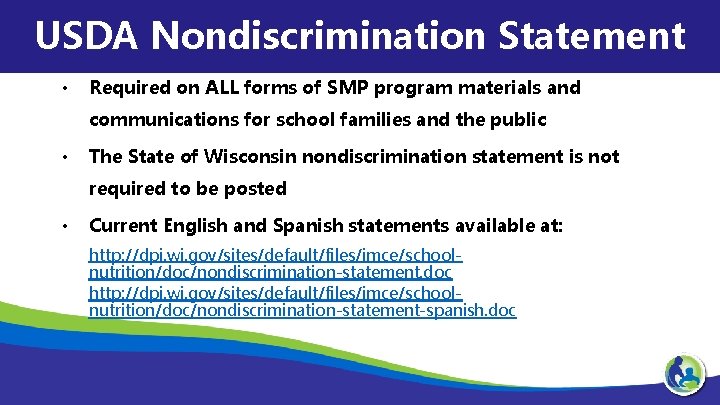
USDA Nondiscrimination Statement • Required on ALL forms of SMP program materials and communications for school families and the public • The State of Wisconsin nondiscrimination statement is not required to be posted • Current English and Spanish statements available at: http: //dpi. wi. gov/sites/default/files/imce/schoolnutrition/doc/nondiscrimination-statement. doc http: //dpi. wi. gov/sites/default/files/imce/schoolnutrition/doc/nondiscrimination-statement-spanish. doc
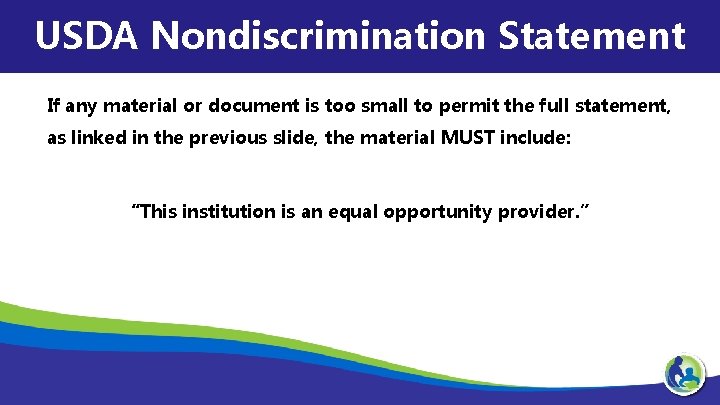
USDA Nondiscrimination Statement If any material or document is too small to permit the full statement, as linked in the previous slide, the material MUST include: “This institution is an equal opportunity provider. ”
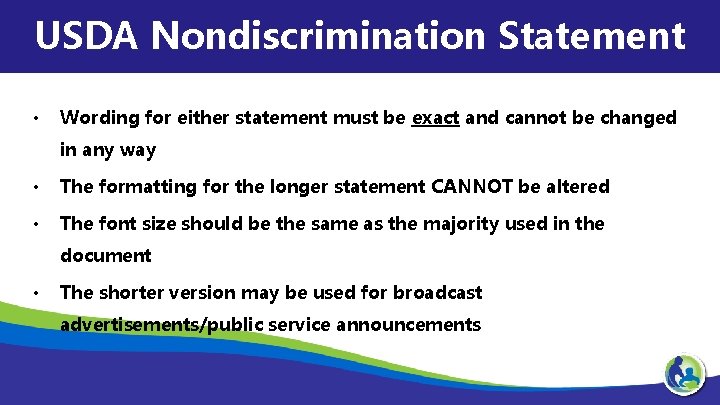
USDA Nondiscrimination Statement • Wording for either statement must be exact and cannot be changed in any way • The formatting for the longer statement CANNOT be altered • The font size should be the same as the majority used in the document • The shorter version may be used for broadcast advertisements/public service announcements
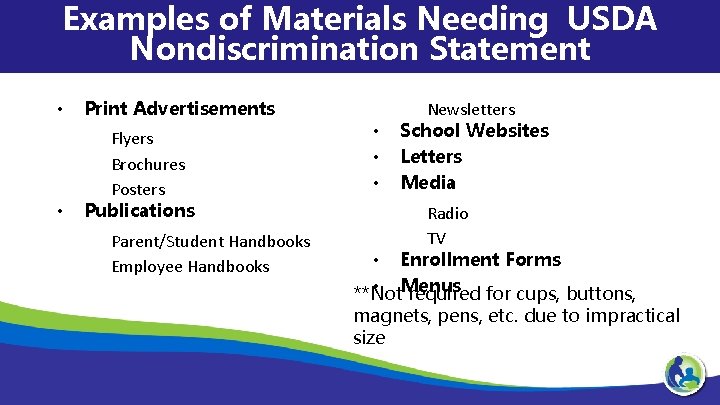
Examples of Materials Needing USDA Nondiscrimination Statement • Print Advertisements • Flyers Brochures Posters Publications Parent/Student Handbooks Employee Handbooks • • • Newsletters School Websites Letters Media Radio TV • Enrollment Forms • Menus **Not required for cups, buttons, magnets, pens, etc. due to impractical size
Equity in Program Materials Reflect diversity and inclusion in all program materials, photos, and graphics
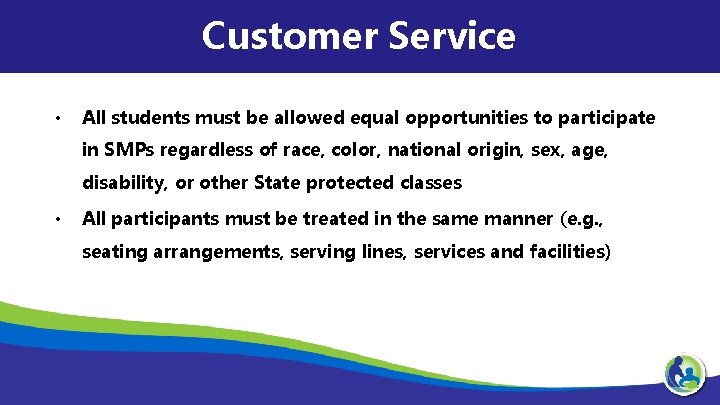
Customer Service • All students must be allowed equal opportunities to participate in SMPs regardless of race, color, national origin, sex, age, disability, or other State protected classes • All participants must be treated in the same manner (e. g. , seating arrangements, serving lines, services and facilities)
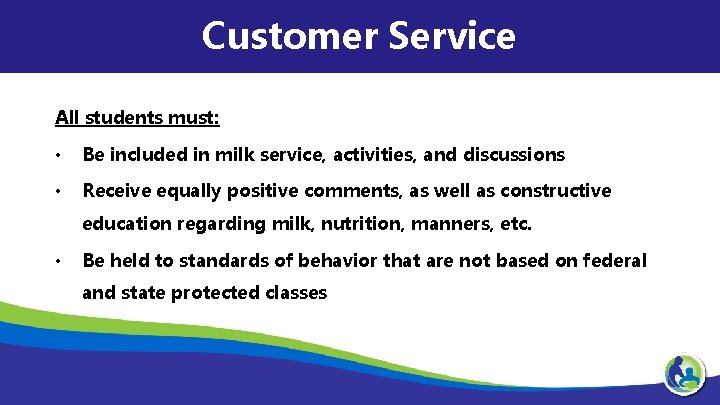
Customer Service All students must: • Be included in milk service, activities, and discussions • Receive equally positive comments, as well as constructive education regarding milk, nutrition, manners, etc. • Be held to standards of behavior that are not based on federal and state protected classes
Customer Service Students must not be required to use a separate room, separate serving line, or separate serving time based on eligibility for free milk (if applicable), sex, national origin, race, color, disability and age
Separation by Gender In general, children are not permitted to be separated by gender during the milk service
Separation by Gender USDA Memo SP 31 -2015 allows exemptions with State Agency approval for: • Meal service at religious institutions operating under the dictates of the religion with which they are affiliated • Meal service at juvenile correctional facilities where combining members of the opposite gender would present a potential safety risk • Meal service at facilities that fully separate by gender as part of their normal operations (for example, gender-separated summer camps) The exemption form is located on the DPI website at: http: //dpi. wi. gov/school-nutrition/national-school-lunch-program/civil
Customer Service All students in the same grade grouping must be offered the same selection of milk types regardless of their race, color, national origin, sex, disability, age, or eligibility status (applicable to SMP with Free Milk Options programs)
Denial of Milk USDA prohibits the denial of milk as a disciplinary action The following are circumstances where milk MAY be denied: • Disciplinary actions that indirectly result in loss of milk (e. g. , student is suspended from school) • Students who do not have money to pay for milk
Free Milk Application Approval Process (Only for Pricing Plans with Free Milk Option) • Admission procedures must not restrict minority persons from enrolling in school or participating in the SMP • Students may not be required to participate in the SMP
Confidentiality and Disclosure • USDA authorizes schools to release free milk eligibility status ONLY to entities as stated in USDA’s Eligibility Manual for School Meals • Eligibility information should only be released to those that have legitimate “need to know” basis
Sharing Information Template Letter (Only for Pricing Plans with Free Milk Option) • Schools must obtain consent from parents/guardians if sharing application information with other programs or using to subsidize school fees • Sharing Information Template Letter • Identifies how the information will be used • Allows for parent/guardian to release or deny information per program • Authorizes release of free milk status • NO OTHER INFORMATION ON THE APPLICATION MAY BE RELEASED!
Confidentiality and Disclosure • Names or other forms of identifying information must not be published, posted, or announced in any manner • No overt identification of students approved for free milk by use of special tickets or tokens • Approved money and milk accountability in online contract must be followed
Respectful Language • Put the person first Example: use “person with a disability” NOT “disabled person” • Use culturally sensitive language • Use inclusive/respectful terms Example: use “chairperson” NOT “chairman”
Respectful Language • How would I want to be addressed? • Am I treating this person in the same manner I treat others? • Have I informed this person exactly what information I need and provided clarification when necessary to make a determination on the application? • Have I provided this person with information (s)he needs to make necessary decisions?
LEP Language Assistance • Limited English Proficiency (LEP): Individuals who do not speak English as their primary language and who have a limited ability to read, speak, write, or understand English • All organizations receiving federal financial assistance via participation in Child Nutrition Programs have a responsibility to take “reasonable steps” to ensure meaningful access to their programs and activities by person with LEP
LEP Language Assistance • SMP information is available to all persons in their language • Translation and interpretation services are an allowable cost to the program • Children should not be used as interpreters; volunteers may be used but should understand confidentiality • Verbal communications is provided for those with literacy deficiencies • www. lep. gov has more information and resources
Reasonable accommodation for persons with disabilities Disability: physical or mental impairment which substantially limits one or more of an individual’s major life activities as documented
Reasonable accommodation for persons with disabilities Disabilities are defined based on Sect 504 of the Rehabilitation Act/Americans with Disabilities Act and Part B of the Individuals with Disabilities Education Act (IDEA) Examples: Orthopedic/visual/speech/hearing impairments, cerebral palsy, epilepsy, muscular dystrophy, multiple sclerosis, cancer, specific learning disabilities, tuberculosis, diabetes, phenylketonuria, heart condition, food anaphylaxis, mental retardation, emotional illness, drug addiction/alcoholism, HIV, autism, traumatic brain injury
Reasonable accommodation for persons with disabilities • Provide facilities and appropriate information in alternative formats for persons with disabilities • Examples include accessible parking lots, entrances and exits, halls, elevators, rest rooms, service animals, Braille signage and materials, alternative arrangements for service, sign language interpreters, etc. • Provide milk substitution for students with disabilities when documented in writing by a licensed medical practitioner
Providing Milk Substitutions • USDA regulations only require substitutions or modifications for children whose disabilities restrict their diets, such as food allergies causing life-threatening anaphylactic reactions
Providing Milk Substitutions • Dietary requests based a disability must be documented by a licensed medical practitioner’s statement, which must include: • The child’s disability • An explanation of why the disability restricts the child’s diet • The major life activity or major bodily function affected by the disability • The replacement for cow’s milk that must be substituted
Providing Milk Substitutions • For food allergies or intolerances not defined as a disability by the licensed medical practitioner, the school may, but is not required to, make substitutions or accommodations. • Remember, lactose free milk can be substituted freely without documentation of a disability and claimed for reimbursement
Racial/Ethnic Data Collection • Racial/ethnic data is used to determine how effectively your program is reaching potentially eligible children and where outreach may be needed • Data must be recorded on an annual basis using the Civil Rights Self Compliance Form (PI-1456)
Racial/Ethnic Data Collection • Parent, guardian or household may be asked to identify the racial and ethnic group of the participant but are not required to do so • Schools may also use the student data base or visual identification for reporting and evaluation
Civil Rights Self Compliance Form (PI 1456) • The Civil Rights Self Compliance Form (PI-1456) is also used to evaluate the school’s compliance with civil rights topics • Noncompliance: a factual finding that any civil rights requirement, as provided by law, regulation, policy, instruction or guidelines is not being adhered to • All instances of noncompliance are considered equally and must be corrected
Examples of Noncompliance • Providing SMP program services, benefits or selecting program sites/facilities that deny individuals access to SMP program on the basis of federal or state protected classes (race, color, national origin, etc. ) • Denying an individual or household the opportunity to apply for free milk on the basis of federal or state protected classes (race, color, national origin, age, etc. )
Resolution of Noncompliance If noncompliance is indicated, a corrective action plan must be implemented immediately to achieve voluntary compliance within 60 days Corrective Action Plan: plan describing the school’s actions to be taken to resolve noncompliance with civil rights requirements
Conflict Resolution • The USDA recommends using an Alternative Dispute Resolution (ADR) program ADR Definition: use of a neutral third party (usually a person acting as a facilitator) to resolve informally a complaint of discrimination through use of various techniques such as fact finding, mediation, peer panels, facilitation, ombudsman support or conciliation
Complaint Procedures and Information • All schools should have procedures (written procedures preferred) in place for handling civil rights complaints • A school may attempt to resolve a situation that is occurring in real time • However, if an individual states that they wish to file a civil rights complaint, the school must provide them with the information necessary to do so and not impede an individual’s right to file
Right to File a Complaint Complainants may contact USDA to register a complaint within 180 days of the alleged discriminatory action U. S. Department of Agriculture, Office of the Assistant Secretary for Civil Rights, 1400 Independence Avenue, SW, Washington, D. C. 202509410, (866) 632 -9992 (toll free), (202) 260 -1026, or (202) 401 -0216 (TDD) USDA Discrimination Complaint form (AD-3027) can be found online at: https: //www. ascr. usda. gov/complaint_filing_cust. html
Right to File a Complaint Complainants may contact Wisconsin DPI to register a complaint within 180 days of the alleged discriminatory action Wisconsin DPI: Director, School Nutrition Programs, 125 South Webster Street, P. O. Box 7841, Madison, WI 53707 -7841, (608) 267 -9121 The form to assist in filing these complaints can be found on the DPI SNT website at https: //www. ocio. usda. gov/sites/default/files/docs/2012/Complain_combin ed_6_8_12. pdf
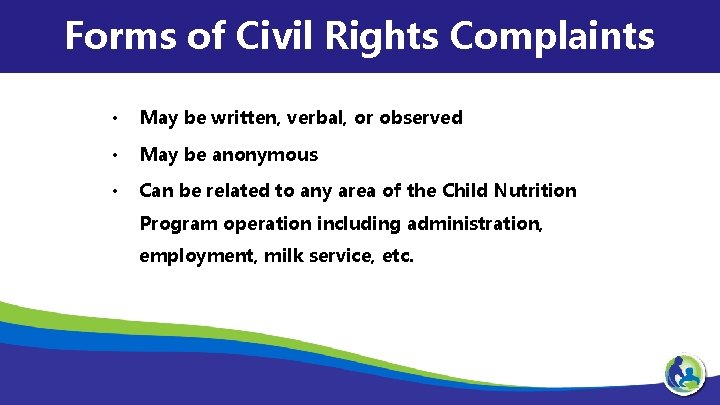
Forms of Civil Rights Complaints • May be written, verbal, or observed • May be anonymous • Can be related to any area of the Child Nutrition Program operation including administration, employment, milk service, etc.
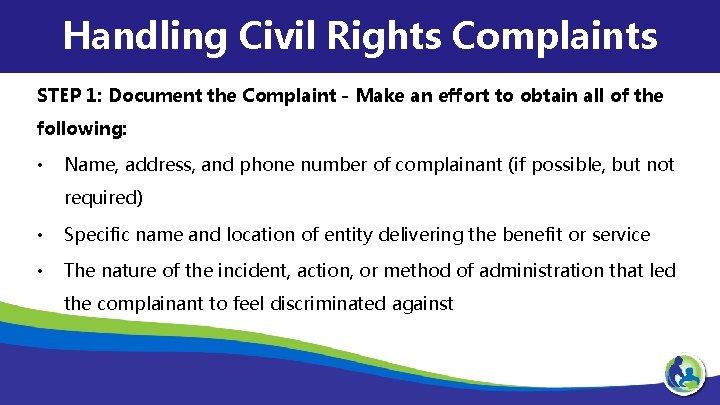
Handling Civil Rights Complaints STEP 1: Document the Complaint - Make an effort to obtain all of the following: • Name, address, and phone number of complainant (if possible, but not required) • Specific name and location of entity delivering the benefit or service • The nature of the incident, action, or method of administration that led the complainant to feel discriminated against
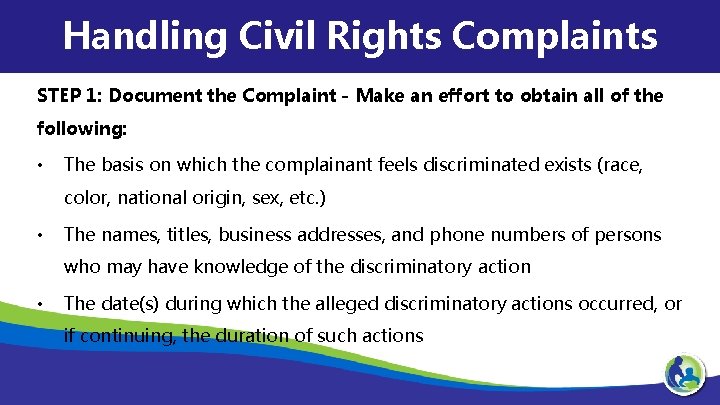
Handling Civil Rights Complaints STEP 1: Document the Complaint - Make an effort to obtain all of the following: • The basis on which the complainant feels discriminated exists (race, color, national origin, sex, etc. ) • The names, titles, business addresses, and phone numbers of persons who may have knowledge of the discriminatory action • The date(s) during which the alleged discriminatory actions occurred, or if continuing, the duration of such actions
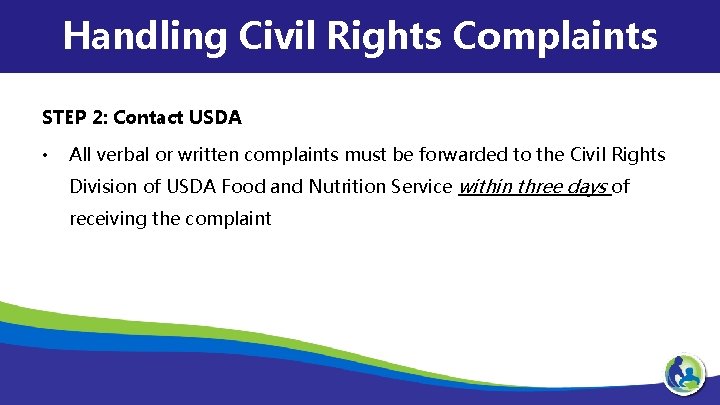
Handling Civil Rights Complaints STEP 2: Contact USDA • All verbal or written complaints must be forwarded to the Civil Rights Division of USDA Food and Nutrition Service within three days of receiving the complaint
Handling Civil Rights Complaints STEP 3: Maintain Records • Agencies should document all complaints in a complaint log or on complaint forms Agencies may provide a complaint form to: Any individual wishing to make a complaint Persons receiving a verbal or phone complaint
Civil Rights Coordinator in Your Schools must designate an employee who is responsible for USDA Civil Rights issues
Questions? Wisconsin Department of Public Instruction School Nutrition Team 125 South Webster Street P. O. Box 7841 Madison, WI 53707 -7841 608 -267 -9228 http: //dpi. wi. gov/school-nutrition
Remember… Please maintain documentation of attendees and power point review date
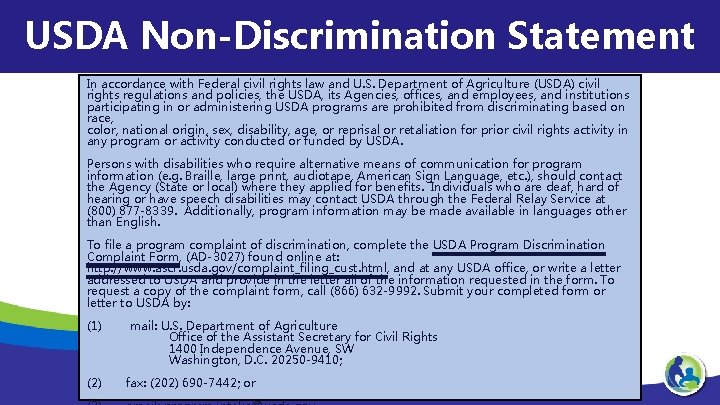
USDA Non-Discrimination Statement In accordance with Federal civil rights law and U. S. Department of Agriculture (USDA) civil rights regulations and policies, the USDA, its Agencies, offices, and employees, and institutions participating in or administering USDA programs are prohibited from discriminating based on race, color, national origin, sex, disability, age, or reprisal or retaliation for prior civil rights activity in any program or activity conducted or funded by USDA. Persons with disabilities who require alternative means of communication for program information (e. g. Braille, large print, audiotape, American Sign Language, etc. ), should contact the Agency (State or local) where they applied for benefits. Individuals who are deaf, hard of hearing or have speech disabilities may contact USDA through the Federal Relay Service at (800) 877 -8339. Additionally, program information may be made available in languages other than English. To file a program complaint of discrimination, complete the USDA Program Discrimination Complaint Form, (AD-3027) found online at: http: //www. ascr. usda. gov/complaint_filing_cust. html, and at any USDA office, or write a letter addressed to USDA and provide in the letter all of the information requested in the form. To request a copy of the complaint form, call (866) 632 -9992. Submit your completed form or letter to USDA by: (1) mail: U. S. Department of Agriculture Office of the Assistant Secretary for Civil Rights 1400 Independence Avenue, SW Washington, D. C. 20250 -9410; (2) fax: (202) 690 -7442; or