
ANNUAL PERFORMANCE PLAN AND BUDGET FOR 201415 Presentation

ANNUAL PERFORMANCE PLAN AND BUDGET FOR 2014/15 Presentation to the Portfolio Committee on Higher Education and Training 2 July 2014
Presentation Outline 1. Strategic Overview 2. Budget Programmes and Financial Information 3. Programme Plans and Targets for 2014/15 - Administration - Human Resource Development, Planning and Monitoring Coordination - University Education - Vocational and Continuing Education and Training - Skills Development 2
Strategic Overview • The Department of Higher Education and Training was established in May 2009 and is responsible for all post-school education and training • Its areas of responsibility were previously located in the former Department of Education, the Department of Labour and the Provincial Departments of Education • The Department is responsible for Outcome 5 of government’s 12 outcomes “A skilled and capable workforce to support an inclusive growth path” 3
Strategic Overview Vision A South Africa in which we have a differentiated and fully inclusive post-school system that allows all South Africans to access and succeed in relevant post-school education and training, in order to fulfil the economic and social goals of participation in an inclusive economy and society 4
Strategic Overview Mission To develop capable, well educated and skilled citizens that are able to compete in a sustainable, diversified and knowledge intensive international economy, which meets the developmental goals of our country. The Department will undertake this by: • reducing the skills bottlenecks, especially in priority and scarce skills areas • improving low participation rates in the post-school system • correcting distortions in the shape, size and distribution of access to post-school education and training • improving the quality and efficiency in the system, its subsystems and institutions 5
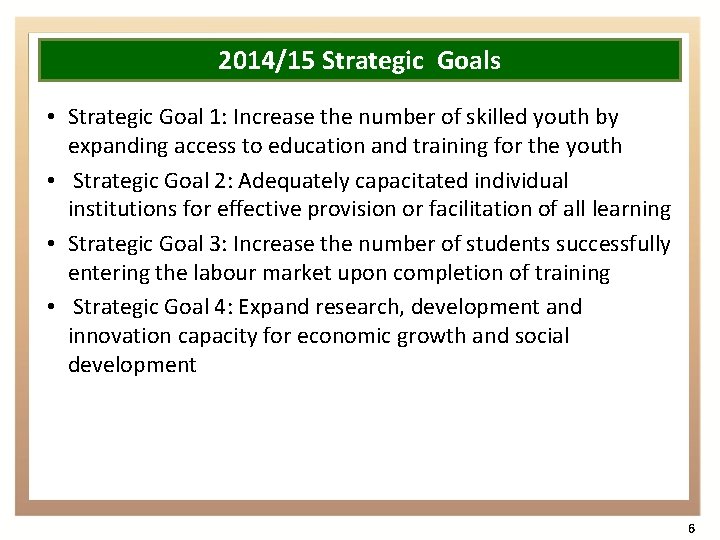
2014/15 Strategic Goals • Strategic Goal 1: Increase the number of skilled youth by expanding access to education and training for the youth • Strategic Goal 2: Adequately capacitated individual institutions for effective provision or facilitation of all learning • Strategic Goal 3: Increase the number of students successfully entering the labour market upon completion of training • Strategic Goal 4: Expand research, development and innovation capacity for economic growth and social development 6

2014/15 Strategic Goals • Strategic Goal 5: A college curriculum that is responsive to the demands of the market place and can transform and adapt quickly and effectively to changing skills needs, with a special emphasis on artisan training • Strategic Goal 6: A credible institutional mechanism for skills planning to support an inclusive economic growth path • Strategic Goal 7: A highly effective, professional, efficient administration informed by good corporate governance practices 7
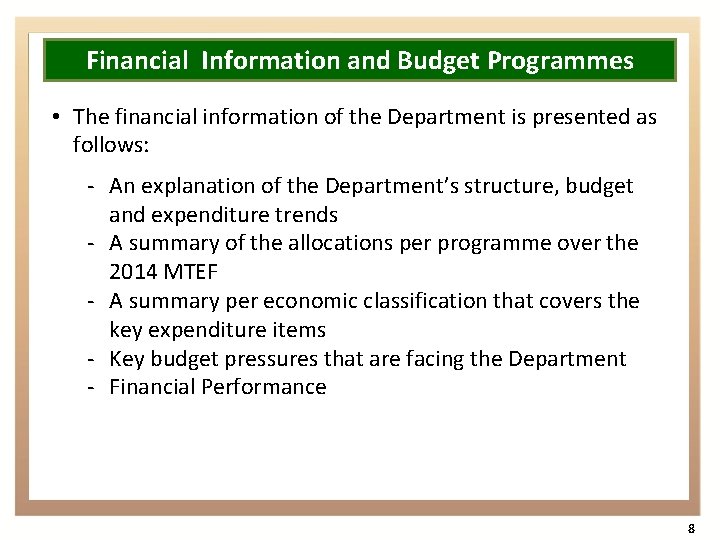
Financial Information and Budget Programmes • The financial information of the Department is presented as follows: - An explanation of the Department’s structure, budget and expenditure trends - A summary of the allocations per programme over the 2014 MTEF - A summary per economic classification that covers the key expenditure items - Key budget pressures that are facing the Department - Financial Performance 8
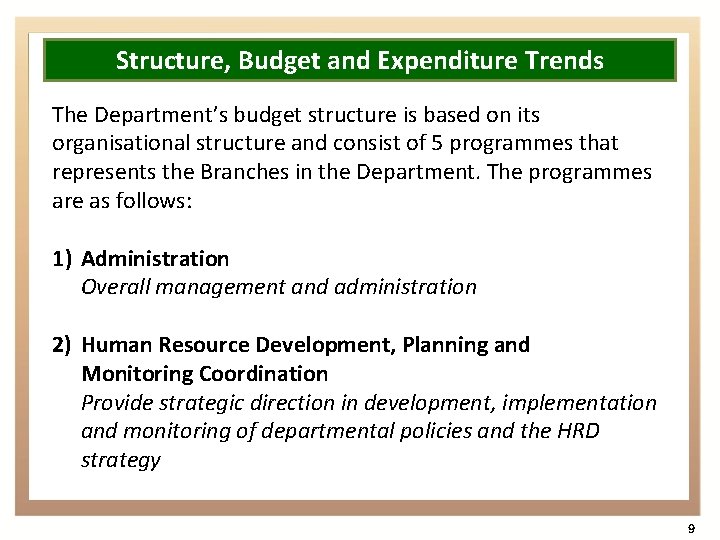
Structure, Budget and Expenditure Trends The Department’s budget structure is based on its organisational structure and consist of 5 programmes that represents the Branches in the Department. The programmes are as follows: 1) Administration Overall management and administration 2) Human Resource Development, Planning and Monitoring Coordination Provide strategic direction in development, implementation and monitoring of departmental policies and the HRD strategy 9
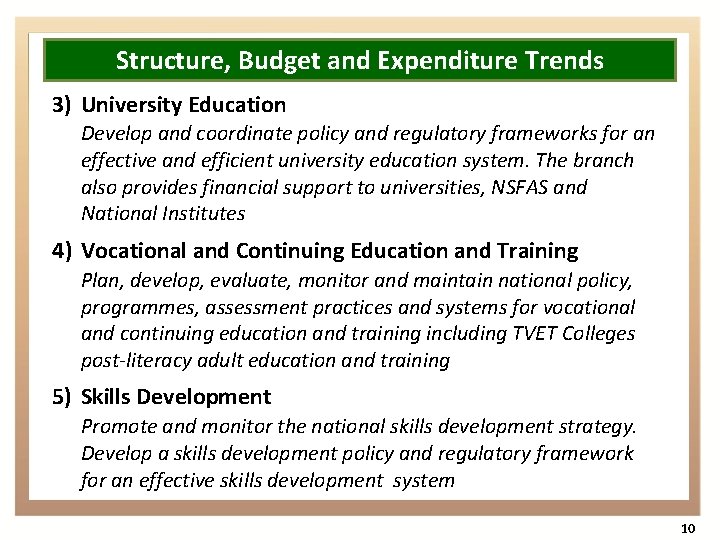
Structure, Budget and Expenditure Trends 3) University Education Develop and coordinate policy and regulatory frameworks for an effective and efficient university education system. The branch also provides financial support to universities, NSFAS and National Institutes 4) Vocational and Continuing Education and Training Plan, develop, evaluate, monitor and maintain national policy, programmes, assessment practices and systems for vocational and continuing education and training including TVET Colleges post-literacy adult education and training 5) Skills Development Promote and monitor the national skills development strategy. Develop a skills development policy and regulatory framework for an effective skills development system 10
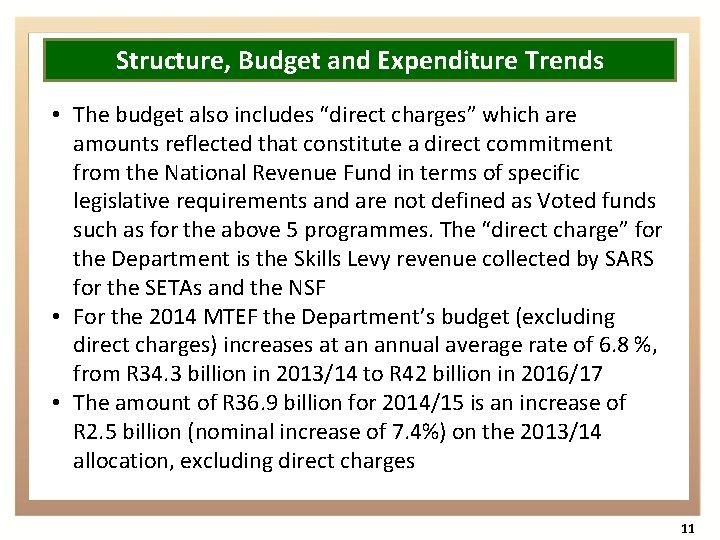
Structure, Budget and Expenditure Trends • The budget also includes “direct charges” which are amounts reflected that constitute a direct commitment from the National Revenue Fund in terms of specific legislative requirements and are not defined as Voted funds such as for the above 5 programmes. The “direct charge” for the Department is the Skills Levy revenue collected by SARS for the SETAs and the NSF • For the 2014 MTEF the Department’s budget (excluding direct charges) increases at an annual average rate of 6. 8 %, from R 34. 3 billion in 2013/14 to R 42 billion in 2016/17 • The amount of R 36. 9 billion for 2014/15 is an increase of R 2. 5 billion (nominal increase of 7. 4%) on the 2013/14 allocation, excluding direct charges 11
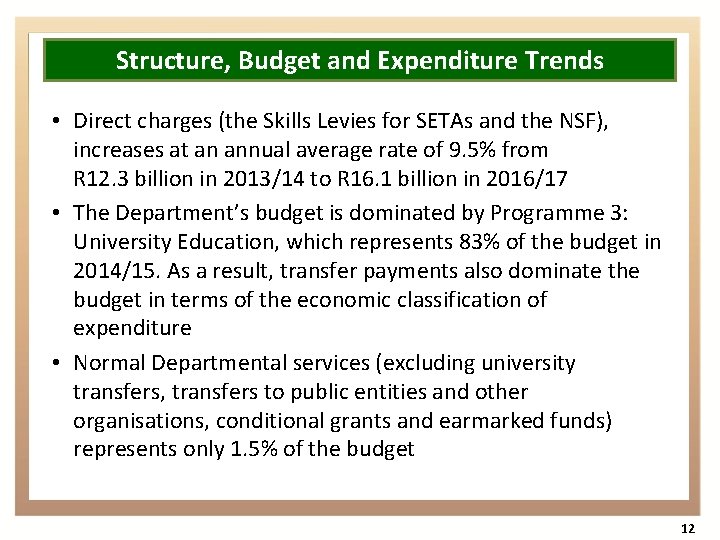
Structure, Budget and Expenditure Trends • Direct charges (the Skills Levies for SETAs and the NSF), increases at an annual average rate of 9. 5% from R 12. 3 billion in 2013/14 to R 16. 1 billion in 2016/17 • The Department’s budget is dominated by Programme 3: University Education, which represents 83% of the budget in 2014/15. As a result, transfer payments also dominate the budget in terms of the economic classification of expenditure • Normal Departmental services (excluding university transfers, transfers to public entities and other organisations, conditional grants and earmarked funds) represents only 1. 5% of the budget 12
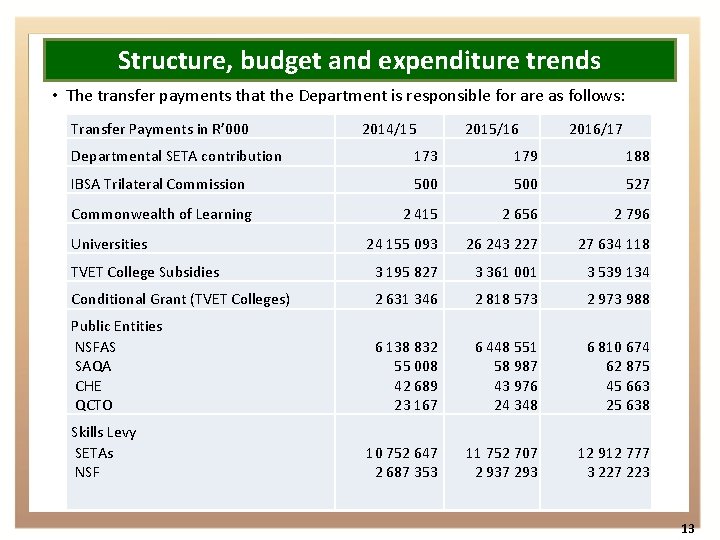
Structure, budget and expenditure trends • The transfer payments that the Department is responsible for are as follows: Transfer Payments in R’ 000 2014/15 2015/16 2016/17 Departmental SETA contribution 173 179 188 IBSA Trilateral Commission 500 527 2 415 2 656 2 796 24 155 093 26 243 227 27 634 118 TVET College Subsidies 3 195 827 3 361 001 3 539 134 Conditional Grant (TVET Colleges) 2 631 346 2 818 573 2 973 988 Public Entities NSFAS SAQA CHE QCTO 6 138 832 55 008 42 689 23 167 6 448 551 58 987 43 976 24 348 6 810 674 62 875 45 663 25 638 10 752 647 2 687 353 11 752 707 2 937 293 12 912 777 3 227 223 Commonwealth of Learning Universities Skills Levy SETAs NSF 13
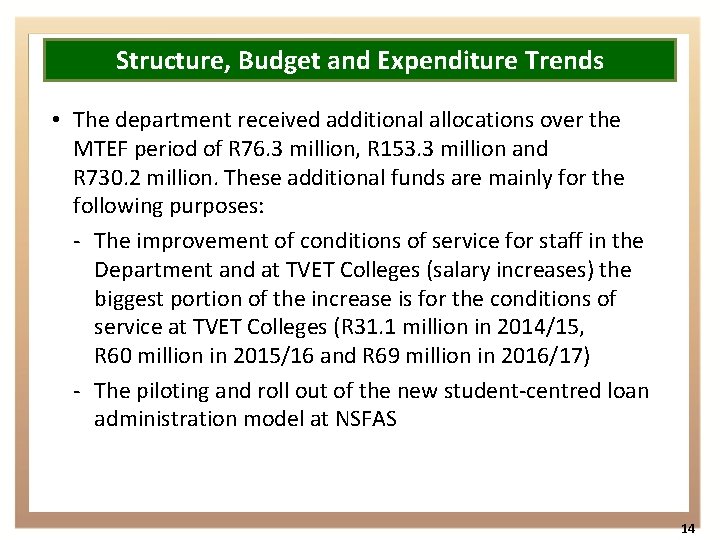
Structure, Budget and Expenditure Trends • The department received additional allocations over the MTEF period of R 76. 3 million, R 153. 3 million and R 730. 2 million. These additional funds are mainly for the following purposes: - The improvement of conditions of service for staff in the Department and at TVET Colleges (salary increases) the biggest portion of the increase is for the conditions of service at TVET Colleges (R 31. 1 million in 2014/15, R 60 million in 2015/16 and R 69 million in 2016/17) - The piloting and roll out of the new student-centred loan administration model at NSFAS 14
Structure, Budget and Expenditure Trends • NSFAS remains one of the biggest growth items in the budget. The 2014 MTEF allocation reflects an increase from R 6. 139 billion in 2014/15 to R 6. 449 billion in 2015/16 and reaches R 6. 811 billion in 2016/17 • While the function shift is still in process, the funding of TVET Colleges consist of two portions namely the direct subsidies to colleges and the conditional grant that is mainly for compensation of employees 15
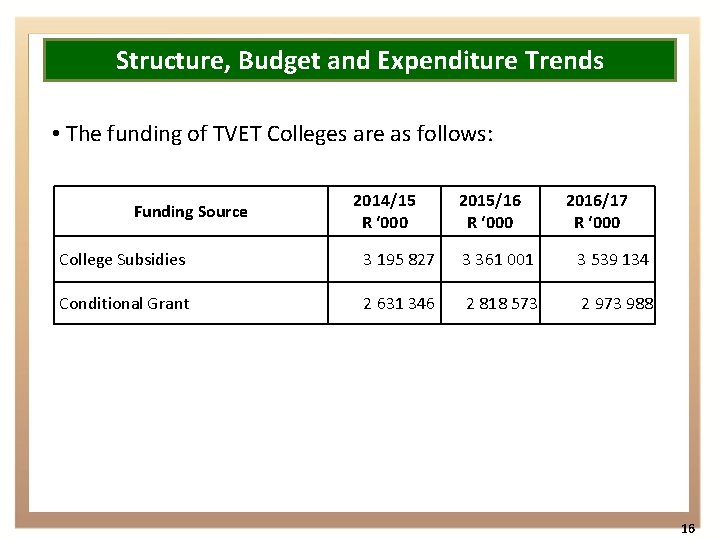
Structure, Budget and Expenditure Trends • The funding of TVET Colleges are as follows: Funding Source 2014/15 R ‘ 000 2015/16 R ‘ 000 2016/17 R ‘ 000 College Subsidies 3 195 827 3 361 001 3 539 134 Conditional Grant 2 631 346 2 818 573 2 973 988 16
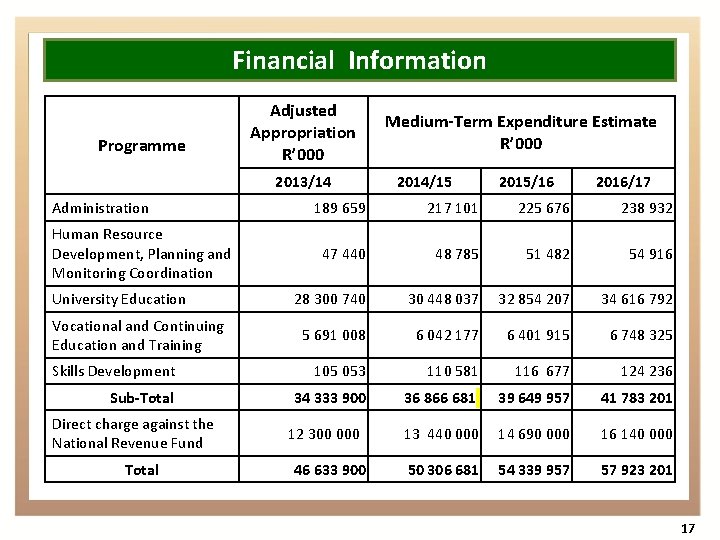
Financial Information Programme Adjusted Appropriation R’ 000 2013/14 Administration Medium-Term Expenditure Estimate R’ 000 2014/15 2015/16 2016/17 189 659 217 101 225 676 238 932 47 440 48 785 51 482 54 916 28 300 740 30 448 037 32 854 207 34 616 792 5 691 008 6 042 177 6 401 915 6 748 325 Skills Development 105 053 110 581 116 677 124 236 Sub-Total 34 333 900 36 866 681 39 649 957 41 783 201 13 440 000 14 690 000 16 140 000 50 306 681 54 339 957 57 923 201 Human Resource Development, Planning and Monitoring Coordination University Education Vocational and Continuing Education and Training Direct charge against the National Revenue Fund Total 12 300 000 46 633 900 17
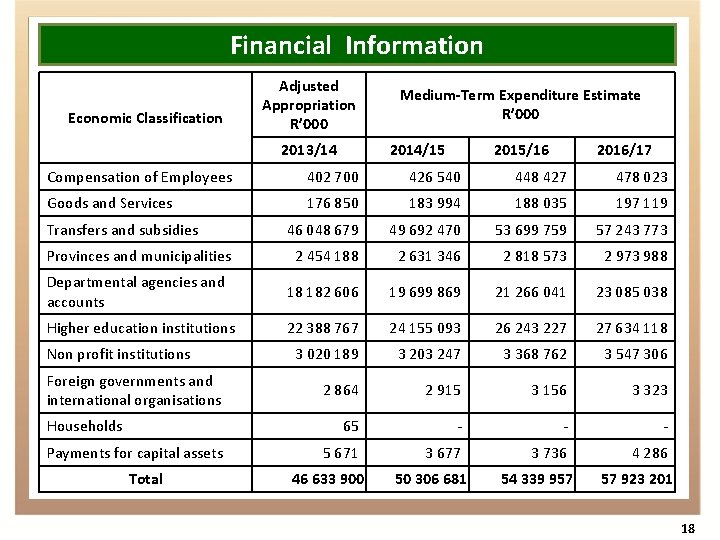
Financial Information Economic Classification Adjusted Appropriation R’ 000 2013/14 Medium-Term Expenditure Estimate R’ 000 2014/15 2015/16 2016/17 Compensation of Employees 402 700 426 540 448 427 478 023 Goods and Services 176 850 183 994 188 035 197 119 46 048 679 49 692 470 53 699 759 57 243 773 Provinces and municipalities 2 454 188 2 631 346 2 818 573 2 973 988 Departmental agencies and accounts 18 182 606 19 699 869 21 266 041 23 085 038 Higher education institutions 22 388 767 24 155 093 26 243 227 27 634 118 3 020 189 3 203 247 3 368 762 3 547 306 2 864 2 915 3 156 3 323 65 - - - 5 671 3 677 3 736 4 286 Transfers and subsidies Non profit institutions Foreign governments and international organisations Households Payments for capital assets Total 46 633 900 50 306 681 54 339 957 57 923 201 18
Key Budget Pressures Facing the Department • Department acknowledges the current fiscal constraints of Government • This has numerous challenges in itself, but also has a serious impact on the service delivery requirements of the Department • Department is unable to attain the growth requirements within the PSET system in terms of enrolments, infrastructure development, increased operations and student support • Limitations are placed on Departmental operations due to the capping of compensation of employees and the inability to roll out the new staff establishment as well as regional presence • Institutional monitoring and evaluation is limited to critical areas • Reliance on NSF project and donor support such as the funding of the activities of the National Artisan Moderation Body • An immediate pressure is the management of the TVET and AET function shift as well as cost implications for examination services and the development of the Central Application Service 19
Financial Performance • The Department managed to remain within its budget since being in operation from 1 April 2010 • Underspending on voted funds were as follows: 2010/11: R 23. 848 million 2011/12: R 17. 817 million 2012/13: R 3. 751 million 2013/14: R 1. 931 million • Unspent amounts were committed for specific goods or services and including outstanding claims for examiners and moderators • The Department received unqualified audits to date 20
Programme 1: Administration Priorities for 2014/15 • Finalisation of the Department’s Communication strategy and profiling of DHET programmes/projects in the public domain through the communication strategy • Reducing the vacancy rate on funded posts to 10% • Ensuring good governance through institutionalization and implementation of Risk Management strategies by: - Providing awareness and training sessions on Risk Management - Developing Risk Management strategy, approve it for implementation • Complete the website improvement project aimed at improving the current look, feel and user-friendliness 21
Programme 1: Administration • To improve efficiency by implementing the necessary information technology infrastructure and systems • To provide effective and efficient human resource planning and management services • Ensure adherence to policies and standards on Supply Chain Management Services 22
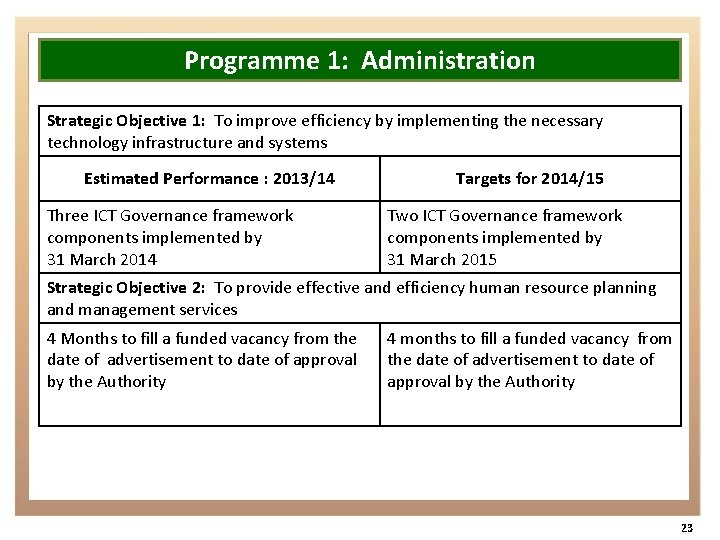
Programme 1: Administration Strategic Objective 1: To improve efficiency by implementing the necessary technology infrastructure and systems Estimated Performance : 2013/14 Three ICT Governance framework components implemented by 31 March 2014 Targets for 2014/15 Two ICT Governance framework components implemented by 31 March 2015 Strategic Objective 2: To provide effective and efficiency human resource planning and management services 4 Months to fill a funded vacancy from the date of advertisement to date of approval by the Authority 4 months to fill a funded vacancy from the date of advertisement to date of approval by the Authority 23
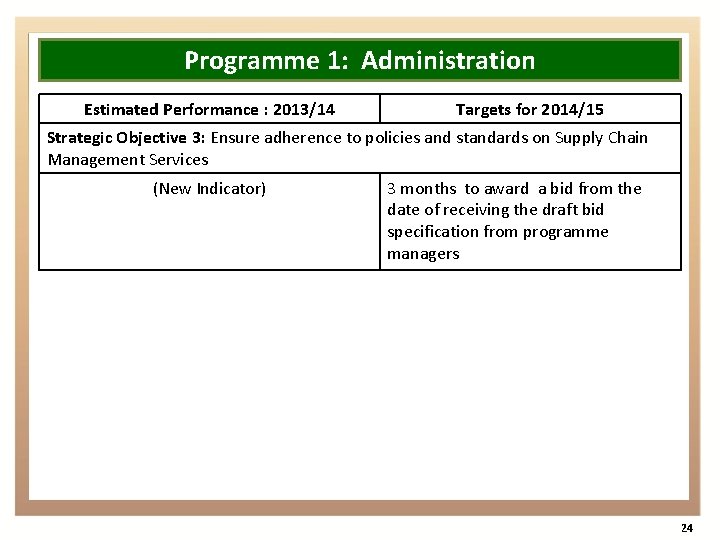
Programme 1: Administration Estimated Performance : 2013/14 Targets for 2014/15 Strategic Objective 3: Ensure adherence to policies and standards on Supply Chain Management Services (New Indicator) 3 months to award a bid from the date of receiving the draft bid specification from programme managers 24
Programme 2: Human Resource Development, Planning and Monitoring Coordination Priorities for 2014/15 • Provide accurate data on skills supply and demand in the country by establishing and maintaining an integrated higher education and training management information system, linking all providers of education and training, and integrating all institutional data into a single system by 2014/15 • Manage and maintain credible planning and budgeting processes for the Department by developing an Annual Performance Plan and performance indicators, and producing quarterly performance progress reports on the implementation of the Department’s strategic and performance plans 25
Programme 2: Human Resource Development, Planning and Monitoring Coordination • Monitor and support actions needed to implement the statutory functions assigned to the Minister, Director-General and quality councils by the National Qualifications Framework Act (2008) by producing a monitoring and evaluation report, developing a Annual Ministerial Policy Guideline and answering all requests for advice from the South African Qualifications Authority 26
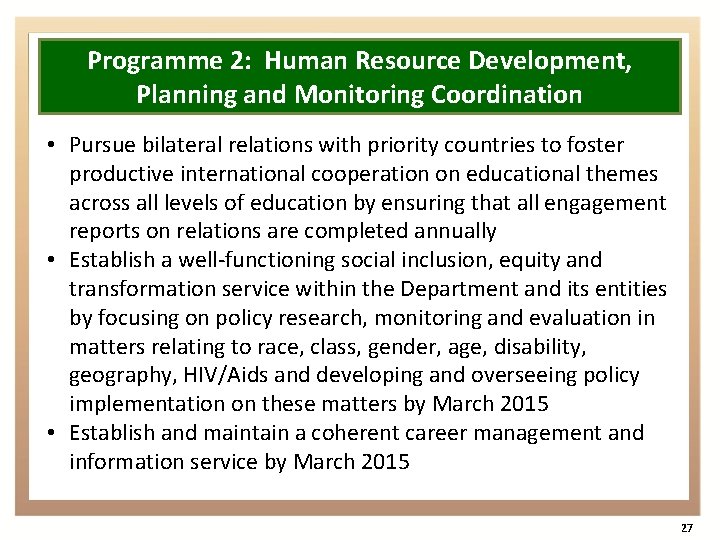
Programme 2: Human Resource Development, Planning and Monitoring Coordination • Pursue bilateral relations with priority countries to foster productive international cooperation on educational themes across all levels of education by ensuring that all engagement reports on relations are completed annually • Establish a well-functioning social inclusion, equity and transformation service within the Department and its entities by focusing on policy research, monitoring and evaluation in matters relating to race, class, gender, age, disability, geography, HIV/Aids and developing and overseeing policy implementation on these matters by March 2015 • Establish and maintain a coherent career management and information service by March 2015 27
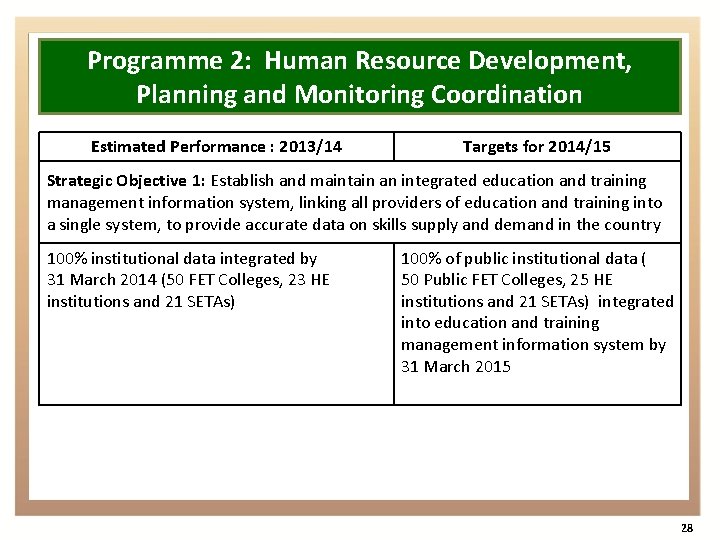
Programme 2: Human Resource Development, Planning and Monitoring Coordination Estimated Performance : 2013/14 Targets for 2014/15 Strategic Objective 1: Establish and maintain an integrated education and training management information system, linking all providers of education and training into a single system, to provide accurate data on skills supply and demand in the country 100% institutional data integrated by 31 March 2014 (50 FET Colleges, 23 HE institutions and 21 SETAs) 100% of public institutional data ( 50 Public FET Colleges, 25 HE institutions and 21 SETAs) integrated into education and training management information system by 31 March 2015 28
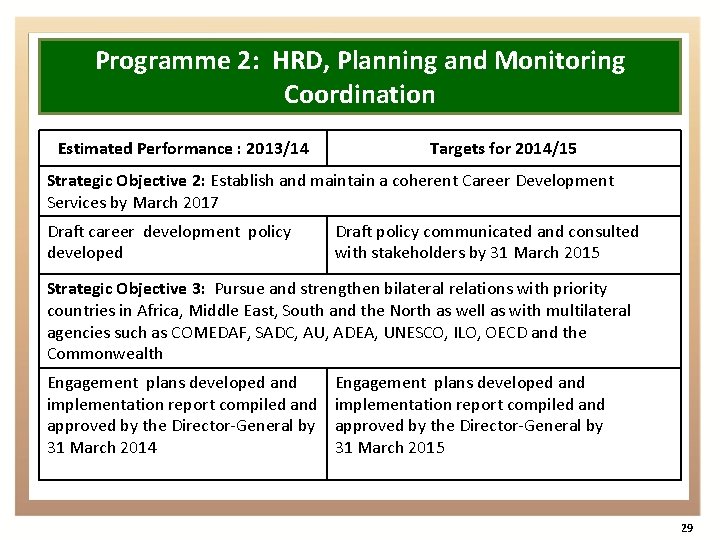
Programme 2: HRD, Planning and Monitoring Coordination Estimated Performance : 2013/14 Targets for 2014/15 Strategic Objective 2: Establish and maintain a coherent Career Development Services by March 2017 Draft career development policy developed Draft policy communicated and consulted with stakeholders by 31 March 2015 Strategic Objective 3: Pursue and strengthen bilateral relations with priority countries in Africa, Middle East, South and the North as well as with multilateral agencies such as COMEDAF, SADC, AU, ADEA, UNESCO, ILO, OECD and the Commonwealth Engagement plans developed and implementation report compiled and approved by the Director-General by 31 March 2014 31 March 2015 29
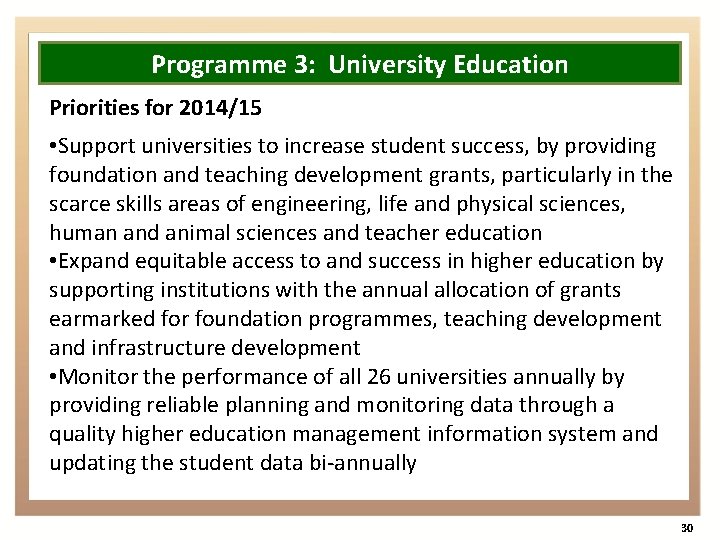
Programme 3: University Education Priorities for 2014/15 • Support universities to increase student success, by providing foundation and teaching development grants, particularly in the scarce skills areas of engineering, life and physical sciences, human and animal sciences and teacher education • Expand equitable access to and success in higher education by supporting institutions with the annual allocation of grants earmarked for foundation programmes, teaching development and infrastructure development • Monitor the performance of all 26 universities annually by providing reliable planning and monitoring data through a quality higher education management information system and updating the student data bi-annually 30
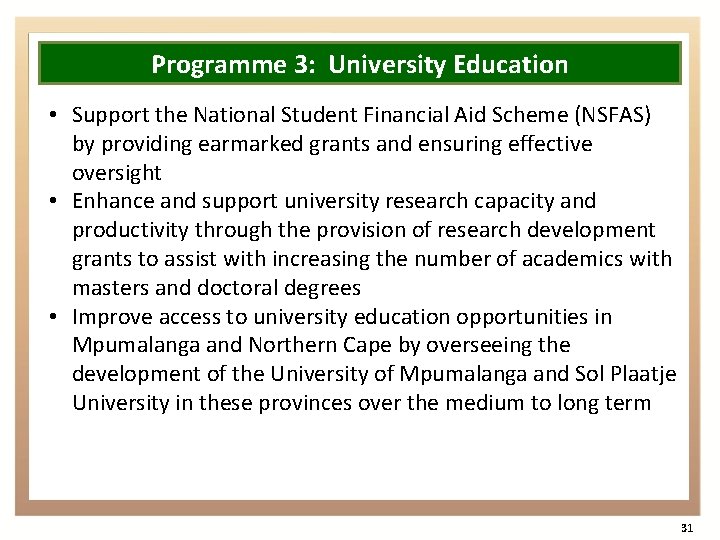
Programme 3: University Education • Support the National Student Financial Aid Scheme (NSFAS) by providing earmarked grants and ensuring effective oversight • Enhance and support university research capacity and productivity through the provision of research development grants to assist with increasing the number of academics with masters and doctoral degrees • Improve access to university education opportunities in Mpumalanga and Northern Cape by overseeing the development of the University of Mpumalanga and Sol Plaatje University in these provinces over the medium to long term 31
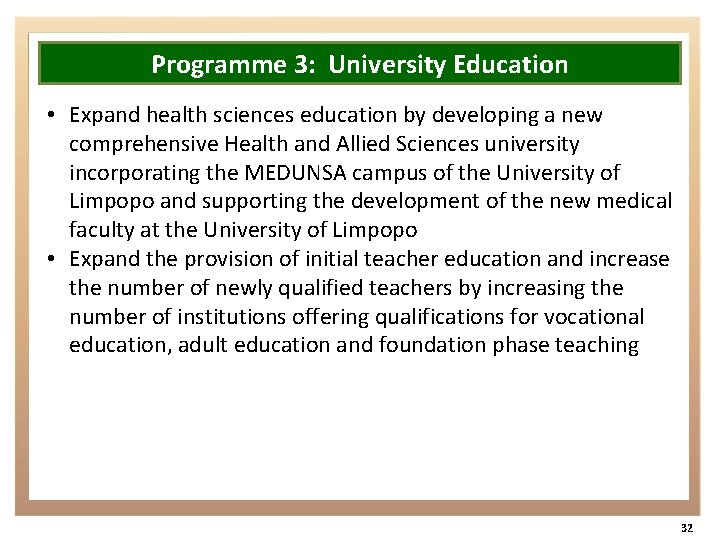
Programme 3: University Education • Expand health sciences education by developing a new comprehensive Health and Allied Sciences university incorporating the MEDUNSA campus of the University of Limpopo and supporting the development of the new medical faculty at the University of Limpopo • Expand the provision of initial teacher education and increase the number of newly qualified teachers by increasing the number of institutions offering qualifications for vocational education, adult education and foundation phase teaching 32
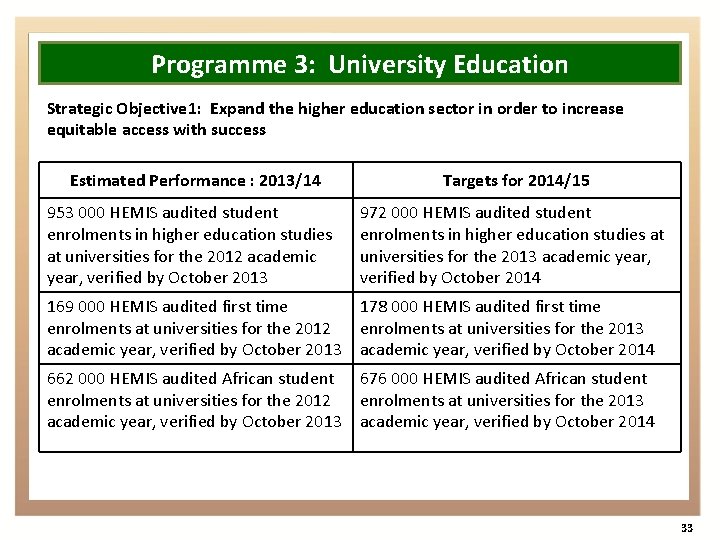
Programme 3: University Education Strategic Objective 1: Expand the higher education sector in order to increase equitable access with success Estimated Performance : 2013/14 Targets for 2014/15 953 000 HEMIS audited student enrolments in higher education studies at universities for the 2012 academic year, verified by October 2013 972 000 HEMIS audited student enrolments in higher education studies at universities for the 2013 academic year, verified by October 2014 169 000 HEMIS audited first time 178 000 HEMIS audited first time enrolments at universities for the 2012 enrolments at universities for the 2013 academic year, verified by October 2014 662 000 HEMIS audited African student 676 000 HEMIS audited African student enrolments at universities for the 2012 enrolments at universities for the 2013 academic year, verified by October 2014 33
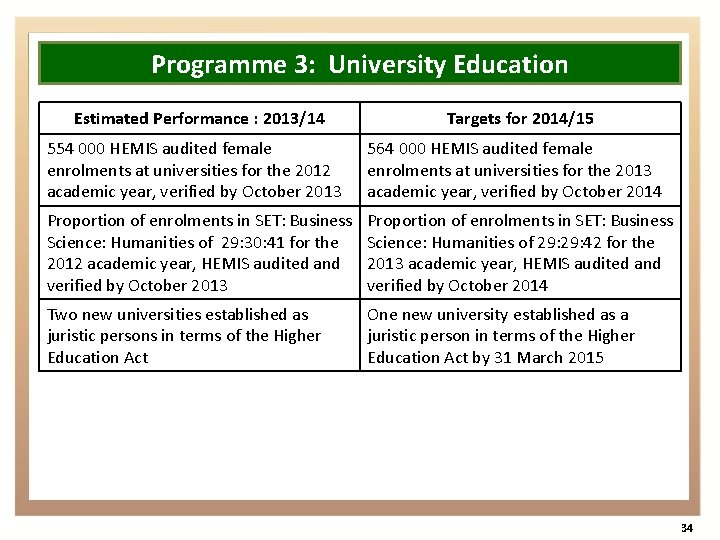
Programme 3: University Education Estimated Performance : 2013/14 Targets for 2014/15 554 000 HEMIS audited female enrolments at universities for the 2012 academic year, verified by October 2013 564 000 HEMIS audited female enrolments at universities for the 2013 academic year, verified by October 2014 Proportion of enrolments in SET: Business Science: Humanities of 29: 30: 41 for the 2012 academic year, HEMIS audited and verified by October 2013 Proportion of enrolments in SET: Business Science: Humanities of 29: 42 for the 2013 academic year, HEMIS audited and verified by October 2014 Two new universities established as juristic persons in terms of the Higher Education Act One new university established as a juristic person in terms of the Higher Education Act by 31 March 2015 34

Programme 3: University Education Estimated Performance : 2013/14 Targets for 2014/15 New indicator A monitoring report on the use of the earmarked grant to support the development of each of the newly established universities (University of Mpumalanga (UMP) and Sol Plaatje University (SPU)) produced and approved by the Director General by 31 March 2015 10 universities identified and supported to develop FET College Lecturer Qualifications in line with the policy by 31 March 2014 5 Universities have submitted applications for PQM approval to offer qualifications for FET College lecturers by 31 March 2015 35
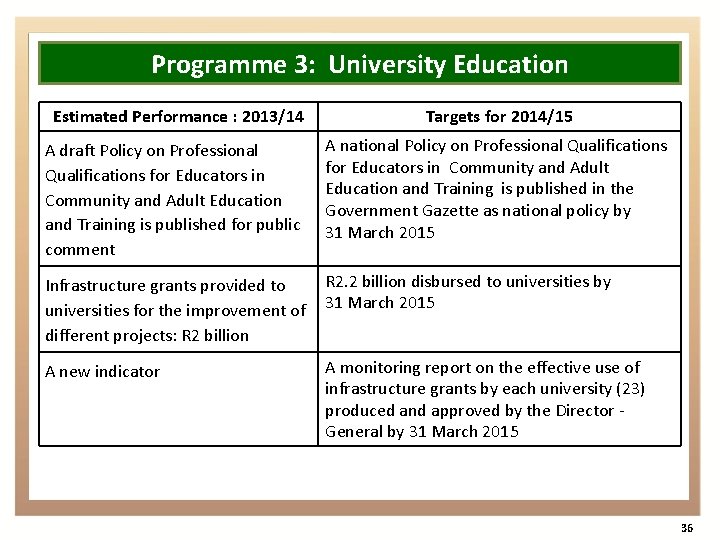
Programme 3: University Education Estimated Performance : 2013/14 Targets for 2014/15 A draft Policy on Professional Qualifications for Educators in Community and Adult Education and Training is published for public comment A national Policy on Professional Qualifications for Educators in Community and Adult Education and Training is published in the Government Gazette as national policy by 31 March 2015 R 2. 2 billion disbursed to universities by Infrastructure grants provided to universities for the improvement of 31 March 2015 different projects: R 2 billion A new indicator A monitoring report on the effective use of infrastructure grants by each university (23) produced and approved by the Director General by 31 March 2015 36
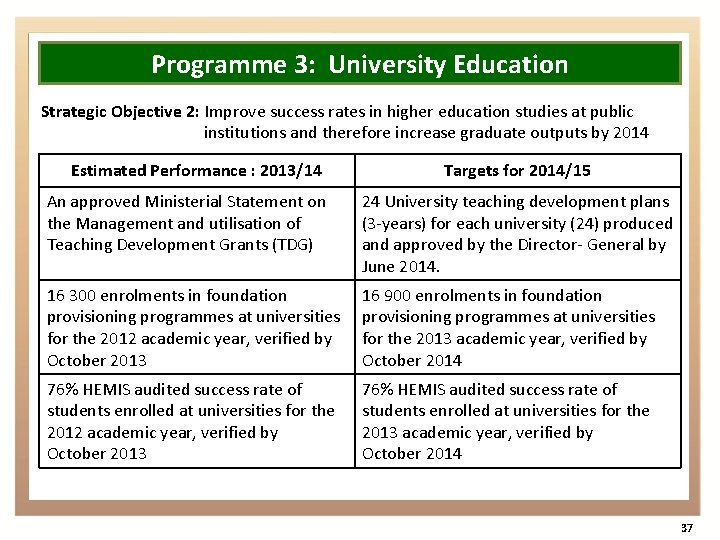
Programme 3: University Education Strategic Objective 2: Improve success rates in higher education studies at public institutions and therefore increase graduate outputs by 2014 Estimated Performance : 2013/14 Targets for 2014/15 An approved Ministerial Statement on the Management and utilisation of Teaching Development Grants (TDG) 24 University teaching development plans (3 -years) for each university (24) produced and approved by the Director- General by June 2014. 16 300 enrolments in foundation provisioning programmes at universities for the 2012 academic year, verified by October 2013 16 900 enrolments in foundation provisioning programmes at universities for the 2013 academic year, verified by October 2014 76% HEMIS audited success rate of students enrolled at universities for the 2012 academic year, verified by October 2013 76% HEMIS audited success rate of students enrolled at universities for the 2013 academic year, verified by October 2014 37
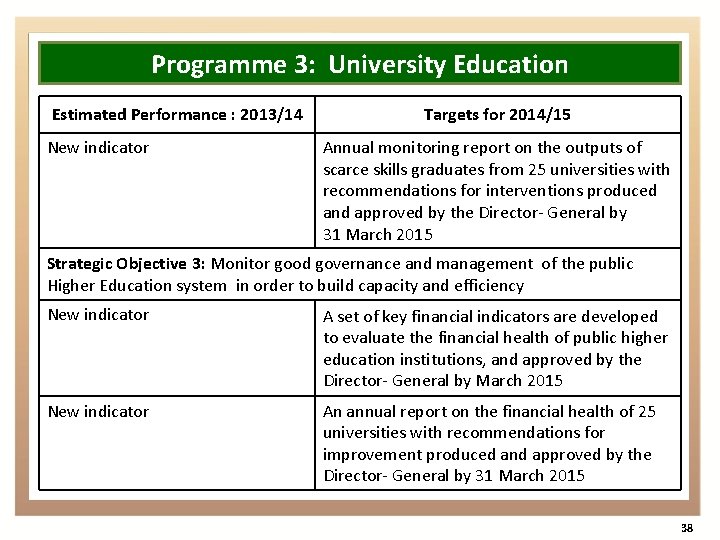
Programme 3: University Education Estimated Performance : 2013/14 New indicator Targets for 2014/15 Annual monitoring report on the outputs of scarce skills graduates from 25 universities with recommendations for interventions produced and approved by the Director- General by 31 March 2015 Strategic Objective 3: Monitor good governance and management of the public Higher Education system in order to build capacity and efficiency New indicator A set of key financial indicators are developed to evaluate the financial health of public higher education institutions, and approved by the Director- General by March 2015 New indicator An annual report on the financial health of 25 universities with recommendations for improvement produced and approved by the Director- General by 31 March 2015 38
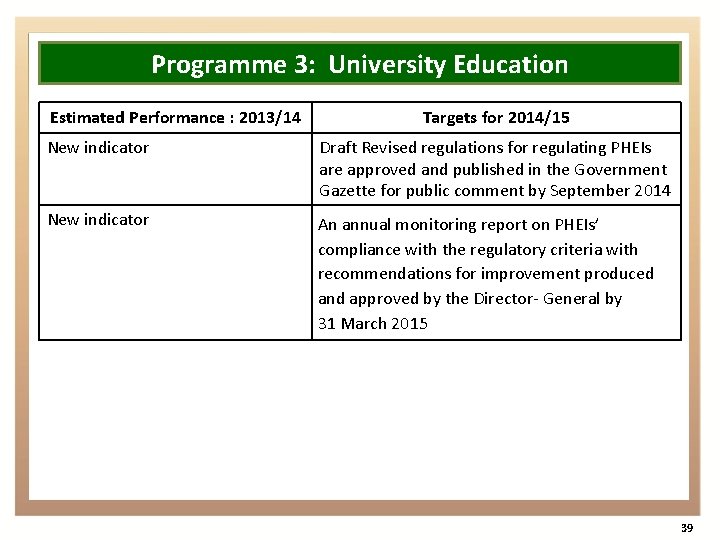
Programme 3: University Education Estimated Performance : 2013/14 Targets for 2014/15 New indicator Draft Revised regulations for regulating PHEIs are approved and published in the Government Gazette for public comment by September 2014 New indicator An annual monitoring report on PHEIs’ compliance with the regulatory criteria with recommendations for improvement produced and approved by the Director- General by 31 March 2015 39
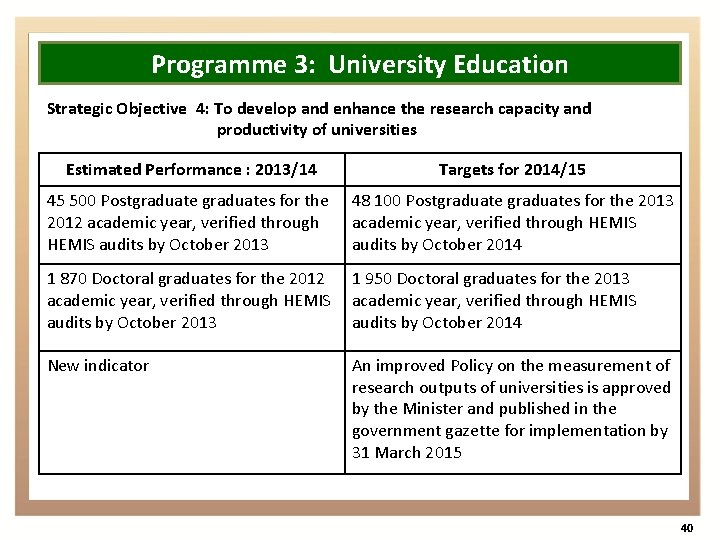
Programme 3: University Education Strategic Objective 4: To develop and enhance the research capacity and productivity of universities Estimated Performance : 2013/14 Targets for 2014/15 45 500 Postgraduates for the 2012 academic year, verified through HEMIS audits by October 2013 48 100 Postgraduates for the 2013 academic year, verified through HEMIS audits by October 2014 1 870 Doctoral graduates for the 2012 1 950 Doctoral graduates for the 2013 academic year, verified through HEMIS audits by October 2013 audits by October 2014 New indicator An improved Policy on the measurement of research outputs of universities is approved by the Minister and published in the government gazette for implementation by 31 March 2015 40
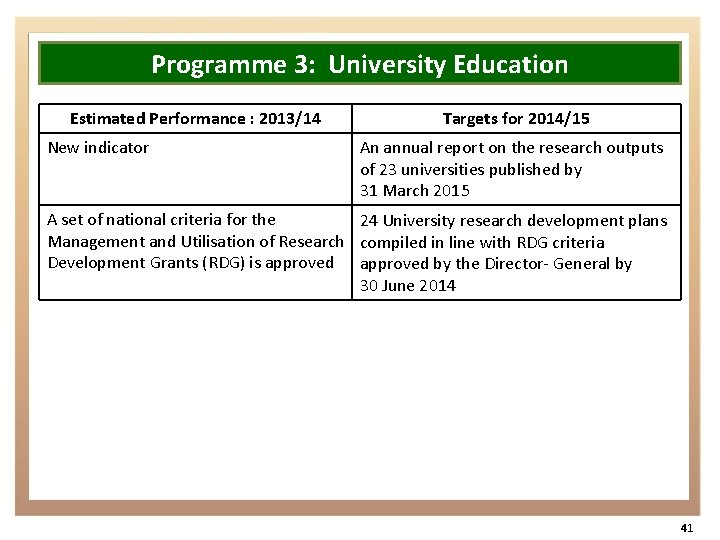
Programme 3: University Education Estimated Performance : 2013/14 New indicator Targets for 2014/15 An annual report on the research outputs of 23 universities published by 31 March 2015 A set of national criteria for the 24 University research development plans Management and Utilisation of Research compiled in line with RDG criteria Development Grants (RDG) is approved by the Director- General by 30 June 2014 41
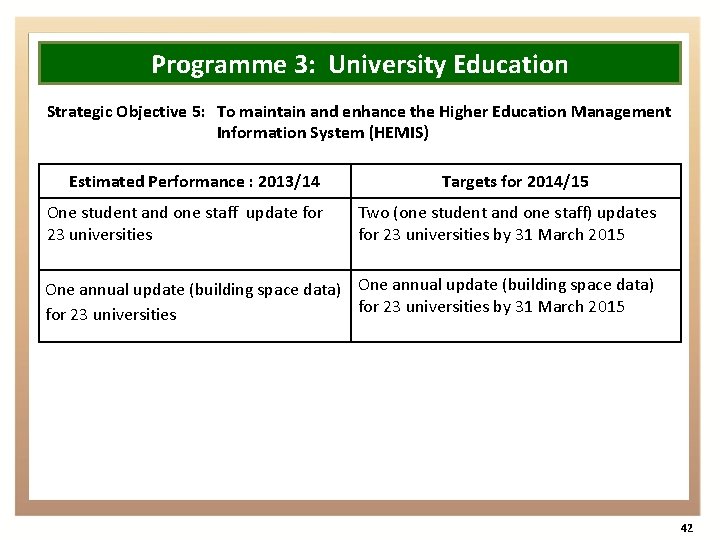
Programme 3: University Education Strategic Objective 5: To maintain and enhance the Higher Education Management Information System (HEMIS) Estimated Performance : 2013/14 One student and one staff update for 23 universities Targets for 2014/15 Two (one student and one staff) updates for 23 universities by 31 March 2015 One annual update (building space data) for 23 universities by 31 March 2015 for 23 universities 42

Programme 4: Vocational and Continuing Education and Training Priorities for 2014/15 • Ensure the continued relevance of further education and training college programmes by supporting the development of a diverse range of high quality and responsive vocational education and training qualifications and programmes over the MTEF period through consultation with relevant role players • Facilitation of collaborations between Higher Education Institutions and FET Colleges towards delivery of learning programmes at level 5 and 6 of the NQF 43
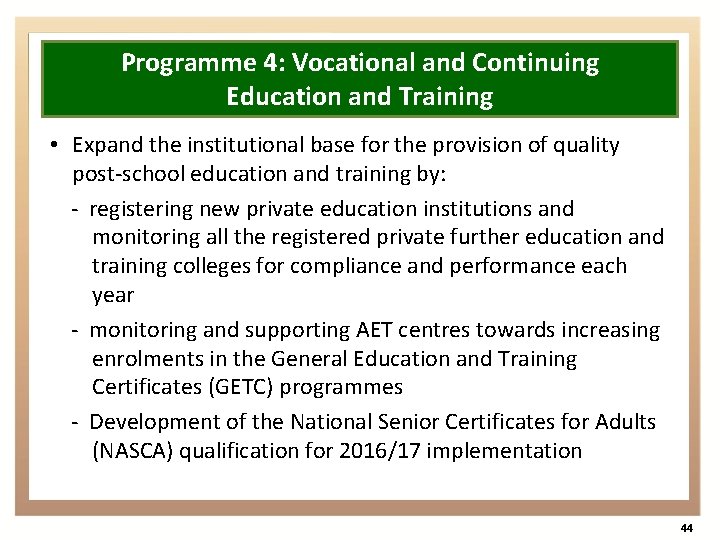
Programme 4: Vocational and Continuing Education and Training • Expand the institutional base for the provision of quality post-school education and training by: - registering new private education institutions and monitoring all the registered private further education and training colleges for compliance and performance each year - monitoring and supporting AET centres towards increasing enrolments in the General Education and Training Certificates (GETC) programmes - Development of the National Senior Certificates for Adults (NASCA) qualification for 2016/17 implementation 44
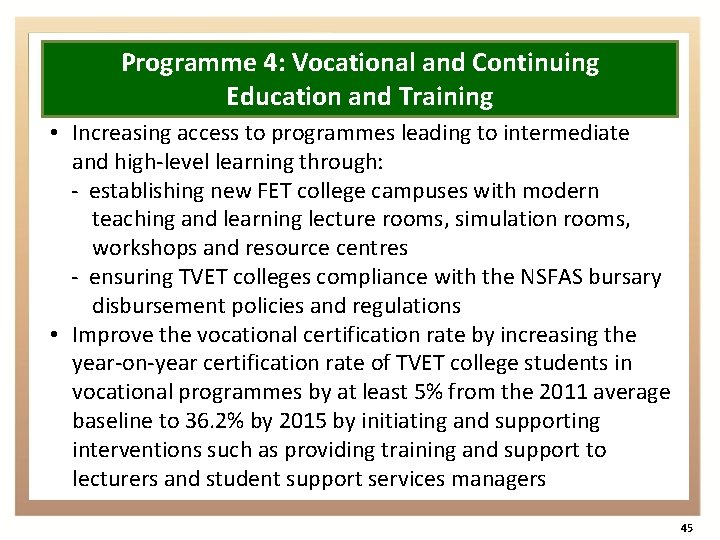
Programme 4: Vocational and Continuing Education and Training • Increasing access to programmes leading to intermediate and high-level learning through: - establishing new FET college campuses with modern teaching and learning lecture rooms, simulation rooms, workshops and resource centres - ensuring TVET colleges compliance with the NSFAS bursary disbursement policies and regulations • Improve the vocational certification rate by increasing the year-on-year certification rate of TVET college students in vocational programmes by at least 5% from the 2011 average baseline to 36. 2% by 2015 by initiating and supporting interventions such as providing training and support to lecturers and student support services managers 45
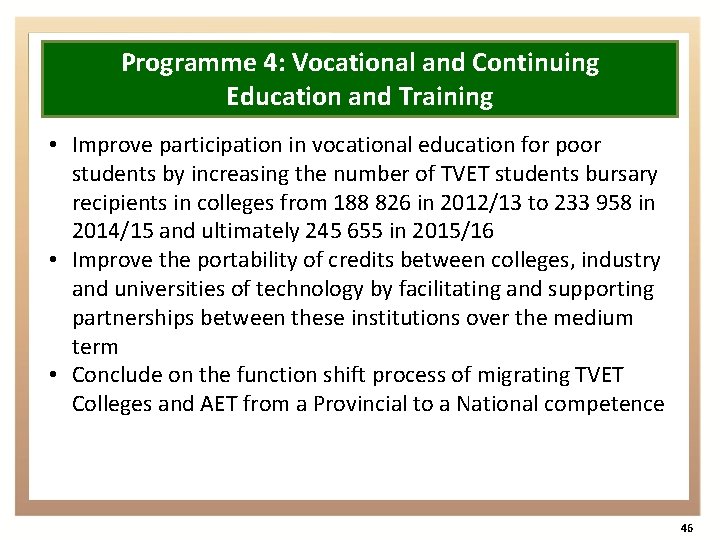
Programme 4: Vocational and Continuing Education and Training • Improve participation in vocational education for poor students by increasing the number of TVET students bursary recipients in colleges from 188 826 in 2012/13 to 233 958 in 2014/15 and ultimately 245 655 in 2015/16 • Improve the portability of credits between colleges, industry and universities of technology by facilitating and supporting partnerships between these institutions over the medium term • Conclude on the function shift process of migrating TVET Colleges and AET from a Provincial to a National competence 46
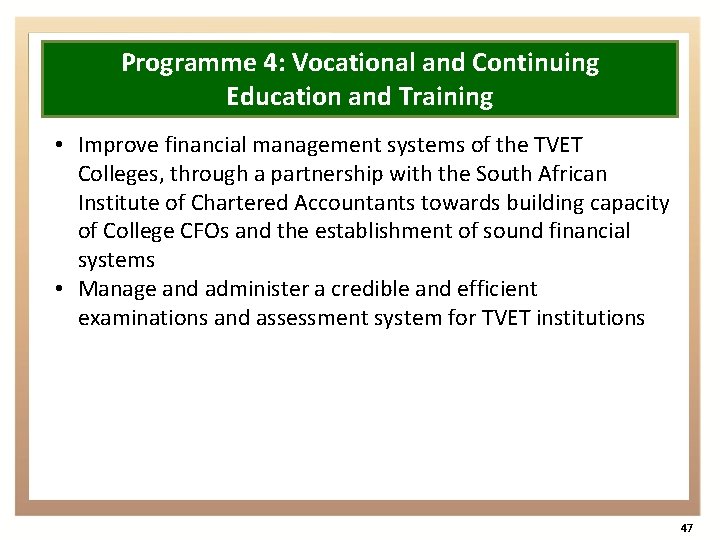
Programme 4: Vocational and Continuing Education and Training • Improve financial management systems of the TVET Colleges, through a partnership with the South African Institute of Chartered Accountants towards building capacity of College CFOs and the establishment of sound financial systems • Manage and administer a credible and efficient examinations and assessment system for TVET institutions 47
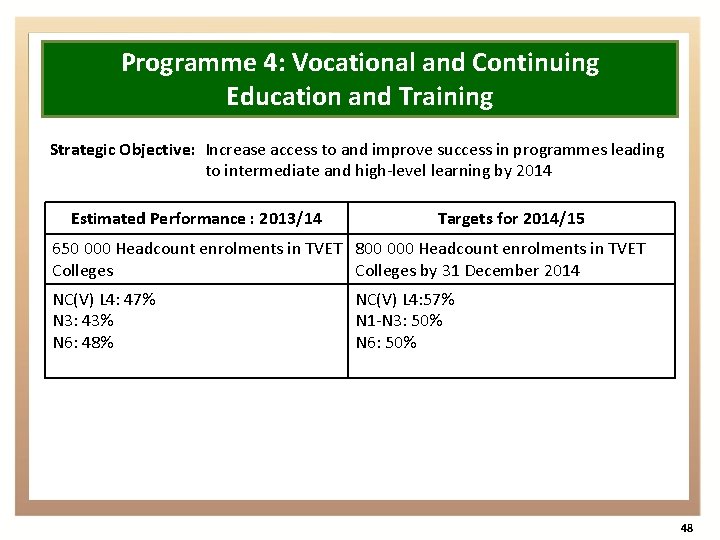
Programme 4: Vocational and Continuing Education and Training Strategic Objective: Increase access to and improve success in programmes leading to intermediate and high-level learning by 2014 Estimated Performance : 2013/14 Targets for 2014/15 650 000 Headcount enrolments in TVET 800 000 Headcount enrolments in TVET Colleges by 31 December 2014 NC(V) L 4: 47% N 3: 43% N 6: 48% NC(V) L 4: 57% N 1 -N 3: 50% N 6: 50% 48
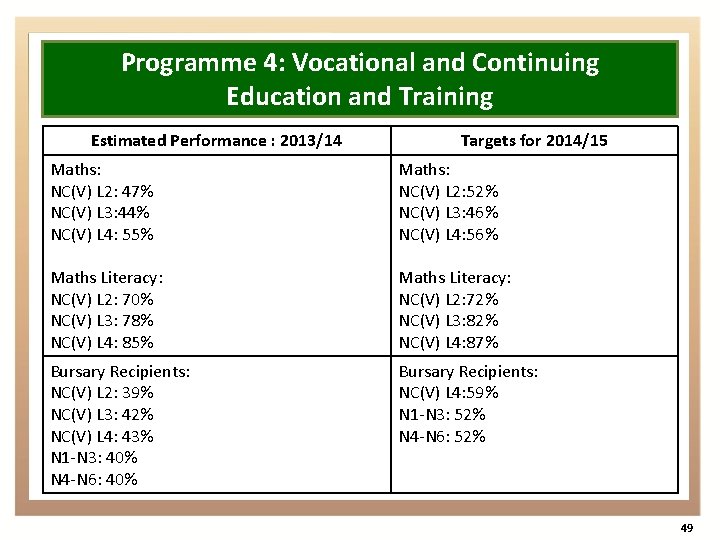
Programme 4: Vocational and Continuing Education and Training Estimated Performance : 2013/14 Targets for 2014/15 Maths: NC(V) L 2: 47% NC(V) L 3: 44% NC(V) L 4: 55% Maths: NC(V) L 2: 52% NC(V) L 3: 46% NC(V) L 4: 56% Maths Literacy: NC(V) L 2: 70% NC(V) L 3: 78% NC(V) L 4: 85% Maths Literacy: NC(V) L 2: 72% NC(V) L 3: 82% NC(V) L 4: 87% Bursary Recipients: NC(V) L 2: 39% NC(V) L 3: 42% NC(V) L 4: 43% N 1 -N 3: 40% N 4 -N 6: 40% Bursary Recipients: NC(V) L 4: 59% N 1 -N 3: 52% N 4 -N 6: 52% 49
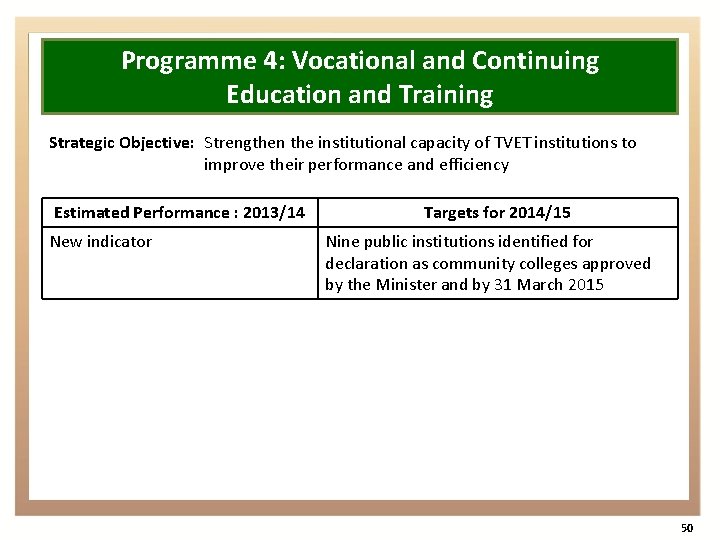
Programme 4: Vocational and Continuing Education and Training Strategic Objective: Strengthen the institutional capacity of TVET institutions to improve their performance and efficiency Estimated Performance : 2013/14 New indicator Targets for 2014/15 Nine public institutions identified for declaration as community colleges approved by the Minister and by 31 March 2015 50
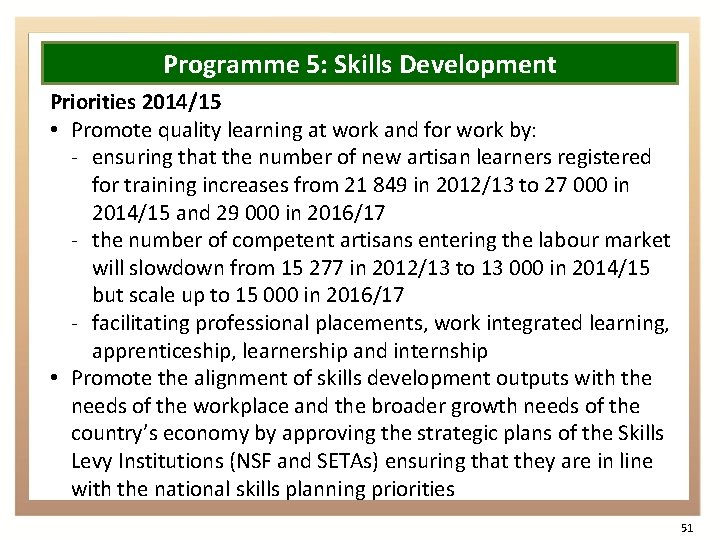
Programme 5: Skills Development Priorities 2014/15 • Promote quality learning at work and for work by: - ensuring that the number of new artisan learners registered for training increases from 21 849 in 2012/13 to 27 000 in 2014/15 and 29 000 in 2016/17 - the number of competent artisans entering the labour market will slowdown from 15 277 in 2012/13 to 13 000 in 2014/15 but scale up to 15 000 in 2016/17 - facilitating professional placements, work integrated learning, apprenticeship, learnership and internship • Promote the alignment of skills development outputs with the needs of the workplace and the broader growth needs of the country’s economy by approving the strategic plans of the Skills Levy Institutions (NSF and SETAs) ensuring that they are in line with the national skills planning priorities 51
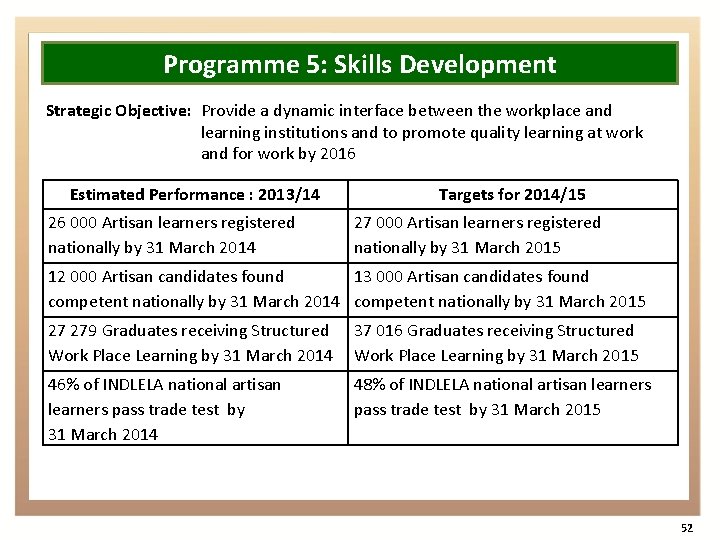
Programme 5: Skills Development Strategic Objective: Provide a dynamic interface between the workplace and learning institutions and to promote quality learning at work and for work by 2016 Estimated Performance : 2013/14 26 000 Artisan learners registered nationally by 31 March 2014 Targets for 2014/15 27 000 Artisan learners registered nationally by 31 March 2015 12 000 Artisan candidates found 13 000 Artisan candidates found competent nationally by 31 March 2014 competent nationally by 31 March 2015 27 279 Graduates receiving Structured Work Place Learning by 31 March 2014 37 016 Graduates receiving Structured Work Place Learning by 31 March 2015 46% of INDLELA national artisan learners pass trade test by 31 March 2014 48% of INDLELA national artisan learners pass trade test by 31 March 2015 52
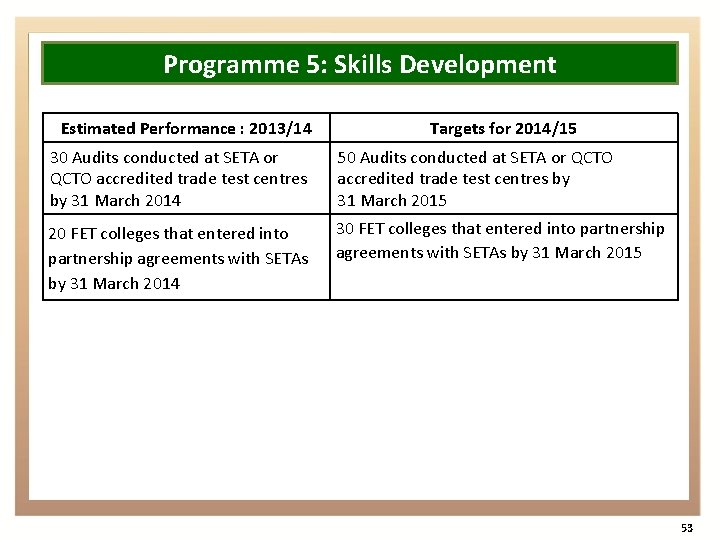
Programme 5: Skills Development Estimated Performance : 2013/14 Targets for 2014/15 30 Audits conducted at SETA or QCTO accredited trade test centres by 31 March 2014 50 Audits conducted at SETA or QCTO accredited trade test centres by 31 March 2015 20 FET colleges that entered into partnership agreements with SETAs by 31 March 2014 30 FET colleges that entered into partnership agreements with SETAs by 31 March 2015 53

Thank You
- Slides: 54