
Annual Motion ecliptic the apparent path of the
- Slides: 26
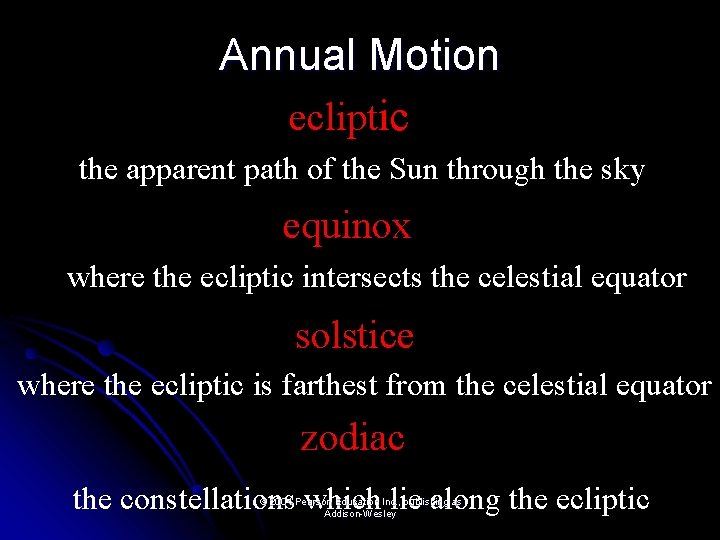
Annual Motion ecliptic the apparent path of the Sun through the sky equinox where the ecliptic intersects the celestial equator solstice where the ecliptic is farthest from the celestial equator zodiac the constellations which lie along the ecliptic © 2004 Pearson Education Inc. , publishing as Addison-Wesley
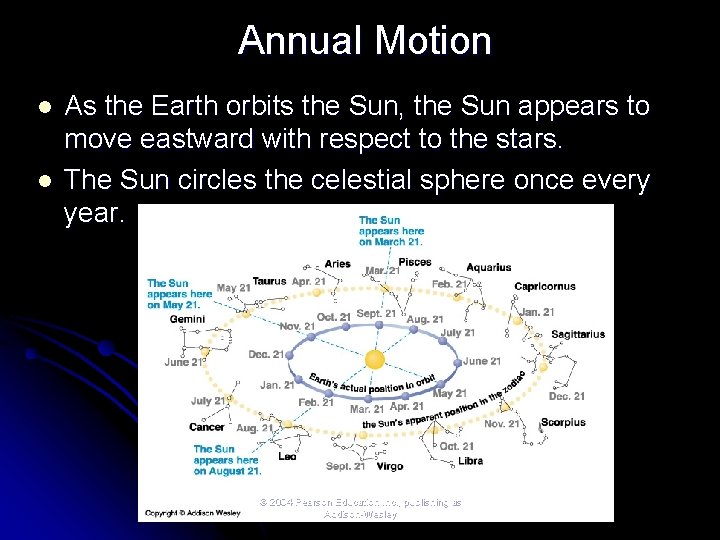
Annual Motion l l As the Earth orbits the Sun, the Sun appears to move eastward with respect to the stars. The Sun circles the celestial sphere once every year. © 2004 Pearson Education Inc. , publishing as Addison-Wesley
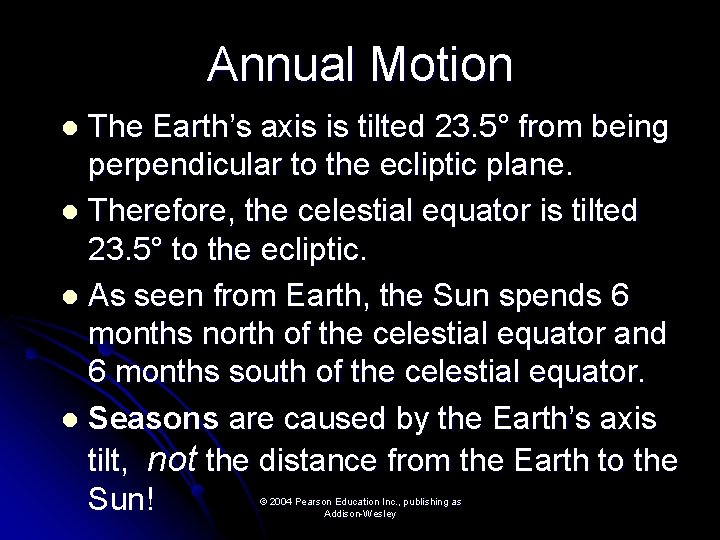
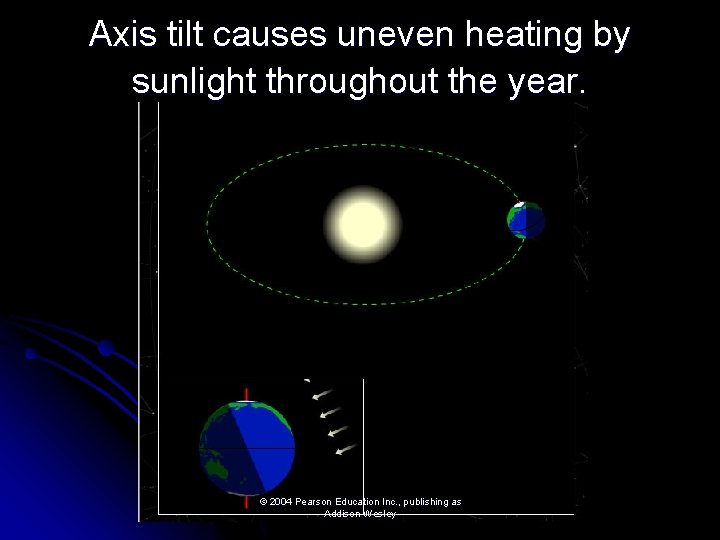
Annual Motion The Earth’s axis is tilted 23. 5° from being perpendicular to the ecliptic plane. l Therefore, the celestial equator is tilted 23. 5° to the ecliptic. l As seen from Earth, the Sun spends 6 months north of the celestial equator and 6 months south of the celestial equator. l Seasons are caused by the Earth’s axis tilt, not the distance from the Earth to the Sun! l © 2004 Pearson Education Inc. , publishing as Addison-Wesley
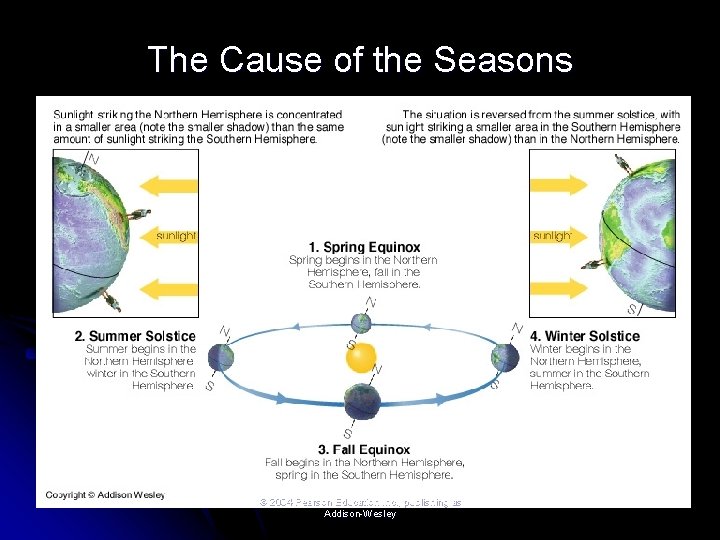
The Cause of the Seasons © 2004 Pearson Education Inc. , publishing as Addison-Wesley
Axis tilt causes uneven heating by sunlight throughout the year. © 2004 Pearson Education Inc. , publishing as Addison-Wesley
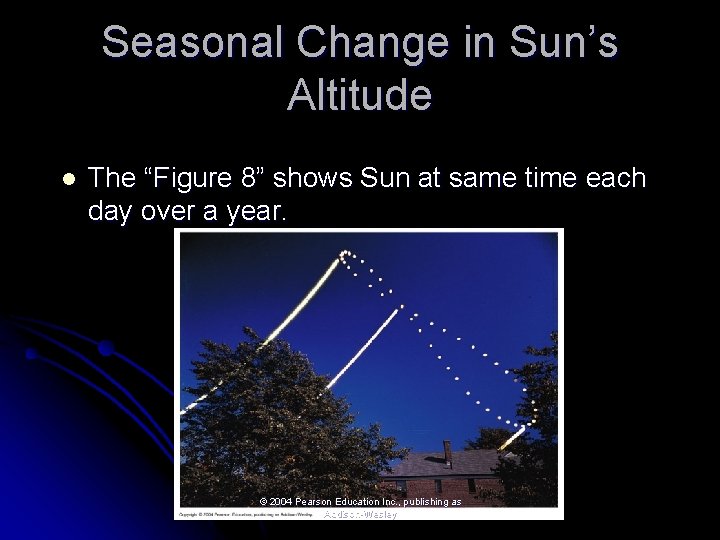
Seasonal Change in Sun’s Altitude l The “Figure 8” shows Sun at same time each day over a year. © 2004 Pearson Education Inc. , publishing as Addison-Wesley
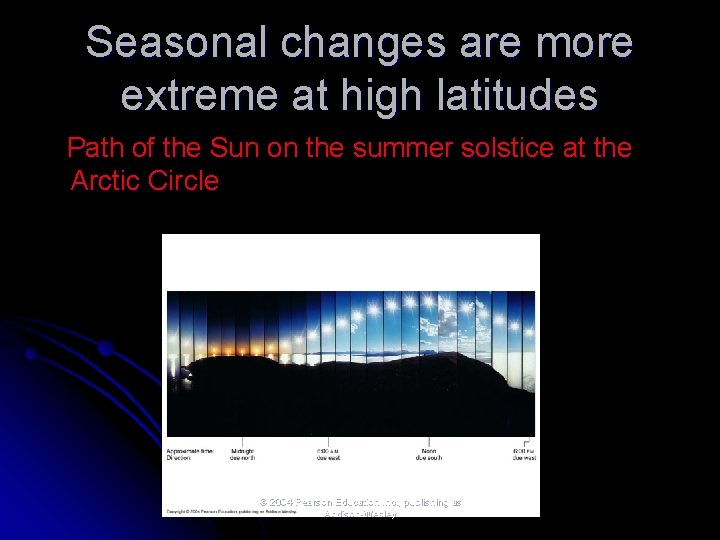
Seasonal changes are more extreme at high latitudes Path of the Sun on the summer solstice at the Arctic Circle © 2004 Pearson Education Inc. , publishing as Addison-Wesley
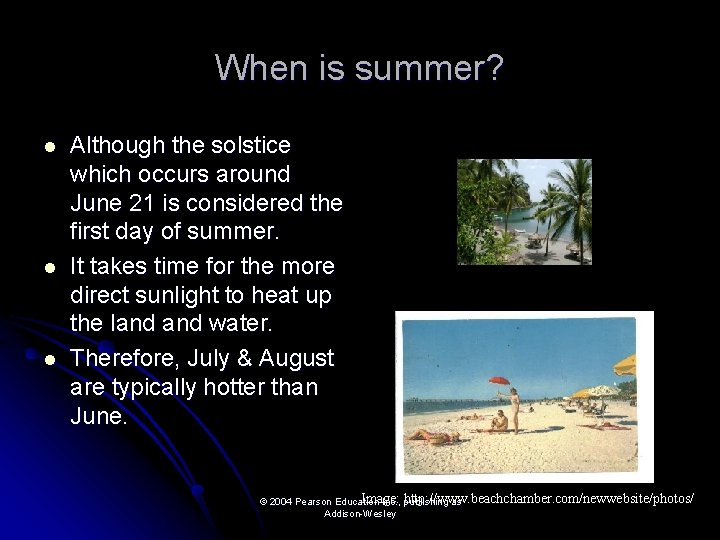
When is summer? l l l Although the solstice which occurs around June 21 is considered the first day of summer. It takes time for the more direct sunlight to heat up the land water. Therefore, July & August are typically hotter than June. Image: http: //www. beachchamber. com/newwebsite/photos/ © 2004 Pearson Education Inc. , publishing as Addison-Wesley
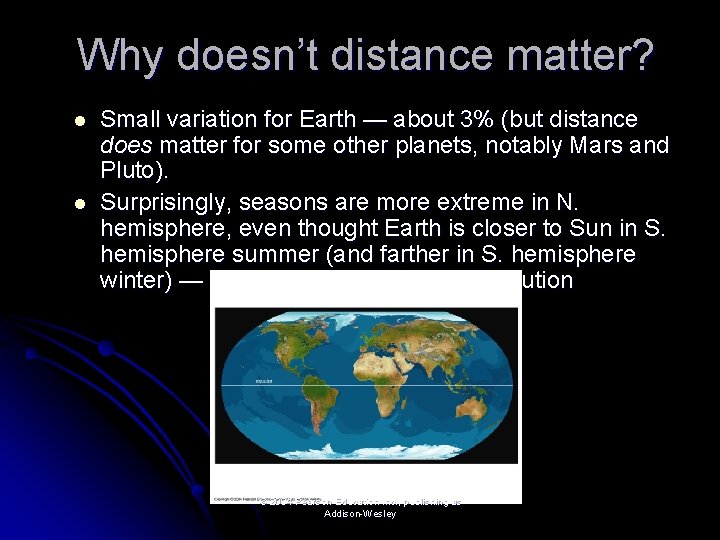
Why doesn’t distance matter? l l Small variation for Earth — about 3% (but distance does matter for some other planets, notably Mars and Pluto). Surprisingly, seasons are more extreme in N. hemisphere, even thought Earth is closer to Sun in S. hemisphere summer (and farther in S. hemisphere winter) — because of land/ocean distribution © 2004 Pearson Education Inc. , publishing as Addison-Wesley
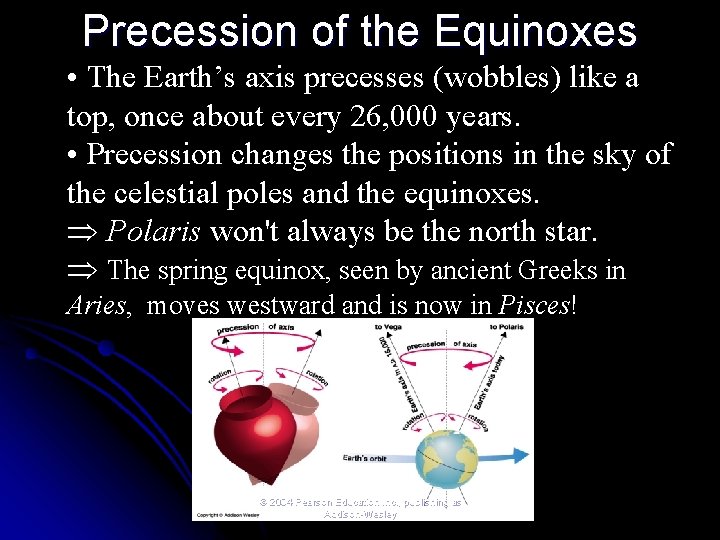
Precession of the Equinoxes • The Earth’s axis precesses (wobbles) like a top, once about every 26, 000 years. • Precession changes the positions in the sky of the celestial poles and the equinoxes. Polaris won't always be the north star. The spring equinox, seen by ancient Greeks in Aries, moves westward and is now in Pisces! © 2004 Pearson Education Inc. , publishing as Addison-Wesley
Sun sign vs. Tropical Sign Tilt of Earth’s axis towards or away from sun determines Season l Calendar is designed to keep same season in the same month…it accounts for precession l Precession changes the place on the Earth’s orbit where a season and month occurs l It is impossible to keep Season, month, and position in orbit the same…so: l © 2004 Pearson Education Inc. , publishing as Addison-Wesley
Horoscope is about one month off! l l l Consider extreme case: in 13, 000 years, sun’s axis will rotate from towards the sun to away from sun. In July, Sun is in conjunction with Leo In 13, 000 years, the sun will be in the same place in its orbit, and in conjunction with Leo, but the calendar will say that it is January. The Zodiac/Horoscope dates were established by Ptolemy, about 100 AD. Since then the Axis has wobbled 2/27 of a complete circle—about a months worth if you are counting. Astrologers differentiate between the Tropical sign (by date) and the Sun sign (by position)…good luck! © 2004 Pearson Education Inc. , publishing as Addison-Wesley
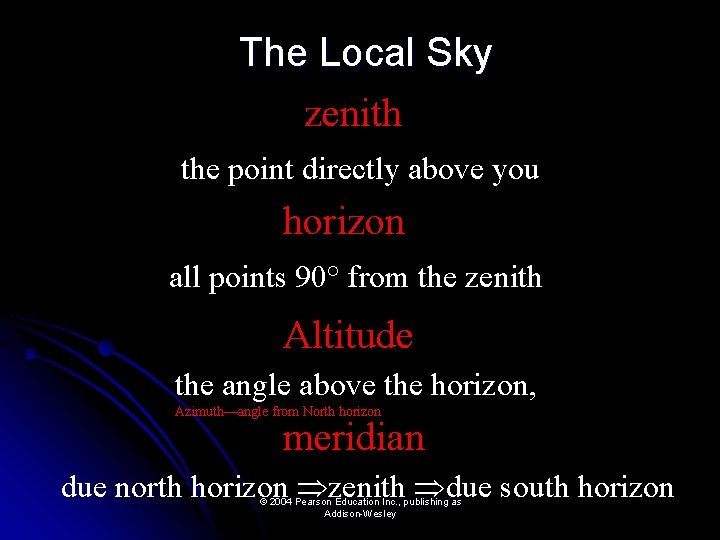
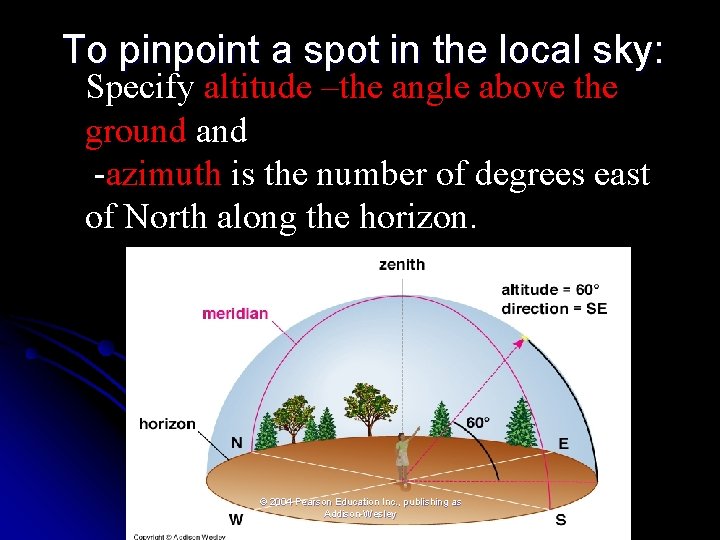
The Local Sky zenith the point directly above you horizon all points 90° from the zenith Altitude the angle above the horizon, Azimuth—angle from North horizon meridian due north horizon zenith due south horizon © 2004 Pearson Education Inc. , publishing as Addison-Wesley
To pinpoint a spot in the local sky: Specify altitude –the angle above the ground and -azimuth is the number of degrees east of North along the horizon. © 2004 Pearson Education Inc. , publishing as Addison-Wesley
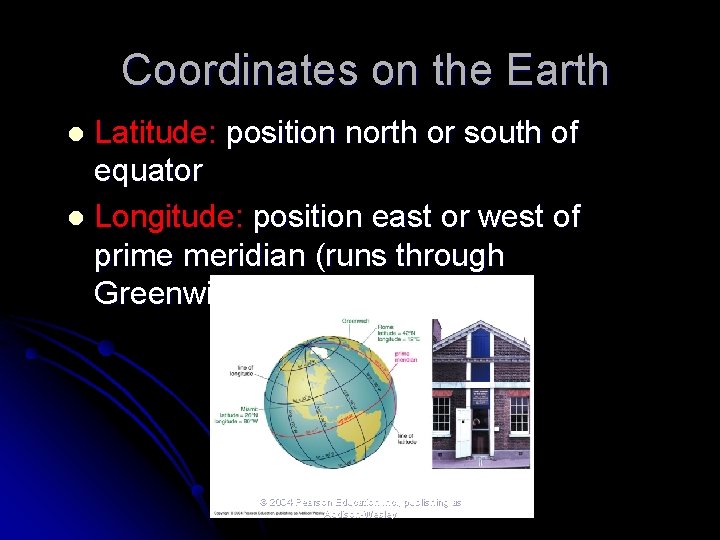
Coordinates on the Earth Latitude: position north or south of equator l Longitude: position east or west of prime meridian (runs through Greenwich, England) l © 2004 Pearson Education Inc. , publishing as Addison-Wesley
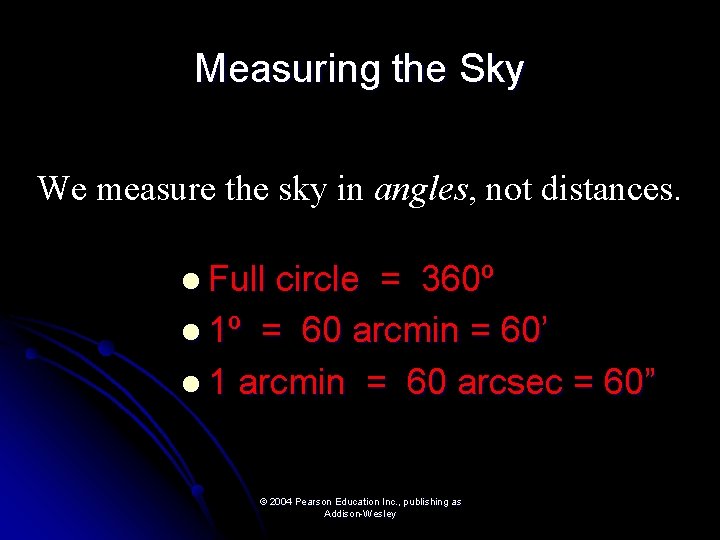
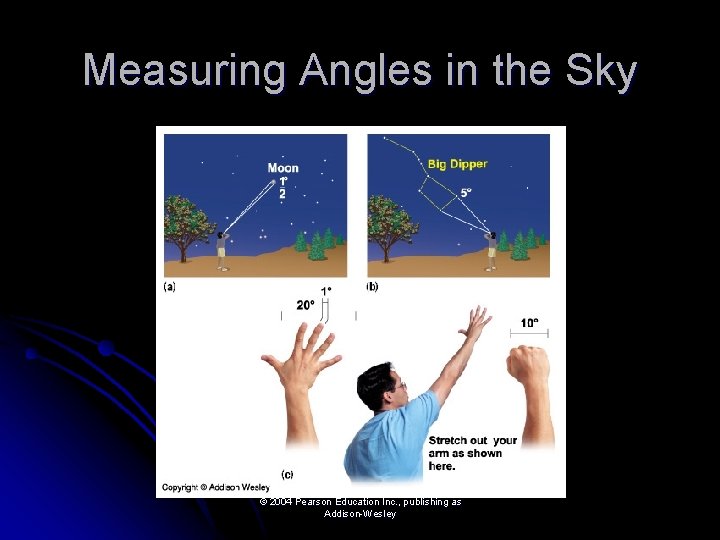
Measuring the Sky We measure the sky in angles, not distances. l Full circle = 360º l 1º = 60 arcmin = 60’ l 1 arcmin = 60 arcsec = 60” © 2004 Pearson Education Inc. , publishing as Addison-Wesley
Measuring Angles in the Sky © 2004 Pearson Education Inc. , publishing as Addison-Wesley
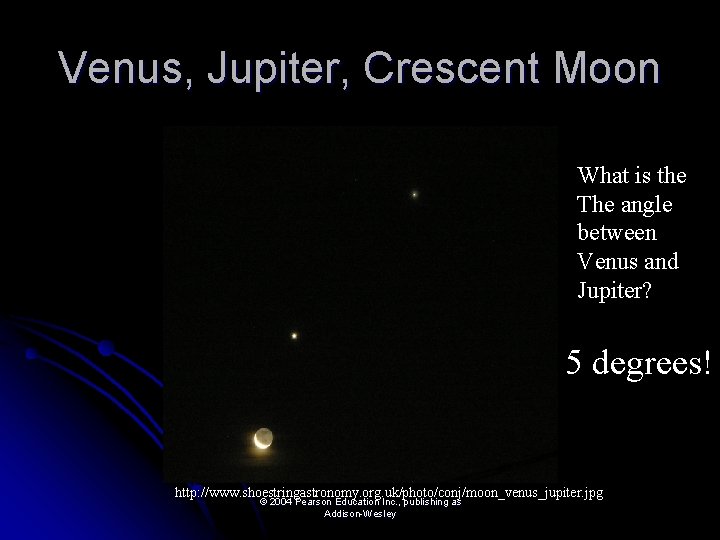
Venus, Jupiter, Crescent Moon What is the The angle between Venus and Jupiter? 5 degrees! http: //www. shoestringastronomy. org. uk/photo/conj/moon_venus_jupiter. jpg © 2004 Pearson Education Inc. , publishing as Addison-Wesley
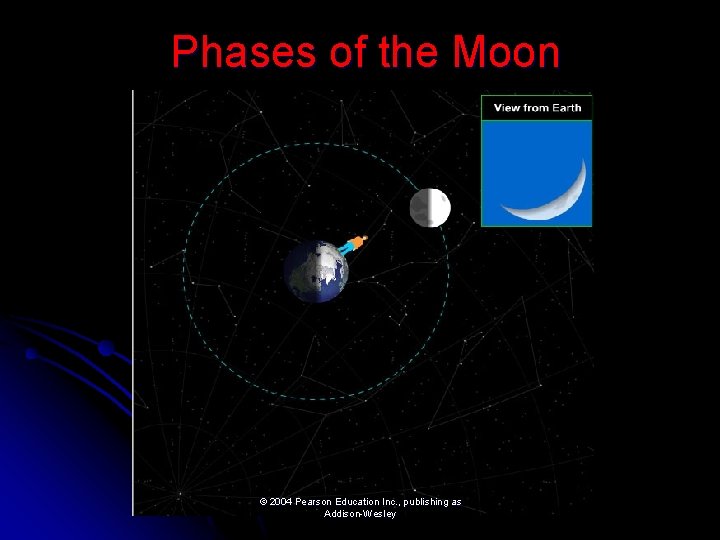
Phases of the Moon © 2004 Pearson Education Inc. , publishing as Addison-Wesley
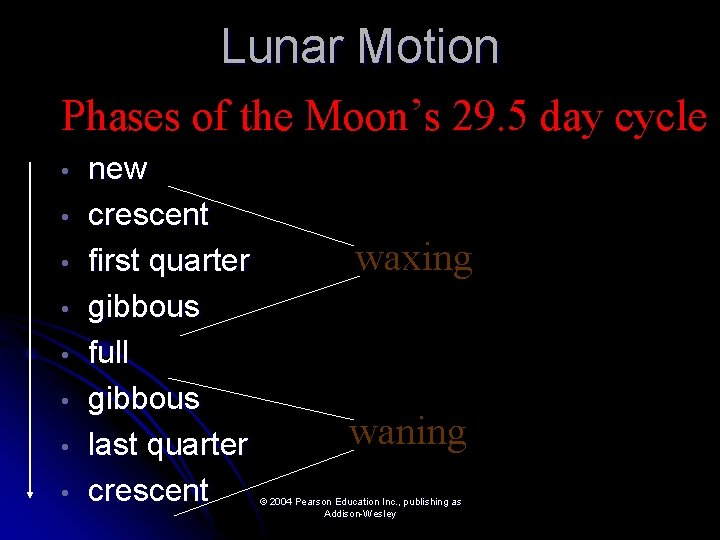
Lunar Motion Phases of the Moon’s 29. 5 day cycle • • new crescent first quarter gibbous full gibbous last quarter crescent waxing waning © 2004 Pearson Education Inc. , publishing as Addison-Wesley
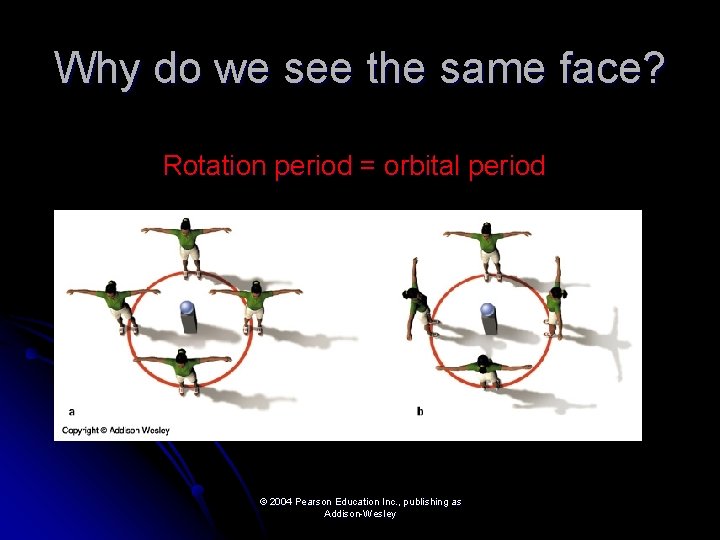
Why do we see the same face? Rotation period = orbital period © 2004 Pearson Education Inc. , publishing as Addison-Wesley
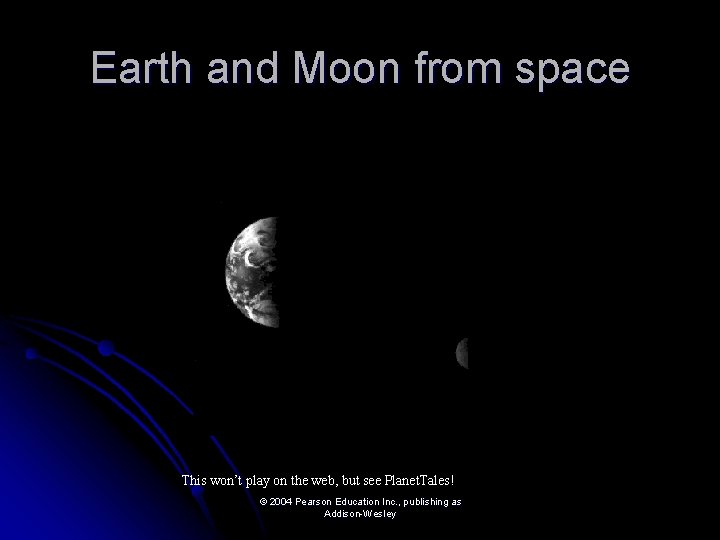
Earth and Moon from space This won’t play on the web, but see Planet. Tales! © 2004 Pearson Education Inc. , publishing as Addison-Wesley
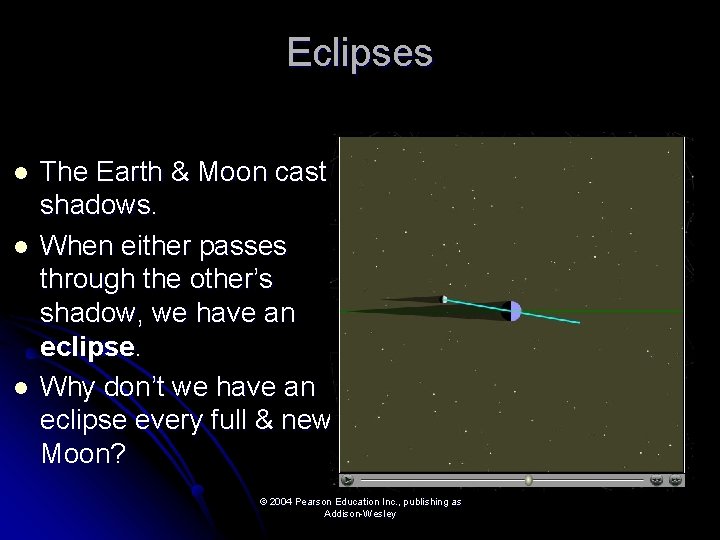
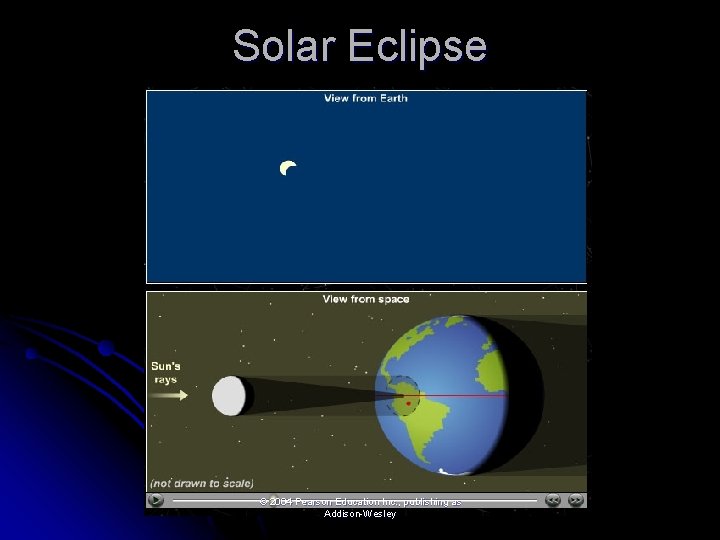
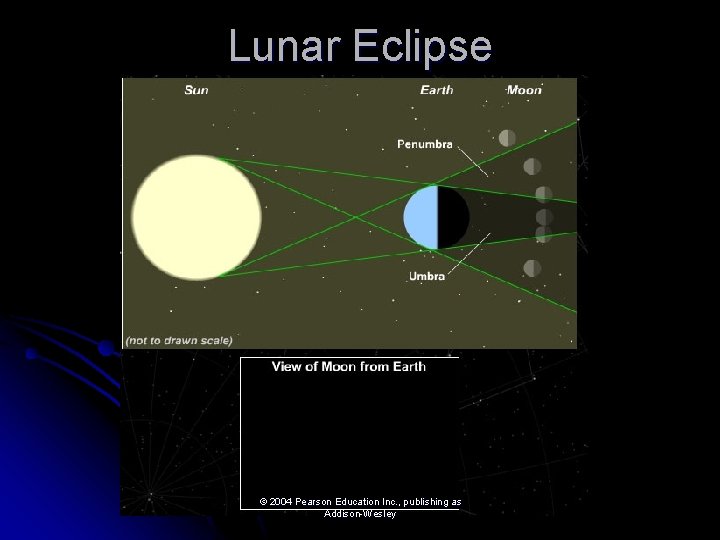
Eclipses l l l The Earth & Moon cast shadows. When either passes through the other’s shadow, we have an eclipse. Why don’t we have an eclipse every full & new Moon? © 2004 Pearson Education Inc. , publishing as Addison-Wesley
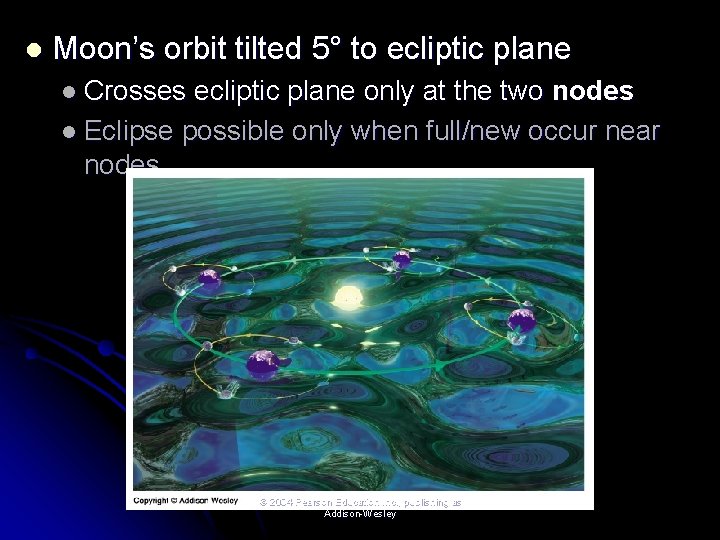
l Moon’s orbit tilted 5° to ecliptic plane l Crosses ecliptic plane only at the two nodes l Eclipse possible only when full/new occur near nodes © 2004 Pearson Education Inc. , publishing as Addison-Wesley
Solar Eclipse © 2004 Pearson Education Inc. , publishing as Addison-Wesley
Lunar Eclipse © 2004 Pearson Education Inc. , publishing as Addison-Wesley