
Annual GSICS Calibration Report for Agency Masaya Takahashi
Annual GSICS Calibration Report for {Agency} Masaya Takahashi (JMA), Dohyeong Kim (KMA), Tim Hewison (EUMETSAT), Xiuqing ”Scott” Hu (CMA), Peter Miu (EUMETSAT) and Ashim Mitra (IMD) 2018 GRWG/GDWG Annual Meeting, 19 -23 March 2018, Shanghai, China 1
GSICS-EP-18 Action (Jun 2017, Jeju, Korea) v GSICS-EP asked GSICS member agencies to provide instrument performance report validated by GSICS inter-calibration methods ü Benefits for both GSICS and satellite data user’s communities Reference Action Description GDWG and GRWG to develop an approach for an Annual GSICS report on the State of the Observing System with respect to Instrument Performance and EP-18. A 03 Inter-comparisons with GSICS Reference Instruments (from presentations given at the GRWG meeting) 2018 GRWG/GDWG Annual Meeting, 19 -23 March 2018, Shanghai, China Actionee Due date GDWG and GRWG EP-19 2
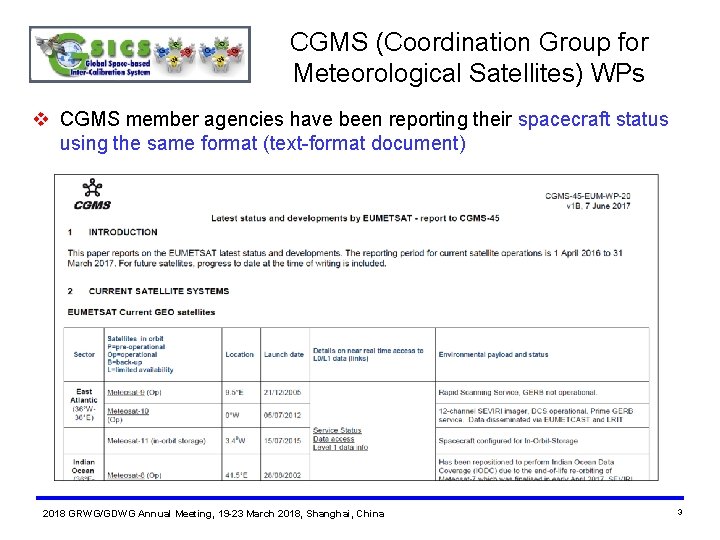
CGMS (Coordination Group for Meteorological Satellites) WPs v CGMS member agencies have been reporting their spacecraft status using the same format (text-format document) 2018 GRWG/GDWG Annual Meeting, 19 -23 March 2018, Shanghai, China 3
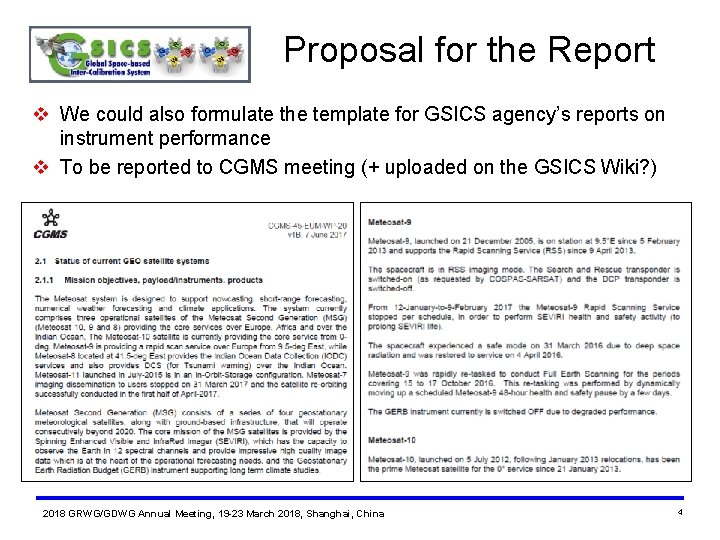
Proposal for the Report v We could also formulate the template for GSICS agency’s reports on instrument performance v To be reported to CGMS meeting (+ uploaded on the GSICS Wiki? ) 2018 GRWG/GDWG Annual Meeting, 19 -23 March 2018, Shanghai, China 4
Concepts of the Report v Target readers ü Satellite data users (+ satellite operators? ) v Adopting existing formats/conventions as possible v Be simple / fewer slides for non calibration experts ü Reducing GSICS members’ work is also important ü Detailed information can be uploaded on Calibration Landing Page v Existing satellite/instrument reports helped us a lot for drafting the report ü Weekly NOAA POLAR-Orbiting Spacecraft Status Reports ü IASI L 0 and L 1 Daily Monitoring Report ü Aqua Status File ü MODIS Weekly Reports ü and so on … 2018 GRWG/GDWG Annual Meeting, 19 -23 March 2018, Shanghai, China 5
Strawman Annual GSICS Calibration Report for {Agency} Name {Agency}
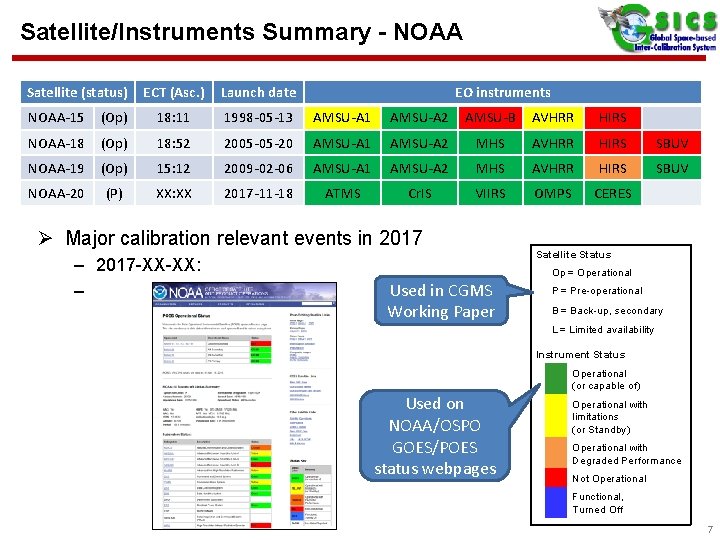
Satellite/Instruments Summary - NOAA Satellite (status) ECT (Asc. ) Launch date EO instruments NOAA-15 (Op) 18: 11 1998 -05 -13 AMSU-A 1 AMSU-A 2 AMSU-B AVHRR HIRS NOAA-18 (Op) 18: 52 2005 -05 -20 AMSU-A 1 AMSU-A 2 MHS AVHRR HIRS SBUV NOAA-19 (Op) 15: 12 2009 -02 -06 AMSU-A 1 AMSU-A 2 MHS AVHRR HIRS SBUV NOAA-20 (P) XX: XX 2017 -11 -18 ATMS Cr. IS VIIRS OMPS CERES Ø Major calibration relevant events in 2017 – 2017 -XX-XX: – Satellite Status Op = Operational Used in CGMS Working Paper P = Pre-operational B = Back-up, secondary L = Limited availability Instrument Status Operational (or capable of) Used on NOAA/OSPO GOES/POES status webpages Operational with limitations (or Standby) Operational with Degraded Performance Not Operational Functional, Turned Off 7
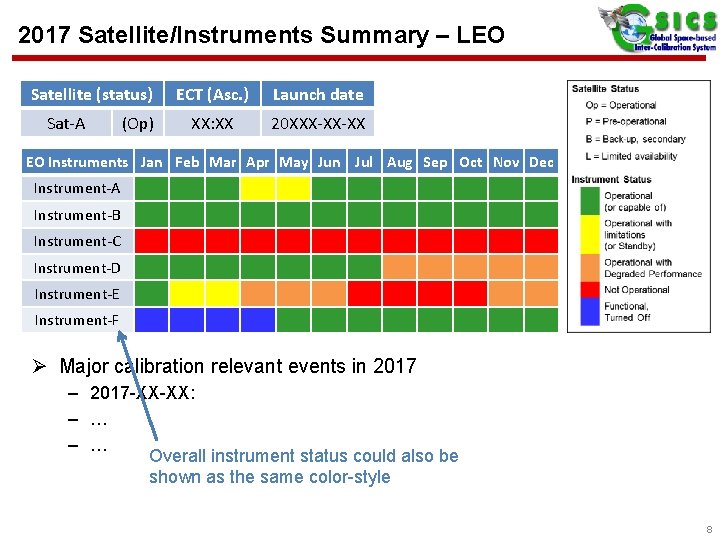
2017 Satellite/Instruments Summary – LEO Satellite (status) Sat-A (Op) ECT (Asc. ) Launch date XX: XX 20 XXX-XX-XX EO Instruments Jan Feb Mar Apr May Jun Jul Aug Sep Oct Nov Dec Instrument-A Instrument-B Instrument-C Instrument-D Instrument-E Instrument-F Ø Major calibration relevant events in 2017 – 2017 -XX-XX: – … Overall instrument status could also be shown as the same color-style 8
Calibration Performance: NOAA-20/ATMS Summarize the instrument’s calibration performance in 1 slide or a few 9
Example – the case for JMA GDWG Breakout Session Joint Actions 10
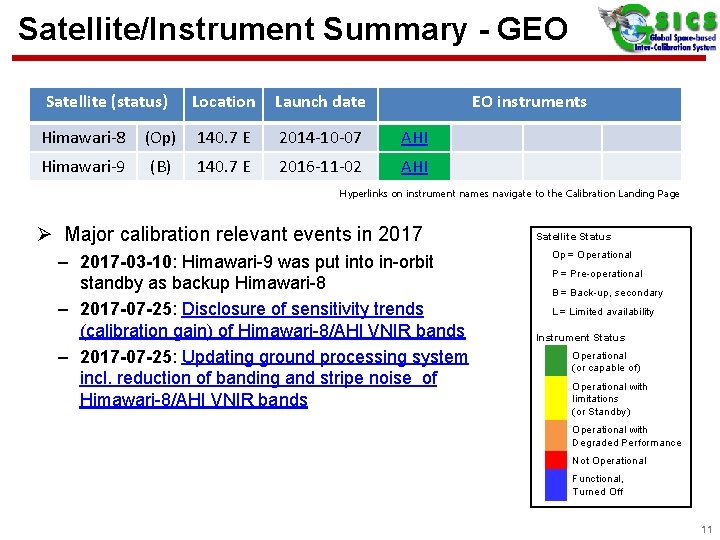
Satellite/Instrument Summary - GEO Satellite (status) Location Launch date EO instruments Himawari-8 (Op) 140. 7 E 2014 -10 -07 AHI Himawari-9 (B) 140. 7 E 2016 -11 -02 AHI Hyperlinks on instrument names navigate to the Calibration Landing Page Ø Major calibration relevant events in 2017 – 2017 -03 -10: Himawari-9 was put into in-orbit standby as backup Himawari-8 – 2017 -07 -25: Disclosure of sensitivity trends (calibration gain) of Himawari-8/AHI VNIR bands – 2017 -07 -25: Updating ground processing system incl. reduction of banding and stripe noise of Himawari-8/AHI VNIR bands Satellite Status Op = Operational P = Pre-operational B = Back-up, secondary L = Limited availability Instrument Status Operational (or capable of) Operational with limitations (or Standby) Operational with Degraded Performance Not Operational Functional, Turned Off 11
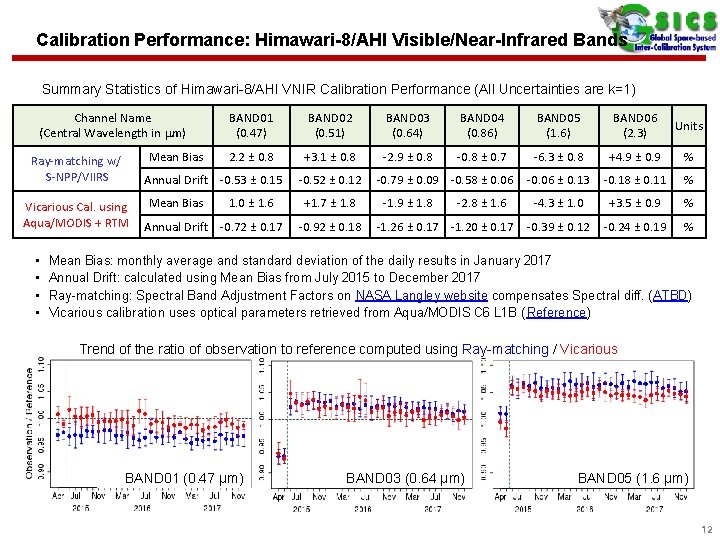
Calibration Performance: Himawari-8/AHI Visible/Near-Infrared Bands Summary Statistics of Himawari-8/AHI VNIR Calibration Performance (All Uncertainties are k=1) Channel Name (Central Wavelength in m) Mean Bias Ray-matching w/ S-NPP/VIIRS BAND 02 (0. 51) BAND 03 (0. 64) BAND 04 (0. 86) BAND 05 (1. 6) BAND 06 (2. 3) Units 2. 2 ± 0. 8 +3. 1 ± 0. 8 -2. 9 ± 0. 8 -0. 8 ± 0. 7 -6. 3 ± 0. 8 +4. 9 ± 0. 9 % -0. 06 ± 0. 13 -0. 18 ± 0. 11 % -4. 3 ± 1. 0 +3. 5 ± 0. 9 % -0. 39 ± 0. 12 -0. 24 ± 0. 19 % Annual Drift -0. 53 ± 0. 15 Vicarious Cal. using Aqua/MODIS + RTM • • BAND 01 (0. 47) Mean Bias 1. 0 ± 1. 6 Annual Drift -0. 72 ± 0. 17 -0. 52 ± 0. 12 +1. 7 ± 1. 8 -0. 92 ± 0. 18 -0. 79 ± 0. 09 -0. 58 ± 0. 06 -1. 9 ± 1. 8 -2. 8 ± 1. 6 -1. 26 ± 0. 17 -1. 20 ± 0. 17 Mean Bias: monthly average and standard deviation of the daily results in January 2017 Annual Drift: calculated using Mean Bias from July 2015 to December 2017 Ray-matching: Spectral Band Adjustment Factors on NASA Langley website compensates Spectral diff. (ATBD) Vicarious calibration uses optical parameters retrieved from Aqua/MODIS C 6 L 1 B ( Reference) Trend of the ratio of observation to reference computed using Ray-matching / Vicarious calibration approaches BAND 01 (0. 47 μm) BAND 03 (0. 64 μm) BAND 05 (1. 6 μm) 12
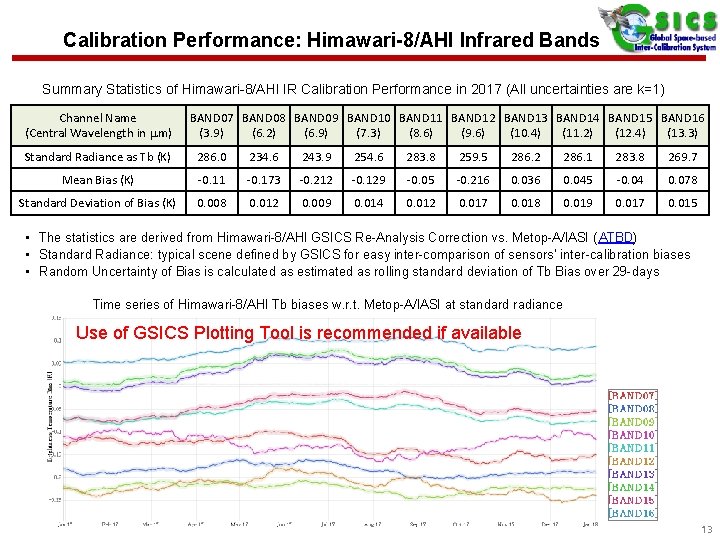
Calibration Performance: Himawari-8/AHI Infrared Bands Summary Statistics of Himawari-8/AHI IR Calibration Performance in 2017 (All uncertainties are k=1) Channel Name (Central Wavelength in m) BAND 07 BAND 08 BAND 09 BAND 10 BAND 11 BAND 12 BAND 13 BAND 14 BAND 15 BAND 16 (3. 9) (6. 2) (6. 9) (7. 3) (8. 6) (9. 6) (10. 4) (11. 2) (12. 4) (13. 3) Standard Radiance as Tb (K) 286. 0 234. 6 243. 9 254. 6 283. 8 259. 5 286. 2 286. 1 283. 8 269. 7 Mean Bias (K) -0. 11 -0. 173 -0. 212 -0. 129 -0. 05 -0. 216 0. 036 0. 045 -0. 04 0. 078 Standard Deviation of Bias (K) 0. 008 0. 012 0. 009 0. 014 0. 012 0. 017 0. 018 0. 019 0. 017 0. 015 • The statistics are derived from Himawari-8/AHI GSICS Re-Analysis Correction vs. Metop-A/IASI ( ATBD) • Standard Radiance: typical scene defined by GSICS for easy inter-comparison of sensors’ inter-calibration biases • Random Uncertainty of Bias is calculated as estimated as rolling standard deviation of Tb Bias over 29 -days Time series of Himawari-8/AHI Tb biases w. r. t. Metop-A/IASI at standard radiance Use of GSICS Plotting Tool is recommended if available 13
Discussion Any thoughts? • • • Target readers Report contents (template) Report type (MS Word / PPT) When to start (next Annual Meeting in 2019? ) …
- Slides: 14