
Announcing You are invited to submit questions that
Announcing: • You are invited to submit questions that you would like to see on the final exam (preferably by e-mail to chrisw@ualberta. ca) • I reserve the right to use all or none of the questions that I receive • Why would you bother? – – You might know the answer to a question you asked You can influence the composition and content of the final exam It might help you study I will give a U of A pen to one lucky participant drawn at random! Neuropsychological Testing
An Introduction To Neuropsychological Testing
Overview • • • Introduction to neuropsychological testing Complications & problems History of neuropsychological testing Example 1: Bender Visual-Gestalt Test Example 2: The Wisconsin Card Sort Test Example 3: The Chicago Word Fluency Test Example 4: The Wechsler Memory Scale (Revised) Example 5: Rey-Osterrieth Complex Figure Test Conclusion Neuropsychological Testing
Neuropsychological Testing DLPFC
What is neuropsychological testing? • Neuropsychological testing looks at two aspects: i. ) Functional integrity: Whether or not any particular specifiable function is intact - Examples: short-term/long-term memory, lexical access, attention, sensory discrimination, motor strength ii. ) Localization: Whether or not any specific neuroanatomical region of the brain is functionally intact Neuropsychological Testing
Some complications • Function and region do not have a one-to-one mapping – Many functions can be affected by lesions at many multiple disparate locations – Many brain regions subserve multiple functions • The brain's functions do not map cleanly onto easilydefinable functional categories – Neither attention, nor lexical access, nor memory (etc. ) are really unitary functions: each can be decomposed into many (sometimes non-intuitive) subfunctions Neuropsychological Testing
Some complications • Functional simplifications and partial relations between function and region- and the relations between these twocan be reified – Partial correlations start masquerading as certain facts – confirming evidence is piled up without weighting disconfirming evidence, making things seem more certain than they are under close scrutiny • Statistically-significant group differences do not guarantee interpretability of individual differences – High overlap = low probability of meaningful interpretation of individual scores Neuropsychological Testing
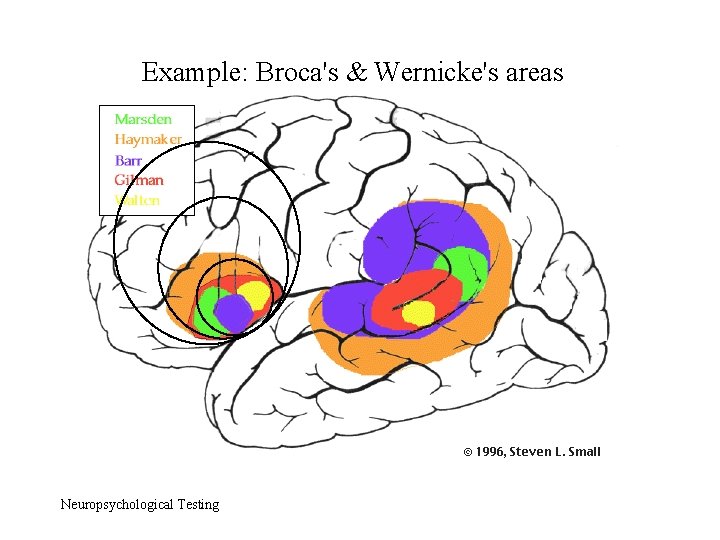
Example: Broca's & Wernicke's areas Neuropsychological Testing
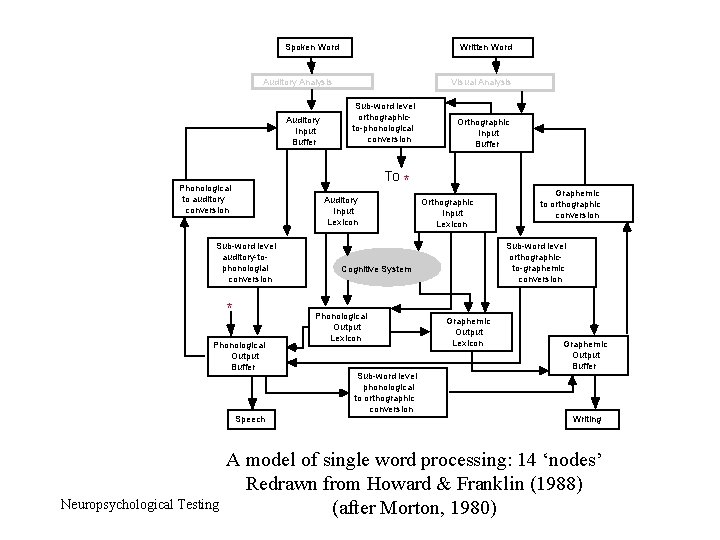
Spoken Word Written Word Auditory Analysis Auditory Input Buffer Sub-word level orthographicto-phonological conversion To Phonological to auditory conversion * Phonological Output Buffer Speech Orthographic Input Buffer * Auditory Input Lexicon Sub-word level auditory-tophonologial conversion Neuropsychological Testing Visual Analysis Orthographic Input Lexicon Sub-word level orthographicto-graphemic conversion Cognitive System Phonological Output Lexicon Sub-word level phonological to orthographic conversion Graphemic Output Lexicon Graphemic Output Buffer Writing A model of single word processing: 14 ‘nodes’ Redrawn from Howard & Franklin (1988) (after Morton, 1980)
Humans have relatively huge amounts of association cortex Adapted from: W. Penfield (1975) The Mystery Of The Mind Neuropsychological Testing
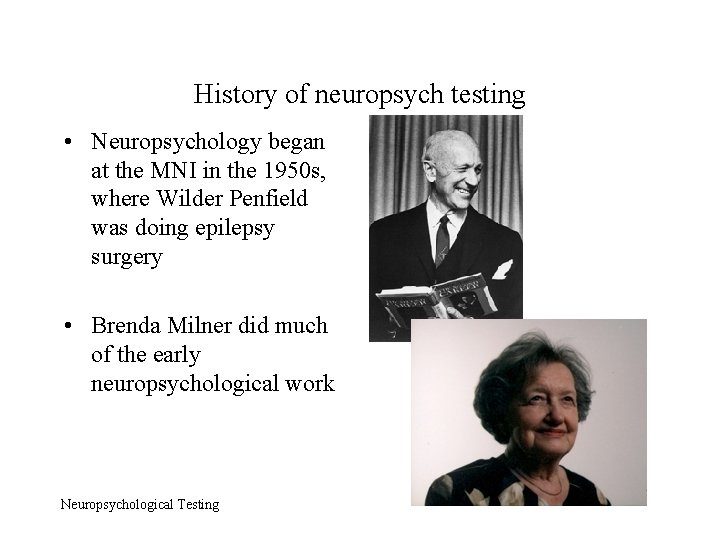
History of neuropsych testing • Neuropsychology began at the MNI in the 1950 s, where Wilder Penfield was doing epilepsy surgery • Brenda Milner did much of the early neuropsychological work Neuropsychological Testing
History of neuropsych testing • Small amounts of information were very valuable in a situation where there was almost no hard data • Many tests were developed from experimental work with minimal attention to psychometric rigor • However, EEG, PET, and MRI have all changed the equation in modern times, leaving much modern neuropsychological testing 'orphaned', especially with respect to localization Neuropsychological Testing
Functional assessment • When neuropsychological tests are used (as they often are) for purely functional assessment, they can escape from the constraining demands of validity simply by having face validity (or even just historical precedent) – A standard battery can have utility simply be virtue of being standard, and/or by allowing for pre-post testing – When inferences are to be made to prior functioning, more psychometric rigor is required, but not always available Neuropsychological Testing
The 10 most commonly used tests 1. ) Wechsler Intelligence Scale for Children (WISC) 2. ) Bender Visual-Motor Gestalt Test 3. ) Wechsler Adult Intelligence Scale (WAIS) 4. ) Minnesota Multiphasic Personality Inventory (MMPI) 5. ) Rorschach Ink Blot Test 6. ) Thematic Apperception Test (TAT) 7. ) Sentence Completion 8. ) Goodenough Draw-A-Person Test 9. ) House-Tree-Person Test 10. ) Stanford-Binet Intelligence Scale From Brown & Mc. Guire, 1976 Neuropsychological Testing
Example 1: Bender Visual-Gestalt Test • The Bender Visual Motor Gestalt Test (1946) is a widelyused test to assess visual motor processing. • It is often referred to as the Bender Gestalt. – ‘Bender’ is the person who designed it. – ‘Gestalt’ comes from a German word meaning ‘form’. • The test simply asks you to copy a set of abstract designs (we will see them in the next lab) Neuropsychological Testing
Example 1: Bender Visual-Gestalt Test • The Bender Gestalt is sensitive at identifying organic brain damage, distinguishing it from purely psychiatric diagnoses. – Visuographic productive abilities are associated with the parietal lobe, especially in the right hemisphere. – A good result cannot rule out brain damage in other regions of the brain. – This test is also sometimes used for assessing mental retardation and regression in the psychoanalytic sense (functioning beneath ones actual developmental level). Neuropsychological Testing
Example 1: Bender Visual-Gestalt Test • The original scoring was very unspecified, requiring an expert qualitative judgment • Many objective scoring systems have since been developed • Some have inter-judge reliabilities above 0. 95. • Bender scores correlate around 0. 5 with all WAIS subtests except Digit Span and Object Assembly, with which they correlate a little lower, around 0. 4. Neuropsychological Testing
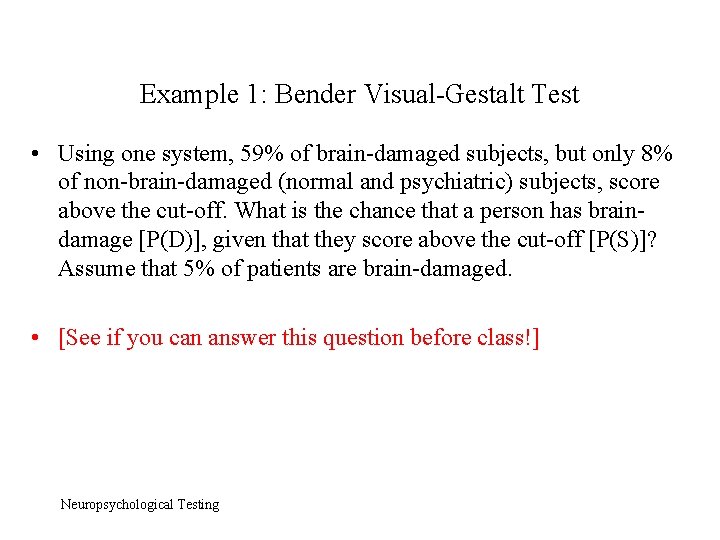
Example 1: Bender Visual-Gestalt Test • Using one system, 59% of brain-damaged subjects, but only 8% of non-brain-damaged (normal and psychiatric) subjects, score above the cut-off. What is the chance that a person has braindamage [P(D)], given that they score above the cut-off [P(S)]? Assume that 5% of patients are brain-damaged. • [See if you can answer this question before class!] Neuropsychological Testing
Example 2: Wisconsin Card Sorting Task Wisconsin Slides are courtesy of Aki Caramanos Neuropsychological Testing

Neuropsychological Testing
- Milner (1971): “the critical lesion is dorsolateral, not orbital, and a small left frontal excision involving this area causes lasting impairment, whereas larger lesions on the right sometimes produce only transient defects, or even none at all” - Milner (1975): “even in cases where early severe injury to the LH has caused speech to be mediated by the RH, frontal removals for the non-speaking LH cause lasting deficits in WCST which are not seen after removals from a comparably damaged RH. ” - Based mainly on the strength of these, and other similar findings the WCST is widely accepted as an indicator of frontal lobe function, left more than right. Neuropsychological Testing
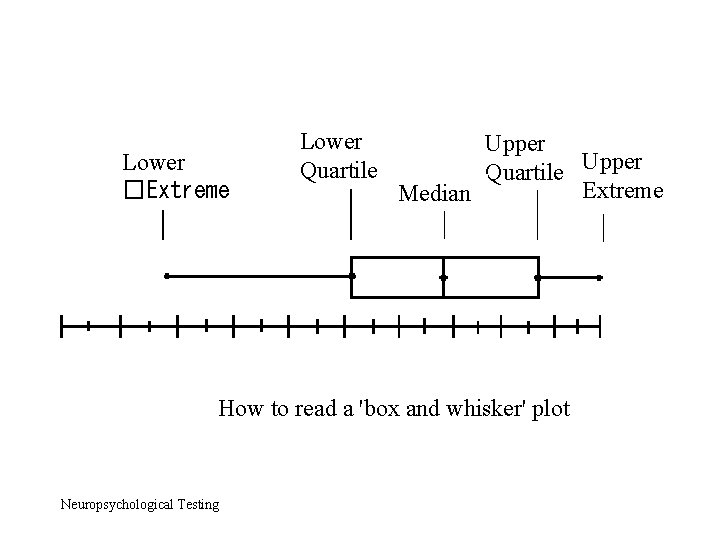
Lower �Extreme Lower Quartile Upper Extreme Median How to read a 'box and whisker' plot Neuropsychological Testing
Categories attained: LF < LT, RF (p < 0. 04) Neuropsychological Testing
Neuropsychological Testing Perseverative errors: LF > RF (p < 0. 1 )
< < By chi-square, WCST cut-off scores are not useful in preoperative discrimination of focal epilepsy patients. Discriminant analyses (by side, location, or location & side) were not successful either Neuropsychological Testing
Summary of findings • While the LF group was statistically impaired on some of the WCST measures relative to the other groups of patients tested, there was almost complete between-group overlap on all measures at all stages of testing = classification of individual patients based on any one measure is impossible. • Individual patient’s pre-operative pattern of performance across the WCST variables could not predict their locus of neural disturbance. • neither early post-operative, nor late follow-up performance could predict site of cortical excision. • The WCST may be an adequate measure of an individual’s ability to repeatedly form, maintain, and switch categories, but it is not an effective tool for localising neural dysfunction Neuropsychological Testing
Example 3: Chicago Word Fluency Test • The Chicago Word Fluency Test is used to measure an individual’s symbolic verbal fluency. • Subjects are required to write as many different words beginning with S as possible in 5 minutes and, after this, as many singular four-letter words beginning with C as possible in 4 minutes. • The total number of ‘S’ and ‘C’ words produced, minus the number of rule-breaking and perseverative responses, yield the patients’ measure of verbal fluency. • Spelling mistakes and socially inappropriate words are noted, but not subtracted from this measure. Neuropsychological Testing
Chicago Word Fluency Test: History • In 1964, Milner found that patients that had undergone discrete cortical excision from the left prefrontal cortex (LF, n=7) for the treatment of focal epilepsy were severely impaired on this task relative to similar patients with excisions from the right-frontal (RF, n=4) or the lefttemporal (LT, n=7) lobes. • In 1974, Perret tested a variety of patients pre-operatively on an oral version of the CWFT and found that patients with frontal lesions performed worse than those with non-frontal lesions (n=68). Moreover, the LF patients (n=23) were more impaired than the RF patients (n=27). • Based on these and other similar findings, the CWFT has been widely accepted as a measure of frontal lobe function. • a recent survey of epilepsy centers found it to be the most widely used measure of verbal fluency Neuropsychological Testing
Chicago Word Fluency Test Valid 'S' Words: - main effect of side, L<R (p<0. 01) - main effect of lobe, F<T (p<0. 01) - no side*lobe interaction Neuropsychological Testing
Chicago Word Fluency Test Valid 'C' Words: - no effect of side - main effect of lobe, F<T (p<0. 001) - no side*lobe interaction - No significant main effects or interactions of # of spelling errors, perseverations, rule breaks, or swear words Neuropsychological Testing
Discriminant Ability: Summary • Frontal patients, as a group, produced statistically fewer words on the CWFT. • Nevertheless, there was almost complete between-group overlap on all measures at all stages of testing • Discriminant analyses not successful at predicting locus of excision in these focal epilepsy patients. • Classification of individual patients based on any one measure was therefore impossible. Neuropsychological Testing
The Structure of Memory • Memory is a complex construct composed on many differentiable subfunctions Neuropsychological Testing
Memory testing • The WAIS is a starting point – Digit Span tests retention – Information tests remote memory • Other common memory tests are: – The Wechsler Memory Scale (1945) – Rey-Osterrieth Complex Figure Recall – Corsi Blocks Neuropsychological Testing
Example 4: The Wechsler Memory Scale (Revised) • Consists of 7 subtests: 1. ) Personal & current information: Age, date of birth, current head of state etc. 2. ) Orientation: Time and place 3. ) Mental control: Automatisms such as alphabet recitation; Conceptual tracking: "Count by 4 from 1 to 53" 4. ) Logical Memory: Immediate recall of two paragraphs Neuropsychological Testing
The Wechsler Memory Scale (Revised) • Consists of 7 subtests: 5. ) Digit Span: Like the WAIS-R, but shorter: no 3 forward/2 -back, or 9 forward/8 -back 6. ) Visual Reproduction: An immediate visual memory drawing task 7. ) Associate learning: 10 words pairs; 6 easy associations (eg. baby-cries) and 4 hard associations (eg. cabbagepen). - 3 presentations with test after each - Score = 0. 5 easy + hard Neuropsychological Testing
The Wechsler Memory Scale (Revised) • Issues: – MQ assumes memory is a unidimensional function – Has been criticized both for an overly-inclusive concept of memory (includes orientation, drawing competency, mental tracking) and for its limitations of functions tested (6/7 tests are verbal; the 7 th- Visual recall- has verbal loading) – Subtest intercorrelations are low, so one cannot assume that intact subjects will perform well on all well enough to identify deviation – Positive correlations with tests of intellectual ability raise questions – Not well tuned for differential diagnostic purposes Neuropsychological Testing
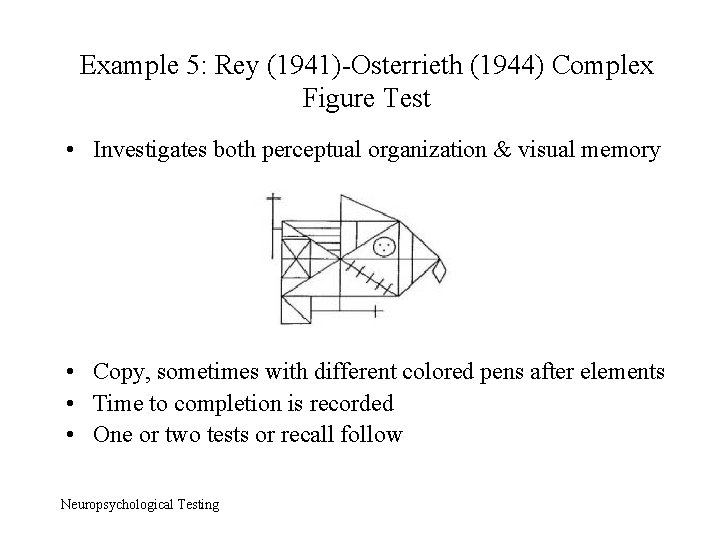
Example 5: Rey (1941)-Osterrieth (1944) Complex Figure Test • Investigates both perceptual organization & visual memory • Copy, sometimes with different colored pens after elements • Time to completion is recorded • One or two tests or recall follow Neuropsychological Testing
Rey-Osterrieth Complex Figure Test • Frontal lobe patients perseverate in copies • LH damage patients tend to break drawing into smaller units than normals (less so at recall) and simplify (eg. by rounding angles such as those on the diamond; drawing dashes instead of each dot; turning the cross into a T) • RH patients tend to make more omissions • Parietal patients have difficulty with spatial organization • Scoring systems exist • Inter-rater R is very high Neuropsychological Testing
Corsi Blocks • Non-verbal analogue to digit span • Nine 1. 4 inch cubes attached to a black background • E taps each one in sequence, adding one after each successful copy by the patient • One pattern is repeated ever third trial (as in Hebb's Digits) • R temporal lobe damage shows little long-term learning and show deficits of short-term recall as well • Other RH damage can also affect performance Neuropsychological Testing
Special factors in neuropsychological testing • • Normal age-related changes Handedness Sex Premorbid psychological status Medication Epilepsy Psychosis, perhaps secondary Malingering Neuropsychological Testing
Conclusions • Tests may (and many do) discriminate groups without succeeding in discriminating individuals • Functional localization claims are fraught with difficulty and can often be resolved with technological rather than inferential tools • Functional claims may be made on the basis of tests being their own validation, since it is not always obvious what else could validate the test more appropriately Neuropsychological Testing
- Slides: 41