
Announcements Russias new secret weapon is inflatable This
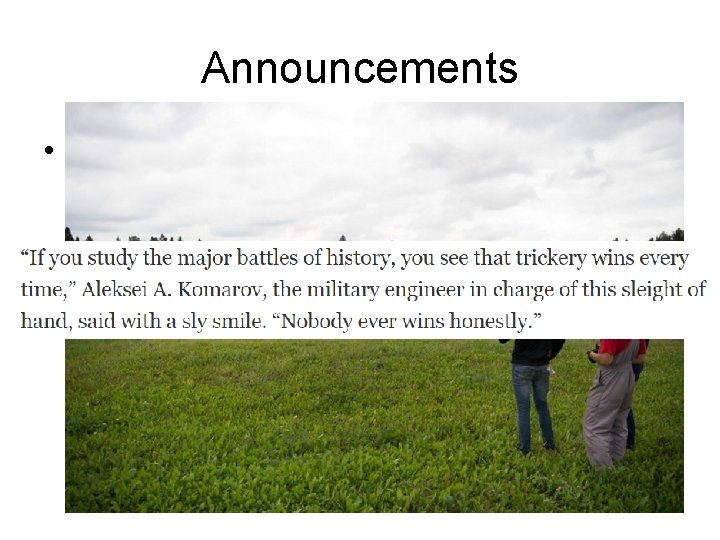
Announcements • Russia’s new secret weapon is inflatable…
This Day in History… The Cuban Missile Crisis begins on October 14, 1962, bringing the United States and the Soviet Union to the brink of nuclear conflict. Photographs taken by a high-altitude U-2 spy plane offered incontrovertible evidence that Soviet-made medium-range missiles in Cuba—capable of carrying nuclear warheads—were now stationed 90 miles off the American coastline.
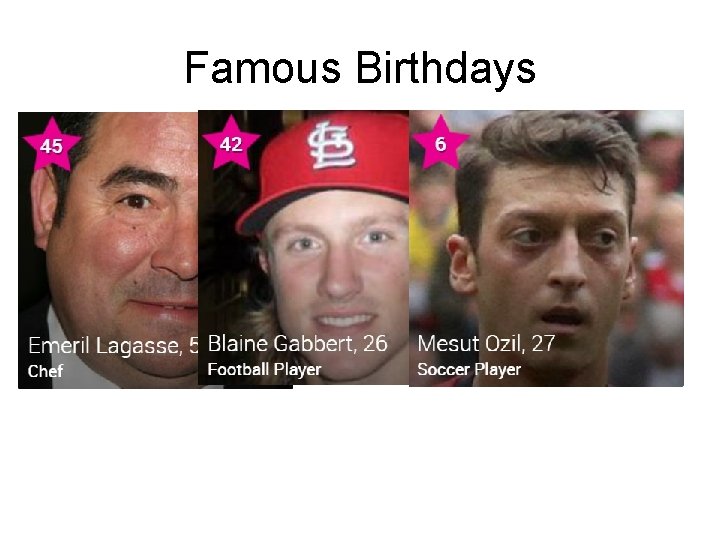
Famous Birthdays
You think you’re random? Pick one of the following numbers. . . 1234 Did you pick 3? So did 75% of the rest of the class… Did you pick 2 or 4? That’s about 20% The truly random people pick 1.
Why Be Random? • What is it about chance outcomes being random that makes random selection seem fair? Two things: – Nobody can guess the outcome before it happens. – When we want things to be fair, usually some underlying set of outcomes will be equally likely (although in many games some combinations of outcomes are more likely than others).
Why Be Random? (cont. ) • Example: – Pick “heads” or “tails. ” – Flip a fair coin. Does the outcome match your choice? Did you know before flipping the coin whether or not it would match?
Why Be Random? (cont. ) • Statisticians don’t think of randomness as the annoying tendency of things to be unpredictable or haphazard. • Statisticians use randomness as a tool. • But, truly random values are surprisingly hard to get…
It’s Not Easy Being Random (cont. ) • It’s surprisingly difficult to generate random values even when they’re equally likely. • Computers have become a popular way to generate random numbers. – Even though they often do much better than humans, computers can’t generate truly random numbers either. – Since computers follow programs, the “random” numbers we get from computers are really pseudorandom. – Fortunately, pseudorandom values are good enough for most purposes.
It’s Not Easy Being Random (cont. ) • There are ways to generate random numbers so that they are both equally likely and truly random. • The best ways we know to generate data that give a fair and accurate picture of the world rely on randomness, and the ways in which we draw conclusions from those data depend on the randomness, too.
A Simulation • A simulation consists of a collection of things that happen at random. – The most basic event is called a component of the simulation. – Each component has a set of possible outcomes, one of which will occur at random.
A Simulation (cont. ) • The sequence of events we want to investigate is called a trial. – Trials usually involve several components. – After the trial, we record what happened—our response variable. • There are seven steps to a simulation…
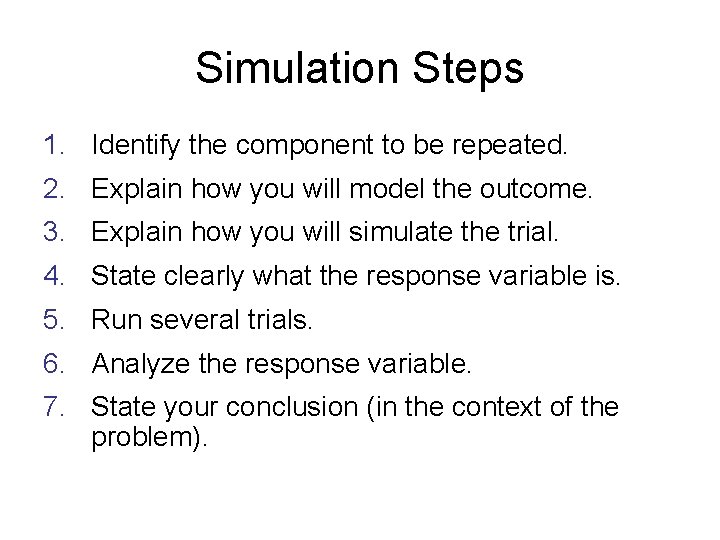
Simulation Steps 1. Identify the component to be repeated. 2. Explain how you will model the outcome. 3. Explain how you will simulate the trial. 4. State clearly what the response variable is. 5. Run several trials. 6. Analyze the response variable. 7. State your conclusion (in the context of the problem).
Example 1 If an airline passenger is stopped at the security checkpoint in the terminal, the probability that the passenger has illegal contraband hidden in their luggage is 0. 18. A police officer manning the security station plans to thoroughly search the luggage of all passengers who are stopped for a search until he finds one with illegal contraband. (a) Use simulation to estimate the probability that illegal contraband will turn up before he searches the luggage of the 10 th passenger who has stopped for a search. Conduct 5 trials. (b) Calculate the exact probability that illegal contraband will be found before the 10 th person who has been stopped has been searched.
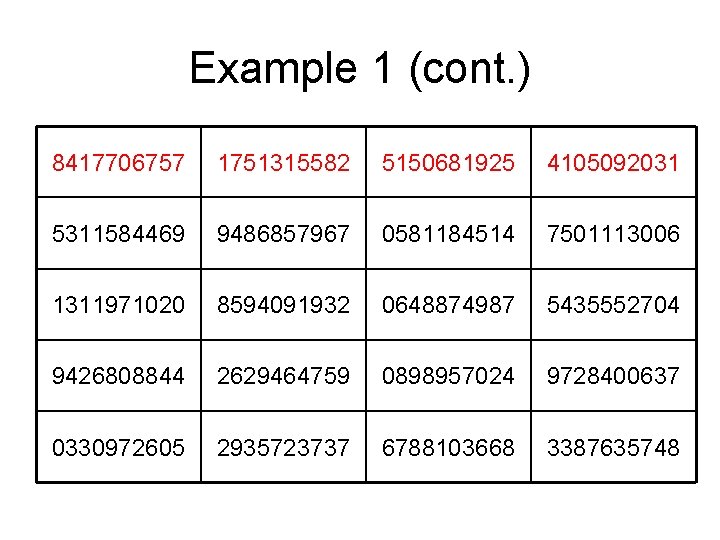
Example 1 (cont. ) 8417706757 1751315582 5150681925 4105092031 5311584469 9486857967 0581184514 7501113006 1311971020 8594091932 0648874987 5435552704 9426808844 2629464759 0898957024 9728400637 0330972605 2935723737 6788103668 3387635748
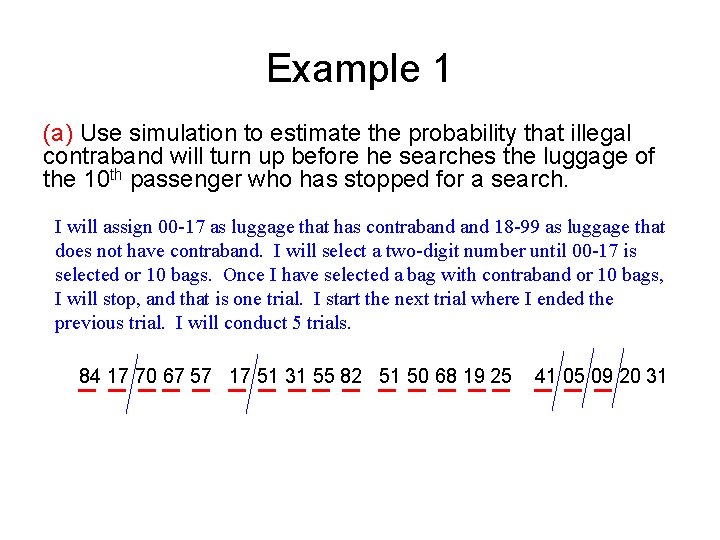
Example 1 (a) Use simulation to estimate the probability that illegal contraband will turn up before he searches the luggage of the 10 th passenger who has stopped for a search. I will assign 00 -17 as luggage that has contraband 18 -99 as luggage that does not have contraband. I will select a two-digit number until 00 -17 is selected or 10 bags. Once I have selected a bag with contraband or 10 bags, I will stop, and that is one trial. I start the next trial where I ended the previous trial. I will conduct 5 trials. 84 17 70 67 57 17 51 31 55 82 51 50 68 19 25 41 05 09 20 31
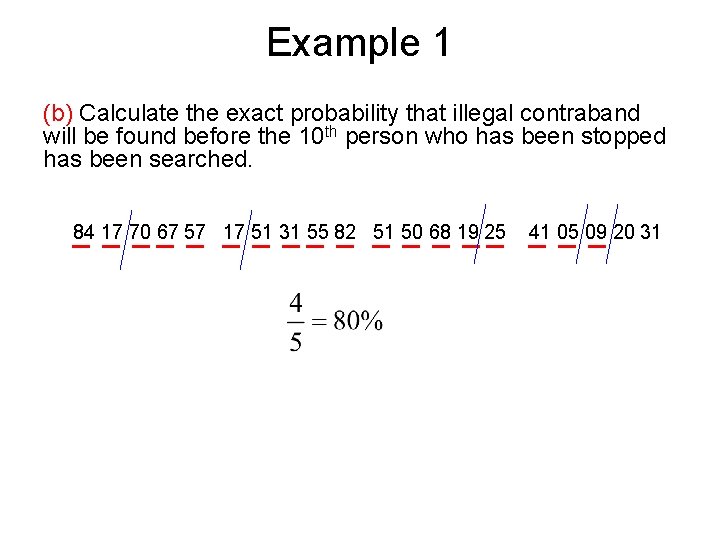
Example 1 (b) Calculate the exact probability that illegal contraband will be found before the 10 th person who has been stopped has been searched. 84 17 70 67 57 17 51 31 55 82 51 50 68 19 25 41 05 09 20 31
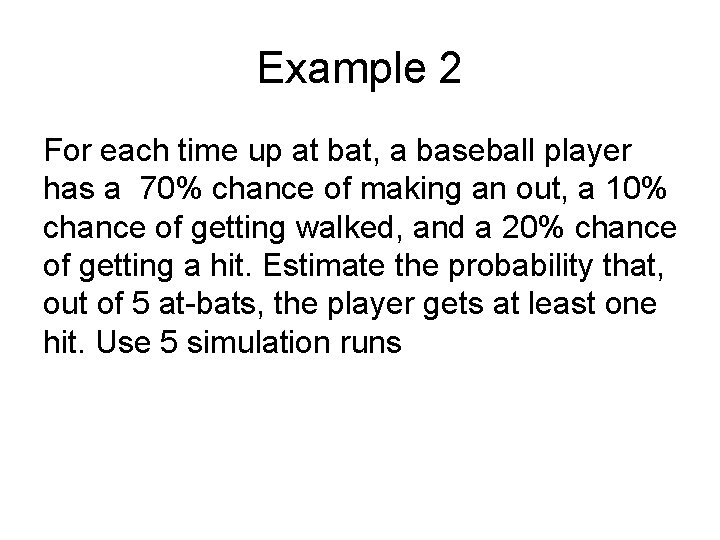
Example 2 For each time up at bat, a baseball player has a 70% chance of making an out, a 10% chance of getting walked, and a 20% chance of getting a hit. Estimate the probability that, out of 5 at-bats, the player gets at least one hit. Use 5 simulation runs
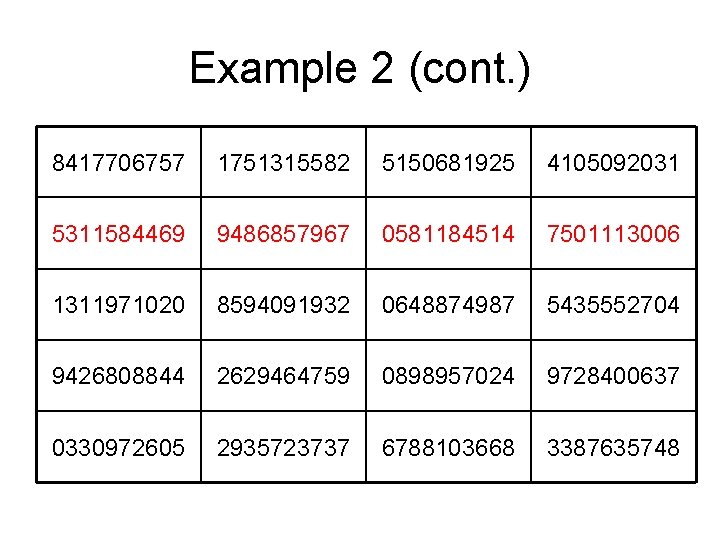
Example 2 (cont. ) 8417706757 1751315582 5150681925 4105092031 5311584469 9486857967 0581184514 7501113006 1311971020 8594091932 0648874987 5435552704 9426808844 2629464759 0898957024 9728400637 0330972605 2935723737 6788103668 3387635748
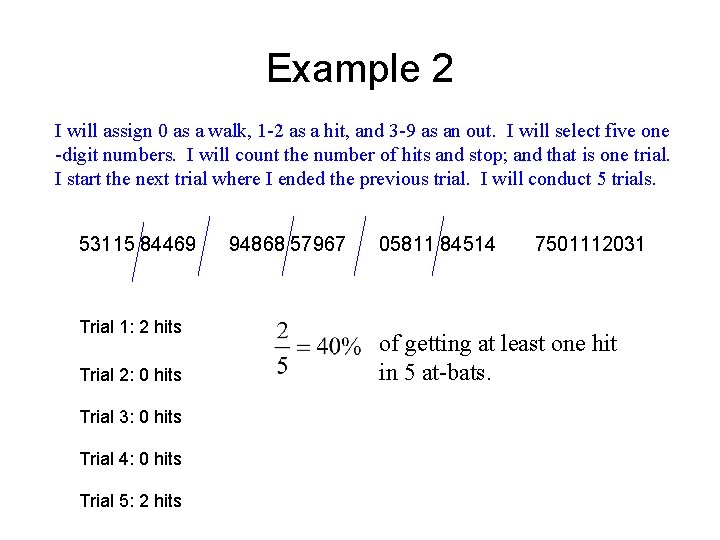
Example 2 I will assign 0 as a walk, 1 -2 as a hit, and 3 -9 as an out. I will select five one -digit numbers. I will count the number of hits and stop; and that is one trial. I start the next trial where I ended the previous trial. I will conduct 5 trials. 53115 84469 Trial 1: 2 hits Trial 2: 0 hits Trial 3: 0 hits Trial 4: 0 hits Trial 5: 2 hits 94868 57967 05811 84514 7501112031 of getting at least one hit in 5 at-bats.
What Can Go Wrong? • Don’t overstate your case. – Always be sure to indicate that future results will not match your simulated results exactly. • Model the outcome chances accurately. • Run enough trials.
Assignment • Page 266: “Randomness” #1 – 11 Odd
- Slides: 21