
Announcements Final exam day events Friday May 12


- Slides: 39
Announcements Final exam day events (Friday, May 12, 10: 00 am to 12: 00 pm) • 50 -point multiple choice end-material test (covering material from chapters 33 -36). (You get a free 8 -point question!) • 200 point comprehensive final exam, all problems (no multiple choice), about 50% emphasis on chapters 33 -36 You may take neither, one, or both of these tests. Your choice. No one admitted after 10: 15 am! You may spend your two hours however you see fit (all on end -material, all on final exam, some mix).
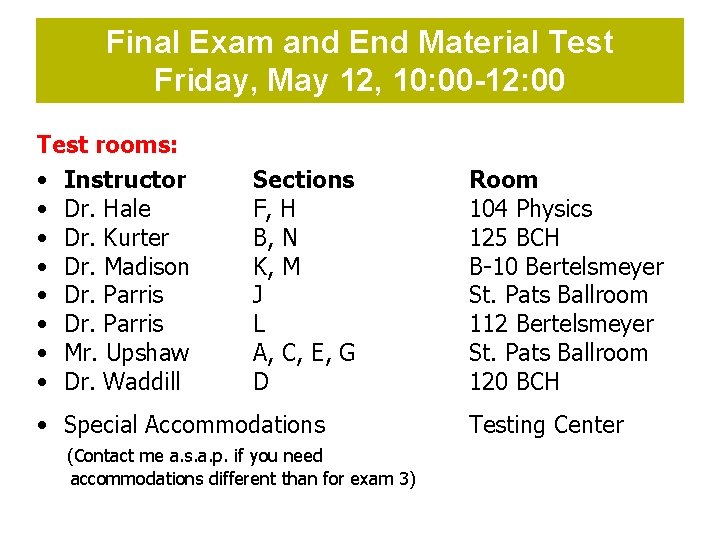
Final Exam and End Material Test Friday, May 12, 10: 00 -12: 00 Test rooms: • Instructor • Dr. Hale • Dr. Kurter • Dr. Madison • Dr. Parris • Mr. Upshaw • Dr. Waddill Sections F, H B, N K, M J L A, C, E, G D • Special Accommodations (Contact me a. s. a. p. if you need accommodations different than for exam 3) Room 104 Physics 125 BCH B-10 Bertelsmeyer St. Pats Ballroom 112 Bertelsmeyer St. Pats Ballroom 120 BCH Testing Center
LEAD Tutors/Peer Instructors Needed! You can tutor or be a PLC peer instructor if you have at least a 3. 6 GPA and get an “A” in the course you want to tutor. Contact me or go to http: //lead. mst. edu/ to fill out the application form. It looks good on your resume, pays well, and is fun!
Today’s agenda: Thin Film Interference. Phase Change Due to Reflection. You must be able to determine whether or not a phase change occurs when a wave is reflected. Phase Change Due to Path Length Difference. You must be able to calculate the phase difference between waves reflecting of the “front” and “back” surfaces of a thin film. Thin Film Interference. You must be able to calculate thin film thicknesses for constructive or destructive interference. Examples. You must be able to solve problems similar to these examples.
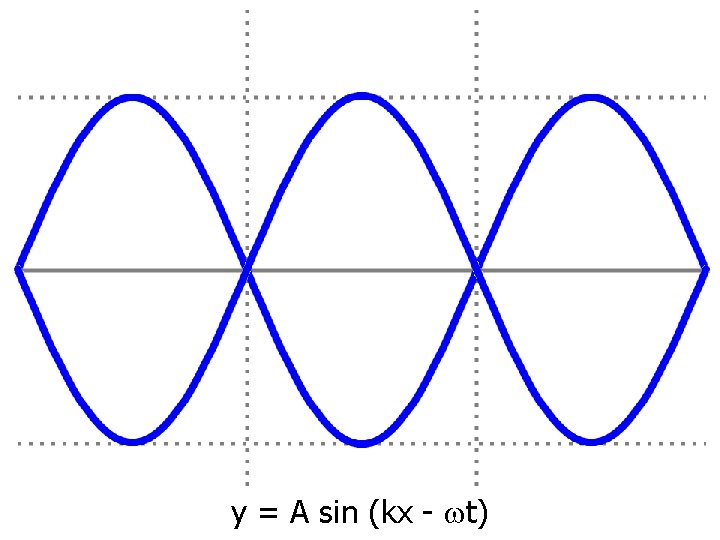
y = A sin (kx - t)
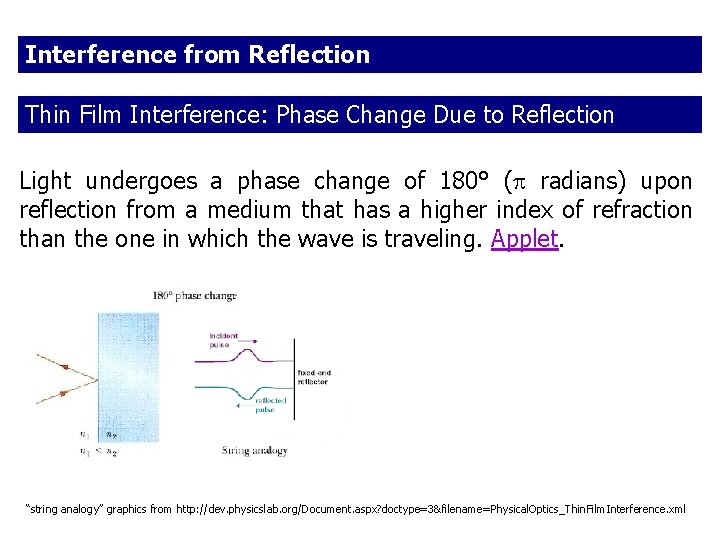
Interference from Reflection Thin Film Interference: Phase Change Due to Reflection Light undergoes a phase change of 180° ( radians) upon reflection from a medium that has a higher index of refraction than the one in which the wave is traveling. Applet. “string analogy” graphics from http: //dev. physicslab. org/Document. aspx? doctype=3&filename=Physical. Optics_Thin. Film. Interference. xml
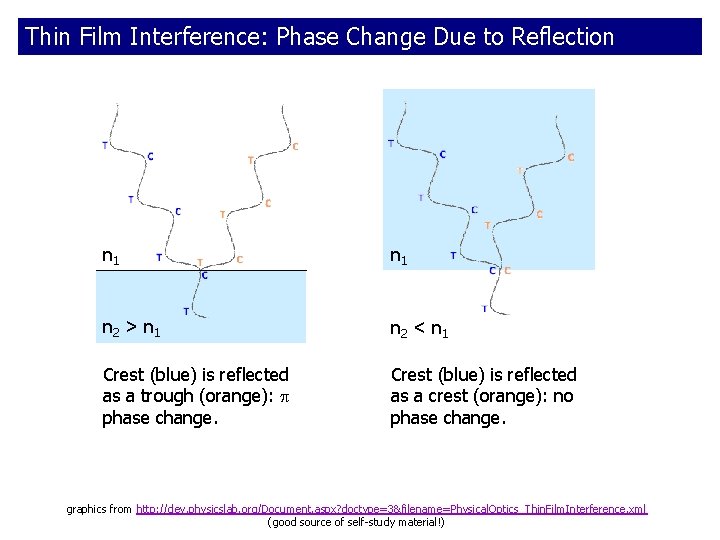
Thin Film Interference: Phase Change Due to Reflection n 1 n 2 > n 1 n 2 < n 1 Crest (blue) is reflected as a trough (orange): phase change. Crest (blue) is reflected as a crest (orange): no phase change. graphics from http: //dev. physicslab. org/Document. aspx? doctype=3&filename=Physical. Optics_Thin. Film. Interference. xml (good source of self-study material!)
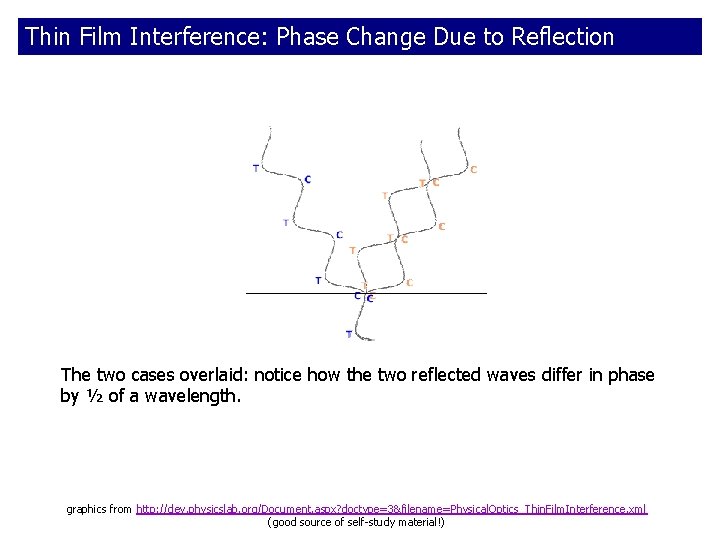
Thin Film Interference: Phase Change Due to Reflection The two cases overlaid: notice how the two reflected waves differ in phase by ½ of a wavelength. graphics from http: //dev. physicslab. org/Document. aspx? doctype=3&filename=Physical. Optics_Thin. Film. Interference. xml (good source of self-study material!)
Thin Film Interference: Phase Change Due to Reflection How to remember the phase change: “Low to high, change is . ” (© 2001, D. M Sparlin)
Today’s agenda: Thin Film Interference. Phase Change Due to Reflection. You must be able to determine whether or not a phase change occurs when a wave is reflected. Phase Change Due to Path Length Difference. You must be able to calculate the phase difference between waves reflecting of the “front” and “back” surfaces of a thin film. Thin Film Interference. You must be able to calculate thin film thicknesses for constructive or destructive interference. Examples. You must be able to solve problems similar to these examples.
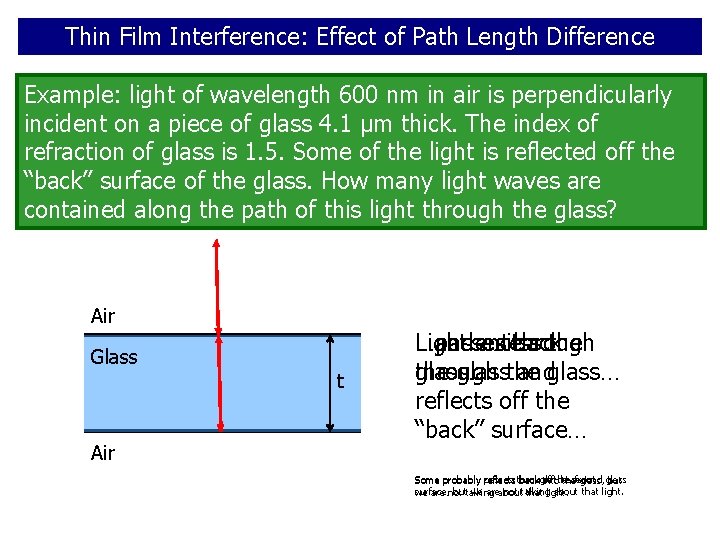
Thin Film Interference: Effect of Path Length Difference Example: light of wavelength 600 nm in air is perpendicularly incident on a piece of glass 4. 1 µm thick. The index of refraction of glass is 1. 5. Some of the light is reflected off the “back” surface of the glass. How many light waves are contained along the path of this light through the glass? Air Glass Air t …andenters Light …passes exits. through back the glass… the through glassthe andglass… reflects off the “back” surface… passes through offthe front Some probably reflects back into thesecond glass, glass but surface, buttalking we areabout not talking about that light. we are not that light.
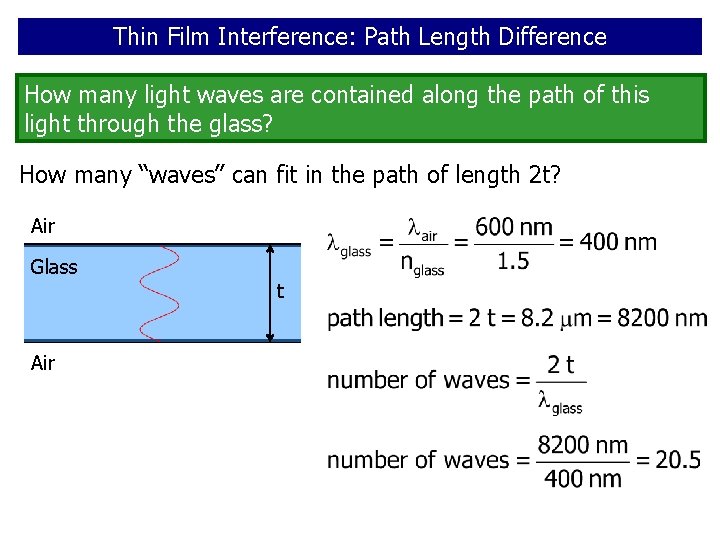
Thin Film Interference: Path Length Difference How many light waves are contained along the path of this light through the glass? How many “waves” can fit in the path of length 2 t? Air Glass Air t
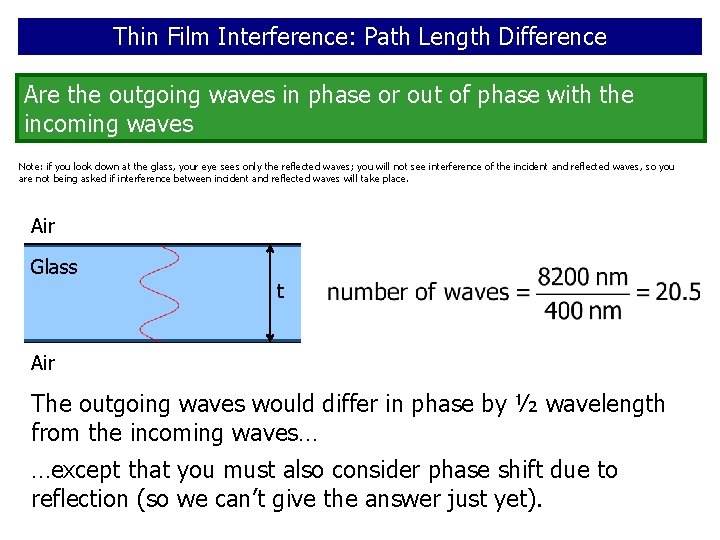
Thin Film Interference: Path Length Difference Are the outgoing waves in phase or out of phase with the incoming waves Note: if you look down at the glass, your eye sees only the reflected waves; you will not see interference of the incident and reflected waves, so you are not being asked if interference between incident and reflected waves will take place. Air Glass t Air The outgoing waves would differ in phase by ½ wavelength from the incoming waves… …except that you must also consider phase shift due to reflection (so we can’t give the answer just yet).
Today’s agenda: Thin Film Interference. Phase Change Due to Reflection. You must be able to determine whether or not a phase change occurs when a wave is reflected. Phase Change Due to Path Length Difference. You must be able to calculate the phase difference between waves reflecting of the “front” and “back” surfaces of a thin film. Thin Film Interference. You must be able to calculate thin film thicknesses for constructive or destructive interference. Examples. You must be able to solve problems similar to these examples.
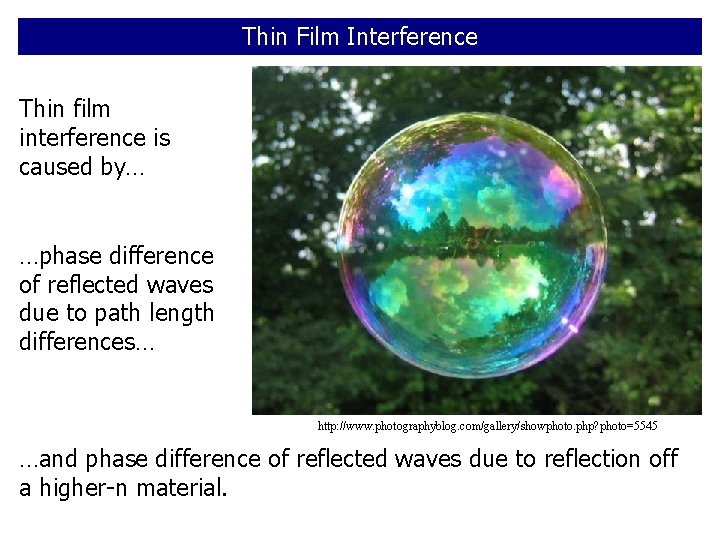
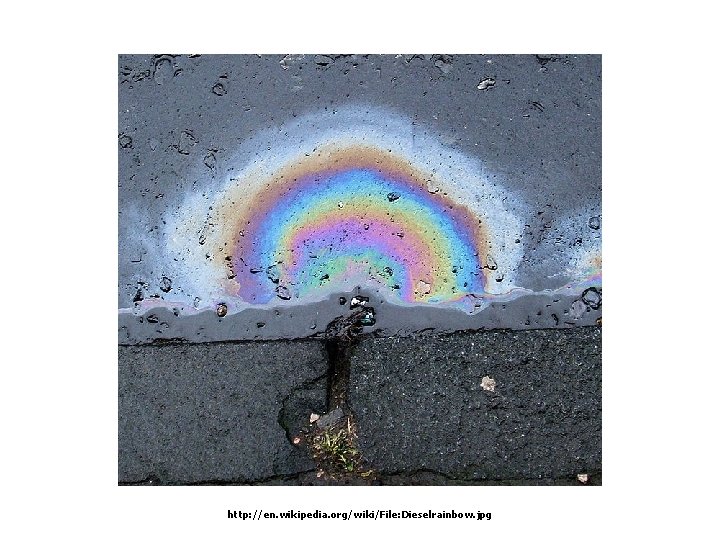
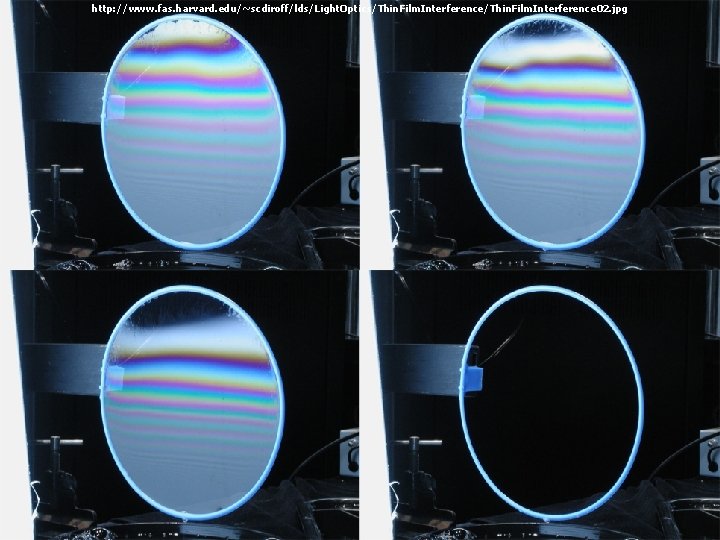
Thin Film Interference Thin film interference is caused by… …phase difference of reflected waves due to path length differences… http: //www. photographyblog. com/gallery/showphoto. php? photo=5545 …and phase difference of reflected waves due to reflection off a higher-n material.
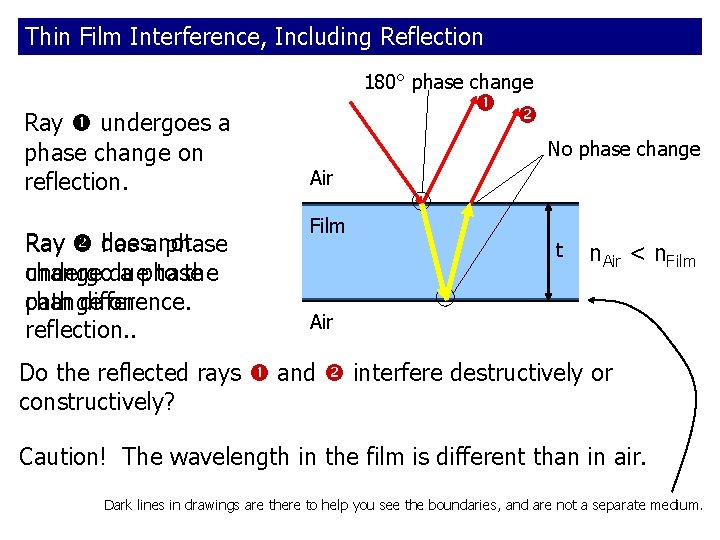
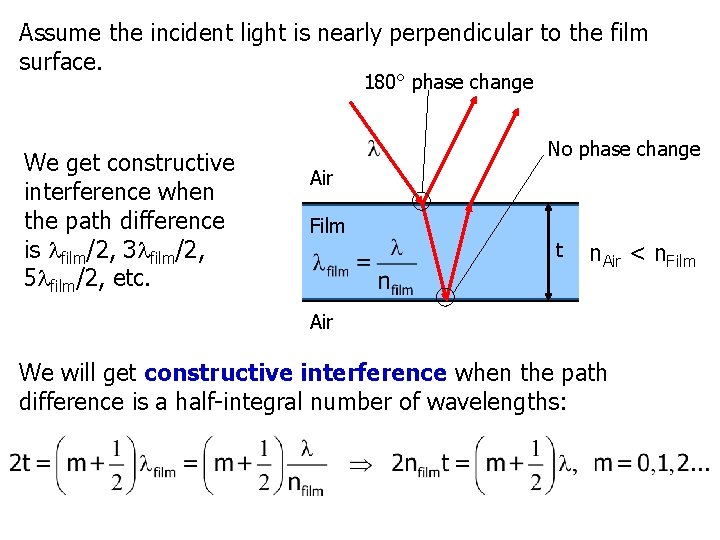
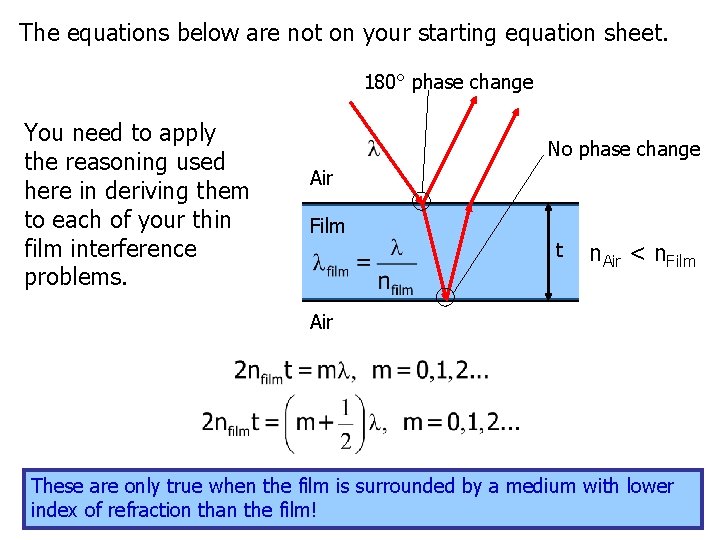
Thin Film Interference, Including Reflection 180° phase change Ray undergoes a phase change on reflection. doesanot Ray has phase undergodue a phase change to the change on path difference. reflection. . No phase change Air Film t n. Air < n. Film Air Do the reflected rays and interfere destructively or constructively? Caution! The wavelength in the film is different than in air. Dark lines in drawings are there to help you see the boundaries, and are not a separate medium.
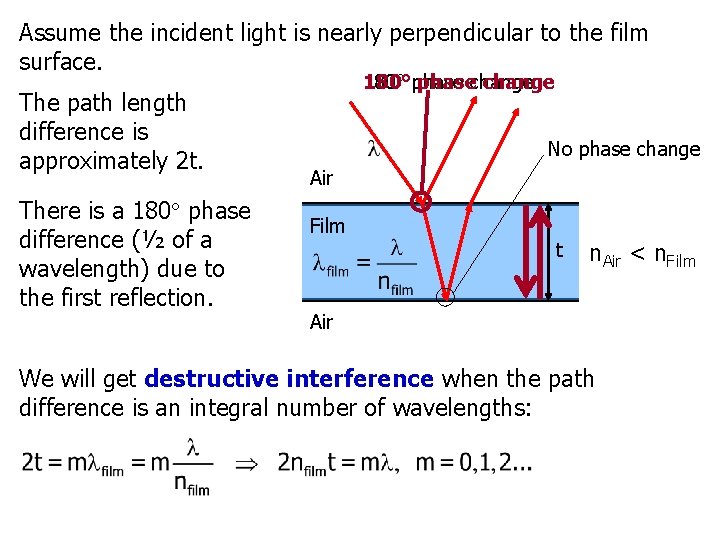
Assume the incident light is nearly perpendicular to the film surface. The path length difference is approximately 2 t. There is a 180 phase difference (½ of a wavelength) due to the first reflection. 180° phasechange No phase change Air Film t n. Air < n. Film Air We will get destructive interference when the path difference is an integral number of wavelengths:
Assume the incident light is nearly perpendicular to the film surface. 180° phase change We get constructive interference when the path difference is film/2, 3 film/2, 5 film/2, etc. No phase change Air Film t n. Air < n. Film Air We will get constructive interference when the path difference is a half-integral number of wavelengths:
The equations below are not on your starting equation sheet. 180° phase change You need to apply the reasoning used here in deriving them to each of your thin film interference problems. No phase change Air Film t n. Air < n. Film Air These are only true when the film is surrounded by a medium with lower index of refraction than the film!
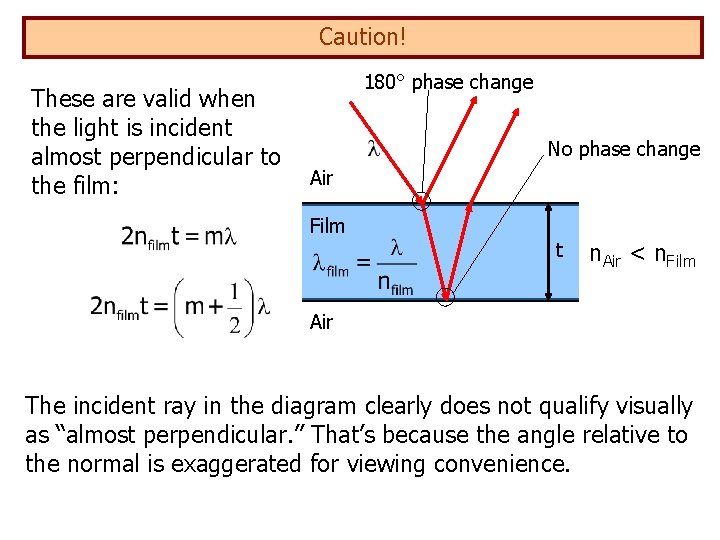
Caution! These are valid when the light is incident almost perpendicular to the film: 180° phase change No phase change Air Film t n. Air < n. Film Air The incident ray in the diagram clearly does not qualify visually as “almost perpendicular. ” That’s because the angle relative to the normal is exaggerated for viewing convenience.
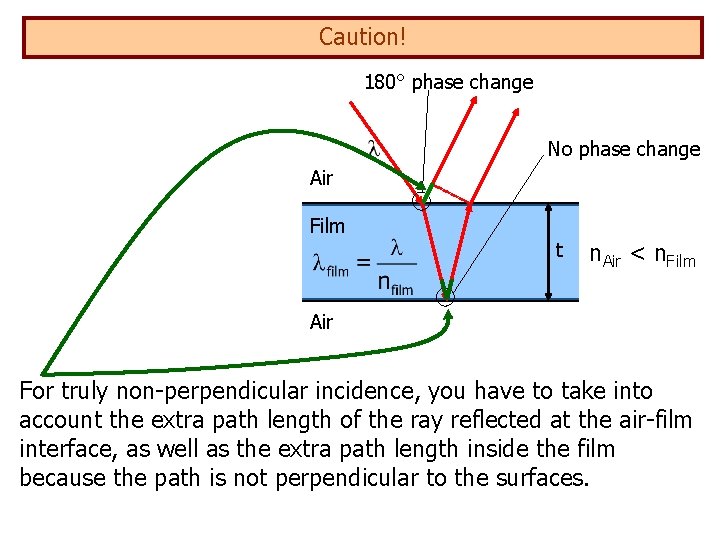
Caution! 180° phase change No phase change Air Film t n. Air < n. Film Air For truly non-perpendicular incidence, you have to take into account the extra path length of the ray reflected at the air-film interface, as well as the extra path length inside the film because the path is not perpendicular to the surfaces.
Let’s look at a couple of applets. Thin film interference. Antireflective coatings.
Thin Film Interference Problem Solving Tips Identify the thin film causing the interference. Phase differences have two causes: (1) path differences and (2) phase changes upon reflection (low to high, change is ). Determine the phase difference due to reflection between the portion of the wave reflected at the upper surface and the portion reflected at the lower surface. Determine the phase difference due to the path length difference (in the thin film). When the total phase difference is an integer multiple of the wavelength ( , 2 , 3 , etc. ) the interference is constructive, and when it is a half-integer multiple of the wavelength ( /2, 3 /2, 5 /2, etc. ) it is destructive.
Today’s agenda: Thin Film Interference. Phase Change Due to Reflection. You must be able to determine whether or not a phase change occurs when a wave is reflected. Phase Change Due to Path Length Difference. You must be able to calculate the phase difference between waves reflecting of the “front” and “back” surfaces of a thin film. Thin Film Interference. You must be able to calculate thin film thicknesses for constructive or destructive interference. Examples. You must be able to solve problems similar to these examples.
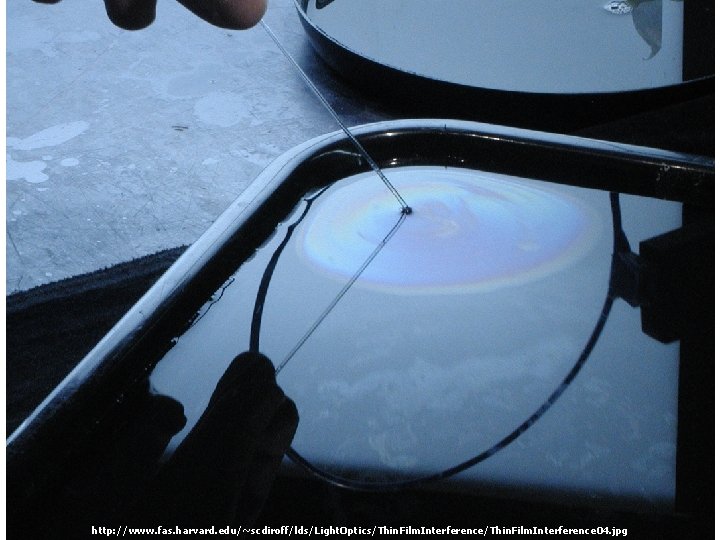
http: //www. fas. harvard. edu/~scdiroff/lds/Light. Optics/Thin. Film. Interference 04. jpg
http: //en. wikipedia. org/wiki/File: Dieselrainbow. jpg
http: //www. fas. harvard. edu/~scdiroff/lds/Light. Optics/Thin. Film. Interference 02. jpg
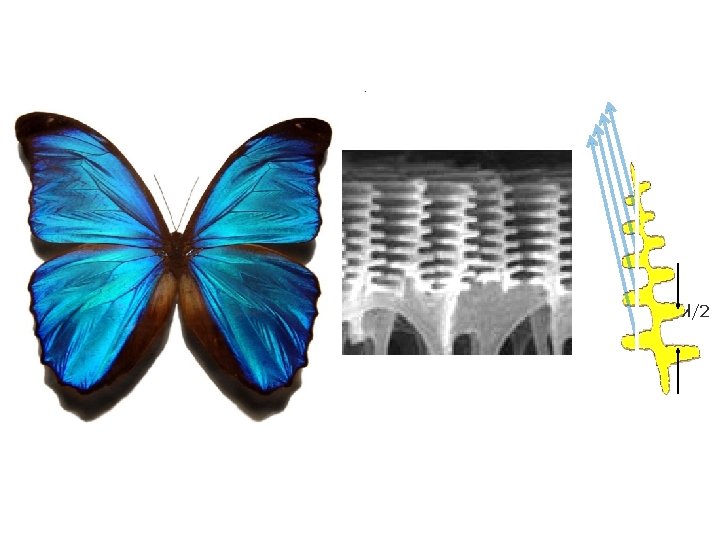
http: //www. tufts. edu/as/tampl/projects/micro_rs/theory. html#thinfilm
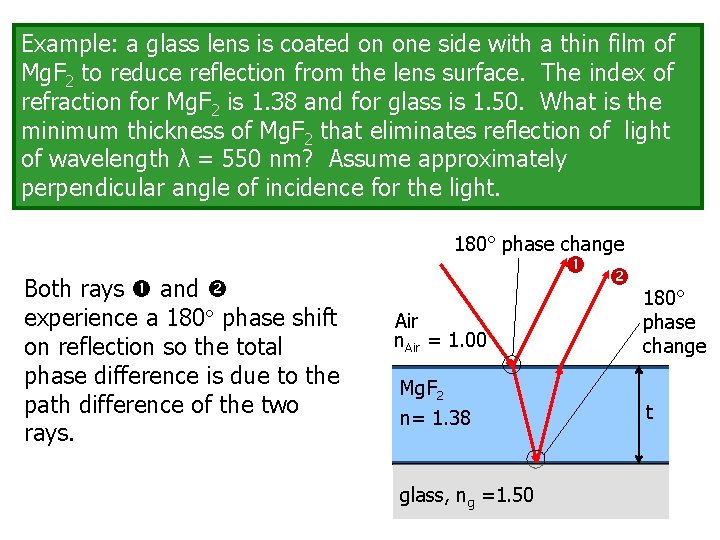
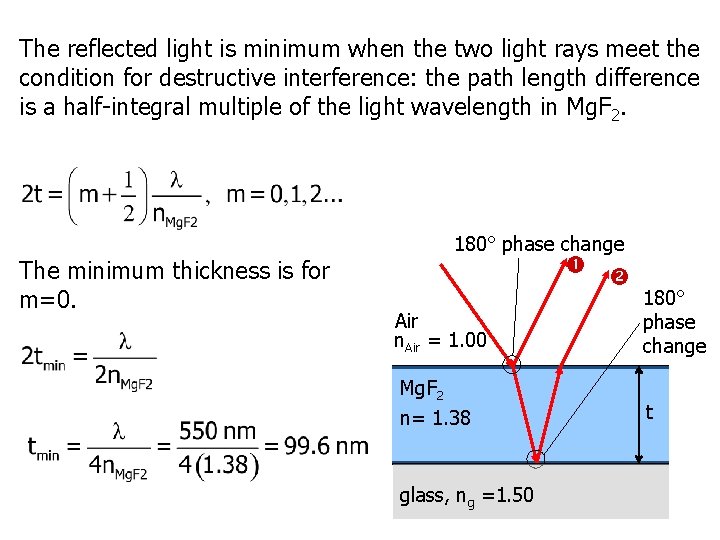
Example: a glass lens is coated on one side with a thin film of Mg. F 2 to reduce reflection from the lens surface. The index of refraction for Mg. F 2 is 1. 38 and for glass is 1. 50. What is the minimum thickness of Mg. F 2 that eliminates reflection of light of wavelength λ = 550 nm? Assume approximately perpendicular angle of incidence for the light. 180° phase change Both rays and experience a 180 phase shift on reflection so the total phase difference is due to the path difference of the two rays. Air n. Air = 1. 00 180° phase change Mg. F 2 n= 1. 38 t glass, ng =1. 50
The reflected light is minimum when the two light rays meet the condition for destructive interference: the path length difference is a half-integral multiple of the light wavelength in Mg. F 2. The minimum thickness is for m=0. 180° phase change Air n. Air = 1. 00 180° phase change Mg. F 2 n= 1. 38 t glass, ng =1. 50
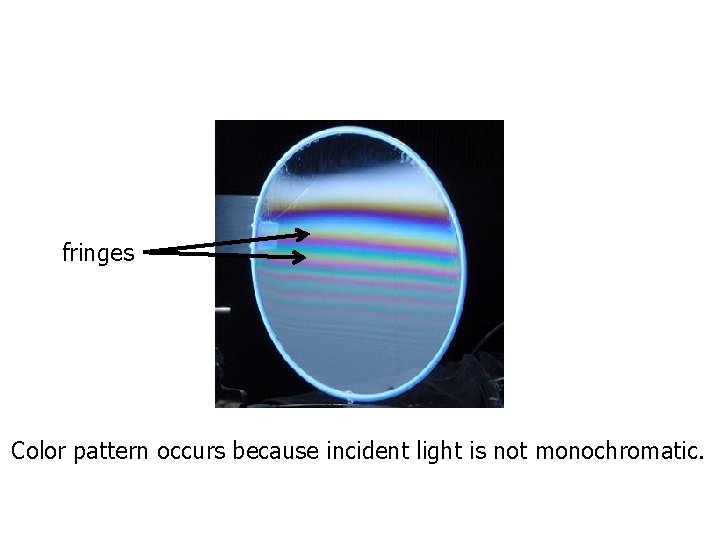
fringes Color pattern occurs because incident light is not monochromatic.
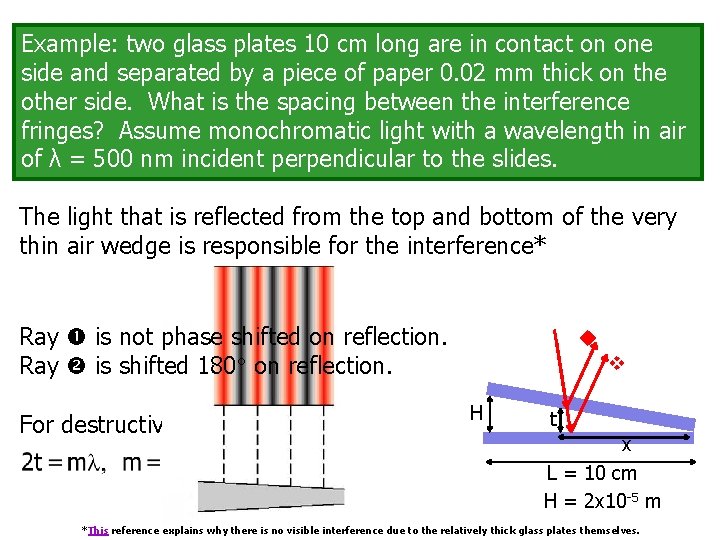
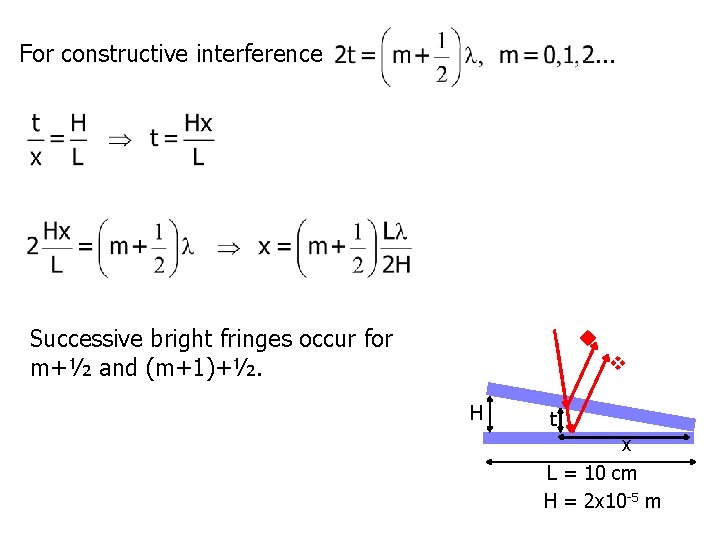
Example: two glass plates 10 cm long are in contact on one side and separated by a piece of paper 0. 02 mm thick on the other side. What is the spacing between the interference fringes? Assume monochromatic light with a wavelength in air of λ = 500 nm incident perpendicular to the slides. The light that is reflected from the top and bottom of the very thin air wedge is responsible for the interference* Ray is not phase shifted on reflection. Ray is shifted 180 on reflection. For destructive interference H t x L = 10 cm H = 2 x 10 -5 m *This reference explains why there is no visible interference due to the relatively thick glass plates themselves.
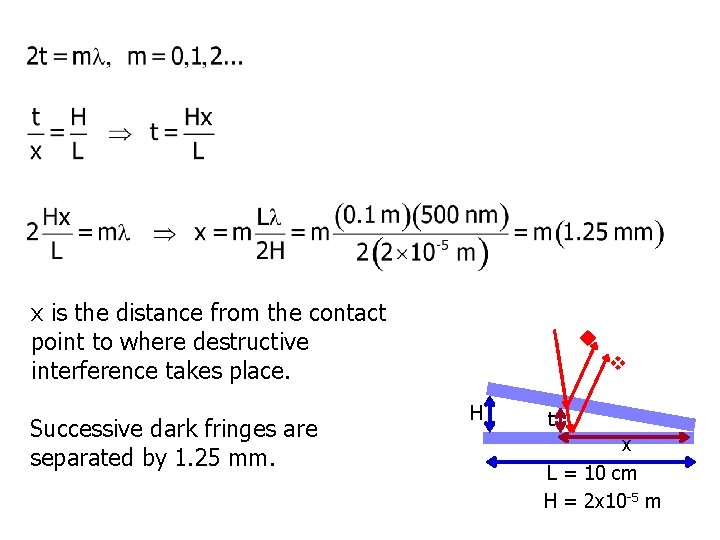
x is the distance from the contact point to where destructive interference takes place. Successive dark fringes are separated by 1. 25 mm. H t x L = 10 cm H = 2 x 10 -5 m
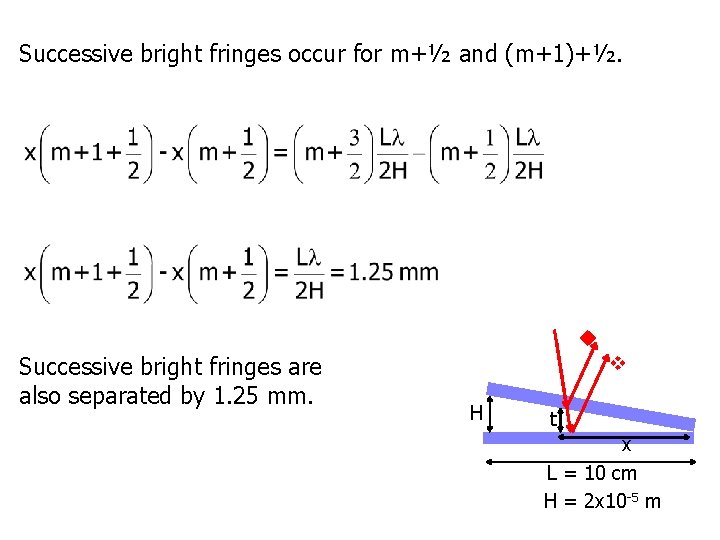
For constructive interference Successive bright fringes occur for m+½ and (m+1)+½. H t x L = 10 cm H = 2 x 10 -5 m
Successive bright fringes occur for m+½ and (m+1)+½. Successive bright fringes are also separated by 1. 25 mm. H t x L = 10 cm H = 2 x 10 -5 m
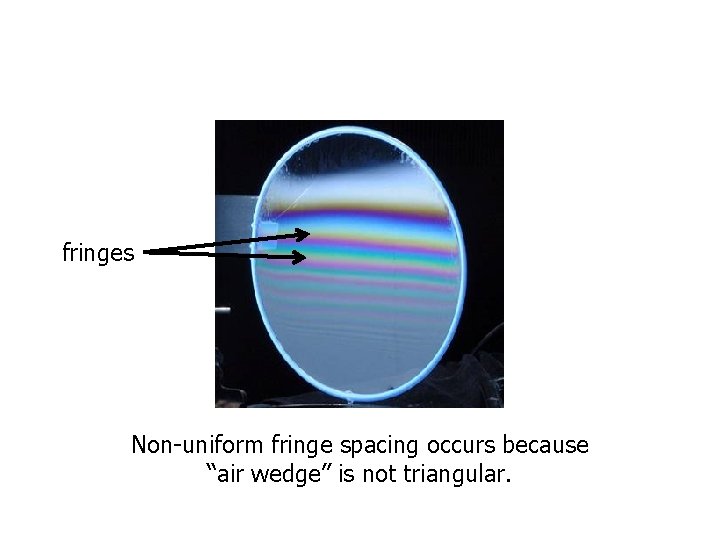
fringes Non-uniform fringe spacing occurs because “air wedge” is not triangular.
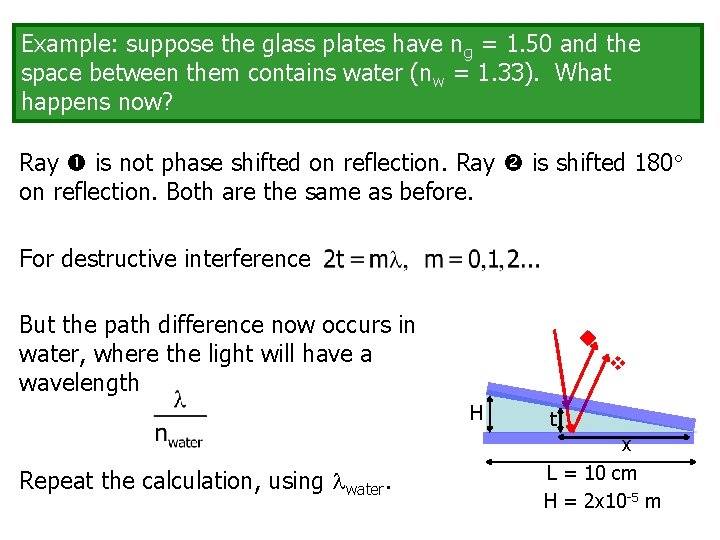
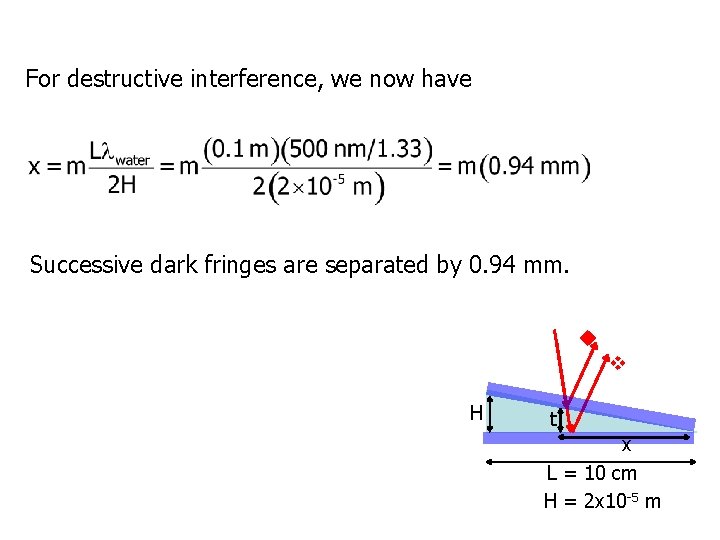
Example: suppose the glass plates have ng = 1. 50 and the space between them contains water (nw = 1. 33). What happens now? Ray is not phase shifted on reflection. Ray is shifted 180 on reflection. Both are the same as before. For destructive interference But the path difference now occurs in water, where the light will have a wavelength H Repeat the calculation, using water. t x L = 10 cm H = 2 x 10 -5 m
For destructive interference, we now have Successive dark fringes are separated by 0. 94 mm. H t x L = 10 cm H = 2 x 10 -5 m