
Announcements Electric Field from a Ring of Charge

- Slides: 20
Announcements
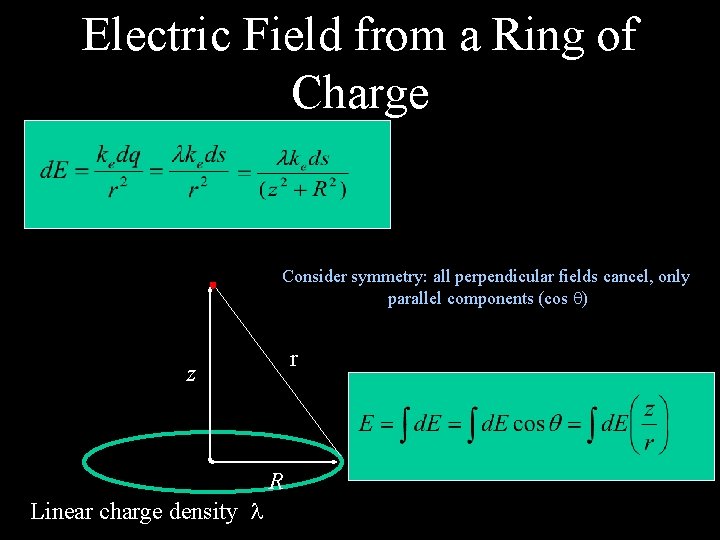
Electric Field from a Ring of Charge Consider symmetry: all perpendicular fields cancel, only parallel components (cos ) r z R Linear charge density
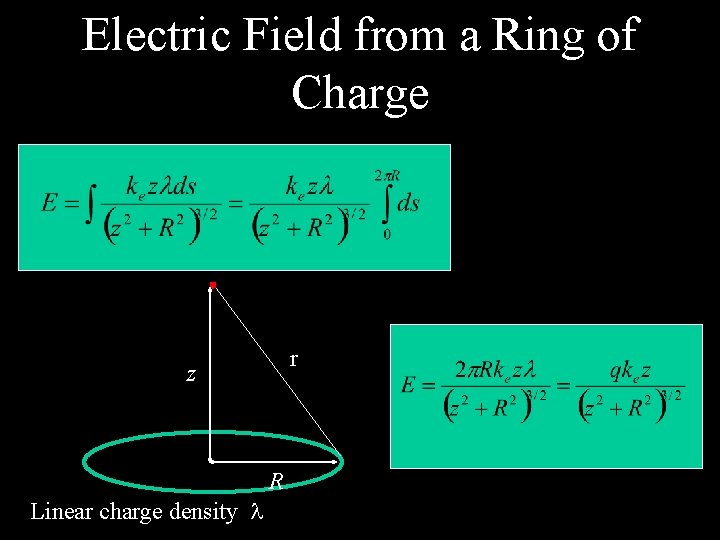
Electric Field from a Ring of Charge r z R Linear charge density
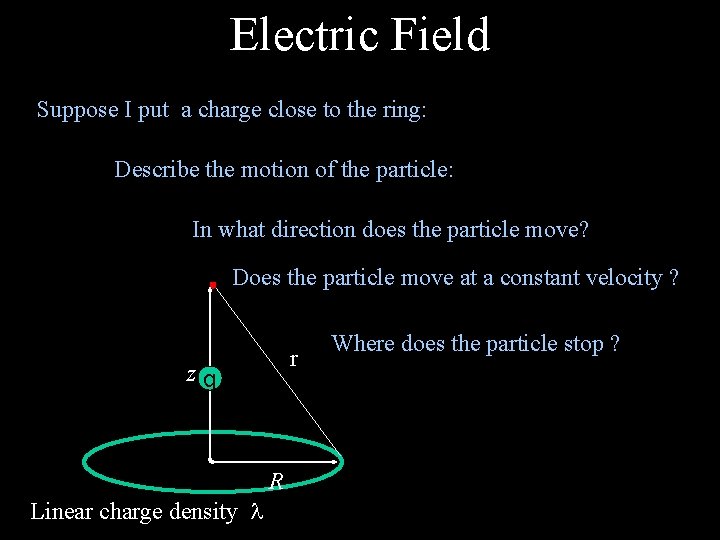
Electric Field Suppose I put a charge close to the ring: Describe the motion of the particle: In what direction does the particle move? Does the particle move at a constant velocity ? r zq R Linear charge density Where does the particle stop ?
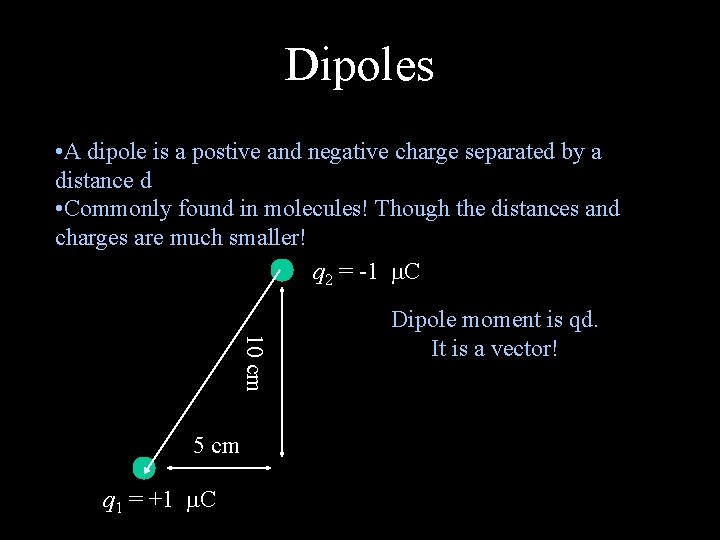
Dipoles • A dipole is a postive and negative charge separated by a distance d • Commonly found in molecules! Though the distances and charges are much smaller! q 2 = -1 C 10 cm 5 cm q 1 = +1 C Dipole moment is qd. It is a vector!
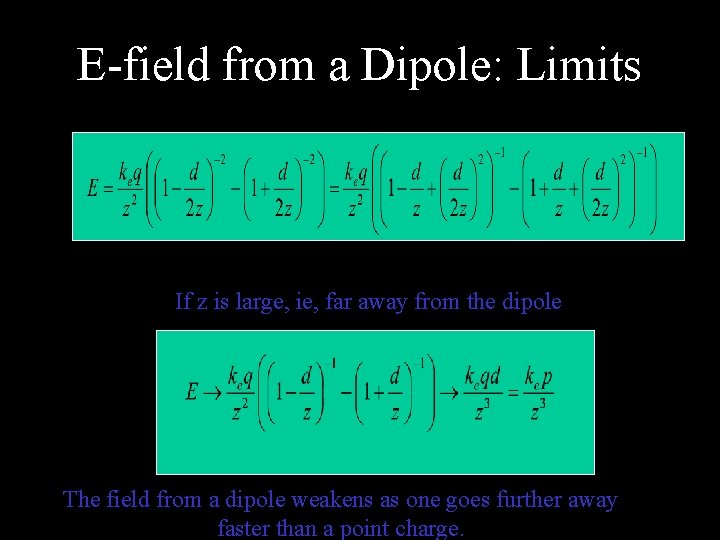
E-field from a Dipole: Limits If z is large, ie, far away from the dipole The field from a dipole weakens as one goes further away faster than a point charge.
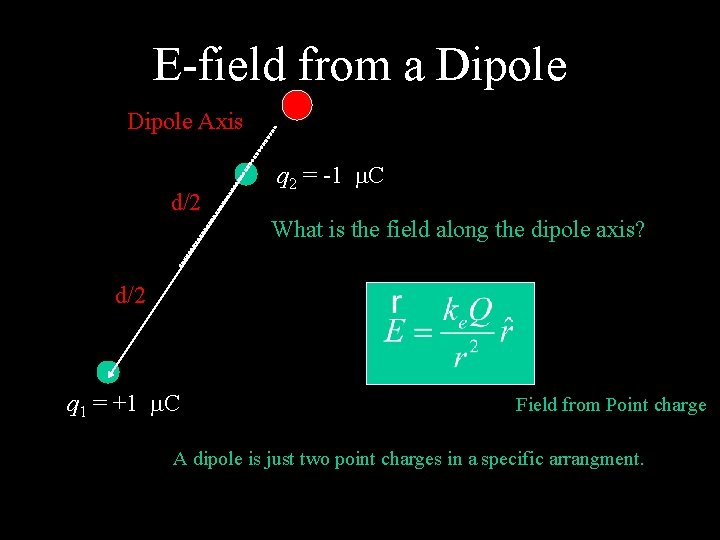
E-field from a Dipole Axis d/2 q 2 = -1 C What is the field along the dipole axis? d/2 q 1 = +1 C Field from Point charge A dipole is just two point charges in a specific arrangment.
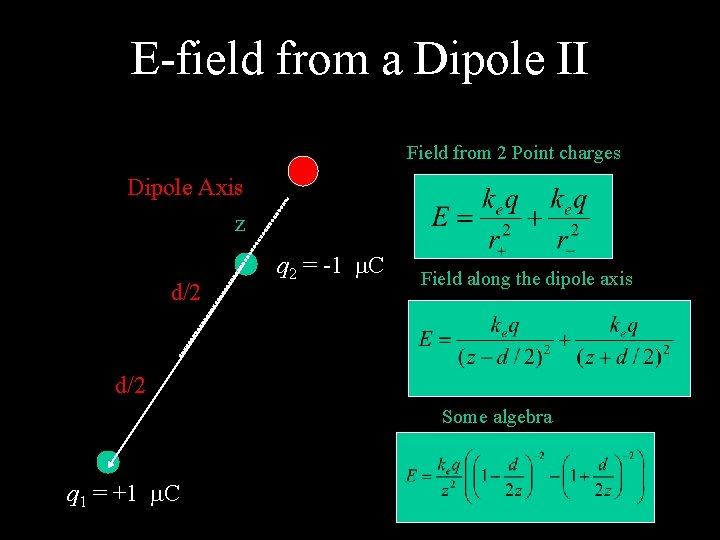
E-field from a Dipole II Field from 2 Point charges Dipole Axis z d/2 q 2 = -1 C Field along the dipole axis d/2 Some algebra q 1 = +1 C
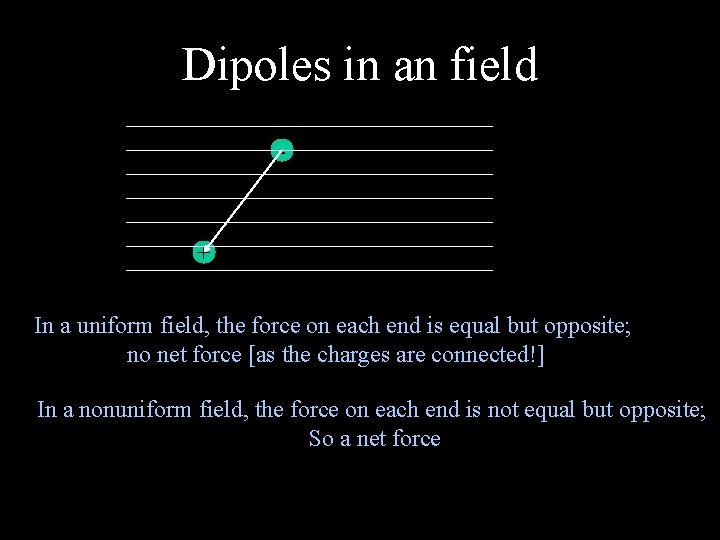
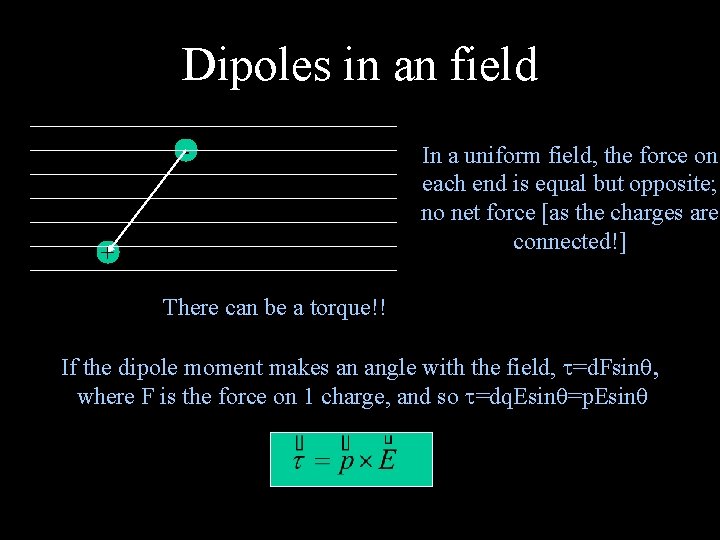
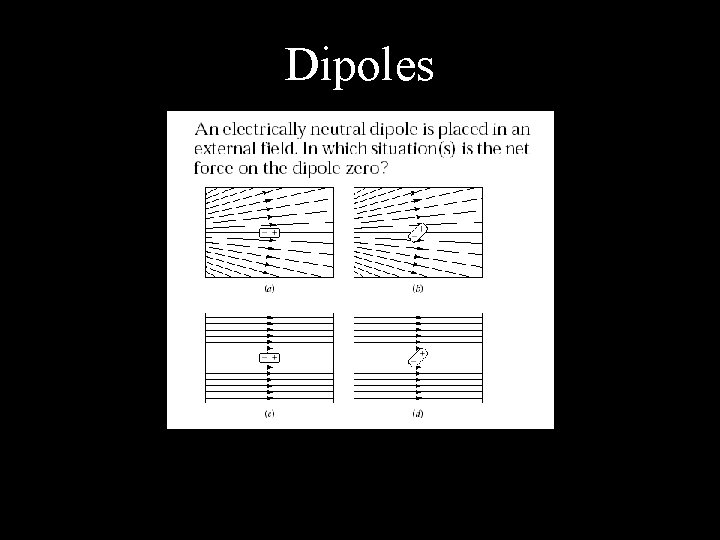
Dipoles in an field - + In a uniform field, the force on each end is equal but opposite; no net force [as the charges are connected!] In a nonuniform field, the force on each end is not equal but opposite; So a net force
Dipoles in an field - + In a uniform field, the force on each end is equal but opposite; no net force [as the charges are connected!] There can be a torque!! If the dipole moment makes an angle with the field, t=d. Fsin , where F is the force on 1 charge, and so t=dq. Esin =p. Esin What is the lever
Dipoles
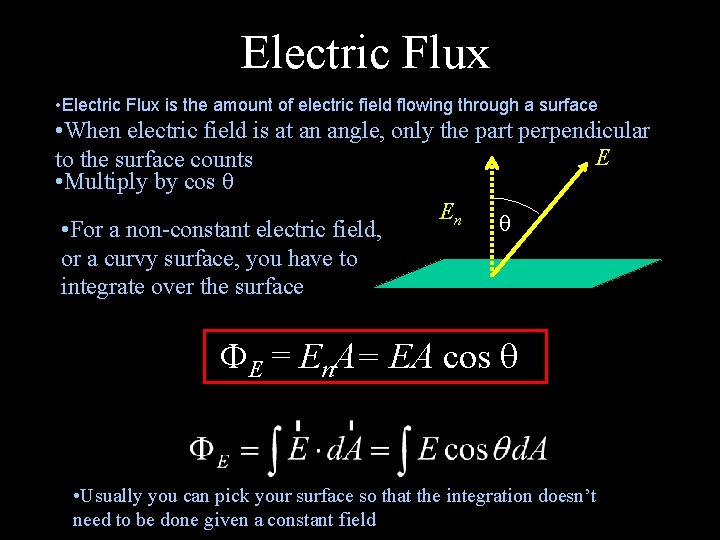
Electric Flux • Electric Flux is the amount of electric field flowing through a surface • When electric field is at an angle, only the part perpendicular E to the surface counts • Multiply by cos En • For a non-constant electric field, or a curvy surface, you have to integrate over the surface E = En. A= EA cos • Usually you can pick your surface so that the integration doesn’t need to be done given a constant field
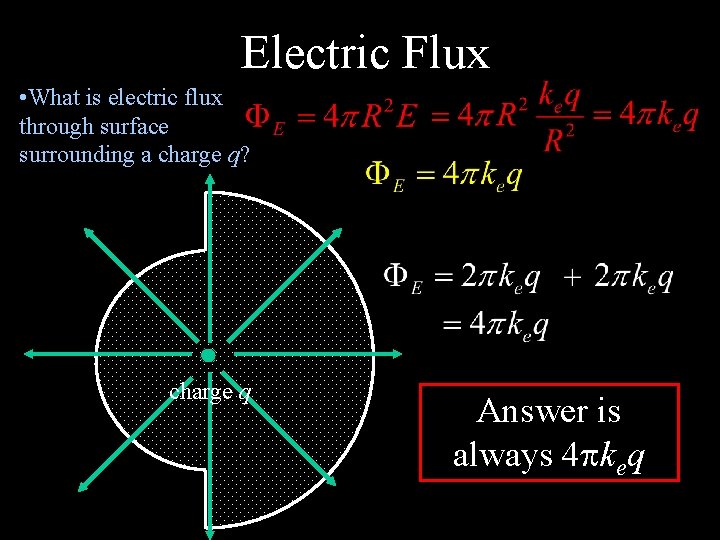
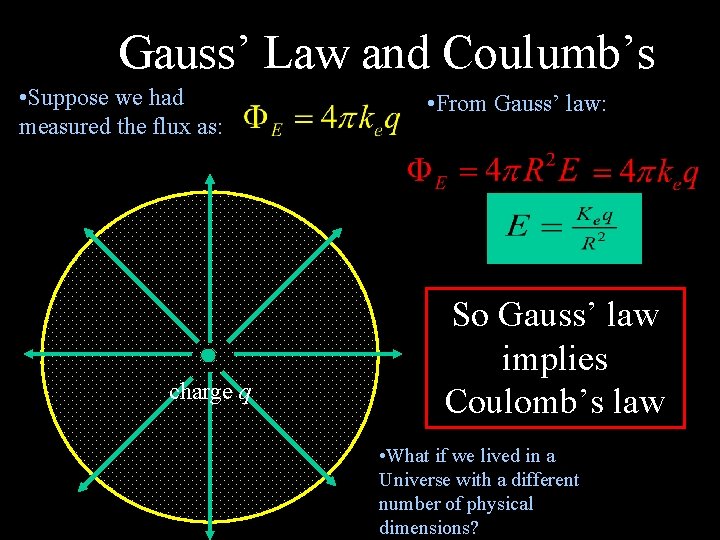
Electric Flux • What is electric flux through surface surrounding a charge q? R charge q Answer is always 4 keq
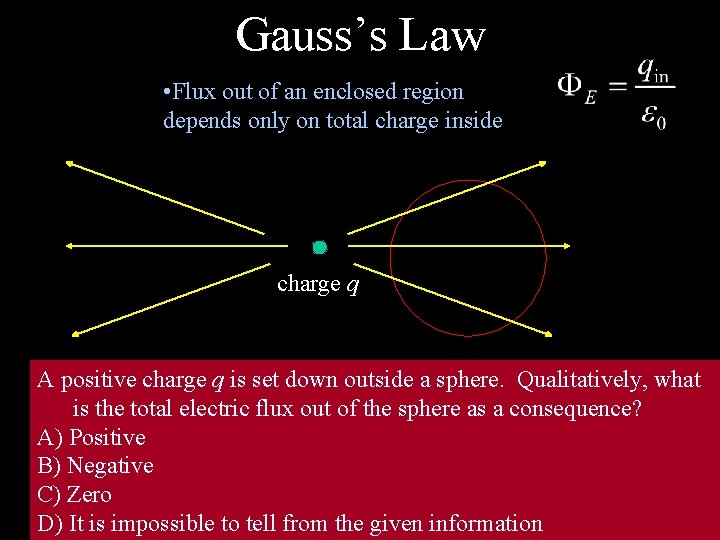
Gauss’s Law • Flux out of an enclosed region depends only on total charge inside charge q A positive charge q is set down outside a sphere. Qualitatively, what is the total electric flux out of the sphere as a consequence? A) Positive B) Negative C) Zero D) It is impossible to tell from the given information
Gauss’ Law and Coulumb’s • Suppose we had measured the flux as: • From Gauss’ law: R charge q So Gauss’ law implies Coulomb’s law • What if we lived in a Universe with a different number of physical dimensions?
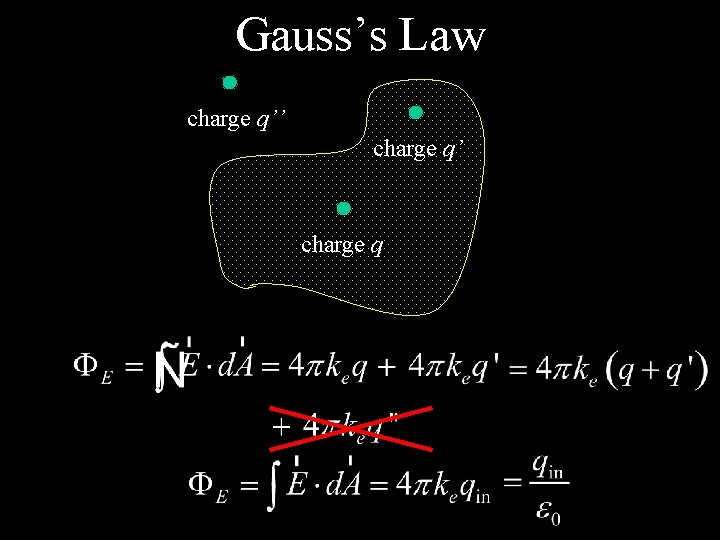
Gauss’s Law charge q’’ charge q
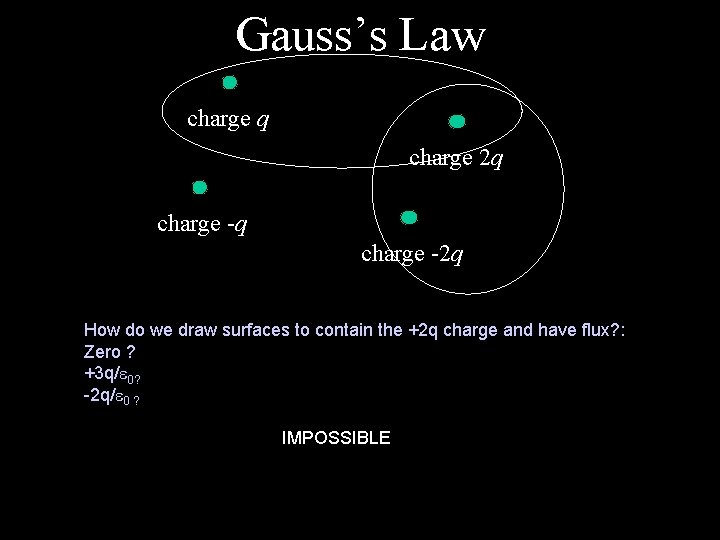
Gauss’s Law charge q charge 2 q charge -2 q How do we draw surfaces to contain the +2 q charge and have flux? : Zero ? +3 q/e 0? -2 q/e 0 ? IMPOSSIBLE
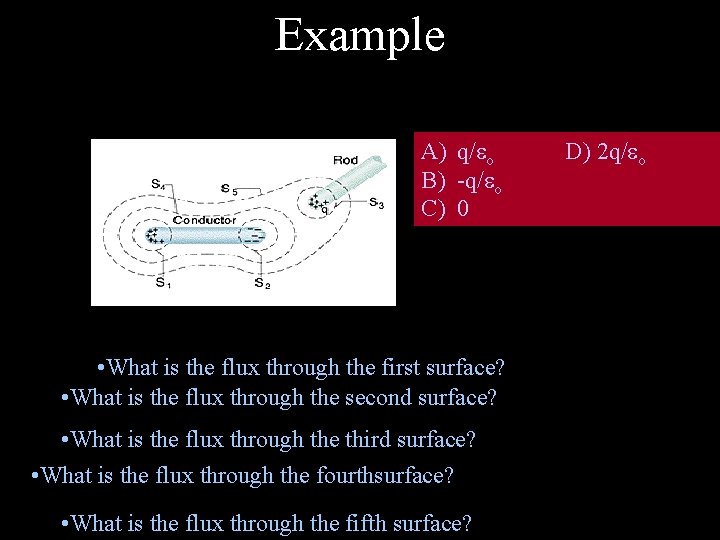
Example A) q/eo B) -q/eo C) 0 Figure 24 -29. • What is the flux through the first surface? • What is the flux through the second surface? • What is the flux through the third surface? • What is the flux through the fourthsurface? • What is the flux through the fifth surface? D) 2 q/eo
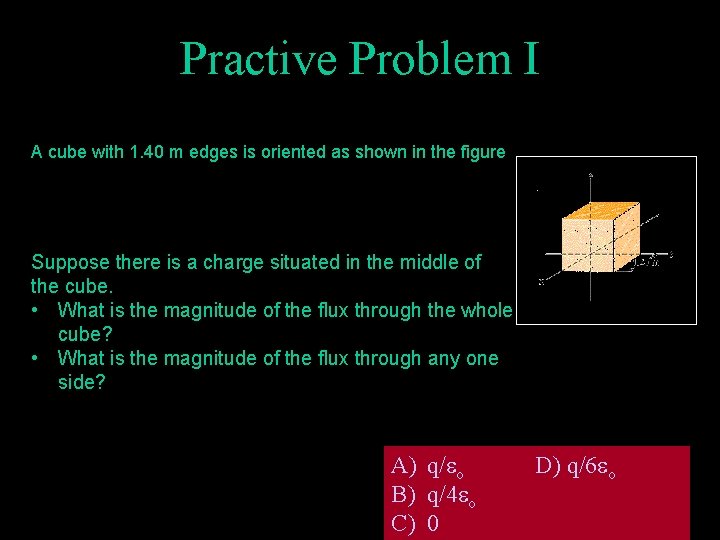
Practive Problem I A cube with 1. 40 m edges is oriented as shown in the figure Suppose there is a charge situated in the middle of the cube. • What is the magnitude of the flux through the whole cube? • What is the magnitude of the flux through any one side? A) q/eo B) q/4 eo C) 0 D) q/6 eo
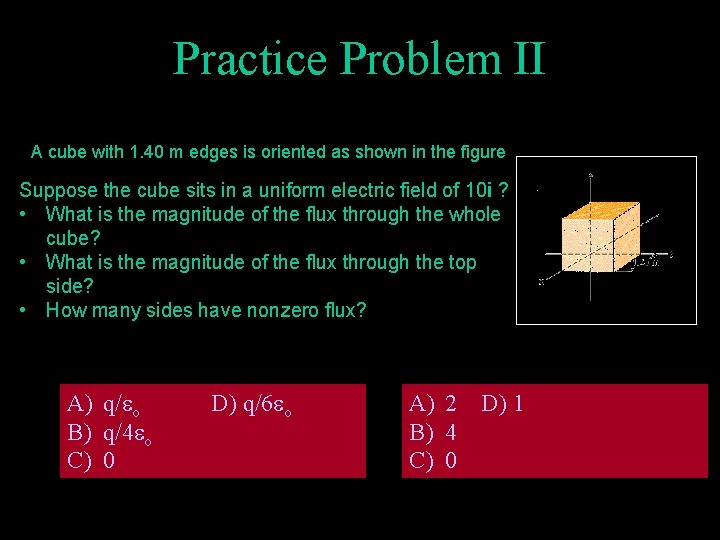
Practice Problem II A cube with 1. 40 m edges is oriented as shown in the figure Suppose the cube sits in a uniform electric field of 10 i ? • What is the magnitude of the flux through the whole cube? • What is the magnitude of the flux through the top side? • How many sides have nonzero flux? A) q/eo B) q/4 eo C) 0 D) q/6 eo A) 2 D) 1 B) 4 C) 0