
Announcements Bachelor of Fine Arts with Emphasis in
Announcements ● Bachelor of Fine Arts with Emphasis in Art Education Program (BFAAE) – ● Deadline for application is March 1 Dave Snyder, math tutor (email: dsnyde) – – Wed 11: 00 – 2: 00 MI B 1 -05 Thurs 2: 00 -5: 00 MI B 1 -05
Summary of Last Class: Science ● Science is a process: – – ● ● ● Observations Theories to unify/explain observations Tests of theories against observations. . . Etc Testing theories is the only way to weed out falsehoods! All theories that survive so far are current best explanations, backed by evidence But any theory could be disproven with the next observation
Summary of Last Class: Life ● Life is complex compared to not-life – – ● Reproduces Adapts Stays alive BEHAVES Nothing is ruled out, but life we can interact with likely requires – – Carbon (but carbon's everywhere!) Liquid solvent like water (Narrow temperature range!)
Feedback: ● Most unclear item from last week's readings?
Feedback: ● How much time was spent on readings? ● How much time was spent on homework?
Projects/Presentations ● ● ● Only a few interested in presentations – good If interested in Mar 12 presentation, sign up now (can change mind later) Presentation, Report, Art project, same goal – Demonstrate an understanding of some significant amount of course-related material. ● Topics need to be checked with me ● (jdursi @ artic. edu)
Possible Topics ● NASA Terrestrial Planet Finder – Sattelite intended to go up in next decade to search for Earth-like planets ● The Formation of Stars ● The Formation of Planets ● History of thought on extraterrestrial life ● Extremophiles – Earth organisms that live in extreme conditions ● Life on gas giants – how? ● . .
What we're going to cover today ● What's in the Universe and where it is: The Distance Ladder – – ● Objects The distance scale from the moon to distant galaxies The Drake Equation – Estimating the number of civilizations in the Galaxy
The Universe and How Big it is: The Contents ● At end of this lecture/reading, should be able to: – Explain what major sorts of objects are seen (by eye!) in night sky, and how to distinguish them ● ● ● Stars Planets Galaxies Clusters Nebulae
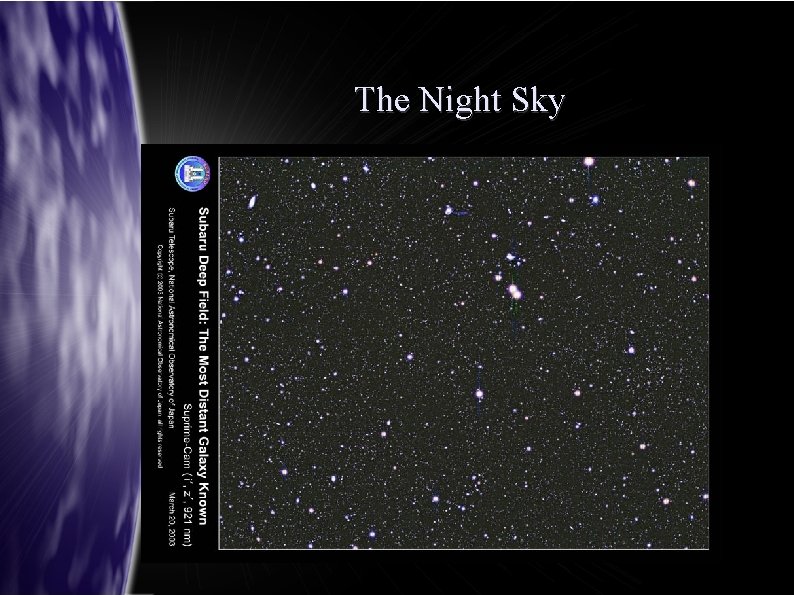
The Night Sky
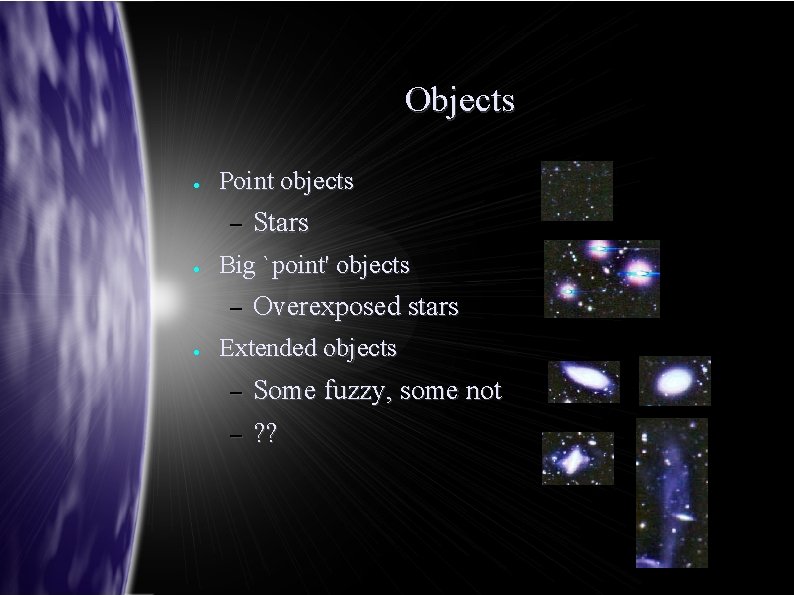
Objects ● Point objects – ● Big `point' objects – ● Stars Overexposed stars Extended objects – – Some fuzzy, some not ? ?
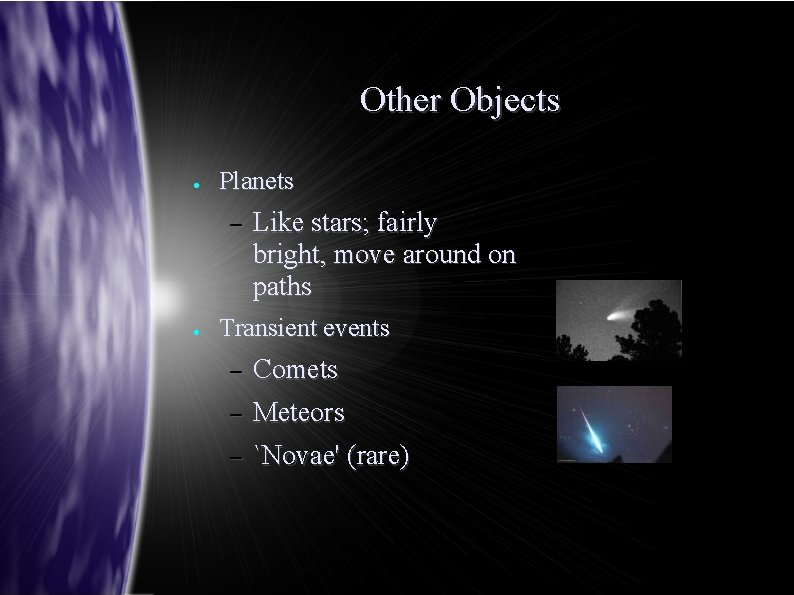
Other Objects ● Planets – ● Like stars; fairly bright, move around on paths Transient events – Comets Meteors – `Novae' (rare) –
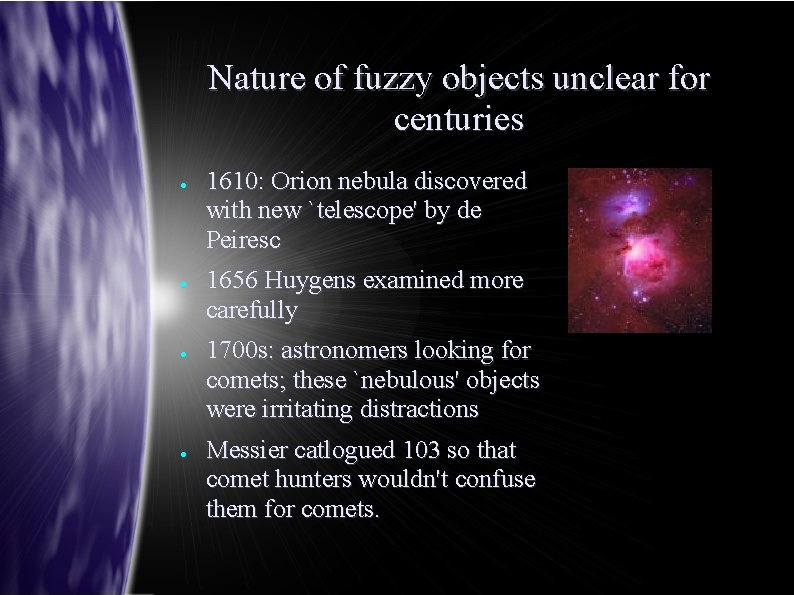
Nature of fuzzy objects unclear for centuries ● ● 1610: Orion nebula discovered with new `telescope' by de Peiresc 1656 Huygens examined more carefully 1700 s: astronomers looking for comets; these `nebulous' objects were irritating distractions Messier catlogued 103 so that comet hunters wouldn't confuse them for comets.
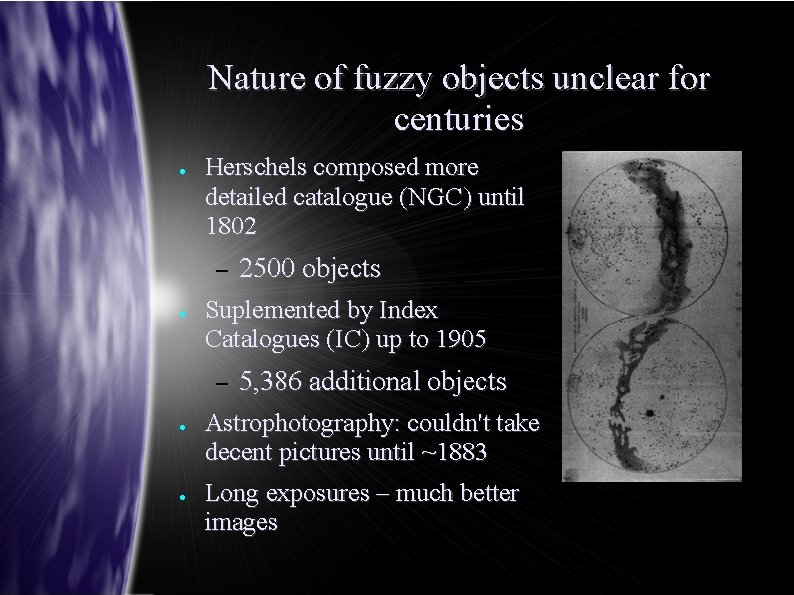
Nature of fuzzy objects unclear for centuries ● Herschels composed more detailed catalogue (NGC) until 1802 – ● Suplemented by Index Catalogues (IC) up to 1905 – ● ● 2500 objects 5, 386 additional objects Astrophotography: couldn't take decent pictures until ~1883 Long exposures – much better images
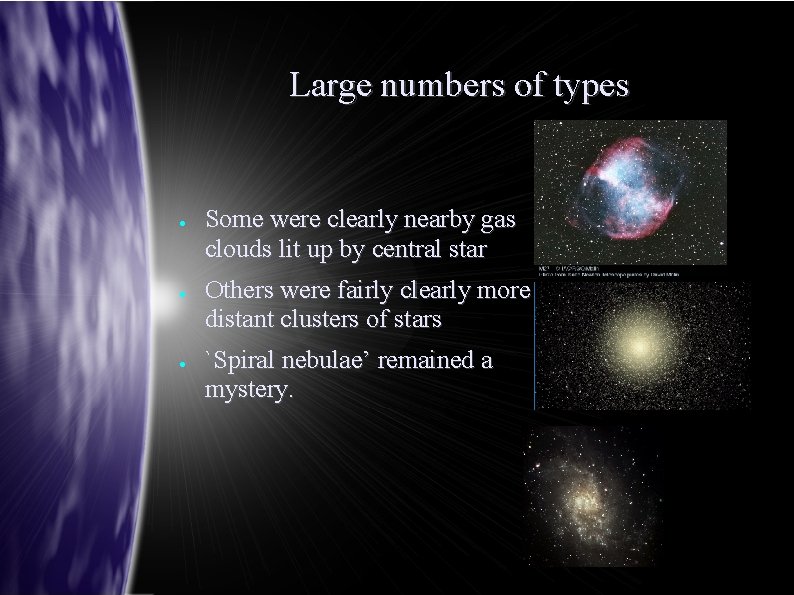
Large numbers of types ● ● ● Some were clearly nearby gas clouds lit up by central star Others were fairly clearly more distant clusters of stars `Spiral nebulae’ remained a mystery.
What are they? ● ● 1920: Shapley-Curtis Debate Shapley: – ● `Spiral Nebulae' were just near by gas clouds; the universe consisted of only one galaxy Curtis – – – Spiral Nebulae are very far away To be seen at this distance, must be huge -- as big as our own galaxy We live in just one of many galaxies!!
Importance of Distance ● Nature and scale of the universe hinged on argument of how distant things are ● Determines their size ● Astronomers can't `see' distances!
The Universe and How Big it is: The Distance Ladder ● At end of this lecture/reading, should be able to: – Describe relative scales of ● ● ● – stars/planets Stellar systems Interstellar distances Galactic Distances Intergalactic Distances And explain how those distances are measured
The Distance Ladder ● ● Need to measure nearby distances Use those to measure distance to more remote objects Build our way up from solar system to entire observable universe Excellent website: – http: //heasarc. gsfc. nasa. gov/docs/cosmic/
Begin with most nearby object http: //www. rathergood. com/moon_song
Lessons from Educational Video ● Some confusion about distance to moon ● Difficulty comparing it with other distances: – – Zeppelin Dirigible Light bulbs Puffins
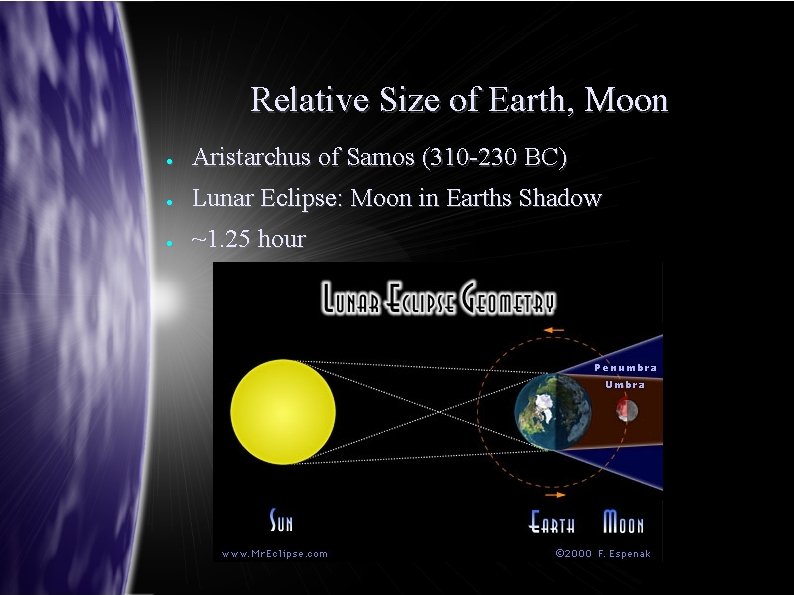
Relative Size of Earth, Moon ● Aristarchus of Samos (310 -230 BC) ● Lunar Eclipse: Moon in Earths Shadow ● ~1. 25 hour
Relative Size of Earth, Moon ● Takes moon about 28 days to circle the earth – 360 degrees ● Travels a bit over a degree an hour ● Moon size is ~0. 5 degrees ● Travels a bit over 2 of its own sizes an hour ● Travels about 3 of its sizes during an eclipse ● Earth's shadow size ~ 3 moon sizes ● Earth ~ 3 x size of moon
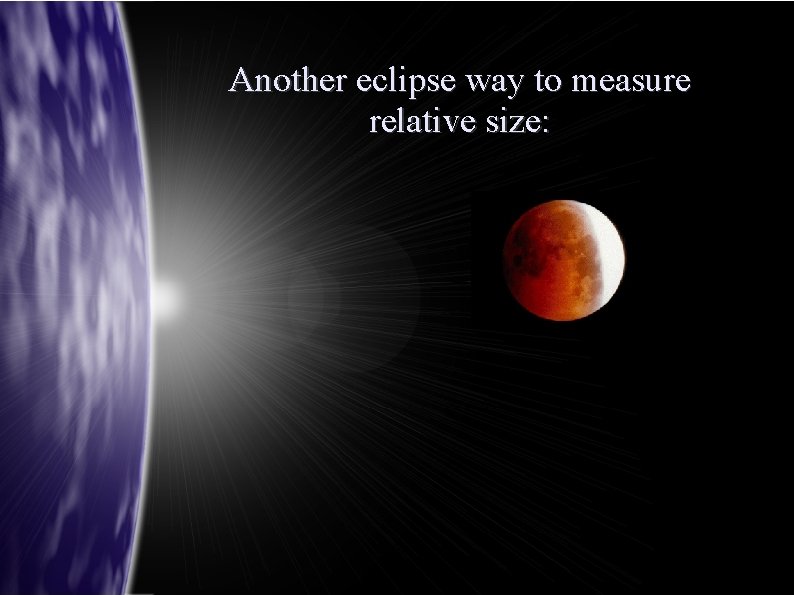
Another eclipse way to measure relative size:
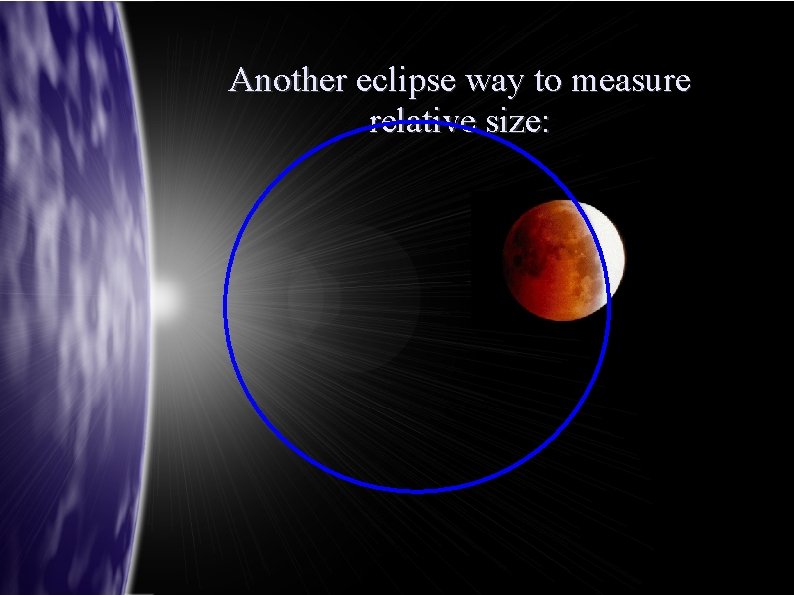
Another eclipse way to measure relative size:
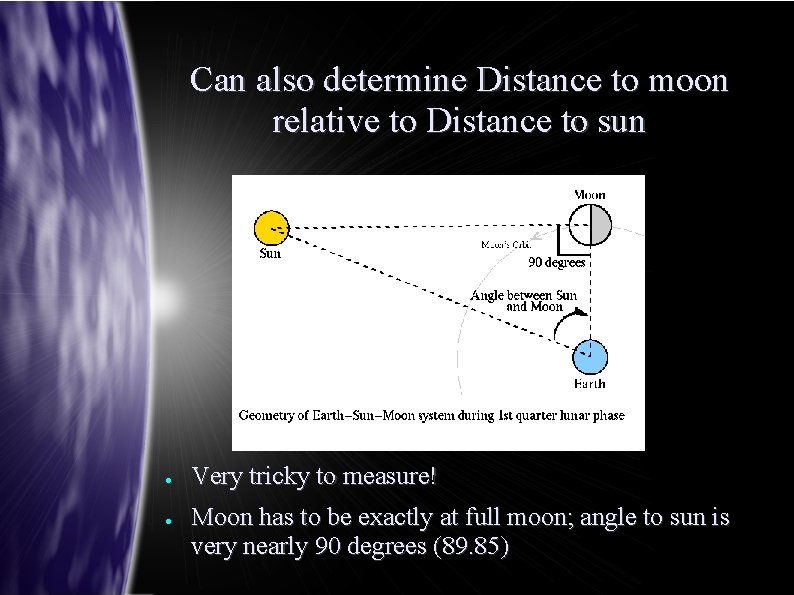
Can also determine Distance to moon relative to Distance to sun ● ● Very tricky to measure! Moon has to be exactly at full moon; angle to sun is very nearly 90 degrees (89. 85)
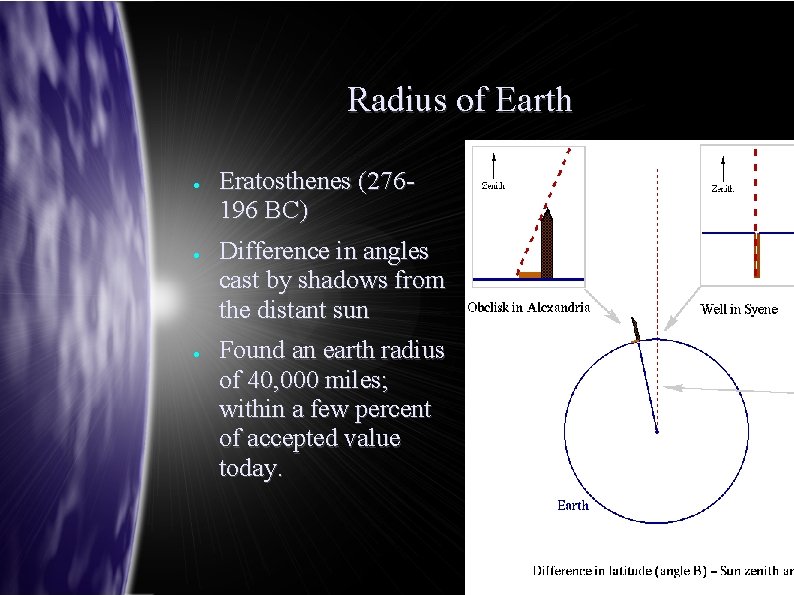
Radius of Earth ● ● ● Eratosthenes (276196 BC) Difference in angles cast by shadows from the distant sun Found an earth radius of 40, 000 miles; within a few percent of accepted value today.
Suddenly: ● ● Know actual size of moon Since know its size and how big it seems, know distance to moon Know distance to sun Today, can verify/improve these distances: – – Radar Space probes Orbit modeling Get us accurate measurements of entire solar system
New length unit: Astronomical Unit (AU): ● Earth-Sun distance so handy for measuring solar system distances that new unit created: ● 1 AU = mean distance between Earth and Sun ● 1 AU = 92, 955, 807 miles
Distances to stars ● Activity: building a constellation
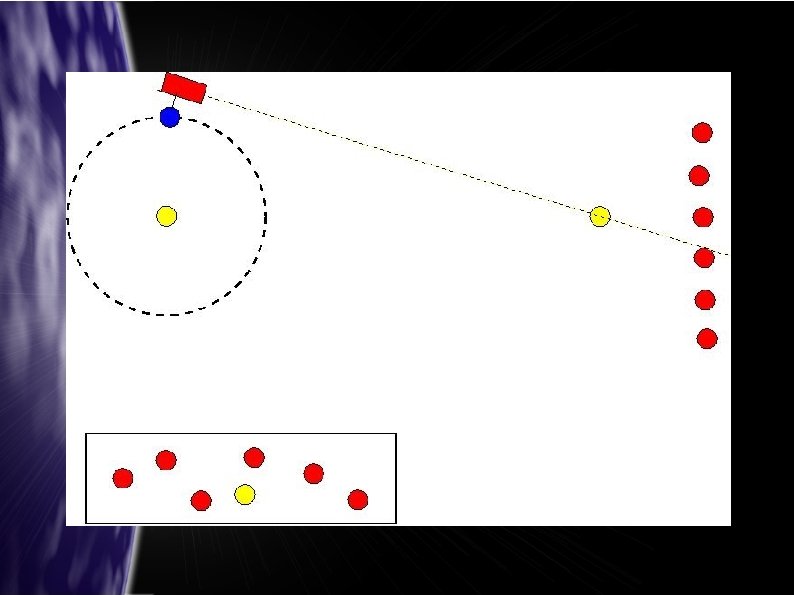
Paralax ● 01234567890123456789012345678901234
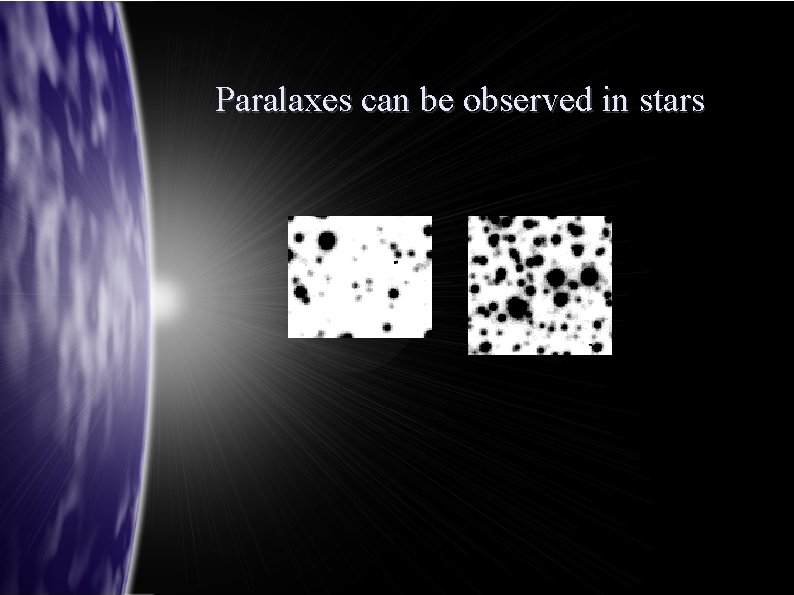
Paralaxes can be observed in stars
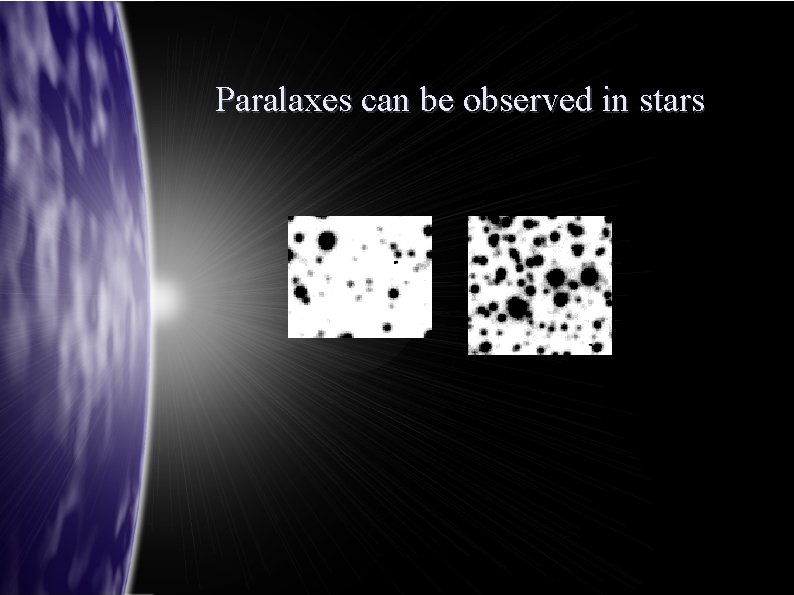
Paralaxes can be observed in stars
What Is Science Not Good At?
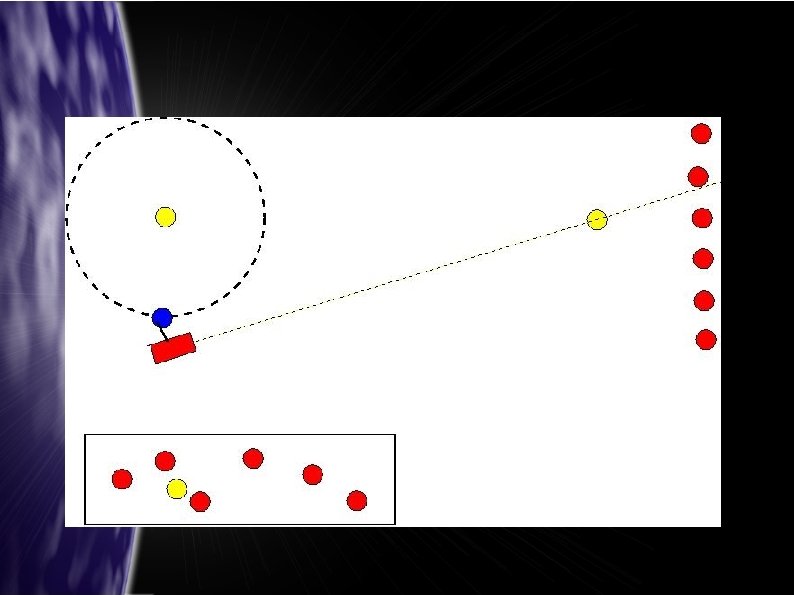
The displacement is measured as an angle on the sky ● 0. 5 degree: about your thumb at arms length ● 1 arc minute: 1/60 th of a degree ● 1 arc second: 1/60 th of an arc minute ● A distance at which the parallax (from Jan to June) is 1 arc second is a parsec (PARallax SECond) ● Can find it from 1 AU with some trig ● 1 pc = 206265 AU
Concept Test: ● Would a ``parmin'' (PARallax MINute) be a LARGER unit of distance, or a SMALLER unit of distance than a parsec?
Concept Test: ● Would a ``parmin'' (PARallax MINute) be a LARGER unit of distance, or a SMALLER unit of distance than a parsec? ● Smaller. ● An arc minute is a BIGGER displacement ● ● CLOSER stars would have bigger displacements; something that had a paralax of an arc minute would be closer. (60 times closer!)
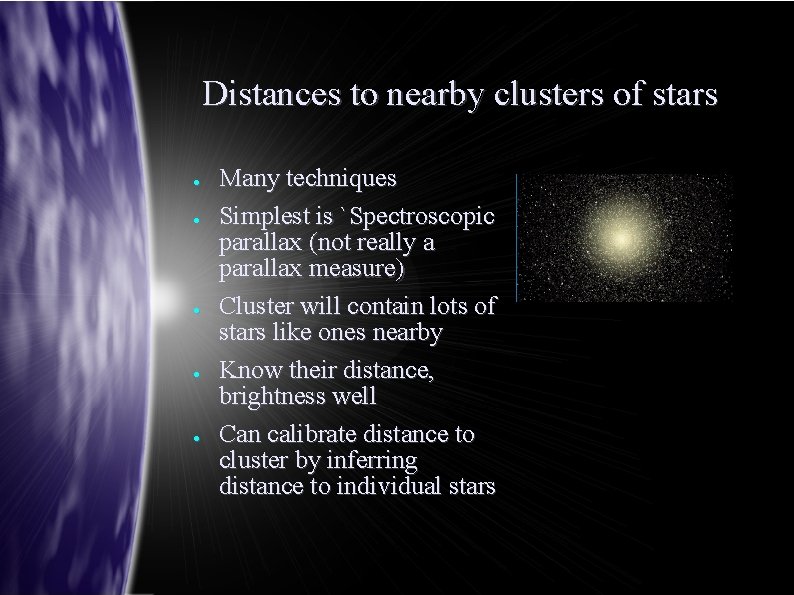
Distances to nearby clusters of stars ● ● ● Many techniques Simplest is `Spectroscopic parallax (not really a parallax measure) Cluster will contain lots of stars like ones nearby Know their distance, brightness well Can calibrate distance to cluster by inferring distance to individual stars
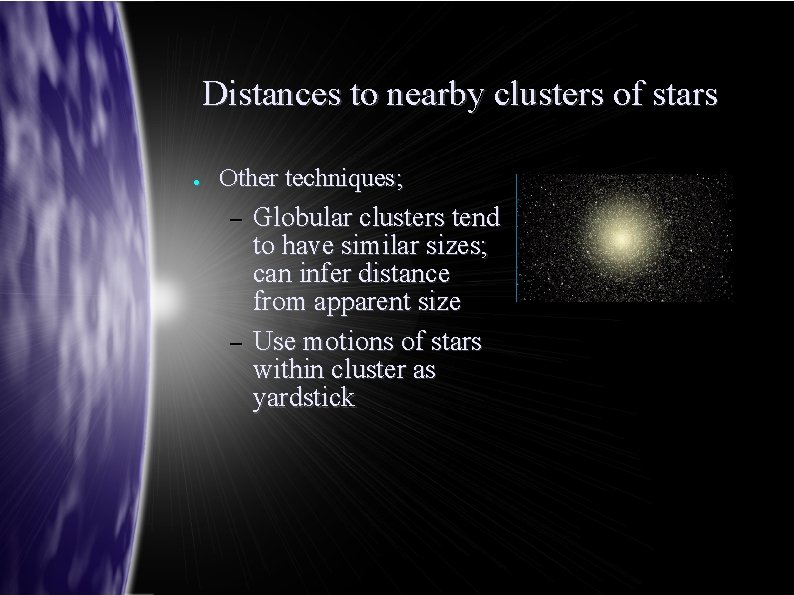
Distances to nearby clusters of stars ● Other techniques; – – Globular clusters tend to have similar sizes; can infer distance from apparent size Use motions of stars within cluster as yardstick
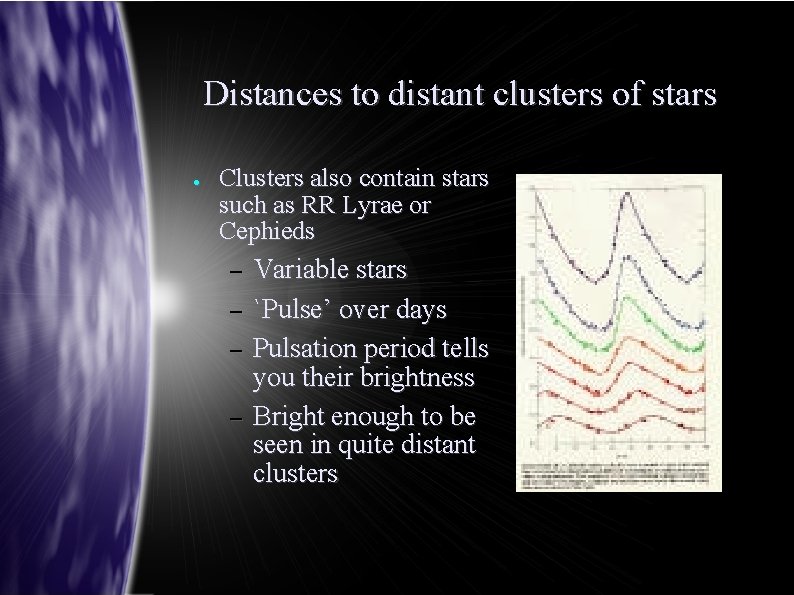
Distances to distant clusters of stars ● Clusters also contain stars such as RR Lyrae or Cephieds – – Variable stars `Pulse’ over days Pulsation period tells you their brightness Bright enough to be seen in quite distant clusters
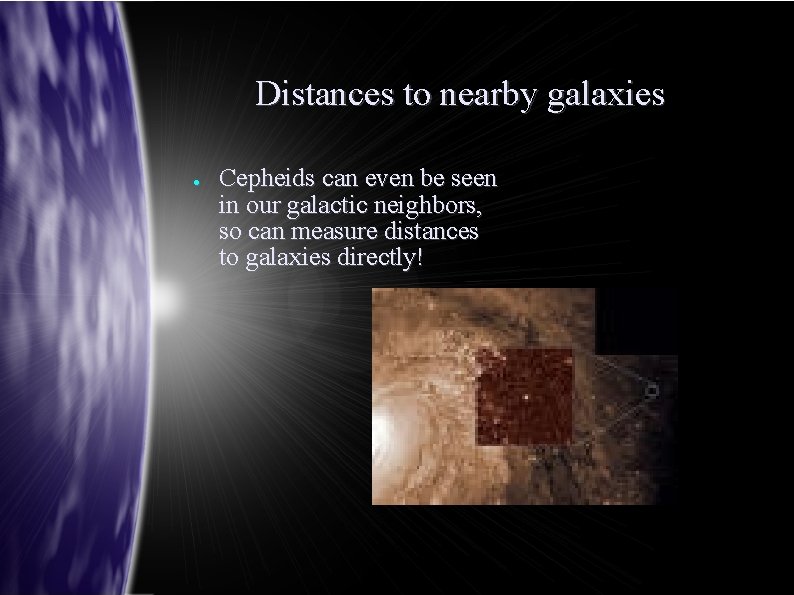
Distances to nearby galaxies ● Cepheids can even be seen in our galactic neighbors, so can measure distances to galaxies directly!
Stringing together a Universe ● Activity: putting relative distances in perspective
Stringing together a Universe ● 1 `tic’ = 1 AU (earth-sun distance)
Stringing together a Universe ● 10 `tic’ = 1 pc (typical inter-stellar distance) ● (1 tic = 1/10 pc = 20, 600 AU)
Stringing together a Universe ● 4 `tic’ = 1 kpc (typical inter-stellar distance) ● (1 tic = 1/4 kpc = 250 pc = 51 million AU)
The Drake Equation ● Drake Equation will structure the rest of our class ● Astronomy ● ● Number of stars in galaxy ● Number of suitable stars ● Number of stars that form planets Geophysics ● ● Number of planets suitable for life Biology ● Where and low life forms on those planets
- Slides: 47