
Annotations Analytical Inquiry of Text By Mesra Phanord

Annotations: Analytical Inquiry of Text By: Mesra Phanord & Cassie Montenegro
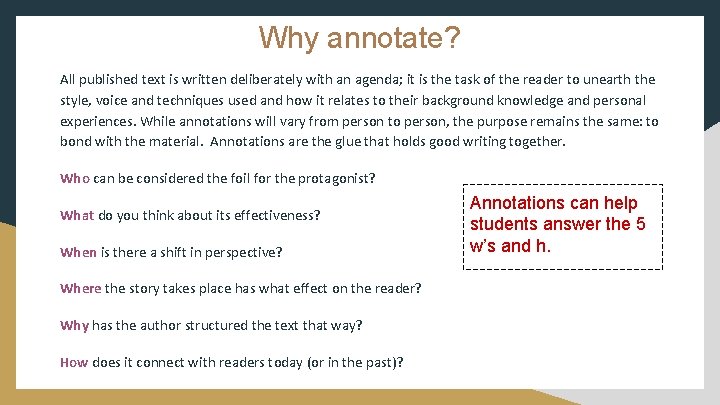
Why annotate? All published text is written deliberately with an agenda; it is the task of the reader to unearth the style, voice and techniques used and how it relates to their background knowledge and personal experiences. While annotations will vary from person to person, the purpose remains the same: to bond with the material. Annotations are the glue that holds good writing together. Who can be considered the foil for the protagonist? What do you think about its effectiveness? When is there a shift in perspective? Where the story takes place has what effect on the reader? Why has the author structured the text that way? How does it connect with readers today (or in the past)? Annotations can help students answer the 5 w’s and h.
Why annotate? Annotations provide readers with analytical notes that can be used to assist in a variety of assignments. ■ Reflection/Extended Response ■ Essays ■ Multiple Choice Quiz or Test Annotating can better facilitate close reading! ■ Projects Annotations can also stand alone as the end of assessment or used solely as discussion starters.
How-To Annotate
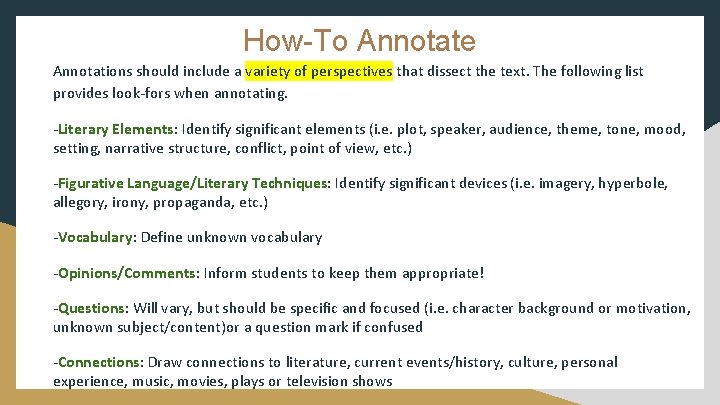
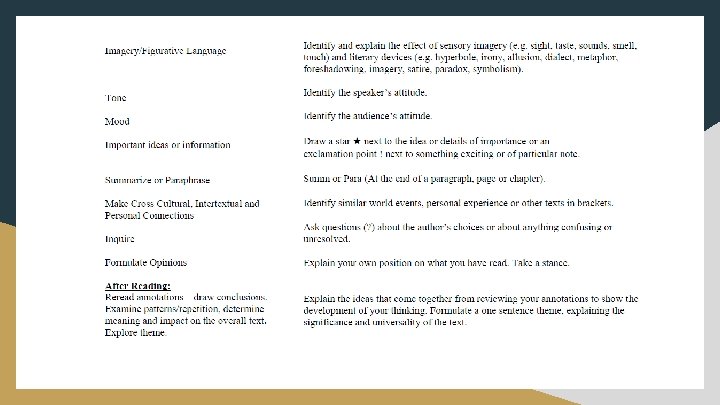
How-To Annotate Annotations should include a variety of perspectives that dissect the text. The following list provides look-fors when annotating. -Literary Elements: Identify significant elements (i. e. plot, speaker, audience, theme, tone, mood, setting, narrative structure, conflict, point of view, etc. ) -Figurative Language/Literary Techniques: Identify significant devices (i. e. imagery, hyperbole, allegory, irony, propaganda, etc. ) -Vocabulary: Define unknown vocabulary -Opinions/Comments: Inform students to keep them appropriate! -Questions: Will vary, but should be specific and focused (i. e. character background or motivation, unknown subject/content)or a question mark if confused -Connections: Draw connections to literature, current events/history, culture, personal experience, music, movies, plays or television shows
How-To Annotate Students must have a pocket dictionary and thesaurus in order to properly annotate. It will assist them in defining unknown vocabulary words and forgotten literary elements or techniques. Post-its are optional, as are highlighters, annotations can be written in the margins of a text or on a separate sheet of paper (2 -column format) with the identifying line or paragraph reference. Suggestions below are how to approach annotating specific types of material. Novel/Literary/Fiction Texts: Mostly focus on what should be provided during specific parts of the plot diagram, any deviations from traditional structure, setting, theme and character development. Informational/Non-Fiction Texts: Mostly focus on purpose, content, claims, evidence, connections, bias and organization.
How-To Annotate Box important words. (Content specific, unknown and when defined shown to be crucial to understanding the text, can be connected into a specific academic connection, etc. ) Highlight or underline ONLY what is important. (What is important? A specific event that drives plot, characterization that demonstrates the evolution or stagnant nature of a character, setting that greatly affects the message, word choice that is colorful and powerful at evoking sentiment, etc. ) Put a question mark when a section or passage is confusing. Teachers can open the lesson by answering questions students may have had during reading at home. Put brackets around long sections to signify their importance. (A brief explanation as to how or why should be in the margin) These steps are already included on the annotation guide, but could be used alone as a way to introduce how to annotate.
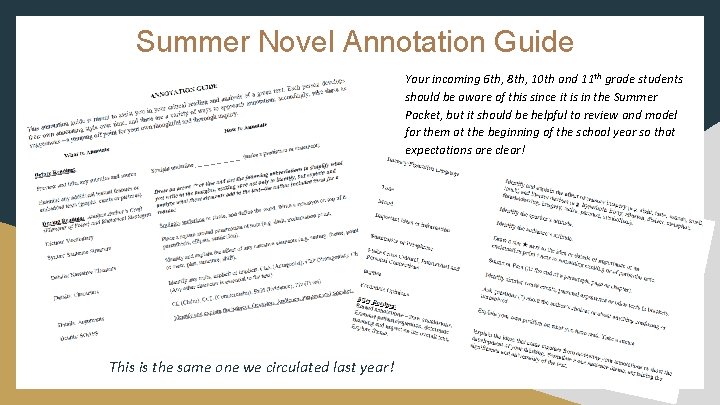
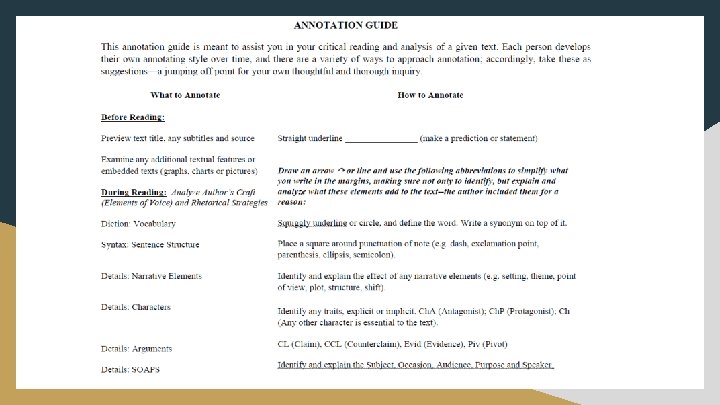
Summer Novel Annotation Guide Your incoming 6 th, 8 th, 10 th and 11 th grade students should be aware of this since it is in the Summer Packet, but it should be helpful to review and model for them at the beginning of the school year so that expectations are clear! This is the same one we circulated last year!
How to Grade Annotations
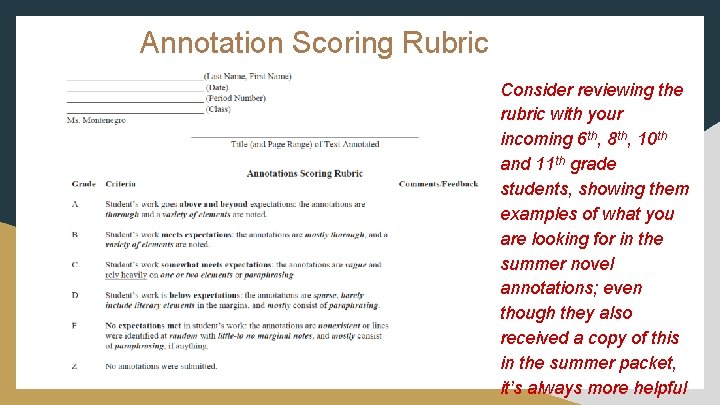
Annotation Scoring Rubric Consider reviewing the rubric with your incoming 6 th, 8 th, 10 th and 11 th grade students, showing them examples of what you are looking for in the summer novel annotations; even though they also received a copy of this in the summer packet, it’s always more helpful
Throughout the year, keep students on their toes! The following is a way to easily and more efficiently assign and grade annotations while also combating cheating on both Literature/Fiction or Informational/Non-Fiction Texts: 1. Assign a few chapters or an entire piece to read annotate. You may: a. Select different chapters or paragraphs by period b. Select certain pages or lines by period c. Select one page per chapter or informational text by period 2. When you grade, only select certain pages, paragraphs or lines with significant meaning, theme, characterization, plot development, claims, evidence, bias, and or shifts in organization or thought in order to draw out (and assess) the most impactful annotations.
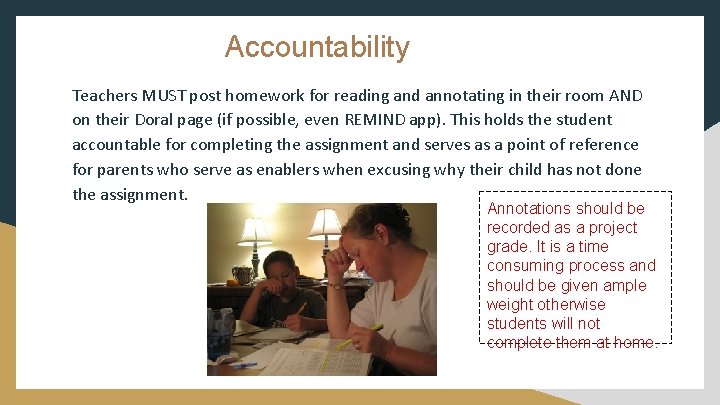
Accountability Teachers MUST post homework for reading and annotating in their room AND on their Doral page (if possible, even REMIND app). This holds the student accountable for completing the assignment and serves as a point of reference for parents who serve as enablers when excusing why their child has not done the assignment. Annotations should be recorded as a project grade. It is a time consuming process and should be given ample weight otherwise students will not complete them at home.
Activities for Annotating
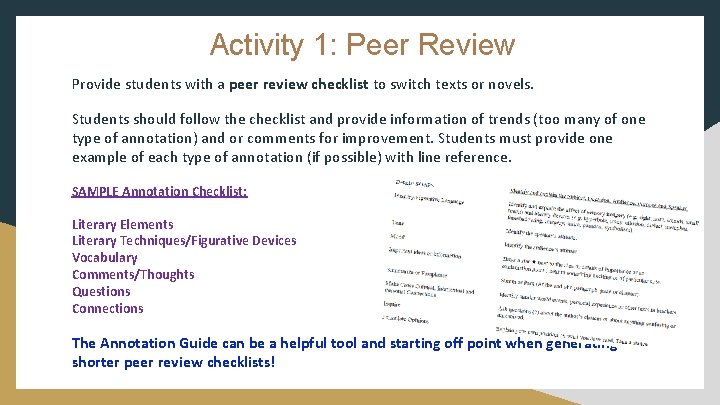
Activity 1: Peer Review Provide students with a peer review checklist to switch texts or novels. Students should follow the checklist and provide information of trends (too many of one type of annotation) and or comments for improvement. Students must provide one example of each type of annotation (if possible) with line reference. SAMPLE Annotation Checklist: Literary Elements Literary Techniques/Figurative Devices Vocabulary Comments/Thoughts Questions Connections The Annotation Guide can be a helpful tool and starting off point when generating shorter peer review checklists!
Activity 2: Annotation Guides Annotation guides are okay to use once or twice, after which it serves more as a crutch that tells students what to look for rather than allow them to decide for themselves what is relevant, significant or serves as a personal connection with the text. OR (possible modification for middle school or lower level high school) A partial annotation guide may be used to help point out significant elements students may miss (i. e. character epiphany or a paradigm shift), then have students look for other types of annotations on their own. Teachers may also identify the type of annotation provided and have students search for all other types of annotations.
Activity 3: Discussion Groups Similar to Socratic Seminar or Literary Circles, discussion groups stem from group review of annotations. This activity combines aspects of review, as the student is now reviewing their own annotations and selecting what they believe to be the best (most intuitive and helpful) in order to share with the group. 4 -6 students with annotated text or novel come together to share annotations and fill out the handout to record all selected annotations. The group will then decide on one annotation to share aloud. Each group will then take 2 minutes to create a response or possibly ask another question based on the annotation shared.
Activity 4: Class Annotations Teacher will project text on the board and have students share out annotations to record using the Smart. Board pen or Expo marker. Teacher can elect a class leader to write the annotations on the board. This activity is a great tool to give students leadership and build confidence in creating their own annotations. After creating class annotations, the teacher can assess understanding using multiple choice questions or an extended response. Scaffold Option (with particularly difficult texts): Teacher can write the annotations on the board themselves and facilitate the ongoing class discussion. Students then write in response to a prompt given, synthesizing the information, and share in class.

Examples
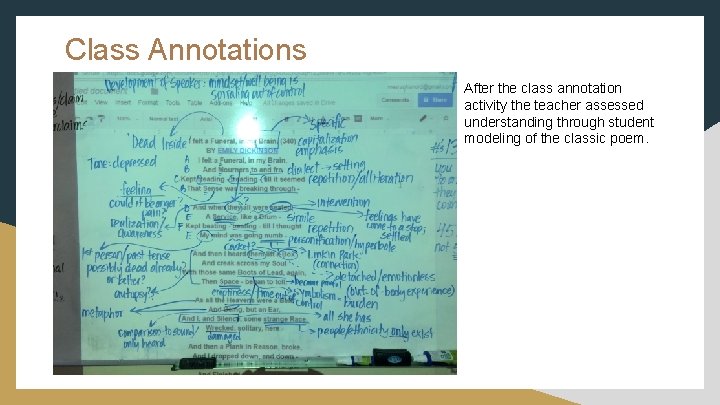
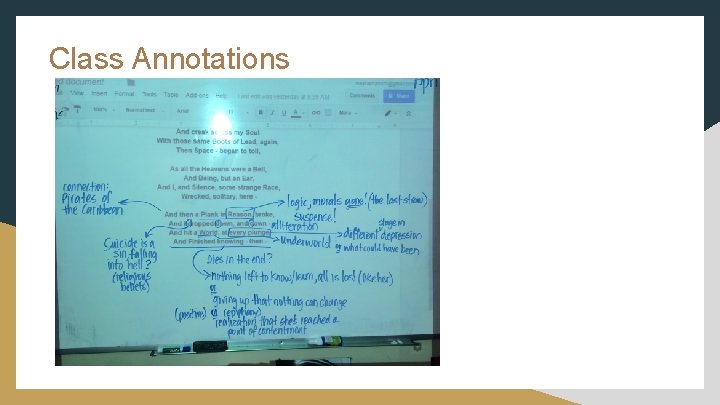
Class Annotations After the class annotation activity the teacher assessed understanding through student modeling of the classic poem.
Class Annotations
Student Modeling https: //docs. google. com/document/d/1 pcz 6 Fe. YLE 3 SJffqh. PEo 4 o_j. MZHw 5 qe. Fl. DX 1 Ltci. ESFk/edit Click link to find Marcelo’s version of Dickinson’s poem.
Extended Response https: //docs. google. com/document/d/1 F 8 DNPk 62 o. JHHxqs. ZI 6 ka. RZFh 0 g 6 p 640 DHKVLPhd. Ub 4 A/edit Click link to find handout for “Walden” by Henry David Thoreau Prior to this, students annotated the text as a class and watched a video about transcendentalism.

Teachers must challenge students to: Question, Analyze, and Lead
- Slides: 25