
Annotation and Dialectical Journal Creation Examining Harper Lees




- Slides: 15
Annotation and Dialectical Journal Creation Examining Harper Lee’s To Kill a Mockingbird
Chapter 1: The Setting; pages 5 -6 Maycomb was an old town, but it was a tired old town when I first knew it. In rainy weather the streets turned to red slop; grass grew on the sidewalks, the courthouse sagged in the square. Somehow, it was hotter then: a black dog suffered on a summer’s day; bony mules hitched to Hoover carts flicked flies in the sweltering shade of the live oaks on the square. Men’s stiff collars wilted by nine in the morning. Ladies bathed before noon, after their three o’clock naps, and by nightfall were like soft teacakes with frostings of sweat and sweet talcum.
Identify / Define Devices and Apply Analysis Maycomb was an old town, but it was a tired old town when I first knew it. [+ / -] Devices? Effect(s)? In rainy weather the streets turned to red slop; grass grew on the sidewalks, the courthouse sagged in the square. [+/-]
Somehow, it was hotter then: a black dog suffered on a summer’s day; bony mules hitched to Hoover carts flicked flies in the sweltering shade of the live oaks on the square. [+/-]
Men’s stiff collars wilted by nine in the morning. Ladies bathed before noon, after their three o’clock naps, and by nightfall were like soft teacakes with frostings of sweat and sweet talcum. [+/-]
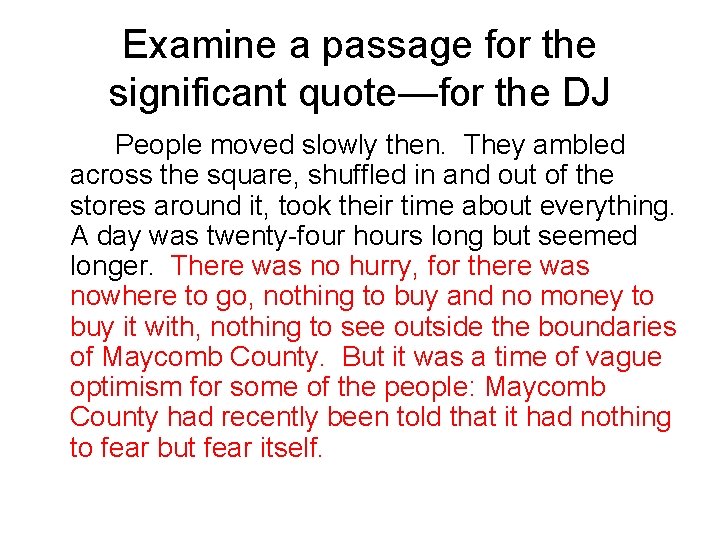
Examine a passage for the significant quote—for the DJ People moved slowly then. They ambled across the square, shuffled in and out of the stores around it, took their time about everything. A day was twenty-four hours long but seemed longer. There was no hurry, for there was nowhere to go, nothing to buy and no money to buy it with, nothing to see outside the boundaries of Maycomb County. But it was a time of vague optimism for some of the people: Maycomb County had recently been told that it had nothing to fear but fear itself.
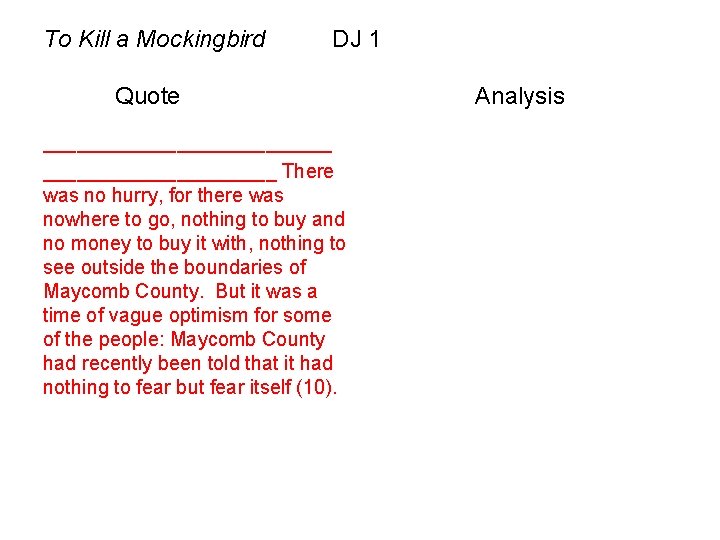
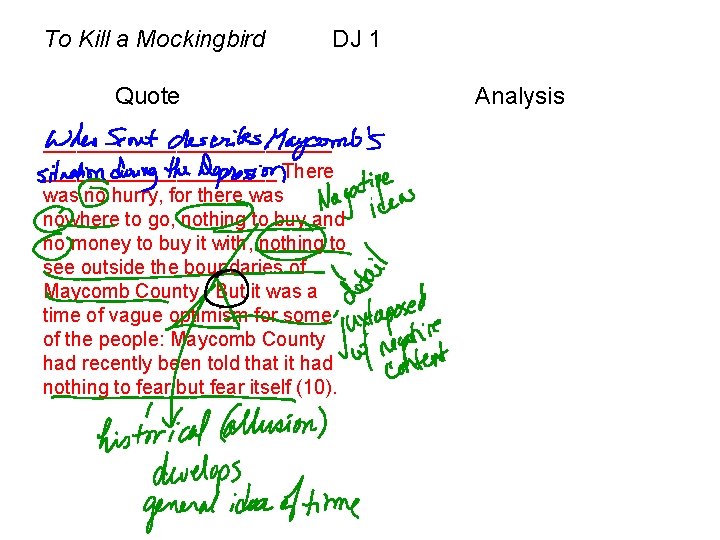
To Kill a Mockingbird DJ 1 Quote _____________ There was no hurry, for there was nowhere to go, nothing to buy and no money to buy it with, nothing to see outside the boundaries of Maycomb County. But it was a time of vague optimism for some of the people: Maycomb County had recently been told that it had nothing to fear but fear itself (10). Analysis
To Kill a Mockingbird DJ 1 Quote _____________ There was no hurry, for there was nowhere to go, nothing to buy and no money to buy it with, nothing to see outside the boundaries of Maycomb County. But it was a time of vague optimism for some of the people: Maycomb County had recently been told that it had nothing to fear but fear itself (10). Analysis
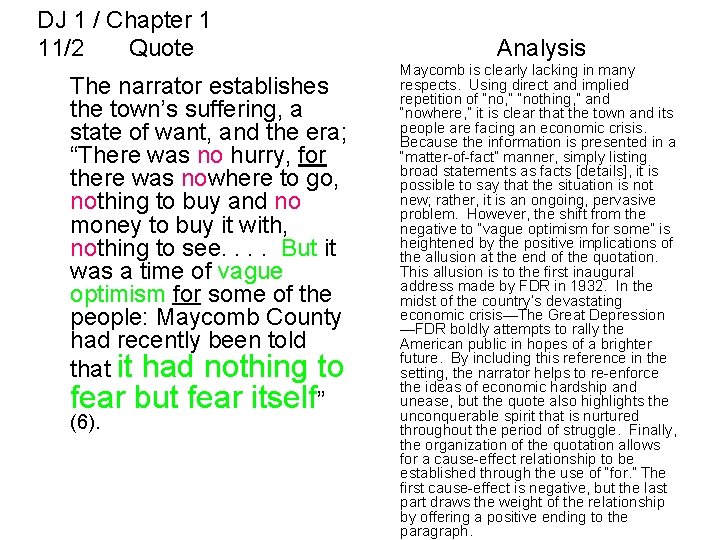
DJ 1 / Chapter 1 11/2 Quote The narrator establishes the town’s suffering, a state of want, and the era; “There was no hurry, for there was nowhere to go, nothing to buy and no money to buy it with, nothing to see. . But it was a time of vague optimism for some of the people: Maycomb County had recently been told that it had nothing to fear but fear itself” (6). Analysis Maycomb is clearly lacking in many respects. Using direct and implied repetition of “no, ” “nothing, ” and “nowhere, ” it is clear that the town and its people are facing an economic crisis. Because the information is presented in a “matter-of-fact” manner, simply listing broad statements as facts [details], it is possible to say that the situation is not new; rather, it is an ongoing, pervasive problem. However, the shift from the negative to “vague optimism for some” is heightened by the positive implications of the allusion at the end of the quotation. This allusion is to the first inaugural address made by FDR in 1932. In the midst of the country’s devastating economic crisis—The Great Depression —FDR boldly attempts to rally the American public in hopes of a brighter future. By including this reference in the setting, the narrator helps to re-enforce the ideas of economic hardship and unease, but the quote also highlights the unconquerable spirit that is nurtured throughout the period of struggle. Finally, the organization of the quotation allows for a cause-effect relationship to be established through the use of “for. ” The first cause-effect is negative, but the last part draws the weight of the relationship by offering a positive ending to the paragraph.
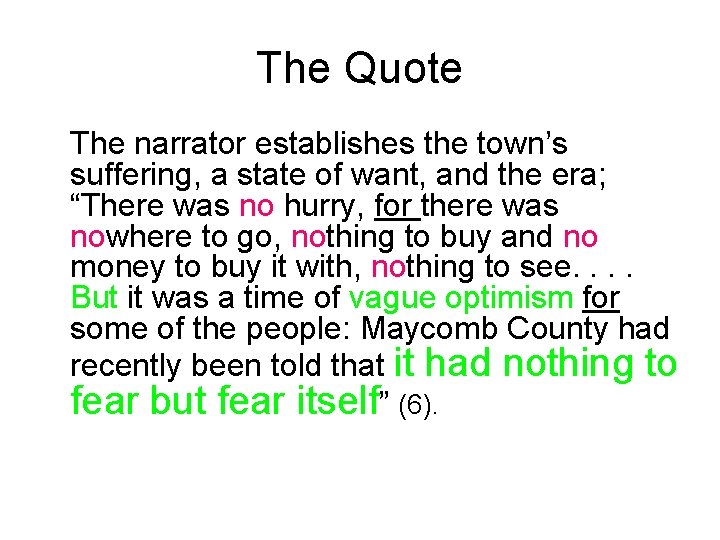
The Quote The narrator establishes the town’s suffering, a state of want, and the era; “There was no hurry, for there was nowhere to go, nothing to buy and no money to buy it with, nothing to see. . But it was a time of vague optimism for some of the people: Maycomb County had recently been told that it had nothing to fear but fear itself” (6).
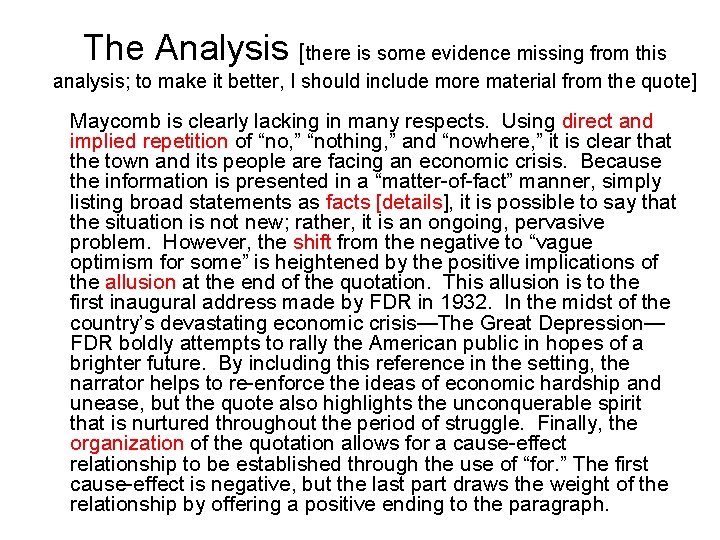
The Analysis [there is some evidence missing from this analysis; to make it better, I should include more material from the quote] Maycomb is clearly lacking in many respects. Using direct and implied repetition of “no, ” “nothing, ” and “nowhere, ” it is clear that the town and its people are facing an economic crisis. Because the information is presented in a “matter-of-fact” manner, simply listing broad statements as facts [details], it is possible to say that the situation is not new; rather, it is an ongoing, pervasive problem. However, the shift from the negative to “vague optimism for some” is heightened by the positive implications of the allusion at the end of the quotation. This allusion is to the first inaugural address made by FDR in 1932. In the midst of the country’s devastating economic crisis—The Great Depression— FDR boldly attempts to rally the American public in hopes of a brighter future. By including this reference in the setting, the narrator helps to re-enforce the ideas of economic hardship and unease, but the quote also highlights the unconquerable spirit that is nurtured throughout the period of struggle. Finally, the organization of the quotation allows for a cause-effect relationship to be established through the use of “for. ” The first cause-effect is negative, but the last part draws the weight of the relationship by offering a positive ending to the paragraph.
DJ 1 chapter 1 Quote Scout recalls Dill’s feelings about the neighborhood enigma, Boo Radley, and “…that Dil gave us the idea of making Boo Radley come out. The Radley Place fascinated Dill. In spite of our warnings and explanations it drew him as the moon draws water, but drew him no nearer than the lightpole on the corner, a safe distance from the Radley gate. There he would stand, his arm around the fat pole, staring and wondering” (12 -13). Analysis