
Annotated Bibliography Your Annotated Bibliography 10 12 sources

Annotated Bibliography
Your Annotated Bibliography � 10 -12 sources At least 4 primary At least 4 secondary ▪ Three of the secondary sources must be scholarly Yes, this adds up to 8. The remaining 2 -4 sources can be any kind of source you find that you feel is applicable to your brand.
As you’re researching… �Think about advertisement layers: Underneath/Implicit Surface/Explicit • Immediate visual/verbal stimuli • Attention grabber/”Plot” • The ideology behind an ad • What are they really trying to sell? Sex, happiness, a certain lifestyle? • Who are they targeting?
Why are you writing an Annotated Bibliography? 4 �Being able to talk critically and intelligently about a piece of writing is crucial to the craft and technique of critical analysis � Nobody can read and then magically create a good essay without thought and preparation. �An annotated bibliography will provide specific info about each source you have chosen. �This annotated bibliography will provide the foundation for your inquiry in Unit 2. What inquiry?

What are its parts? �Citation of source with proper MLA format. �Summary �Evaluation

Summary �A visual/primary source Give me an idea of what is going on in the visual, what is the general point/purpose of the ad? Help me see the visual through your words �A textual/secondary source What is the author’s main point/the general gist of the argument?
Steps to writing a summary 151 From Inquiry 7 � 1) Describe the key claims of the text � 2) Select examples to illustrate the author’s argument. � 3) Present the gist of the author’s argument. � 4) Contextualize what you summarize. �Summaries will be a little different if you’re working with a visual (picture, or video).
Evaluation 8 � Parts: � Identification of possible target audiences. � Explanation of the marketing strategies, advertising techniques, and appeals (ethos, pathos, & logos). � Connection to societal values, ideas, trends, and/or events that are associated with your brand/product � Evaluation of the source’s credibility and/or biases (This could be an author, a company/brand, a website, a publisher, etc. ) � Proposed use of source: how will this source contribute to your argument?
Evaluation (continued) �Things to ask when evaluating a source: What ideologies are represented? What ideologies should be represented but are not? Does this affect the credibility of the source? How do represented (or excluded) ideologies play into a marketing strategy?
Things to consider when evaluating: � Publisher/Sponsor Credentials: What can you learn about the publisher or sponsor of the source? Ex- Is it a newspaper known for integrity or a tabloid? Is it popular or academic? No hard and fast rules exist for deciding what kinds of sources to use, but knowing about the publisher/sponsor can help you decide. � Author Credentials: Does the abstract/summary give any information about the author’s authority? You can search the Internet for information on the author � Date of Publication: Recent sources are generally more useful/relevant � Stance of the Source: Identify the source’s point of view and scrutinize it. Does it present facts, or does it interpret and evaluate them? Think about the goals of the source-what does the author/sponsor want (to convince, to sell, to spark change)?
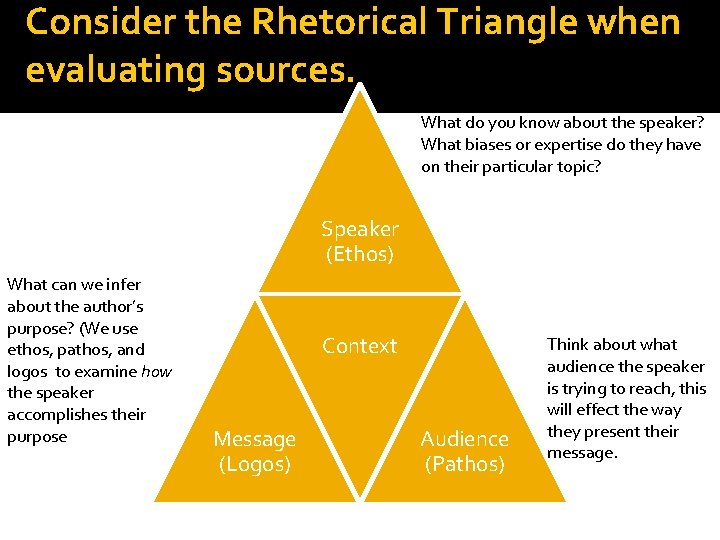
Consider the Rhetorical Triangle when evaluating sources. What do you know about the speaker? What biases or expertise do they have on their particular topic? Speaker (Ethos) What can we infer about the author’s purpose? (We use ethos, pathos, and logos to examine how the speaker accomplishes their purpose Context Message (Logos) Audience (Pathos) Think about what audience the speaker is trying to reach, this will effect the way they present their message.
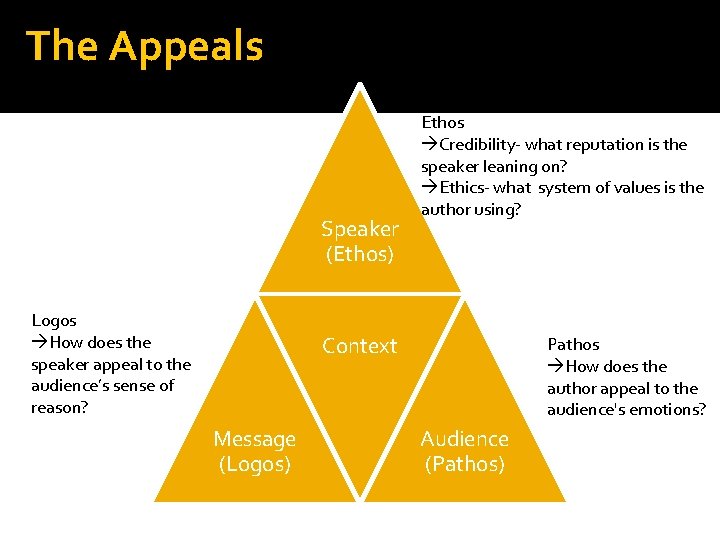
The Appeals Speaker (Ethos) Logos How does the speaker appeal to the audience’s sense of reason? Ethos Credibility- what reputation is the speaker leaning on? Ethics- what system of values is the author using? Context Message (Logos) Pathos How does the author appeal to the audience's emotions? Audience (Pathos)
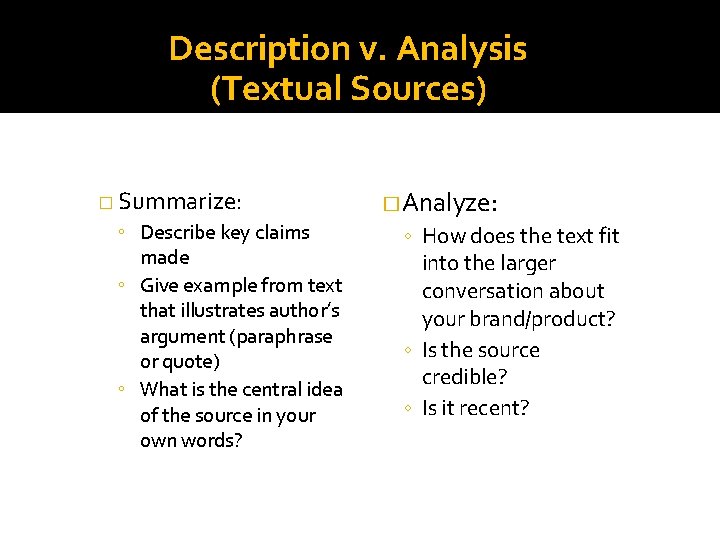
Description v. Analysis (Textual Sources) � Summarize: ◦ Describe key claims made ◦ Give example from text that illustrates author’s argument (paraphrase or quote) ◦ What is the central idea of the source in your own words? � Analyze: ◦ How does the text fit into the larger conversation about your brand/product? ◦ Is the source credible? ◦ Is it recent?
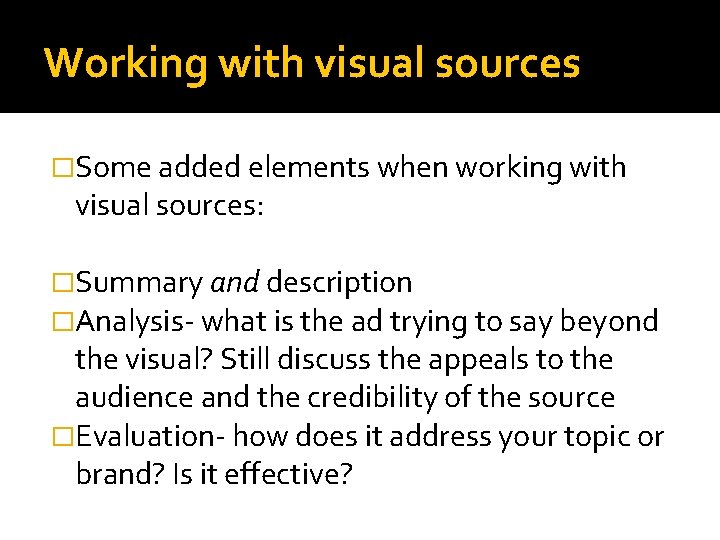
Working with visual sources �Some added elements when working with visual sources: �Summary and description �Analysis- what is the ad trying to say beyond the visual? Still discuss the appeals to the audience and the credibility of the source �Evaluation- how does it address your topic or brand? Is it effective?
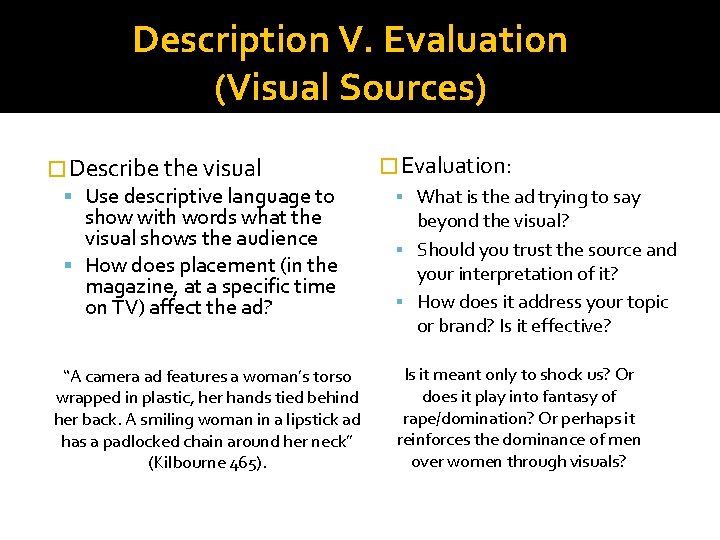
Description V. Evaluation (Visual Sources) � Describe the visual Use descriptive language to show with words what the visual shows the audience How does placement (in the magazine, at a specific time on TV) affect the ad? “A camera ad features a woman’s torso wrapped in plastic, her hands tied behind her back. A smiling woman in a lipstick ad has a padlocked chain around her neck” (Kilbourne 465). � Evaluation: What is the ad trying to say beyond the visual? Should you trust the source and your interpretation of it? How does it address your topic or brand? Is it effective? Is it meant only to shock us? Or does it play into fantasy of rape/domination? Or perhaps it reinforces the dominance of men over women through visuals?
Annotation Exercise Use worksheet to analyze one of your sources • What techniques is the ad using to grab attention? • Read beyond the surface, what is the implied meaning? • Use this in your Kilbourne Reading Response.
Citing Unusual Sources see Everyday Writer and page 51 of Manual for more details & examples How to cite a product you own: � Brand. Product name. Date of Purchase/Date of manufacture. � � Example: Red Bull Energy Drink. 5 Oct. 2010. � � How to cite a Youtube video: Title of Video. Date. Title of website. Publication Medium. Date of Access. � � Example: Hilary Clinton Sopranos Parody. 19 June 2007. Youtube. Web. June 2009 17
Citing Unusual Sources see Everyday Writer and page 51 of Manual for more details & examples How to cite a tweet: Writer’s name or username. “Entire Tweet, in quotes. ” Date and time of message. Medium. Example (from Everyday Writer): Bedford. Bits. “#4 C 12 ‘Think of citations as a guide for the engaged reader. ’ Writing center tutor quoted by E. Kleinfeld. See http: //citationproject. net/” 23 Mar. 2012, 4: 01 p. m. Tweet.
Kilbourne 19 �Kilbourne’s article in some regards is like an annotated bibliography. �Think about how ideologies affect and influence advertisement. �What Kilbourne presents is a great example of how gender and socioeconomic ideologies influence our feelings toward advertisements.
Kilbourne Discussion �In essence, this is an example of the argumentative paper-she draws on many sources, synthesizes them to make meaning and then argues her POV. �She describes visual and textual sources vividly �She analyzes advertisements and facts/statistics, relating them to the larger context of media stereotypes and ideology.
The Visual Element �What is �How do the visual 21 Kilbourne’s sources/advertisements argument? How used within the piece does that connect help Kilbourne make to the title of the her argument? piece? �Your Questions.
Advertisement in General 22 What conclusion does Kilbourne draw based on her analysis of the visual sources as well as statistics/facts/court cases? “A 1993 report. . . Found that 76 percent of female students in grades � eight to eleven and 56 percent of male students said they had been sexually harassed in school” (475). “… when a young woman accused William Kennedy Smith of raping her, the fact that she wore Victoria’s Secret panties was used against her as an indication of her immorality. A jury acquitted Smith, whose alleged history of violence against women was not permitted to be introduced at trial…. It is sadly not surprising that the jury was composed mostly of women” (463). “… the rate of sexual assault in the United States is the highest of any industrialized nation in the world” (468).
Advertisement, Hegemony and Repression � “When power is unequal, when one group is oppressed and discriminated against as a group, when there is a context of systemic and historical oppression, stereotypes and prejudice have different weight and meaning” (467). � “… the message to men is clear: women are always available as the targets of aggression and violence, women are inferior to men and thus deserve to be dominated, and women exist to fulfill the needs of men” (477). � “… our entire culture is predicated on this illusion of male dominance, and our institutions are set up in ways that perpetuate it” (477). � “I contend that all girls growing up in this culture are sexually assaulted—abused by the pornographic images of female sexuality that surround them from birth…” (476).
Kilbourne Annotation Exercise 24 �In groups, create an annotation for one of Kilbourne’s visual sources. �Be sure to include a description of the source as well as an evaluation of the source. �Parts of annotation: Description of visual Identify target audience(s) Explain marketing strategy/appeals Connect to societal values/trends Evaluate credibility/bias
Annotated Bib Peer Review Thursday! �In groups of three, read through your partners’ papers and complete the peer review worksheet. �Take 15 minutes to read each paper and provide feedback �Bring Everyday Writer --�After peer review: On your own, take 10 minutes to compile a least of revisions you need to make to your bibliography What kinds of sources do you still need to find? What opinions, if any, are you beginning to form about your brand/product?
Homework • Kilbourne Reading Response prompt on page 34. First draft of annotated bib due as RWL. 3 primary and 3 secondary sources annotated with titles only. Bring 3 copies.
- Slides: 26