
Annie Witte Occupational Therapy Student The Ohio State

- Slides: 19
Annie Witte Occupational Therapy Student The Ohio State University Monday July 20 th 12: 00 pm
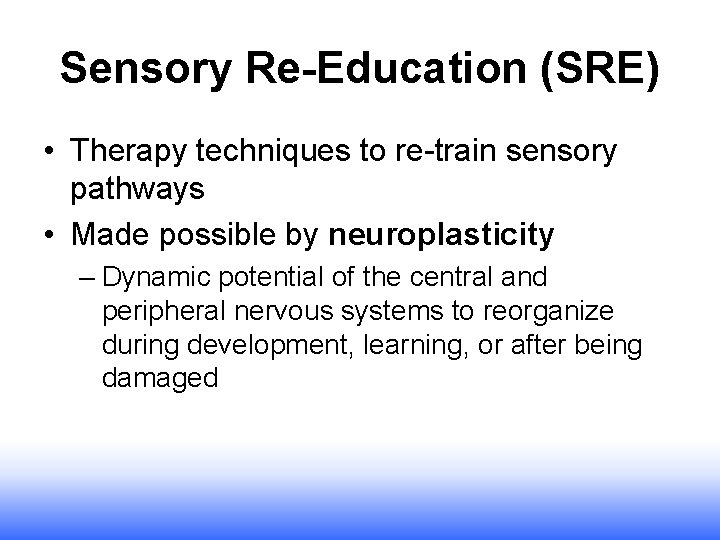
Sensory Re-Education (SRE) • Therapy techniques to re-train sensory pathways • Made possible by neuroplasticity – Dynamic potential of the central and peripheral nervous systems to reorganize during development, learning, or after being damaged
Why SRE Matters • 50 -85% of patients present with sensory deficits after stroke 2 • Re-training sensation can permit normal cortical representations to be maintained. 3 – Down-side to neuroplasticity: When input is eliminated, adjacent cortical regions take over the unused areas • Sensation impacts function 3
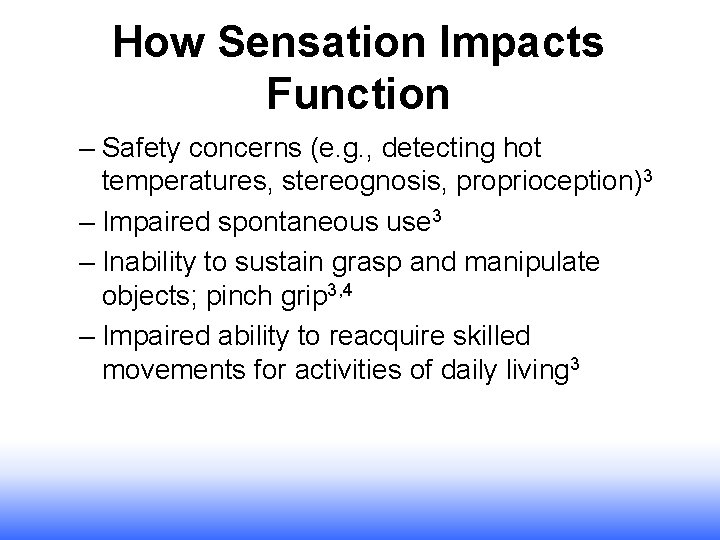
How Sensation Impacts Function – Safety concerns (e. g. , detecting hot temperatures, stereognosis, proprioception)3 – Impaired spontaneous use 3 – Inability to sustain grasp and manipulate objects; pinch grip 3, 4 – Impaired ability to reacquire skilled movements for activities of daily living 3
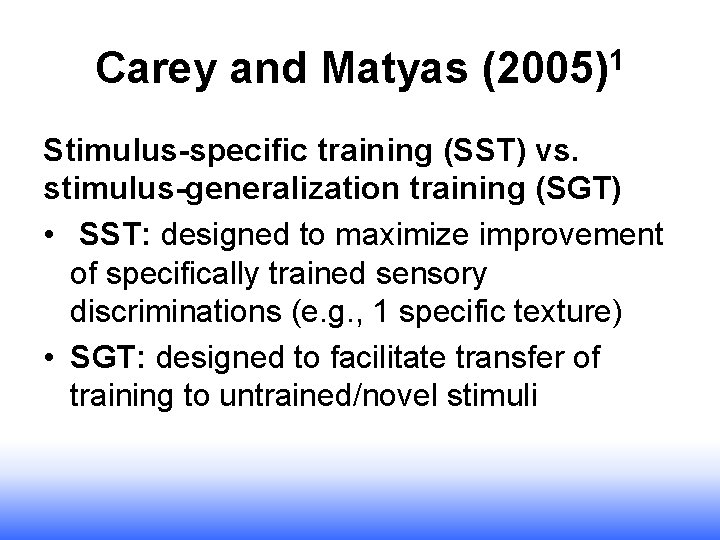
Carey and Matyas (2005)1 Stimulus-specific training (SST) vs. stimulus-generalization training (SGT) • SST: designed to maximize improvement of specifically trained sensory discriminations (e. g. , 1 specific texture) • SGT: designed to facilitate transfer of training to untrained/novel stimuli
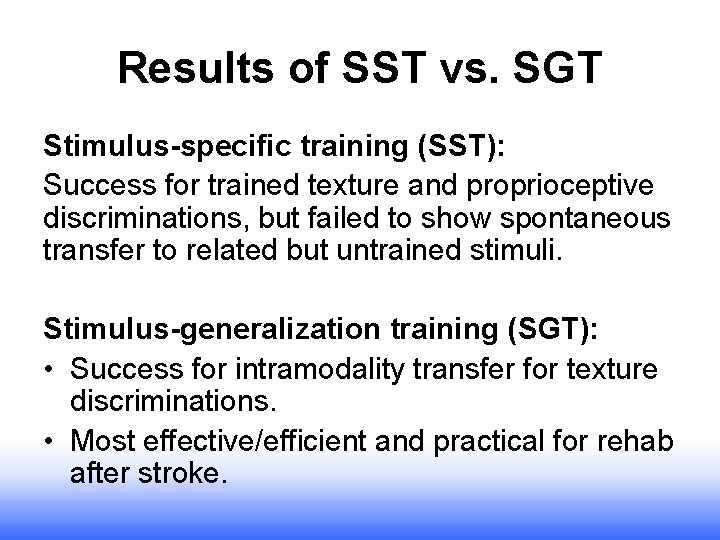
Results of SST vs. SGT Stimulus-specific training (SST): Success for trained texture and proprioceptive discriminations, but failed to show spontaneous transfer to related but untrained stimuli. Stimulus-generalization training (SGT): • Success for intramodality transfer for texture discriminations. • Most effective/efficient and practical for rehab after stroke.
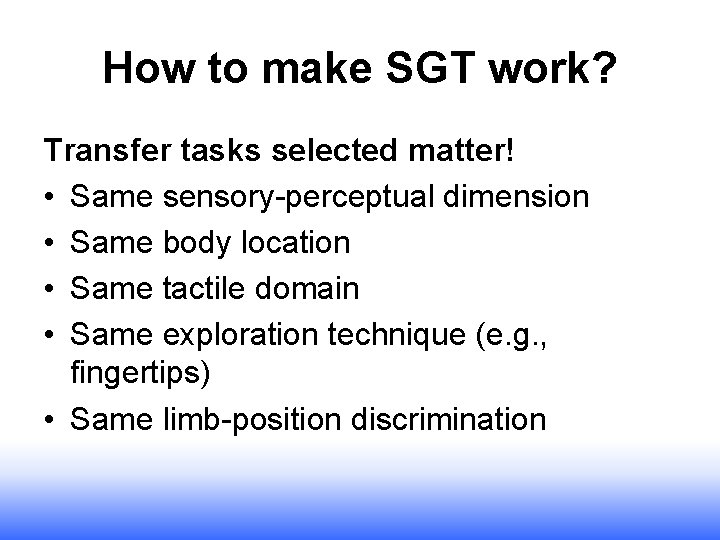
How to make SGT work? Transfer tasks selected matter! • Same sensory-perceptual dimension • Same body location • Same tactile domain • Same exploration technique (e. g. , fingertips) • Same limb-position discrimination
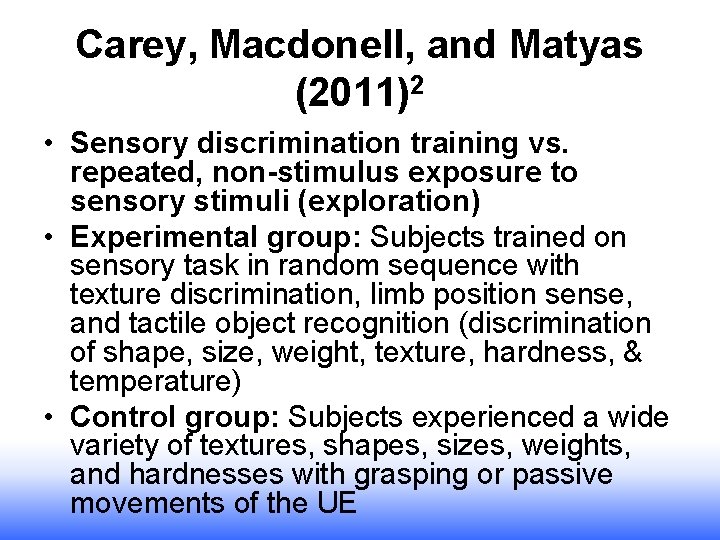
Carey, Macdonell, and Matyas (2011)2 • Sensory discrimination training vs. repeated, non-stimulus exposure to sensory stimuli (exploration) • Experimental group: Subjects trained on sensory task in random sequence with texture discrimination, limb position sense, and tactile object recognition (discrimination of shape, size, weight, texture, hardness, & temperature) • Control group: Subjects experienced a wide variety of textures, shapes, sizes, weights, and hardnesses with grasping or passive movements of the UE
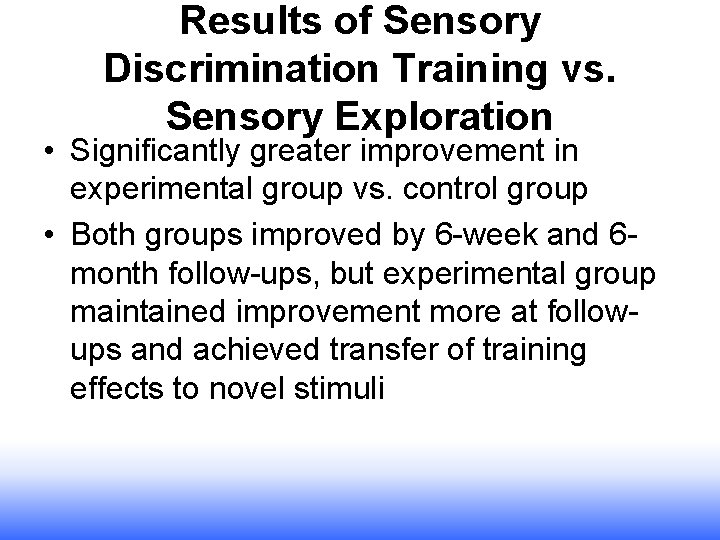
Results of Sensory Discrimination Training vs. Sensory Exploration • Significantly greater improvement in experimental group vs. control group • Both groups improved by 6 -week and 6 month follow-ups, but experimental group maintained improvement more at followups and achieved transfer of training effects to novel stimuli
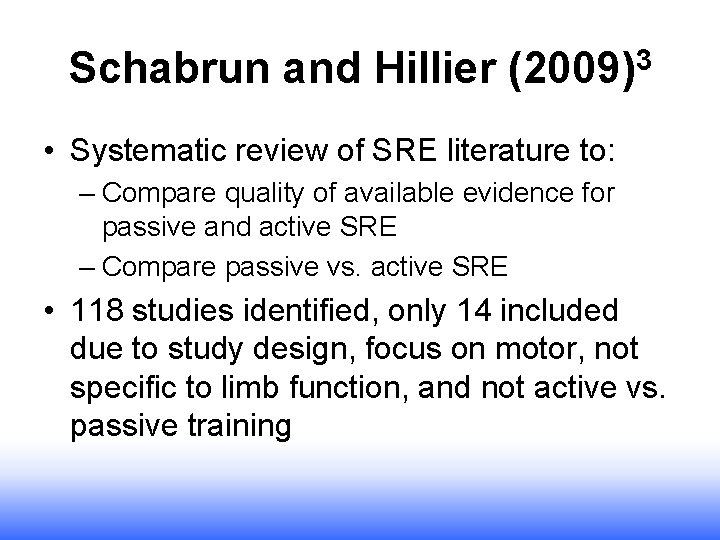
Schabrun and Hillier (2009)3 • Systematic review of SRE literature to: – Compare quality of available evidence for passive and active SRE – Compare passive vs. active SRE • 118 studies identified, only 14 included due to study design, focus on motor, not specific to limb function, and not active vs. passive training
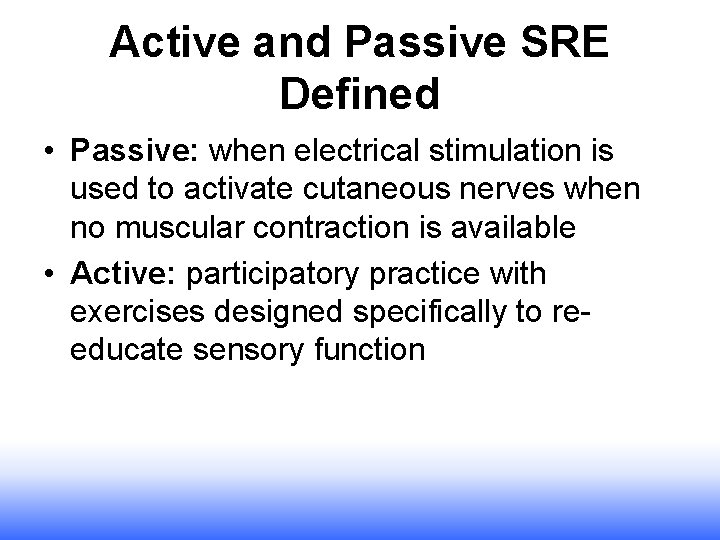
Active and Passive SRE Defined • Passive: when electrical stimulation is used to activate cutaneous nerves when no muscular contraction is available • Active: participatory practice with exercises designed specifically to reeducate sensory function
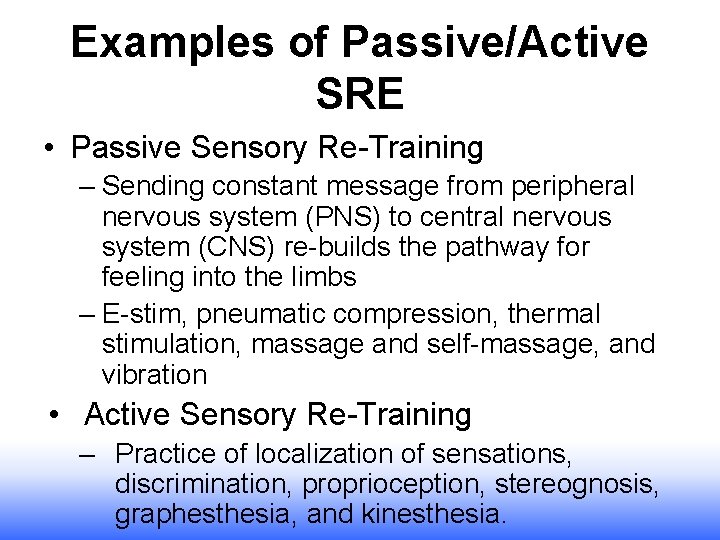
Examples of Passive/Active SRE • Passive Sensory Re-Training – Sending constant message from peripheral nervous system (PNS) to central nervous system (CNS) re-builds the pathway for feeling into the limbs – E-stim, pneumatic compression, thermal stimulation, massage and self-massage, and vibration • Active Sensory Re-Training – Practice of localization of sensations, discrimination, proprioception, stereognosis, graphesthesia, and kinesthesia.
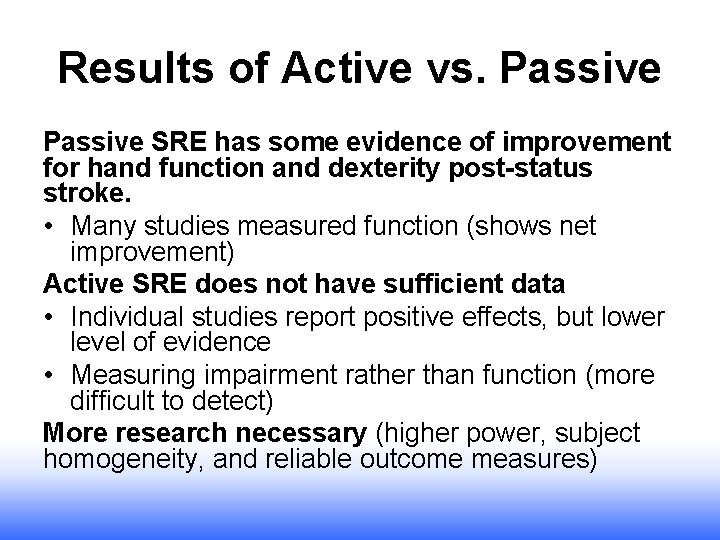
Results of Active vs. Passive SRE has some evidence of improvement for hand function and dexterity post-status stroke. • Many studies measured function (shows net improvement) Active SRE does not have sufficient data • Individual studies report positive effects, but lower level of evidence • Measuring impairment rather than function (more difficult to detect) More research necessary (higher power, subject homogeneity, and reliable outcome measures)
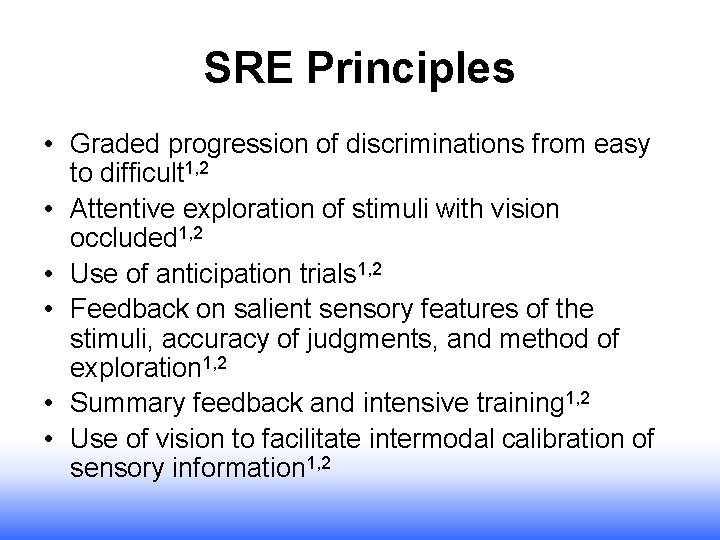
SRE Principles • Graded progression of discriminations from easy to difficult 1, 2 • Attentive exploration of stimuli with vision occluded 1, 2 • Use of anticipation trials 1, 2 • Feedback on salient sensory features of the stimuli, accuracy of judgments, and method of exploration 1, 2 • Summary feedback and intensive training 1, 2 • Use of vision to facilitate intermodal calibration of sensory information 1, 2
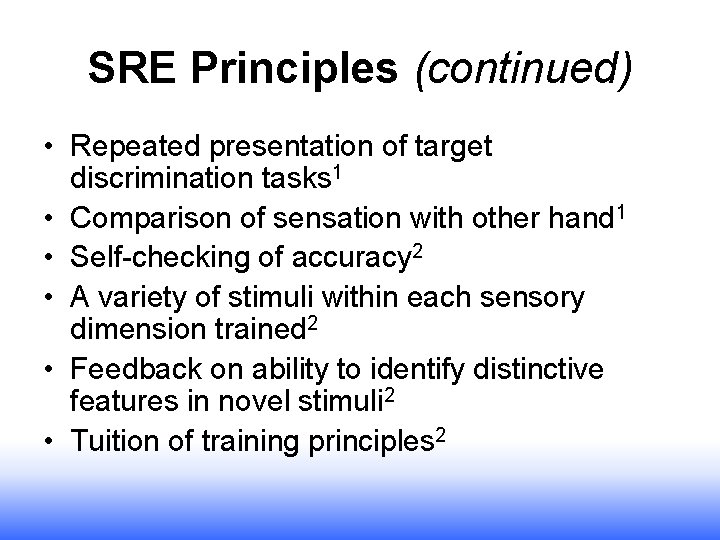
SRE Principles (continued) • Repeated presentation of target discrimination tasks 1 • Comparison of sensation with other hand 1 • Self-checking of accuracy 2 • A variety of stimuli within each sensory dimension trained 2 • Feedback on ability to identify distinctive features in novel stimuli 2 • Tuition of training principles 2
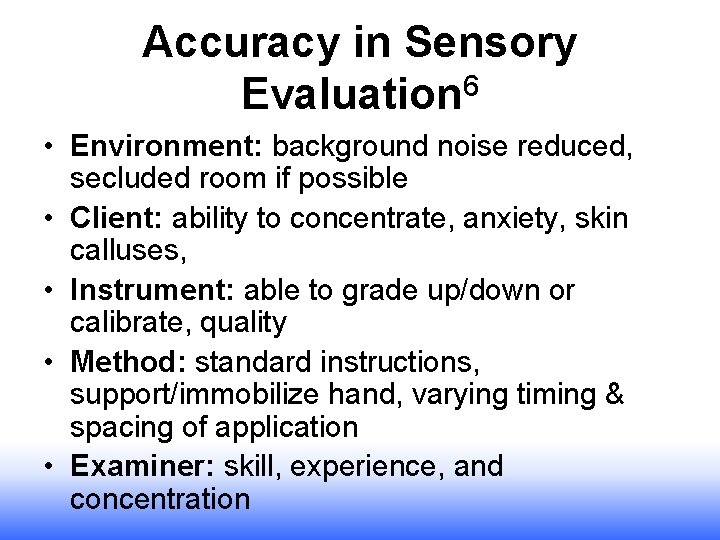
Accuracy in Sensory Evaluation 6 • Environment: background noise reduced, secluded room if possible • Client: ability to concentrate, anxiety, skin calluses, • Instrument: able to grade up/down or calibrate, quality • Method: standard instructions, support/immobilize hand, varying timing & spacing of application • Examiner: skill, experience, and concentration
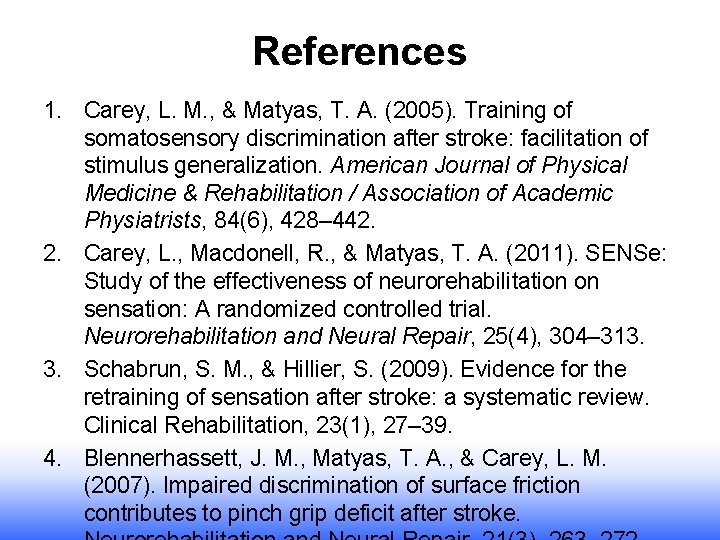
References 1. Carey, L. M. , & Matyas, T. A. (2005). Training of somatosensory discrimination after stroke: facilitation of stimulus generalization. American Journal of Physical Medicine & Rehabilitation / Association of Academic Physiatrists, 84(6), 428– 442. 2. Carey, L. , Macdonell, R. , & Matyas, T. A. (2011). SENSe: Study of the effectiveness of neurorehabilitation on sensation: A randomized controlled trial. Neurorehabilitation and Neural Repair, 25(4), 304– 313. 3. Schabrun, S. M. , & Hillier, S. (2009). Evidence for the retraining of sensation after stroke: a systematic review. Clinical Rehabilitation, 23(1), 27– 39. 4. Blennerhassett, J. M. , Matyas, T. A. , & Carey, L. M. (2007). Impaired discrimination of surface friction contributes to pinch grip deficit after stroke.
References 5. Pumpa, L. U. , Cahill, L. S. , & Carey, L. M. (2015). Somatosensory assessment and treatment after stroke: An evidence-practice gap. Australian Occupational Therapy Journal, 62(2), 93– 104. http: //doi. org/10. 1111/1440 -1630. 12170 6. Pedretti, L. , Pendleton, H. & Krohn, W. (2006). Pedretti's occupational therapy: Practice skills for physical dysfunction. St. Louis, Mo: Mosby/Elsevier.
Please contact me for references or if you have any questions. Annie Witte witte. 34@osu. edu Occupational Therapy Student The Ohio State University