
Annex I Methods Tools ICH Q 9 QUALITY

- Slides: 32
Annex I: Methods & Tools ICH Q 9 QUALITY RISK MANAGEMENT Annex I. 2 Failure Mode Effects Analysis (FMEA) prepared by some members of the ICH Q 9 EWG for example only; not an official policy/guidance July 2006, slide 1
Annex I: Methods & Tools ICH Q 9 QUALITY RISK MANAGEMENT I. 2: Failure Mode Effects Analysis (FMEA) (see IEC 60812) · Evaluation of potential failure modes for processes · The likely effect on outcomes and/or product performance · Once failure modes are established, risk reduction can be used to eliminate, reduce or control the potential failures · FMEA relies on process understanding · Summarize the important modes of failure, factors causing these failures and the likely effects of these failures How to perform? Break down large complex processes into manageable steps ICH Q 9 prepared by some members of the ICH Q 9 EWG for example only; not an official policy/guidance July 2006, slide 2
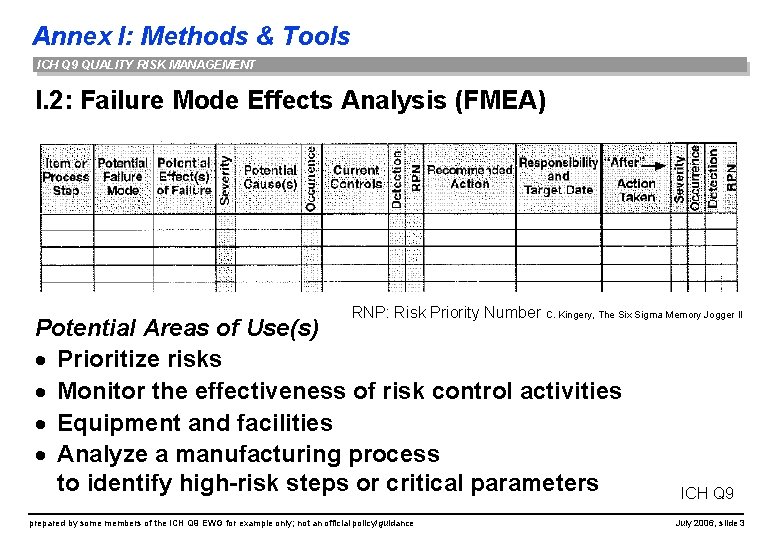
Annex I: Methods & Tools ICH Q 9 QUALITY RISK MANAGEMENT I. 2: Failure Mode Effects Analysis (FMEA) RNP: Risk Priority Number C. Kingery, The Six Sigma Memory Jogger II Potential Areas of Use(s) · Prioritize risks · Monitor the effectiveness of risk control activities · Equipment and facilities · Analyze a manufacturing process to identify high-risk steps or critical parameters prepared by some members of the ICH Q 9 EWG for example only; not an official policy/guidance ICH Q 9 July 2006, slide 3
Annex I: Methods & Tools ICH Q 9 QUALITY RISK MANAGEMENT EXAMPLE I. 2: Failure Mode Effects Analysis (FMEA) How to perform? 1. Establish a team 2. Identify the known and potential failure modes: Develop lists of known problems and brainstorm other potentials… e. g. > Product not meeting specification > Process not meeting yield requirements > Malfunctioning equipment > Software problems Newly identified failure modes should be added at any time prepared by some members of the ICH Q 9 EWG for example only; not an official policy/guidance July 2006, slide 4
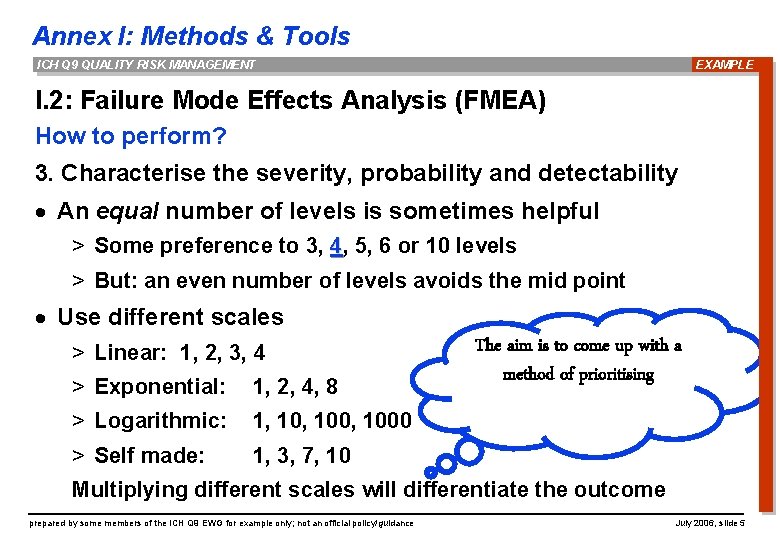
Annex I: Methods & Tools ICH Q 9 QUALITY RISK MANAGEMENT EXAMPLE I. 2: Failure Mode Effects Analysis (FMEA) How to perform? 3. Characterise the severity, probability and detectability · An equal number of levels is sometimes helpful > Some preference to 3, 4, 5, 6 or 10 levels > But: an even number of levels avoids the mid point · Use different scales > Linear: 1, 2, 3, 4 > Exponential: 1, 2, 4, 8 > Logarithmic: 1, 100, 1000 > Self made: 1, 3, 7, 10 The aim is to come up with a method of prioritising Multiplying different scales will differentiate the outcome prepared by some members of the ICH Q 9 EWG for example only; not an official policy/guidance July 2006, slide 5
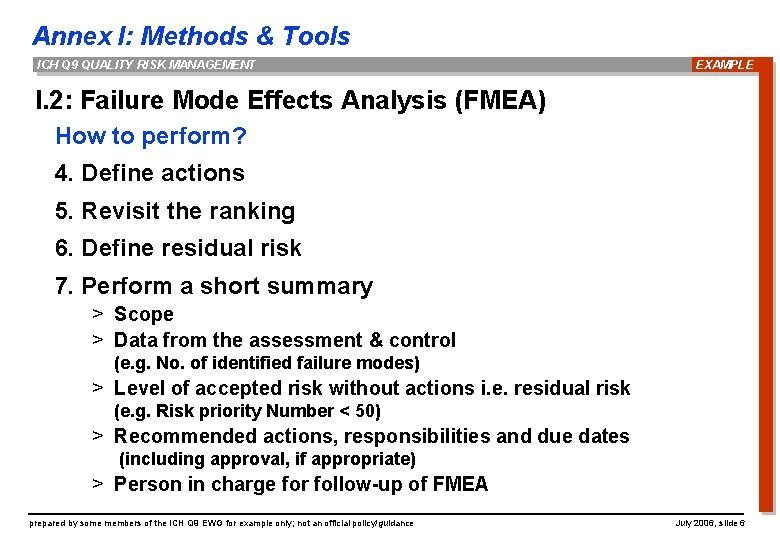
Annex I: Methods & Tools ICH Q 9 QUALITY RISK MANAGEMENT EXAMPLE I. 2: Failure Mode Effects Analysis (FMEA) How to perform? 4. Define actions 5. Revisit the ranking 6. Define residual risk 7. Perform a short summary > Scope > Data from the assessment & control (e. g. No. of identified failure modes) > Level of accepted risk without actions i. e. residual risk (e. g. Risk priority Number < 50) > Recommended actions, responsibilities and due dates (including approval, if appropriate) > Person in charge for follow-up of FMEA prepared by some members of the ICH Q 9 EWG for example only; not an official policy/guidance July 2006, slide 6
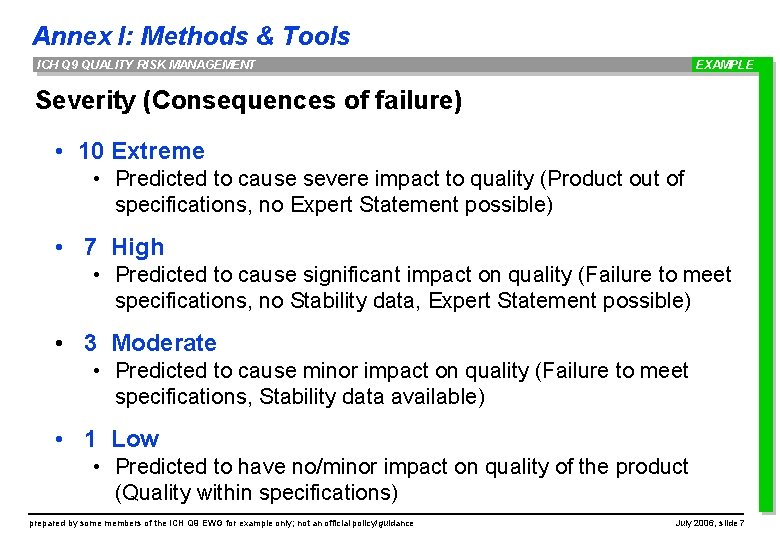
Annex I: Methods & Tools ICH Q 9 QUALITY RISK MANAGEMENT EXAMPLE Severity (Consequences of failure) • 10 Extreme • Predicted to cause severe impact to quality (Product out of specifications, no Expert Statement possible) • 7 High • Predicted to cause significant impact on quality (Failure to meet specifications, no Stability data, Expert Statement possible) • 3 Moderate • Predicted to cause minor impact on quality (Failure to meet specifications, Stability data available) • 1 Low • Predicted to have no/minor impact on quality of the product (Quality within specifications) prepared by some members of the ICH Q 9 EWG for example only; not an official policy/guidance July 2006, slide 7
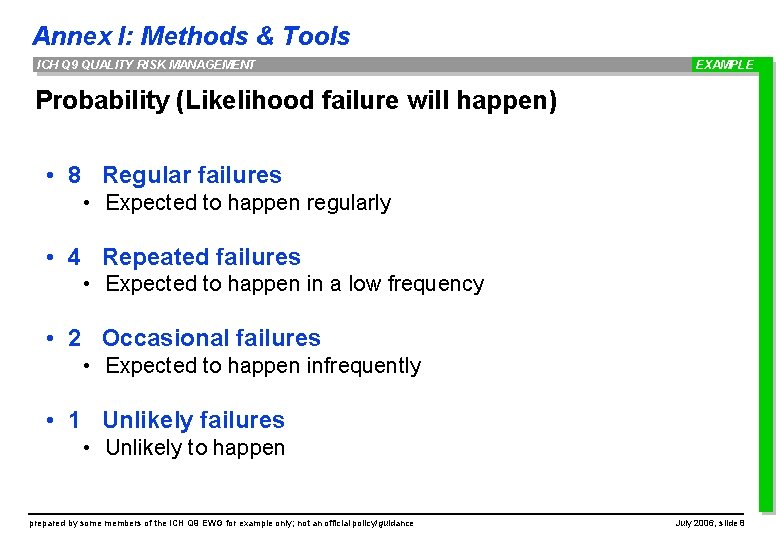
Annex I: Methods & Tools ICH Q 9 QUALITY RISK MANAGEMENT EXAMPLE Probability (Likelihood failure will happen) • 8 Regular failures • Expected to happen regularly • 4 Repeated failures • Expected to happen in a low frequency • 2 Occasional failures • Expected to happen infrequently • 1 Unlikely failures • Unlikely to happen prepared by some members of the ICH Q 9 EWG for example only; not an official policy/guidance July 2006, slide 8
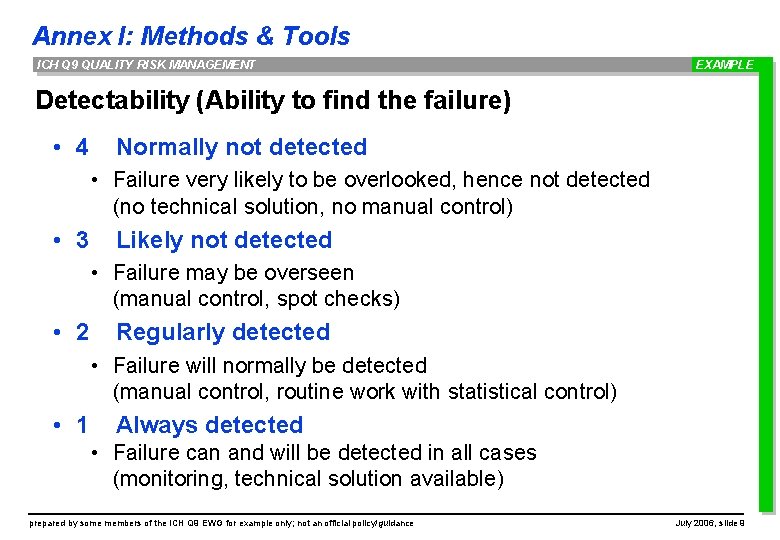
Annex I: Methods & Tools ICH Q 9 QUALITY RISK MANAGEMENT EXAMPLE Detectability (Ability to find the failure) • 4 Normally not detected • Failure very likely to be overlooked, hence not detected (no technical solution, no manual control) • 3 Likely not detected • Failure may be overseen (manual control, spot checks) • 2 Regularly detected • Failure will normally be detected (manual control, routine work with statistical control) • 1 Always detected • Failure can and will be detected in all cases (monitoring, technical solution available) prepared by some members of the ICH Q 9 EWG for example only; not an official policy/guidance July 2006, slide 9
Annex I: Methods & Tools ICH Q 9 QUALITY RISK MANAGEMENT EXAMPLE FMEA: Quantitation of Risk : Severity 10 Dangerously High Failure could lead to death or permanent injury to the customer. Financial: >$1, 000 9 Extremely high Failure could lead to injury to the customer. Failure would create non-compliance with registered specifications. Failure likely to lead to recall. Financial: $1, 000 8 Very High Failure could lead to adverse reaction for customer. Failure would create noncompliance with GMP regulations or product registrations. Failure possible to lead to recall. Financial: $500, 000 7 High Failure leads to customer percept ion of safety issue. Failure renders individual unit(s) unusable. Failure causes a high degree of customer dissatisfaction. Recall for business reasons possible but Authority required recall unlikely. Financial: $100, 000 6 Moderate Failure causes a high degree of customer dissatisfaction and numerous complaints. Failure unlikely to lead to recall. Financial: $50, 000 5 Low Failure likely to cause isolated customer complaints. Financial: $10, 000 4 Very Low 3 Minor 2 Very Minor 1 None Failure relates to non-dosage form issues (like minor packaging problems) and can be easily overcome by the customer. Financial: $5, 000 Failure could be noticed by the customer but is unlikely to be perceived as significant enough to warrant a complaint. Failure not readily apparent to the customer. Financial: <$1, 000 Failure would not be noticeable to the customer. Financial: none Dr. Gary Harbour, Pfizer prepared by some members of the ICH Q 9 EWG for example only; not an official policy/guidance July 2006, slide 10
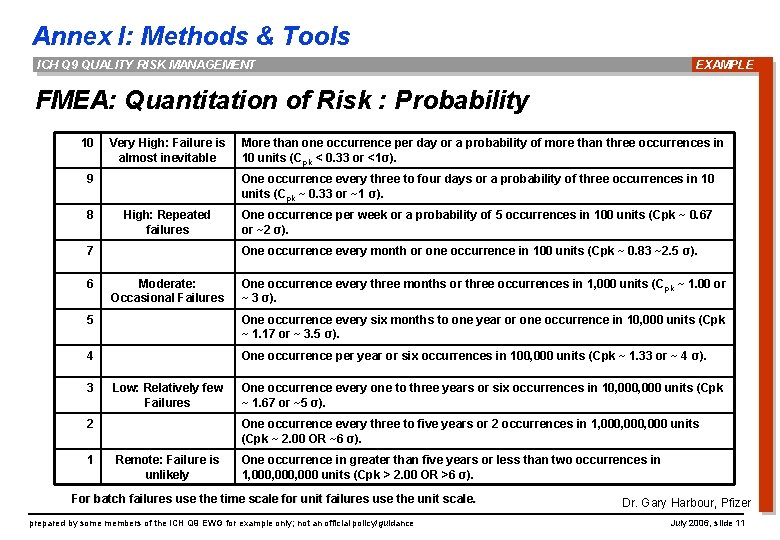
Annex I: Methods & Tools ICH Q 9 QUALITY RISK MANAGEMENT EXAMPLE FMEA: Quantitation of Risk : Probability 10 Very High: Failure is almost inevitable More than one occurrence per day or a probability of more than three occurrences in 10 units (Cpk < 0. 33 or <1σ). 9 One occurrence every three to four days or a probability of three occurrences in 10 units (Cpk ~ 0. 33 or ~1 σ). 8 High: Repeated failures One occurrence per week or a probability of 5 occurrences in 100 units (Cpk ~ 0. 67 or ~2 σ). 7 6 Moderate: Occasional Failures One occurrence every three months or three occurrences in 1, 000 units (Cpk ~ 1. 00 or ~ 3 σ). 5 One occurrence every six months to one year or one occurrence in 10, 000 units (Cpk ~ 1. 17 or ~ 3. 5 σ). 4 One occurrence per year or six occurrences in 100, 000 units (Cpk ~ 1. 33 or ~ 4 σ). 3 Low: Relatively few Failures 2 1 Remote: Failure is unlikely One occurrence every month or one occurrence in 100 units (Cpk ~ 0. 83 ~2. 5 σ). One occurrence every one to three years or six occurrences in 10, 000 units (Cpk ~ 1. 67 or ~5 σ). One occurrence every three to five years or 2 occurrences in 1, 000, 000 units (Cpk ~ 2. 00 OR ~6 σ). One occurrence in greater than five years or less than two occurrences in 1, 000, 000 units (Cpk > 2. 00 OR >6 σ). For batch failures use the time scale for unit failures use the unit scale. prepared by some members of the ICH Q 9 EWG for example only; not an official policy/guidance Dr. Gary Harbour, Pfizer July 2006, slide 11
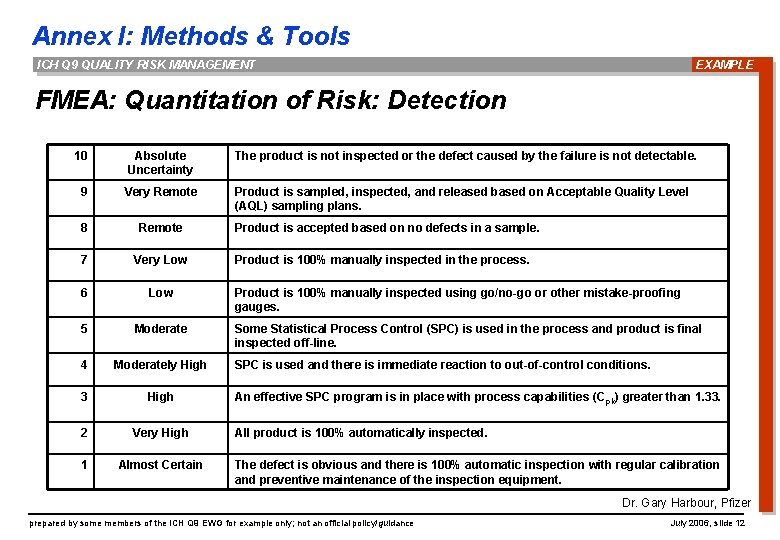
Annex I: Methods & Tools ICH Q 9 QUALITY RISK MANAGEMENT EXAMPLE FMEA: Quantitation of Risk: Detection 10 Absolute Uncertainty The product is not inspected or the defect caused by the failure is not detectable. 9 Very Remote Product is sampled, inspected, and released based on Acceptable Quality Level (AQL) sampling plans. 8 Remote 7 Very Low 6 Low 5 Moderate 4 Moderately High 3 High 2 Very High 1 Almost Certain Product is accepted based on no defects in a sample. Product is 100% manually inspected in the process. Product is 100% manually inspected using go/no-go or other mistake-proofing gauges. Some Statistical Process Control (SPC) is used in the process and product is final inspected off-line. SPC is used and there is immediate reaction to out-of-control conditions. An effective SPC program is in place with process capabilities (C pk) greater than 1. 33. All product is 100% automatically inspected. The defect is obvious and there is 100% automatic inspection with regular calibration and preventive maintenance of the inspection equipment. Dr. Gary Harbour, Pfizer prepared by some members of the ICH Q 9 EWG for example only; not an official policy/guidance July 2006, slide 12
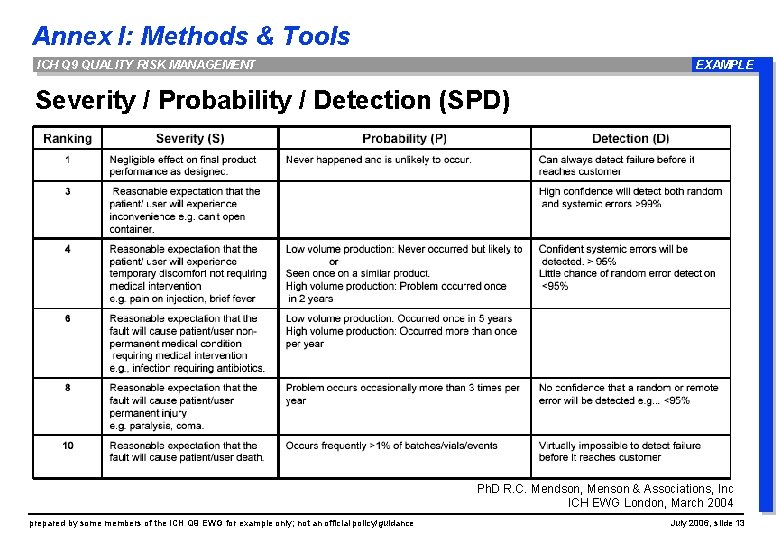
Annex I: Methods & Tools ICH Q 9 QUALITY RISK MANAGEMENT EXAMPLE Severity / Probability / Detection (SPD) Ph. D R. C. Mendson, Menson & Associations, Inc ICH EWG London, March 2004 prepared by some members of the ICH Q 9 EWG for example only; not an official policy/guidance July 2006, slide 13
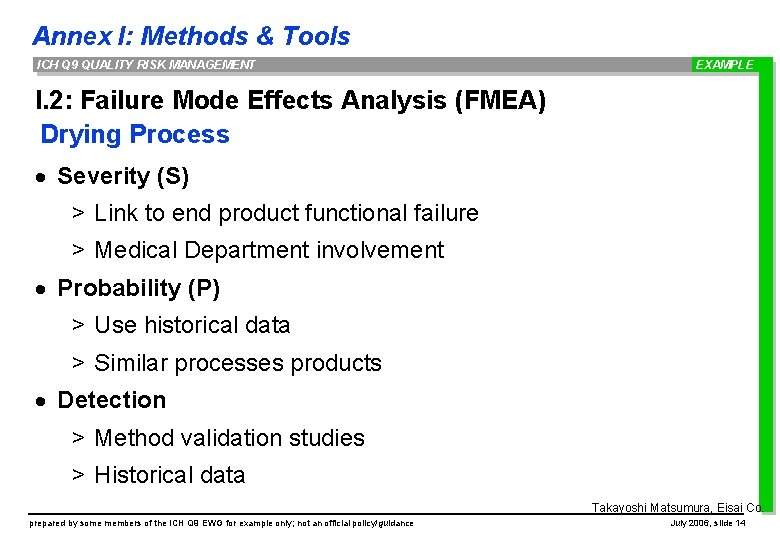
Annex I: Methods & Tools ICH Q 9 QUALITY RISK MANAGEMENT EXAMPLE I. 2: Failure Mode Effects Analysis (FMEA) Drying Process · Severity (S) > Link to end product functional failure > Medical Department involvement · Probability (P) > Use historical data > Similar processes products · Detection > Method validation studies > Historical data Takayoshi Matsumura, Eisai Co. prepared by some members of the ICH Q 9 EWG for example only; not an official policy/guidance July 2006, slide 14
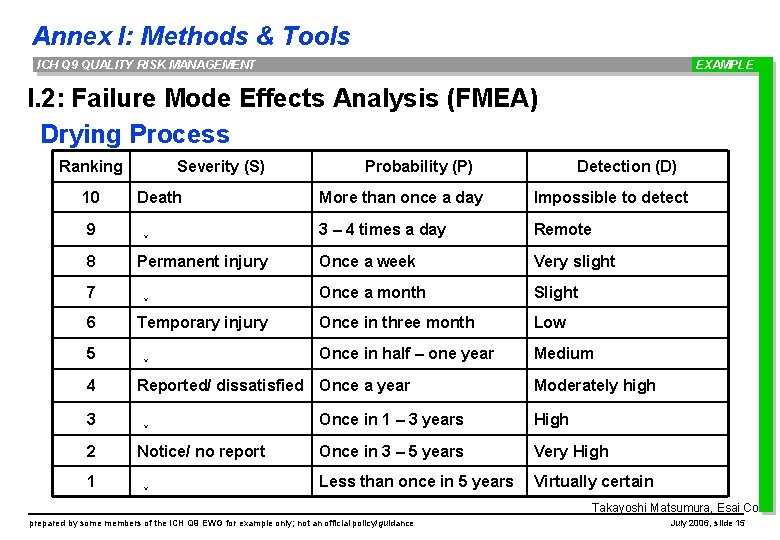
Annex I: Methods & Tools ICH Q 9 QUALITY RISK MANAGEMENT EXAMPLE I. 2: Failure Mode Effects Analysis (FMEA) Drying Process Ranking Severity (S) Probability (P) Detection (D) 10 Death More than once a day Impossible to detect 9 ↓ 3 – 4 times a day Remote 8 Permanent injury Once a week Very slight 7 ↓ Once a month Slight 6 Temporary injury Once in three month Low 5 ↓ Once in half – one year Medium 4 Reported/ dissatisfied Once a year Moderately high 3 ↓ Once in 1 – 3 years High 2 Notice/ no report Once in 3 – 5 years Very High 1 ↓ Less than once in 5 years Virtually certain Takayoshi Matsumura, Esai Co prepared by some members of the ICH Q 9 EWG for example only; not an official policy/guidance July 2006, slide 15
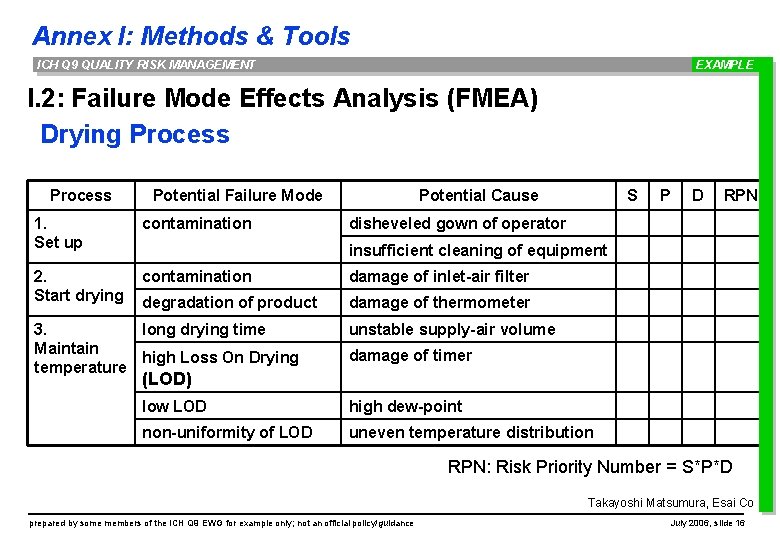
Annex I: Methods & Tools ICH Q 9 QUALITY RISK MANAGEMENT EXAMPLE I. 2: Failure Mode Effects Analysis (FMEA) Drying Process Potential Failure Mode Potential Cause 1. Set up contamination 2. Start drying contamination damage of inlet-air filter degradation of product damage of thermometer S P D RPN disheveled gown of operator insufficient cleaning of equipment 3. long drying time Maintain high Loss On Drying temperature unstable supply-air volume damage of timer (LOD) low LOD high dew-point non-uniformity of LOD uneven temperature distribution RPN: Risk Priority Number = S*P*D Takayoshi Matsumura, Esai Co prepared by some members of the ICH Q 9 EWG for example only; not an official policy/guidance July 2006, slide 16
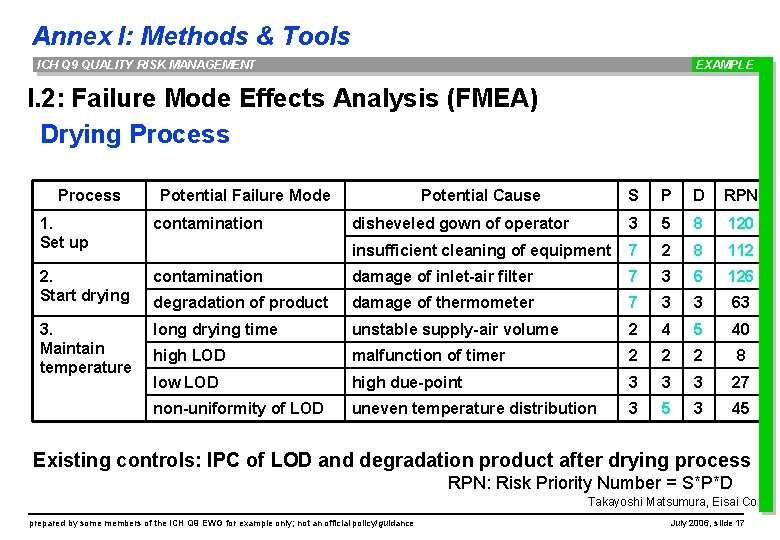
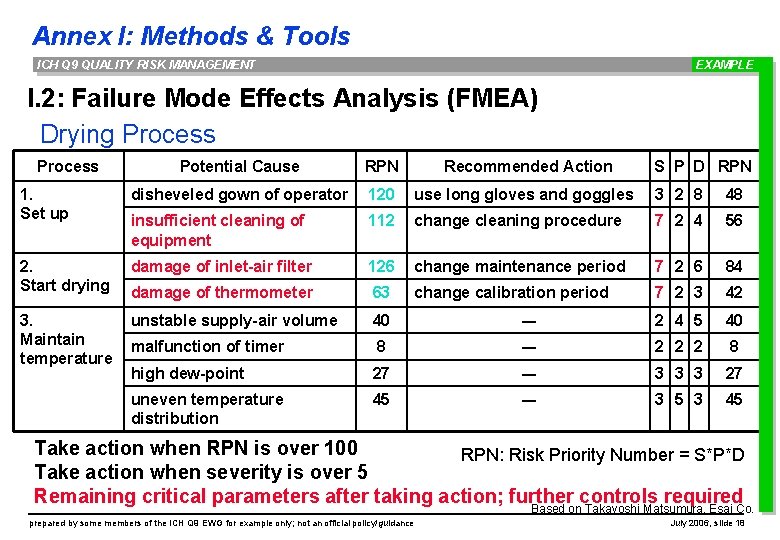
Annex I: Methods & Tools ICH Q 9 QUALITY RISK MANAGEMENT EXAMPLE I. 2: Failure Mode Effects Analysis (FMEA) Drying Process Potential Failure Mode Potential Cause S P D RPN disheveled gown of operator 3 5 8 120 insufficient cleaning of equipment 7 2 8 112 1. Set up contamination 2. Start drying contamination damage of inlet-air filter 7 3 6 126 degradation of product damage of thermometer 7 3 3 63 3. Maintain temperature long drying time unstable supply-air volume 2 4 5 40 high LOD malfunction of timer 2 2 2 8 low LOD high due-point 3 3 3 27 non-uniformity of LOD uneven temperature distribution 3 5 3 45 Existing controls: IPC of LOD and degradation product after drying process RPN: Risk Priority Number = S*P*D Takayoshi Matsumura, Eisai Co prepared by some members of the ICH Q 9 EWG for example only; not an official policy/guidance July 2006, slide 17
Annex I: Methods & Tools ICH Q 9 QUALITY RISK MANAGEMENT EXAMPLE I. 2: Failure Mode Effects Analysis (FMEA) Drying Process Potential Cause RPN Recommended Action S P D RPN 1. Set up disheveled gown of operator 120 use long gloves and goggles 3 2 8 48 insufficient cleaning of equipment 112 change cleaning procedure 7 2 4 56 2. Start drying damage of inlet-air filter 126 change maintenance period 7 2 6 84 damage of thermometer 63 change calibration period 7 2 3 42 3. Maintain temperature unstable supply-air volume 40 ― 2 4 5 40 malfunction of timer 8 ― 2 2 2 8 high dew-point 27 ― 3 3 3 27 uneven temperature distribution 45 ― 3 5 3 45 Take action when RPN is over 100 RPN: Risk Priority Number = S*P*D Take action when severity is over 5 Remaining critical parameters after taking action; further controls required Based on Takayoshi Matsumura, Esai Co. prepared by some members of the ICH Q 9 EWG for example only; not an official policy/guidance July 2006, slide 18
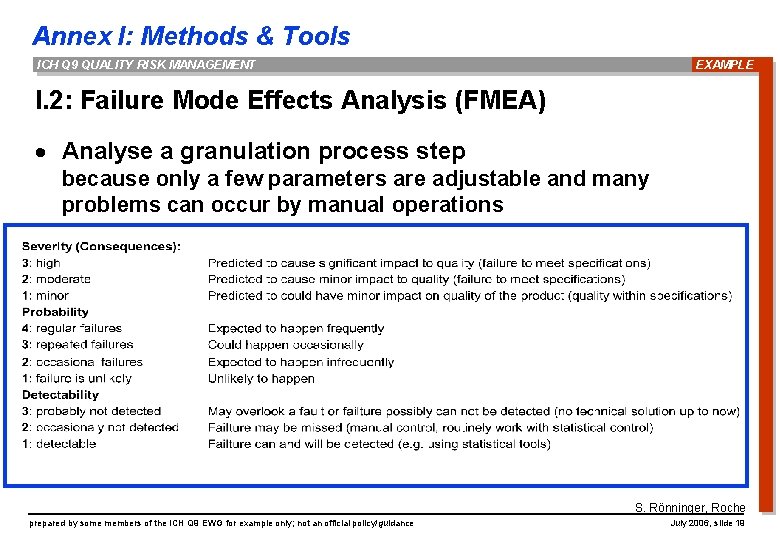
Annex I: Methods & Tools ICH Q 9 QUALITY RISK MANAGEMENT EXAMPLE I. 2: Failure Mode Effects Analysis (FMEA) · Analyse a granulation process step because only a few parameters are adjustable and many problems can occur by manual operations S. Rönninger, Roche prepared by some members of the ICH Q 9 EWG for example only; not an official policy/guidance July 2006, slide 19
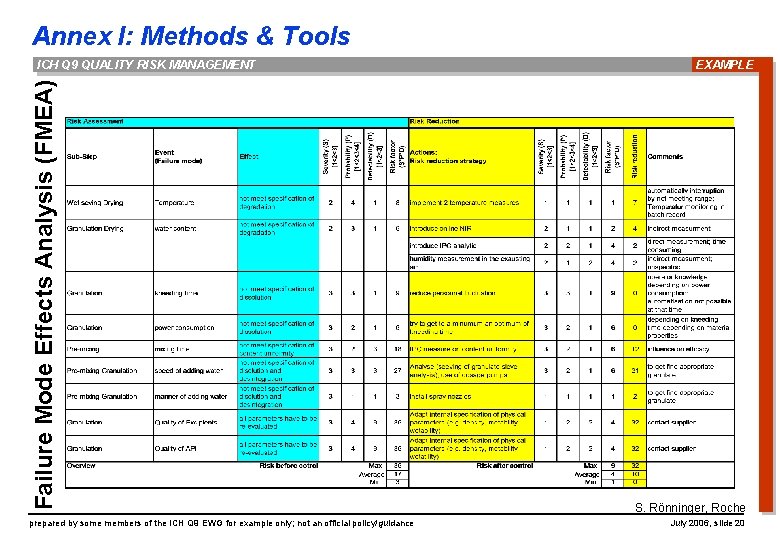
Annex I: Methods & Tools Failure Mode Effects Analysis (FMEA) ICH Q 9 QUALITY RISK MANAGEMENT prepared by some members of the ICH Q 9 EWG for example only; not an official policy/guidance EXAMPLE S. Rönninger, Roche July 2006, slide 20
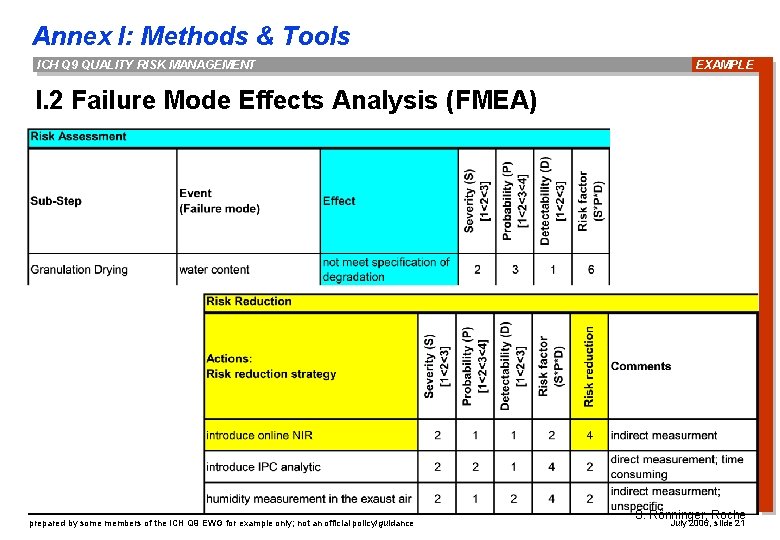
Annex I: Methods & Tools ICH Q 9 QUALITY RISK MANAGEMENT EXAMPLE I. 2 Failure Mode Effects Analysis (FMEA) prepared by some members of the ICH Q 9 EWG for example only; not an official policy/guidance S. Rönninger, Roche July 2006, slide 21
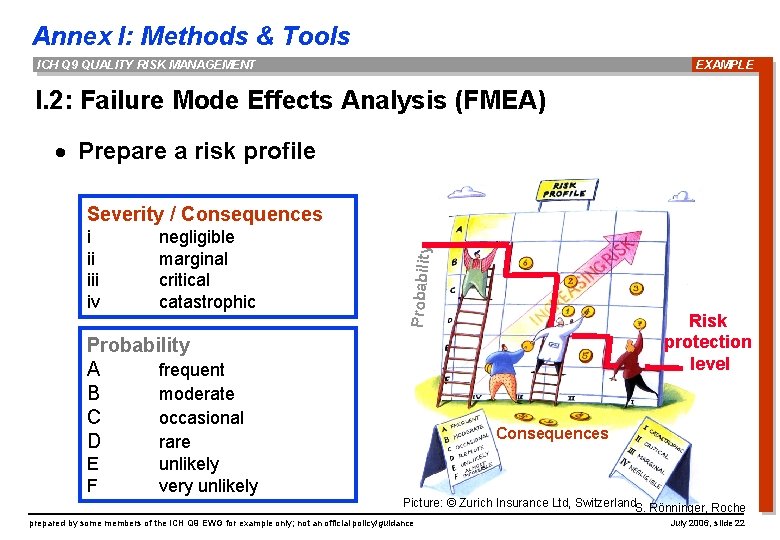
Annex I: Methods & Tools ICH Q 9 QUALITY RISK MANAGEMENT EXAMPLE I. 2: Failure Mode Effects Analysis (FMEA) · Prepare a risk profile i ii iv negligible marginal critical catastrophic Probability Severity / Consequences Probability A frequent B moderate C occasional D rare E F Risk protection level Consequences unlikely very unlikely Picture: © Zurich Insurance Ltd, Switzerland. S. Rönninger, Roche prepared by some members of the ICH Q 9 EWG for example only; not an official policy/guidance July 2006, slide 22
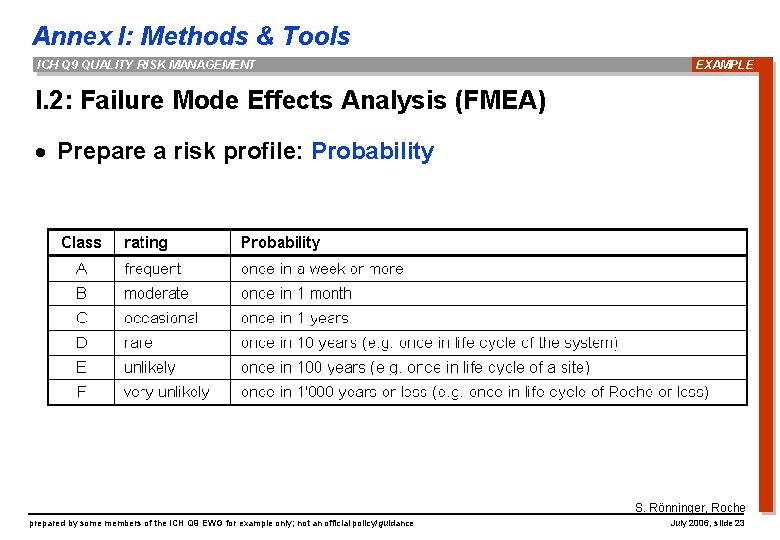
Annex I: Methods & Tools ICH Q 9 QUALITY RISK MANAGEMENT EXAMPLE I. 2: Failure Mode Effects Analysis (FMEA) · Prepare a risk profile: Probability S. Rönninger, Roche prepared by some members of the ICH Q 9 EWG for example only; not an official policy/guidance July 2006, slide 23
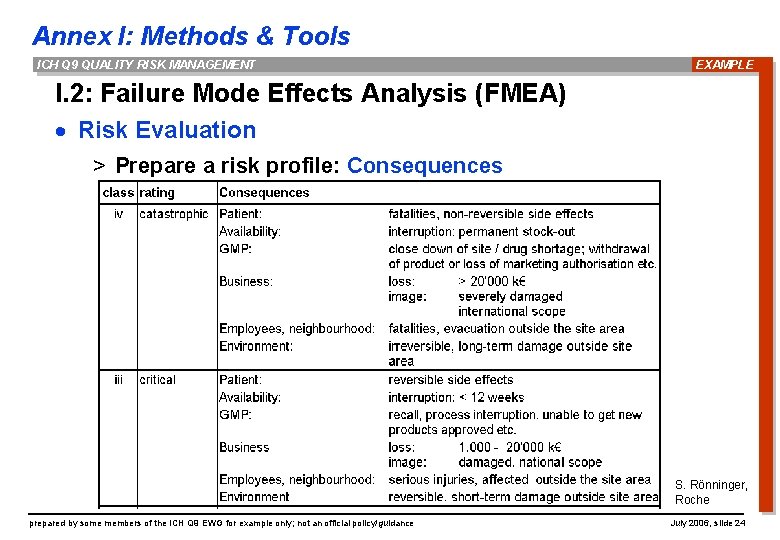
Annex I: Methods & Tools ICH Q 9 QUALITY RISK MANAGEMENT EXAMPLE I. 2: Failure Mode Effects Analysis (FMEA) · Risk Evaluation > Prepare a risk profile: Consequences S. Rönninger, Roche prepared by some members of the ICH Q 9 EWG for example only; not an official policy/guidance July 2006, slide 24
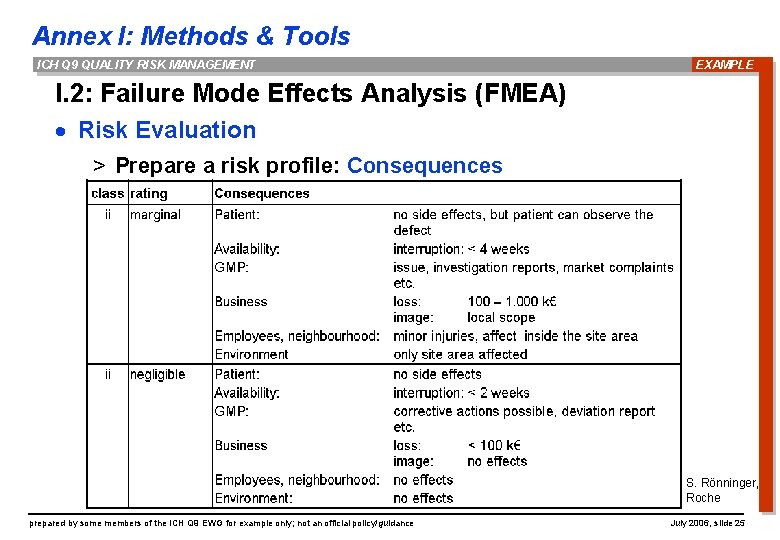
Annex I: Methods & Tools ICH Q 9 QUALITY RISK MANAGEMENT EXAMPLE I. 2: Failure Mode Effects Analysis (FMEA) · Risk Evaluation > Prepare a risk profile: Consequences S. Rönninger, Roche prepared by some members of the ICH Q 9 EWG for example only; not an official policy/guidance July 2006, slide 25
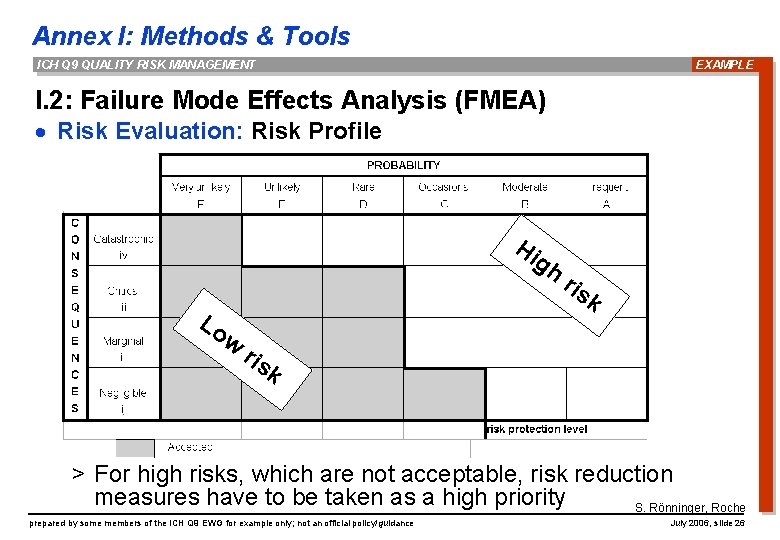
Annex I: Methods & Tools ICH Q 9 QUALITY RISK MANAGEMENT EXAMPLE I. 2: Failure Mode Effects Analysis (FMEA) · Risk Evaluation: Risk Profile Hi gh Lo ri sk w ri sk > For high risks, which are not acceptable, risk reduction measures have to be taken as a high priority S. Rönninger, Roche prepared by some members of the ICH Q 9 EWG for example only; not an official policy/guidance July 2006, slide 26
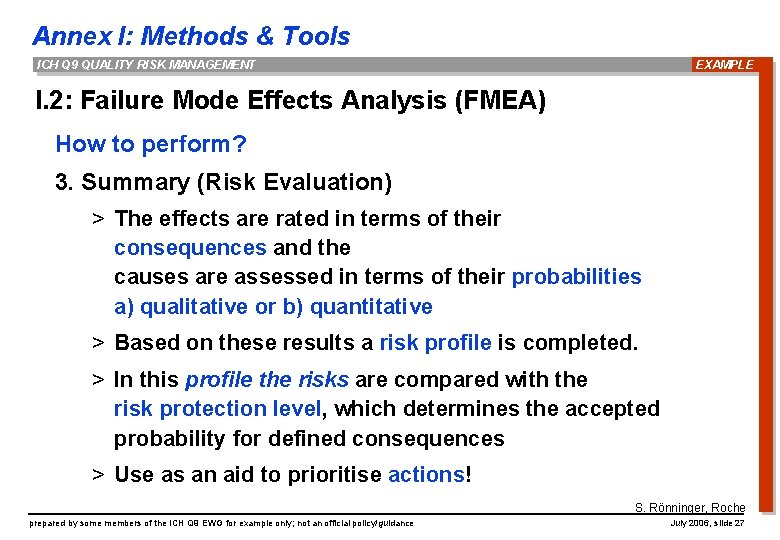
Annex I: Methods & Tools ICH Q 9 QUALITY RISK MANAGEMENT EXAMPLE I. 2: Failure Mode Effects Analysis (FMEA) How to perform? 3. Summary (Risk Evaluation) > The effects are rated in terms of their consequences and the causes are assessed in terms of their probabilities a) qualitative or b) quantitative > Based on these results a risk profile is completed. > In this profile the risks are compared with the risk protection level, which determines the accepted probability for defined consequences > Use as an aid to prioritise actions! S. Rönninger, Roche prepared by some members of the ICH Q 9 EWG for example only; not an official policy/guidance July 2006, slide 27
Annex I: Methods & Tools ICH Q 9 QUALITY RISK MANAGEMENT EXAMPLE I. 2: Failure Mode Effects Analysis (FMEA) · QRM for facilities, equipment and utilities Assess an existing compressed air system > Old approach: 60 “risks” should have been solved in detail > Initial RM-Approach: Ø Ø 4 sessions in total 16 people 153 potential risks discussed 34 Cases beyond the action limit 30 Corrective actions have been performed (- 50%) > Review of RM-Approach after inspection Ø Did you consider this hazard? - yes: - yes, but - no: show and explain rationale start discussion for a yes/no decision revisit initial risk assessment prepared by some members of the ICH Q 9 EWG for example only; not an official policy/guidance July 2006, slide 28
Annex I: Methods & Tools ICH Q 9 QUALITY RISK MANAGEMENT EXAMPLE I. 2: Failure Mode Effects Analysis (FMEA) Experiences · Ease of applicability > Prospective tool > Good tool for operators to use > Can be used to identify critical steps for validation > More objective than Fault Tree Analysis > Covers minor risks prepared by some members of the ICH Q 9 EWG for example only; not an official policy/guidance July 2006, slide 29
Annex I: Methods & Tools ICH Q 9 QUALITY RISK MANAGEMENT EXAMPLE I. 2: Failure Mode Effects Analysis (FMEA) Experiences · Limitations > > > Can be time and resource consuming Mitigation plans must be followed up Not a good tool for analysis of complex systems Compound failure effects cannot be analyzed Incorporating all possible factors requires a thorough knowledge of characteristics and performance of the different components of the system > Successful completion requires expertise, experience and good team skills > Dealing with data redundancies can be difficult Based on Takayoshi Matsumura, Esai Co prepared by some members of the ICH Q 9 EWG for example only; not an official policy/guidance July 2006, slide 30
Annex I: Methods & Tools ICH Q 9 QUALITY RISK MANAGEMENT Annex I. 3 Failure Mode, Effects and Criticality Analysis (FMECA) prepared by some members of the ICH Q 9 EWG for example only; not an official policy/guidance July 2006, slide 31
Annex I: Methods & Tools ICH Q 9 QUALITY RISK MANAGEMENT I. 3: Failure Mode, Effects and Criticality Analysis (FMECA) (IEC 60812) · Extended to incorporate an investigation of the degree of severity of the consequences, their respective probabilities of occurrence and their detectability · The product or process specifications should be established · Identify places where additional preventive actions may be necessary to minimize risks Potential Areas of Use(s) · Utilized on failures and risks associated with manufacturing ICH Q 9 processes prepared by some members of the ICH Q 9 EWG for example only; not an official policy/guidance July 2006, slide 32