
Annex C Guide Summary Outputs Strategic Operational Plan

- Slides: 6
Annex C (Guide): Summary Outputs: Strategic Operational Plan The following summary slides are derived from Zimbabwe’s National Condom strategic planning process. They present interventions addressing strategic constraints and priorities, and supporting outputs. Slides have been edited.
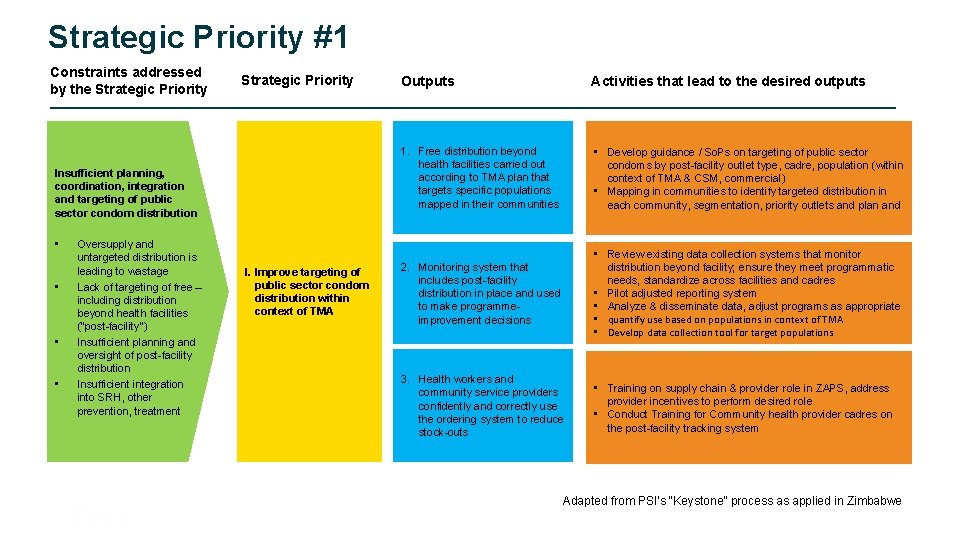
Strategic Priority #1 Constraints addressed by the Strategic Priority Insufficient planning, coordination, integration and targeting of public sector condom distribution • • Oversupply and untargeted distribution is leading to wastage Lack of targeting of free – including distribution beyond health facilities (“post-facility”) Insufficient planning and oversight of post-facility distribution Insufficient integration into SRH, other prevention, treatment I. Improve targeting of public sector condom distribution within context of TMA Outputs Activities that lead to the desired outputs 1. Free distribution beyond health facilities carried out according to TMA plan that targets specific populations mapped in their communities • Develop guidance / So. Ps on targeting of public sector condoms by post-facility outlet type, cadre, population (within context of TMA & CSM, commercial) • Mapping in communities to identify targeted distribution in each community, segmentation, priority outlets and plan and 2. Monitoring system that includes post-facility distribution in place and used to make programmeimprovement decisions • Review existing data collection systems that monitor distribution beyond facility; ensure they meet programmatic needs, standardize across facilities and cadres • Pilot adjusted reporting system • Analyze & disseminate data, adjust programs as appropriate • quantify use based on populations in context of TMA • Develop data collection tool for target populations 3. Health workers and community service providers confidently and correctly use the ordering system to reduce stock-outs • Training on supply chain & provider role in ZAPS, address provider incentives to perform desired role • Conduct Training for Community health provider cadres on the post-facility tracking system Adapted from PSI’s “Keystone” process as applied in Zimbabwe
Strategic Priority #2 Constraints addressed by the Strategic Priority Inadequate demand creation, and insufficient segmentation of programs targeting prioritized populations • Youth, AGYW & young men, and KP (not adequately supported by peer education and other media) • Rural (poor coverage & reach) • Lack of standardized messaging & approach for each population (i. e. , standard operating procedures) II. Increase demand creation interventions with sufficient audience segmentation for AGYW, young men and KPs Outputs Activities that lead to the desired outputs 1. Population-specific, evidencebased demand creation strategies in place and used to increase reach and coverage of AGYW, young men, and KP § Create audience profiles for each of the priority populations § Develop target audience specific messages for the priority populations § Develop interventions to deliver the messages for both urban and rural populations § Implement demand creation initiatives § Monitor demand creation initiatives 2. Community service providers’ (all cadres) follow standard operating procedures and tool kits for targeted demand creation for priority pops and targeted distribution • Develop SOPs & supporting integrated training curriculum for community demand creation cadres for each priority population • Develop toolkit to standardize the community demand creation efforts specific to target groups • Create database of the community demand creation workers, identify To. Ts for each district • Training of To. Ts on condoms SOP including targeted condom distribution • Local trainings of community demand creation cadres in all districts • Monitoring of quality of message delivery by the community demand creation cadres Adapted from PSI’s “Keystone” process as applied in Zimbabwe
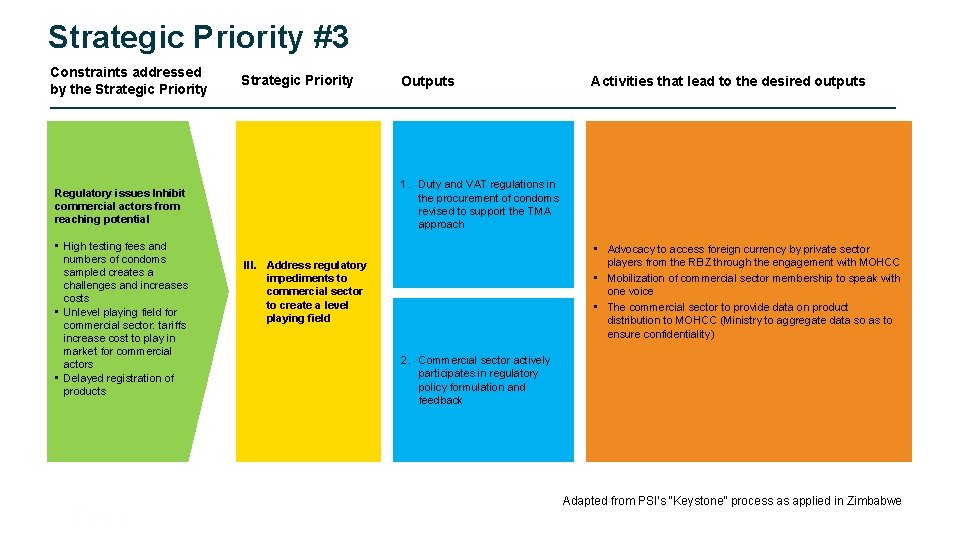
Strategic Priority #3 Constraints addressed by the Strategic Priority Activities that lead to the desired outputs 1. Duty and VAT regulations in the procurement of condoms revised to support the TMA approach Regulatory issues Inhibit commercial actors from reaching potential • High testing fees and numbers of condoms sampled creates a challenges and increases costs • Unlevel playing field for commercial sector: tariffs increase cost to play in market for commercial actors • Delayed registration of products Outputs • Advocacy to access foreign currency by private sector players from the RBZ through the engagement with MOHCC • Mobilization of commercial sector membership to speak with one voice • The commercial sector to provide data on product distribution to MOHCC (Ministry to aggregate data so as to ensure confidentiality) III. Address regulatory impediments to commercial sector to create a level playing field 2. Commercial sector actively participates in regulatory policy formulation and feedback Adapted from PSI’s “Keystone” process as applied in Zimbabwe
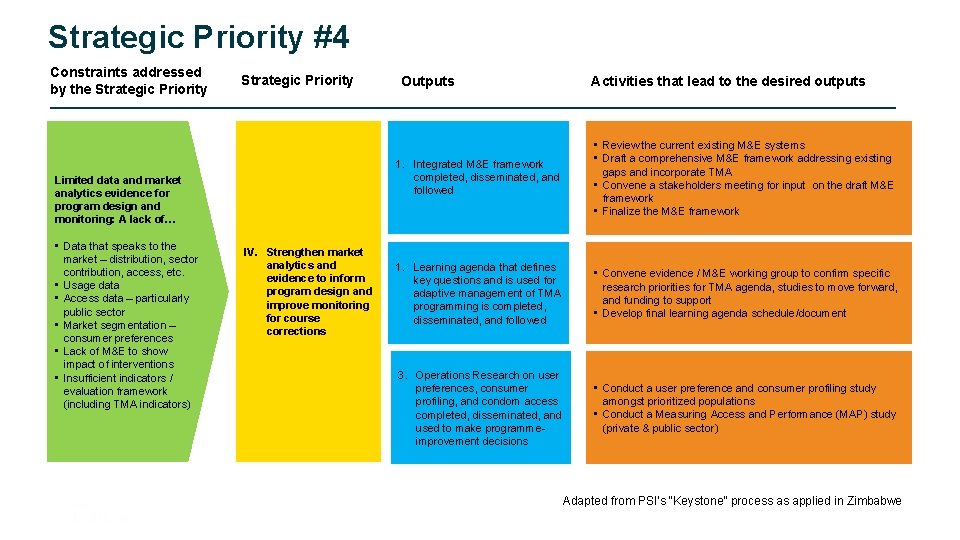
Strategic Priority #4 Constraints addressed by the Strategic Priority Limited data and market analytics evidence for program design and monitoring: A lack of… • Data that speaks to the market – distribution, sector contribution, access, etc. • Usage data • Access data – particularly public sector • Market segmentation – consumer preferences • Lack of M&E to show impact of interventions • Insufficient indicators / evaluation framework (including TMA indicators) IV. Strengthen market analytics and evidence to inform program design and improve monitoring for course corrections Outputs Activities that lead to the desired outputs 1. Integrated M&E framework completed, disseminated, and followed • Review the current existing M&E systems • Draft a comprehensive M&E framework addressing existing gaps and incorporate TMA • Convene a stakeholders meeting for input on the draft M&E framework • Finalize the M&E framework 1. Learning agenda that defines key questions and is used for adaptive management of TMA programming is completed, disseminated, and followed • Convene evidence / M&E working group to confirm specific research priorities for TMA agenda, studies to move forward, and funding to support • Develop final learning agenda schedule/document 3. Operations Research on user preferences, consumer profiling, and condom access completed, disseminated, and used to make programmeimprovement decisions • Conduct a user preference and consumer profiling study amongst prioritized populations • Conduct a Measuring Access and Performance (MAP) study (private & public sector) Adapted from PSI’s “Keystone” process as applied in Zimbabwe
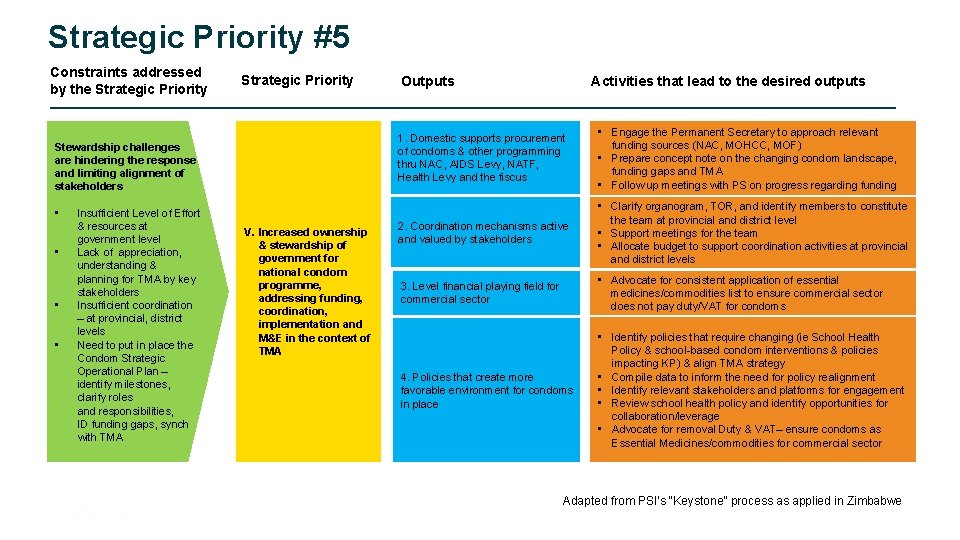
Strategic Priority #5 Constraints addressed by the Strategic Priority Stewardship challenges are hindering the response and limiting alignment of stakeholders • • Insufficient Level of Effort & resources at government level Lack of appreciation, understanding & planning for TMA by key stakeholders Insufficient coordination – at provincial, district levels Need to put in place the Condom Strategic Operational Plan – identify milestones, clarify roles and responsibilities, ID funding gaps, synch with TMA V. Increased ownership & stewardship of government for national condom programme, addressing funding, coordination, implementation and M&E in the context of TMA Activities that lead to the desired outputs Outputs 1. Domestic supports procurement of condoms & other programming thru NAC, AIDS Levy, NATF, Health Levy and the fiscus • Engage the Permanent Secretary to approach relevant funding sources (NAC, MOHCC, MOF) • Prepare concept note on the changing condom landscape, funding gaps and TMA • Follow up meetings with PS on progress regarding funding 2. Coordination mechanisms active and valued by stakeholders • Clarify organogram, TOR, and identify members to constitute the team at provincial and district level • Support meetings for the team • Allocate budget to support coordination activities at provincial and district levels 3. Level financial playing field for commercial sector • Advocate for consistent application of essential medicines/commodities list to ensure commercial sector does not pay duty/VAT for condoms 4. Policies that create more favorable environment for condoms in place • Identify policies that require changing (ie School Health Policy & school-based condom interventions & policies impacting KP) & align TMA strategy • Compile data to inform the need for policy realignment • Identify relevant stakeholders and platforms for engagement • Review school health policy and identify opportunities for collaboration/leverage • Advocate for removal Duty & VAT– ensure condoms as Essential Medicines/commodities for commercial sector Adapted from PSI’s “Keystone” process as applied in Zimbabwe