
Annelids Segmented Worms Chapter 17 Phylum Annelida means
- Slides: 44
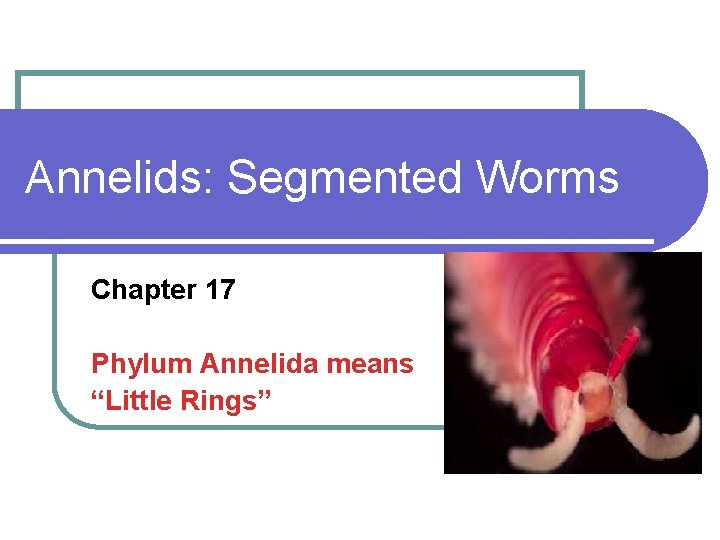
Annelids: Segmented Worms Chapter 17 Phylum Annelida means “Little Rings”
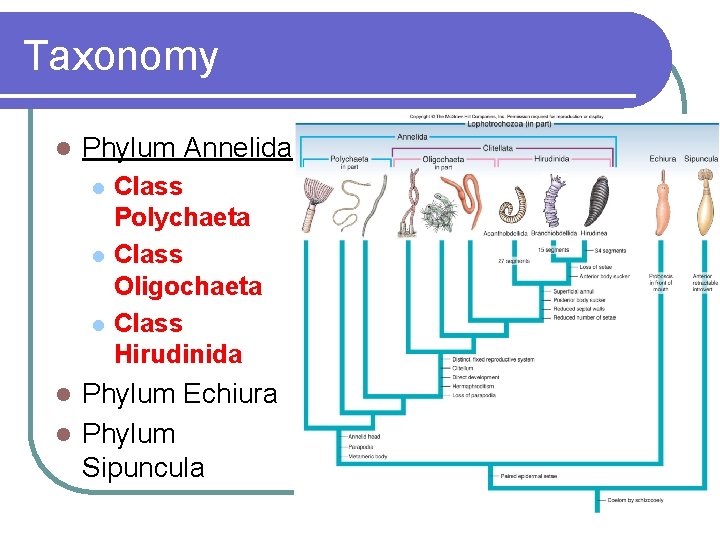
Taxonomy l Phylum Annelida l l l Class Polychaeta Class Oligochaeta Class Hirudinida Phylum Echiura l Phylum Sipuncula l
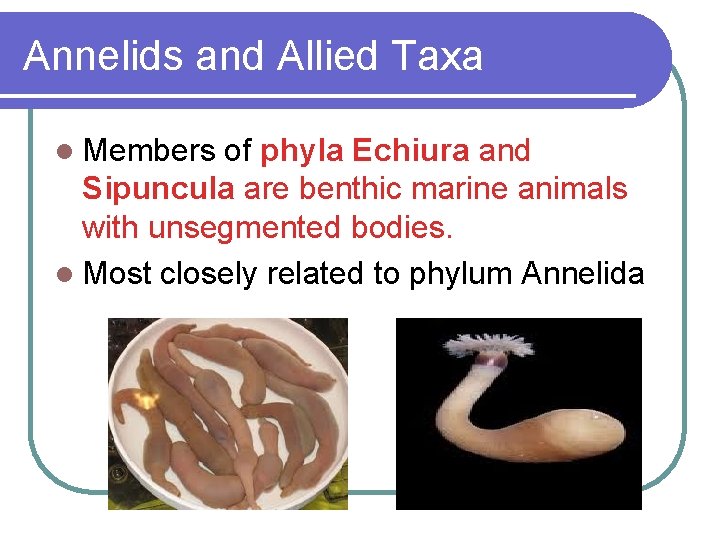
Annelids and Allied Taxa l Members of phyla Echiura and Sipuncula are benthic marine animals with unsegmented bodies. l Most closely related to phylum Annelida
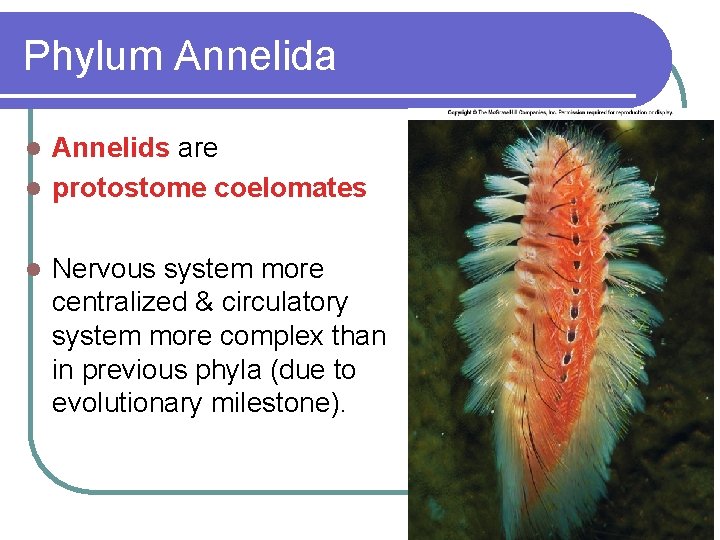
Phylum Annelida Annelids are l protostome coelomates l l Nervous system more centralized & circulatory system more complex than in previous phyla (due to evolutionary milestone).
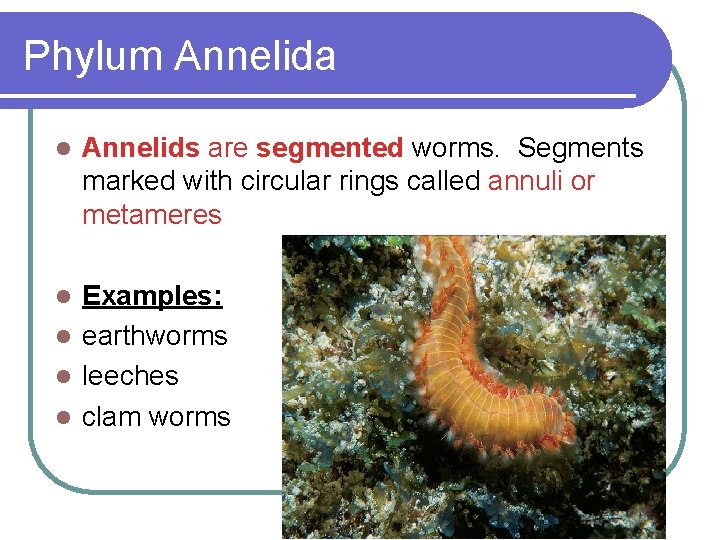
Phylum Annelida l Annelids are segmented worms. Segments marked with circular rings called annuli or metameres Examples: l earthworms l leeches l clam worms l
Phylum Annelida l The evolutionary milestone shown by annelids is segmentation (metamerism). l Segmentation evolved separately in annelids, arthropods, and chordates. l l The body is divided into a series of segments, each having similar components of all major organ systems. Built in fail-safe (if parts of body fail!). l Allows for specialization. l
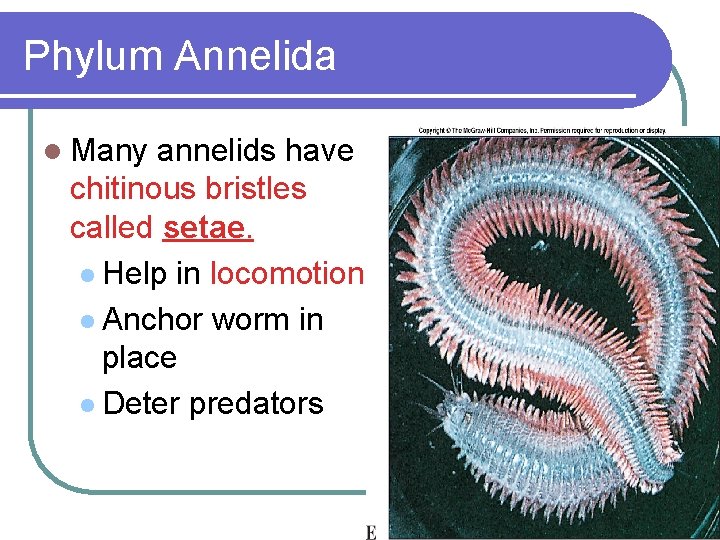
Phylum Annelida l Many annelids have chitinous bristles called setae. l Help in locomotion l Anchor worm in place l Deter predators
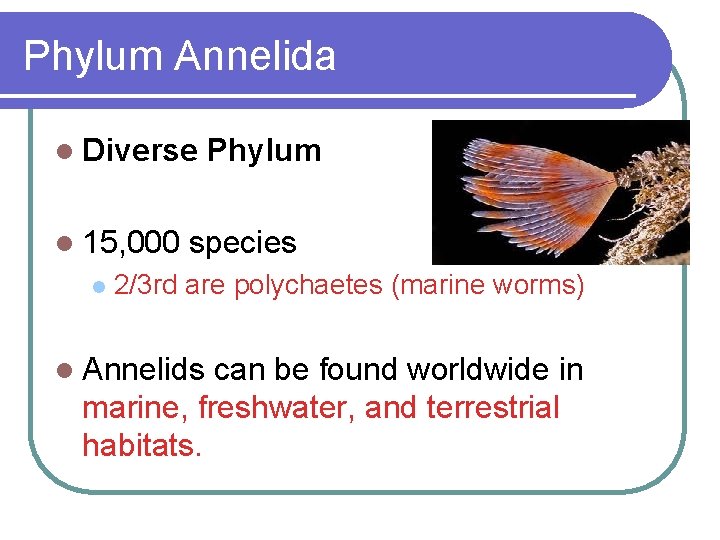
Phylum Annelida l Diverse l 15, 000 l Phylum species 2/3 rd are polychaetes (marine worms) l Annelids can be found worldwide in marine, freshwater, and terrestrial habitats.
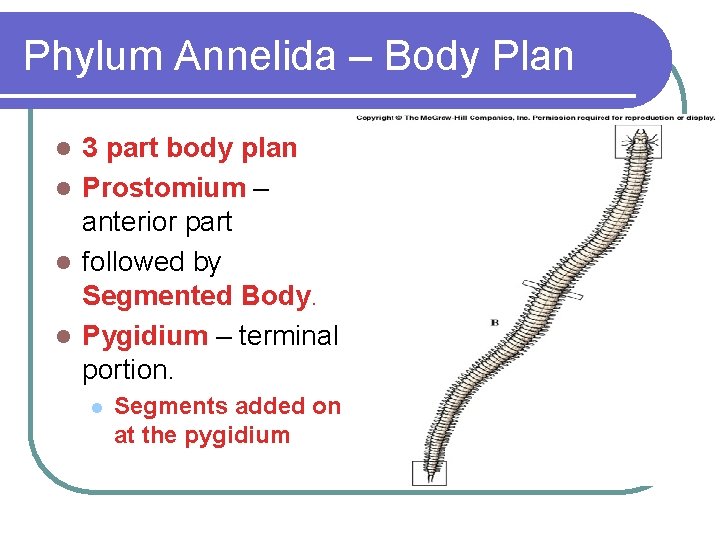
Phylum Annelida – Body Plan 3 part body plan l Prostomium – anterior part l followed by Segmented Body. l Pygidium – terminal portion. l l Segments added on at the pygidium
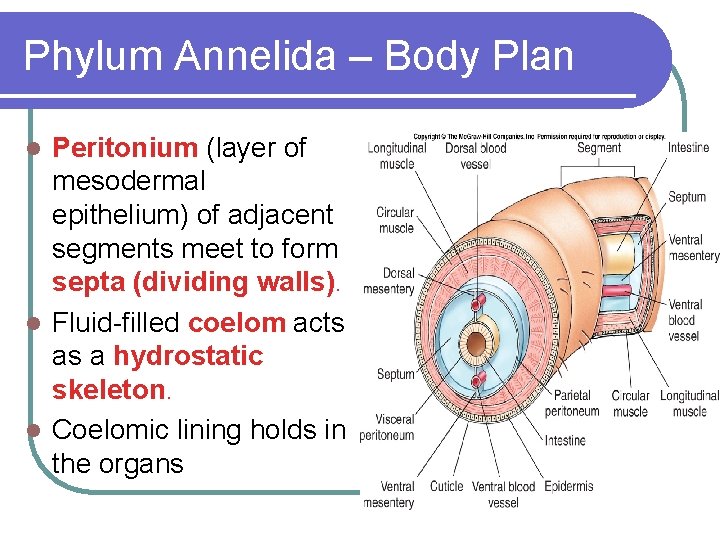
Phylum Annelida – Body Plan Peritonium (layer of mesodermal epithelium) of adjacent segments meet to form septa (dividing walls). l Fluid-filled coelom acts as a hydrostatic skeleton. l Coelomic lining holds in the organs l
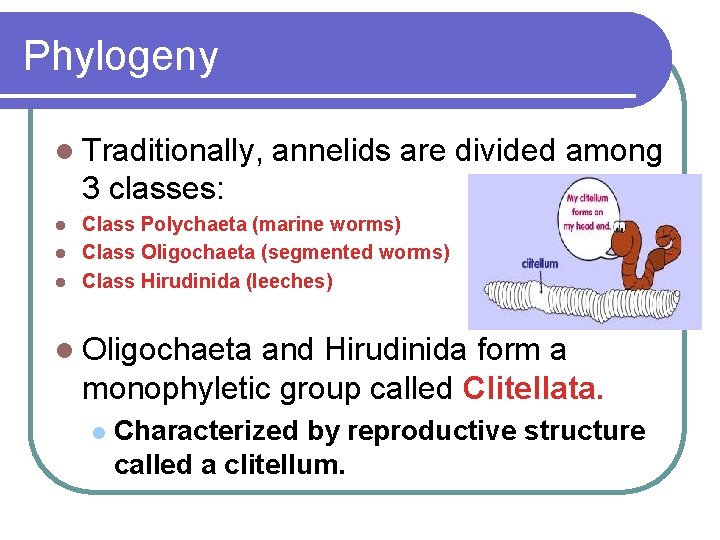
Phylogeny l Traditionally, annelids are divided among 3 classes: Class Polychaeta (marine worms) l Class Oligochaeta (segmented worms) l Class Hirudinida (leeches) l l Oligochaeta and Hirudinida form a monophyletic group called Clitellata. l Characterized by reproductive structure called a clitellum.
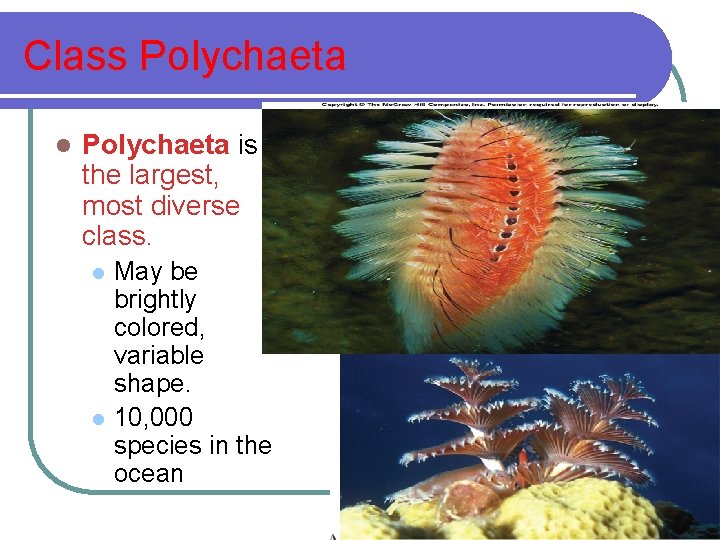
Class Polychaeta l Polychaeta is the largest, most diverse class. l l May be brightly colored, variable shape. 10, 000 species in the ocean
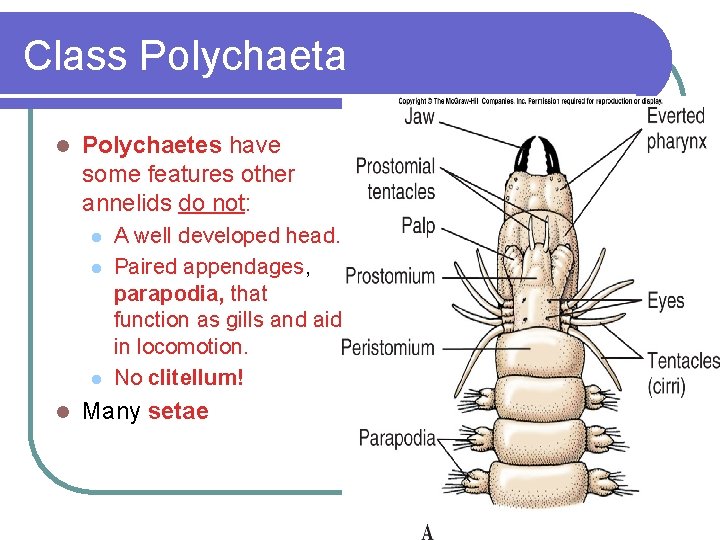
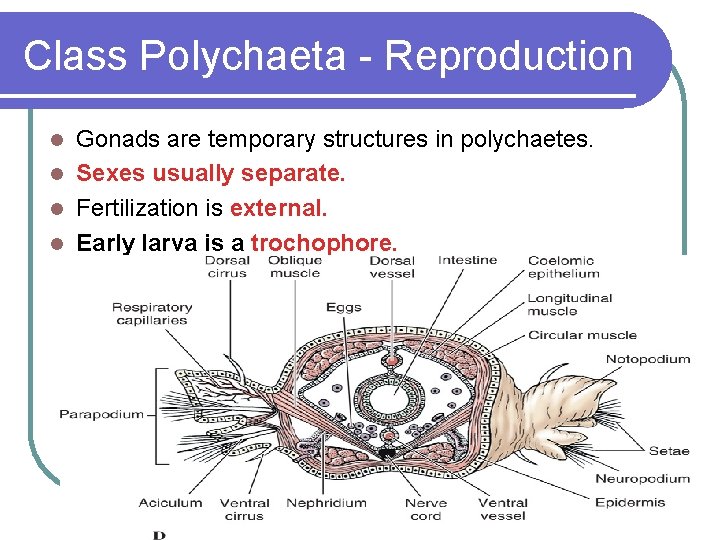
Class Polychaeta l Polychaetes have some features other annelids do not: l l A well developed head. Paired appendages, parapodia, that function as gills and aid in locomotion. No clitellum! Many setae
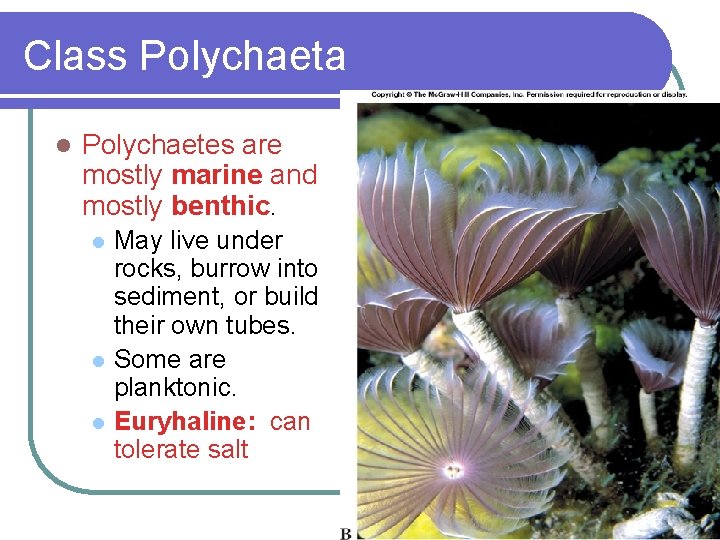
Class Polychaeta l Polychaetes are mostly marine and mostly benthic. l l l May live under rocks, burrow into sediment, or build their own tubes. Some are planktonic. Euryhaline: can tolerate salt
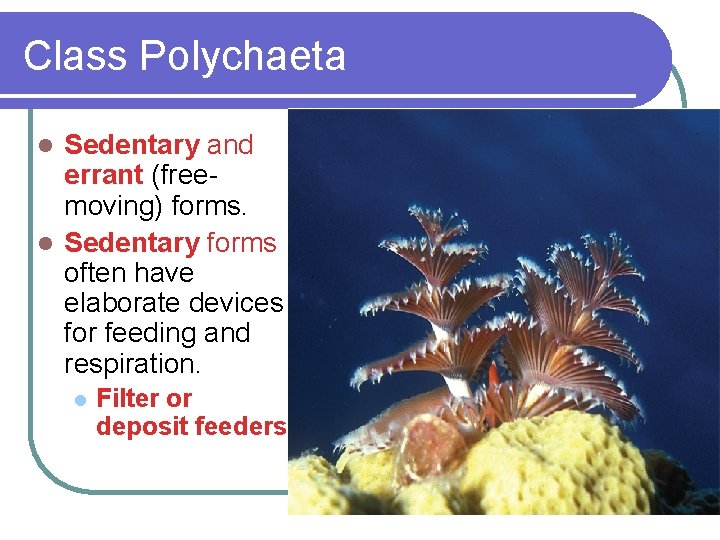
Class Polychaeta Sedentary and errant (freemoving) forms. l Sedentary forms often have elaborate devices for feeding and respiration. l l Filter or deposit feeders.
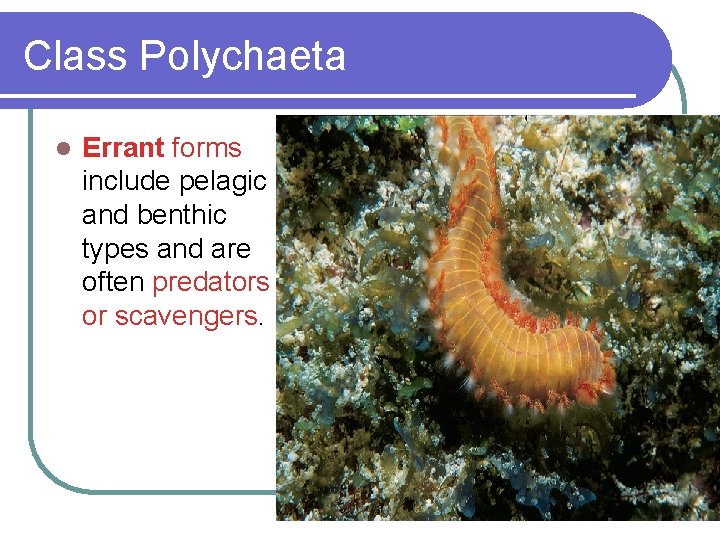
Class Polychaeta l Errant forms include pelagic and benthic types and are often predators or scavengers.
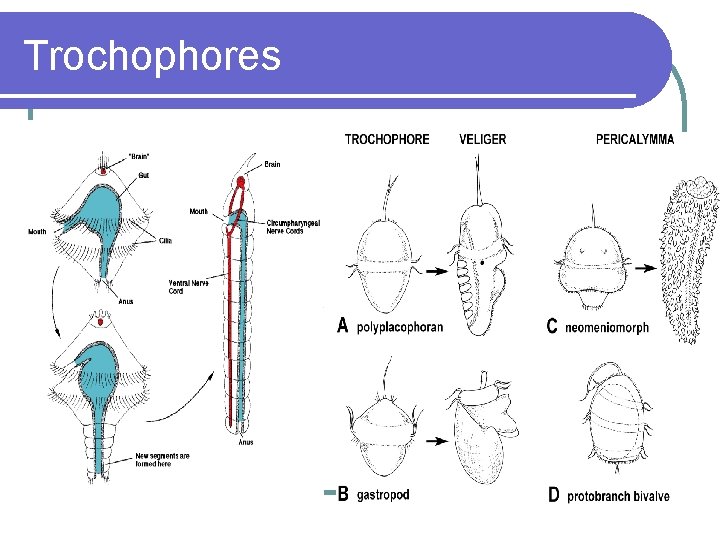
Class Polychaeta - Reproduction Gonads are temporary structures in polychaetes. l Sexes usually separate. l Fertilization is external. l Early larva is a trochophore. l
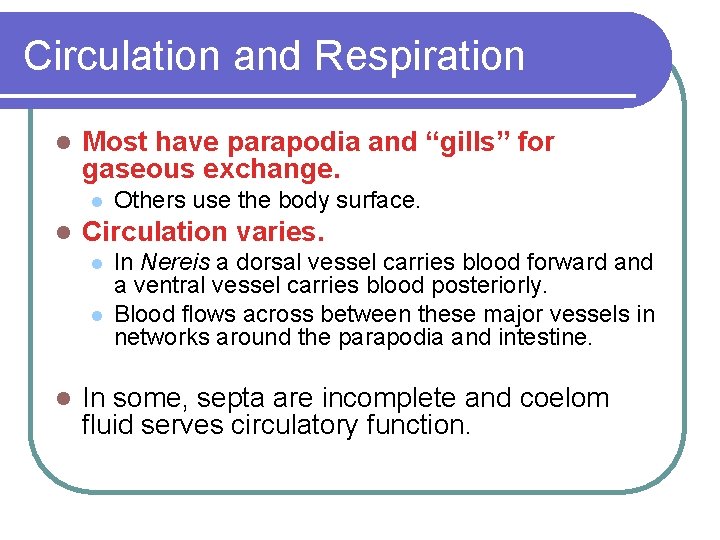
Circulation and Respiration l Most have parapodia and “gills” for gaseous exchange. l l Circulation varies. l l l Others use the body surface. In Nereis a dorsal vessel carries blood forward and a ventral vessel carries blood posteriorly. Blood flows across between these major vessels in networks around the parapodia and intestine. In some, septa are incomplete and coelom fluid serves circulatory function.
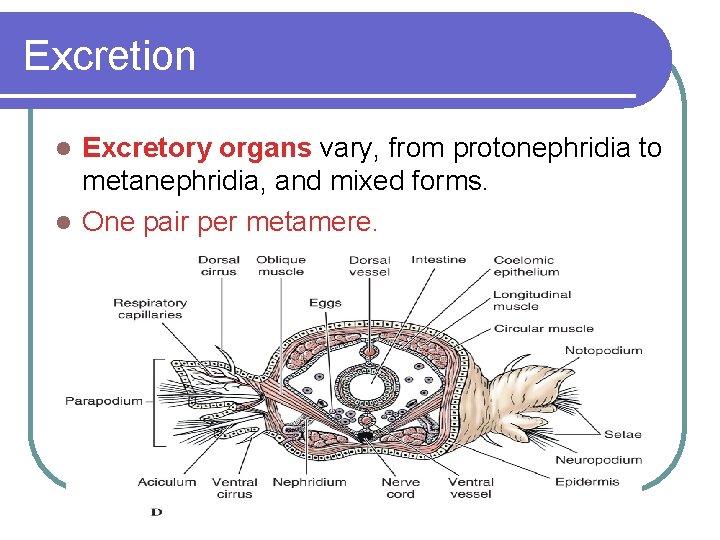
Excretion Excretory organs vary, from protonephridia to metanephridia, and mixed forms. l One pair per metamere. l
Nervous System and Sense Organs Double ventral nerve cord runs length of the worm with ganglia in each metamere. l Sense organs include: l l l Eyes, nuchal organs and statocysts (balance). Eyes vary from simple eyespots to well-developed image-resolving eyes similar to mollusc eyes. Nuchal organs are ciliated sensory pits that are probably chemoreceptive. Some burrowing and tube-building polychaetes use statocysts to orient their body.
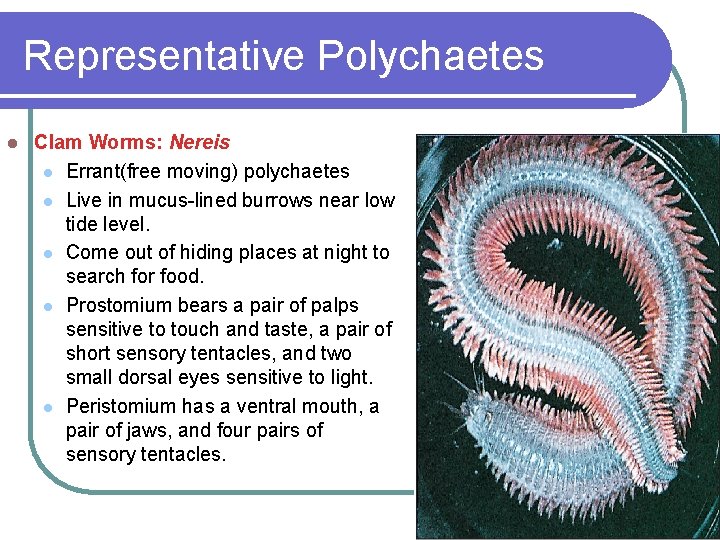
Representative Polychaetes l Clam Worms: Nereis l Errant(free moving) polychaetes l Live in mucus-lined burrows near low tide level. l Come out of hiding places at night to search for food. l Prostomium bears a pair of palps sensitive to touch and taste, a pair of short sensory tentacles, and two small dorsal eyes sensitive to light. l Peristomium has a ventral mouth, a pair of jaws, and four pairs of sensory tentacles.
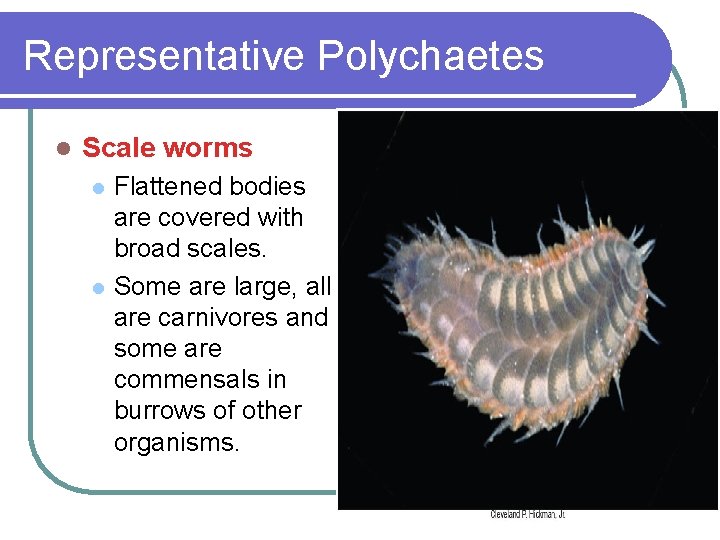
Representative Polychaetes l Scale worms l l Flattened bodies are covered with broad scales. Some are large, all are carnivores and some are commensals in burrows of other organisms.
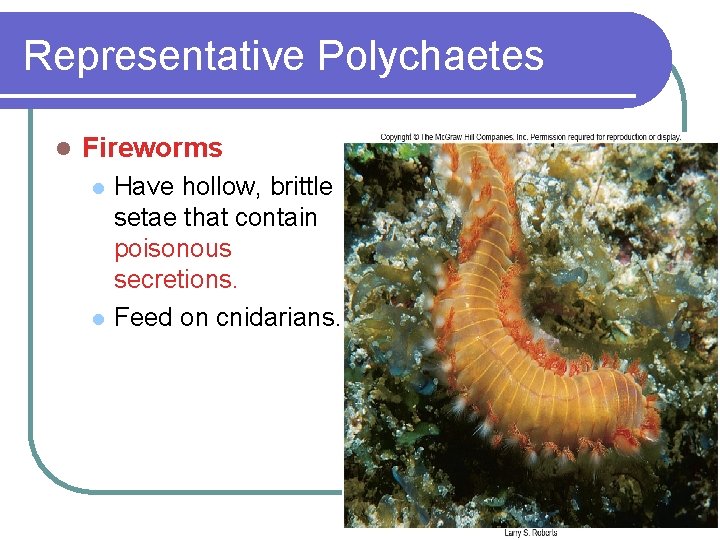
Representative Polychaetes l Fireworms l l Have hollow, brittle setae that contain poisonous secretions. Feed on cnidarians.
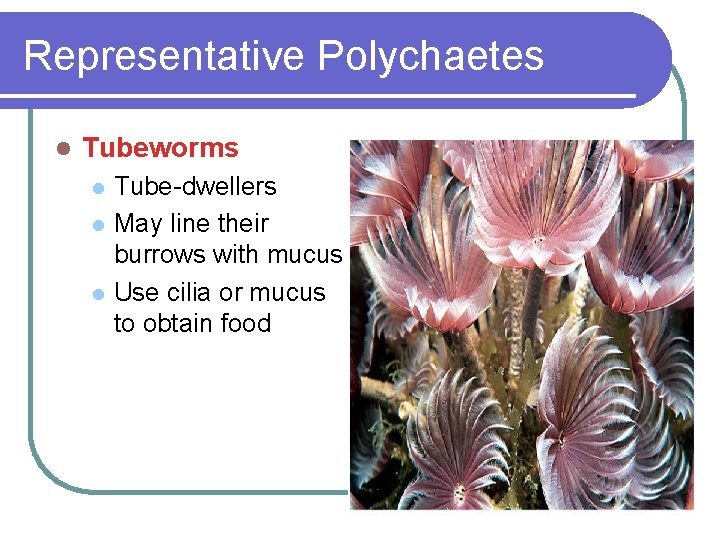
Representative Polychaetes l Tubeworms l l l Tube-dwellers May line their burrows with mucus Use cilia or mucus to obtain food
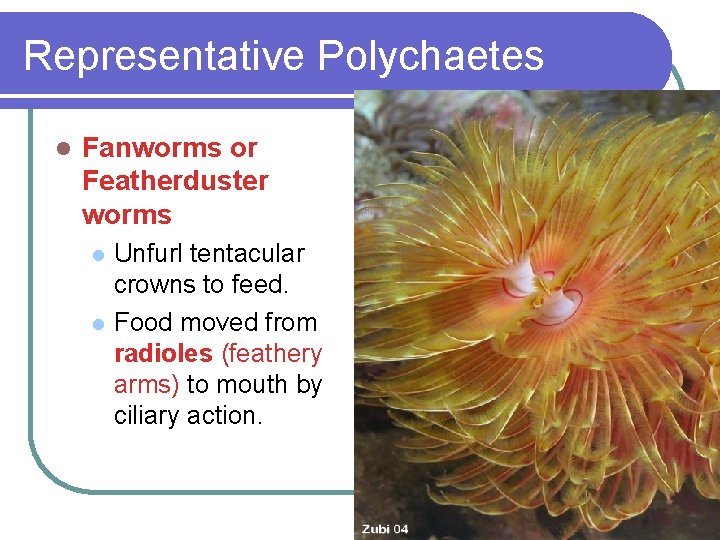
Representative Polychaetes l Fanworms or Featherduster worms l l Unfurl tentacular crowns to feed. Food moved from radioles (feathery arms) to mouth by ciliary action.
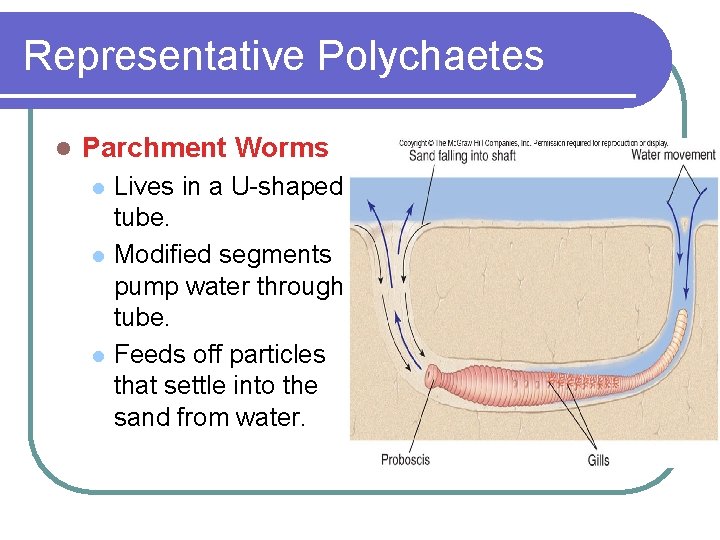
Representative Polychaetes l Parchment Worms l l l Lives in a U-shaped tube. Modified segments pump water through tube. Feeds off particles that settle into the sand from water.
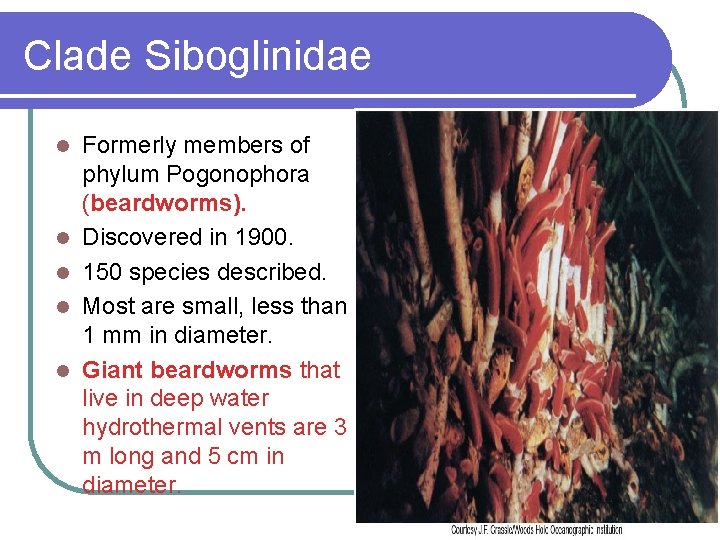
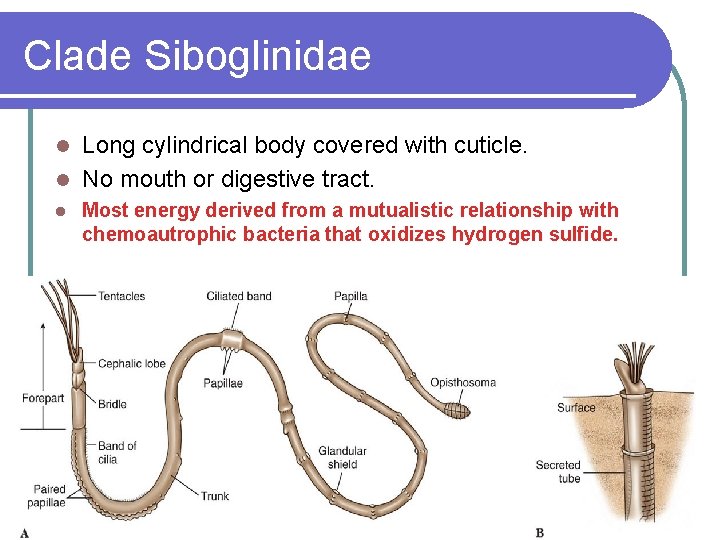
Clade Siboglinidae l l l Formerly members of phylum Pogonophora (beardworms). Discovered in 1900. 150 species described. Most are small, less than 1 mm in diameter. Giant beardworms that live in deep water hydrothermal vents are 3 m long and 5 cm in diameter.
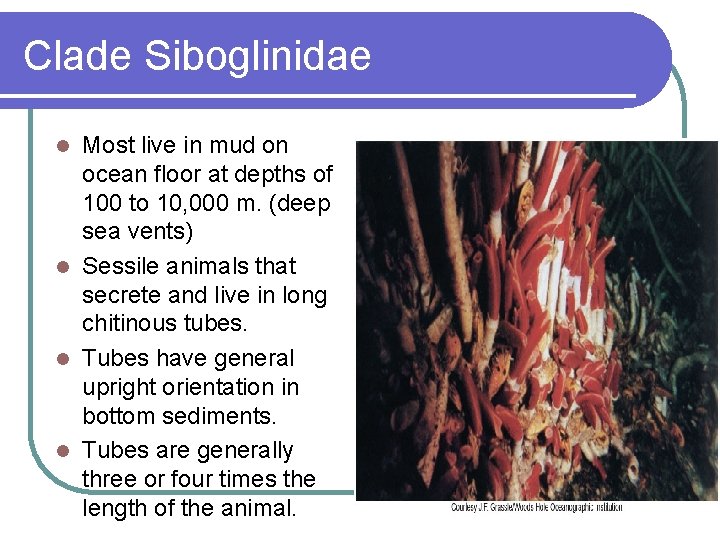
Clade Siboglinidae Most live in mud on ocean floor at depths of 100 to 10, 000 m. (deep sea vents) l Sessile animals that secrete and live in long chitinous tubes. l Tubes have general upright orientation in bottom sediments. l Tubes are generally three or four times the length of the animal. l
Clade Siboglinidae Long cylindrical body covered with cuticle. l No mouth or digestive tract. l l Most energy derived from a mutualistic relationship with chemoautrophic bacteria that oxidizes hydrogen sulfide.
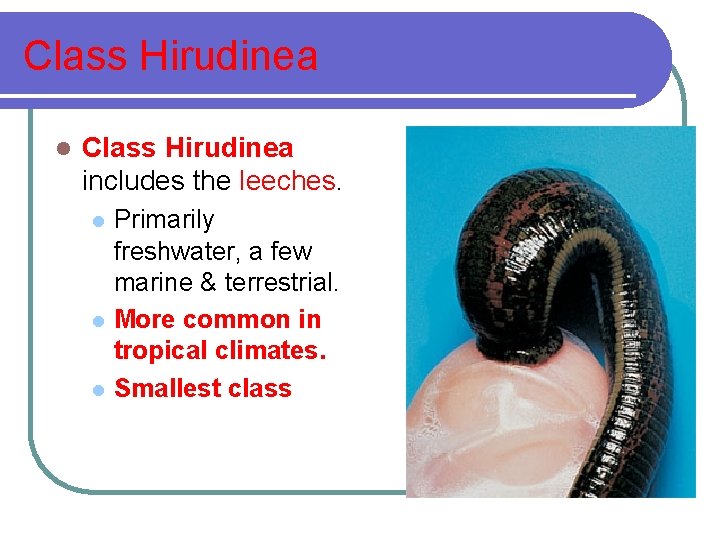
Class Hirudinea l Class Hirudinea includes the leeches. l l l Primarily freshwater, a few marine & terrestrial. More common in tropical climates. Smallest class
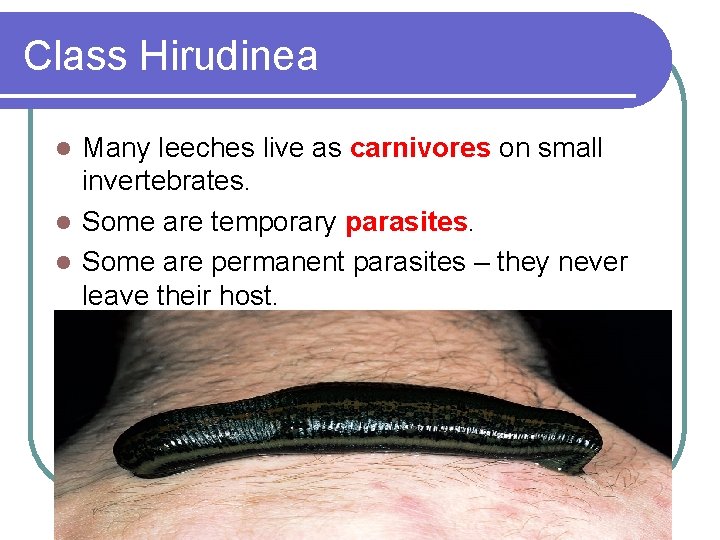
Class Hirudinea Many leeches live as carnivores on small invertebrates. l Some are temporary parasites. l Some are permanent parasites – they never leave their host. l
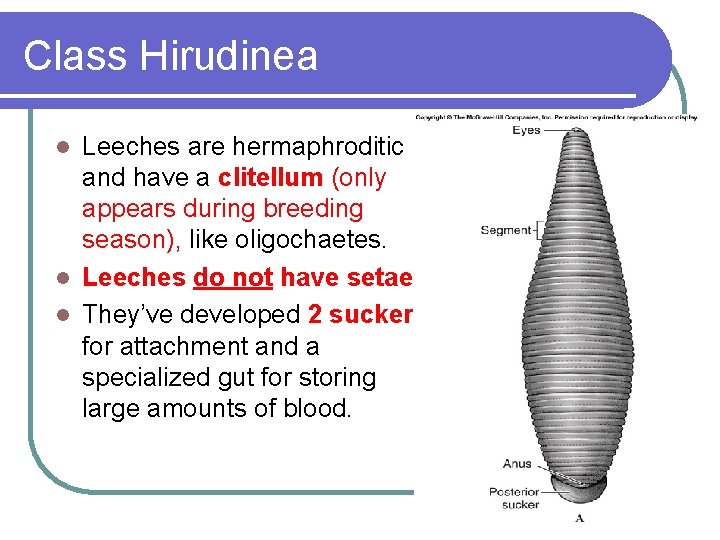
Class Hirudinea Leeches are hermaphroditic and have a clitellum (only appears during breeding season), like oligochaetes. l Leeches do not have setae. l They’ve developed 2 suckers for attachment and a specialized gut for storing large amounts of blood. l
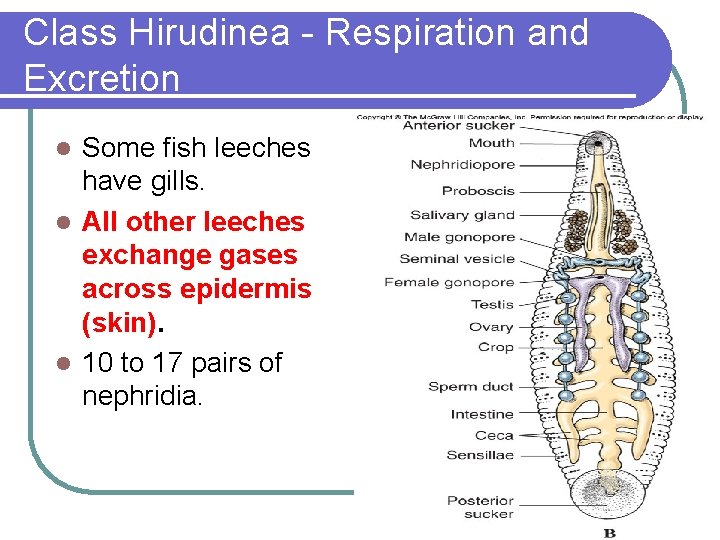
Class Hirudinea - Respiration and Excretion Some fish leeches have gills. l All other leeches exchange gases across epidermis (skin). l 10 to 17 pairs of nephridia. l
Class Hirudinea - Nervous and Sensory Systems l Two “brains” Anterior fused ganglia form a ring around the pharynx. l Seven pairs of posterior fused ganglia. l l 21 pairs of segmental ganglia in between along a double nerve cord. l Epidermis contains free sensory nerve endings and photoreceptor cells. l Pigment-cup ocelli are present.
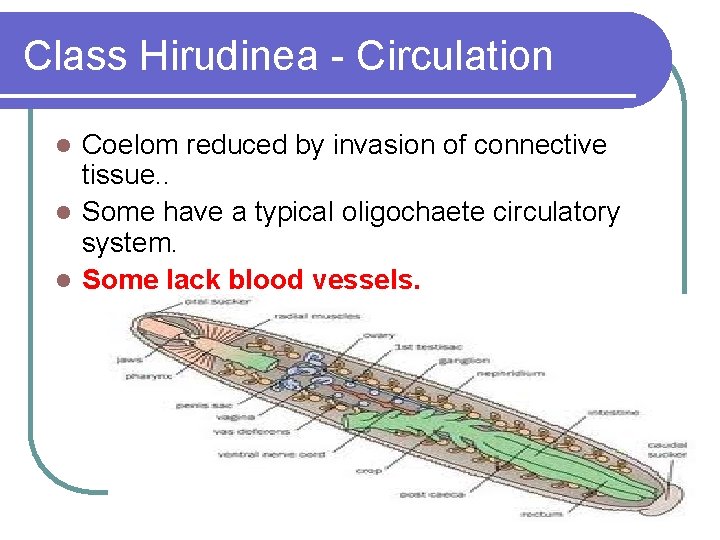
Class Hirudinea - Circulation Coelom reduced by invasion of connective tissue. . l Some have a typical oligochaete circulatory system. l Some lack blood vessels. l
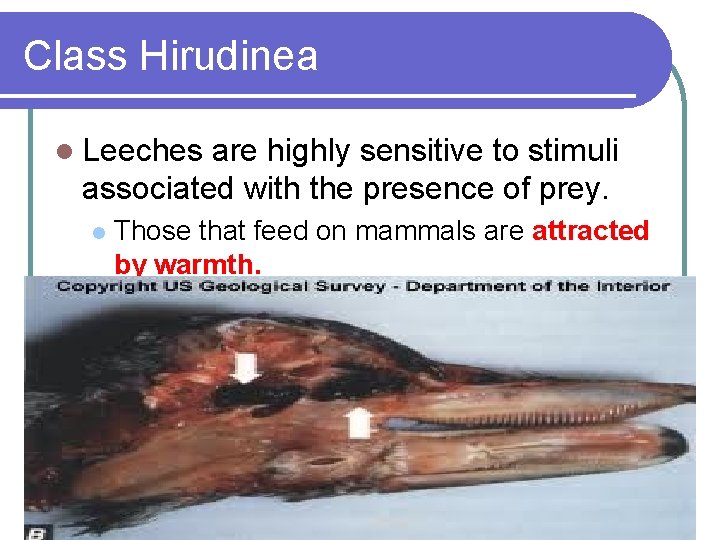
Class Hirudinea l Leeches are highly sensitive to stimuli associated with the presence of prey. l Those that feed on mammals are attracted by warmth.
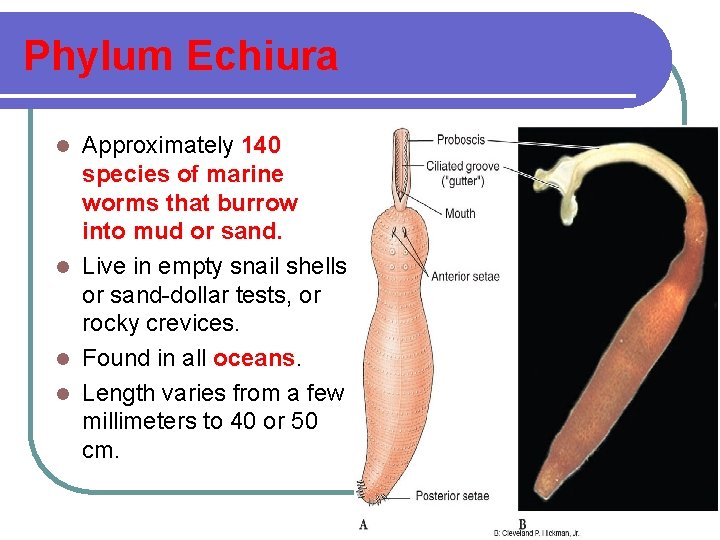
Phylum Echiura Approximately 140 species of marine worms that burrow into mud or sand. l Live in empty snail shells or sand-dollar tests, or rocky crevices. l Found in all oceans. l Length varies from a few millimeters to 40 or 50 cm. l
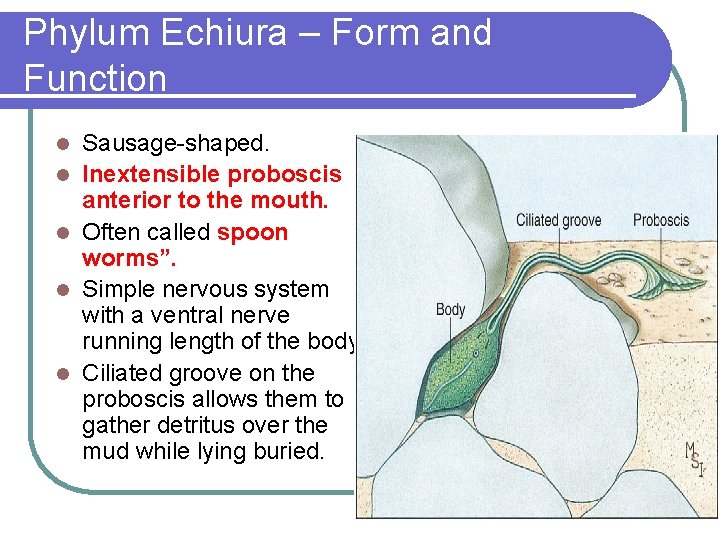
Phylum Echiura – Form and Function l l l Sausage-shaped. Inextensible proboscis anterior to the mouth. Often called spoon worms”. Simple nervous system with a ventral nerve running length of the body. Ciliated groove on the proboscis allows them to gather detritus over the mud while lying buried.
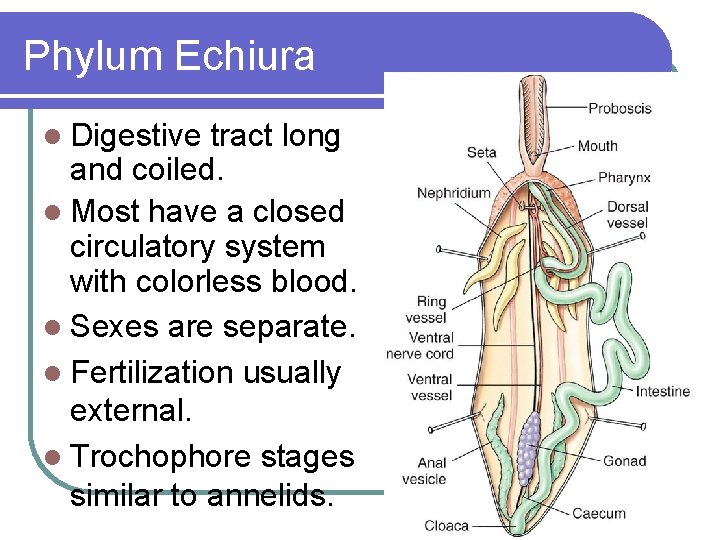
Phylum Echiura l Digestive tract long and coiled. l Most have a closed circulatory system with colorless blood. l Sexes are separate. l Fertilization usually external. l Trochophore stages similar to annelids.
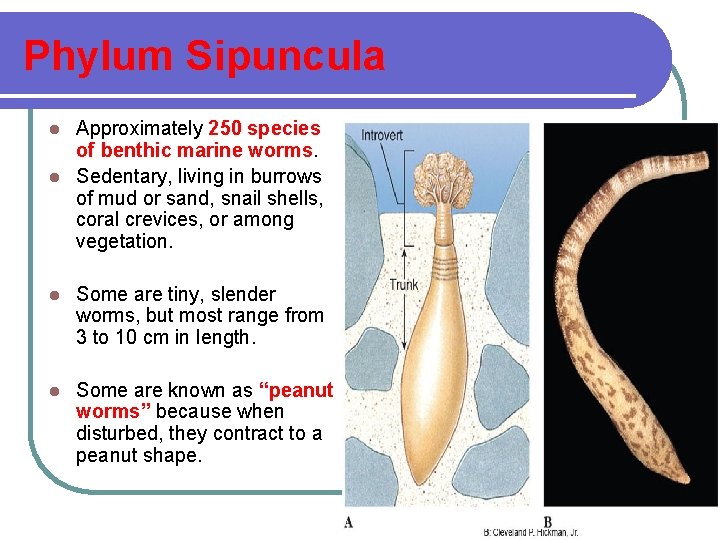
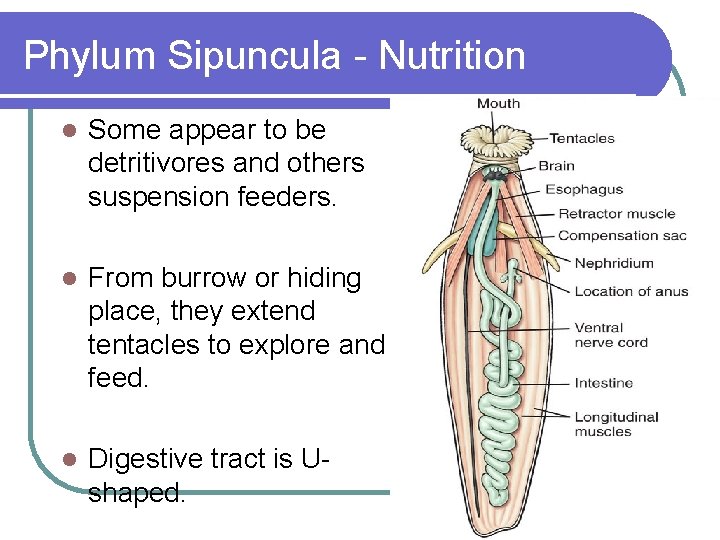
Phylum Sipuncula Approximately 250 species of benthic marine worms. l Sedentary, living in burrows of mud or sand, snail shells, coral crevices, or among vegetation. l l Some are tiny, slender worms, but most range from 3 to 10 cm in length. l Some are known as “peanut worms” because when disturbed, they contract to a peanut shape.
Phylum Sipuncula - Nutrition l Some appear to be detritivores and others suspension feeders. l From burrow or hiding place, they extend tentacles to explore and feed. l Digestive tract is Ushaped.
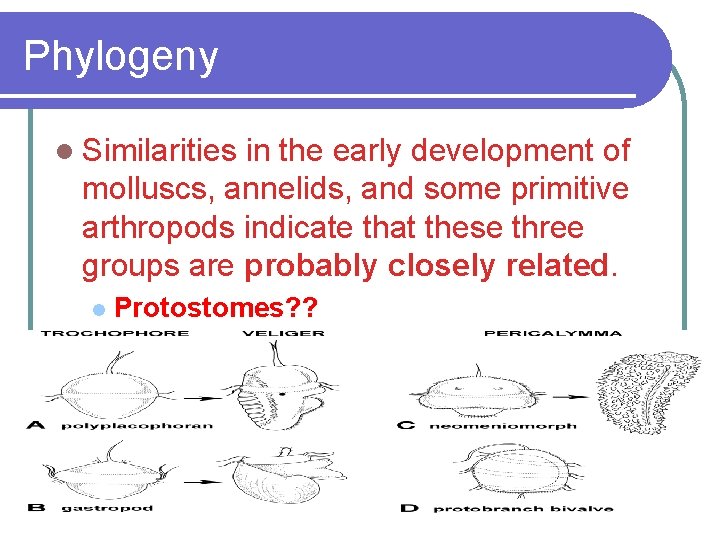
Phylogeny l Similarities in the early development of molluscs, annelids, and some primitive arthropods indicate that these three groups are probably closely related. Protostomes? ? l Trochophore larva? ? l
Trochophores
Evolutionary Significance of Metamerism l However-Current evidence supports the hypothesis that segmentation arose independently multiple times. l Selective advantage of a segmented body for annelids appears to lie in the efficiency of burrowing. l However, does not explain segmentation in arthropods given the rigidity of the exoskeleton.