
Annealing Paths for the Evaluation of Topic Models
- Slides: 45
Annealing Paths for the Evaluation of Topic Models James Foulds Padhraic Smyth Department of Computer Science University of California, Irvine* *James Foulds has recently moved to the University of California, Santa Cruz
Motivation • Topic model extensions – Structure, prior knowledge and constraints • Sparse, nonparametric, correlated, tree-structured, time series, supervised, focused, determinantal… – Special-purpose models • Authorship, scientific impact, political affiliation, conversational influence, networks, machine translation… – General-purpose models • Dirichlet multinomial regression (DMR), sparse additive generative (SAGE)… Structural topic model (STM) 2
Motivation • Topic model extensions – Structure, prior knowledge and constraints • Sparse, nonparametric, correlated, tree-structured, time series, supervised, focused, determinantal… – Special-purpose models • Authorship, scientific impact, political affiliation, conversational influence, networks, machine translation… – General-purpose models • Dirichlet multinomial regression (DMR), sparse additive generative (SAGE)… Structural topic model (STM) 3
Motivation • Topic model extensions – Structure, prior knowledge and constraints • Sparse, nonparametric, correlated, tree-structured, time series, supervised, focused, determinantal… – Special-purpose models • Authorship, scientific impact, political affiliation, conversational influence, networks, machine translation… – General-purpose models • Dirichlet multinomial regression (DMR), sparse additive generative (SAGE), Structural topic model (STM), … 4
Motivation • Inference algorithms for topic models – Optimization • EM, variational inference, collapsed variational inference, … – Sampling • Collapsed Gibbs sampling, Langevin dynamics, … – Scaling to ``big data’’ • Stochastic algorithms, distributed algorithms, map reduce… 5
Motivation • Inference algorithms for topic models – Optimization • EM, variational inference, collapsed variational inference, … – Sampling • Collapsed Gibbs sampling, Langevin dynamics, … – Scaling to ``big data’’ • Stochastic algorithms, distributed algorithms, map reduce… 6
Motivation • Inference algorithms for topic models – Optimization • EM, variational inference, collapsed variational inference, … – Sampling • Collapsed Gibbs sampling, Langevin dynamics, … – Scaling up to ``big data’’ • Stochastic algorithms, distributed algorithms, map reduce, sparse data structures… 7
Motivation • Which existing techniques should we use? • Is my new model/algorithm better than previous methods? 8
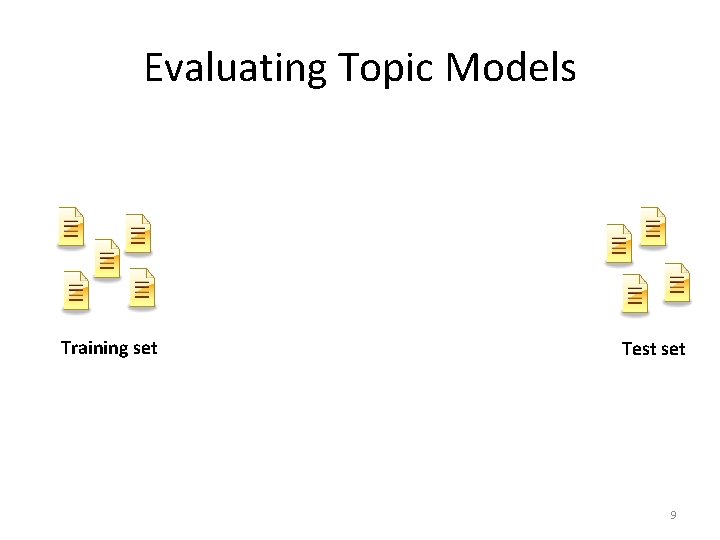
Evaluating Topic Models Training set Test set 9
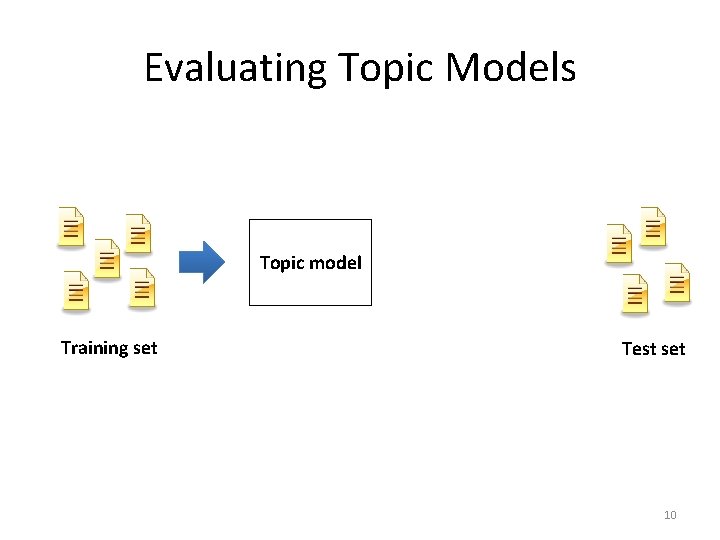
Evaluating Topic Models Topic model Training set Test set 10
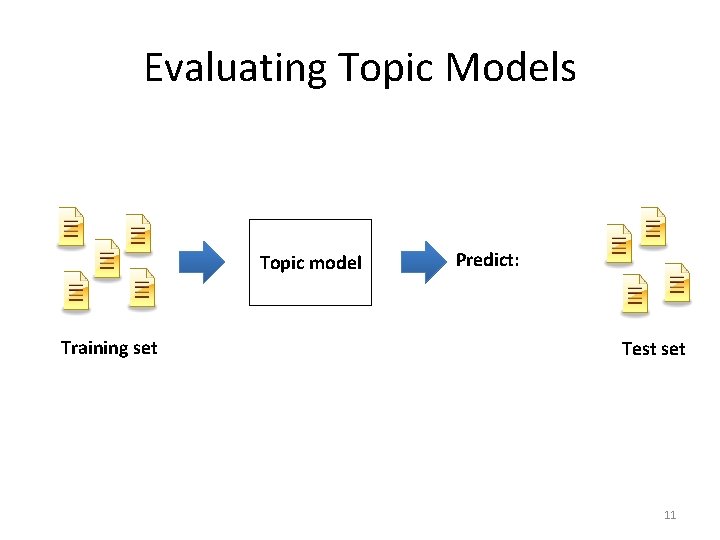
Evaluating Topic Models Topic model Training set Predict: Test set 11
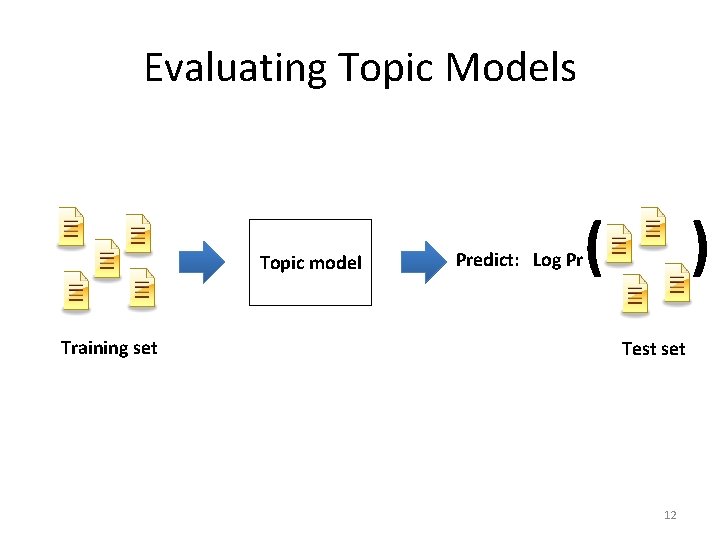
Evaluating Topic Models Topic model Training set Predict: Log Pr ( ) Test set 12
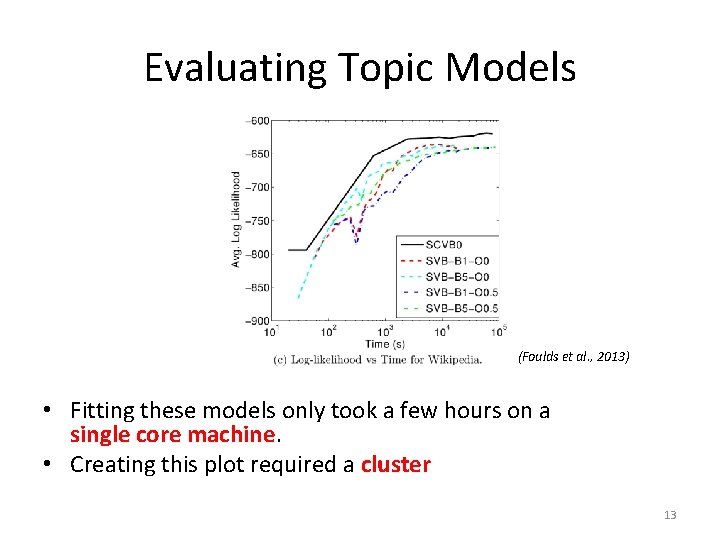
Evaluating Topic Models (Foulds et al. , 2013) • Fitting these models only took a few hours on a single core machine. • Creating this plot required a cluster 13
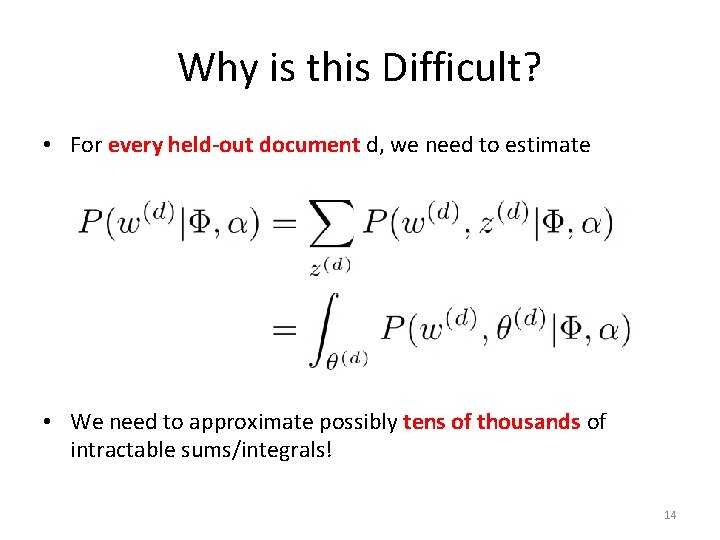
Why is this Difficult? • For every held-out document d, we need to estimate • We need to approximate possibly tens of thousands of intractable sums/integrals! 14
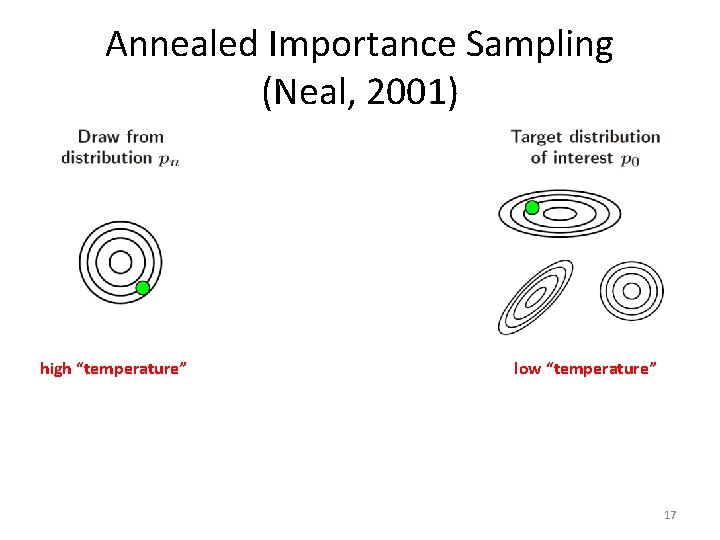
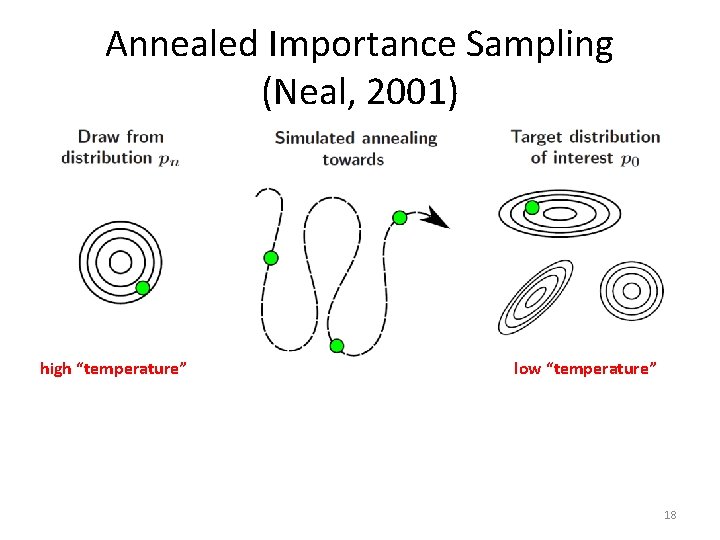
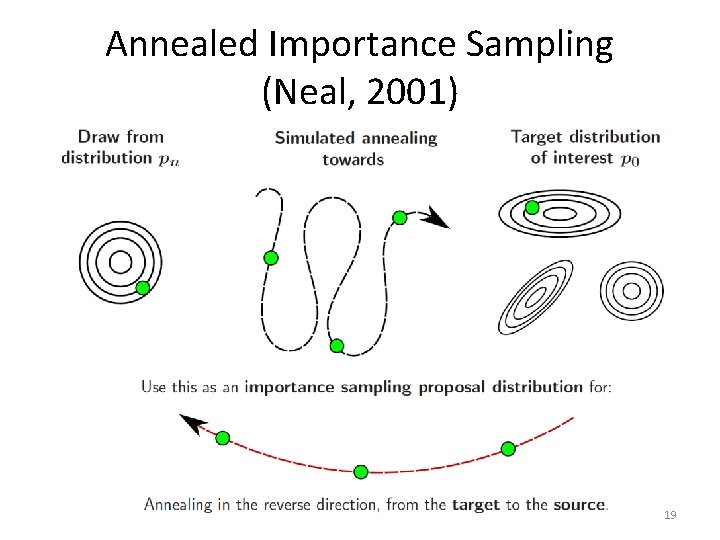
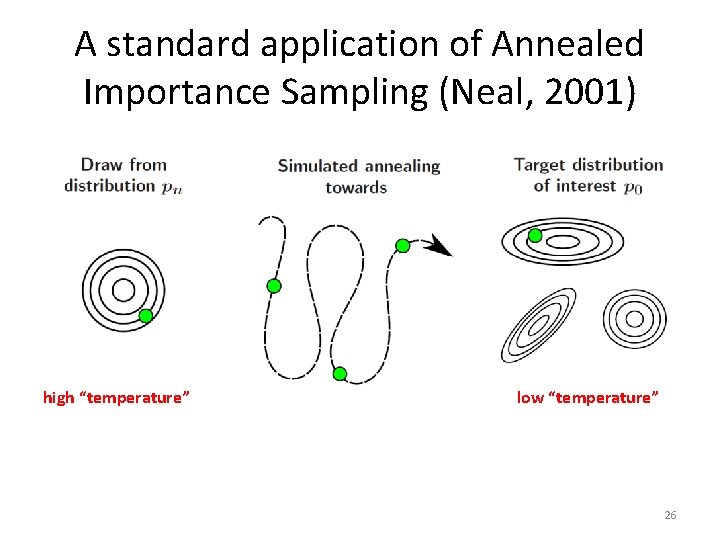
Annealed Importance Sampling (Neal, 2001) • Scales up importance sampling to high dimensional data, using MCMC • Corrects for MCMC convergence failures using importance weights 15
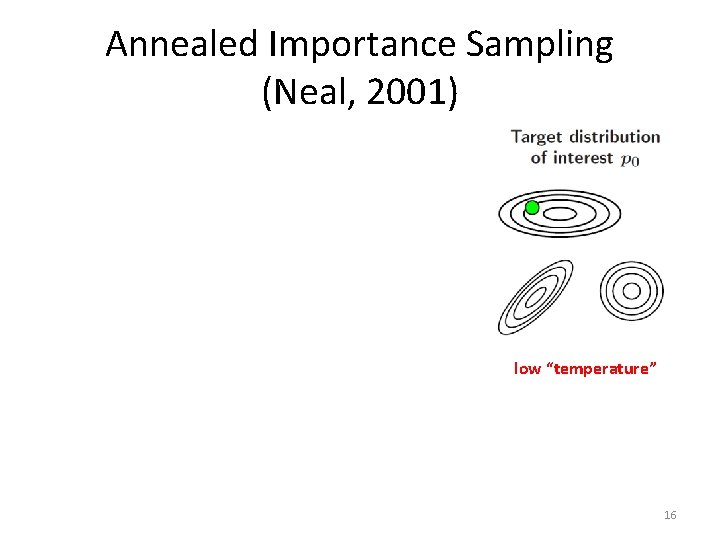
Annealed Importance Sampling (Neal, 2001) low “temperature” 16
Annealed Importance Sampling (Neal, 2001) high “temperature” low “temperature” 17
Annealed Importance Sampling (Neal, 2001) high “temperature” low “temperature” 18
Annealed Importance Sampling (Neal, 2001) 19
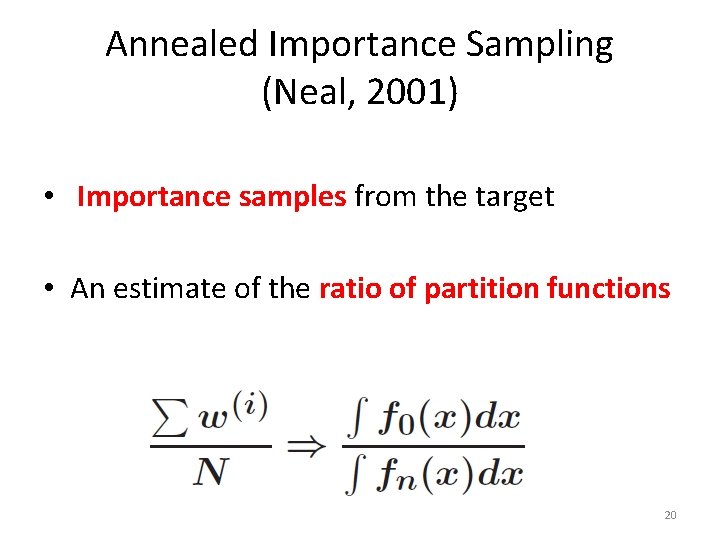
Annealed Importance Sampling (Neal, 2001) • Importance samples from the target • An estimate of the ratio of partition functions 20
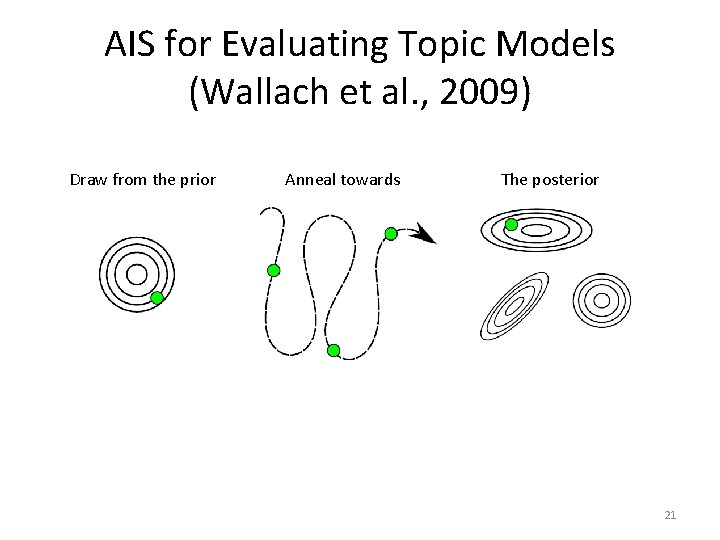
AIS for Evaluating Topic Models (Wallach et al. , 2009) Draw from the prior Anneal towards The posterior 21
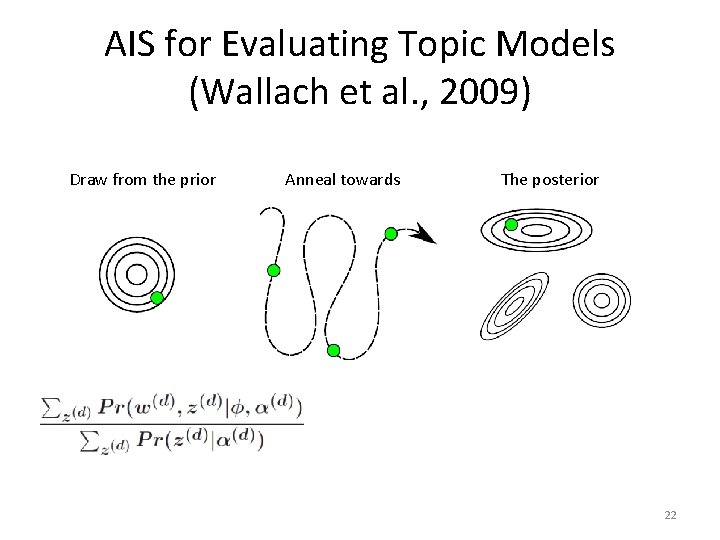
AIS for Evaluating Topic Models (Wallach et al. , 2009) Draw from the prior Anneal towards The posterior 22
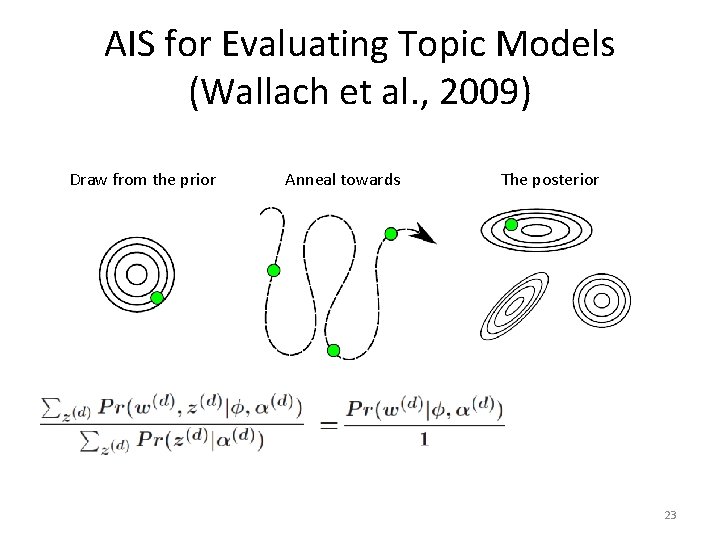
AIS for Evaluating Topic Models (Wallach et al. , 2009) Draw from the prior Anneal towards The posterior 23
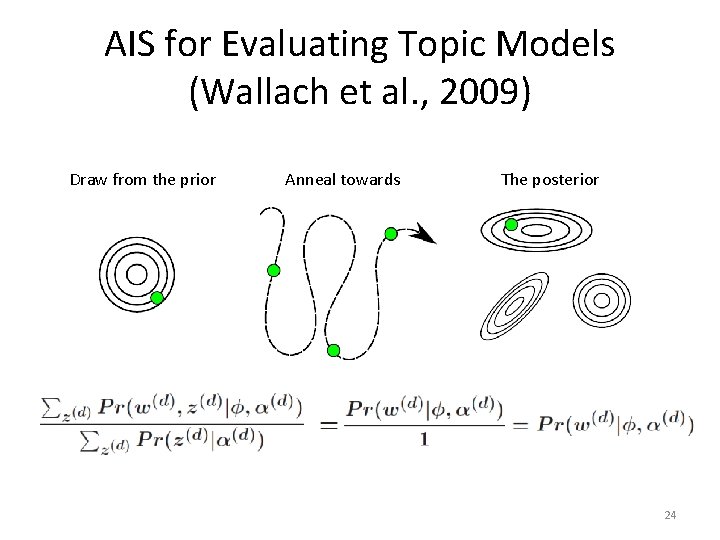
AIS for Evaluating Topic Models (Wallach et al. , 2009) Draw from the prior Anneal towards The posterior 24
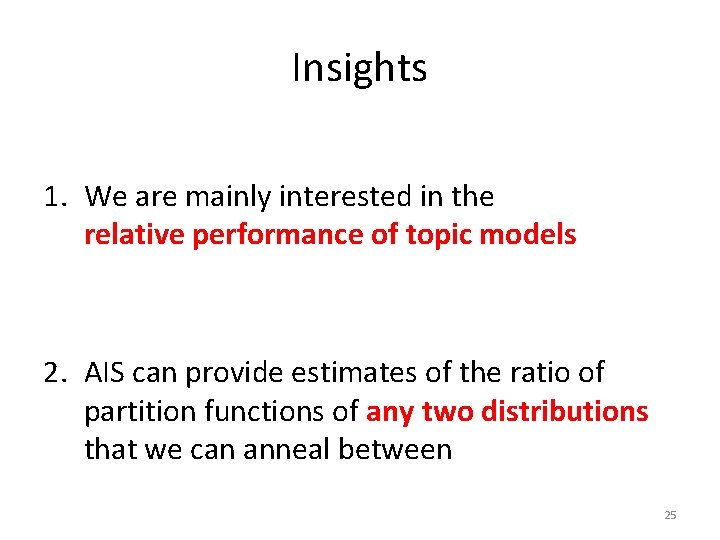
Insights 1. We are mainly interested in the relative performance of topic models 2. AIS can provide estimates of the ratio of partition functions of any two distributions that we can anneal between 25
A standard application of Annealed Importance Sampling (Neal, 2001) high “temperature” low “temperature” 26
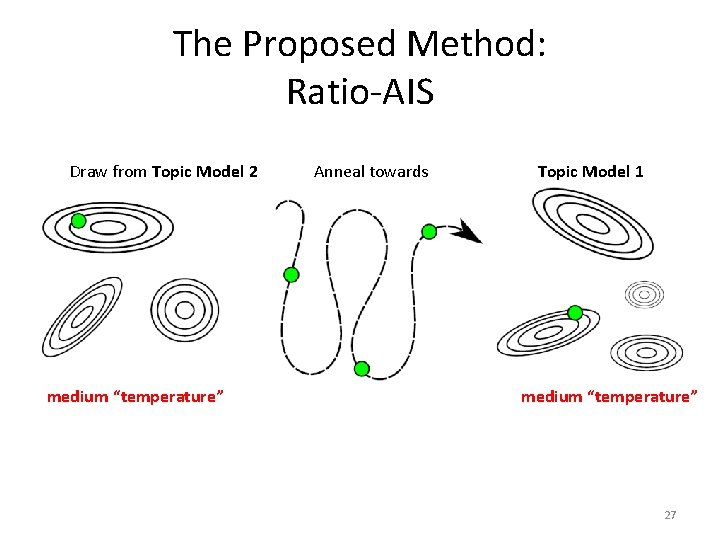
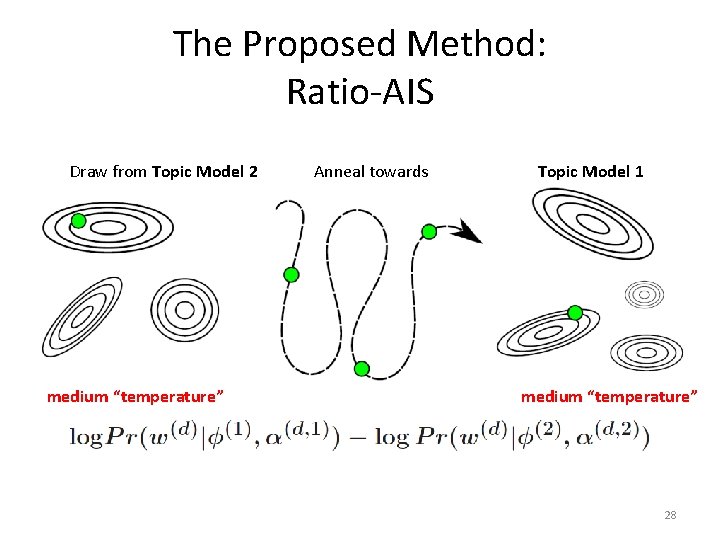
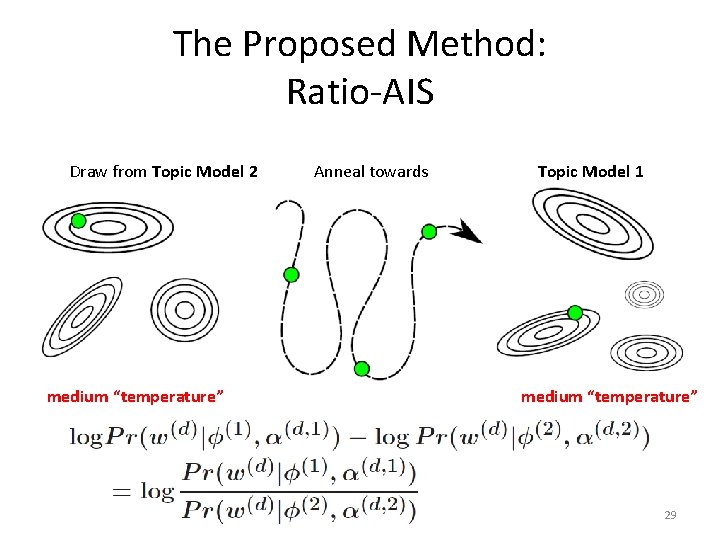
The Proposed Method: Ratio-AIS Draw from Topic Model 2 medium “temperature” Anneal towards Topic Model 1 medium “temperature” 27
The Proposed Method: Ratio-AIS Draw from Topic Model 2 medium “temperature” Anneal towards Topic Model 1 medium “temperature” 28
The Proposed Method: Ratio-AIS Draw from Topic Model 2 medium “temperature” Anneal towards Topic Model 1 medium “temperature” 29
Advantages of Ratio-AIS • Ratio-AIS avoids several sources of Monte Carlo error for comparing two models. The standard method – estimates the denominator of a ratio even though it is a constant (=1), – uses different z’s for both models, – and is run twice, introducing Monte Carlo noise each time. • An easy convergence check: anneal in the reverse direction to compute the reciprocal. 30
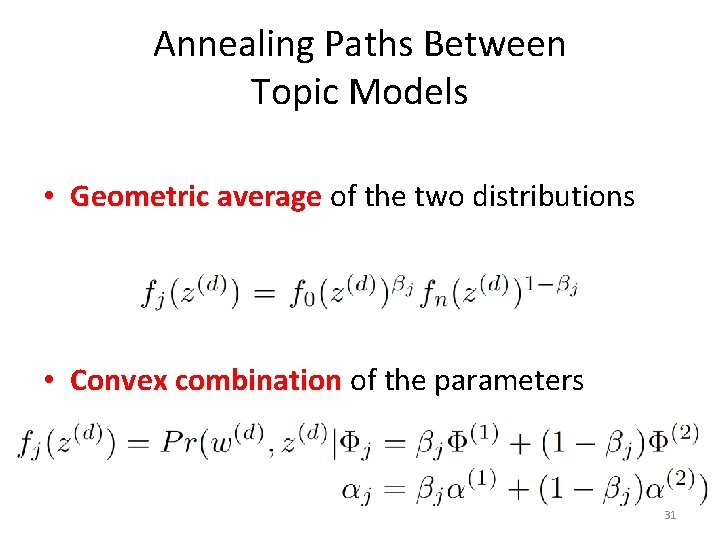
Annealing Paths Between Topic Models • Geometric average of the two distributions • Convex combination of the parameters 31
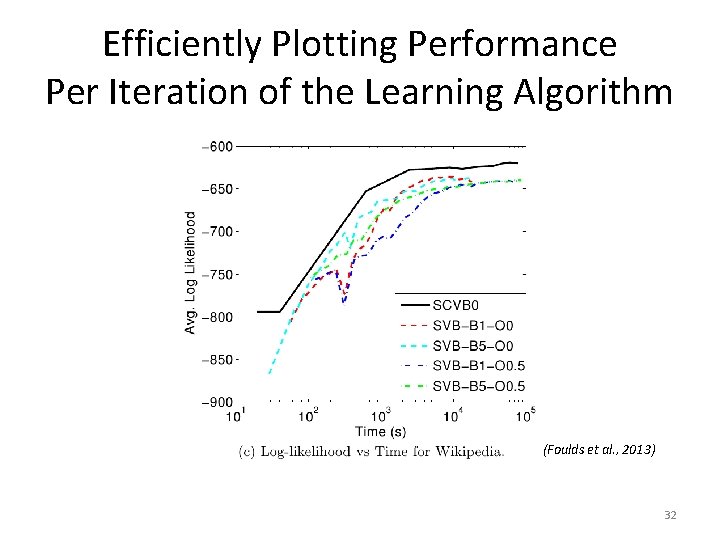
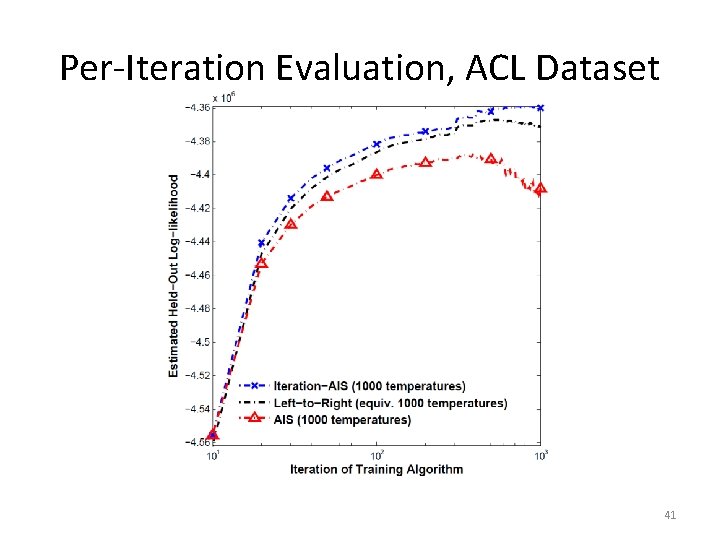
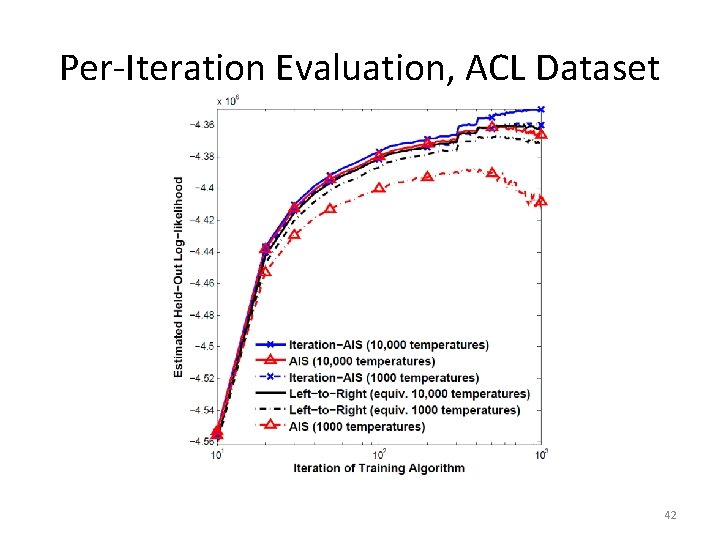
Efficiently Plotting Performance Per Iteration of the Learning Algorithm (Foulds et al. , 2013) 32
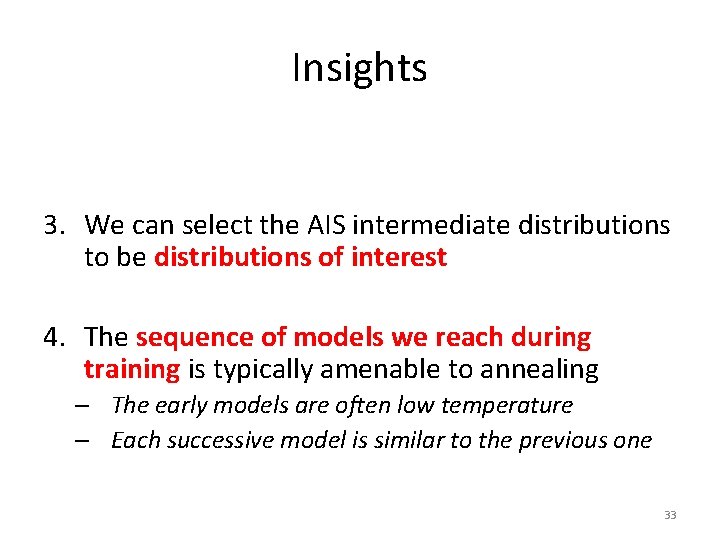
Insights 1. Fsf 2. 2 sfd 3. We can select the AIS intermediate distributions to be distributions of interest 4. The sequence of models we reach during training is typically amenable to annealing – The early models are often low temperature – Each successive model is similar to the previous one 33
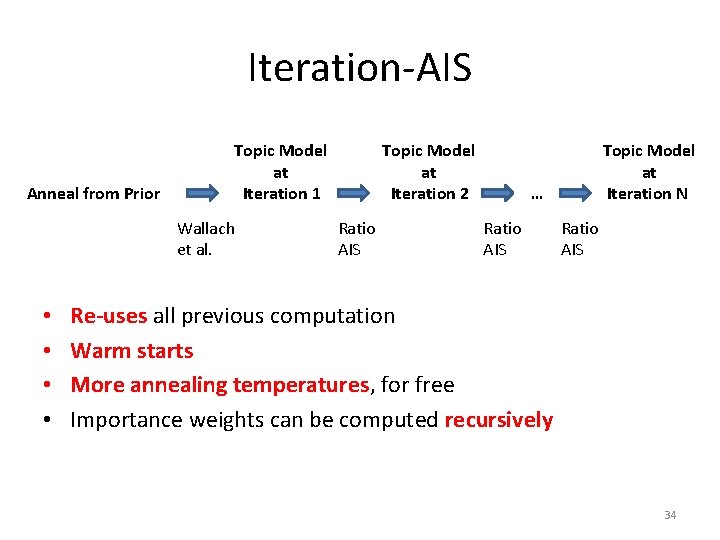
Iteration-AIS Anneal from Prior Topic Model at Iteration 1 Wallach et al. • • Topic Model at Iteration 2 Ratio AIS Topic Model at Iteration N … Ratio AIS Re-uses all previous computation Warm starts More annealing temperatures, for free Importance weights can be computed recursively 34
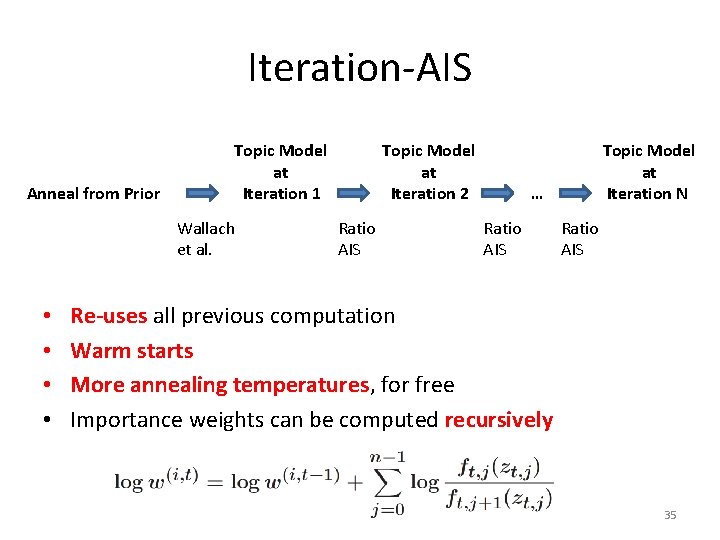
Iteration-AIS Anneal from Prior Topic Model at Iteration 1 Wallach et al. • • Topic Model at Iteration 2 Ratio AIS Topic Model at Iteration N … Ratio AIS Re-uses all previous computation Warm starts More annealing temperatures, for free Importance weights can be computed recursively 35
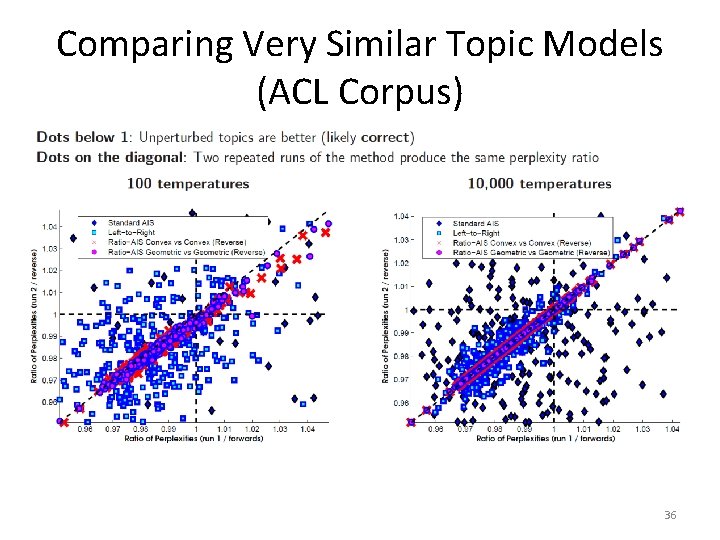
Comparing Very Similar Topic Models (ACL Corpus) 36
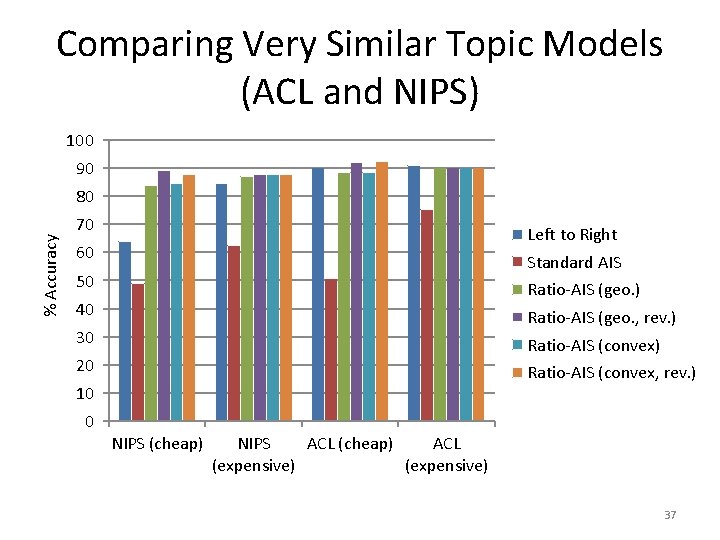
Comparing Very Similar Topic Models (ACL and NIPS) 100 90 % Accuracy 80 70 Left to Right 60 Standard AIS 50 Ratio-AIS (geo. ) 40 Ratio-AIS (geo. , rev. ) 30 Ratio-AIS (convex) 20 Ratio-AIS (convex, rev. ) 10 0 NIPS (cheap) NIPS ACL (cheap) ACL (expensive) 37
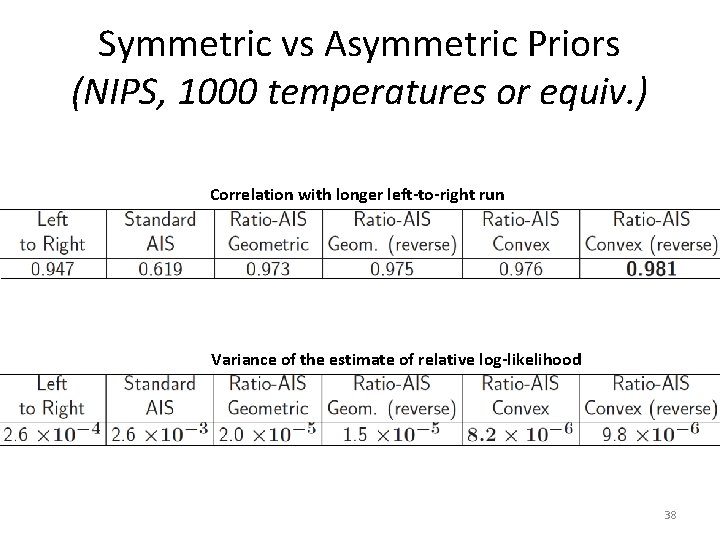
Symmetric vs Asymmetric Priors (NIPS, 1000 temperatures or equiv. ) Correlation with longer left-to-right run Variance of the estimate of relative log-likelihood 38
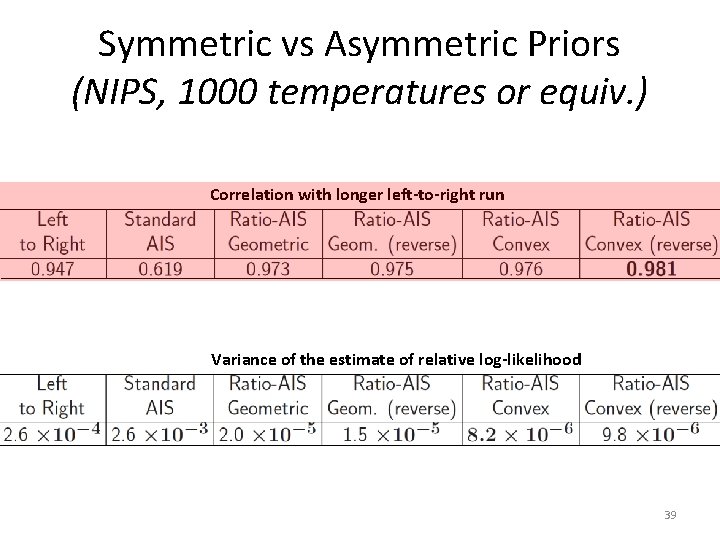
Symmetric vs Asymmetric Priors (NIPS, 1000 temperatures or equiv. ) Correlation with longer left-to-right run Variance of the estimate of relative log-likelihood 39
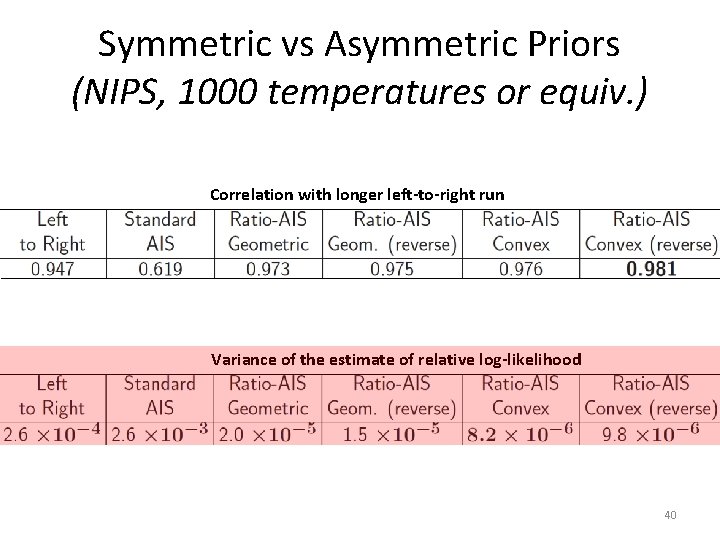
Symmetric vs Asymmetric Priors (NIPS, 1000 temperatures or equiv. ) Correlation with longer left-to-right run Variance of the estimate of relative log-likelihood 40
Per-Iteration Evaluation, ACL Dataset 41
Per-Iteration Evaluation, ACL Dataset 42
Conclusions • Use Ratio-AIS for detailed document-level analysis • Run the annealing in both directions to check for convergence failures • Use Left to Right for corpus-level analysis • Use Iteration-AIS to evaluate training algorithms 43
Future Directions • The ratio-AIS and iteration-AIS ideas can potentially be applied to other models with intractable likelihoods or partition functions (e. g. RBMs, ERGMs) • Other annealing paths may be possible • Evaluating topic models remains an important, computationally challenging problem 44
Thank You! Questions? 45