
ANNbased image segmentation and classification for dynamic contrastenhanced
ANN-based image segmentation and classification for dynamic contrast-enhanced breast MRI Botond K. Szabó * Peter Aspelin ** Maria Kristoffersen-Wiberg ** * Department of Radiology, University of Szeged of Clinical Science, Internvention and Technology, Karolinska Institutet, Sweden **Department Hungary Slicer Training 2011 - University of Szeged 1 12/14/2021
Indications for breast MRI • Breast implants failure • Preoperative staging of lobular ca • Monitoring the effect of chemotherapy • Postoperative follow-up • Detection of occult carcinomas • Screening in high-risk women 2 Center for Surgical Sciences, Karolinska Institutet 14/12/2021
MRI of the breast • Non-enhanced MRI: breast implants • Gd-DTPA-enhanced dynamic MRI: detection of breast cancer Features of contrast enhancement used for image interpretation: - amount - morphology - kinetics 3 Center for Surgical Sciences, Karolinska Institutet 14/12/2021
Dynamic contrast-enhanced MRI of the breast /DCE-MRI/ • Dynamic study: 1 pre + 7 post-contrast series • Enhancing areas are suspicious of cancer – assessed on subtraction series • Kinetic curves obtained • Manually with ROI technique • Kinetic information can be displayed using colour coded maps on precontast images (primarily to assist diagnosis) 4 Hungary Slicer Training 2011 - University of Szeged 12/14/2021
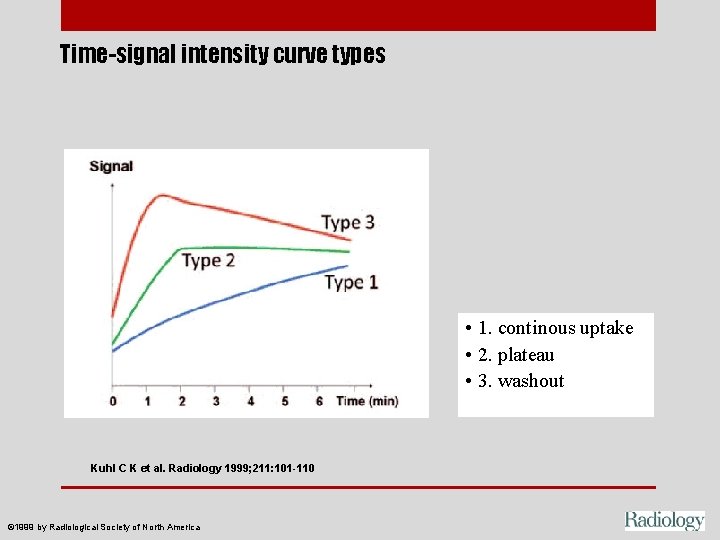
Time-signal intensity curve types • 1. continous uptake • 2. plateau • 3. washout Kuhl C K et al. Radiology 1999; 211: 101 -110 © 1999 by Radiological Society of North America
Aims of the study • ANN-based segmentation system for dynamic breast MR images • Comparison with empiric and pharmaco-kinetic parameters • Diagnostic performance 6 Hungary Slicer Training 2011 - University of Szeged 12/14/2021
Material and Methods (1) • 10 histopathologically verified lesions (7 malignant, 3 benign) • MR technique: • • 1. 5 T system Dynamic study: 1 pre-, 7 postcontrast T 1 -weighted 3 D-FLASH TR 8. 1 ms, TE 4 ms, FA 200, FOV 320 mm, matrix 96 x 256, AT 1 min, contrast dose: 0. 1 mmol/kg bw. 7 Hungary Slicer Training 2011 - University of Szeged 12/14/2021
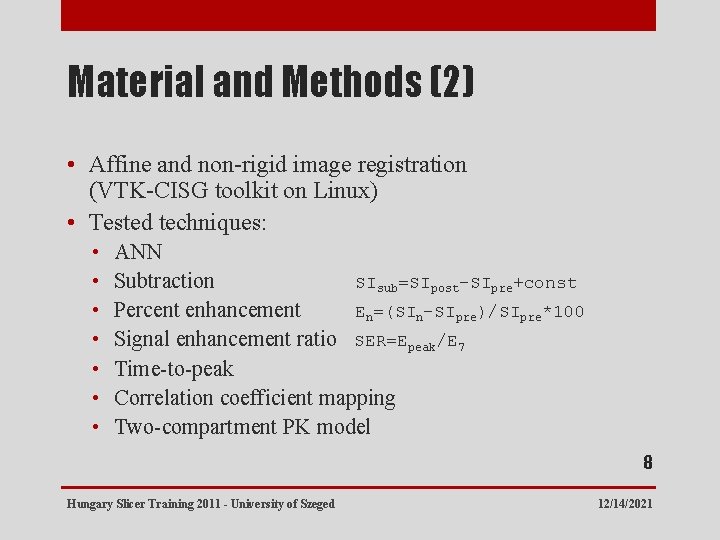
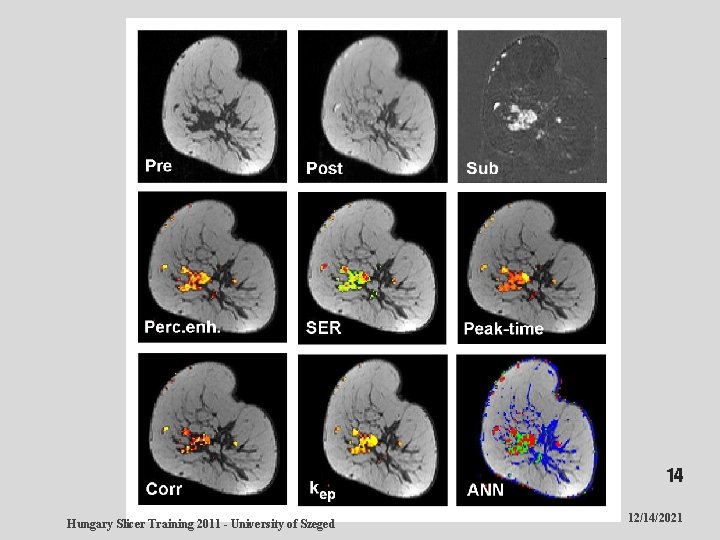
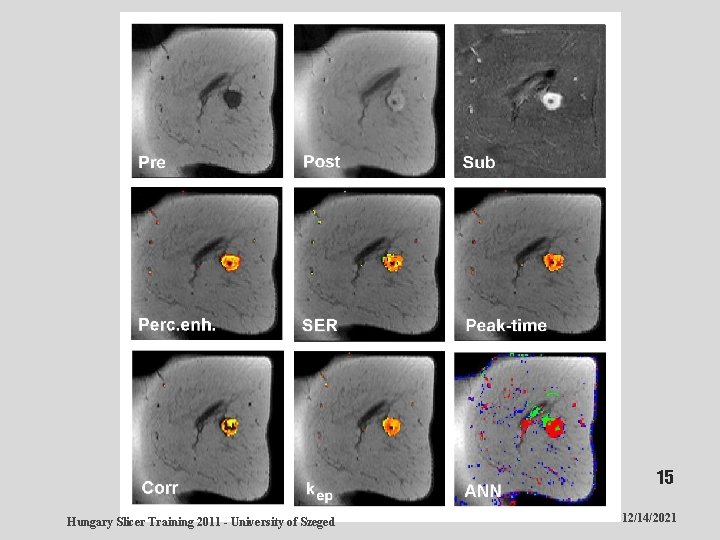
Material and Methods (2) • Affine and non-rigid image registration (VTK-CISG toolkit on Linux) • Tested techniques: • • ANN Subtraction SIsub=SIpost-SIpre+const Percent enhancement En=(SIn-SIpre)/SIpre*100 Signal enhancement ratio SER=Epeak/E 7 Time-to-peak Correlation coefficient mapping Two-compartment PK model 8 Hungary Slicer Training 2011 - University of Szeged 12/14/2021

ANN-based segmentation • Two-layered FFBP ANN (trained on 140 curves) • 7 input units: E 1 -E 7 • 4 hidden units • 4 output classes: • • M=malignant B=benign P=parenchyma F=fat tissue E 1 E 2 M E 3 E 4 B E 5 P E 6 E 7 F 9 Hungary Slicer Training 2011 - University of Szeged 12/14/2021
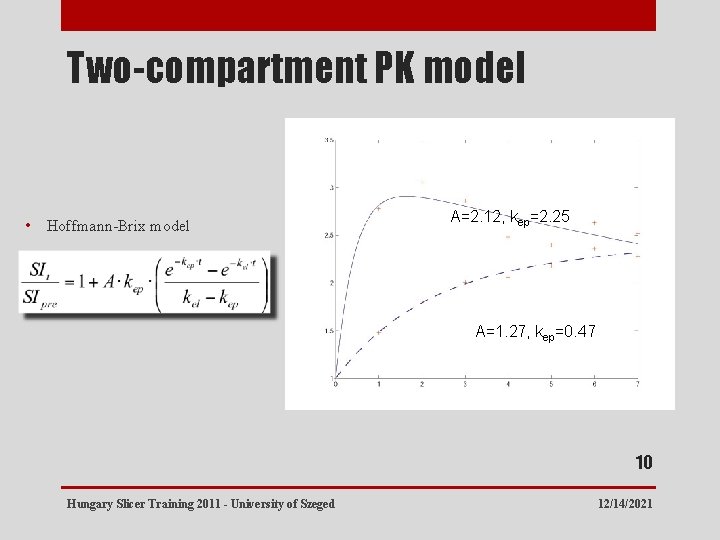
Two-compartment PK model • Hoffmann-Brix model A=2. 12, kep=2. 25 A=1. 27, kep=0. 47 10 Hungary Slicer Training 2011 - University of Szeged 12/14/2021
Correlation coefficient mapping • Spearman’s rank order correlation coefficient mapping • reference curve: mean malignant (washout) curve 11 Hungary Slicer Training 2011 - University of Szeged 12/14/2021
Statistical analysis • stepwise logistic regression • compare ANN output with other parameters • 250 benign and 250 malignant pixels 12 Hungary Slicer Training 2011 - University of Szeged 12/14/2021
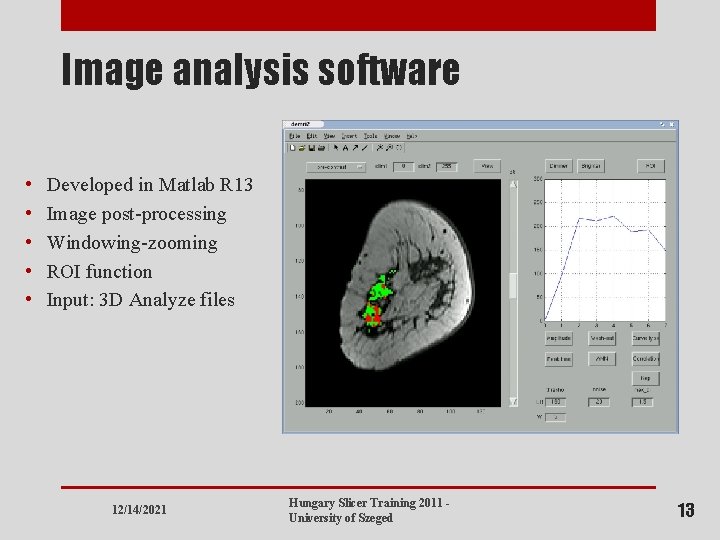
Image analysis software • • • Developed in Matlab R 13 Image post-processing Windowing-zooming ROI function Input: 3 D Analyze files 12/14/2021 Hungary Slicer Training 2011 University of Szeged 13
14 Hungary Slicer Training 2011 - University of Szeged 12/14/2021
15 Hungary Slicer Training 2011 - University of Szeged 12/14/2021
Results: diagnostic performance • Human reader: sensitivity=100%, specificity=66% • ANN: sensitivity=71%, specificity=100% 16 Hungary Slicer Training 2011 - University of Szeged 12/14/2021
Results: statistical analysis • Parameters independently related to ANN output: • Correlation coefficient (OR=12. 9) • kep (OR=1. 8) • Time-to-peak (OR=0. 45) 17 Hungary Slicer Training 2011 - University of Szeged 12/14/2021
Conclusions • ANN method was successfully applied to segmentation and classification of breast DCE-MR images • Mapping correlation coefficient and PK parameters are comparable to ANN 18 Hungary Slicer Training 2011 - University of Szeged 12/14/2021
- Slides: 18