
AnNajah National University Engineering Faculty Civil Engineering Department



- Slides: 25
An-Najah National University Engineering Faculty Civil Engineering Department Design of Several Foundation Systems For Faculty of Optics Prepared by: Maysaa Qushou Sama Ismail Supervisor: Dr. Isam Jaradanah
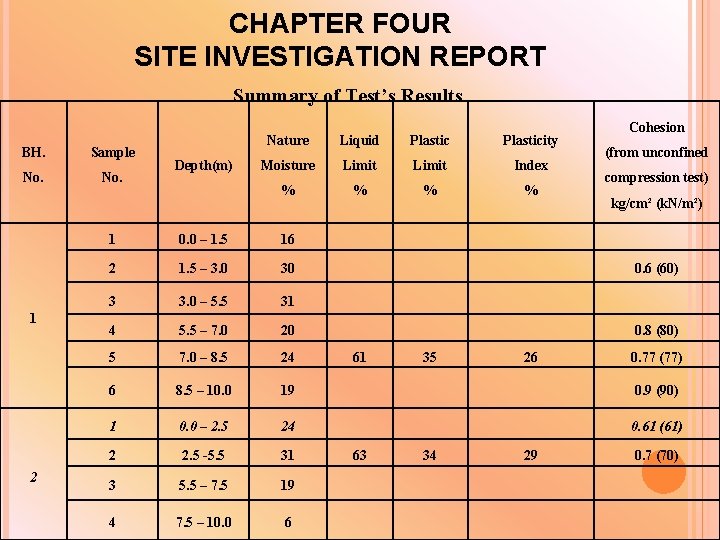
Chapter one presents the introduction of the whole project. Chapter Two presents general types of foundation system Chapter three presents the structural system of the building that analyzed by two methods which are; tributary area and SAP 2000 ver. 12 program to find the loads applied on columns and walls. Chapter four presents site investigation report including the main aspects of geotechnical prosperities
The rest chapters present the design of foundations system for the proposed project. In Chapter five, the isolated footing is checked if it can be used or not. while chapter six presents the design of mat foundation, including mat thickness, settlement, mat reinforcement. Finally, chapter seven presents design of pile foundation. Single pile capacity is estimated using several methods, group of piles is found, and pile cap is designed.
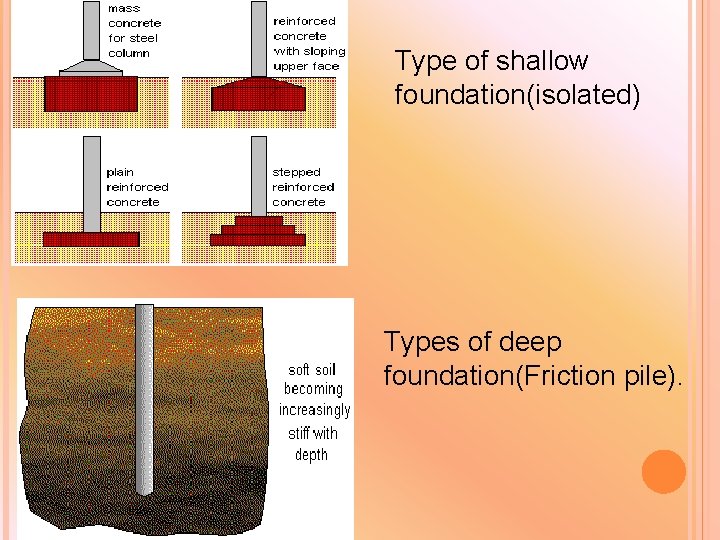
CHAPTER TWO REVIEW OF ENGINEERING FOUNDATIONS The lowest part of the structure generally is referred to as the foundation; its function is to transfer the load of the structure to the soil on which it is resting. Types of Foundations There are two main types of foundations: • Shallow Foundations • Deep Foundations
Type of shallow foundation(isolated) Types of deep foundation(Friction pile).
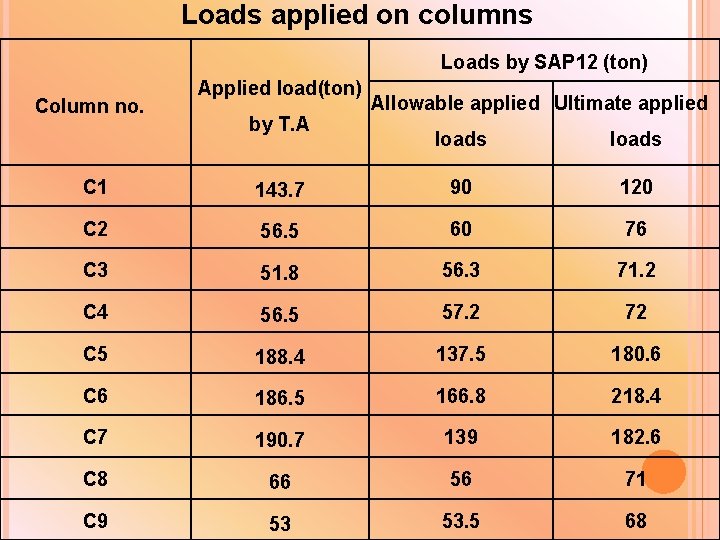
CHAPTER THREE STRUCTURAL SYSTEM Description of the Structure The structure that will be analyzed is the Optics Building in An-Najah University. The structure consists of seven stories building; its area is equal to 1200 m². The main objective of this chapter is to find the loads applied on columns using two methods which are; Tributary area method analysis using software called SAP 12.
Loads applied on columns Loads by SAP 12 (ton) Column no. Applied load(ton) by T. A Allowable applied Ultimate applied loads C 1 143. 7 90 120 C 2 56. 5 60 76 C 3 51. 8 56. 3 71. 2 C 4 56. 5 57. 2 72 C 5 188. 4 137. 5 180. 6 C 6 186. 5 166. 8 218. 4 C 7 190. 7 139 182. 6 C 8 66 56 71 C 9 53 53. 5 68
CHAPTER FOUR SITE INVESTIGATION REPORT Summary of Test’s Results BH. Sample No. 1 2 Depth(m) Nature Liquid Plasticity Moisture Limit Index % % Cohesion (from unconfined compression test) kg/cm² (k. N/m²) 1 0. 0 – 1. 5 16 2 1. 5 – 3. 0 30 3 3. 0 – 5. 5 31 4 5. 5 – 7. 0 20 5 7. 0 – 8. 5 24 6 8. 5 – 10. 0 19 0. 9 (90) 1 0. 0 – 2. 5 24 0. 61 (61) 2 2. 5 -5. 5 31 3 5. 5 – 7. 5 19 4 7. 5 – 10. 0 6 0. 6 (60) 0. 8 (80) 61 63 35 34 26 29 0. 77 (77) 0. 7 (70)
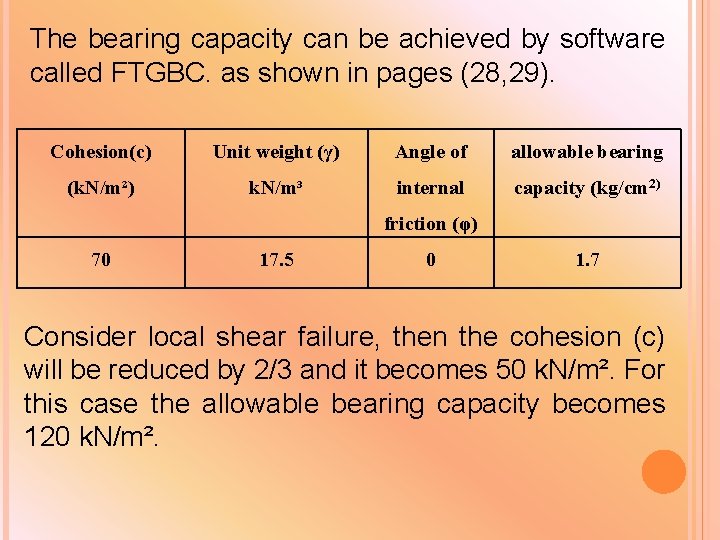
The bearing capacity can be achieved by software called FTGBC. as shown in pages (28, 29). Cohesion(c) Unit weight (γ) Angle of allowable bearing (k. N/m²) k. N/m³ internal capacity (kg/cm 2) friction (φ) 70 17. 5 0 1. 7 Consider local shear failure, then the cohesion (c) will be reduced by 2/3 and it becomes 50 k. N/m². For this case the allowable bearing capacity becomes 120 k. N/m².
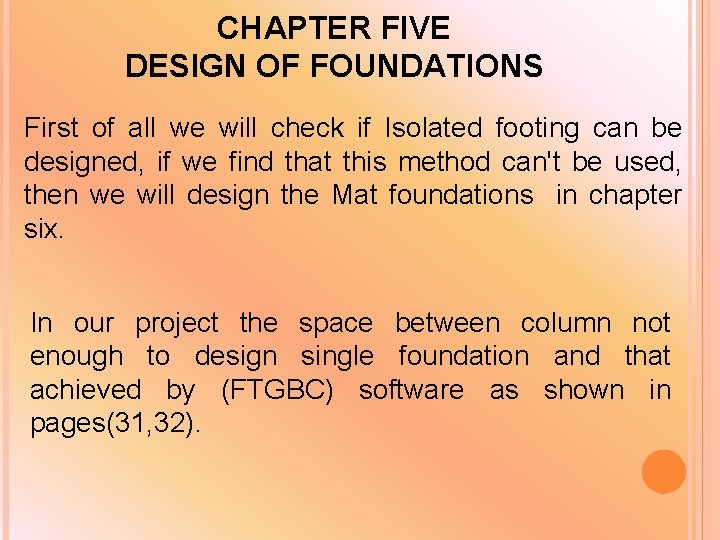
CHAPTER FIVE DESIGN OF FOUNDATIONS First of all we will check if Isolated footing can be designed, if we find that this method can't be used, then we will design the Mat foundations in chapter six. In our project the space between column not enough to design single foundation and that achieved by (FTGBC) software as shown in pages(31, 32).
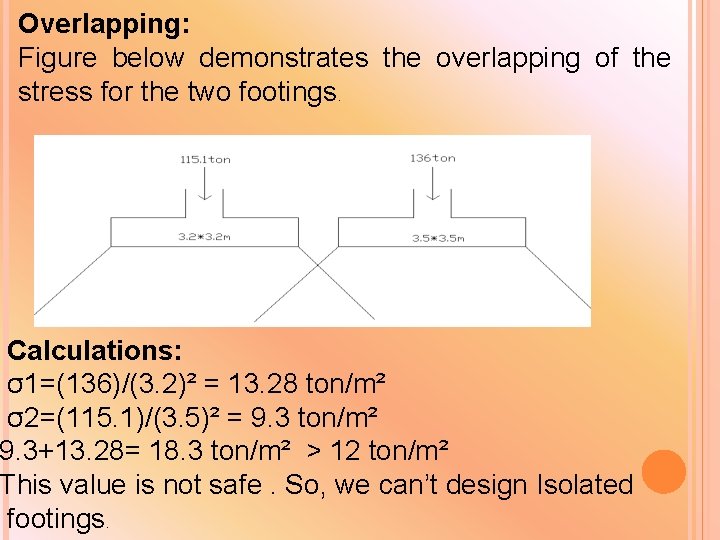
Overlapping: Figure below demonstrates the overlapping of the stress for the two footings. Calculations: σ1=(136)/(3. 2)² = 13. 28 ton/m² σ2=(115. 1)/(3. 5)² = 9. 3 ton/m² 9. 3+13. 28= 18. 3 ton/m² > 12 ton/m² This value is not safe. So, we can’t design Isolated footings.
CHAPTER SIX MAT FOUNDATIONS Mat foundations are used to spread the load from a structure over a large area, normally the entire area of the structure. To design Mat Foundations, the depth of the mat has to be found from punching shear equation manually. Then, the maximum moment in (X) and (Y) directions, area of steel and settlement are found from SAP.
To find the depth of foundation, the punching shear equation is used at edge, corner, middle. Φ Vc= (0. 85)(0. 34)(√fc`)(bo)(d) The results achieved are: d = 60 cm At edge. d = 80 cm at corner. d = 40 cm at middle. d selected = d max. = 80 cm. Then the total thickness of the mat equals: h= d + cover + de h= 80 + 25 + 5= 110 cm
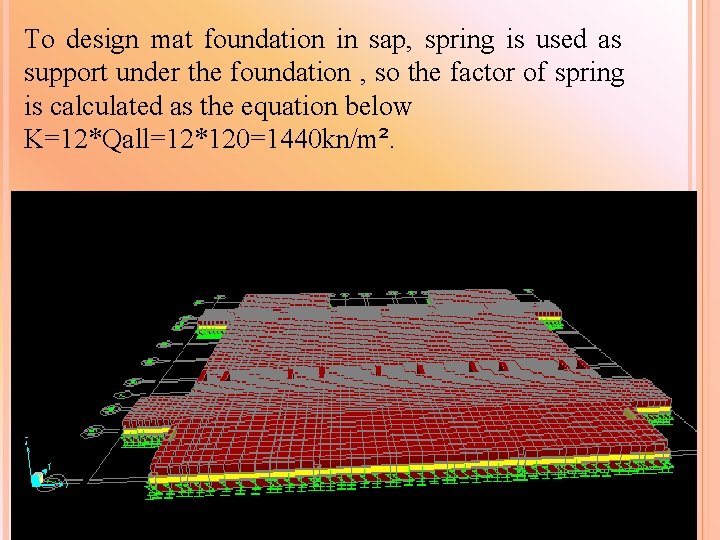
To design mat foundation in sap, spring is used as support under the foundation , so the factor of spring is calculated as the equation below K=12*Qall=12*120=1440 kn/m².
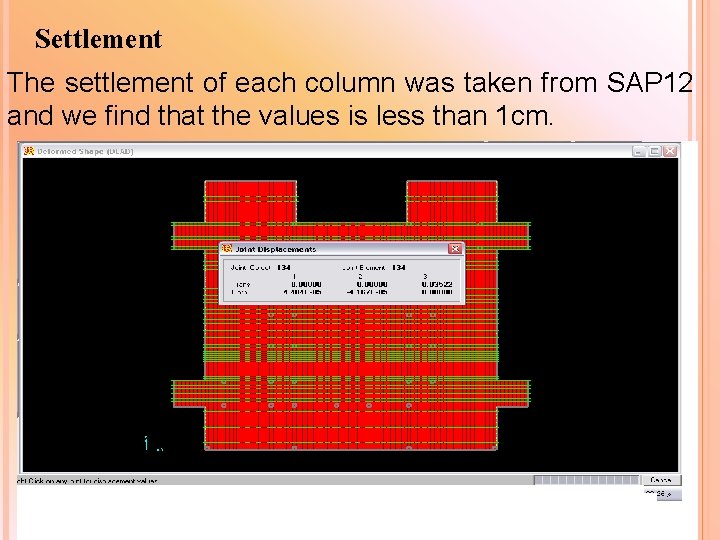
Settlement The settlement of each column was taken from SAP 12 and we find that the values is less than 1 cm.
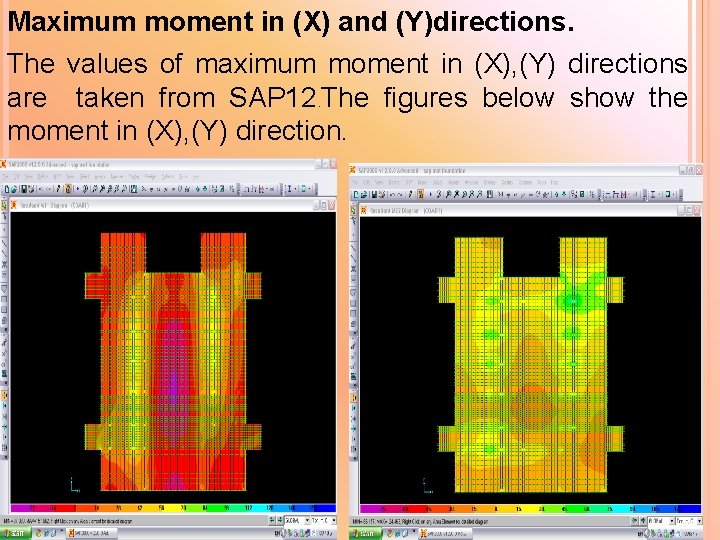
Maximum moment in (X) and (Y)directions. The values of maximum moment in (X), (Y) directions are taken from SAP 12. The figures below show the moment in (X), (Y) direction.
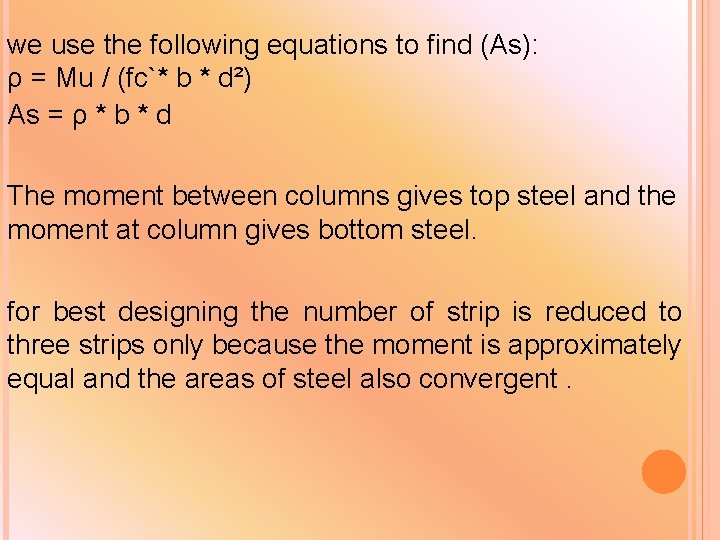
we use the following equations to find (As): ρ = Mu / (fc`* b * d²) As = ρ * b * d The moment between columns gives top steel and the moment at column gives bottom steel. for best designing the number of strip is reduced to three strips only because the moment is approximately equal and the areas of steel also convergent.
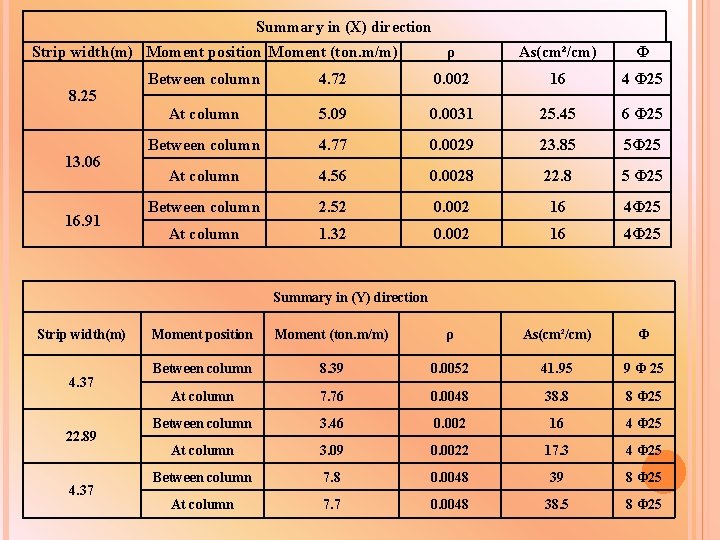
Summary in (X) direction Strip width(m) Moment position Moment (ton. m/m) 8. 25 13. 06 16. 91 ρ As(cm²/cm) Φ Between column 4. 72 0. 002 16 4 Φ 25 At column 5. 09 0. 0031 25. 45 6 Φ 25 Between column 4. 77 0. 0029 23. 85 5Φ 25 At column 4. 56 0. 0028 22. 8 5 Φ 25 Between column 2. 52 0. 002 16 4Φ 25 At column 1. 32 0. 002 16 4Φ 25 Summary in (Y) direction Strip width(m) 4. 37 22. 89 4. 37 Moment position Moment (ton. m/m) ρ As(cm²/cm) Φ Between column 8. 39 0. 0052 41. 95 9 Φ 25 At column 7. 76 0. 0048 38. 8 8 Φ 25 Between column 3. 46 0. 002 16 4 Φ 25 At column 3. 09 0. 0022 17. 3 4 Φ 25 Between column 7. 8 0. 0048 39 8 Φ 25 At column 7. 7 0. 0048 38. 5 8 Φ 25
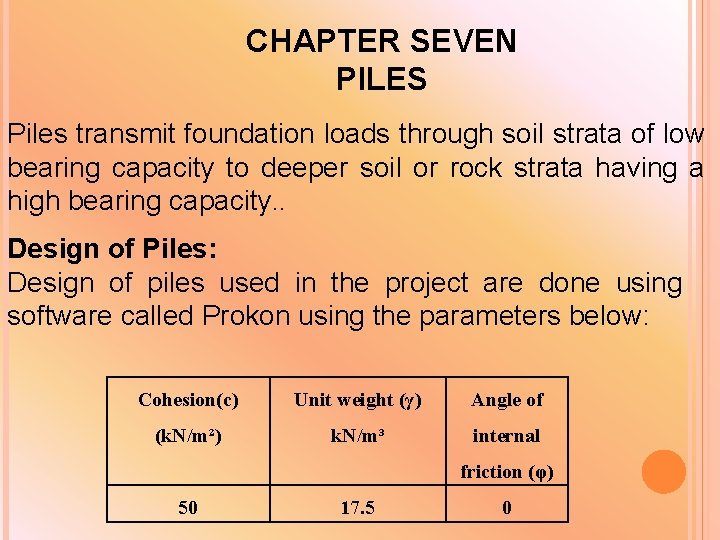
CHAPTER SEVEN PILES Piles transmit foundation loads through soil strata of low bearing capacity to deeper soil or rock strata having a high bearing capacity. . Design of Piles: Design of piles used in the project are done using software called Prokon using the parameters below: Cohesion(c) Unit weight (γ) Angle of (k. N/m²) k. N/m³ internal friction (φ) 50 17. 5 0
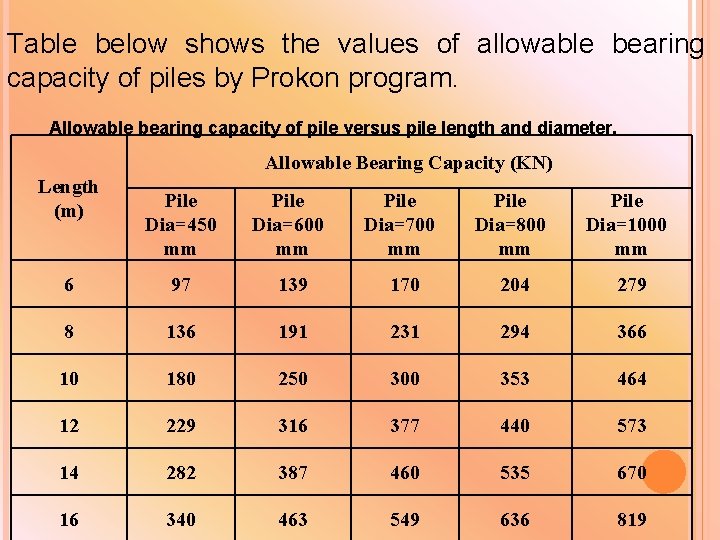
Table below shows the values of allowable bearing capacity of piles by Prokon program. Allowable bearing capacity of pile versus pile length and diameter. Allowable Bearing Capacity (KN) Length (m) Pile Dia=450 mm Pile Dia=600 mm Pile Dia=700 mm Pile Dia=800 mm Pile Dia=1000 mm 6 97 139 170 204 279 8 136 191 231 294 366 10 180 250 300 353 464 12 229 316 377 440 573 14 282 387 460 535 670 16 340 463 549 636 819
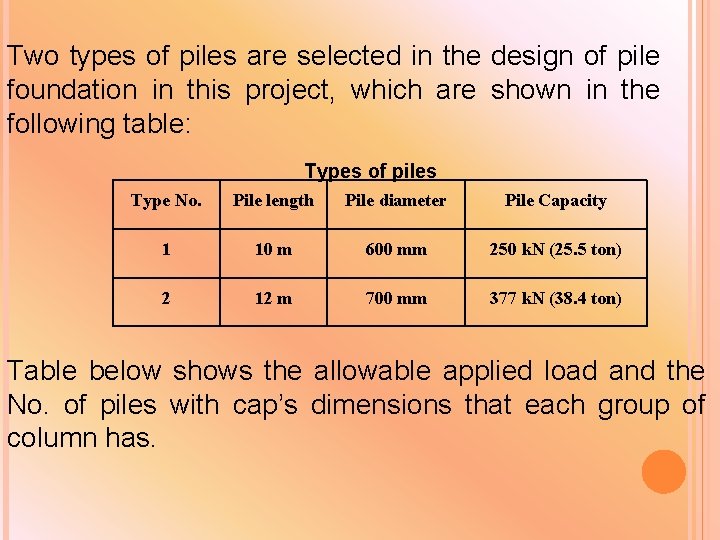
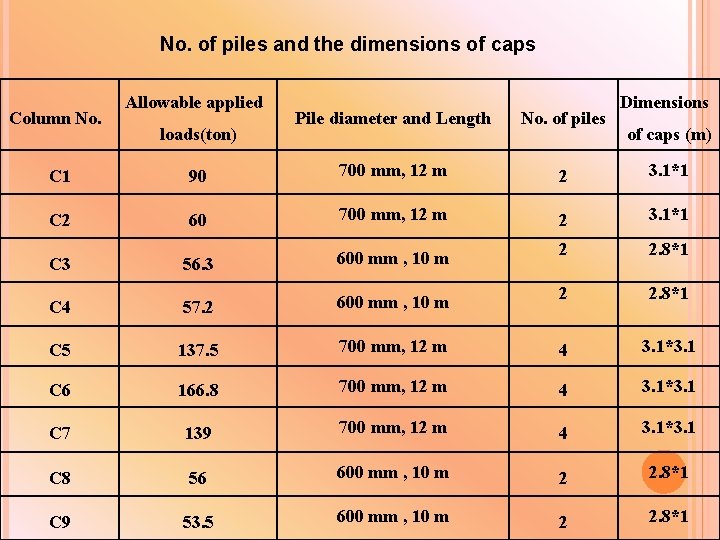
Two types of piles are selected in the design of pile foundation in this project, which are shown in the following table: Types of piles Type No. Pile length Pile diameter Pile Capacity 1 10 m 600 mm 250 k. N (25. 5 ton) 2 12 m 700 mm 377 k. N (38. 4 ton) Table below shows the allowable applied load and the No. of piles with cap’s dimensions that each group of column has.
No. of piles and the dimensions of caps Column No. Allowable applied loads(ton) Pile diameter and Length No. of piles Dimensions of caps (m) C 1 90 700 mm, 12 m 2 3. 1*1 C 2 60 700 mm, 12 m 2 3. 1*1 56. 3 600 mm , 10 m 2 2. 8*1 C 4 57. 2 600 mm , 10 m 2 2. 8*1 C 5 137. 5 700 mm, 12 m 4 3. 1*3. 1 C 6 166. 8 700 mm, 12 m 4 3. 1*3. 1 C 7 139 700 mm, 12 m 4 3. 1*3. 1 C 8 56 600 mm , 10 m 2 2. 8*1 C 9 53. 5 600 mm , 10 m 2 2. 8*1 C 3
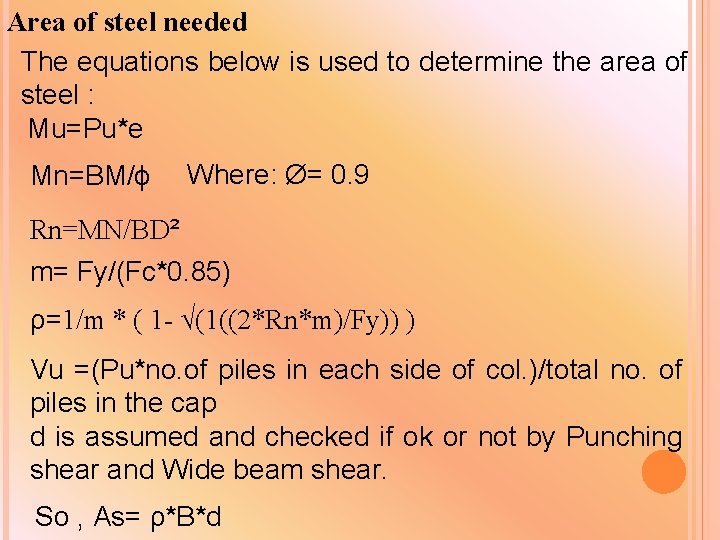
Area of steel needed The equations below is used to determine the area of steel : Mu=Pu*e Mn=BM/ɸ Where: Ø= 0. 9 Rn=MN/BD² m= Fy/(Fc*0. 85) ρ=1/m * ( 1 - √(1((2*Rn*m)/Fy)) ) Vu =(Pu*no. of piles in each side of col. )/total no. of piles in the cap d is assumed and checked if ok or not by Punching shear and Wide beam shear. So , As= ρ*B*d
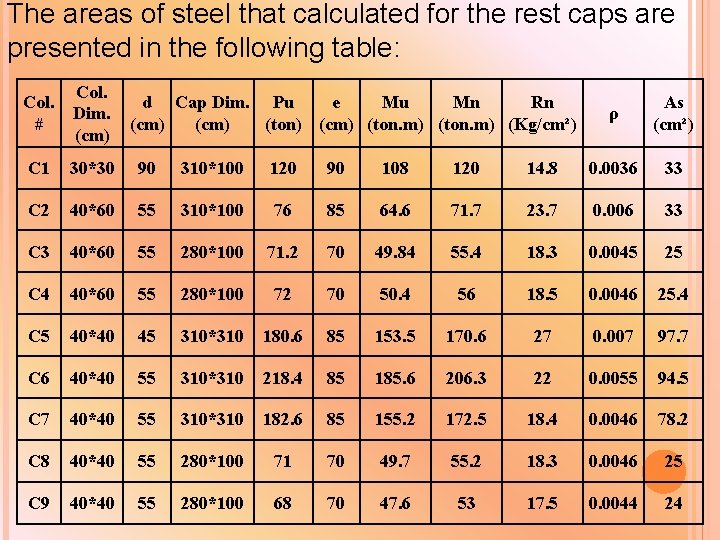
The areas of steel that calculated for the rest caps are presented in the following table: Col. # Col. Dim. (cm) C 1 30*30 90 310*100 120 90 108 120 C 2 40*60 55 310*100 76 85 64. 6 C 3 40*60 55 280*100 71. 2 70 C 4 40*60 55 280*100 72 C 5 40*40 45 310*310 C 6 40*40 55 C 7 40*40 C 8 C 9 d Cap Dim. Pu e Mu Mn Rn (cm) (ton) (cm) (ton. m) (Kg/cm²) ρ As (cm²) 14. 8 0. 0036 33 71. 7 23. 7 0. 006 33 49. 84 55. 4 18. 3 0. 0045 25 70 50. 4 56 18. 5 0. 0046 25. 4 180. 6 85 153. 5 170. 6 27 0. 007 97. 7 310*310 218. 4 85 185. 6 206. 3 22 0. 0055 94. 5 55 310*310 182. 6 85 155. 2 172. 5 18. 4 0. 0046 78. 2 40*40 55 280*100 71 70 49. 7 55. 2 18. 3 0. 0046 25 40*40 55 280*100 68 70 47. 6 53 17. 5 0. 0044 24
Thank you for your attention