
Anna Frebel nucleosynthesis stars chemical evolution Nucleosynthesis stellar
Anna Frebel nucleosynthesis, stars + chemical evolution Nucleosynthesis, stellar abundances, and chemical evolution Anna Frebel P-329 Guest lecture “Stars and planets” class by Dimitar Sasselov, Fall 2010
Anna Frebel nucleosynthesis, stars + chemical evolution Ulitmate question How did the solar abundances come about?
nucleosynthesis, stars + chemical evolution Stellar spectra Anna Frebel
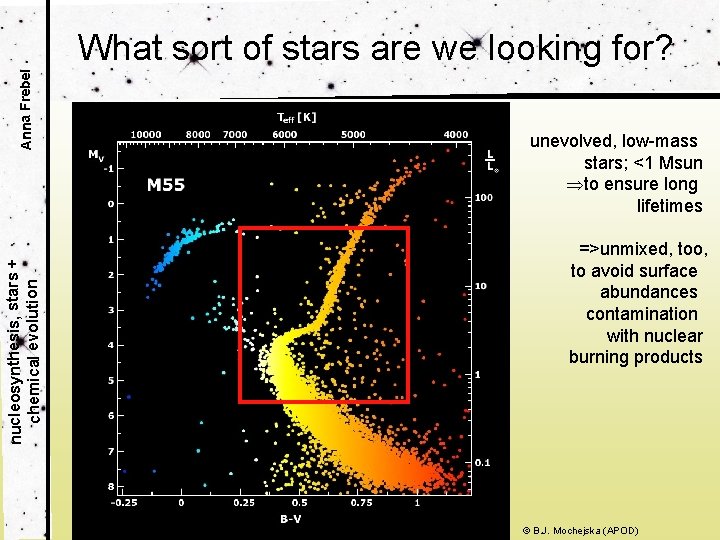
nucleosynthesis, stars + chemical evolution Anna Frebel What sort of stars are we looking for? unevolved, low-mass stars; <1 Msun to ensure long lifetimes =>unmixed, too, to avoid surface abundances contamination with nuclear burning products © B. J. Mochejska (APOD)
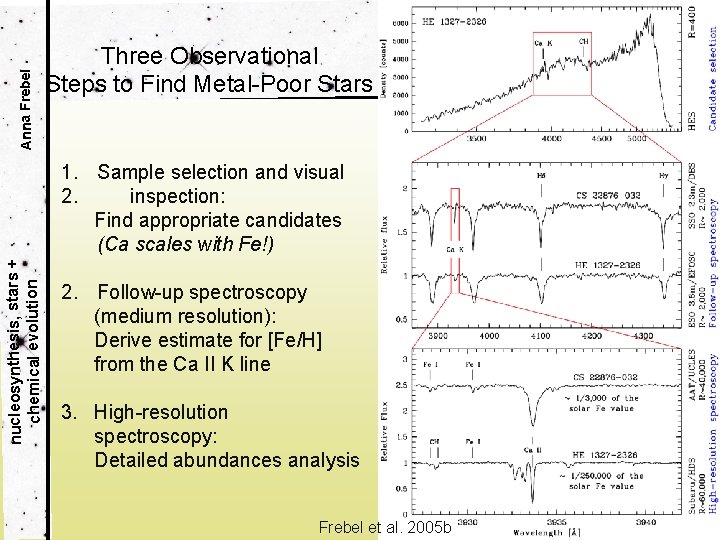
Anna Frebel Three Observational Steps to Find Metal-Poor Stars nucleosynthesis, stars + chemical evolution 1. Sample selection and visual 2. inspection: Find appropriate candidates (Ca scales with Fe!) 2. Follow-up spectroscopy (medium resolution): Derive estimate for [Fe/H] from the Ca II K line 3. High-resolution spectroscopy: Detailed abundances analysis Frebel et al. 2005 b
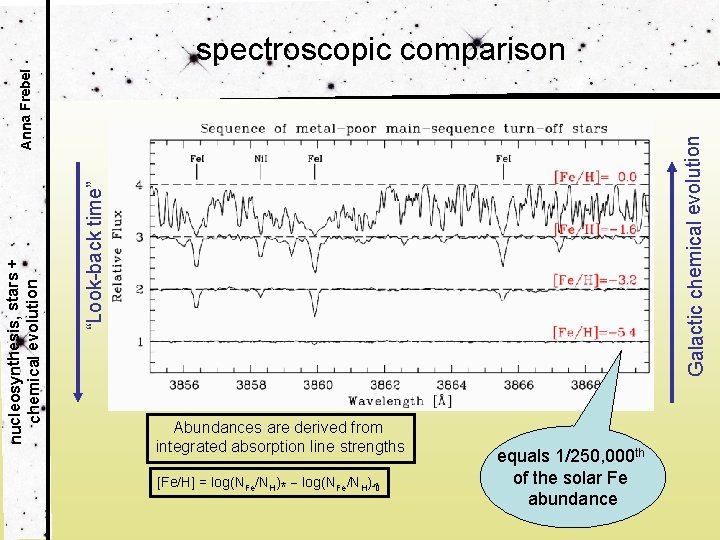
Galactic chemical evolution “Look-back time” nucleosynthesis, stars + chemical evolution Anna Frebel spectroscopic comparison Abundances are derived from integrated absorption line strengths [Fe/H] = log(NFe/NH) * equals 1/250, 000 th of the solar Fe abundance
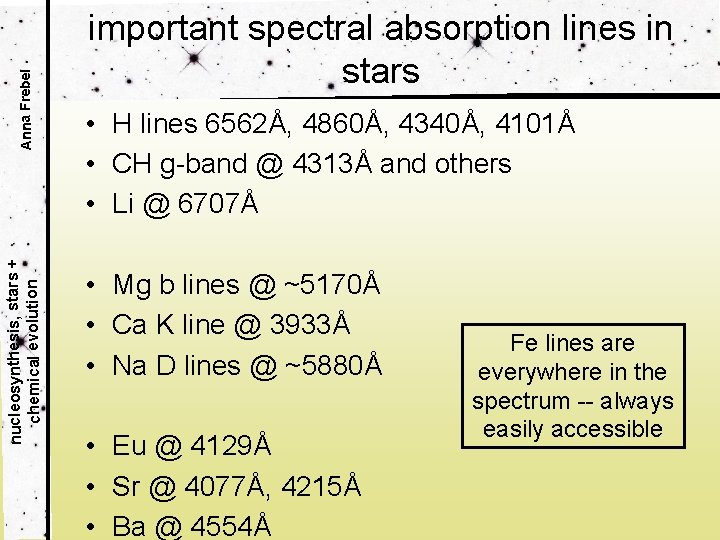
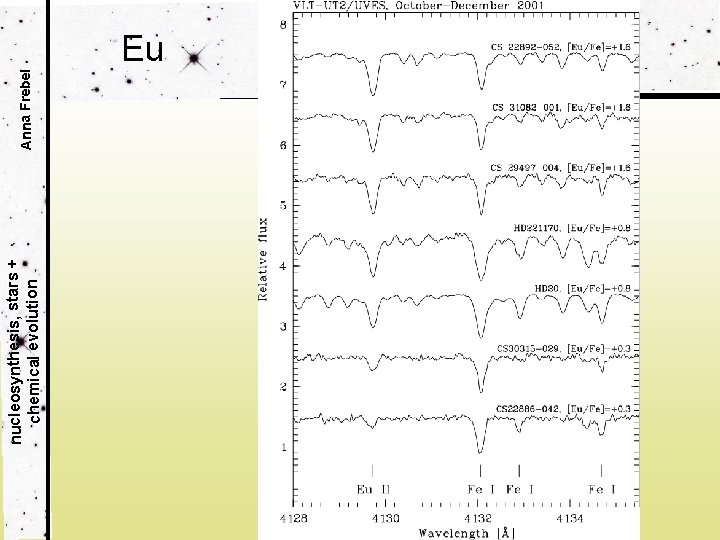
Anna Frebel nucleosynthesis, stars + chemical evolution important spectral absorption lines in stars • H lines 6562Å, 4860Å, 4340Å, 4101Å • CH g-band @ 4313Å and others • Li @ 6707Å • Mg b lines @ ~5170Å • Ca K line @ 3933Å • Na D lines @ ~5880Å • Eu @ 4129Å • Sr @ 4077Å, 4215Å • Ba @ 4554Å Fe lines are everywhere in the spectrum -- always easily accessible
![Anna Frebel Carbon & nitrogen Huge carbon abundance ([C/Fe]= +3. 7): (=> not so](http://slidetodoc.com/presentation_image_h/bdb865055f441c97be4cdff0a7e62025/image-8.jpg "Anna Frebel Carbon & nitrogen Huge carbon abundance ([C/Fe]= +3. 7): (=> not so")
Anna Frebel Carbon & nitrogen Huge carbon abundance ([C/Fe]= +3. 7): (=> not so carbon-poor. . . ) nucleosynthesis, stars + chemical evolution Synthetic spectrum: red lines Carbon (CH) band 5, 000 and 12, 000 times more carbon and nitrogen exist than iron! Huge nitrogen abundance ([N/Fe]= +4. 1): (=> not so nitrogen-poor. . . ) Synthetic spectrum: red lines Reminder: Solar ratio [C, N/Fe] = 0 Nitrogen (NH) band Frebel et al. 2008, Ap. J subm.
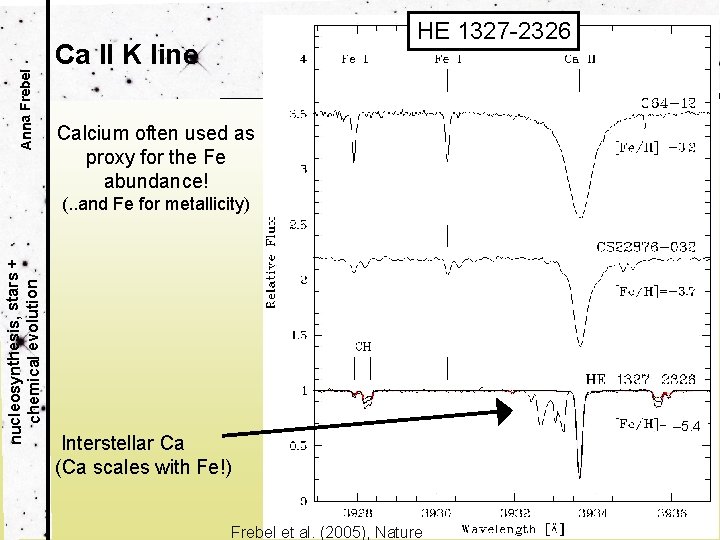
Anna Frebel HE 1327 -2326 Ca II K line Calcium often used as proxy for the Fe abundance! nucleosynthesis, stars + chemical evolution (. . and Fe for metallicity) Interstellar Ca (Ca scales with Fe!) Frebel et al. (2005), Nature – 5. 4
nucleosynthesis, stars + chemical evolution Anna Frebel Mg b lines
nucleosynthesis, stars + chemical evolution Anna Frebel Eu
Anna Frebel Thorium II Line 4019Å Abundance: Synthetic spectrum (based on atomic data and model atmosphere) to match observed spectrum ‘Best fit’ synthetic spectrum Th HE 1523 -0901 Frebel et al. (2010), in prep. nucleosynthesis, stars + chemical evolution Synthetic spectrum that includes NO thorium
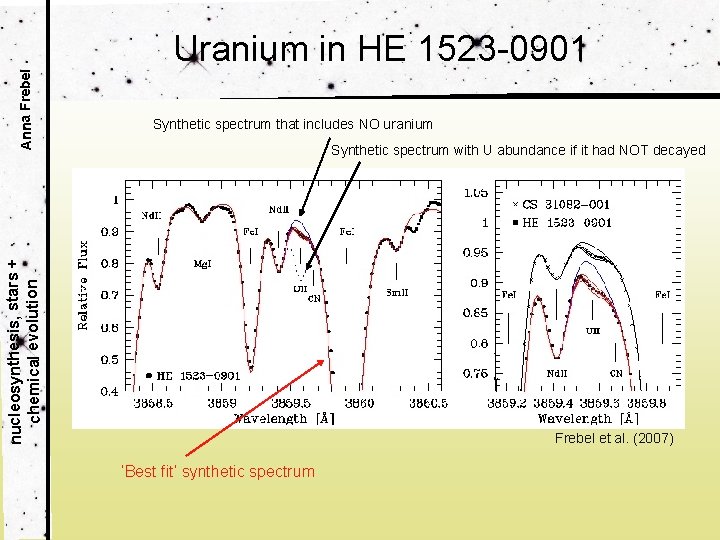
Synthetic spectrum that includes NO uranium Synthetic spectrum with U abundance if it had NOT decayed nucleosynthesis, stars + chemical evolution Anna Frebel Uranium in HE 1523 -0901 Frebel et al. (2007) ‘Best fit’ synthetic spectrum
Anna Frebel nucleosynthesis, stars + chemical evolution How do we interpret stellar spectra? need to know: model atmosphere analysis techniques knowledge about nucleosynthesis, stellar evolution, chemical evolution, cosmological understanding of galaxy formation
Anna Frebel nucleosynthesis, stars + chemical evolution Model atmosphere analysis techniques Stellar parameters fully characterize a star: effective temperature Teff surface gravity log g metallicity [Fe/H] (microturbulent velocity vmic)
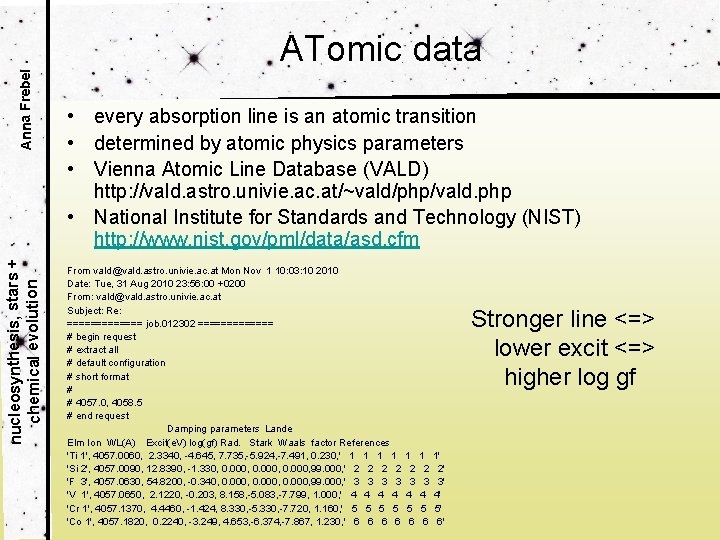
Anna Frebel nucleosynthesis, stars + chemical evolution ATomic data • every absorption line is an atomic transition • determined by atomic physics parameters • Vienna Atomic Line Database (VALD) http: //vald. astro. univie. ac. at/~vald/php/vald. php • National Institute for Standards and Technology (NIST) http: //www. nist. gov/pml/data/asd. cfm From vald@vald. astro. univie. ac. at Mon Nov 1 10: 03: 10 2010 Date: Tue, 31 Aug 2010 23: 56: 00 +0200 From: vald@vald. astro. univie. ac. at Subject: Re: ======= job. 012302 ======= # begin request # extract all # default configuration # short format # # 4057. 0, 4058. 5 # end request Damping parameters Lande Elm Ion WL(A) Excit(e. V) log(gf) Rad. Stark Waals factor References 'Ti 1', 4057. 0060, 2. 3340, -4. 645, 7. 735, -5. 924, -7. 491, 0. 230, ' 1 1 'Si 2', 4057. 0090, 12. 8390, -1. 330, 0. 000, 99. 000, ' 2 2 'F 3', 4057. 0630, 54. 8200, -0. 340, 0. 000, 99. 000, ' 3 3 'V 1', 4057. 0650, 2. 1220, -0. 203, 8. 158, -5. 083, -7. 799, 1. 000, ' 4 4 'Cr 1', 4057. 1370, 4. 4460, -1. 424, 8. 330, -5. 330, -7. 720, 1. 160, ' 5 5 'Co 1', 4057. 1820, 0. 2240, -3. 249, 4. 653, -6. 374, -7. 867, 1. 230, ' 6 6 Stronger line <=> lower excit <=> higher log gf 1 2 3 4 5 6 1' 2' 3' 4' 5' 6'
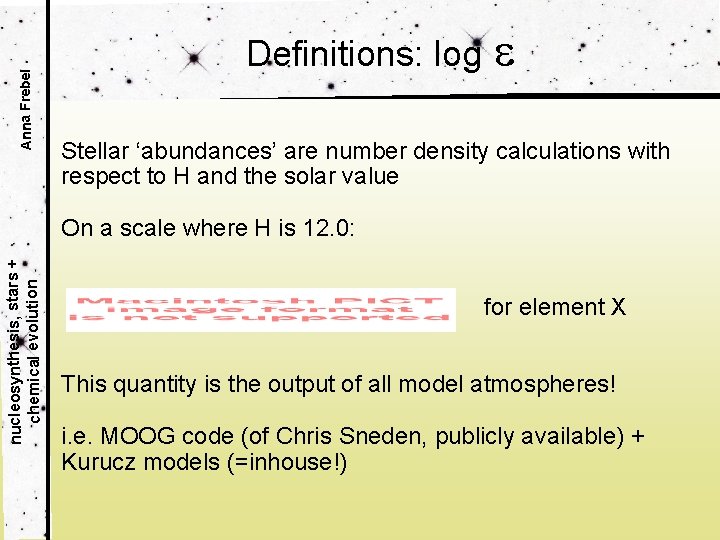
Anna Frebel Definitions: log Stellar ‘abundances’ are number density calculations with respect to H and the solar value nucleosynthesis, stars + chemical evolution On a scale where H is 12. 0: for element X This quantity is the output of all model atmospheres! i. e. MOOG code (of Chris Sneden, publicly available) + Kurucz models (=inhouse!)
![Anna Frebel definitions: [fe/h] nucleosynthesis, stars + chemical evolution where NFe and NH is](http://slidetodoc.com/presentation_image_h/bdb865055f441c97be4cdff0a7e62025/image-18.jpg "Anna Frebel definitions: [fe/h] nucleosynthesis, stars + chemical evolution where NFe and NH is")
Anna Frebel definitions: [fe/h] nucleosynthesis, stars + chemical evolution where NFe and NH is the no. of iron and hydrogen atoms per unit of volume respectively. for elements A and B
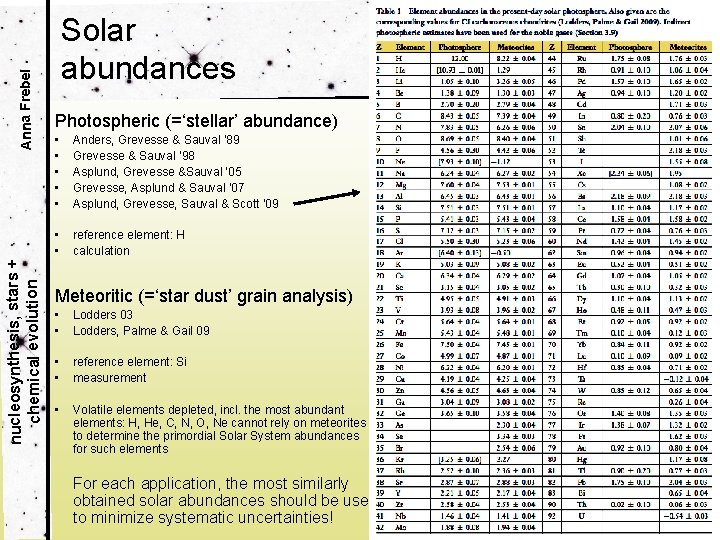
Anna Frebel nucleosynthesis, stars + chemical evolution Solar abundances Photospheric (=‘stellar’ abundance) • • • Anders, Grevesse & Sauval ‘ 89 Grevesse & Sauval ‘ 98 Asplund, Grevesse &Sauval ‘ 05 Grevesse, Asplund & Sauval ‘ 07 Asplund, Grevesse, Sauval & Scott ‘ 09 • • reference element: H calculation Meteoritic (=‘star dust’ grain analysis) • • Lodders 03 Lodders, Palme & Gail 09 • • reference element: Si measurement • Volatile elements depleted, incl. the most abundant elements: H, He, C, N, O, Ne cannot rely on meteorites to determine the primordial Solar System abundances for such elements For each application, the most similarly obtained solar abundances should be use to minimize systematic uncertainties!
Anna Frebel nucleosynthesis, stars + chemical evolution how to calculate chemical abundances • Need a spectrum => measure equivalent width of absorption lines (=integrated line strength) • Need atomic data (excit. potential+log gf values) => feed both into “model atmosphere” • Get: calculated abundance (number density) log (X) • Calculate [Fe/H] with solar abundances • • • Example: log (Mg)star = 5. 96; log (Fe)star = 5. 50 log (Mg)sun = 7. 60; log (Fe)sun = 7. 50 [Mg/H] = log (Mg)star - log (Mg)sun = -1. 64 [Mg/Fe] = [Mg/H] - [Fe/H] = -1. 64 - (-2. 0) = 0. 36
Anna Frebel nucleosynthesis, stars + chemical evolution How metal-poor? classical example: early universe: primordial gas how metal-poor is the next-generation star? canonical SN Fe yield: 0. 1 Msun available gas mass: 106 Msun
![Anna Frebel nucleosynthesis, stars + chemical evolution classification scheme Range [Fe/H] ≥ +0. 5](http://slidetodoc.com/presentation_image_h/bdb865055f441c97be4cdff0a7e62025/image-22.jpg "Anna Frebel nucleosynthesis, stars + chemical evolution classification scheme Range [Fe/H] ≥ +0. 5")
Anna Frebel nucleosynthesis, stars + chemical evolution classification scheme Range [Fe/H] ≥ +0. 5 [Fe/H] = 0. 0 [Fe/H] ≤ – 1. 0 [Fe/H] ≤ – 2. 0 [Fe/H] ≤ – 3. 0 [Fe/H] ≤ – 4. 0 [Fe/H] ≤ – 5. 0 [Fe/H] ≤ – 6. 0 Term Acronym # Super metal-rich SMR some Solar — a lot! Metal-poor MP very many Very metal-poor VMP many Extremely metal-poor EMP ~100 Ultra metal-poor UMP 1 Hyper metal-poor HMP 2 Mega metal-poor MMP -- Extreme Pop II stars! as suggested by Beers & Christlieb 2005
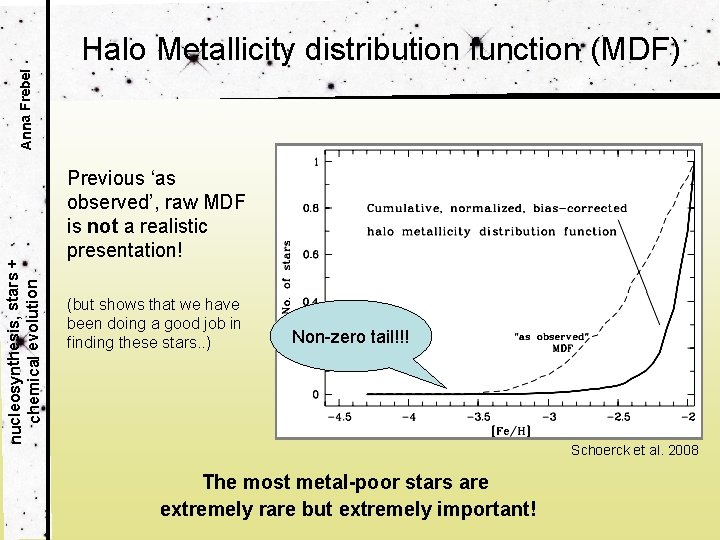
nucleosynthesis, stars + chemical evolution Anna Frebel Halo Metallicity distribution function (MDF) Previous ‘as observed’, raw MDF is not a realistic presentation! (but shows that we have been doing a good job in finding these stars. . ) Non-zero tail!!! Schoerck et al. 2008 The most metal-poor stars are extremely rare but extremely important!
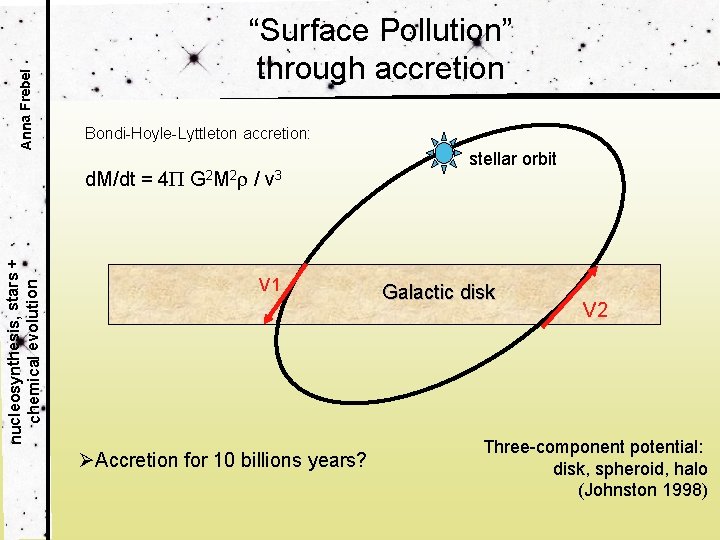
Anna Frebel “Surface Pollution” through accretion Bondi-Hoyle-Lyttleton accretion: nucleosynthesis, stars + chemical evolution d. M/dt = 4 G 2 M 2 / v 3 V 1 ØAccretion for 10 billions years? stellar orbit Galactic disk V 2 Three-component potential: disk, spheroid, halo (Johnston 1998)
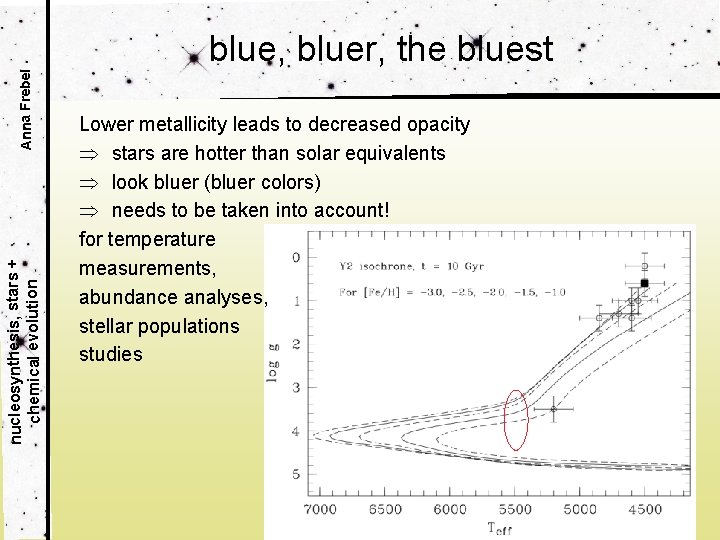
Anna Frebel nucleosynthesis, stars + chemical evolution blue, bluer, the bluest Lower metallicity leads to decreased opacity stars are hotter than solar equivalents look bluer (bluer colors) needs to be taken into account! for temperature measurements, abundance analyses, stellar populations studies
Anna Frebel nucleosynthesis, stars + chemical evolution Nucleosynthesis All elements heavier than Li, Be, B are made during stellar evolution and supernova explosions
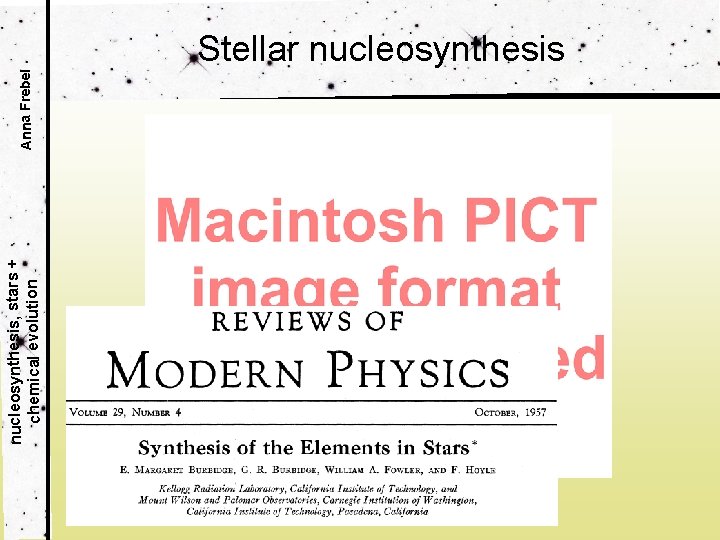
nucleosynthesis, stars + chemical evolution Anna Frebel Stellar nucleosynthesis
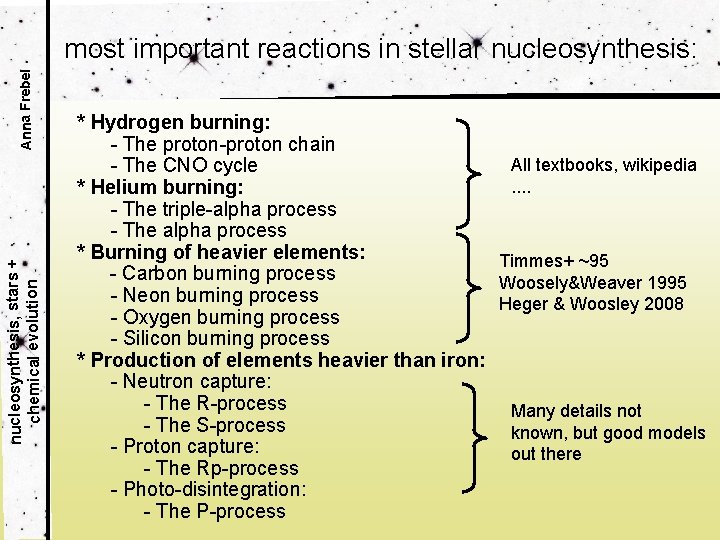
nucleosynthesis, stars + chemical evolution Anna Frebel most important reactions in stellar nucleosynthesis: * Hydrogen burning: - The proton-proton chain All textbooks, wikipedia - The CNO cycle. . * Helium burning: - The triple-alpha process - The alpha process * Burning of heavier elements: Timmes+ ~95 - Carbon burning process Woosely&Weaver 1995 - Neon burning process Heger & Woosley 2008 - Oxygen burning process - Silicon burning process * Production of elements heavier than iron: - Neutron capture: - The R-process Many details not - The S-process known, but good models - Proton capture: out there - The Rp-process - Photo-disintegration: - The P-process
-decay: n => p + e- v _ e nucleosynthesis, stars + chemical evolution Anna Frebel neutron-capture processes • s-process: neutron-capture longer than beta-decay timescale • r-process: neutron-capture shorter than beta-decay timescale
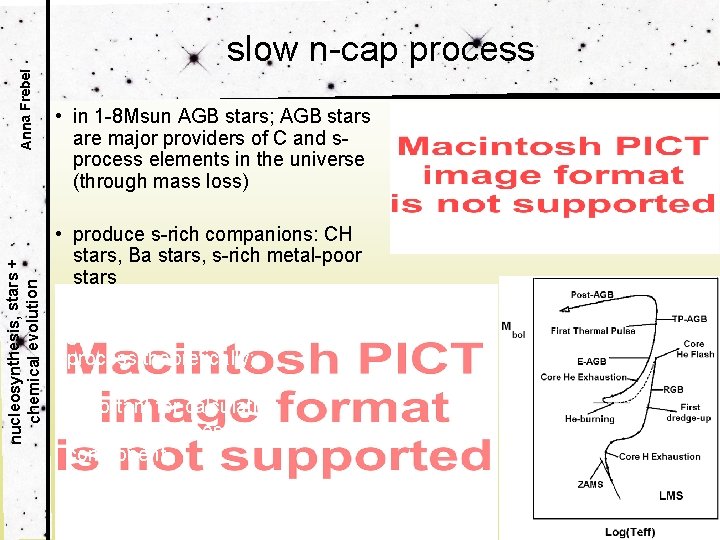
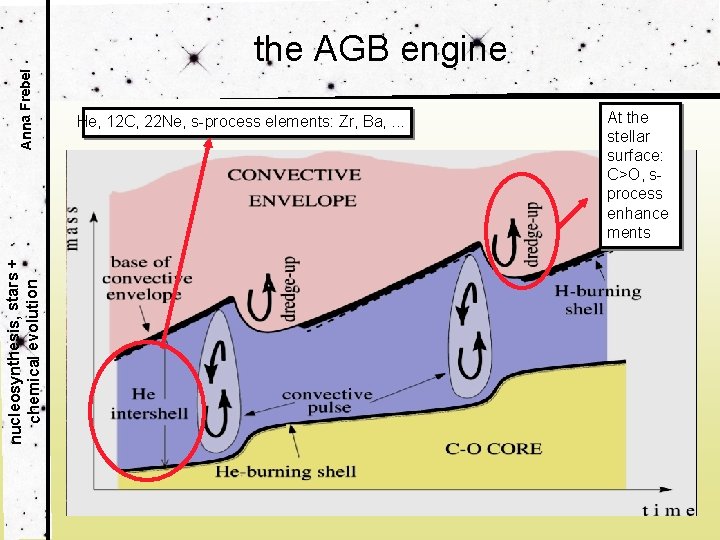
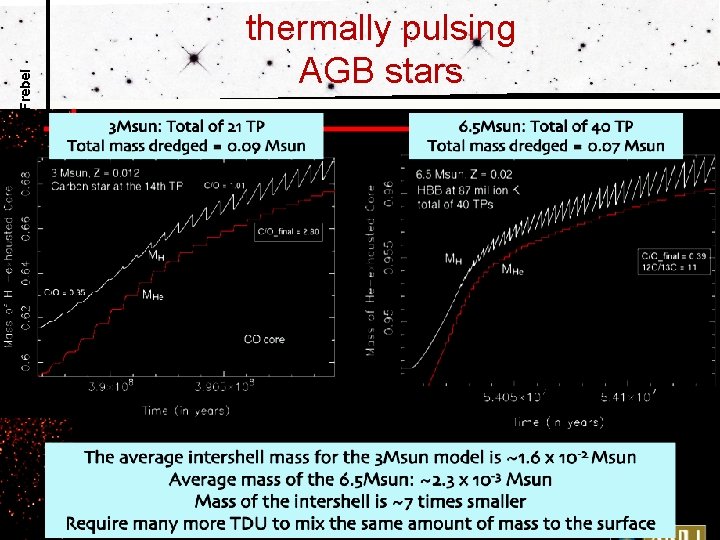
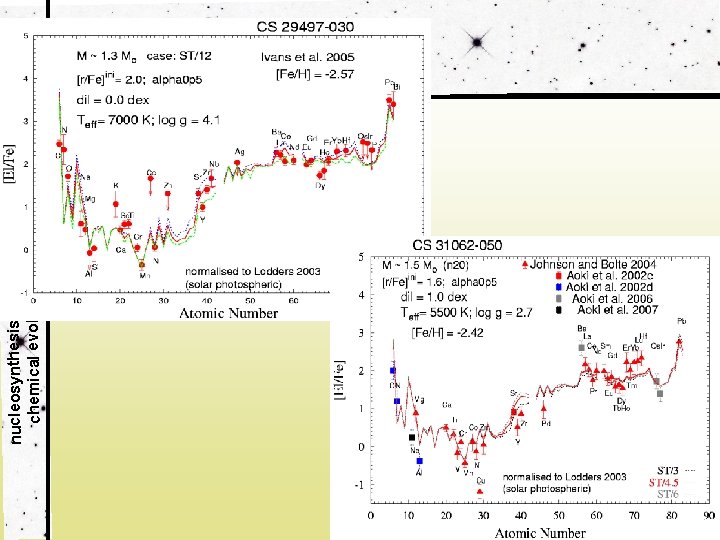
Anna Frebel nucleosynthesis, stars + chemical evolution slow n-cap process • in 1 -8 Msun AGB stars; AGB stars are major providers of C and sprocess elements in the universe (through mass loss) • produce s-rich companions: CH stars, Ba stars, s-rich metal-poor stars good knowledge of sprocess theoretically; important for calculating the solar r-process component
Anna Frebel The two neutron sources in AGB stars nucleosynthesis, stars + chemical evolution 13 C( , n)16 O Needs 13 C ! Major neutron source 13 C-pocket Primary source! T 8 = 0. 9 -1 Interpulse phase (1 - 0. 4) 105 yr Radiative conditions Nn = 107 cm-3 lower mass AGBs 22 Ne( , n)25 Mg Abundant 22 Ne Minor neutron source Neutron burst Secondary source T 8 = 3 (low 22 Ne efficiency) Thermal pulse 6 yr Convective conditions Nn (peak) = 1010 cm-3 higher mass AGBs
Anna Frebel nucleosynthesis, stars + chemical evolution the AGB engine He, 12 C, 22 Ne, s-process elements: Zr, Ba, . . . At the stellar surface: C>O, sprocess enhance ments
nucleosynthesis, stars + chemical evolution Anna Frebel thermally pulsing AGB stars
nucleosynthesis, stars + chemical evolution Anna Frebel
nucleosynthesis, stars + chemical evolution Anna Frebel r-process
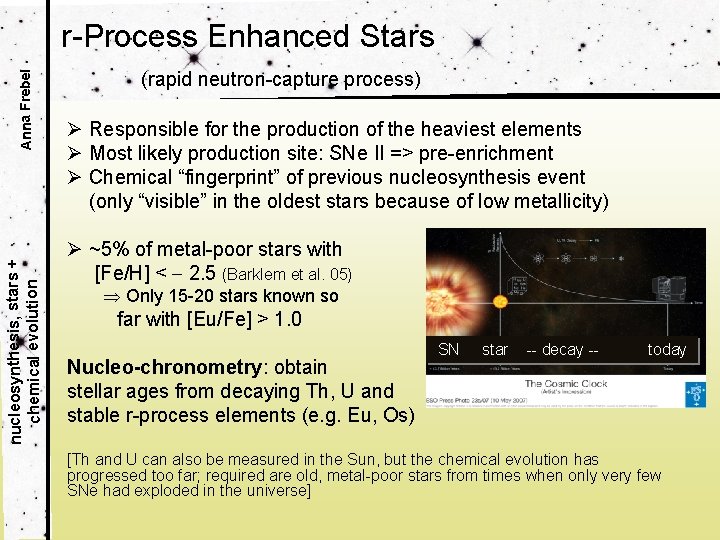
nucleosynthesis, stars + chemical evolution Anna Frebel r-Process Enhanced Stars (rapid neutron-capture process) Ø Responsible for the production of the heaviest elements Ø Most likely production site: SNe II => pre-enrichment Ø Chemical “fingerprint” of previous nucleosynthesis event (only “visible” in the oldest stars because of low metallicity) Ø ~5% of metal-poor stars with [Fe/H] < 2. 5 (Barklem et al. 05) Only 15 -20 stars known so far with [Eu/Fe] > 1. 0 Nucleo-chronometry: obtain stellar ages from decaying Th, U and stable r-process elements (e. g. Eu, Os) SN star -- decay -- today [Th and U can also be measured in the Sun, but the chemical evolution has progressed too far; required are old, metal-poor stars from times when only very few SNe had exploded in the universe]
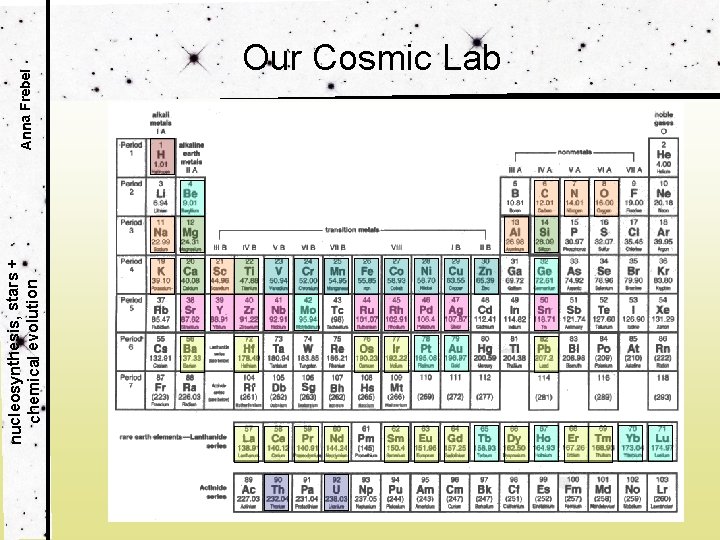
nucleosynthesis, stars + chemical evolution Anna Frebel Our Cosmic Lab
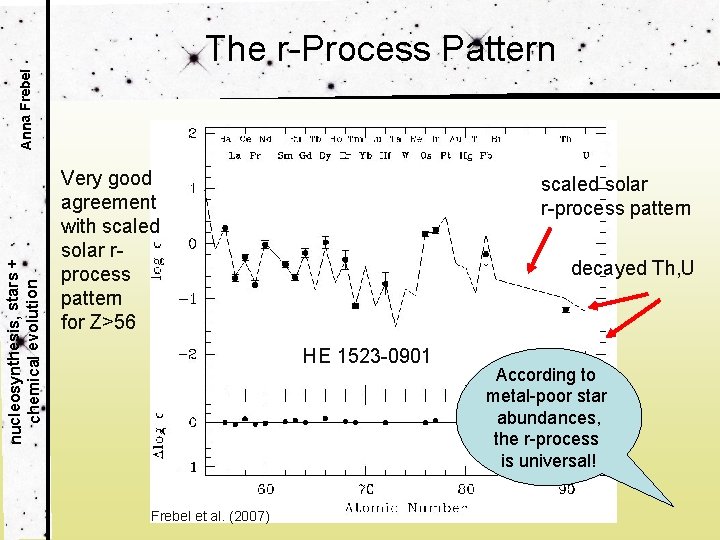
nucleosynthesis, stars + chemical evolution Anna Frebel The r-Process Pattern Very good agreement with scaled solar rprocess pattern for Z>56 scaled solar r-process pattern decayed Th, U HE 1523 -0901 Frebel et al. (2007) According to metal-poor star abundances, the r-process is universal!
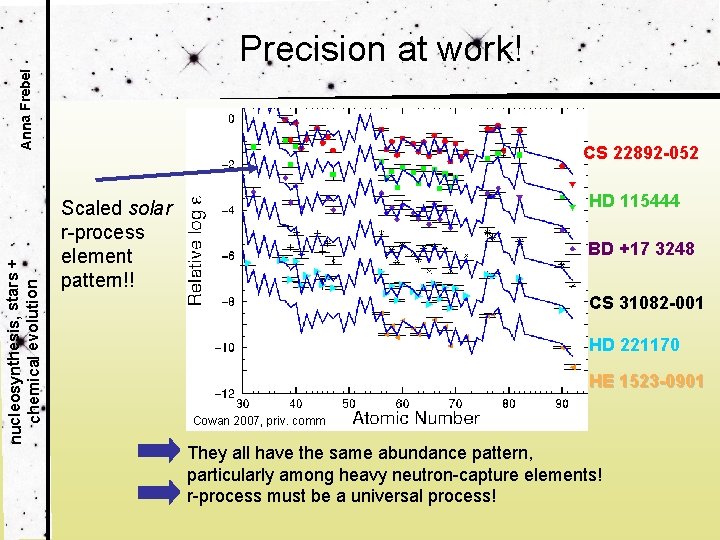
nucleosynthesis, stars + chemical evolution Anna Frebel Precision at work! CS 22892 -052 HD 115444 Scaled solar r-process element pattern!! BD +17 3248 CS 31082 -001 HD 221170 HE 1523 -0901 Cowan 2007, priv. comm They all have the same abundance pattern, particularly among heavy neutron-capture elements! r-process must be a universal process!
Anna Frebel nucleosynthesis, stars + chemical evolution origin of the elements abundances trends
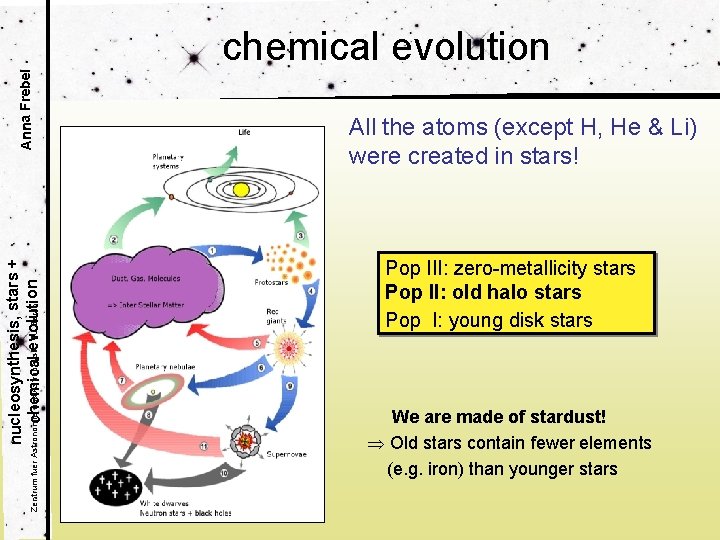
nucleosynthesis, stars + Zentrum fuer Astronomie und Astrophysik, TU Berlin ution ical evol chem Anna Frebel chemical evolution All the atoms (except H, He & Li) were created in stars! Pop III: zero-metallicity stars Pop II: old halo stars Pop I: young disk stars We are made of stardust! Old stars contain fewer elements (e. g. iron) than younger stars
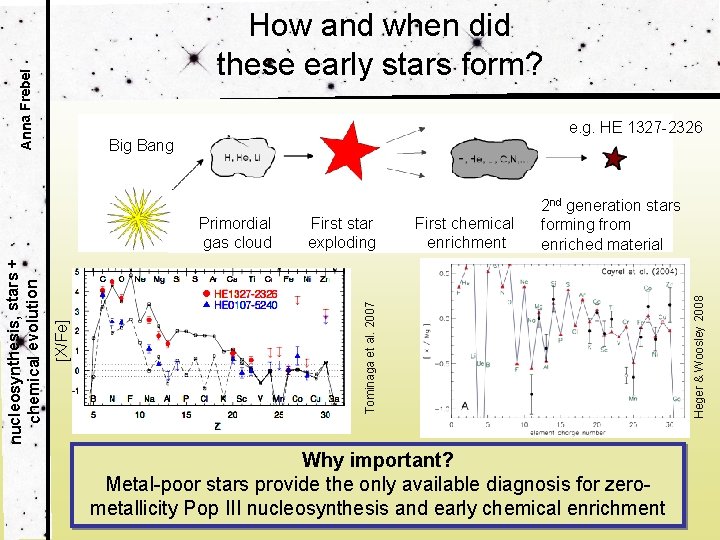
Anna Frebel How and when did these early stars form? e. g. HE 1327 -2326 Big Bang First chemical enrichment Why important? Metal-poor stars provide the only available diagnosis for zerometallicity Pop III nucleosynthesis and early chemical enrichment Heger & Woosley 2008 First star exploding Tominaga et al. 2007 [X/Fe] nucleosynthesis, stars + chemical evolution Primordial gas cloud 2 nd generation stars forming from enriched material
• “Faint” SN with mixing and fallback: Post-explosion abundance distribution Iwamoto et al. 2005 Science 309 451 Anna Frebel Pre-enrichment by a “faint SN” nucleosynthesis, stars + chemical evolution –Explains high C, N, O, Mg (Smaller mass cut for HE 1327 -2326 to account for high [Mg/Fe]) –Explain other metal-poor stars with [Fe/H]< 3. 5 –Neutron-capture elements not included M=25 M , Z=0, low E
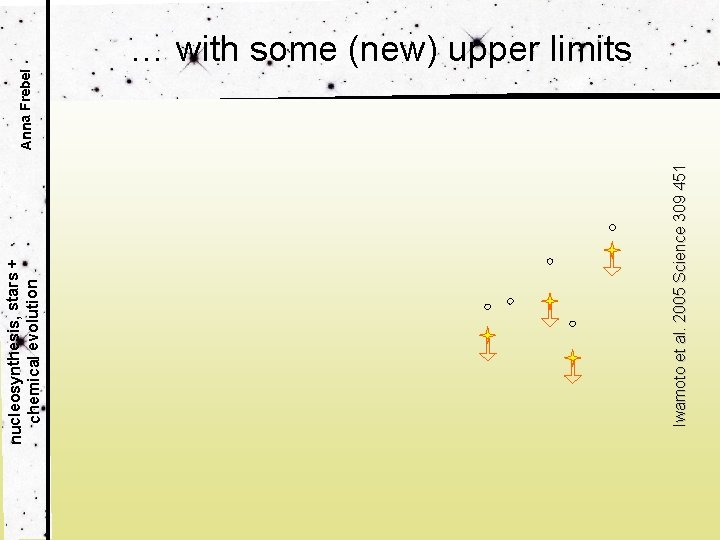
Iwamoto et al. 2005 Science 309 451 nucleosynthesis, stars + chemical evolution Anna Frebel … with some (new) upper limits
![Anna Frebel nucleosynthesis, stars + chemical evolution Abundance trends [Mg/Fe] Alpha-elements [Si/Fe] Alpha elements](http://slidetodoc.com/presentation_image_h/bdb865055f441c97be4cdff0a7e62025/image-45.jpg "Anna Frebel nucleosynthesis, stars + chemical evolution Abundance trends [Mg/Fe] Alpha-elements [Si/Fe] Alpha elements")
Anna Frebel nucleosynthesis, stars + chemical evolution Abundance trends [Mg/Fe] Alpha-elements [Si/Fe] Alpha elements multiple of He: (C, O), Ne, Mg, Si, S, Ar, Ca, Ti (not pure) [Ca/Fe] Synthesis during stellar evolution and -capture in supernova explosion of massive stars (>8 M ) Pagel & Tautvaišiene (1995)) Fe and -elements produced in the explosions of massive stars (SN type II) Fe-rich ejecta from the SN of low-mass stars (SN type Ia)
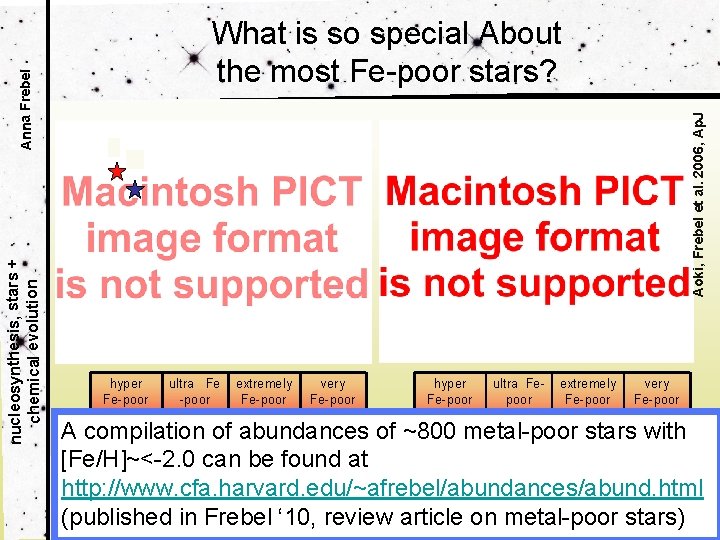
Aoki, Frebel et al. 2006, Ap. J nucleosynthesis, stars + chemical evolution Anna Frebel What is so special About the most Fe-poor stars? hyper Fe-poor ultra Fe -poor extremely Fe-poor very Fe-poor hyper Fe-poor ultra Fepoor extremely Fe-poor very Fe-poor A compilation of abundances of ~800 metal-poor stars with The very different chemical signature of the hyper iron-poor stars [Fe/H]~<-2. 0 can be found at is crucial for understanding the formation of the elements! http: //www. cfa. harvard. edu/~afrebel/abundances/abund. html (published in Frebel ‘ 10, review article on metal-poor stars)
Anna Frebel nucleosynthesis, stars + chemical evolution plots with abundance trends https: //www. cfa. harvard. edu/~afrebel/abundances/abund. html
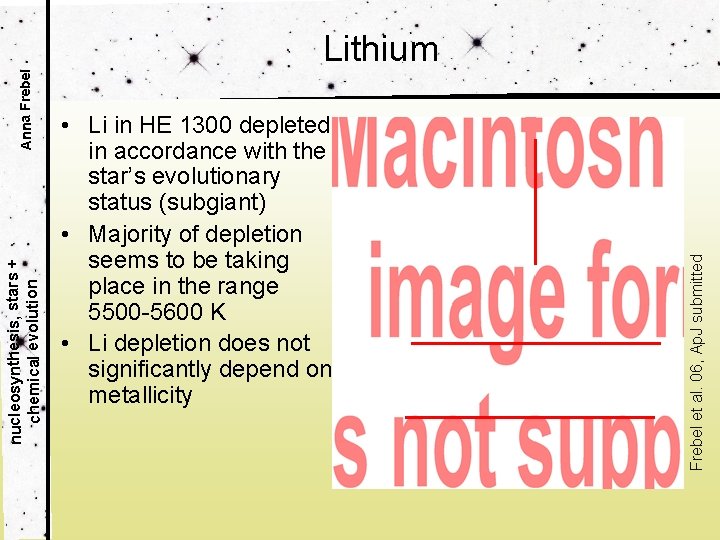
• Li in HE 1300 depleted in accordance with the star’s evolutionary status (subgiant) • Majority of depletion seems to be taking place in the range 5500 -5600 K • Li depletion does not significantly depend on metallicity Frebel et al. 06, Ap. J submitted Anna Frebel nucleosynthesis, stars + chemical evolution Lithium
Anna Frebel nucleosynthesis, stars + chemical evolution the bigger picture using stars to study the hierarchical assembly of galaxy formation “near-field cosmology”
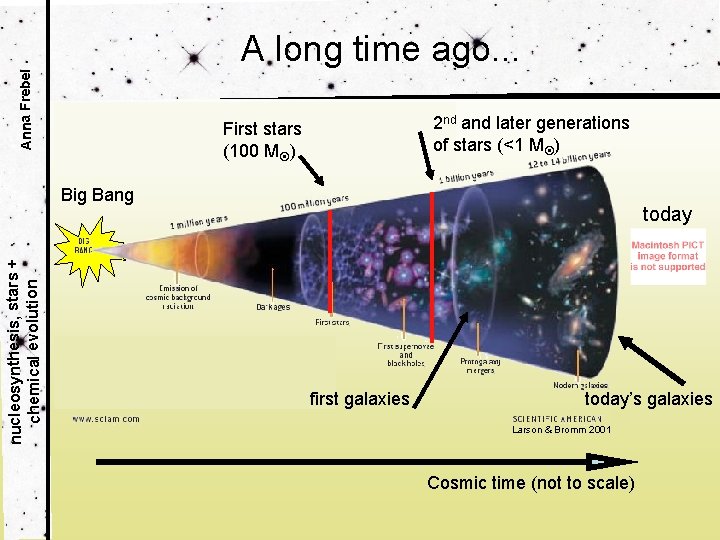
Anna Frebel A long time ago. . . 2 nd and later generations of stars (<1 M ) First stars (100 M ) nucleosynthesis, stars + chemical evolution Big Bang today first galaxies today’s galaxies Larson & Bromm 2001 Cosmic time (not to scale)
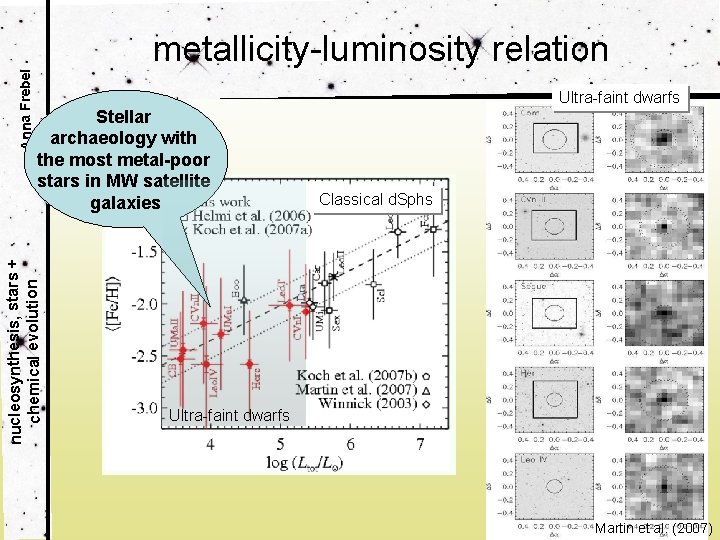
Stellar archaeology with the most metal-poor stars in MW satellite galaxies nucleosynthesis, stars + chemical evolution Anna Frebel metallicity-luminosity relation Ultra-faint dwarfs Classical d. Sphs Ultra-faint dwarfs Martin et al. (2007)
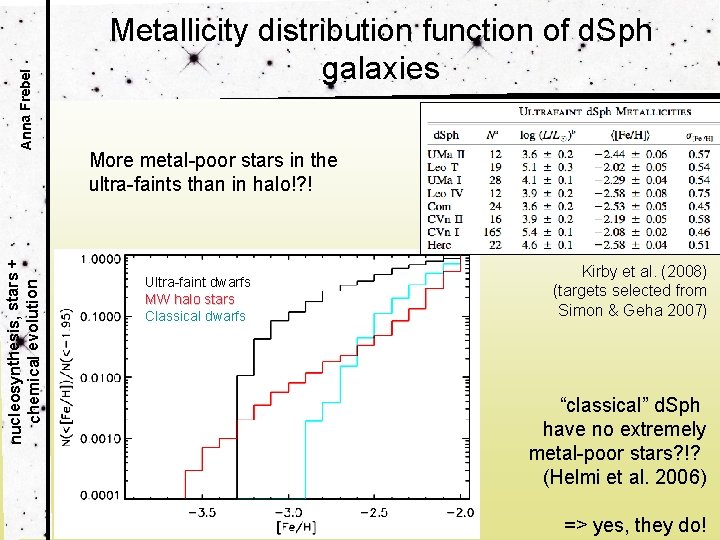
Anna Frebel nucleosynthesis, stars + chemical evolution Metallicity distribution function of d. Sph galaxies More metal-poor stars in the ultra-faints than in halo!? ! Ultra-faint dwarfs MW halo stars Classical dwarfs Kirby et al. (2008) (targets selected from Simon & Geha 2007) “classical” d. Sph have no extremely metal-poor stars? !? (Helmi et al. 2006) => yes, they do!
Anna Frebel nucleosynthesis, stars + chemical evolution What can we learn from the existing dwarf galaxies? Stellar archaeology: examine the chemical history in search for their oldest population to learn about - early chemical evolution in small systems - chemical signatures that relate dwarf galaxies to MW If surviving dwarfs are analogs of early MW building blocks then we should find chemical evidence of it! Stellar metallicities & abundances of metalpoor stars in dwarf galaxies should agree with those found in the MW halo
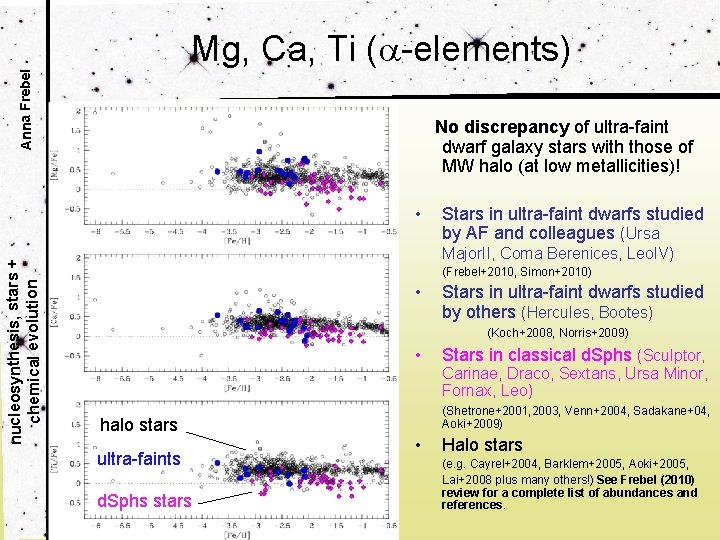
Anna Frebel Mg, Ca, Ti ( -elements) No discrepancy of ultra-faint dwarf galaxy stars with those of MW halo (at low metallicities)! nucleosynthesis, stars + chemical evolution • Stars in ultra-faint dwarfs studied by AF and colleagues (Ursa Major. II, Coma Berenices, Leo. IV) (Frebel+2010, Simon+2010) • Stars in ultra-faint dwarfs studied by others (Hercules, Bootes) (Koch+2008, Norris+2009) • halo stars ultra-faints d. Sphs stars Stars in classical d. Sphs (Sculptor, Carinae, Draco, Sextans, Ursa Minor, Fornax, Leo) (Shetrone+2001, 2003, Venn+2004, Sadakane+04, Aoki+2009) • Halo stars (e. g. Cayrel+2004, Barklem+2005, Aoki+2005, Lai+2008 plus many others!) See Frebel (2010) review for a complete list of abundances and references.
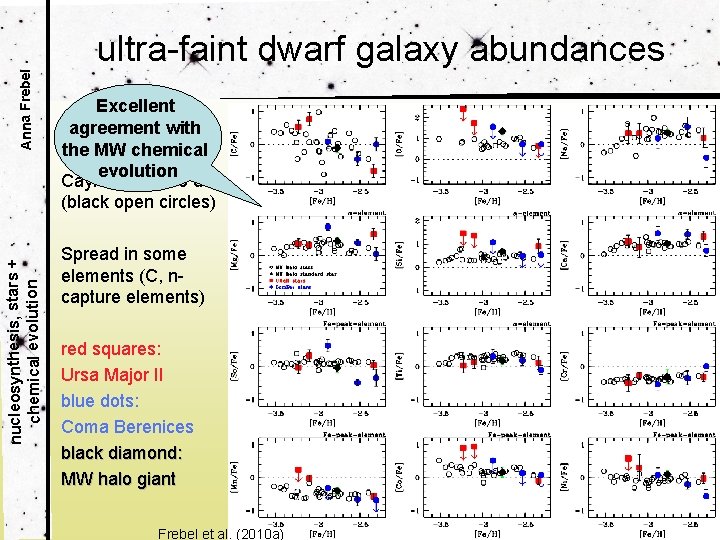
Anna Frebel nucleosynthesis, stars + chemical evolution ultra-faint dwarf galaxy abundances Excellent agreement with the MW chemical Comparison with evolution Cayrel+ 04 halo data (black open circles) Spread in some elements (C, ncapture elements) red squares: Ursa Major II blue dots: Coma Berenices black diamond: MW halo giant Frebel et al. (2010 a)
Anna Frebel nucleosynthesis, stars + chemical evolution Summary • • • spectroscopy abundance analyses stellar atmospheres stellar evolution nucleosynthesis SN physics and explosions nuclear+atomic physics chemical evolution (near-field) cosmology
- Slides: 56