
Ankle Arthroplasty Can the Ankle Joint be Replaced
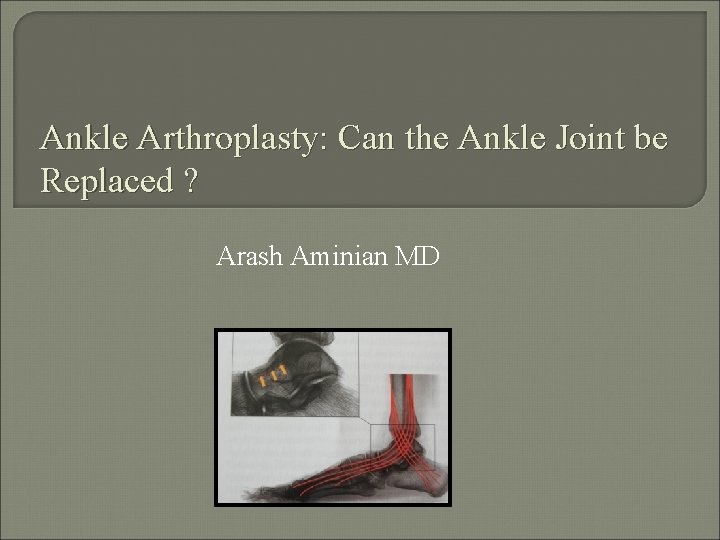
Ankle Arthroplasty: Can the Ankle Joint be Replaced ? Arash Aminian MD
Overview Anatomy • Biomechanics • History • Current Designs • Indications • Results • Cases •
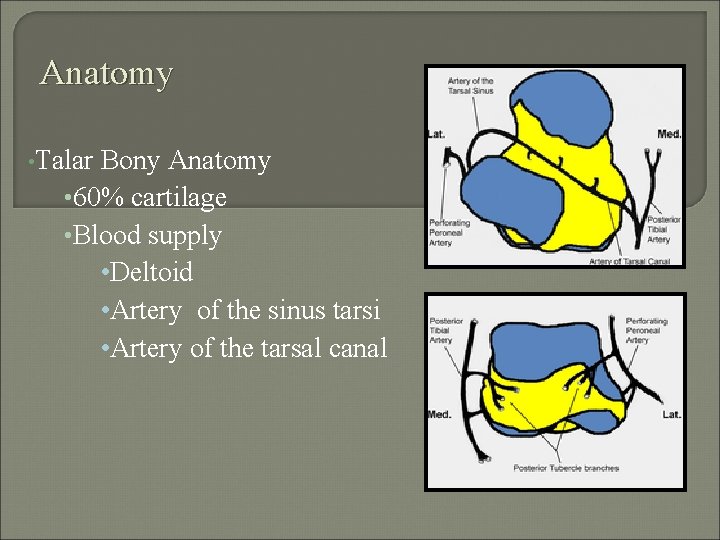
Anatomy • Talar Bony Anatomy • 60% cartilage • Blood supply • Deltoid • Artery of the sinus tarsi • Artery of the tarsal canal

Anatomy • Distal Tibial Anatomy
Anatomy: Stability Ankle ligaments • Articular geometry • • Stormont et al AJSM 1985 13: 295. • Ankle ligament sectioning study: Articular surface 30% rotational stability
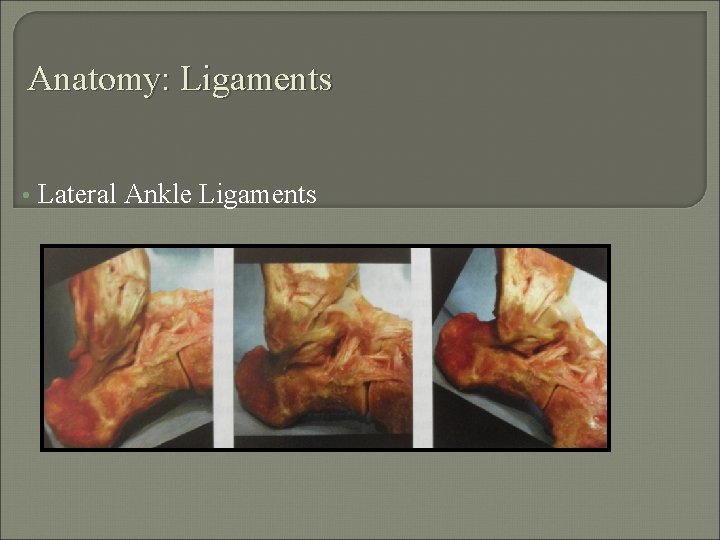
Anatomy: Ligaments • Lateral Ankle Ligaments
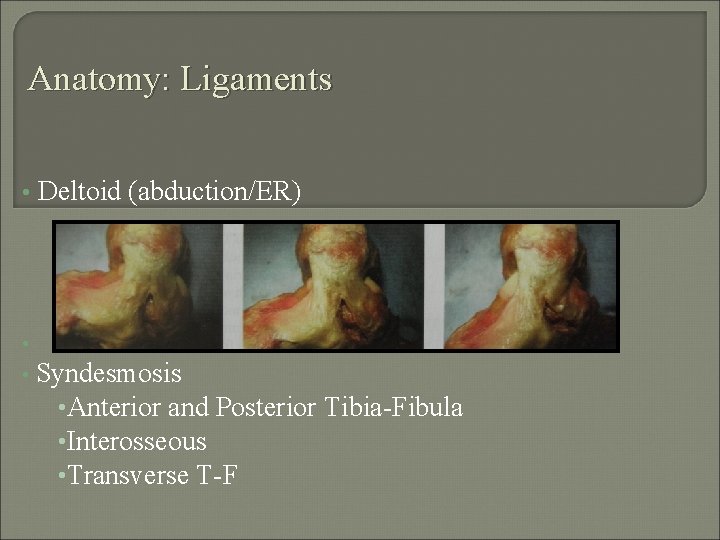
Anatomy: Ligaments • Deltoid (abduction/ER) • • Syndesmosis • Anterior and Posterior Tibia-Fibula • Interosseous • Transverse T-F
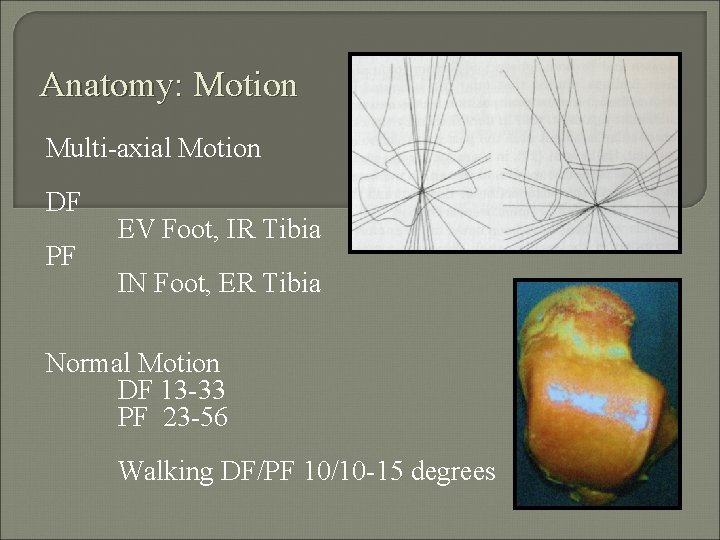
Anatomy: Motion Multi-axial Motion DF PF EV Foot, IR Tibia IN Foot, ER Tibia Normal Motion DF 13 -33 PF 23 -56 Walking DF/PF 10/10 -15 degrees
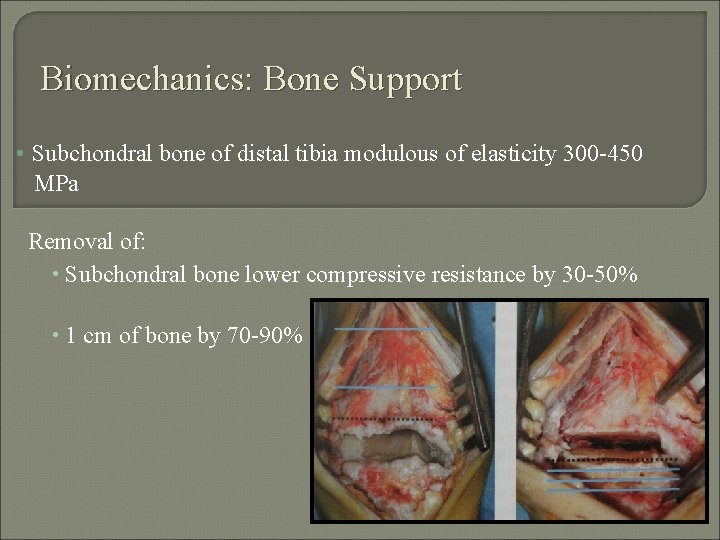
Biomechanics: Bone Support • Subchondral bone of distal tibia modulous of elasticity 300 -450 MPa Removal of: • Subchondral bone lower compressive resistance by 30 -50% • 1 cm of bone by 70 -90%
Biomechanics Vertical load 5. 2 x BW during normal gait • GR forces 3 D • Compressive • Shear • Torsional • Micromotion (0. 15 mm) prevents ingrowth • CORR 1977 127: 189 -196.
History: Questions Restore Anatomy • Which Surfaces to replace • Fixation • Poly size (4 -6 mm Hip, 6 -8 mm Knee, Ankle? ) •
History: Classification • Fixation: Cemented, Uncemented • Number of components: 2/3 • Constraint: Constrained/Semi/Non • Congruity/Conformity • Component shape: Anatomic/Non-anatomic • Bearing: Fixed/Mobile
History: 1970 s First Generation Poorly designed instruments: mal-position • Soft tissue balancing not addressed • Bone cement for fixation • Excessive bone removal • Non-anatomically shaped implants • Soft tissue envelope •
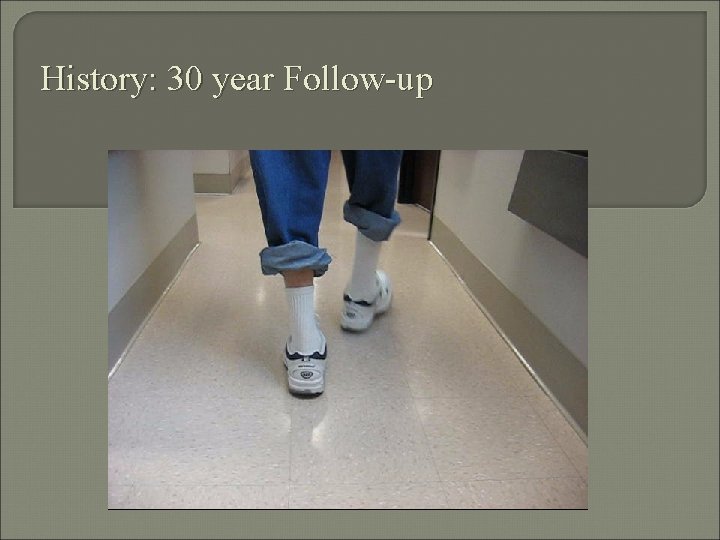
History: 30 year Follow-up
Ankle Arthritis: Comparison of Health-Related Quality of Life Between Patients with End-Stage Ankle and Hip Arthrosis. Glazebrook et al. J Bone Joint Surg Am. 2008; 90: 499 -505. • SF 36 scores cohort 136 ankle arthrosis/130 hip arthrosis • Ankle arthrosis: worse mental component summary, role-physical score, general health score
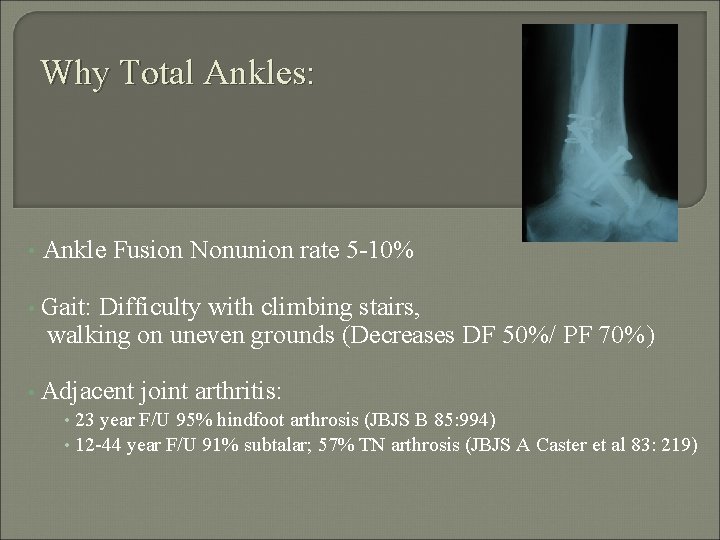
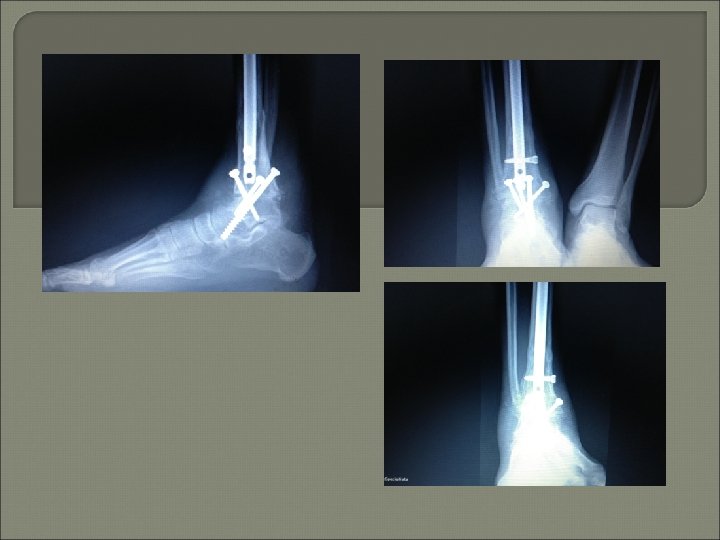
Why Total Ankles: • Ankle Fusion Nonunion rate 5 -10% • Gait: Difficulty with climbing stairs, walking on uneven grounds (Decreases DF 50%/ PF 70%) • Adjacent joint arthritis: • 23 year F/U 95% hindfoot arthrosis (JBJS B 85: 994) • 12 -44 year F/U 91% subtalar; 57% TN arthrosis (JBJS A Caster et al 83: 219)
History: Second Generation Constraint: Resistance of the implant to degrees of freedom (shear stresses). Decreasing constraint minimizes shear stress forces at the bone-implant interface Congruity/Conformity: Radii of curvatures of the implant and poly-wear
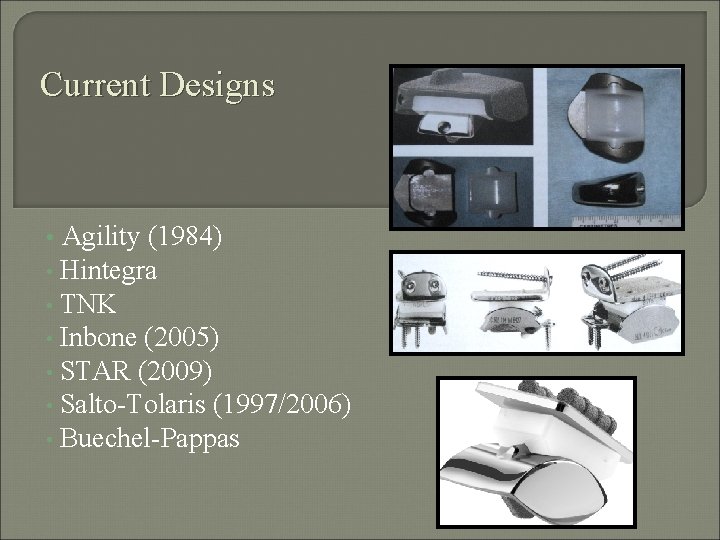
Current Designs Agility (1984) • Hintegra • TNK • Inbone (2005) • STAR (2009) • Salto-Tolaris (1997/2006) • Buechel-Pappas •
Ideal Design Small bone resection • Anatomic (physiologic motion/balance ligaments) • Unconstrained • Porous surface (ingrowth within 3 D spaces) with HA (early fixation) • Large prosthesis (prevent subsidence) • Motion DF/PF 10/20 degrees • Poly 8 mm (increase durability) • Poly conforming (decrease contact stresses: prevent loosening) •
Indications and Considerations: Age • Primary/Secondary Arthritis • Deformity • Good bone stock • Normal neuro-vascular exam • Motion • Ankle Stability • Low physical demand •
Relative Contra-Indications: AVN • Severe osteoperosis/penia • IDDM • Demanding work/sport activities • Weight? • Previous Infection? •
Absolute Contra-Indications Deformity greater than 10 degrees • Ligamentous Instability (lateral/medial) • Poor soft-tissue envelope • Neurovascular compromise • Acute infection • Joint hypermobility •
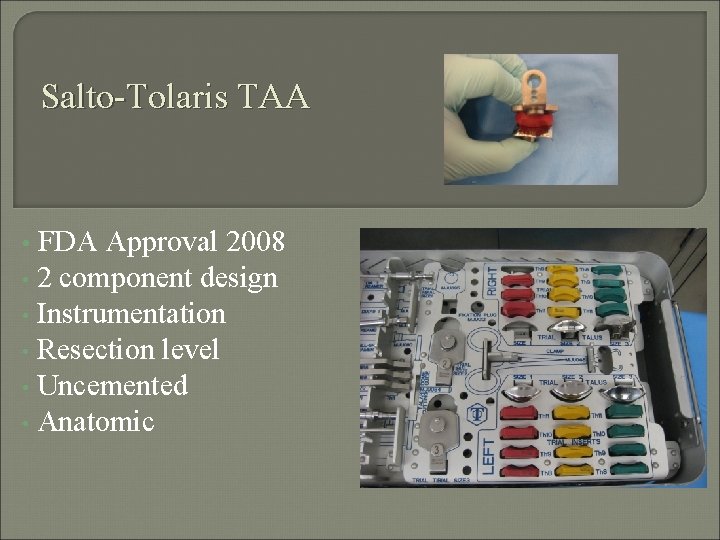
Salto-Tolaris TAA FDA Approval 2008 • 2 component design • Instrumentation • Resection level • Uncemented • Anatomic •
Results: Literature Review Intermediate and Long-Term Outcomes of Total Ankle Arthroplasty and Ankle Arthrodesis. A systematic review of the Literature. Haddad et al. J Bone Joint Surg Am. 2007; 89: 1899 -1905 TAA: 5 year survival 78% 10 year survival 77% Revision rate of 7%: Loosening or subsidence
Results: How successful are TAA Residual pain is common (27 -60%) • Superficial wound complications (0 -14. 7%) • Deep wound complications (0 -4. 6%) • Overall failure rate 10% at 5 years • Gougoulias et al. CORR 2010 Jan: 468(1): 199 -208
Results: Survivorship 7 -11 years for Salto TAA 85 patients (87 TAA): mean follow-up 8. 9 years (6. 8 -11 years) • Survival rate 65% with any reoperation, 85% with revision as an end point • Causes of reoperation: • Bone cysts (11) • Fracture of the polyethylene (5) • Pain (3) Bonnon M et al. CORR 2010 Jul 1
Complications: Evidence Based Classification of Complications in Total Ankle Arthroplasty Glazebrook et al Foot and Ankle Int 2009 Oct 30(10): 945 -9. Deep infection • Aseptic loosening • Implant failure • Subsidence • Fractures (intra-op/post-operative) • Wound healing problems •
TAA vs Ankle Fusion ? Preference-based Quality of Life of End-stage Ankle arthritis with Arthroplasty or Arthrodesis Slobogean et al. Foot and Ankle Int 2010 July 31(7): 563 -6. Prospective study 107 patients with TAA /Arthrodesis: At one year follow-up SF-36 score TAA (0. 73), Arthrodesis (0. 73)
Outcome Measures JBJS Am. 2012 Jan 4; 94(1): 43 -8. Intermediate to long-term outcomes of the STAR Total Ankle Replacement: the patient perspective. 82 patients, average follow-up 60 months The most compelling finding of the present study involved the marked improvement in terms of the selfreported measures of impairments, quality of life, pain, and function.
Outcome Measures Acta Orthop. 2011 Dec; 82(6): 655 -9. 10 -year survival of total ankle arthroplasties: a report on 780 cases from the Swedish Ankle Register. Of the 780 prostheses implanted since 1993, 168 (22%) had been revised by June 15, 2010. The overall survival rate fell from 0. 81 (95% CI: 0. 79 -0. 83) at 5 years to 0. 69 (95% CI: 0. 67 -0. 71) at 10 years. .
Outcome Measures Foot Ankle Int. 2011 Aug; 32(8): 740 -5. Revision rates after total ankle arthroplasty in sample-based clinical studies and national registries. These were STAR Ankle, Büchel-Pappas, Hintegra, Mobility, Agility, and Ramses Total Ankle Arthroplasty. The revision rate was used as the main outcome parameter. Irrespective of the implant, the average revision rate to be expected according to the registry data available is 21. 8% after 5 years, and 43. 5% after 10 years.
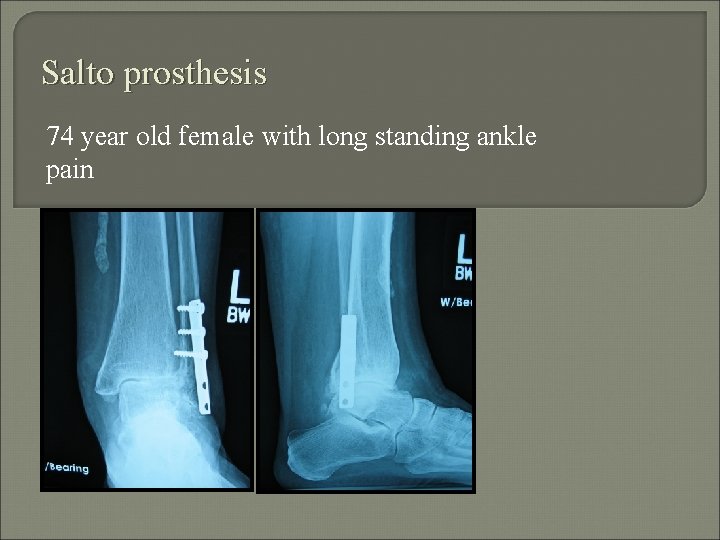
Salto prosthesis 74 year old female with long standing ankle pain
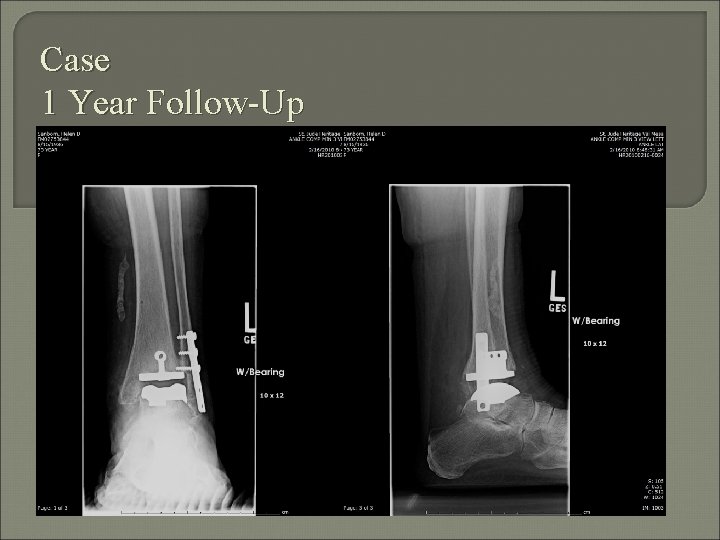
Case 1 Year Follow-Up
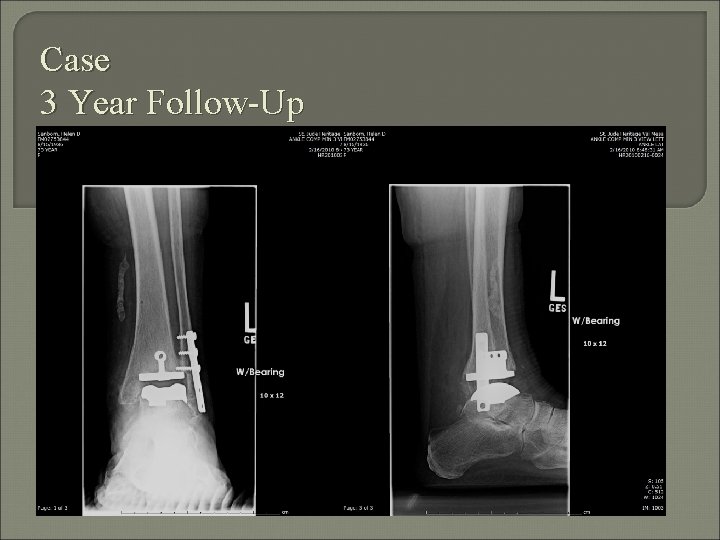
Case 3 Year Follow-Up
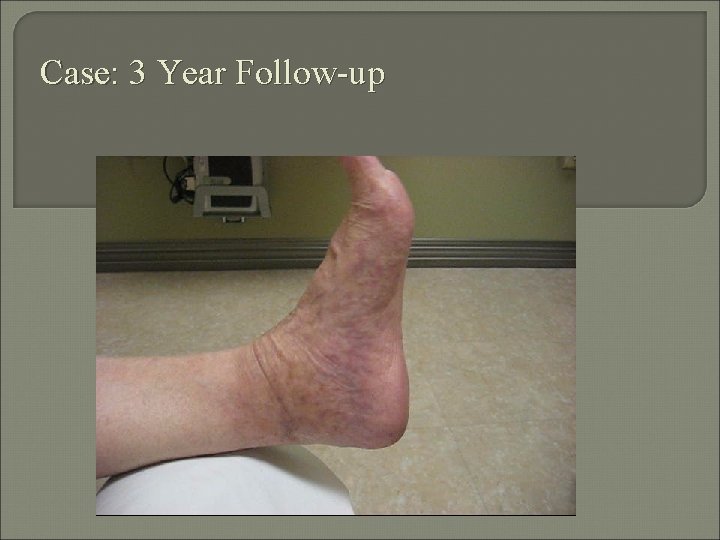
Case: 3 Year Follow-up
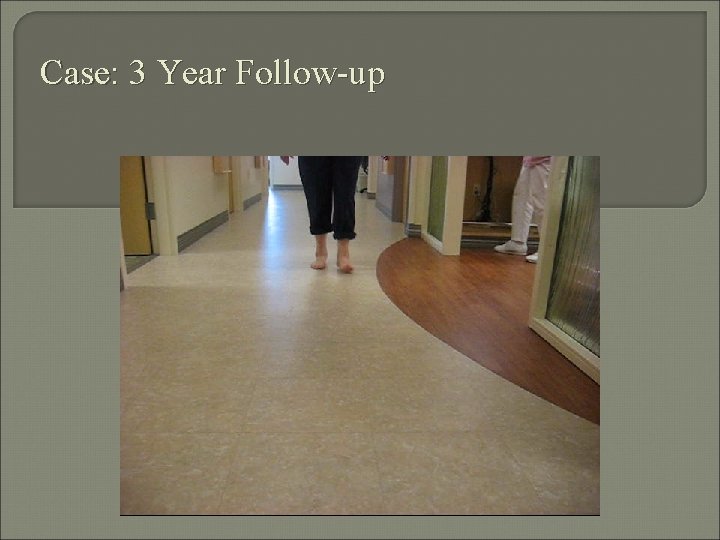
Case: 3 Year Follow-up

Inbone prosthesis

Inbone prosthesis

STAR
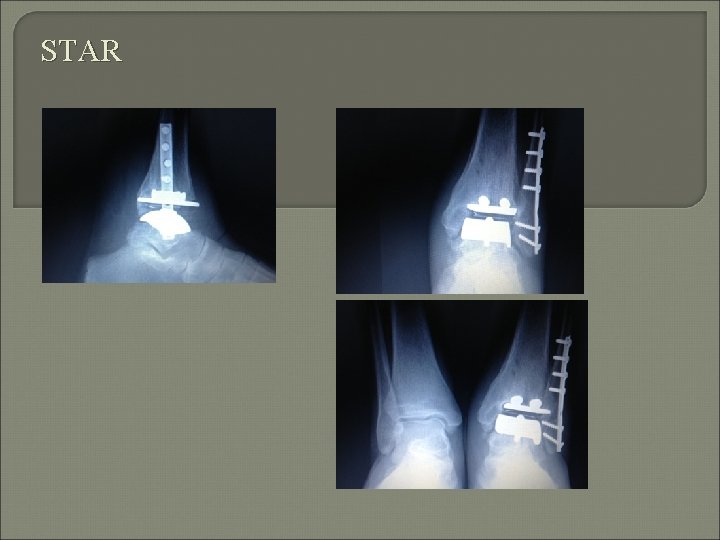
STAR
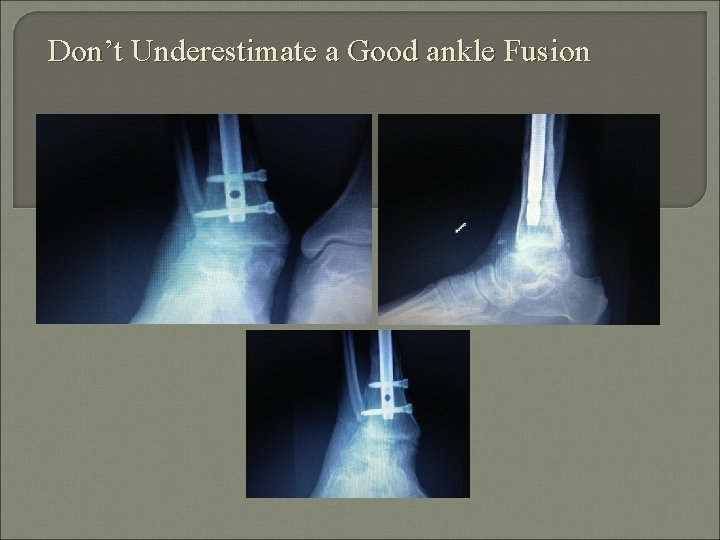
Don’t Underestimate a Good ankle Fusion
- Slides: 42