
Anitha George Varghese Dept of Chemistry Marthoma College

- Slides: 20
Anitha George Varghese Dept. of Chemistry Marthoma College
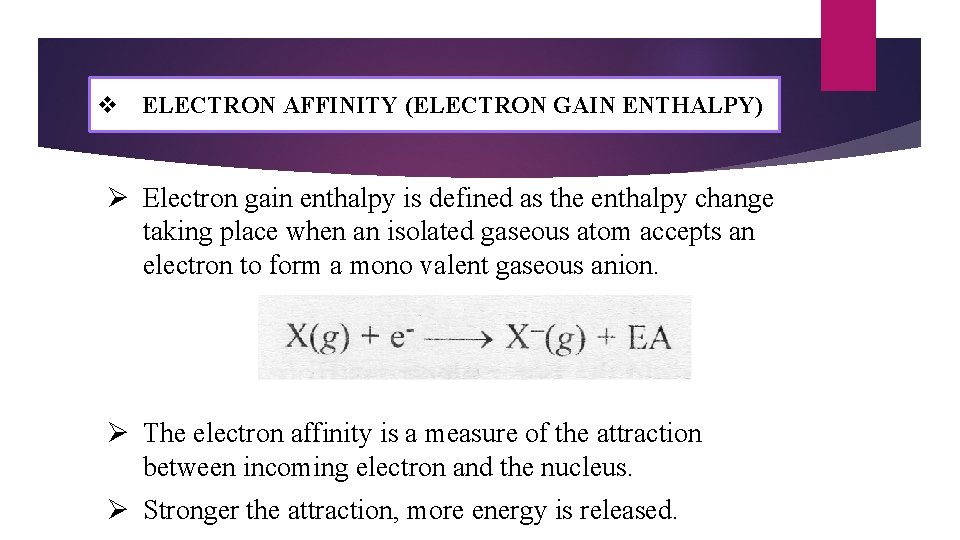
v ELECTRON AFFINITY (ELECTRON GAIN ENTHALPY) Ø Electron gain enthalpy is defined as the enthalpy change taking place when an isolated gaseous atom accepts an electron to form a mono valent gaseous anion. Ø The electron affinity is a measure of the attraction between incoming electron and the nucleus. Ø Stronger the attraction, more energy is released.
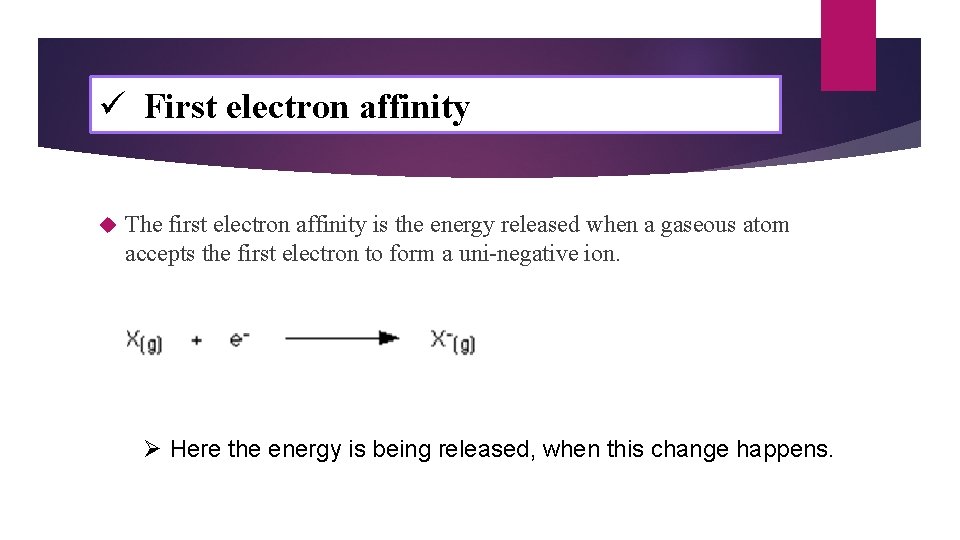
ü First electron affinity The first electron affinity is the energy released when a gaseous atom accepts the first electron to form a uni-negative ion. Ø Here the energy is being released, when this change happens.
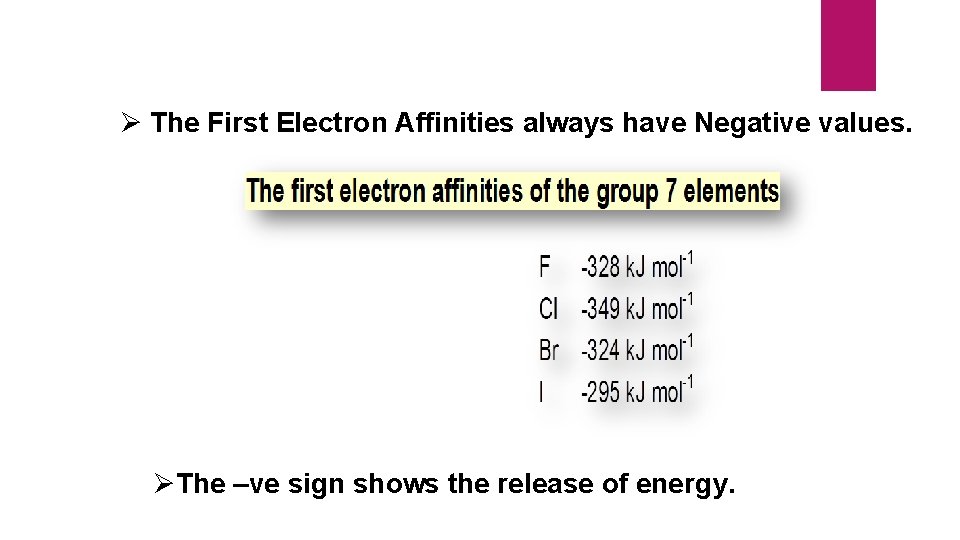
Ø The First Electron Affinities always have Negative values. ØThe –ve sign shows the release of energy.
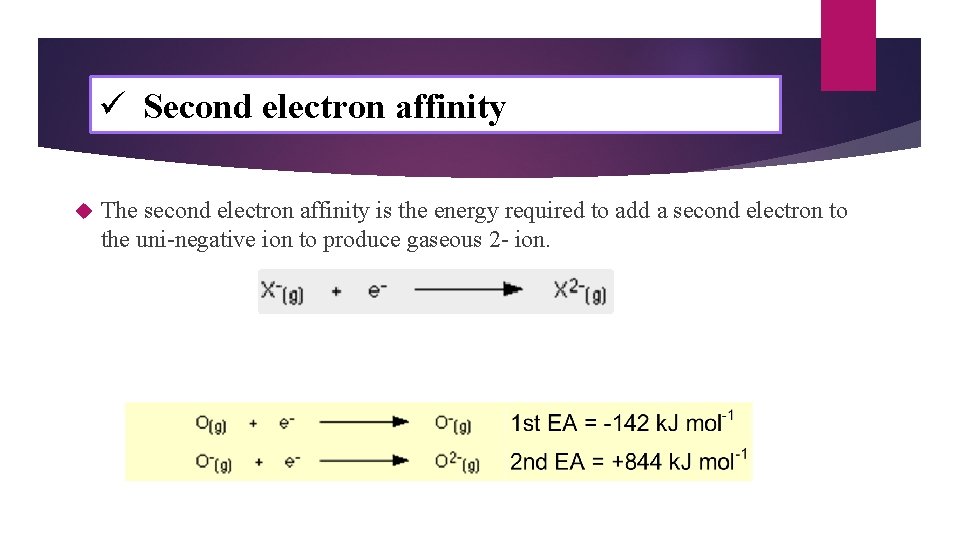
ü Second electron affinity The second electron affinity is the energy required to add a second electron to the uni-negative ion to produce gaseous 2 - ion.
ü SUCCESSIVE ELECTRON AFFINITIES Ø Always second electron affinities require more energy than first electron affinities. ü Why this happens ? § In the second electron affinity , when an electron is added , it experiences a repulsive force from the anion. § More energy has to be supplied to overcome this repulsive force. § Thus by the addition of the second electron , energy is required rather than released. § Therefore the value of second electron gain enthalpy and the successive electron gain enthalpies are positive.
Ø FACTORS AFFECTING ELECTRON GAIN ENTHALPY Nuclear Charge Atomic Size Electronic Configuration
v. Nuclear Charge Greater the magnitude of nuclear charge, larger will be the negative value of electron gain enthalpy. v. Atomic Size Larger the size of an atom, smaller will be the negative value of Electron gain enthalpy. v. Electronic Configuration Stable the electronic configuration of an atom is, larger will be the positive Value of its electron gain enthalpy.
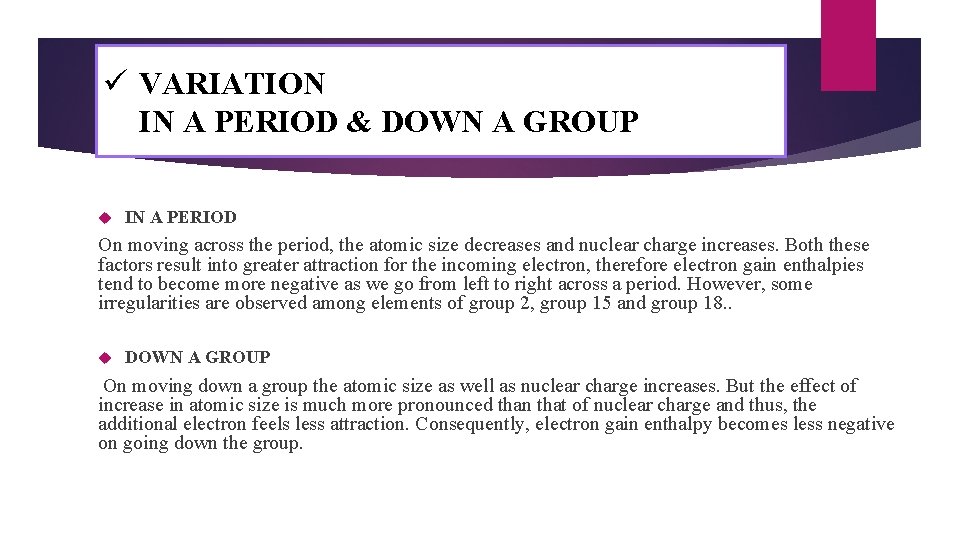
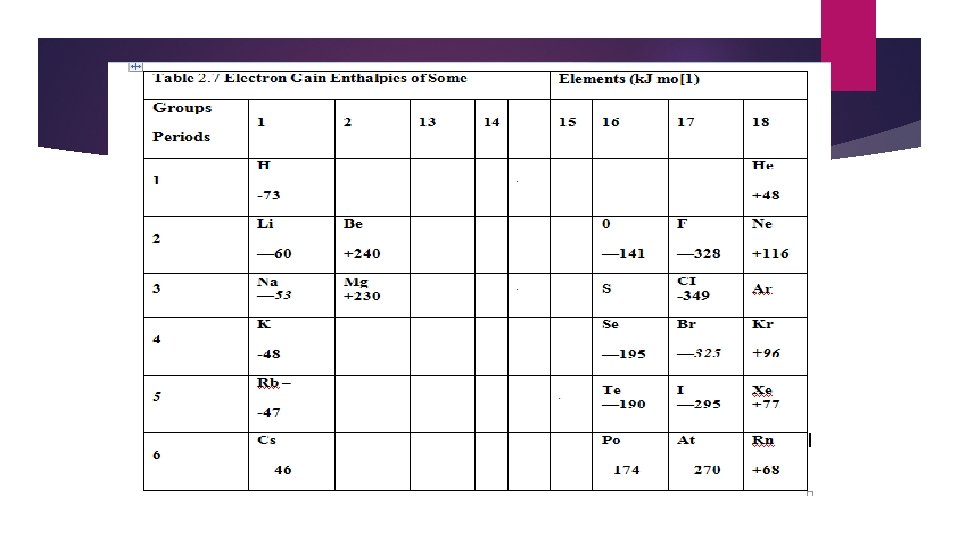
ü VARIATION IN A PERIOD & DOWN A GROUP IN A PERIOD On moving across the period, the atomic size decreases and nuclear charge increases. Both these factors result into greater attraction for the incoming electron, therefore electron gain enthalpies tend to become more negative as we go from left to right across a period. However, some irregularities are observed among elements of group 2, group 15 and group 18. . DOWN A GROUP On moving down a group the atomic size as well as nuclear charge increases. But the effect of increase in atomic size is much more pronounced than that of nuclear charge and thus, the additional electron feels less attraction. Consequently, electron gain enthalpy becomes less negative on going down the group.
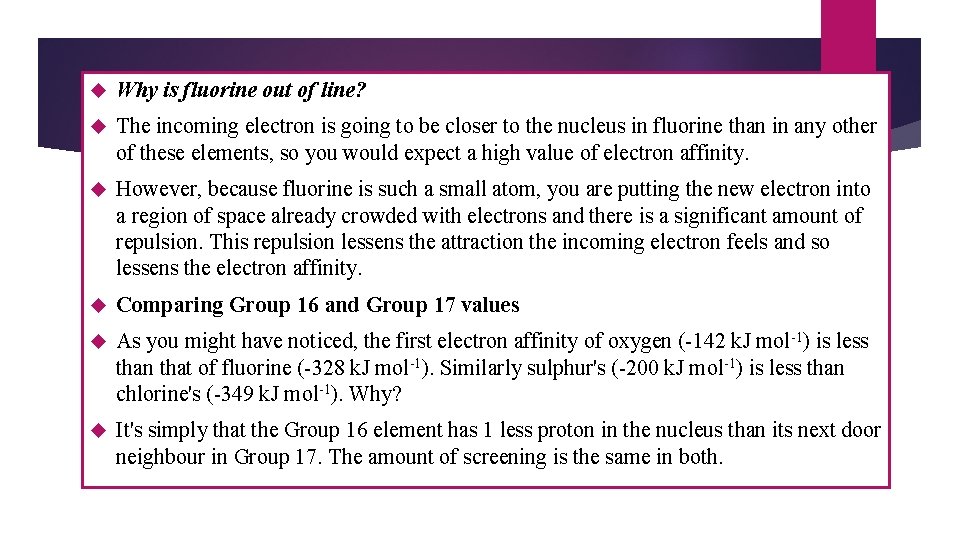
Why is fluorine out of line? The incoming electron is going to be closer to the nucleus in fluorine than in any other of these elements, so you would expect a high value of electron affinity. However, because fluorine is such a small atom, you are putting the new electron into a region of space already crowded with electrons and there is a significant amount of repulsion. This repulsion lessens the attraction the incoming electron feels and so lessens the electron affinity. Comparing Group 16 and Group 17 values As you might have noticed, the first electron affinity of oxygen (-142 k. J mol-1) is less than that of fluorine (-328 k. J mol-1). Similarly sulphur's (-200 k. J mol-1) is less than chlorine's (-349 k. J mol-1). Why? It's simply that the Group 16 element has 1 less proton in the nucleus than its next door neighbour in Group 17. The amount of screening is the same in both.
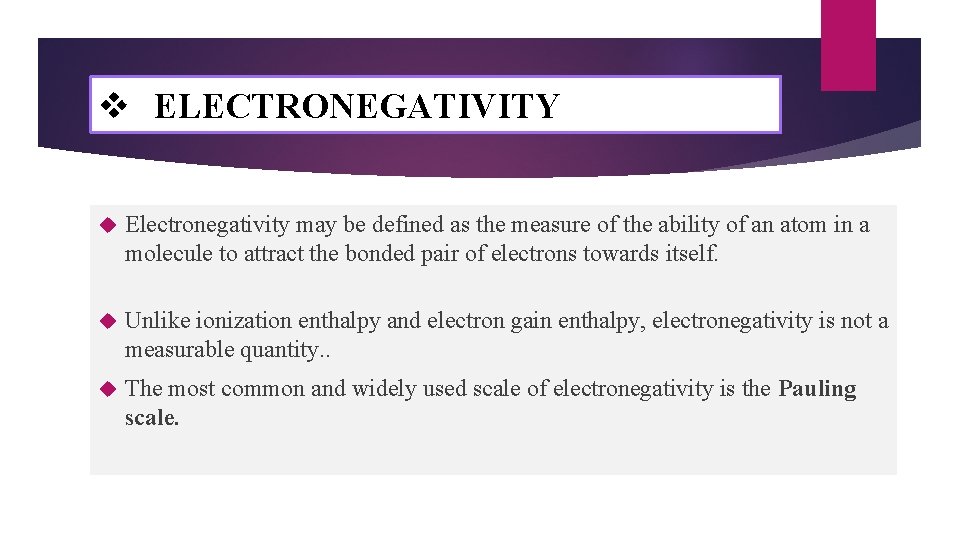
v ELECTRONEGATIVITY Electronegativity may be defined as the measure of the ability of an atom in a molecule to attract the bonded pair of electrons towards itself. Unlike ionization enthalpy and electron gain enthalpy, electronegativity is not a measurable quantity. . The most common and widely used scale of electronegativity is the Pauling scale.
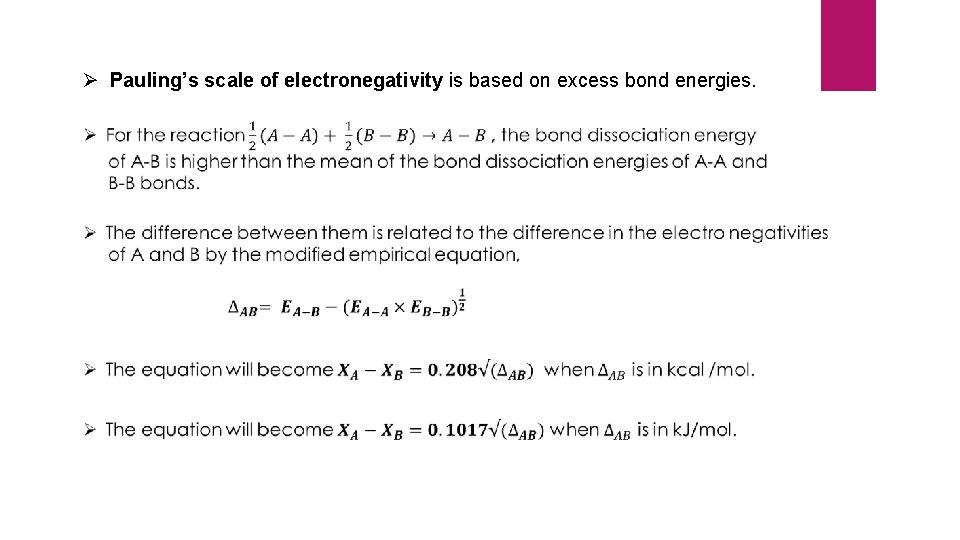
Ø Pauling’s scale of electronegativity is based on excess bond energies.
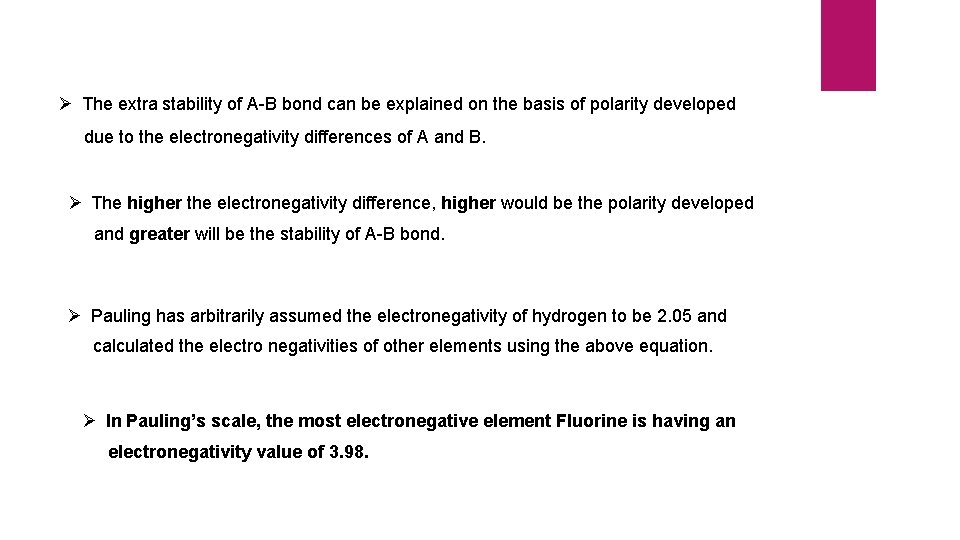
Ø The extra stability of A-B bond can be explained on the basis of polarity developed due to the electronegativity differences of A and B. Ø The higher the electronegativity difference, higher would be the polarity developed and greater will be the stability of A-B bond. Ø Pauling has arbitrarily assumed the electronegativity of hydrogen to be 2. 05 and calculated the electro negativities of other elements using the above equation. Ø In Pauling’s scale, the most electronegative element Fluorine is having an electronegativity value of 3. 98.
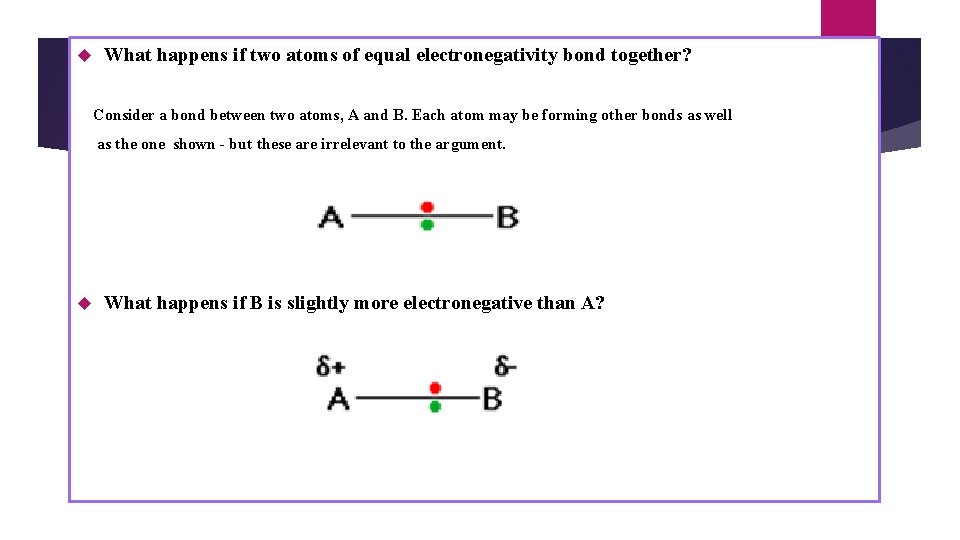
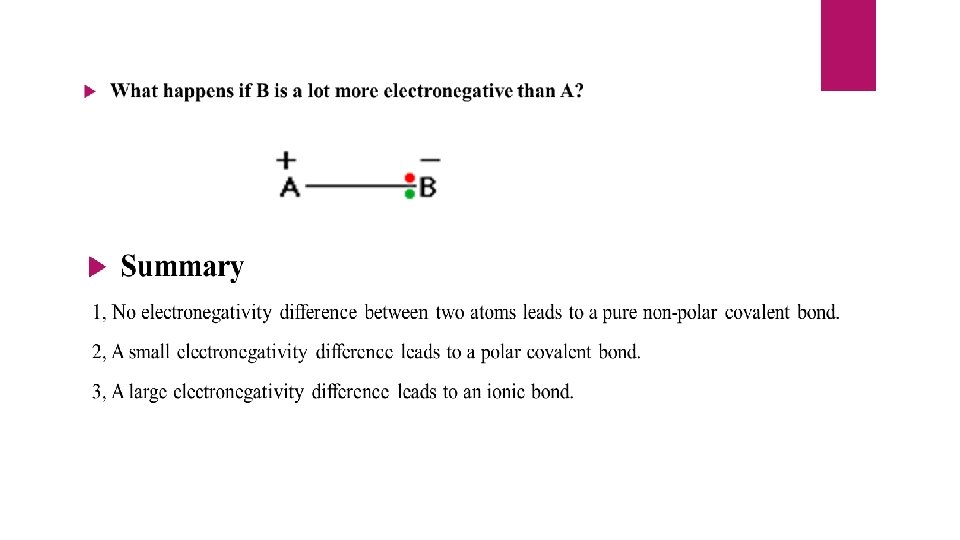
What happens if two atoms of equal electronegativity bond together? Consider a bond between two atoms, A and B. Each atom may be forming other bonds as well as the one shown - but these are irrelevant to the argument. What happens if B is slightly more electronegative than A?
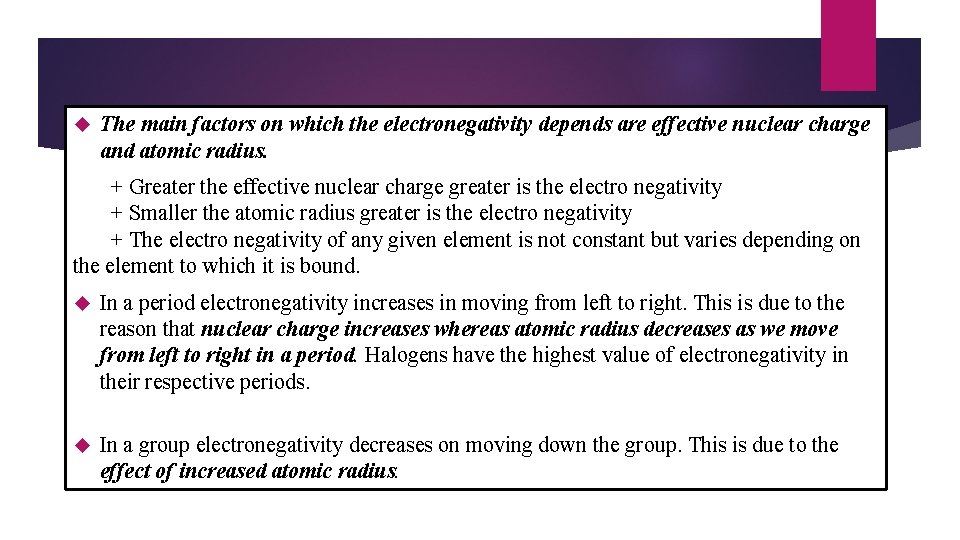
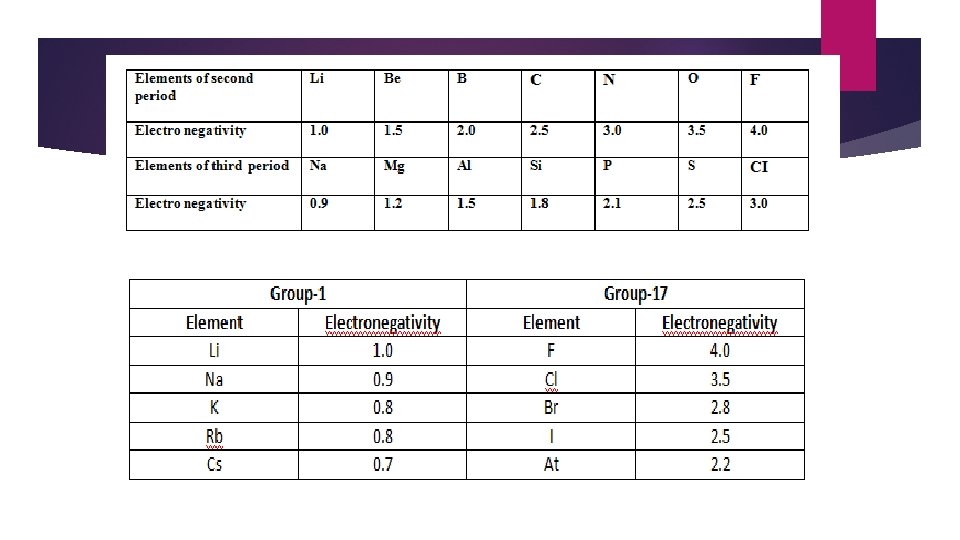
The main factors on which the electronegativity depends are effective nuclear charge and atomic radius. + Greater the effective nuclear charge greater is the electro negativity + Smaller the atomic radius greater is the electro negativity + The electro negativity of any given element is not constant but varies depending on the element to which it is bound. In a period electronegativity increases in moving from left to right. This is due to the reason that nuclear charge increases whereas atomic radius decreases as we move from left to right in a period. Halogens have the highest value of electronegativity in their respective periods. In a group electronegativity decreases on moving down the group. This is due to the effect of increased atomic radius.
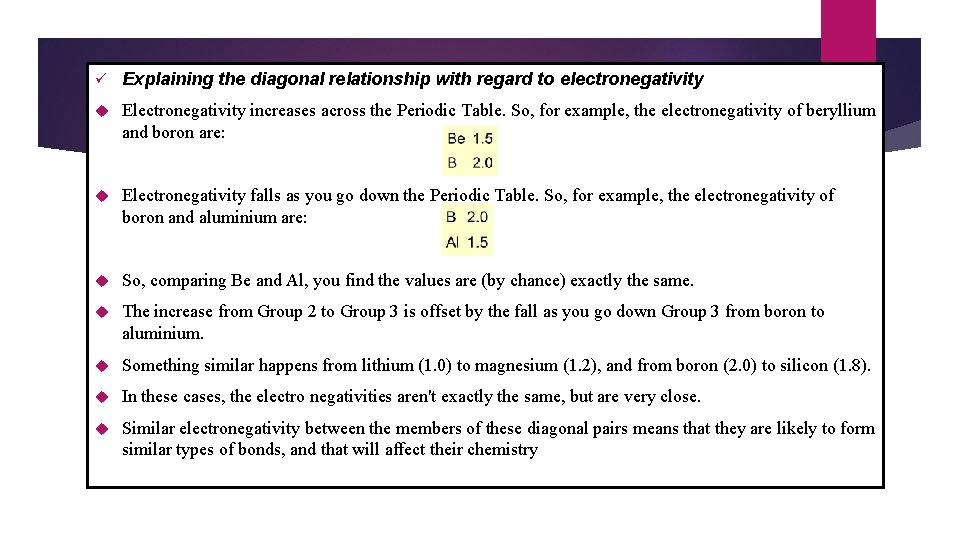
ü Explaining the diagonal relationship with regard to electronegativity Electronegativity increases across the Periodic Table. So, for example, the electronegativity of beryllium and boron are: Electronegativity falls as you go down the Periodic Table. So, for example, the electronegativity of boron and aluminium are: So, comparing Be and Al, you find the values are (by chance) exactly the same. The increase from Group 2 to Group 3 is offset by the fall as you go down Group 3 from boron to aluminium. Something similar happens from lithium (1. 0) to magnesium (1. 2), and from boron (2. 0) to silicon (1. 8). In these cases, the electro negativities aren't exactly the same, but are very close. Similar electronegativity between the members of these diagonal pairs means that they are likely to form similar types of bonds, and that will affect their chemistry
THE END THANK YOU