
ANITA Thermal Analysis and Design Kurt Liewer Collaboration

ANITA Thermal Analysis and Design Kurt Liewer Collaboration Meeting at UCI, April 7 -9, 2005
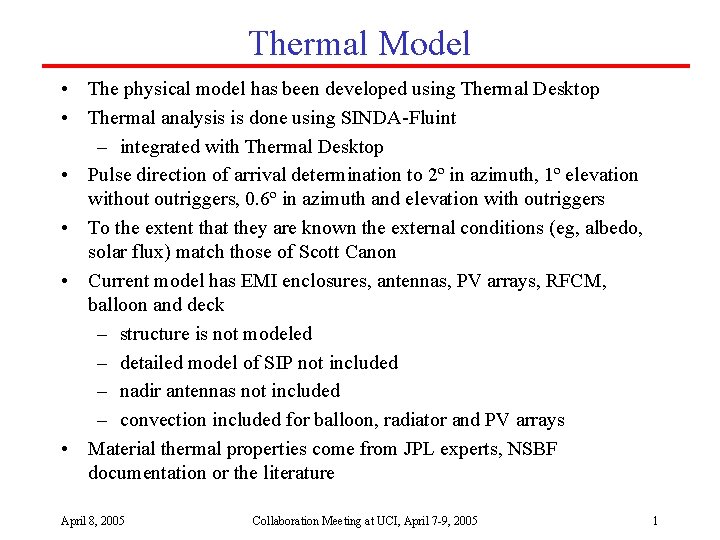
Thermal Model • The physical model has been developed using Thermal Desktop • Thermal analysis is done using SINDA-Fluint – integrated with Thermal Desktop • Pulse direction of arrival determination to 2º in azimuth, 1º elevation without outriggers, 0. 6º in azimuth and elevation with outriggers • To the extent that they are known the external conditions (eg, albedo, solar flux) match those of Scott Canon • Current model has EMI enclosures, antennas, PV arrays, RFCM, balloon and deck – structure is not modeled – detailed model of SIP not included – nadir antennas not included – convection included for balloon, radiator and PV arrays • Material thermal properties come from JPL experts, NSBF documentation or the literature April 8, 2005 Collaboration Meeting at UCI, April 7 -9, 2005 1
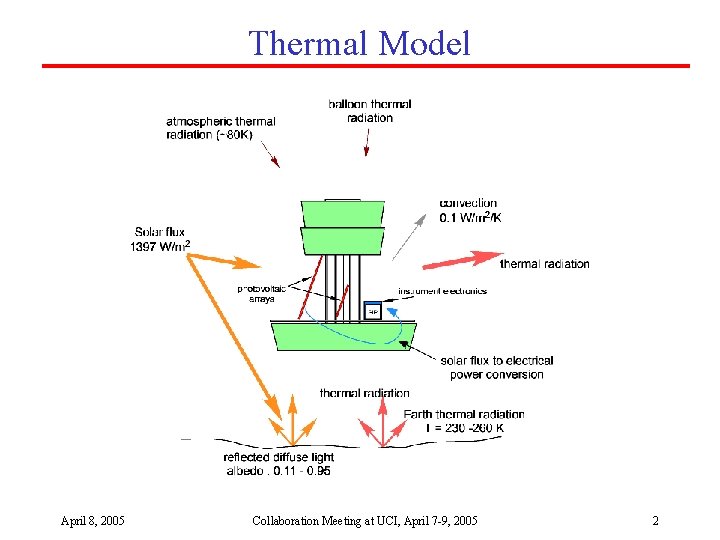
Thermal Model April 8, 2005 Collaboration Meeting at UCI, April 7 -9, 2005 2
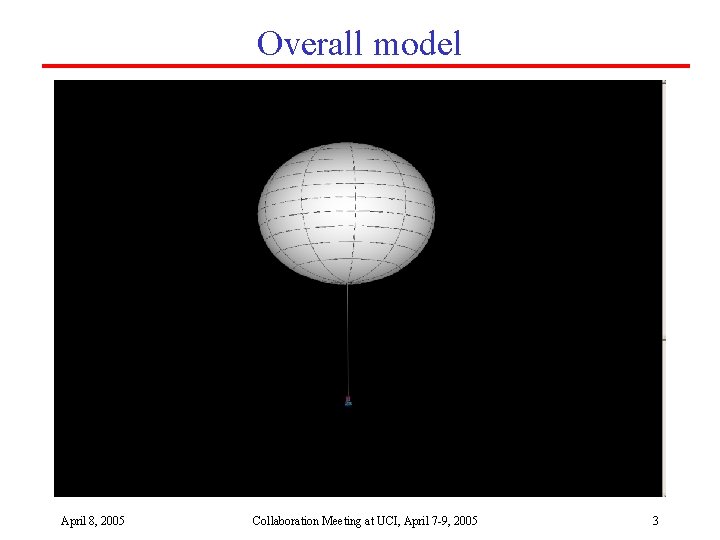
Overall model April 8, 2005 Collaboration Meeting at UCI, April 7 -9, 2005 3
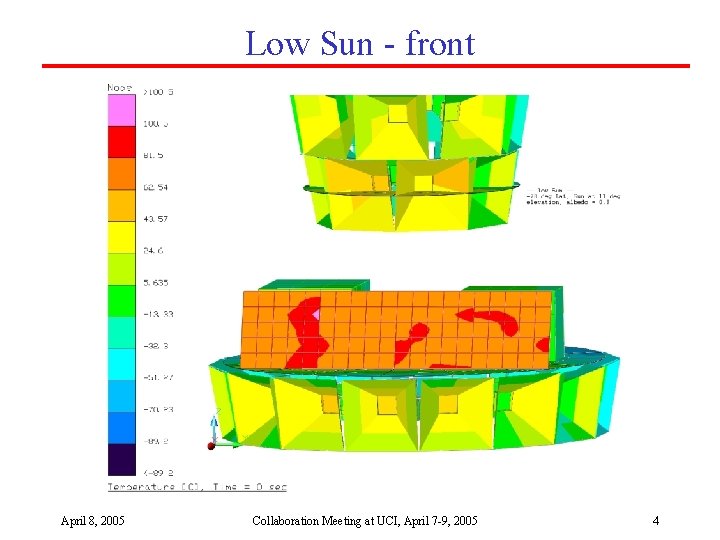
Low Sun - front April 8, 2005 Collaboration Meeting at UCI, April 7 -9, 2005 4
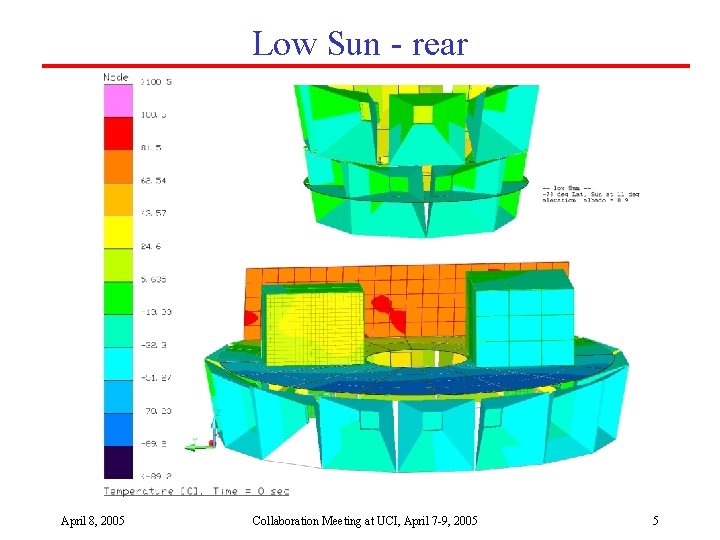
Low Sun - rear April 8, 2005 Collaboration Meeting at UCI, April 7 -9, 2005 5

Low Sun - radiator surface April 8, 2005 Collaboration Meeting at UCI, April 7 -9, 2005 6
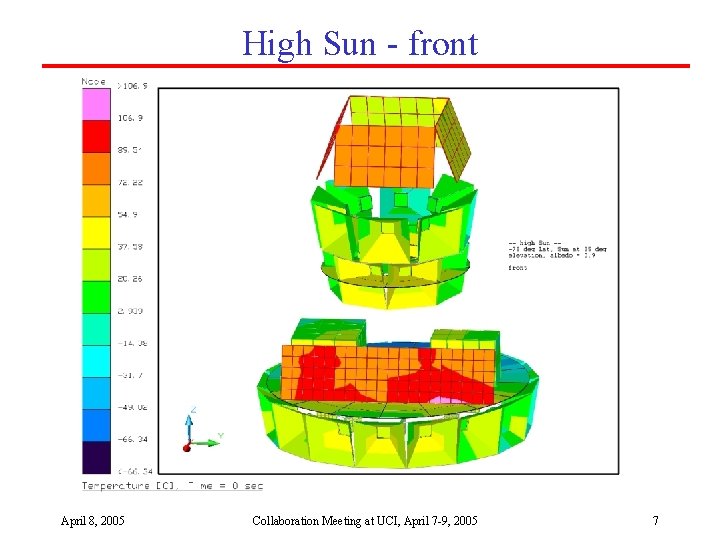
High Sun - front April 8, 2005 Collaboration Meeting at UCI, April 7 -9, 2005 7
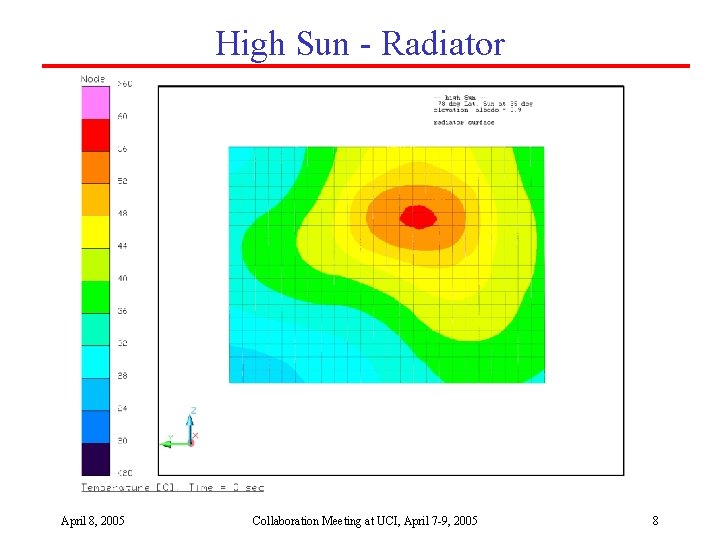
High Sun - Radiator April 8, 2005 Collaboration Meeting at UCI, April 7 -9, 2005 8
Concerns • Additional heat load on the radiator is making the temperatures at the crate interface much too large – no obvious solution • Inadequate SIP model • Transient cooling in tropopause during ascent has not been modeled April 8, 2005 Collaboration Meeting at UCI, April 7 -9, 2005 9
- Slides: 10