
Anisotropy Studies of UltraHigh Energy Cosmic Rays Using
![The Galactic Center: a=0. 005+/-0. 055 90% Confidence Interval: [-0. 085, 0. 090] John](https://slidetodoc.com/presentation_image_h/2b34f8fb70ac30622d30fcdeb6e7cef2/image-14.jpg "The Galactic Center: a=0. 005+/-0. 055 90% Confidence Interval: [-0. 085, 0. 090] John")
![The Galactic Center: a=0. 005+/-0. 055 90% Confidence Interval: [-0. 085, 0. 090] Centaurus](https://slidetodoc.com/presentation_image_h/2b34f8fb70ac30622d30fcdeb6e7cef2/image-15.jpg "The Galactic Center: a=0. 005+/-0. 055 90% Confidence Interval: [-0. 085, 0. 090] Centaurus")
- Slides: 27
Anisotropy Studies of Ultra-High Energy Cosmic Rays Using Monocular Data Collected by the High-Resolution Fly’s Eye (Hi. Res) 28 th International Cosmic Ray Conference, Tsukuba, Japan John Belz (University of Montana) for J. Bellido, B. Dawson, C. Jui, M. Kirn, B. Stokes and the Hi. Res Collaboration John Belz University of Montana
To be presented: • Upper limits on pointlike sources (> 1018. 5 e. V) • Search for global dipole enhancement(> 1018. 5 e. V) • Clustering studies (> 1019. 5 e. V) John Belz University of Montana
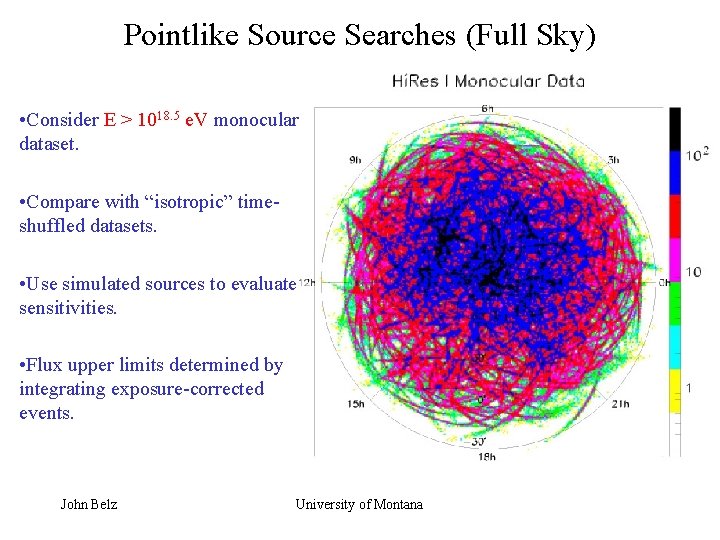
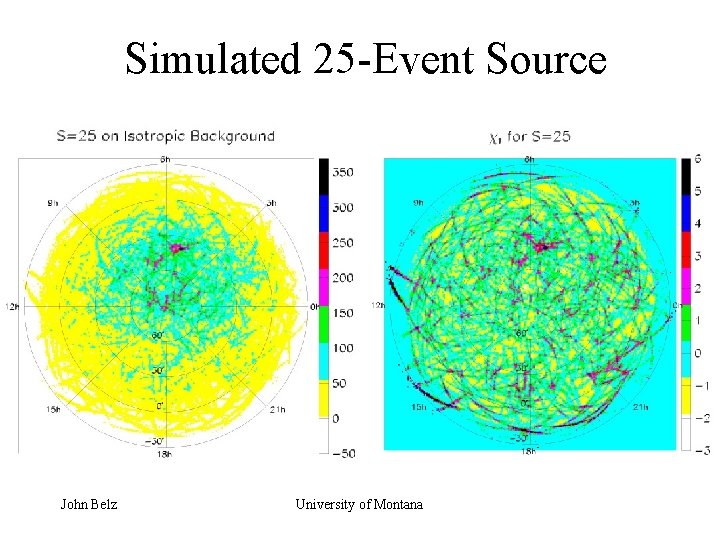
Pointlike Source Searches (Full Sky) • Consider E > 1018. 5 e. V monocular dataset. • Compare with “isotropic” timeshuffled datasets. • Use simulated sources to evaluate sensitivities. • Flux upper limits determined by integrating exposure-corrected events. John Belz University of Montana
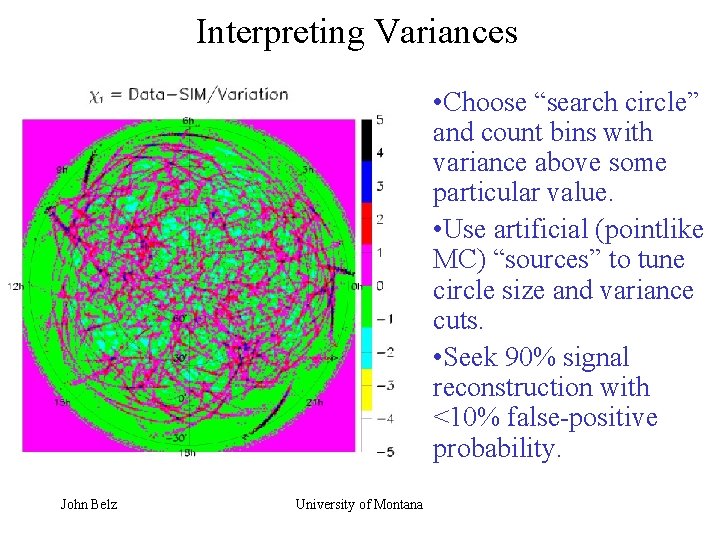
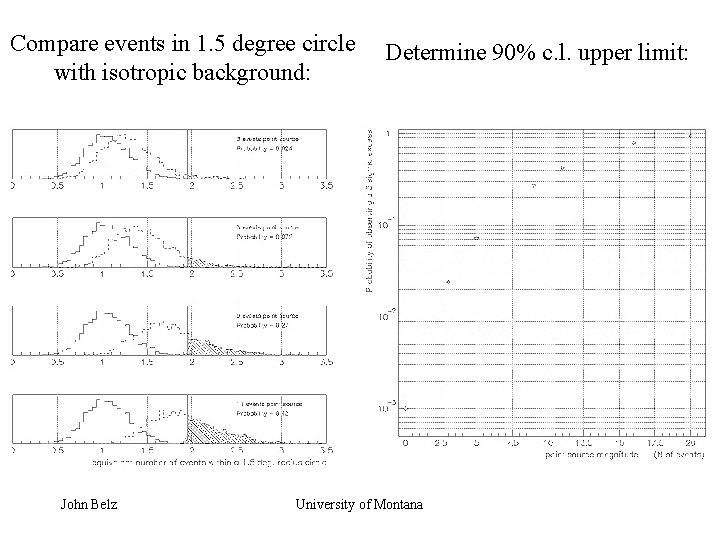
Interpreting Variances • Choose “search circle” and count bins with variance above some particular value. • Use artificial (pointlike MC) “sources” to tune circle size and variance cuts. • Seek 90% signal reconstruction with <10% false-positive probability. John Belz University of Montana
Simulated 25 -Event Source John Belz University of Montana
Pointlike Source Flux Upper Limit • With Hi. Res monocular dataset (1, 525 events, E > 1018. 5 e. V), we rule out the existence of northern hemisphere pointlike sources of greater than 25 events at 90% confidence level. • < 0. 33 events/km 2 *Yr (90% c. l. ) • < 1. 1 x 10 -18 events/cm 2*sec (90% c. l. ) John Belz University of Montana
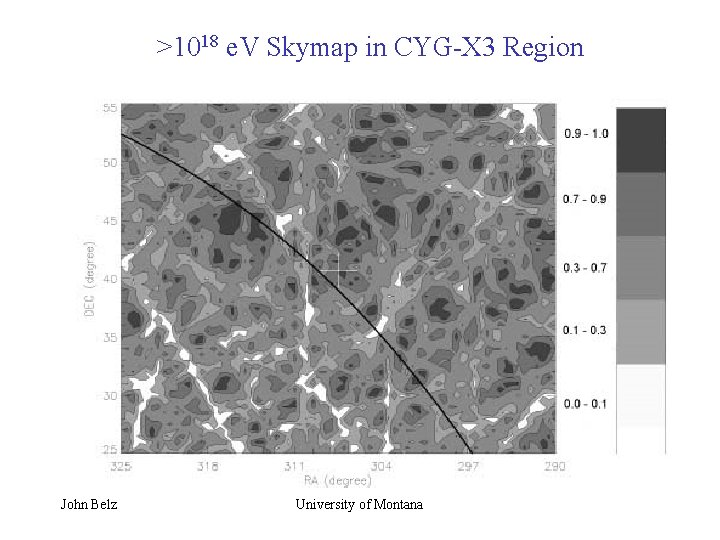
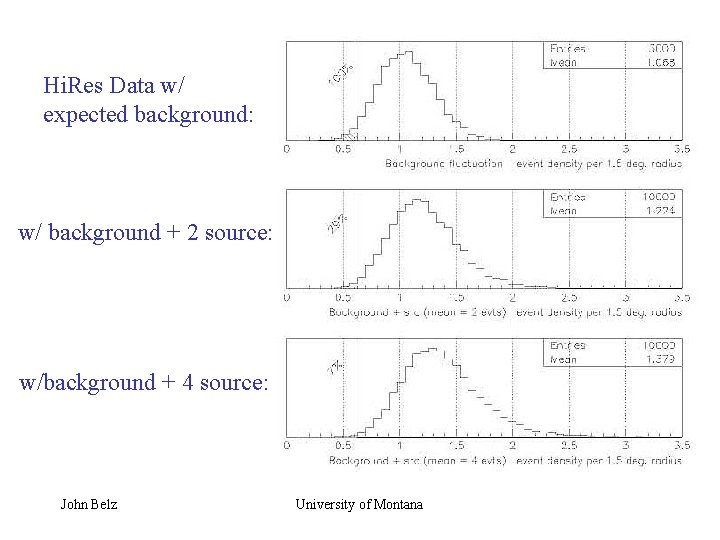
Pointlike Source Upper Limit (Cygnus X-3) • Cygnus X-3 chosen as a priori candidate: – G. Cassiday et al. , Phys. Rev. Lett 62 383 (1989). – M. Lawrence et al. , Phys. Rev Lett 63 1121 (1989). – M. Teshima et al. , Phys. Rev. Lett. 64 1628 (1990). • Use simulated sources to evaluate sensitivities. • Flux upper limits determined by integrating exposure-corrected events. John Belz University of Montana
>1018 e. V Skymap in CYG-X 3 Region John Belz University of Montana
Hi. Res Data w/ expected background: w/ background + 2 source: w/background + 4 source: John Belz University of Montana
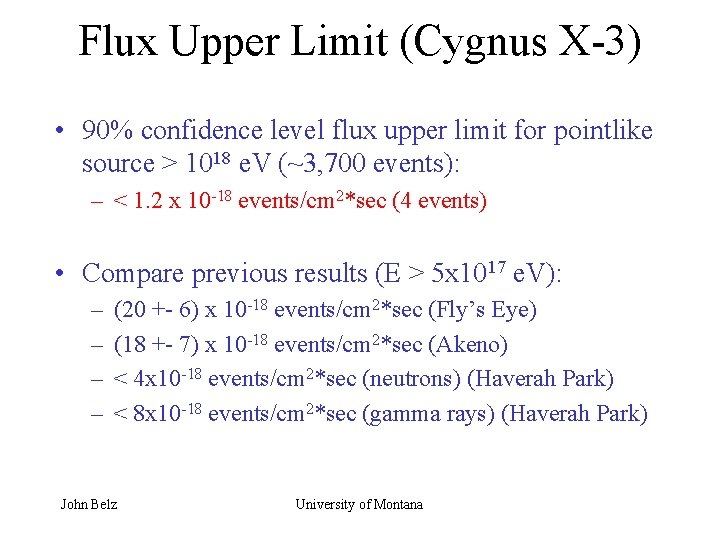
Flux Upper Limit (Cygnus X-3) • 90% confidence level flux upper limit for pointlike source > 1018 e. V (~3, 700 events): – < 1. 2 x 10 -18 events/cm 2*sec (4 events) • Compare previous results (E > 5 x 10¹⁷ e. V): – – (20 +- 6) x 10 -18 events/cm 2*sec (Fly’s Eye) (18 +- 7) x 10 -18 events/cm 2*sec (Akeno) < 4 x 10 -18 events/cm 2*sec (neutrons) (Haverah Park) < 8 x 10 -18 events/cm 2*sec (gamma rays) (Haverah Park) John Belz University of Montana
Global Dipole Searches • Galactic Center — possible effects observed by AGASA and Fly’s Eye • CEN-A — suggested as a potential source of a dipole effect (Farrar and Piran) • M 87 — possible weak effects (Biermann) John Belz University of Montana
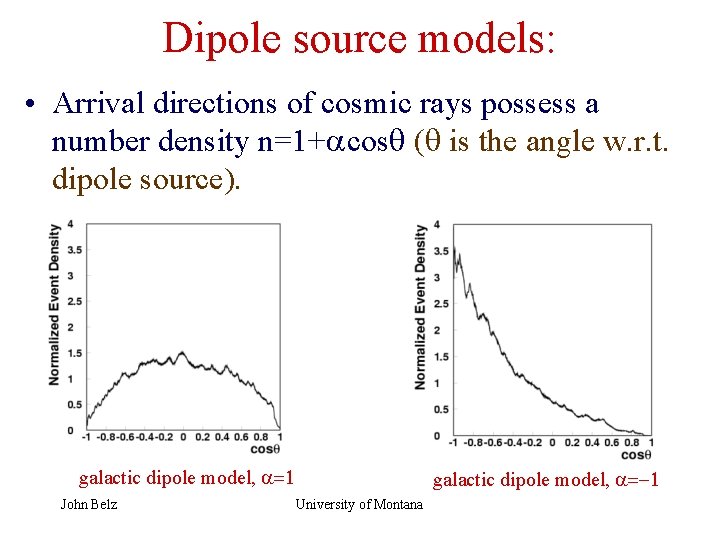
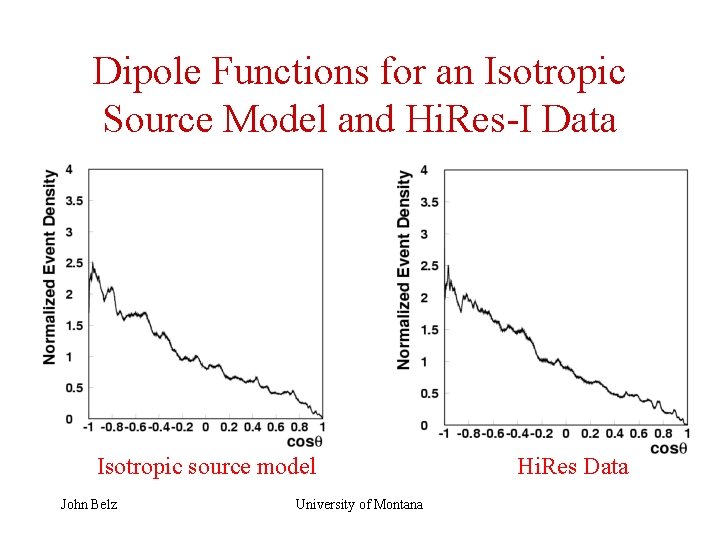
Dipole source models: • Arrival directions of cosmic rays possess a number density n=1+acosq (q is the angle w. r. t. dipole source). galactic dipole model, a=1 John Belz galactic dipole model, a=-1 University of Montana
Dipole Functions for an Isotropic Source Model and Hi. Res-I Data Isotropic source model John Belz University of Montana Hi. Res Data
The Galactic Center: a=0. 005+/-0. 055 90% Confidence Interval: [-0. 085, 0. 090] John Belz University of Montana
The Galactic Center: a=0. 005+/-0. 055 90% Confidence Interval: [-0. 085, 0. 090] Centaurus A: a=-0. 005+/-0. 065 90% Confidence Interval: [-0. 090, 0. 085] M 87: a=-0. 010+/-0. 045 90% Confidence Interval: [-0. 080, 0. 070] (Hi. Res-1 Monocular, 1525 events > 1018. 5 e. V) John Belz University of Montana
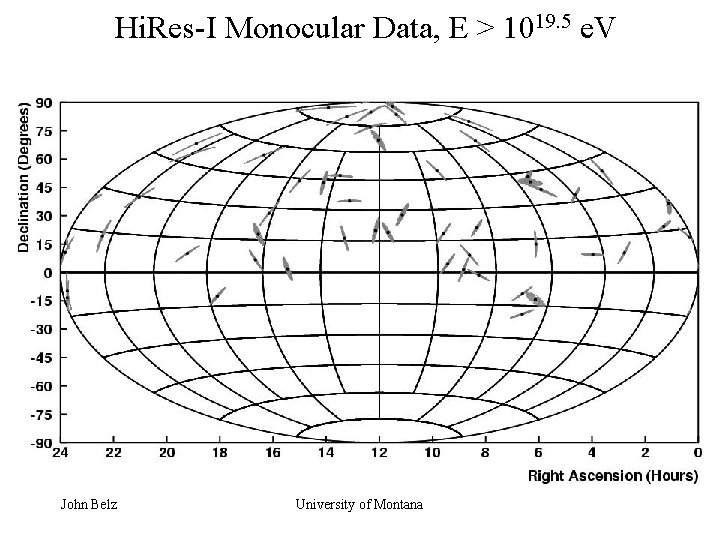
Hi. Res-I Monocular Data, E > 1019. 5 e. V John Belz University of Montana
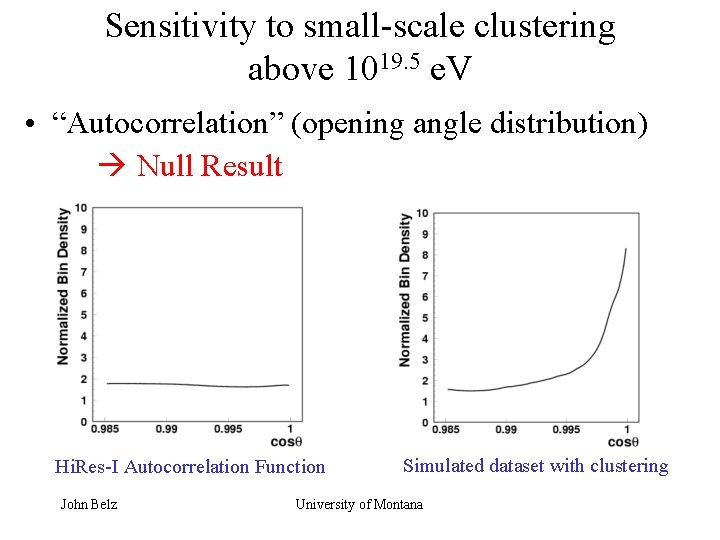
Sensitivity to small-scale clustering above 1019. 5 e. V • “Autocorrelation” (opening angle distribution) Null Result Hi. Res-I Autocorrelation Function John Belz Simulated dataset with clustering University of Montana
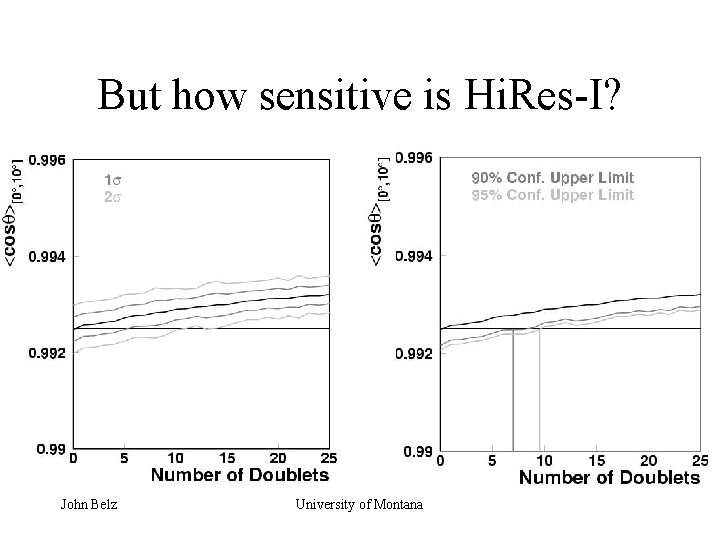
But how sensitive is Hi. Res-I? John Belz University of Montana
Hi. Res-I Autocorrelation Results • Hi. Res-I-like experiment should be able to distinguish seven doublets from background 90% of the time. • Current data set (52 northern-hemisphere events above 1019. 5 e. V) contains < 4 doublets (90% c. l. ) John Belz University of Montana
Conclusions Hi. Res-I Anisotropy searches have yielded null results: • Flux upper limit of 0. 33 events/km 2 *Yr (90% c. l. ) on pointlike sources with E > 1018. 5 e. V in northern hemisphere • Flux upper limit of 1. 2 x 10 -18 events/cm 2*sec (90% c. l. ) on pointlike sources with E > 1018 e. V centered at Cygnus X-3 • Dipole analyses consistent with isotropy for sources at galactic center, Centaurus A, M-87 • No clustering observed in highest energy events. Upper limit of 4 doublets (90% c. l. ) in Hi. Res-I monocular dataset. John Belz University of Montana
Other Hi. Res Anisotropy Presentations: • Ben Stokes, Using Fractal Dimensionality in the Search for Anisotropy of Ultra-High Energy Cosmic Rays, HE: Poster Session 2. • Chad Finley, Small-Scale Anisotropy Studies of the Highest Energy Cosmic Rays Observed in Stereo by Hi. Res, HE-1. 3, 16. John Belz University of Montana
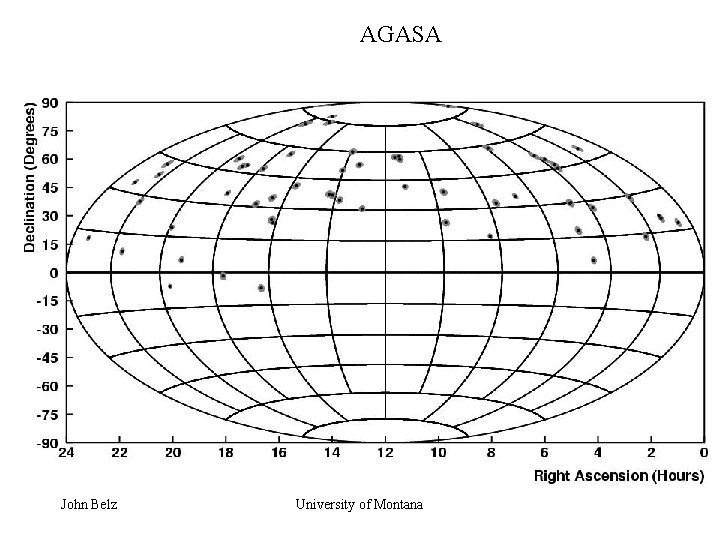
AGASA John Belz University of Montana
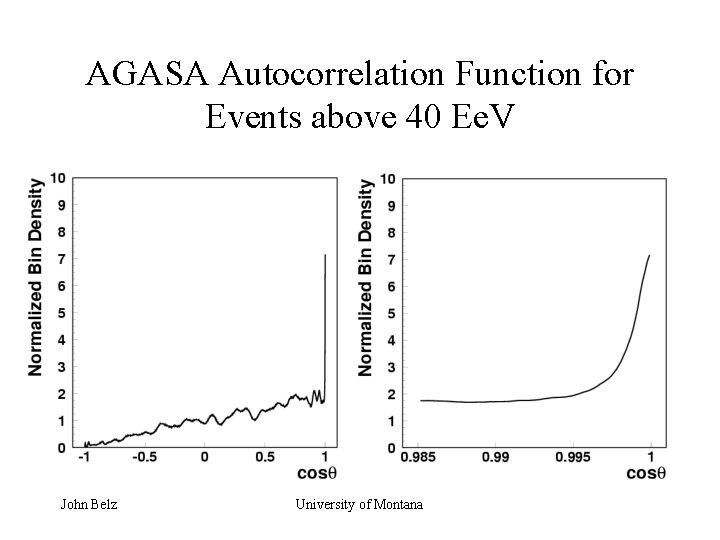
AGASA Autocorrelation Function for Events above 40 Ee. V John Belz University of Montana
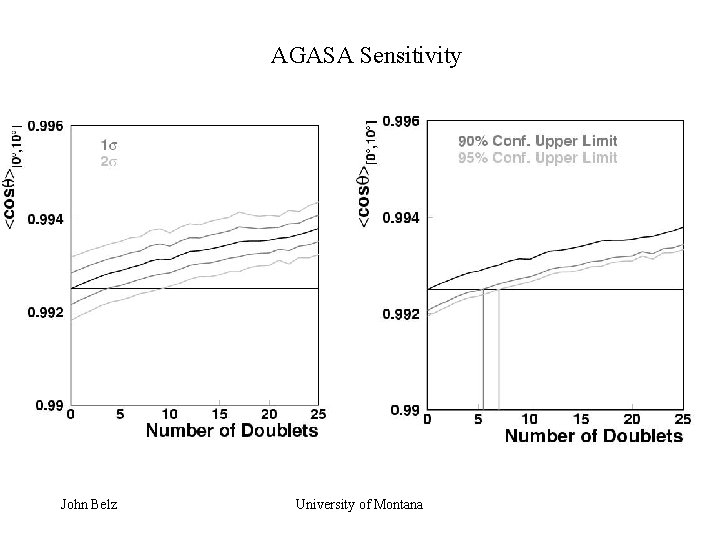
AGASA Sensitivity John Belz University of Montana
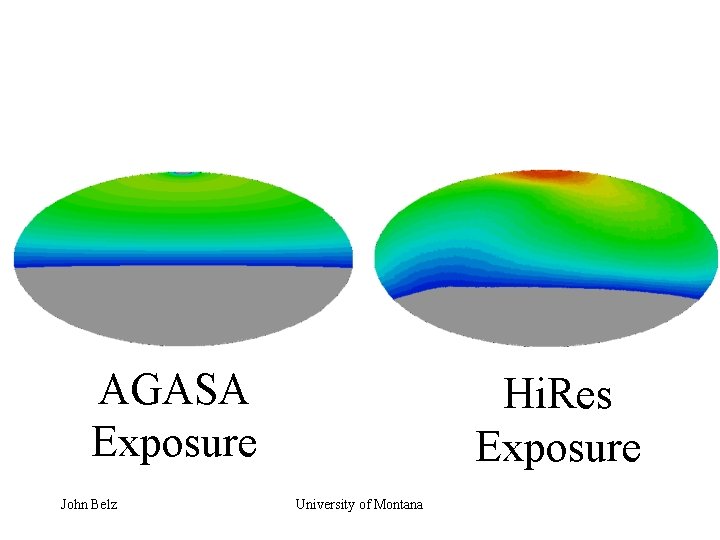
AGASA Exposure John Belz Hi. Res Exposure University of Montana
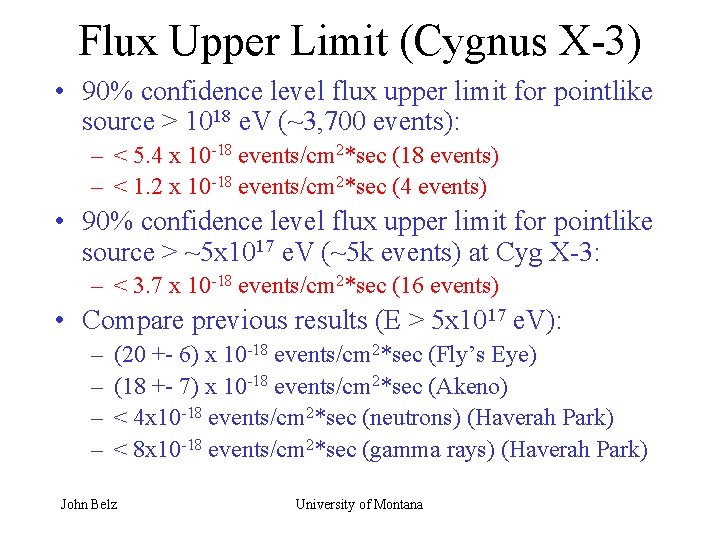
Flux Upper Limit (Cygnus X-3) • 90% confidence level flux upper limit for pointlike source > 1018 e. V (~3, 700 events): – < 5. 4 x 10 -18 events/cm 2*sec (18 events) – < 1. 2 x 10 -18 events/cm 2*sec (4 events) • 90% confidence level flux upper limit for pointlike source > ~5 x 10¹⁷ e. V (~5 k events) at Cyg X-3: – < 3. 7 x 10 -18 events/cm 2*sec (16 events) • Compare previous results (E > 5 x 10¹⁷ e. V): – – (20 +- 6) x 10 -18 events/cm 2*sec (Fly’s Eye) (18 +- 7) x 10 -18 events/cm 2*sec (Akeno) < 4 x 10 -18 events/cm 2*sec (neutrons) (Haverah Park) < 8 x 10 -18 events/cm 2*sec (gamma rays) (Haverah Park) John Belz University of Montana
Compare events in 1. 5 degree circle with isotropic background: John Belz Determine 90% c. l. upper limit: University of Montana