
Anisotropic Spin Fluctuations and Superconductivity in 115 Heavy

- Slides: 33
Anisotropic Spin Fluctuations and Superconductivity in ‘ 115’ Heavy Fermion Compounds : 59 Co NMR Study in Pu. Co. Ga 5 S. -H. Baek et. al. PRL 105, 217002(2010) Kazuhiro Nishimoto Kitaoka lab. 1
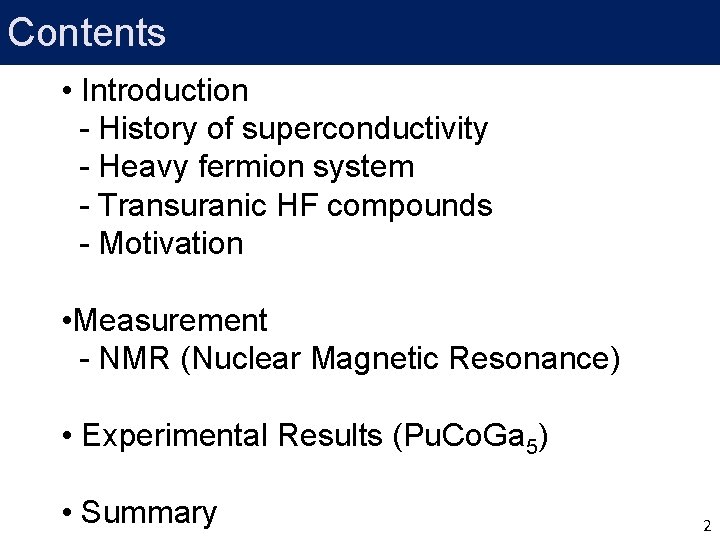
Contents • Introduction - History of superconductivity - Heavy fermion system - Transuranic HF compounds - Motivation • Measurement - NMR (Nuclear Magnetic Resonance) • Experimental Results (Pu. Co. Ga 5) • Summary 2
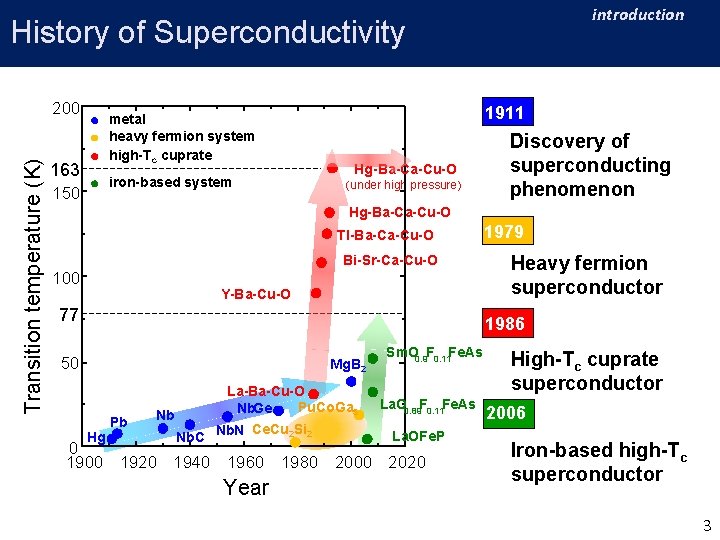
introduction History of Superconductivity Transition temperature (K) 200 metal heavy fermion system high-Tc cuprate 163 iron-based system 150 1911 Hg-Ba-Ca-Cu-O (under high pressure) Discovery of superconducting phenomenon Hg-Ba-Ca-Cu-O Tl-Ba-Ca-Cu-O Bi-Sr-Ca-Cu-O 100 Y-Ba-Cu-O 77 1979 Heavy fermion superconductor 1986 50 Mg. B 2 Hg Pb Nb Nb. C La-Ba-Cu-O Pu. Co. Ga 5 Nb. Ge Nb. N Ce. Cu 2 Si 2 Sm. O 0. 9 F 0. 11 Fe. As La. O 0. 89 F 0. 11 Fe. As La. OFe. P 0 1900 1920 1940 1960 1980 2000 2020 Year High-Tc cuprate superconductor 2006 Iron-based high-Tc superconductor 3
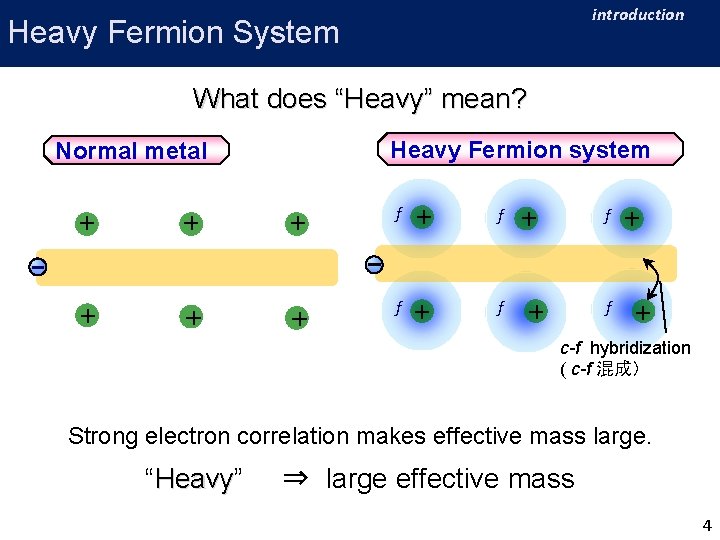
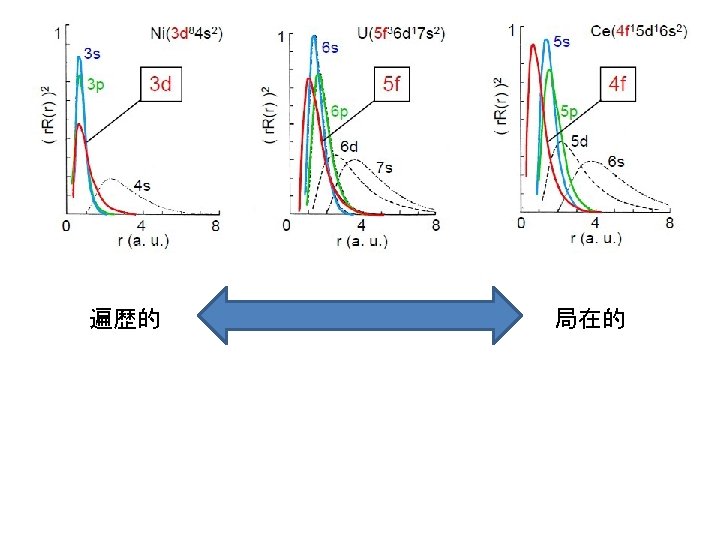
introduction Heavy Fermion System What does “Heavy” mean? Heavy Fermion system Normal metal + + + f + f f + + c-f hybridization ( c-f 混成) Strong electron correlation makes effective mass large. “Heavy” Heavy ⇒ large effective mass 4
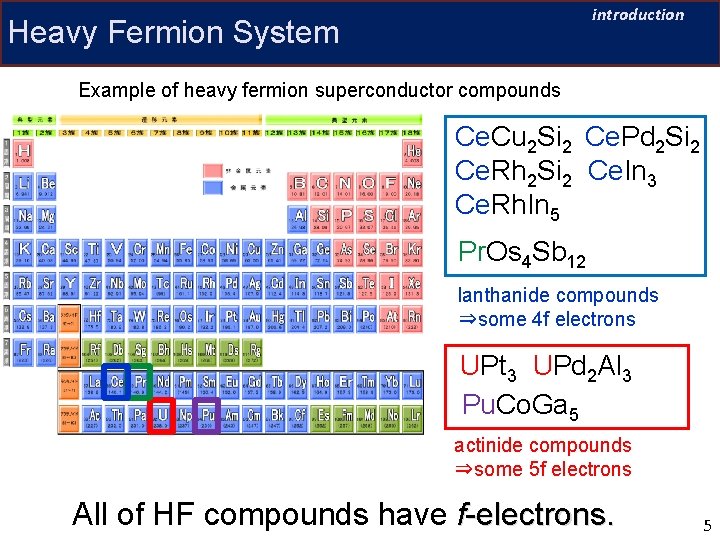
introduction Heavy Fermion System Example of heavy fermion superconductor compounds Ce. Cu 2 Si 2 Ce. Pd 2 Si 2 Ce. Rh 2 Si 2 Ce. In 3 Ce. Rh. In 5 Pr. Os 4 Sb 12 lanthanide compounds ⇒some 4 f electrons UPt 3 UPd 2 Al 3 Pu. Co. Ga 5 actinide compounds ⇒some 5 f electrons All of HF compounds have f-electrons. 5
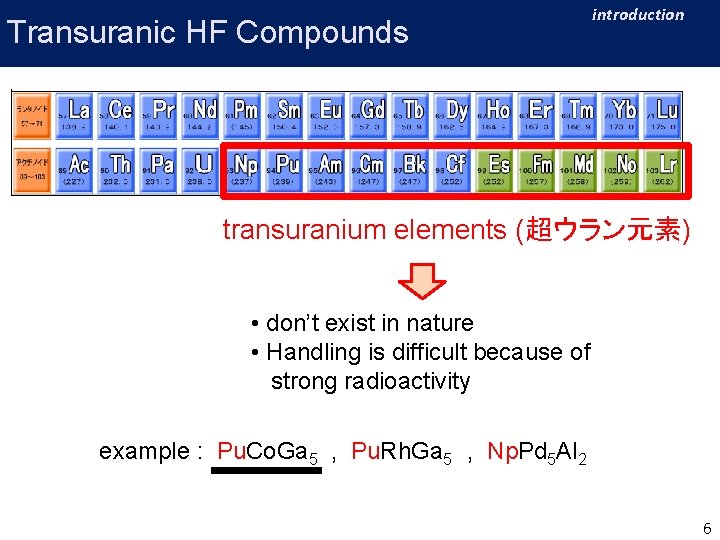
Transuranic HF Compounds introduction transuranium elements (超ウラン元素) • don’t exist in nature • Handling is difficult because of strong radioactivity example : Pu. Co. Ga 5 , Pu. Rh. Ga 5 , Np. Pd 5 Al 2 6
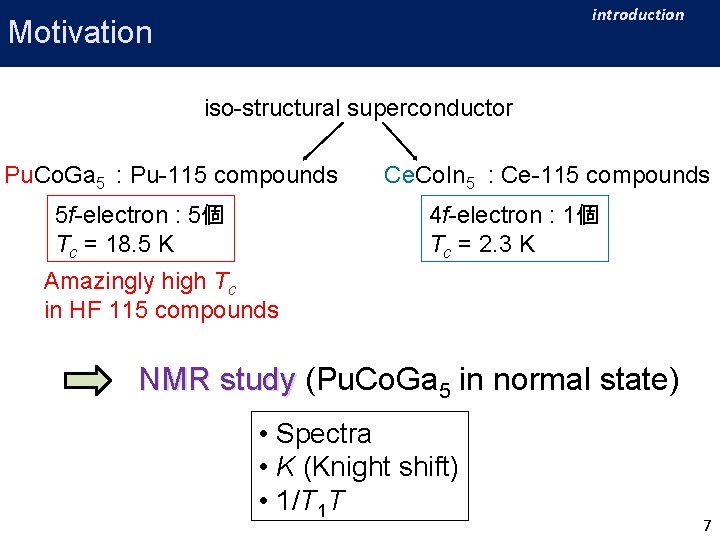
introduction Motivation iso-structural superconductor Pu. Co. Ga 5 : Pu-115 compounds 5 f-electron : 5個 Tc = 18. 5 K Ce. Co. In 5 : Ce-115 compounds 4 f-electron : 1個 Tc = 2. 3 K Amazingly high Tc in HF 115 compounds NMR study (Pu. Co. Ga 5 in normal state) • Spectra • K (Knight shift) • 1/T 1 T 7
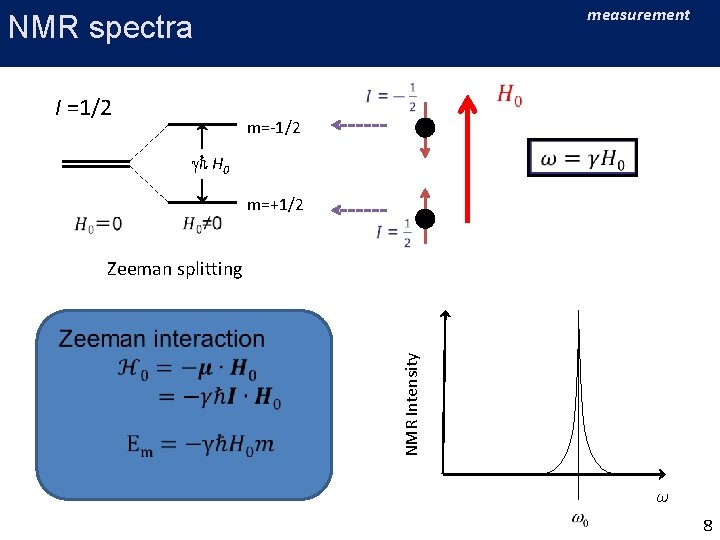
Introduction measurement NMR spectra I =1/2 m=-1/2 gℏ H 0 m=+1/2 Zeeman splitting NMR Intensity ω 8
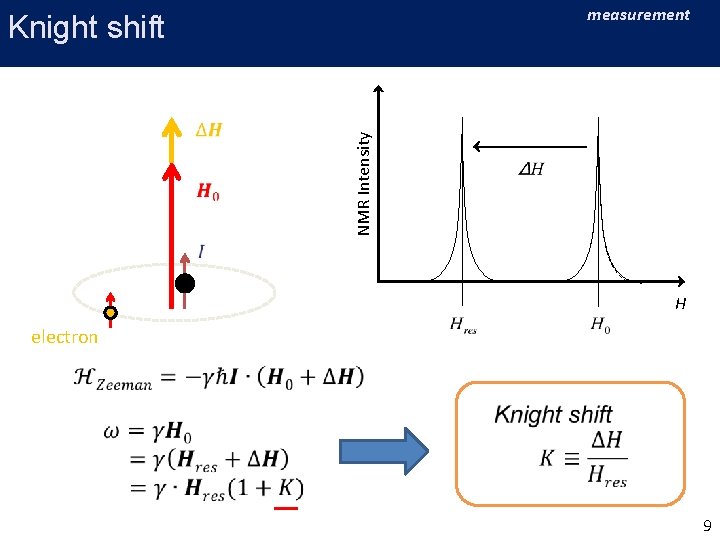
measurement NMR Intensity Knight shift H electron 9
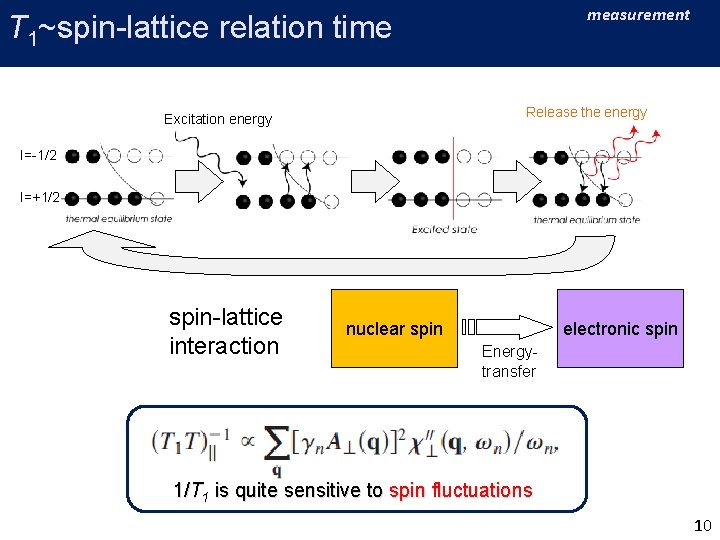
measurement T 1~spin-lattice relation time Release the energy Excitation energy I=-1/2 I=+1/2 spin-lattice interaction nuclear spin electronic spin Energytransfer 1/T 1 is quite sensitive to spin fluctuations 10
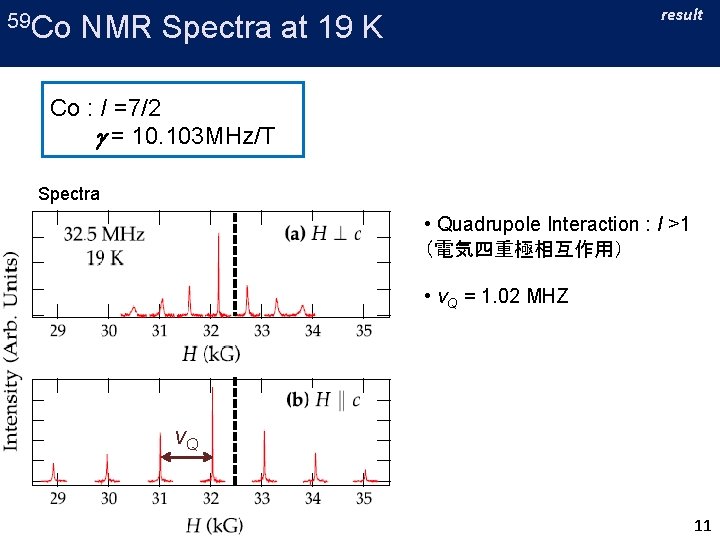
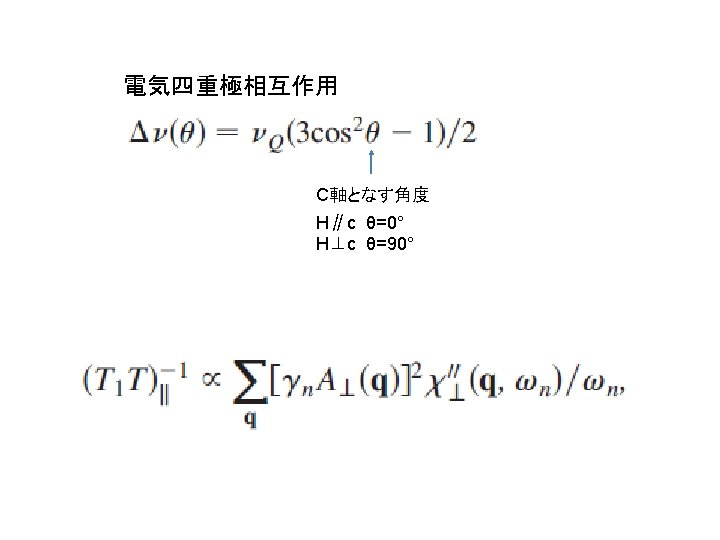
59 Co result NMR Spectra at 19 K Co : I =7/2 g = 10. 103 MHz/T Spectra • Quadrupole Interaction : I >1 (電気四重極相互作用) • νQ = 1. 02 MHZ νQ 11
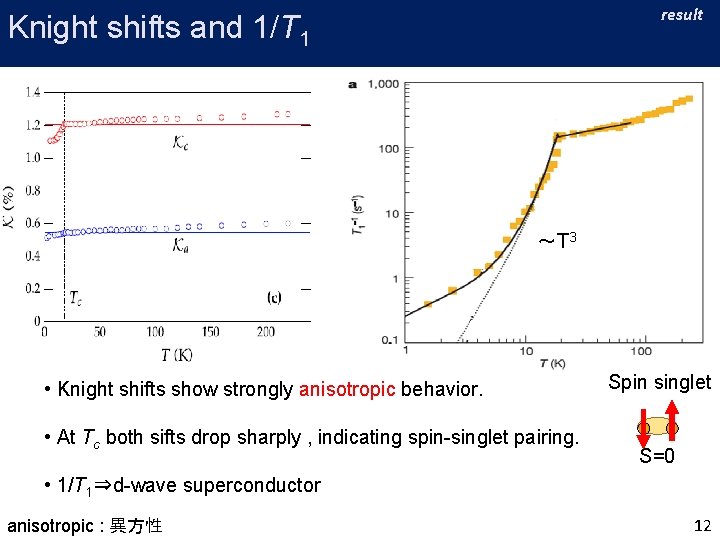
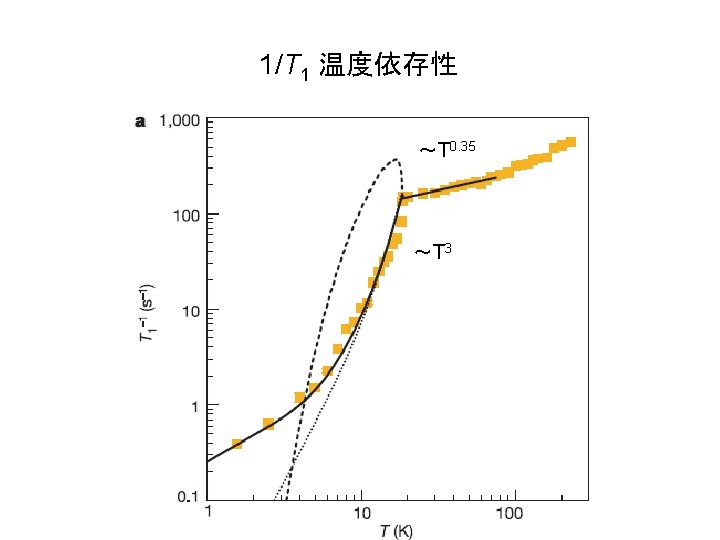
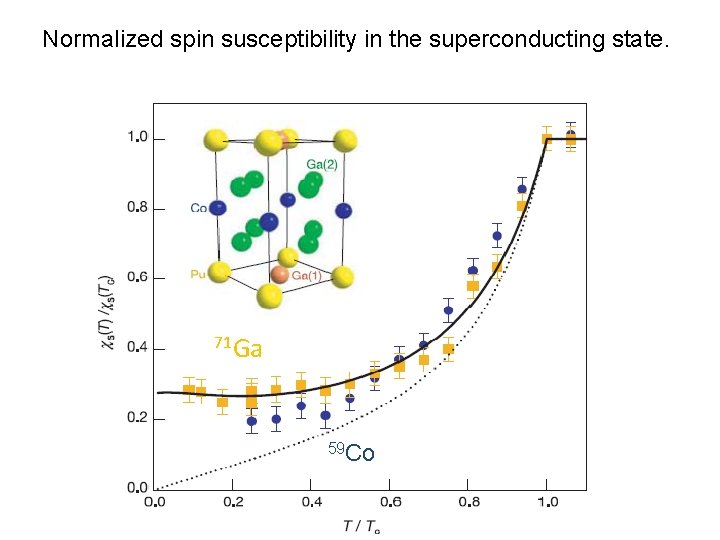
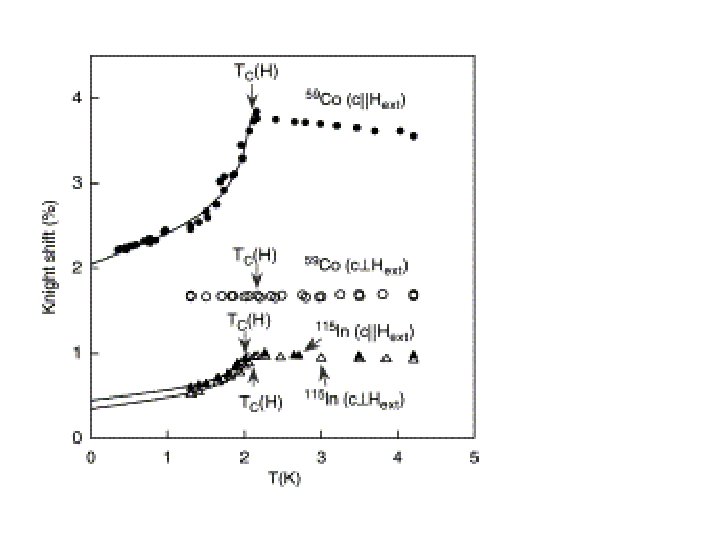
result Knight shifts and 1/T 1 ~T 3 • Knight shifts show strongly anisotropic behavior. • At Tc both sifts drop sharply , indicating spin-singlet pairing. Spin singlet S=0 • 1/T 1⇒d-wave superconductor anisotropic : 異方性 12
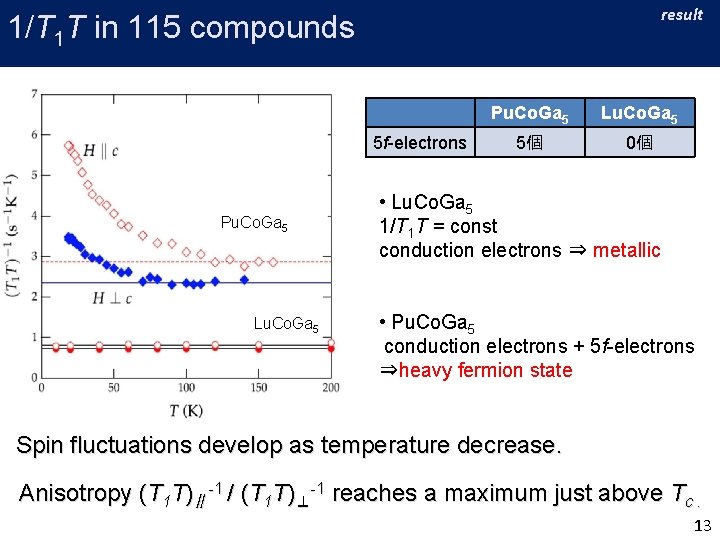
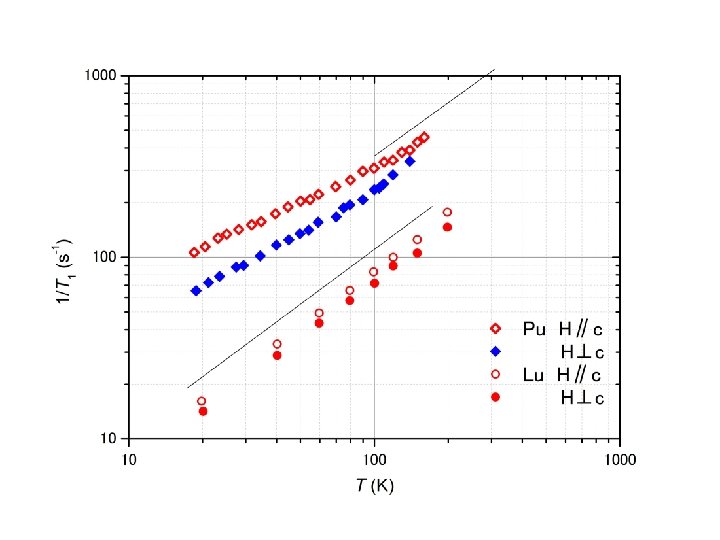
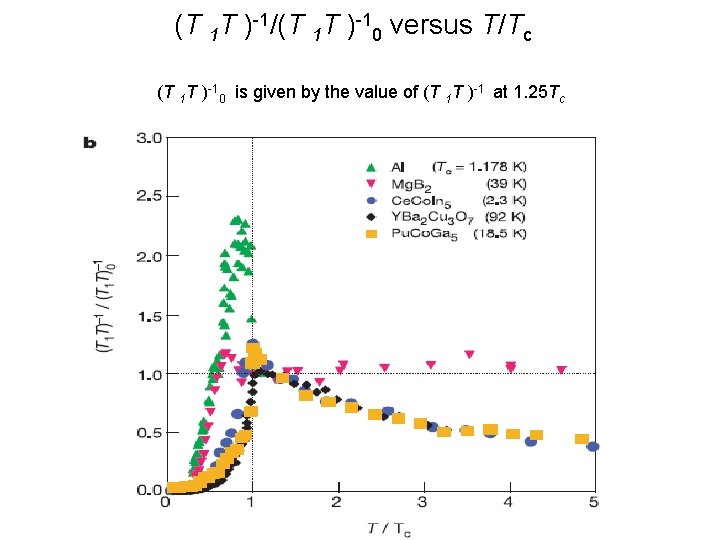
result 1/T 1 T in 115 compounds 5 f-electrons Pu. Co. Ga 5 Lu. Co. Ga 5 5個 0個 • Lu. Co. Ga 5 1/T 1 T = const conduction electrons ⇒ metallic • Pu. Co. Ga 5 conduction electrons + 5 f-electrons ⇒heavy fermion state Spin fluctuations develop as temperature decrease. Anisotropy (T 1 T)∥-1 / (T 1 T)⊥-1 reaches a maximum just above Tc. 13
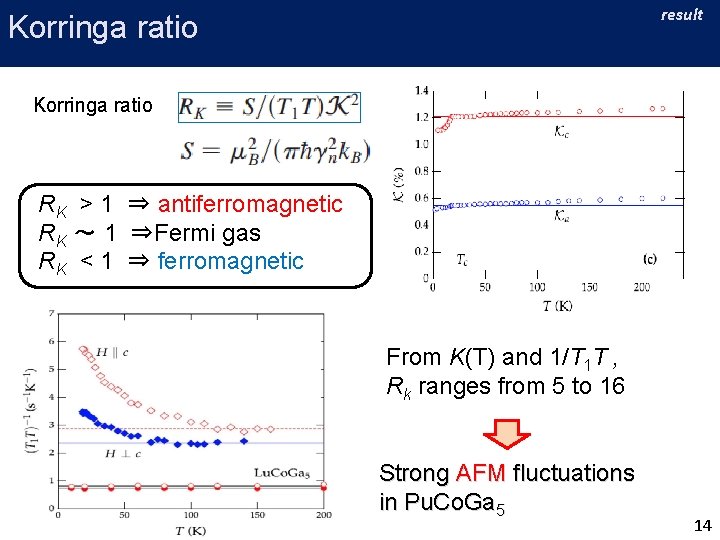
result Korringa ratio RK > 1 ⇒ antiferromagnetic RK ~ 1 ⇒Fermi gas RK < 1 ⇒ ferromagnetic From K(T) and 1/T 1 T , Rk ranges from 5 to 16 Strong AFM fluctuations in Pu. Co. Ga 5 14
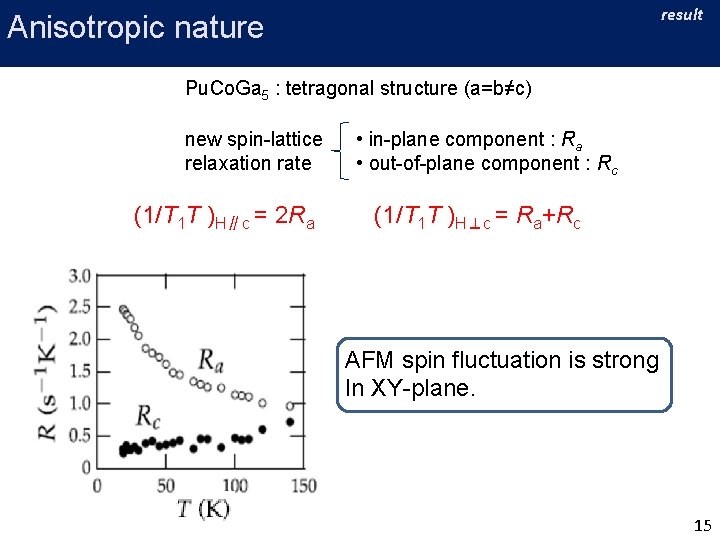
result Anisotropic nature Pu. Co. Ga 5 : tetragonal structure (a=b≠c) new spin-lattice relaxation rate (1/T 1 T )H∥c = 2 Ra • in-plane component : Ra • out-of-plane component : Rc (1/T 1 T )H⊥c = Ra+Rc AFM spin fluctuation is strong In XY-plane. 15
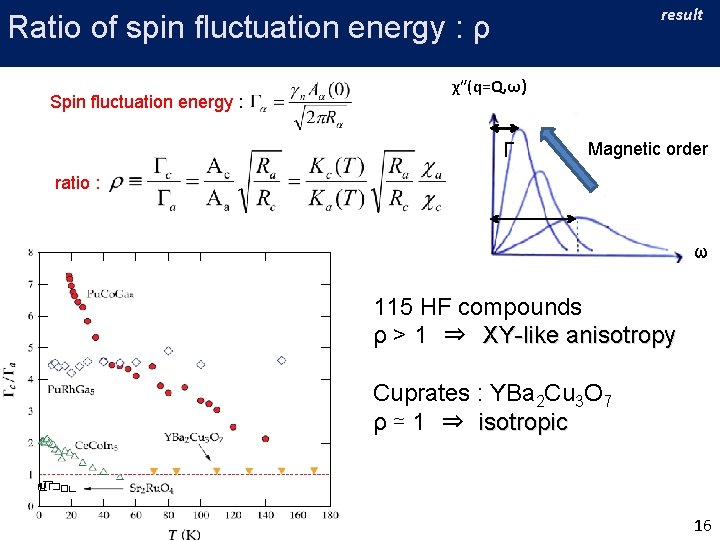
result Ratio of spin fluctuation energy : ρ Spin fluctuation energy : χ″(q=Q, ω) Γ Magnetic order ratio : ω 115 HF compounds ρ > 1 ⇒ XY-like anisotropy Cuprates : YBa 2 Cu 3 O 7 ρ ⋍ 1 ⇒ isotropic 16
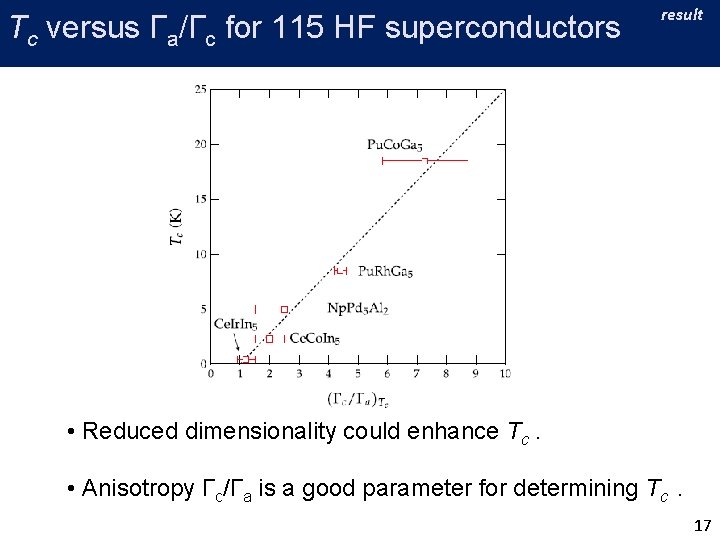
Tc versus Γa/Γc for 115 HF superconductors result • Reduced dimensionality could enhance Tc. • Anisotropy Γc/Γa is a good parameter for determining Tc. 17
Summary Pu. Co. Ga 5 : 59 Co. NMR study in the normal state • Spin fluctuations promote d-wave superconductivity in the iso-structural 115 HF compounds. • Both the Knight shift K and the spin-lattice relaxation rate 1/T 1 are strongly anisotropic. • The ratio Γc/Γa (spin fluctuation energy) is a characteristic quantity in 115 HF compounds. This suggest the possibility that anisotropic spin-fluctuations enhance Tc. 18
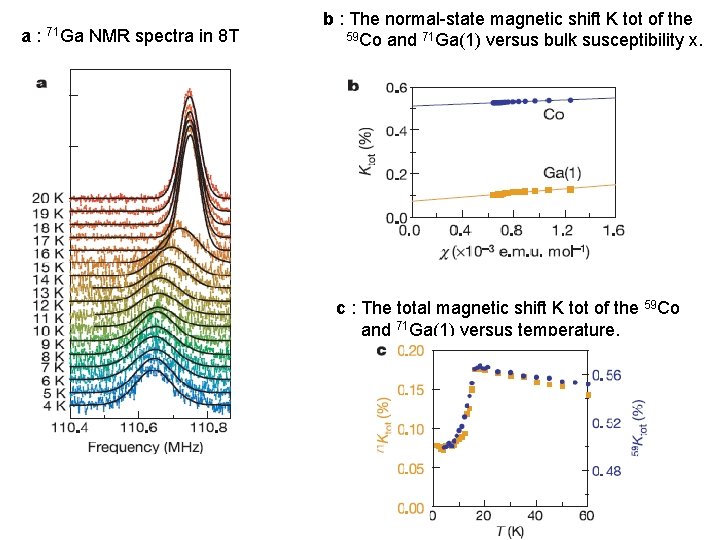
a: 71 Ga NMR spectra in 8 T b : The normal-state magnetic shift K tot of the 59 Co and 71 Ga(1) versus bulk susceptibility x. c : The total magnetic shift K tot of the 59 Co and 71 Ga(1) versus temperature.
Normalized spin susceptibility in the superconducting state. 71 Ga 59 Co
(T 1 T )-1/(T 1 T )-10 versus T/Tc (T 1 T )-10 is given by the value of (T 1 T )-1 at 1. 25 Tc
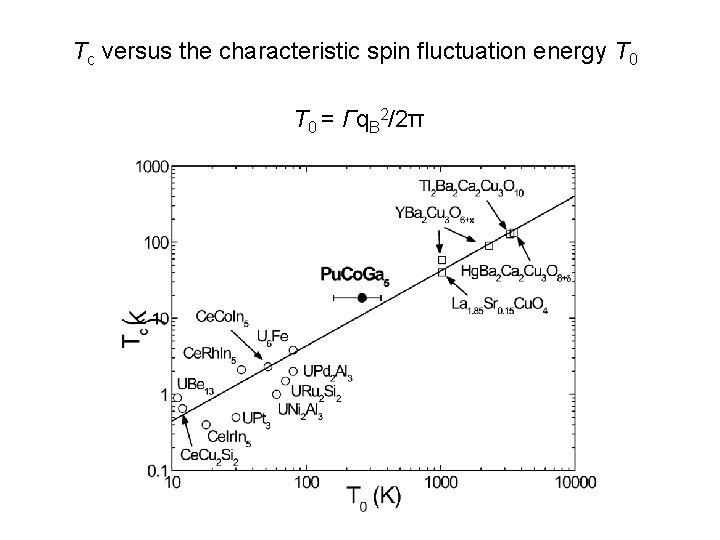
Tc versus the characteristic spin fluctuation energy T 0 = Γq. B 2/2π
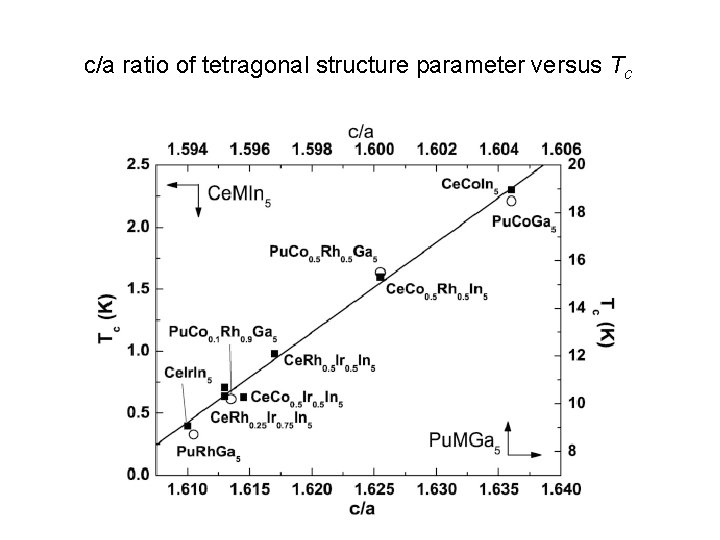
c/a ratio of tetragonal structure parameter versus Tc
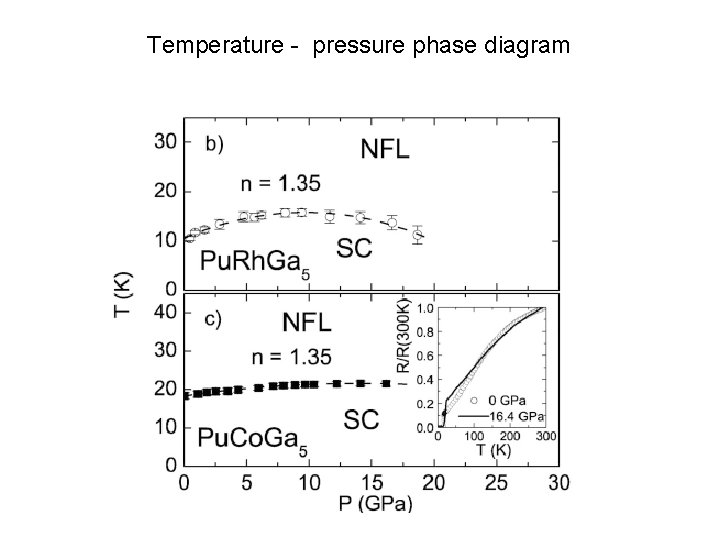
Temperature - pressure phase diagram
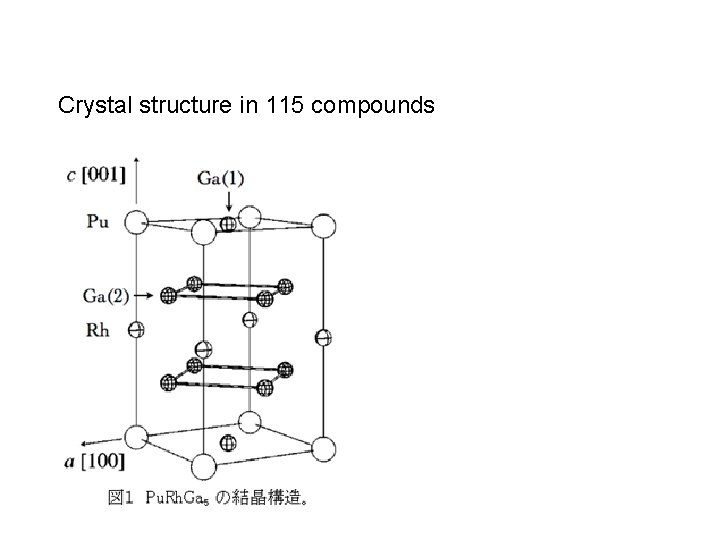
Crystal structure in 115 compounds
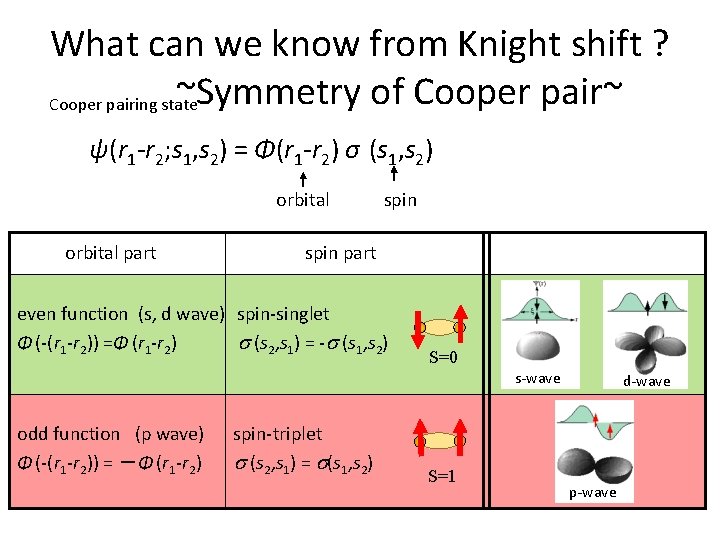
What can we know from Knight shift ? of Cooper pair~ Cooper ~Symmetry pairing state ψ(r 1 -r 2; s 1, s 2) = Φ(r 1 -r 2) σ (s 1, s 2) orbital part spin part even function (s, d wave) spin-singlet Φ (-(r 1 -r 2)) =Φ (r 1 -r 2) s (s 2, s 1) = -s (s 1, s 2) S=0 s-wave odd function (p wave) Φ (-(r 1 -r 2)) = -Φ (r 1 -r 2) spin-triplet s (s 2, s 1) = s(s 1, s 2) S=1 d-wave p-wave
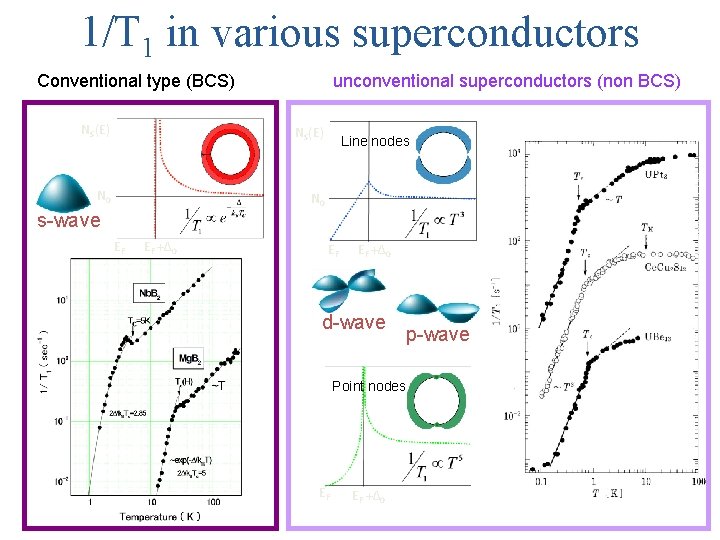
1/T 1 in various superconductors Conventional type (BCS) unconventional superconductors (non BCS) NS(E) N 0 Line nodes s-wave EF EF +Δ 0 d-wave p-wave Point nodes EF EF +Δ 0