
Anisotropic flow at RHIC from SPS to RHIC

- Slides: 38
Anisotropic flow at RHIC from SPS to RHIC Raimond Snellings; Moriond 2004
Introduction • Heavy-Ion Collisions – Study QCD at high temperature and density – Establish and characterize properties of deconfined matter and the phase transition • Requirement observables – Provide information about the early, possibly deconfined phase – Sensitive to the bulk properties Raimond Snellings; Moriond 2004 2
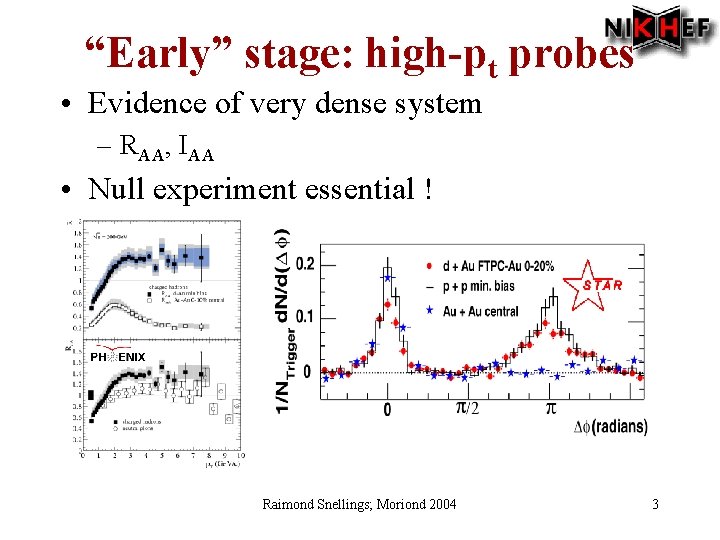
“Early” stage: high-pt probes • Evidence of very dense system – RAA, IAA • Null experiment essential ! Raimond Snellings; Moriond 2004 3
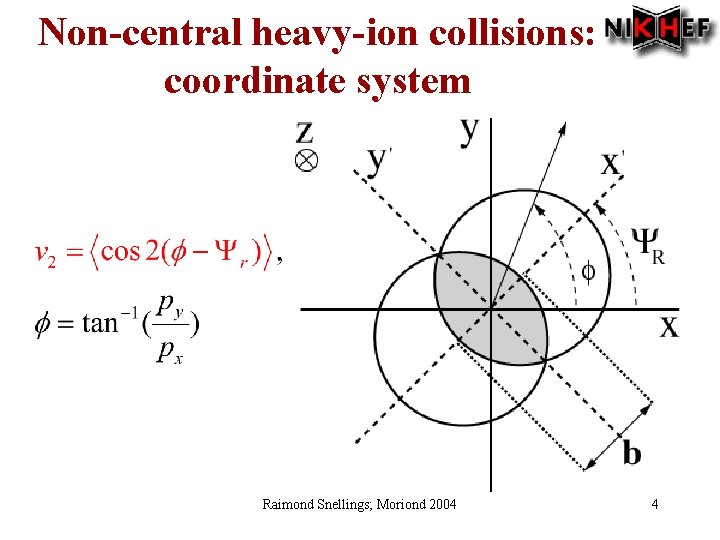
Non-central heavy-ion collisions: coordinate system Raimond Snellings; Moriond 2004 4
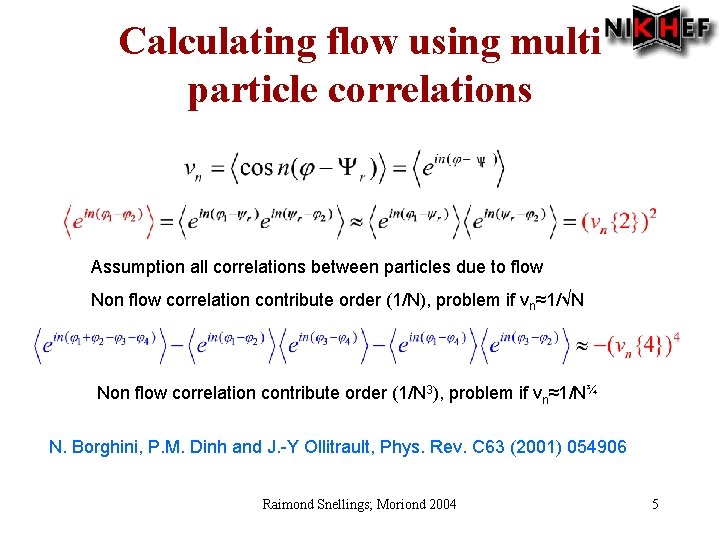
Calculating flow using multi particle correlations Assumption all correlations between particles due to flow Non flow correlation contribute order (1/N), problem if vn≈1/√N Non flow correlation contribute order (1/N 3), problem if vn≈1/N¾ N. Borghini, P. M. Dinh and J. -Y Ollitrault, Phys. Rev. C 63 (2001) 054906 Raimond Snellings; Moriond 2004 5
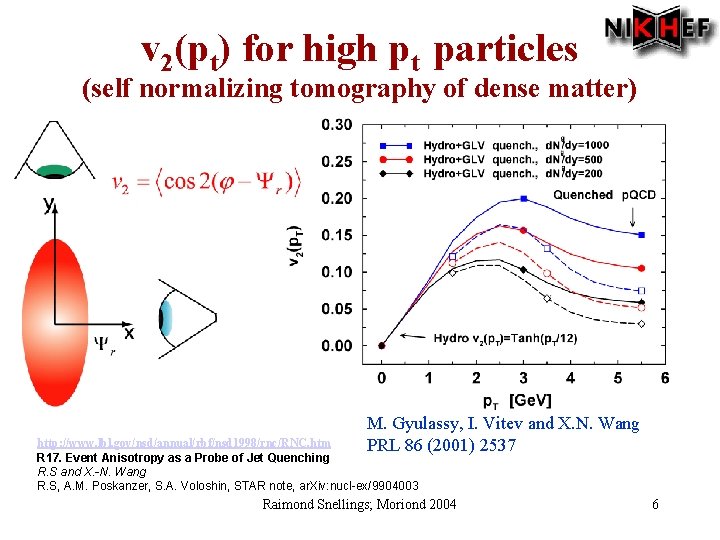
v 2(pt) for high pt particles (self normalizing tomography of dense matter) M. Gyulassy, I. Vitev and X. N. Wang PRL 86 (2001) 2537 http: //www. lbl. gov/nsd/annual/rbf/nsd 1998/rnc/RNC. htm R 17. Event Anisotropy as a Probe of Jet Quenching R. S and X. -N. Wang R. S, A. M. Poskanzer, S. A. Voloshin, STAR note, ar. Xiv: nucl-ex/9904003 Raimond Snellings; Moriond 2004 6
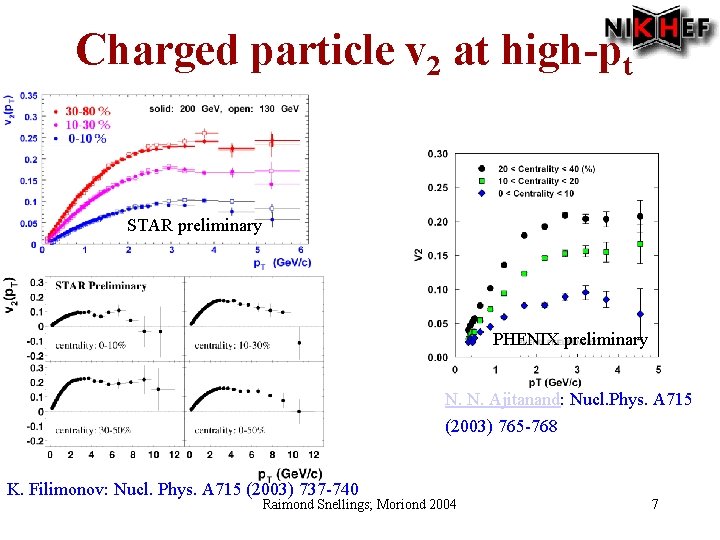
Charged particle v 2 at high-pt STAR preliminary PHENIX preliminary N. N. Ajitanand: Nucl. Phys. A 715 (2003) 765 -768 K. Filimonov: Nucl. Phys. A 715 (2003) 737 -740 Raimond Snellings; Moriond 2004 7
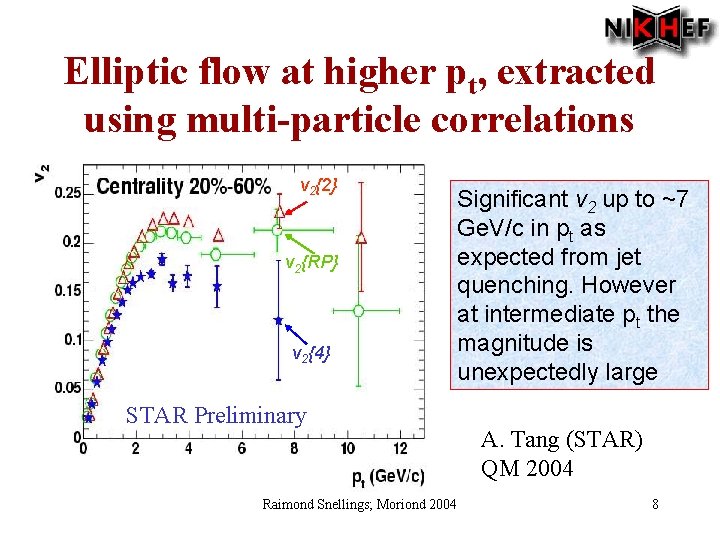
Elliptic flow at higher pt, extracted using multi-particle correlations v 2{2} v 2{RP} v 2{4} Significant v 2 up to ~7 Ge. V/c in pt as expected from jet quenching. However at intermediate pt the magnitude is unexpectedly large STAR Preliminary Raimond Snellings; Moriond 2004 A. Tang (STAR) QM 2004 8
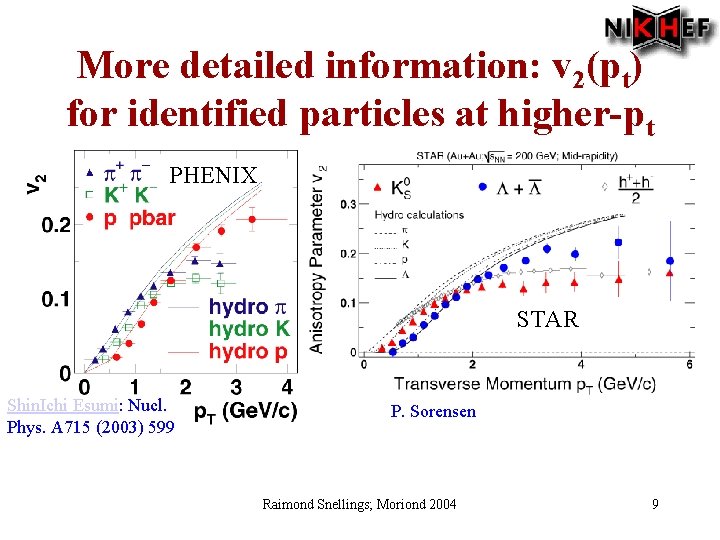
More detailed information: v 2(pt) for identified particles at higher-pt PHENIX STAR Preliminary Shin. Ichi Esumi: Nucl. Phys. A 715 (2003) 599 P. Sorensen Raimond Snellings; Moriond 2004 9
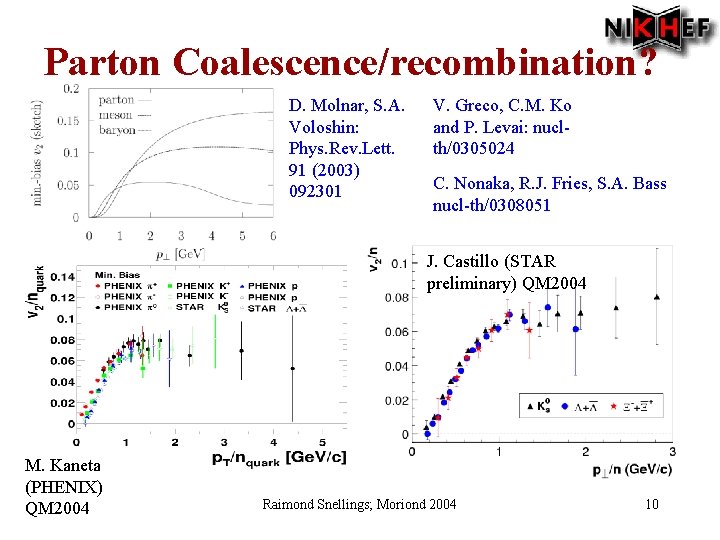
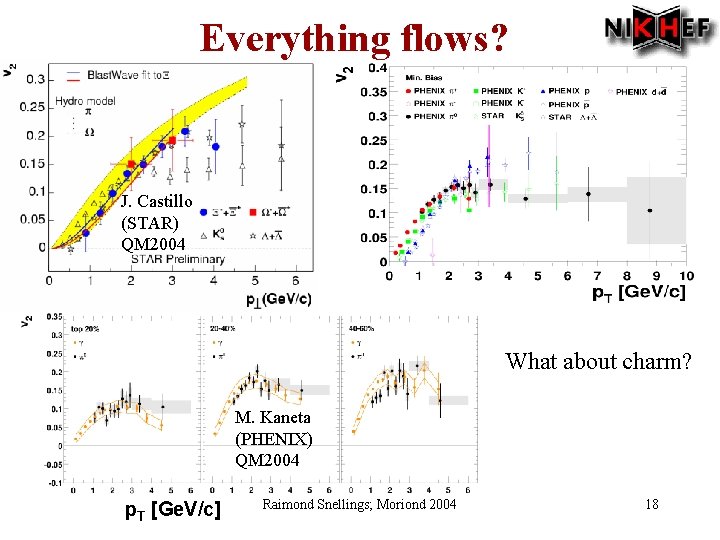
Parton Coalescence/recombination? D. Molnar, S. A. Voloshin: Phys. Rev. Lett. 91 (2003) 092301 V. Greco, C. M. Ko and P. Levai: nuclth/0305024 C. Nonaka, R. J. Fries, S. A. Bass nucl-th/0308051 J. Castillo (STAR preliminary) QM 2004 M. Kaneta (PHENIX) QM 2004 Raimond Snellings; Moriond 2004 10
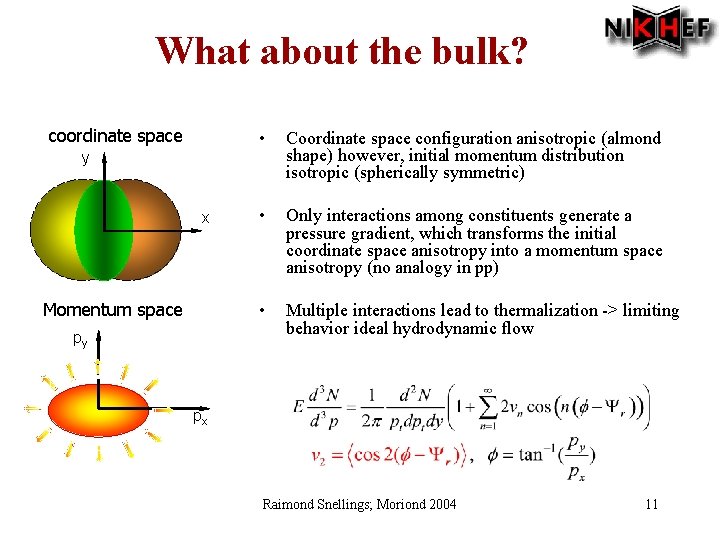
What about the bulk? coordinate space • Coordinate space configuration anisotropic (almond shape) however, initial momentum distribution isotropic (spherically symmetric) • Only interactions among constituents generate a pressure gradient, which transforms the initial coordinate space anisotropy into a momentum space anisotropy (no analogy in pp) • Multiple interactions lead to thermalization -> limiting behavior ideal hydrodynamic flow y x Momentum space py px Raimond Snellings; Moriond 2004 11
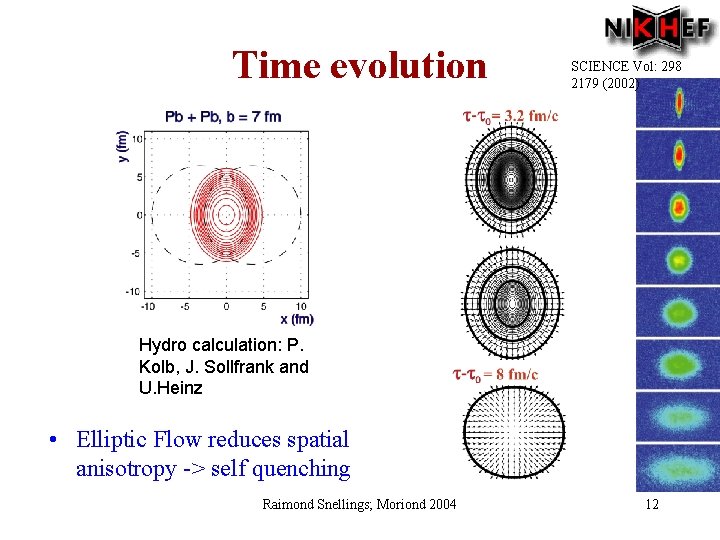
Time evolution SCIENCE Vol: 298 2179 (2002) Hydro calculation: P. Kolb, J. Sollfrank and U. Heinz • Elliptic Flow reduces spatial anisotropy -> self quenching Raimond Snellings; Moriond 2004 12
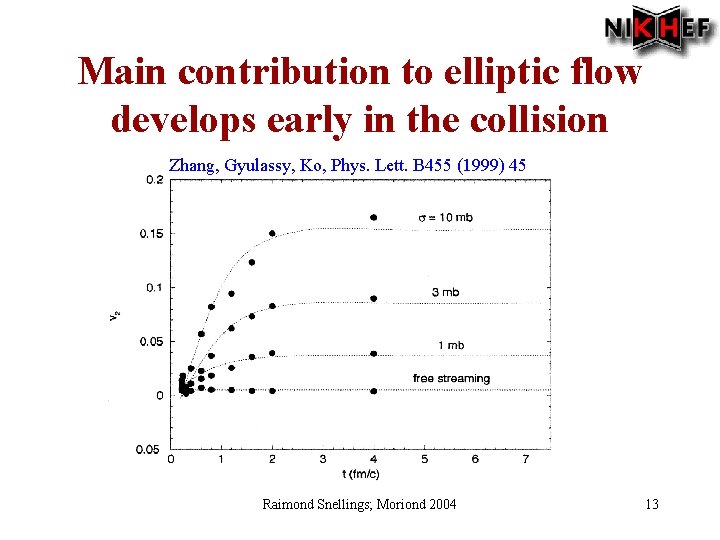
Main contribution to elliptic flow develops early in the collision Zhang, Gyulassy, Ko, Phys. Lett. B 455 (1999) 45 Raimond Snellings; Moriond 2004 13
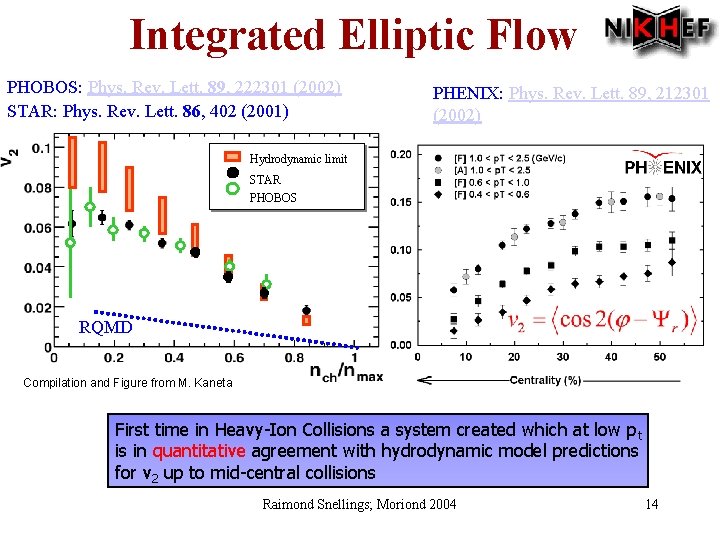
Integrated Elliptic Flow PHOBOS: Phys. Rev. Lett. 89, 222301 (2002) STAR: Phys. Rev. Lett. 86, 402 (2001) PHENIX: Phys. Rev. Lett. 89, 212301 (2002) Hydrodynamic limit STAR PHOBOS RQMD Compilation and Figure from M. Kaneta First time in Heavy-Ion Collisions a system created which at low p t is in quantitative agreement with hydrodynamic model predictions for v 2 up to mid-central collisions Raimond Snellings; Moriond 2004 14
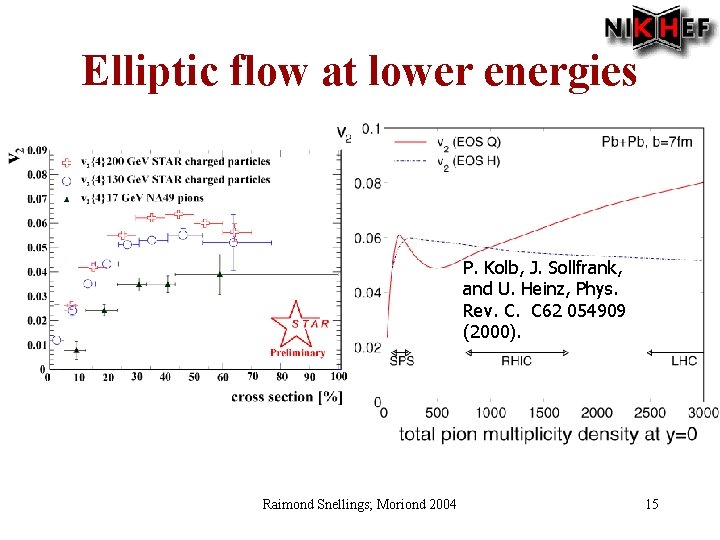
Elliptic flow at lower energies P. Kolb, J. Sollfrank, and U. Heinz, Phys. Rev. C. C 62 054909 (2000). Raimond Snellings; Moriond 2004 15
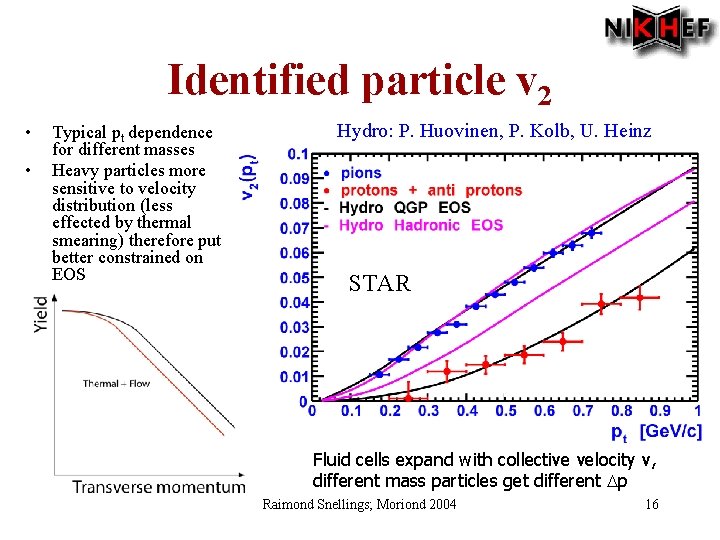
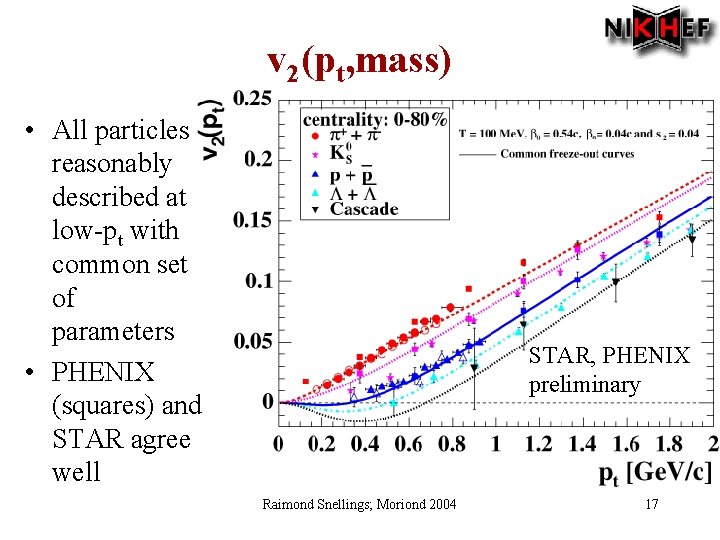
Identified particle v 2 • • Typical pt dependence for different masses Heavy particles more sensitive to velocity distribution (less effected by thermal smearing) therefore put better constrained on EOS Hydro: P. Huovinen, P. Kolb, U. Heinz STAR Fluid cells expand with collective velocity v, different mass particles get different Dp Raimond Snellings; Moriond 2004 16
v 2(pt, mass) • All particles reasonably described at low-pt with common set of parameters • PHENIX (squares) and STAR agree well STAR, PHENIX preliminary Raimond Snellings; Moriond 2004 17
Everything flows? J. Castillo (STAR) QM 2004 What about charm? M. Kaneta (PHENIX) QM 2004 p. T [Ge. V/c] Raimond Snellings; Moriond 2004 18
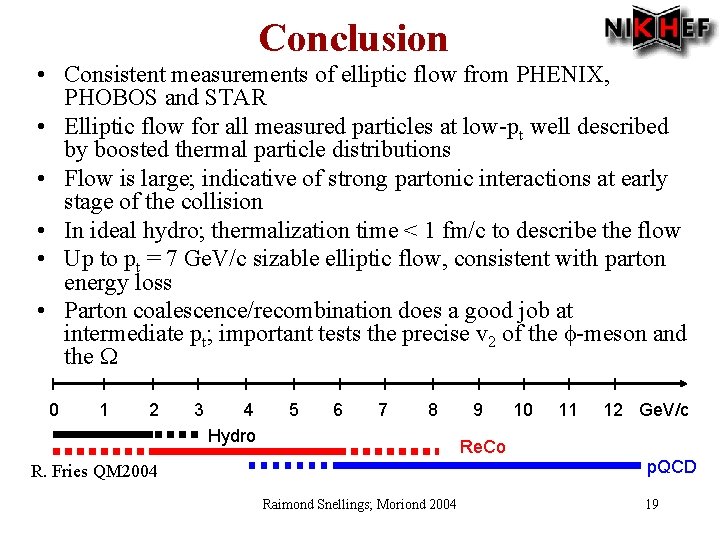
Conclusion • Consistent measurements of elliptic flow from PHENIX, PHOBOS and STAR • Elliptic flow for all measured particles at low-pt well described by boosted thermal particle distributions • Flow is large; indicative of strong partonic interactions at early stage of the collision • In ideal hydro; thermalization time < 1 fm/c to describe the flow • Up to pt = 7 Ge. V/c sizable elliptic flow, consistent with parton energy loss • Parton coalescence/recombination does a good job at intermediate pt; important tests the precise v 2 of the f-meson and the W 0 1 2 3 4 Hydro 5 6 7 8 9 Re. Co R. Fries QM 2004 Raimond Snellings; Moriond 2004 10 11 12 Ge. V/c p. QCD 19
What have we learned from elliptic flow so far (according to theorists)? – U. Heinz: Resulting in a well-developed quark-gluon plasma with almost ideal fluid-dynamical collective behavior and a lifetime of several fm/c (ar. Xiv: hep-ph/0109006). – E. Shuryak: Probably the most direct signature of QGP plasma formation, observed at RHIC (ar. Xiv: nuclth/0112042). – L. Mc. Lerran: one needs very strong interactions amongst the quark and gluons at very early times in the collision (ar. Xiv: hep-ph/0202025). – M. Gyulassy: The most powerful probe of the QGP equation of state: the mass dependence of v 2; One of the three lines of evidence for the QGP at RHIC (ar. Xiv: nucl-th/0403032). Raimond Snellings; Moriond 2004 20
Backup Raimond Snellings; Moriond 2004 21
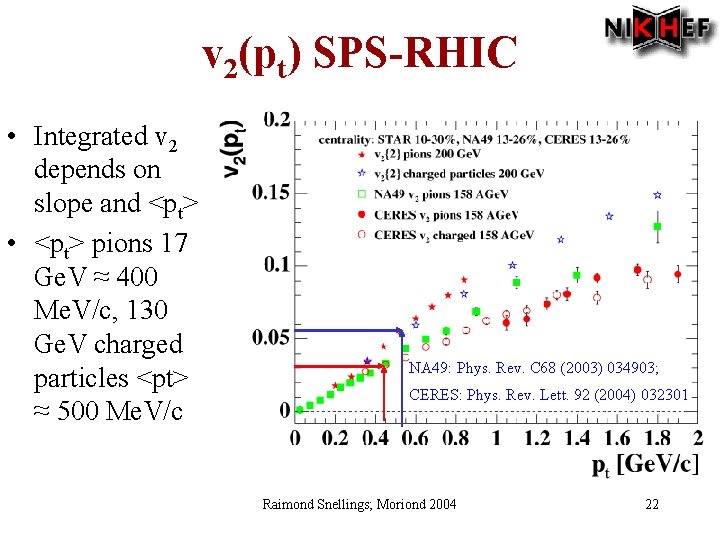
v 2(pt) SPS-RHIC • Integrated v 2 depends on slope and <pt> • <pt> pions 17 Ge. V ≈ 400 Me. V/c, 130 Ge. V charged particles <pt> ≈ 500 Me. V/c NA 49: Phys. Rev. C 68 (2003) 034903; CERES: Phys. Rev. Lett. 92 (2004) 032301 Raimond Snellings; Moriond 2004 22
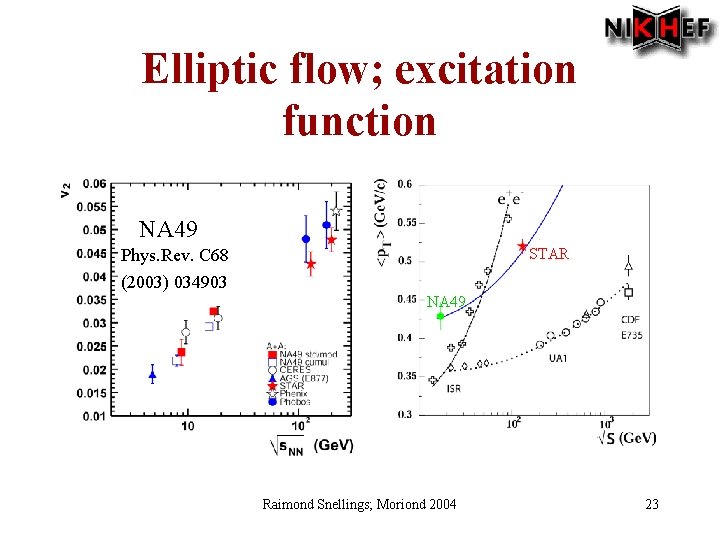
Elliptic flow; excitation function NA 49 STAR Phys. Rev. C 68 (2003) 034903 NA 49 Raimond Snellings; Moriond 2004 23
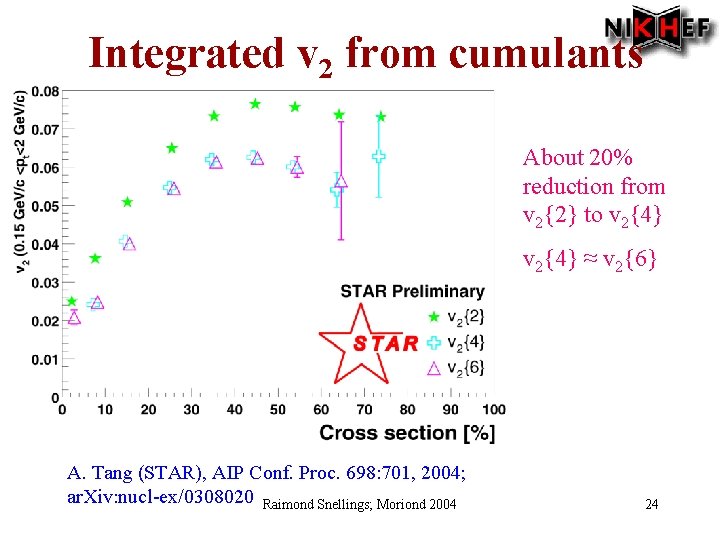
Integrated v 2 from cumulants About 20% reduction from v 2{2} to v 2{4} ≈ v 2{6} A. Tang (STAR), AIP Conf. Proc. 698: 701, 2004; ar. Xiv: nucl-ex/0308020 Raimond Snellings; Moriond 2004 24
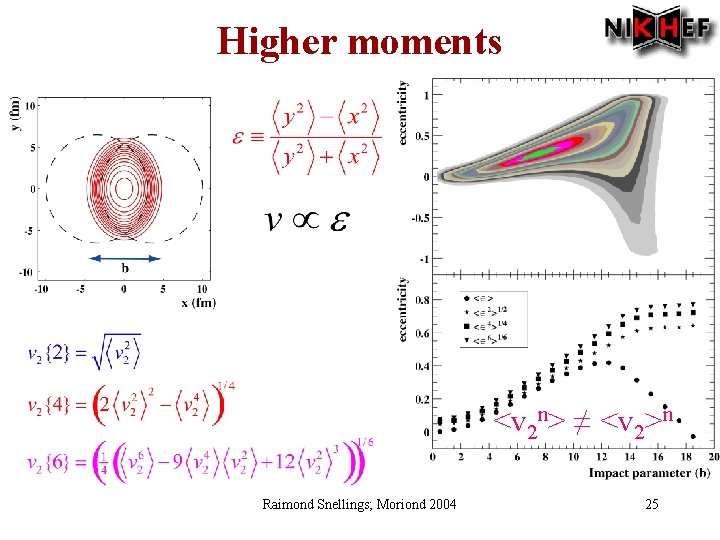
Higher moments <v 2 n> ≠ <v 2>n Raimond Snellings; Moriond 2004 25
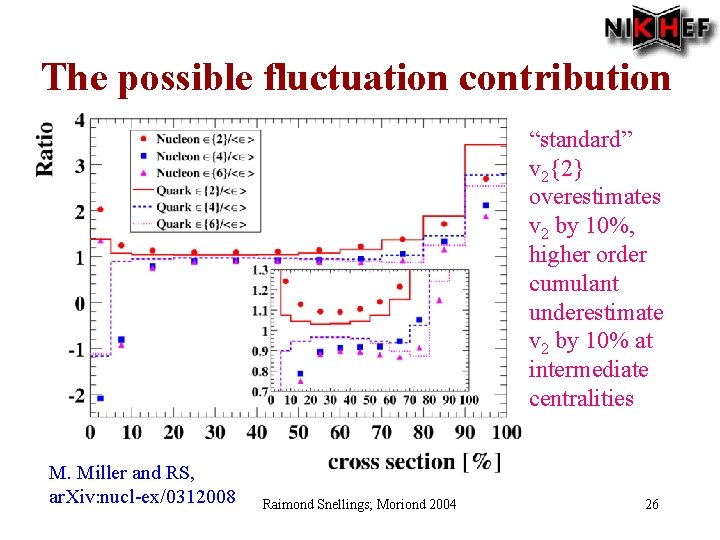
The possible fluctuation contribution “standard” v 2{2} overestimates v 2 by 10%, higher order cumulant underestimate v 2 by 10% at intermediate centralities M. Miller and RS, ar. Xiv: nucl-ex/0312008 Raimond Snellings; Moriond 2004 26
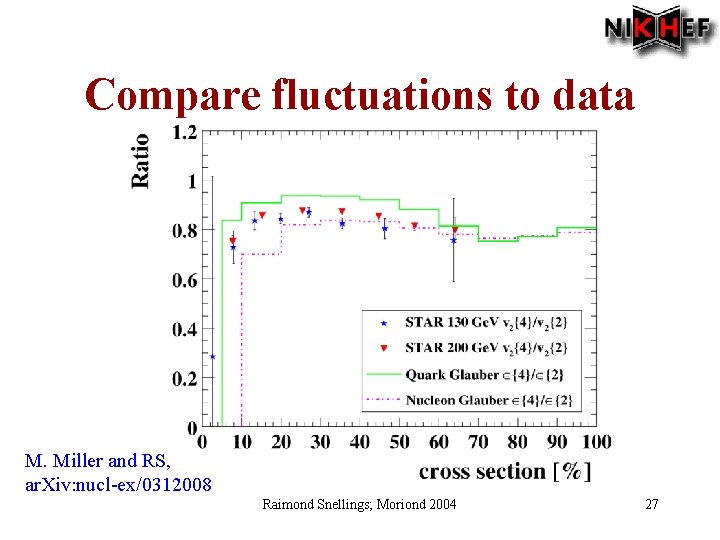
Compare fluctuations to data M. Miller and RS, ar. Xiv: nucl-ex/0312008 Raimond Snellings; Moriond 2004 27
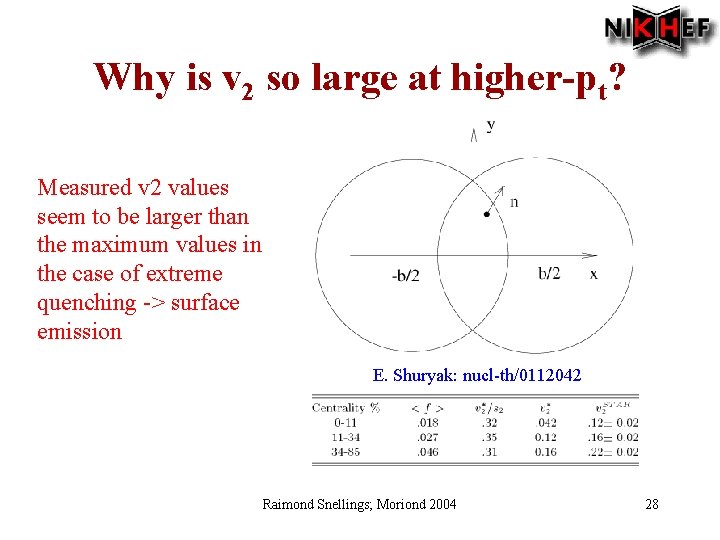
Why is v 2 so large at higher-pt? Measured v 2 values seem to be larger than the maximum values in the case of extreme quenching -> surface emission E. Shuryak: nucl-th/0112042 Raimond Snellings; Moriond 2004 28
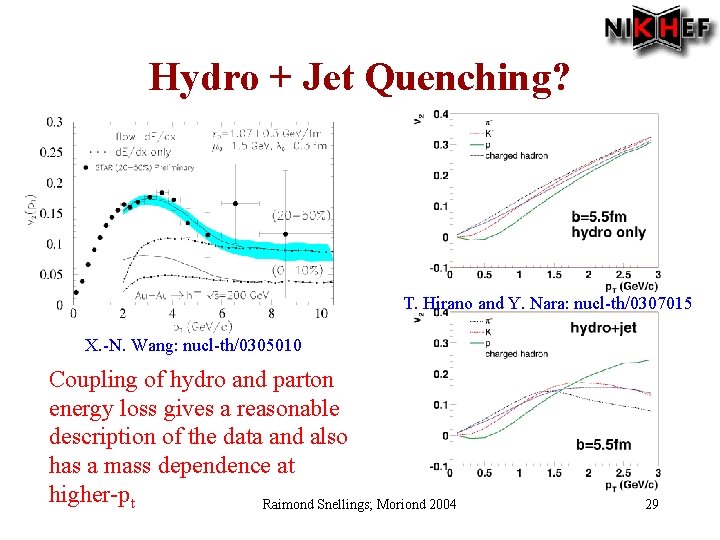
Hydro + Jet Quenching? T. Hirano and Y. Nara: nucl-th/0307015 X. -N. Wang: nucl-th/0305010 Coupling of hydro and parton energy loss gives a reasonable description of the data and also has a mass dependence at higher-pt Raimond Snellings; Moriond 2004 29
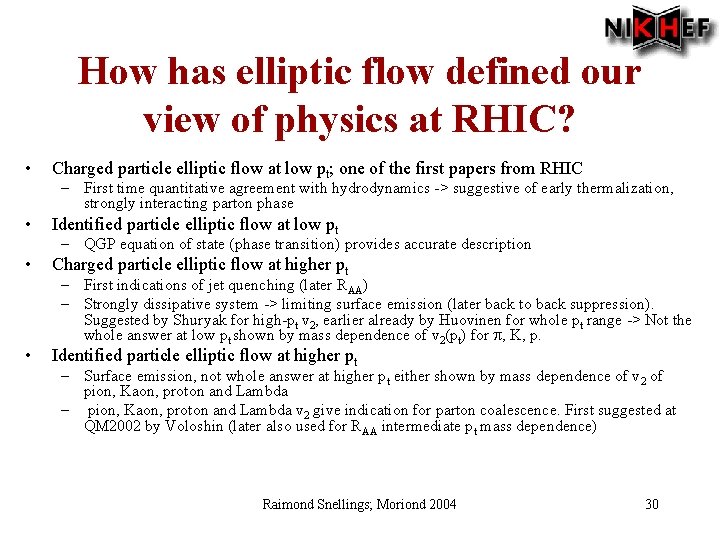
How has elliptic flow defined our view of physics at RHIC? • Charged particle elliptic flow at low pt; one of the first papers from RHIC – First time quantitative agreement with hydrodynamics -> suggestive of early thermalization, strongly interacting parton phase • Identified particle elliptic flow at low pt – QGP equation of state (phase transition) provides accurate description • • Charged particle elliptic flow at higher pt – First indications of jet quenching (later RAA) – Strongly dissipative system -> limiting surface emission (later back to back suppression). Suggested by Shuryak for high-pt v 2, earlier already by Huovinen for whole pt range -> Not the whole answer at low pt shown by mass dependence of v 2(pt) for p, K, p. Identified particle elliptic flow at higher pt – Surface emission, not whole answer at higher pt either shown by mass dependence of v 2 of pion, Kaon, proton and Lambda – pion, Kaon, proton and Lambda v 2 give indication for parton coalescence. First suggested at QM 2002 by Voloshin (later also used for RAA intermediate pt mass dependence) Raimond Snellings; Moriond 2004 30
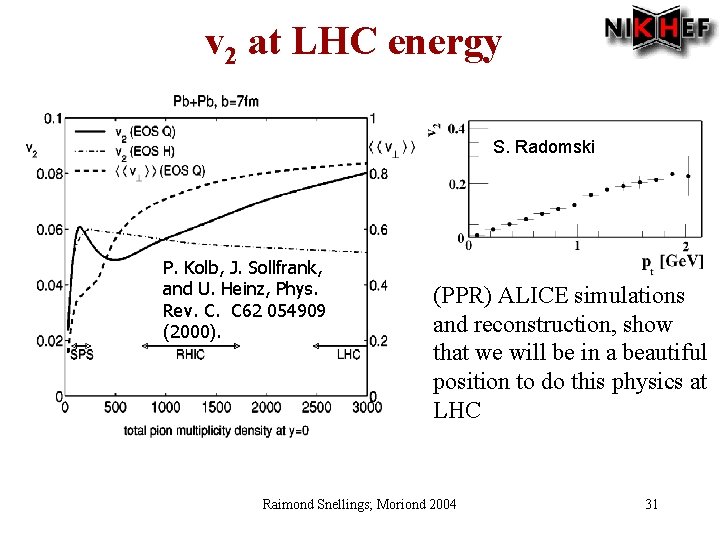
v 2 at LHC energy S. Radomski P. Kolb, J. Sollfrank, and U. Heinz, Phys. Rev. C. C 62 054909 (2000). (PPR) ALICE simulations and reconstruction, show that we will be in a beautiful position to do this physics at LHC Raimond Snellings; Moriond 2004 31
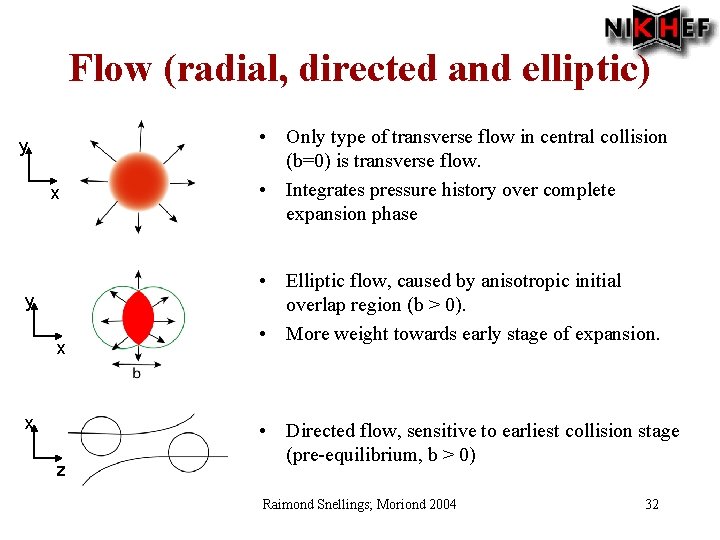
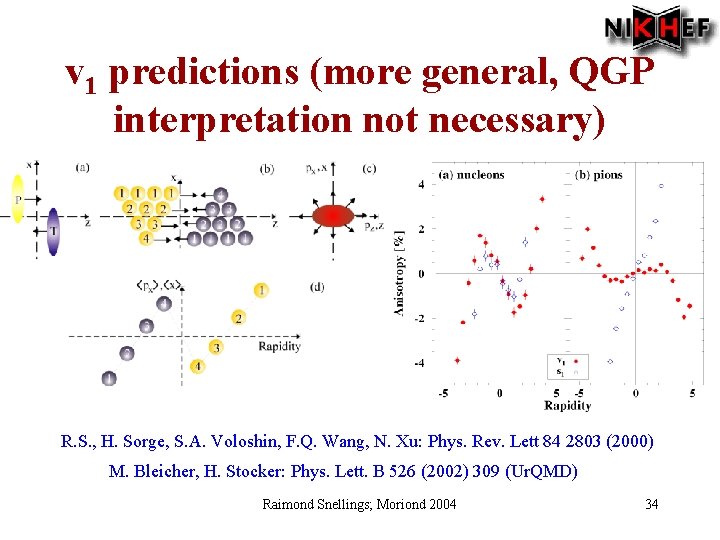
Flow (radial, directed and elliptic) y x x z • Only type of transverse flow in central collision (b=0) is transverse flow. • Integrates pressure history over complete expansion phase • Elliptic flow, caused by anisotropic initial overlap region (b > 0). • More weight towards early stage of expansion. • Directed flow, sensitive to earliest collision stage (pre-equilibrium, b > 0) Raimond Snellings; Moriond 2004 32
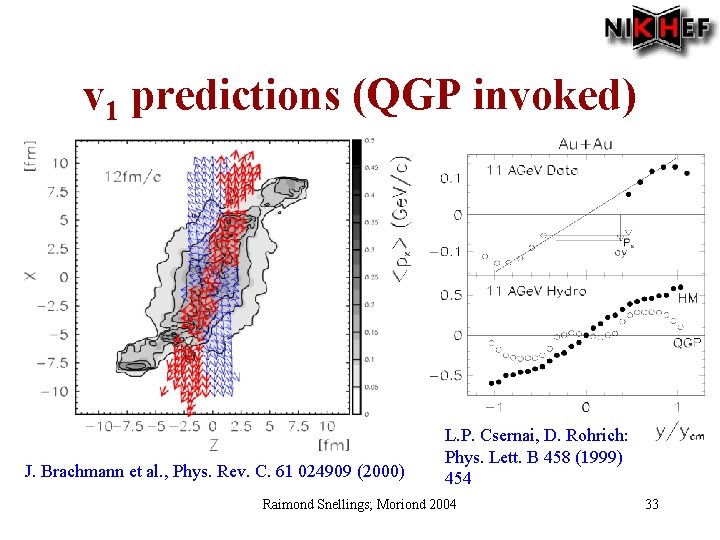
v 1 predictions (QGP invoked) J. Brachmann et al. , Phys. Rev. C. 61 024909 (2000) L. P. Csernai, D. Rohrich: Phys. Lett. B 458 (1999) 454 Raimond Snellings; Moriond 2004 33
v 1 predictions (more general, QGP interpretation not necessary) R. S. , H. Sorge, S. A. Voloshin, F. Q. Wang, N. Xu: Phys. Rev. Lett 84 2803 (2000) M. Bleicher, H. Stocker: Phys. Lett. B 526 (2002) 309 (Ur. QMD) Raimond Snellings; Moriond 2004 34
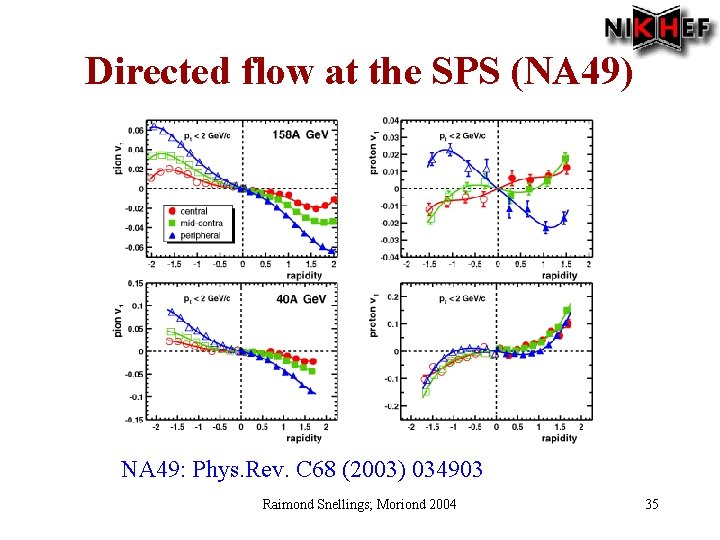
Directed flow at the SPS (NA 49) NA 49: Phys. Rev. C 68 (2003) 034903 Raimond Snellings; Moriond 2004 35
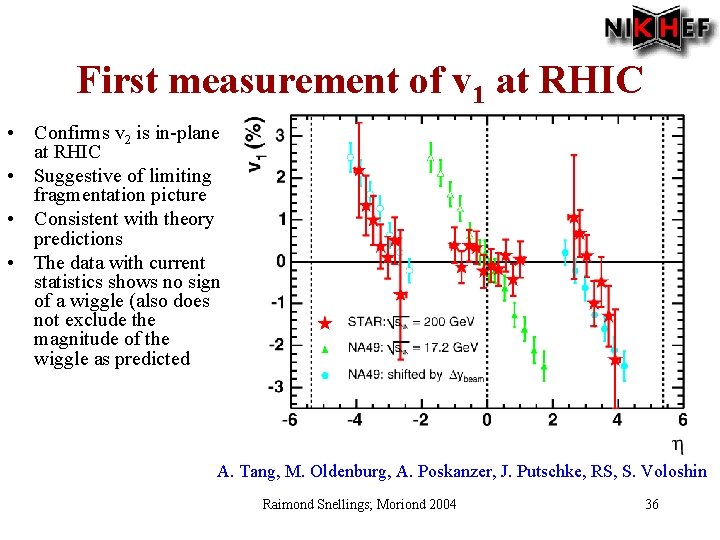
First measurement of v 1 at RHIC • Confirms v 2 is in-plane at RHIC • Suggestive of limiting fragmentation picture • Consistent with theory predictions • The data with current statistics shows no sign of a wiggle (also does not exclude the magnitude of the wiggle as predicted A. Tang, M. Oldenburg, A. Poskanzer, J. Putschke, RS, S. Voloshin Raimond Snellings; Moriond 2004 36
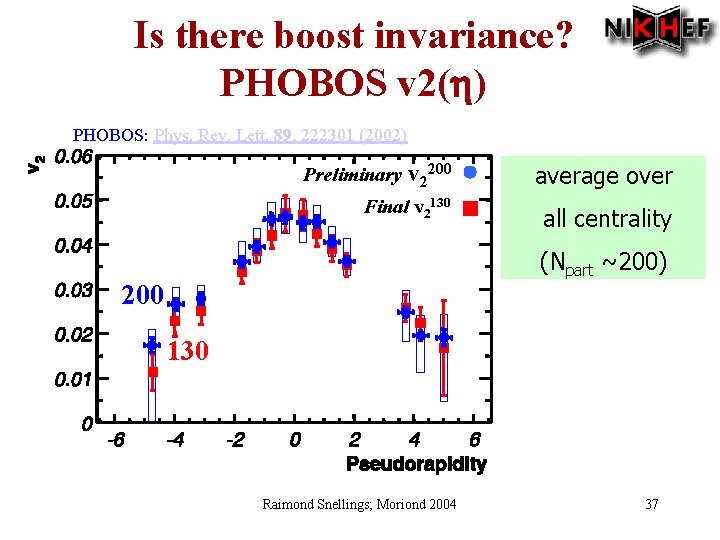
Is there boost invariance? PHOBOS v 2(h) PHOBOS: Phys. Rev. Lett. 89, 222301 (2002) v 2200 average over Final v 2130 all centrality Preliminary (Npart ~200) 200 130 Raimond Snellings; Moriond 2004 37
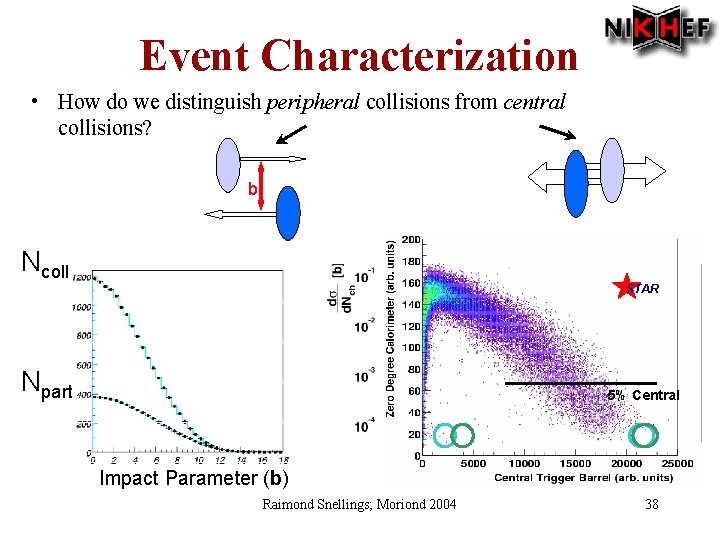
Event Characterization • How do we distinguish peripheral collisions from central collisions? • b Ncoll STAR Npart 5% Central Impact Parameter (b) Raimond Snellings; Moriond 2004 38