
Anionic Polymerization Basic Principles Monomers A monomer can
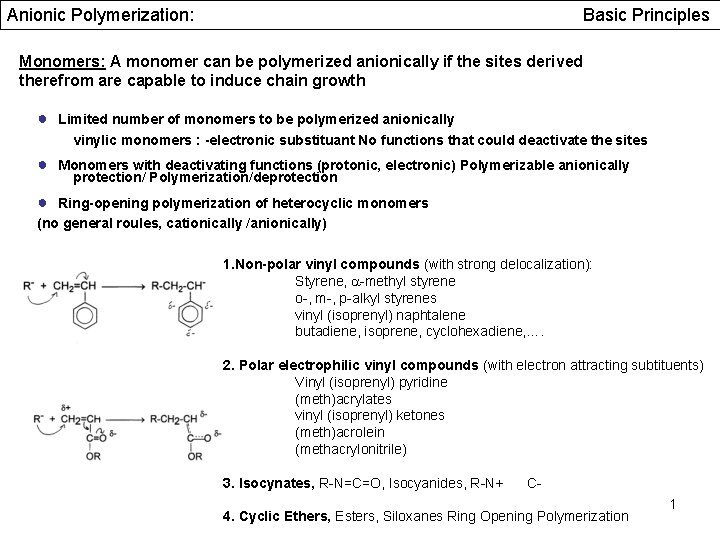
Anionic Polymerization: Basic Principles Monomers: A monomer can be polymerized anionically if the sites derived therefrom are capable to induce chain growth ● Limited number of monomers to be polymerized anionically vinylic monomers : -electronic substituant No functions that could deactivate the sites ● Monomers with deactivating functions (protonic, electronic) Polymerizable anionically protection/ Polymerization/deprotection ● Ring-opening polymerization of heterocyclic monomers (no general roules, cationically /anionically) 1. Non-polar vinyl compounds (with strong delocalization): Styrene, a-methyl styrene o-, m-, p-alkyl styrenes vinyl (isoprenyl) naphtalene butadiene, isoprene, cyclohexadiene, …. 2. Polar electrophilic vinyl compounds (with electron attracting subtituents) Vinyl (isoprenyl) pyridine (meth)acrylates vinyl (isoprenyl) ketones (meth)acrolein (methacrylonitrile) 3. Isocynates, R-N=C=O, Isocyanides, R-N+ C- 4. Cyclic Ethers, Esters, Siloxanes Ring Opening Polymerization 1
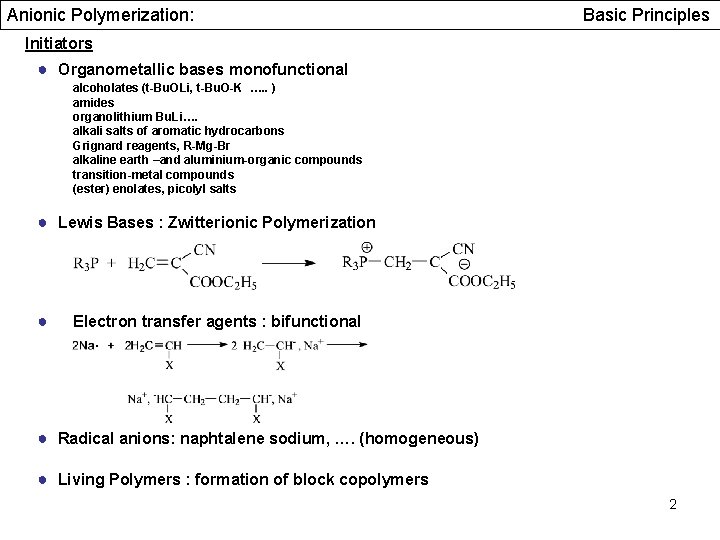
Anionic Polymerization: Basic Principles Initiators ● Organometallic bases monofunctional alcoholates (t-Bu. OLi, t-Bu. O-K …. . ) amides organolithium Bu. Li…. alkali salts of aromatic hydrocarbons Grignard reagents, R-Mg-Br alkaline earth –and aluminium-organic compounds transition-metal compounds (ester) enolates, picolyl salts ● Lewis Bases : Zwitterionic Polymerization ● Electron transfer agents : bifunctional ● Radical anions: naphtalene sodium, …. (homogeneous) ● Living Polymers : formation of block copolymers 2
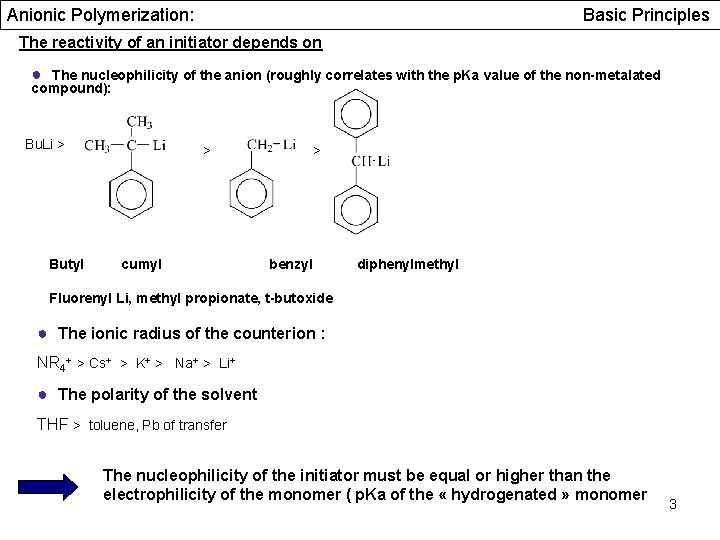
Anionic Polymerization: Basic Principles The reactivity of an initiator depends on ● The nucleophilicity of the anion (roughly correlates with the p. Ka value of the non-metalated compound): Bu. Li > Butyl > cumyl > benzyl diphenylmethyl Fluorenyl Li, methyl propionate, t-butoxide ● The ionic radius of the counterion : NR 4+ > Cs+ > K+ > Na+ > Li+ ● The polarity of the solvent THF > toluene, Pb of transfer The nucleophilicity of the initiator must be equal or higher than the electrophilicity of the monomer ( p. Ka of the « hydrogenated » monomer 3
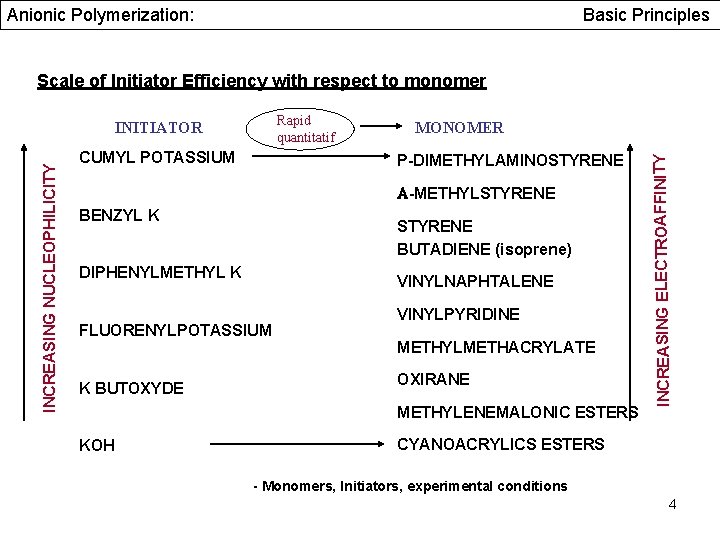
Anionic Polymerization: Basic Principles Scale of Initiator Efficiency with respect to monomer INCREASING NUCLEOPHILICITY CUMYL POTASSIUM MONOMER P-DIMETHYLAMINOSTYRENE A-METHYLSTYRENE BENZYL K STYRENE BUTADIENE (isoprene) DIPHENYLMETHYL K VINYLNAPHTALENE FLUORENYLPOTASSIUM K BUTOXYDE VINYLPYRIDINE METHYLMETHACRYLATE OXIRANE METHYLENEMALONIC ESTERS KOH INCREASING ELECTROAFFINITY Rapid quantitatif INITIATOR CYANOACRYLICS ESTERS - Monomers, Initiators, experimental conditions 4
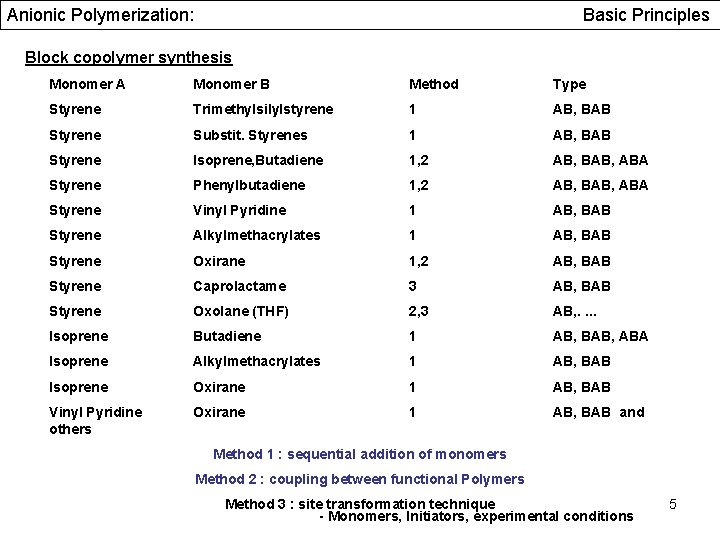
Anionic Polymerization: Basic Principles Block copolymer synthesis Monomer A Monomer B Method Type Styrene Trimethylsilylstyrene 1 AB, BAB Styrene Substit. Styrenes 1 AB, BAB Styrene Isoprene, Butadiene 1, 2 AB, BAB, ABA Styrene Phenylbutadiene 1, 2 AB, BAB, ABA Styrene Vinyl Pyridine 1 AB, BAB Styrene Alkylmethacrylates 1 AB, BAB Styrene Oxirane 1, 2 AB, BAB Styrene Caprolactame 3 AB, BAB Styrene Oxolane (THF) 2, 3 AB, . . Isoprene Butadiene 1 AB, BAB, ABA Isoprene Alkylmethacrylates 1 AB, BAB Isoprene Oxirane 1 AB, BAB Vinyl Pyridine others Oxirane 1 AB, BAB and Method 1 : sequential addition of monomers Method 2 : coupling between functional Polymers Method 3 : site transformation technique - Monomers, Initiators, experimental conditions 5
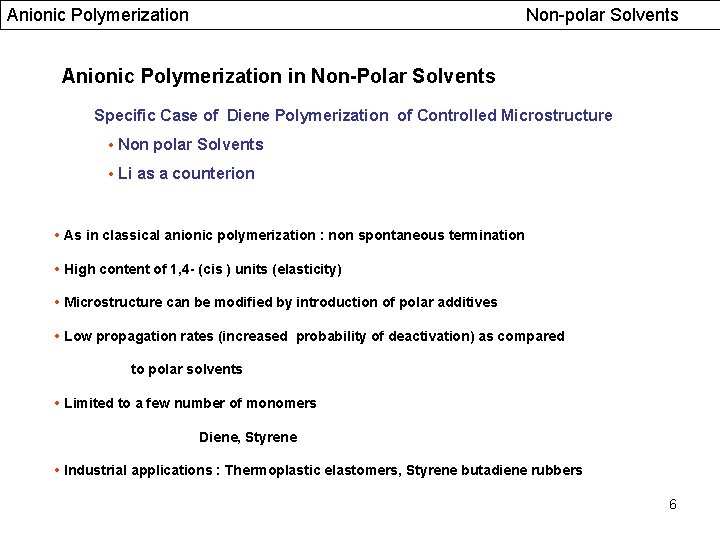
Anionic Polymerization Non-polar Solvents Anionic Polymerization in Non-Polar Solvents Specific Case of Diene Polymerization of Controlled Microstructure • Non polar Solvents • Li as a counterion • As in classical anionic polymerization : non spontaneous termination • High content of 1, 4 - (cis ) units (elasticity) • Microstructure can be modified by introduction of polar additives • Low propagation rates (increased probability of deactivation) as compared to polar solvents • Limited to a few number of monomers Diene, Styrene • Industrial applications : Thermoplastic elastomers, Styrene butadiene rubbers 6
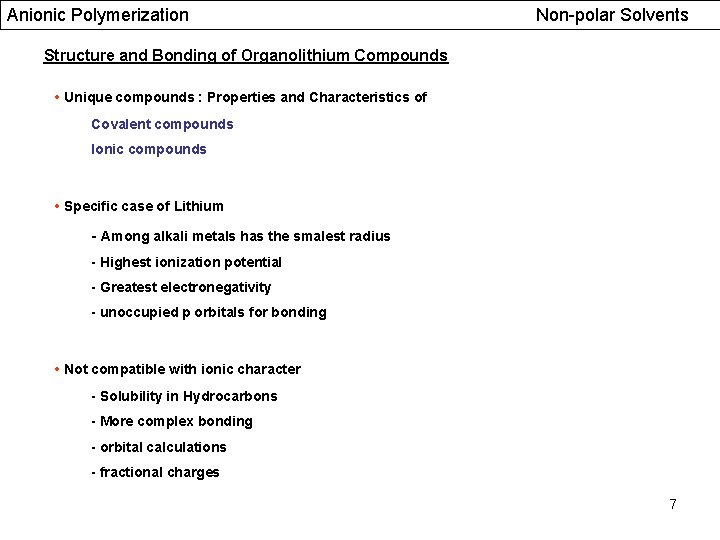
Anionic Polymerization Non-polar Solvents Structure and Bonding of Organolithium Compounds • Unique compounds : Properties and Characteristics of Covalent compounds Ionic compounds • Specific case of Lithium - Among alkali metals has the smalest radius - Highest ionization potential - Greatest electronegativity - unoccupied p orbitals for bonding • Not compatible with ionic character - Solubility in Hydrocarbons - More complex bonding - orbital calculations - fractional charges 7
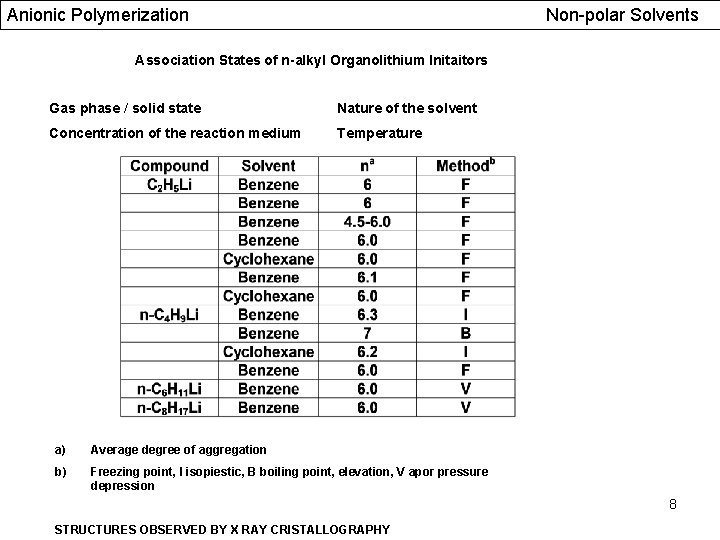
Anionic Polymerization Non-polar Solvents Association States of n-alkyl Organolithium Initaitors Gas phase / solid state Nature of the solvent Concentration of the reaction medium Temperature a) Average degree of aggregation b) Freezing point, I isopiestic, B boiling point, elevation, V apor pressure depression 8 STRUCTURES OBSERVED BY X RAY CRISTALLOGRAPHY
Anionic Polymerization Non-polar Solvents CLASSICAL ANIONIC INITIATORS IN NON POLAR SOLVENTS • Monofunctional - Soluble in classical non polar solvents - Butyllithium (Bu. Li) , sec Bu. Li is the best - Phenyllithium - Diphenylmethyllithium Preparation easy, commercially available • Difunctional - Specific case of difunctional initiators - Association degrees , mixed association - Problem : solubility in non polar solvents How to obtain them ? Typical non-polar solvents : Benzene, toluene, ethylbenzene, xylene Cyclohexane, n-hexane 9
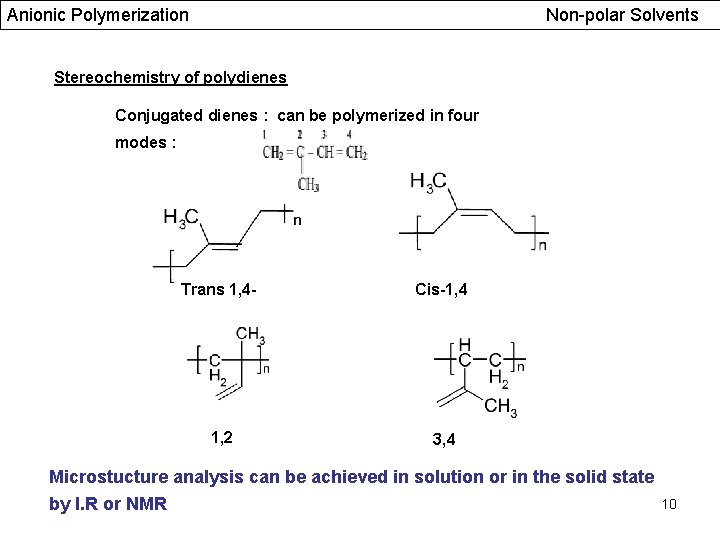
Anionic Polymerization Non-polar Solvents Stereochemistry of polydienes Conjugated dienes : can be polymerized in four modes : Trans 1, 4 - Cis-1, 4 1, 2 3, 4 Microstucture analysis can be achieved in solution or in the solid state by I. R or NMR 10
Anionic Polymerization Non-polar Solvents Microstructure depends on the - Nature of the counter-ion (Li+, K+, Na+. . . , Li+ favours 1, 4 units in non polar solvents - Nature of the solvent : polar 1, 2 (ex. THF), non-polar 1, 4 (ex. cyclohexane) - Presence of polar additives (amines, ethers: increase 1, 2 content) - Polymerization temperature, pressure, concentration of active sites Statistical incorporation of styrene in SBRs can be controlled by: - The introduction of low amounts of ether - The introduction of potassium alcoholates The presence of ethers, amines increases the propagation rate 11
- Slides: 11