
Anion Coordination Chemistry Parallels to Transition Metal Chemistry
- Slides: 12
Anion Coordination Chemistry: Parallels to Transition Metal Chemistry Honoring ACS Award in Inorganic Chemistry, 2021 Kristin Bowman-James, University of Kansas This presentation was created in March 2021 by Hilary Eppley (De. Pauw University, heppley@depauw. edu) and Shirley Lin (Naval Academy, lin@usna. edu) , and posted on VIPEr on March 11, 2021, Copyright 2021. This work is licensed under the Creative Commons Attribution-Non. Commercial-Share. Alike License. To view a copy of this license visit https: //creativecommons. org/licenses/by-nc-sa/4. 0/
Macromolecular, Supramolecular and Nanoscale (MSN) Chemistry Required for ACS-certified bachelor’s degrees Topics that are on the list for MSN and related to this presentation ● Supramolecular inclusion complexes ● Impact of non-covalent interactions in determining key properties and behaviors https: //www. acs. org/content/dam/acsorg/about/governance/committees/training/acsapproved/degreeprogram/ macromolecular-supramolecular-nanoscale-supplement. pdf
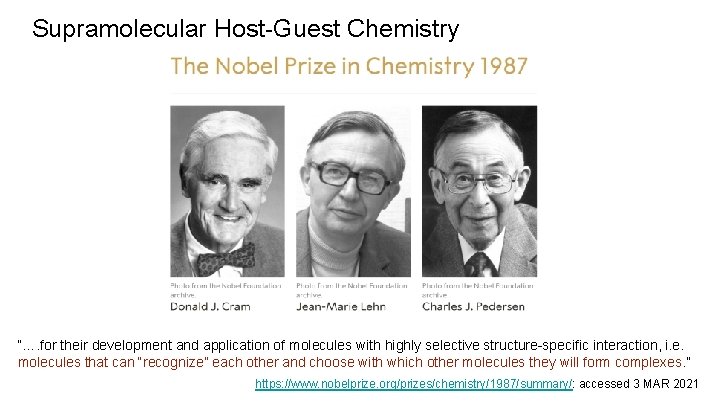
Supramolecular Host-Guest Chemistry “…. for their development and application of molecules with highly selective structure-specific interaction, i. e. molecules that can “recognize” each other and choose with which other molecules they will form complexes. ” https: //www. nobelprize. org/prizes/chemistry/1987/summary/: accessed 3 MAR 2021
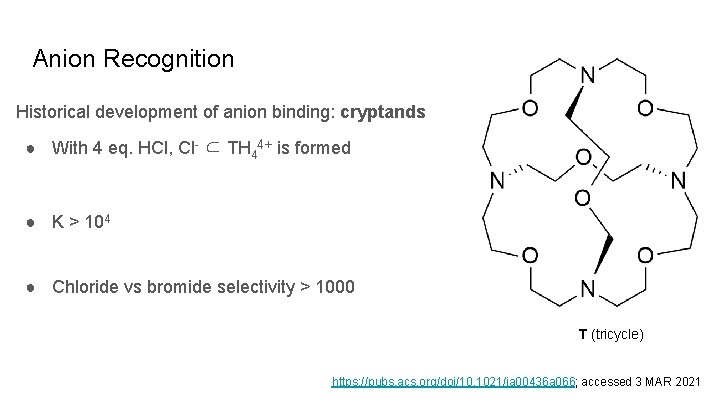
Anion Recognition Historical development of anion binding: cryptands ● With 4 eq. HCl, Cl- ⊂ TH 44+ is formed ● K > 104 ● Chloride vs bromide selectivity > 1000 T (tricycle) https: //pubs. acs. org/doi/10. 1021/ja 00436 a 066; accessed 3 MAR 2021
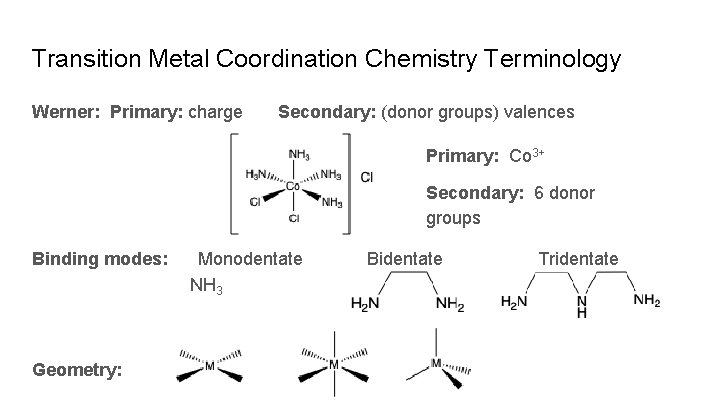
Transition Metal Coordination Chemistry Terminology Werner: Primary: charge Secondary: (donor groups) valences Primary: Co 3+ Secondary: 6 donor groups Binding modes: Geometry: Monodentate NH 3 Bidentate Tridentate
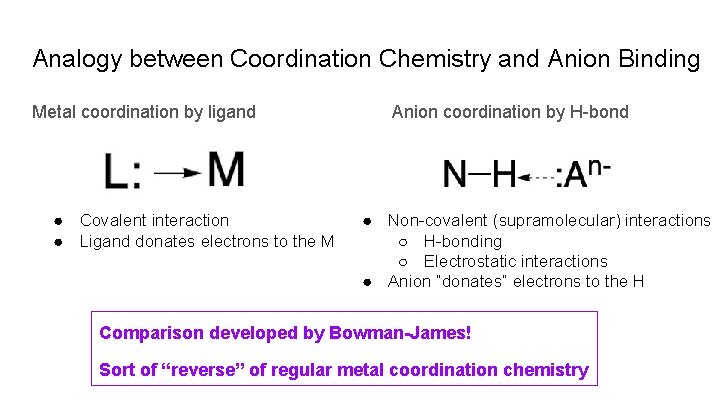
Analogy between Coordination Chemistry and Anion Binding Metal coordination by ligand ● Covalent interaction ● Ligand donates electrons to the M Anion coordination by H-bond ● Non-covalent (supramolecular) interactions ○ H-bonding ○ Electrostatic interactions ● Anion “donates” electrons to the H Comparison developed by Bowman-James! Sort of “reverse” of regular metal coordination chemistry
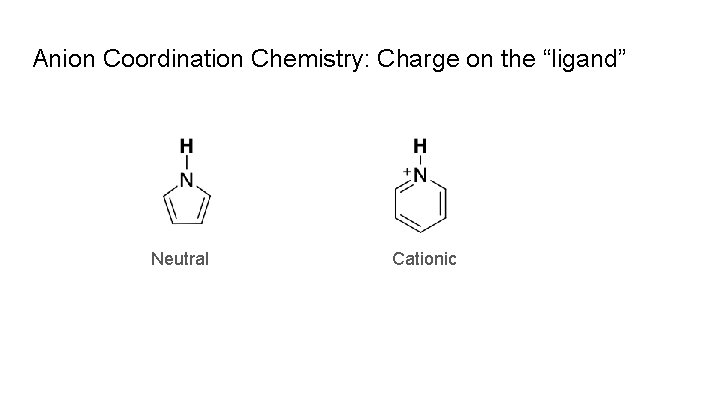
Anion Coordination Chemistry: Charge on the “ligand” Neutral Cationic
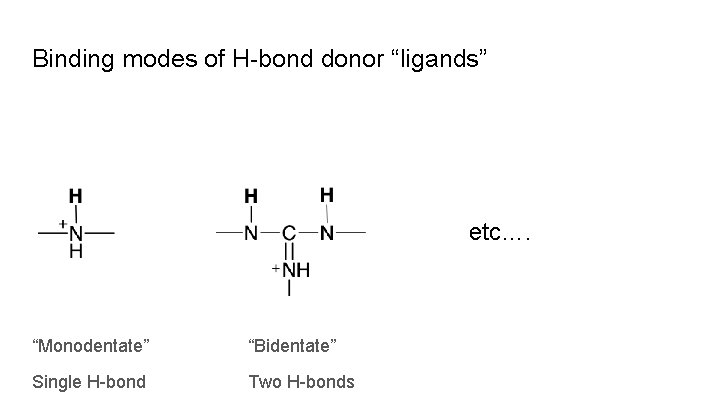
Binding modes of H-bond donor “ligands” etc…. “Monodentate” “Bidentate” Single H-bond Two H-bonds
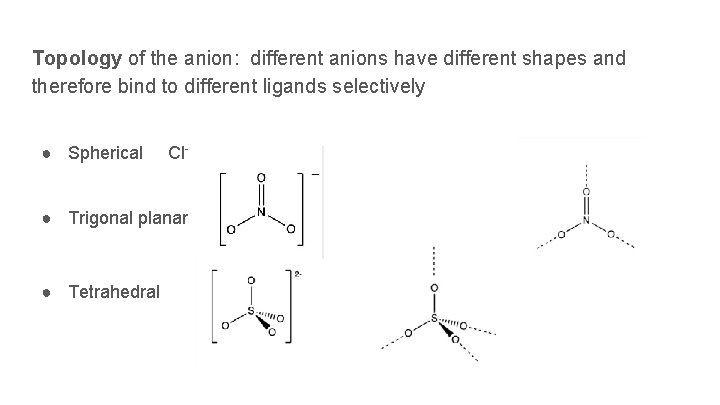
Topology of the anion: different anions have different shapes and therefore bind to different ligands selectively ● Spherical Cl– ● Trigonal planar ● Tetrahedral
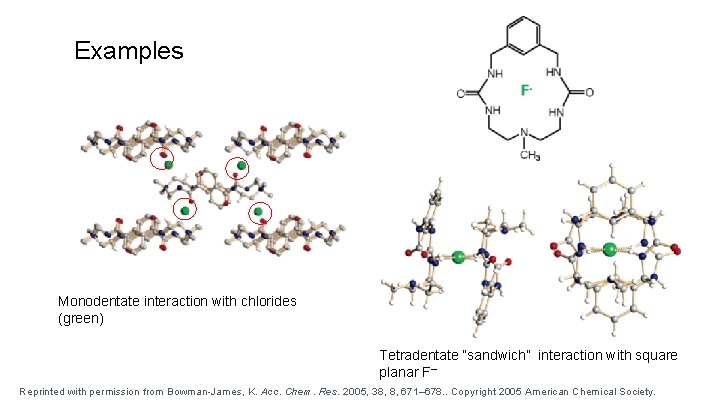
Examples Monodentate interaction with chlorides (green) Tetradentate “sandwich” interaction with square planar F– Reprinted with permission from Bowman-James, K. Acc. Chem. Res. 2005, 38, 8, 671– 678. . Copyright 2005 American Chemical Society.
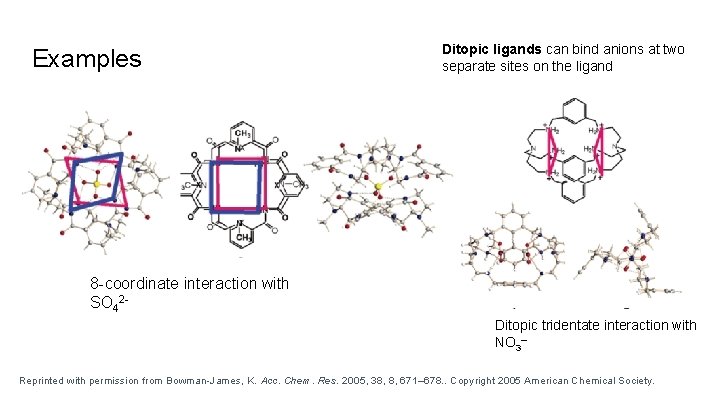
Examples Ditopic ligands can bind anions at two separate sites on the ligand 8 -coordinate interaction with SO 42 Ditopic tridentate interaction with NO 3– Reprinted with permission from Bowman-James, K. Acc. Chem. Res. 2005, 38, 8, 671– 678. . Copyright 2005 American Chemical Society.
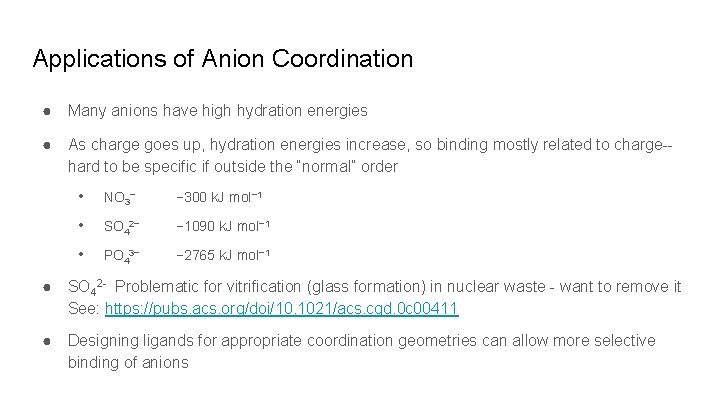
Applications of Anion Coordination ● Many anions have high hydration energies ● As charge goes up, hydration energies increase, so binding mostly related to charge-hard to be specific if outside the “normal” order • NO 3− − 300 k. J mol− 1 • SO 42− − 1090 k. J mol− 1 • PO 43− − 2765 k. J mol− 1 ● SO 42 - Problematic for vitrification (glass formation) in nuclear waste - want to remove it See: https: //pubs. acs. org/doi/10. 1021/acs. cgd. 0 c 00411 ● Designing ligands for appropriate coordination geometries can allow more selective binding of anions