
ANIMISM Some Characteristics All things in nature have

- Slides: 24
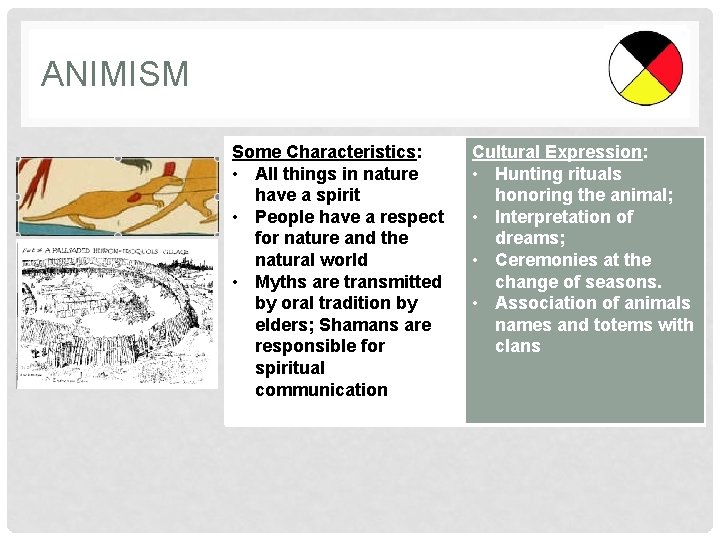
ANIMISM Some Characteristics: • All things in nature have a spirit • People have a respect for nature and the natural world • Myths are transmitted by oral tradition by elders; Shamans are responsible for spiritual communication. Cultural Expression: • Hunting rituals honoring the animal; • Interpretation of dreams; • Ceremonies at the change of seasons. • Association of animals names and totems with clans
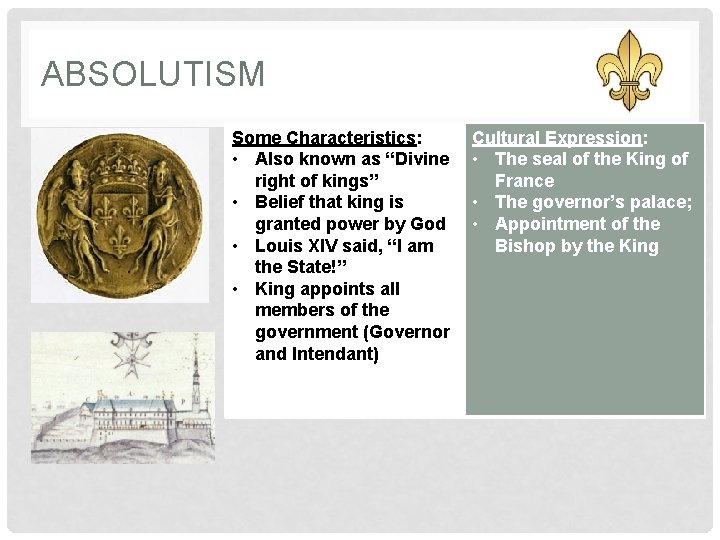
ABSOLUTISM Some Characteristics: • Also known as “Divine right of kings” • Belief that king is granted power by God • Louis XIV said, “I am the State!” • King appoints all members of the government (Governor and Intendant). Cultural Expression: • The seal of the King of France • The governor’s palace; • Appointment of the Bishop by the King
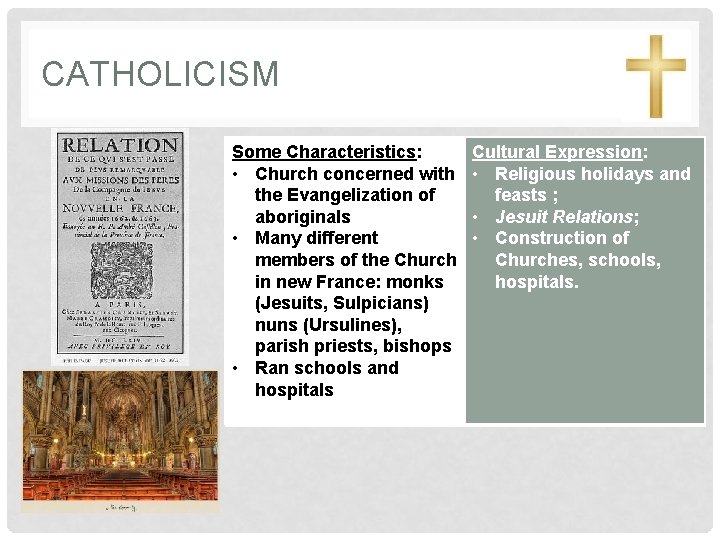
CATHOLICISM Some Characteristics: • Church concerned with the Evangelization of aboriginals • Many different members of the Church in new France: monks (Jesuits, Sulpicians) nuns (Ursulines), parish priests, bishops • Ran schools and hospitals. Cultural Expression: • Religious holidays and feasts ; • Jesuit Relations; • Construction of Churches, schools, hospitals.
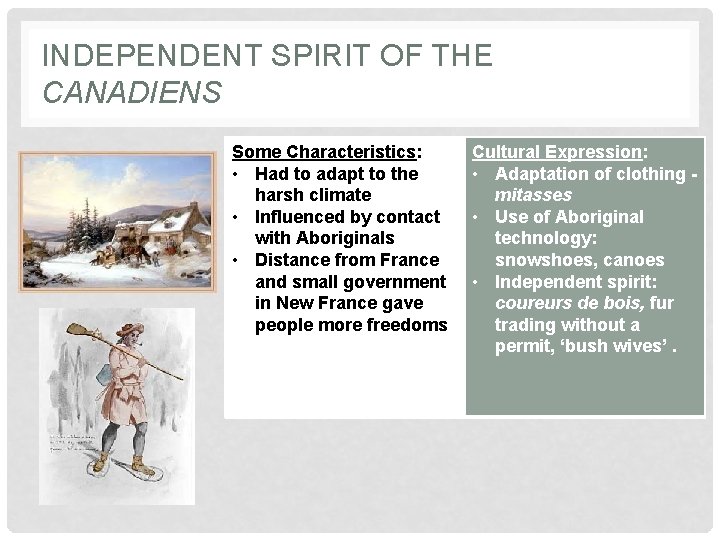
INDEPENDENT SPIRIT OF THE CANADIENS Some Characteristics: • Had to adapt to the harsh climate • Influenced by contact with Aboriginals • Distance from France and small government in New France gave people more freedoms. Cultural Expression: • Adaptation of clothing mitasses • Use of Aboriginal technology: snowshoes, canoes • Independent spirit: coureurs de bois, fur trading without a permit, ‘bush wives’.
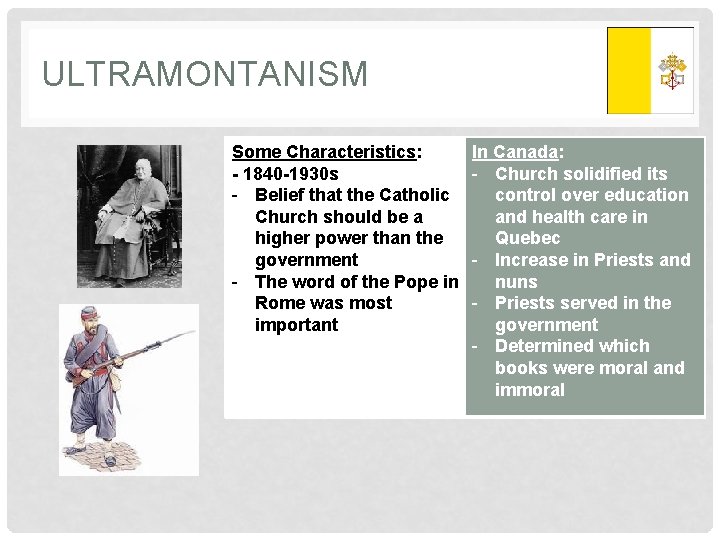
ULTRAMONTANISM Some Characteristics: - 1840 -1930 s - Belief that the Catholic Church should be a higher power than the government - The word of the Pope in Rome was most important In Canada: - Church solidified its control over education and health care in Quebec - Increase in Priests and nuns - Priests served in the government - Determined which books were moral and immoral
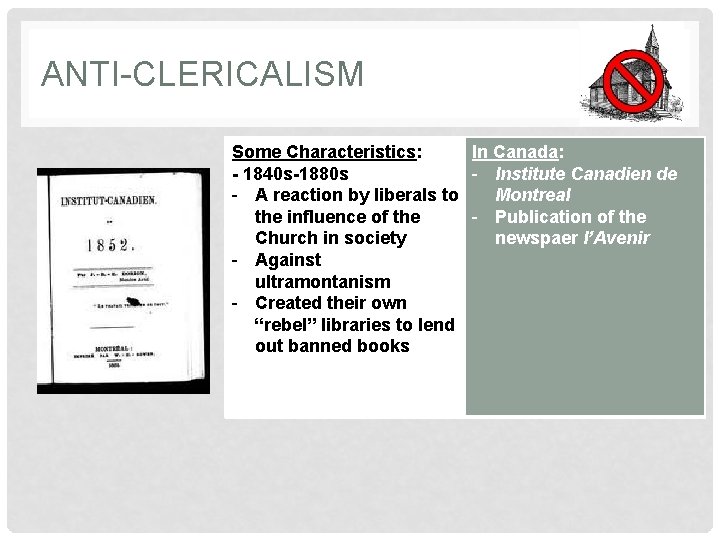
ANTI-CLERICALISM Some Characteristics: In Canada: - 1840 s-1880 s - Institute Canadien de - A reaction by liberals to Montreal the influence of the - Publication of the Church in society newspaer l’Avenir - Against ultramontanism - Created their own “rebel” libraries to lend out banned books
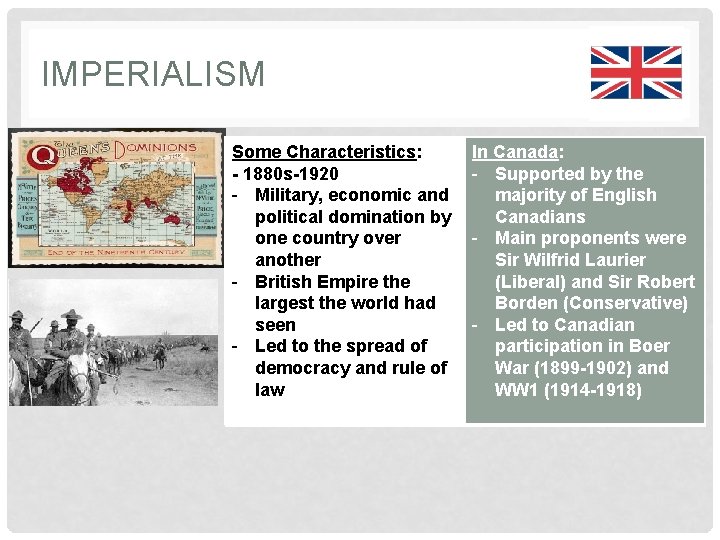
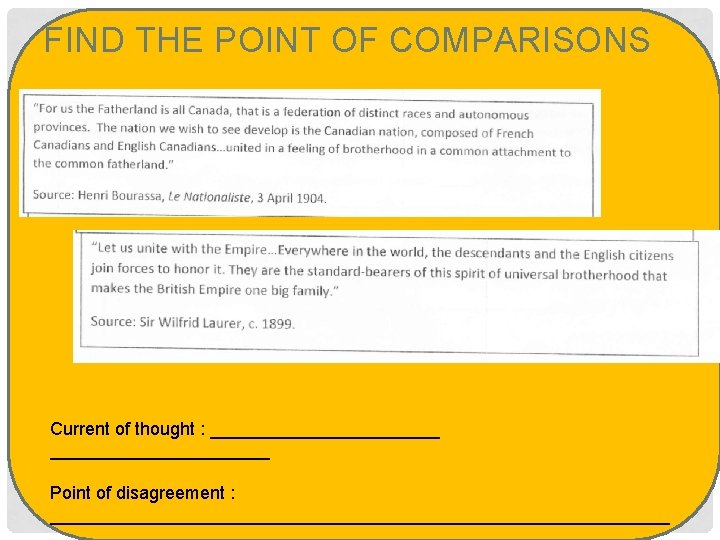
IMPERIALISM Some Characteristics: - 1880 s-1920 - Military, economic and political domination by one country over another - British Empire the largest the world had seen - Led to the spread of democracy and rule of law In Canada: - Supported by the majority of English Canadians - Main proponents were Sir Wilfrid Laurier (Liberal) and Sir Robert Borden (Conservative) - Led to Canadian participation in Boer War (1899 -1902) and WW 1 (1914 -1918)
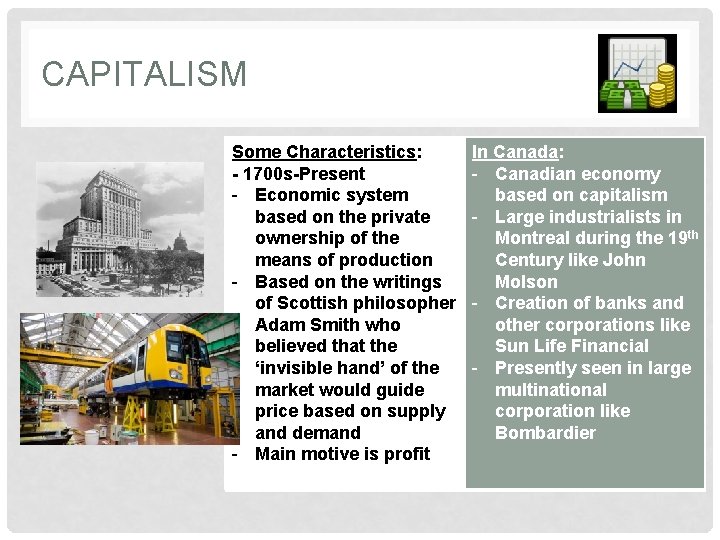
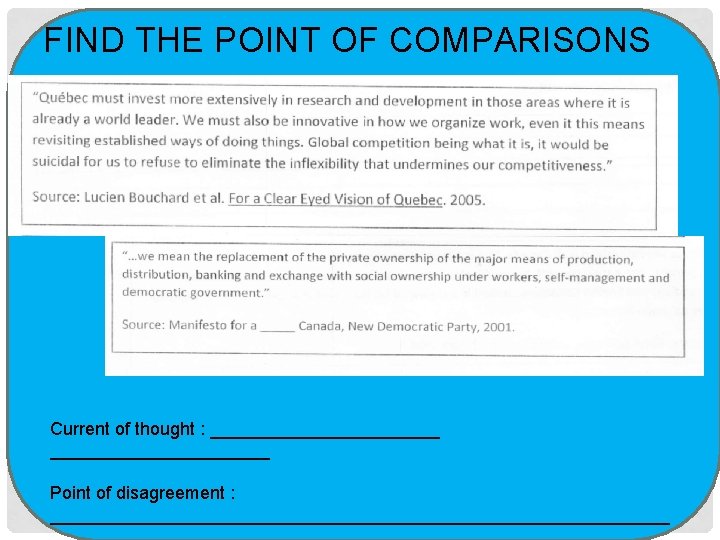
CAPITALISM Some Characteristics: - 1700 s-Present - Economic system based on the private ownership of the means of production - Based on the writings of Scottish philosopher Adam Smith who believed that the ‘invisible hand’ of the market would guide price based on supply and demand - Main motive is profit In Canada: - Canadian economy based on capitalism - Large industrialists in Montreal during the 19 th Century like John Molson - Creation of banks and other corporations like Sun Life Financial - Presently seen in large multinational corporation like Bombardier
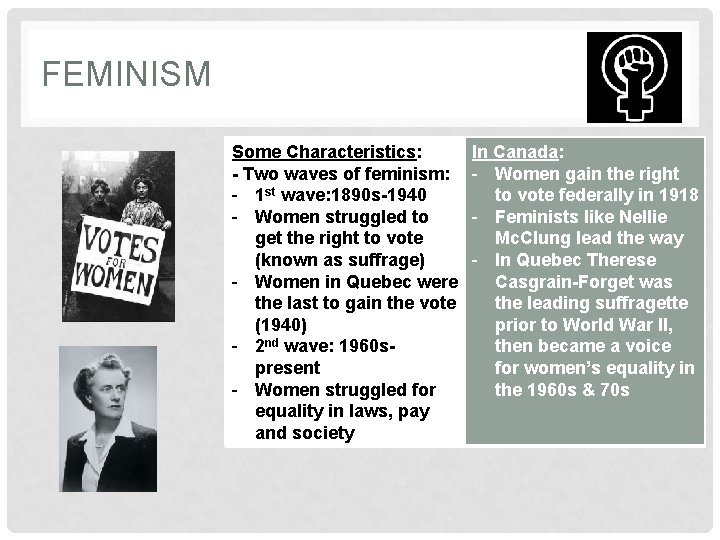
FEMINISM Some Characteristics: - Two waves of feminism: - 1 st wave: 1890 s-1940 - Women struggled to get the right to vote (known as suffrage) - Women in Quebec were the last to gain the vote (1940) - 2 nd wave: 1960 spresent - Women struggled for equality in laws, pay and society In Canada: - Women gain the right to vote federally in 1918 - Feminists like Nellie Mc. Clung lead the way - In Quebec Therese Casgrain-Forget was the leading suffragette prior to World War II, then became a voice for women’s equality in the 1960 s & 70 s
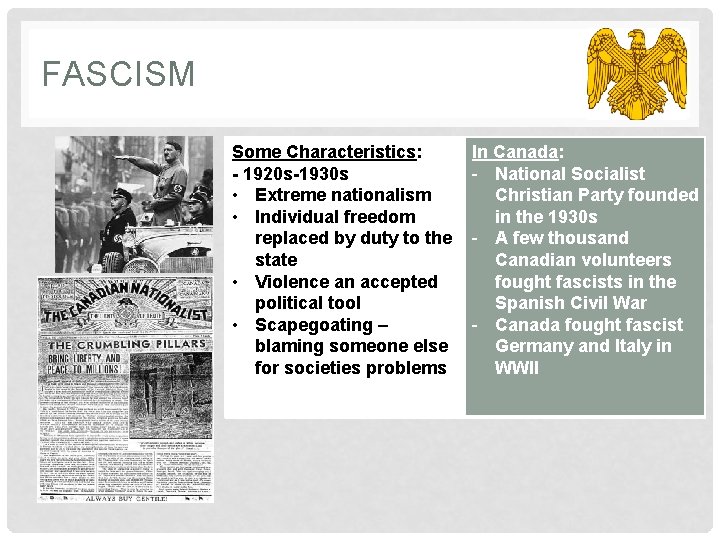
FASCISM Some Characteristics: - 1920 s-1930 s • Extreme nationalism • Individual freedom replaced by duty to the state • Violence an accepted political tool • Scapegoating – blaming someone else for societies problems. In Canada: - National Socialist Christian Party founded in the 1930 s - A few thousand Canadian volunteers fought fascists in the Spanish Civil War - Canada fought fascist Germany and Italy in WWII
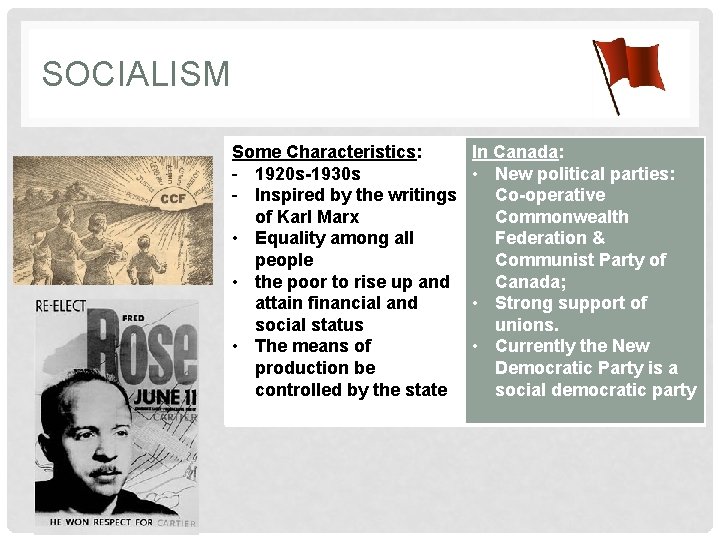
SOCIALISM Some Characteristics: - 1920 s-1930 s - Inspired by the writings of Karl Marx • Equality among all people • the poor to rise up and attain financial and social status • The means of production be controlled by the state. In Canada: • New political parties: Co-operative Commonwealth Federation & Communist Party of Canada; • Strong support of unions. • Currently the New Democratic Party is a social democratic party
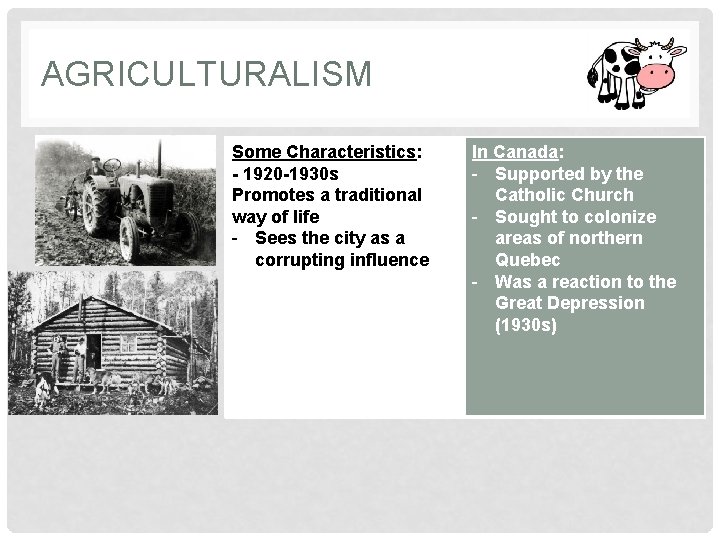
AGRICULTURALISM Some Characteristics: - 1920 -1930 s Promotes a traditional way of life - Sees the city as a corrupting influence In Canada: - Supported by the Catholic Church - Sought to colonize areas of northern Quebec - Was a reaction to the Great Depression (1930 s)
COOPERATISM Some Characteristics: - 1900 -present - Members pool their resources for mutual benefit - Members share any surplus (agricultural or monetary) - Allowed in Quebec under the Cooperative Syndicates Act (1906) to help the working class and farmers In Canada: - Desjardins Group - Mountain Equipement Co-op - Union Catholique des Cultivateurs
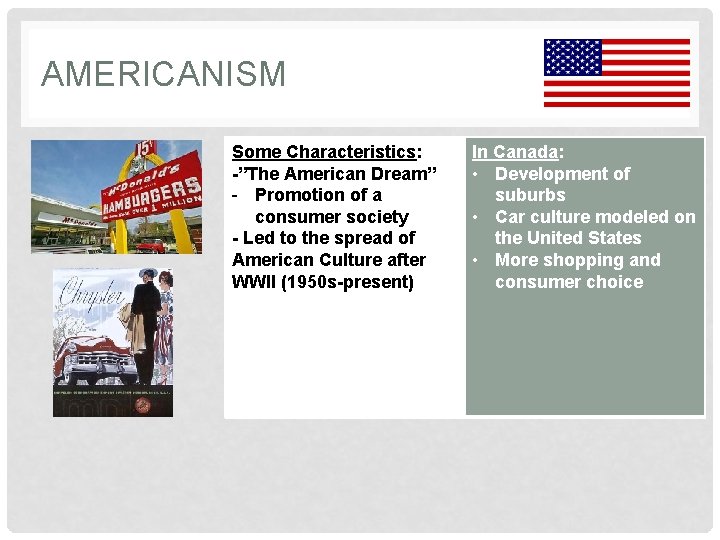
AMERICANISM Some Characteristics: -”The American Dream” - Promotion of a consumer society - Led to the spread of American Culture after WWII (1950 s-present). In Canada: • Development of suburbs • Car culture modeled on the United States • More shopping and consumer choice
SECULARISM Some Characteristics: -the separation of church and state - Religious organizations are not the providers of social services - People no longer influenced by the teachings of the church. In Canada: - Church attendance begins to drop in the 1960 s - Government of Quebec begins to directly fund schools in the 1960 s - In 2000, schools no longer have religious affiliation
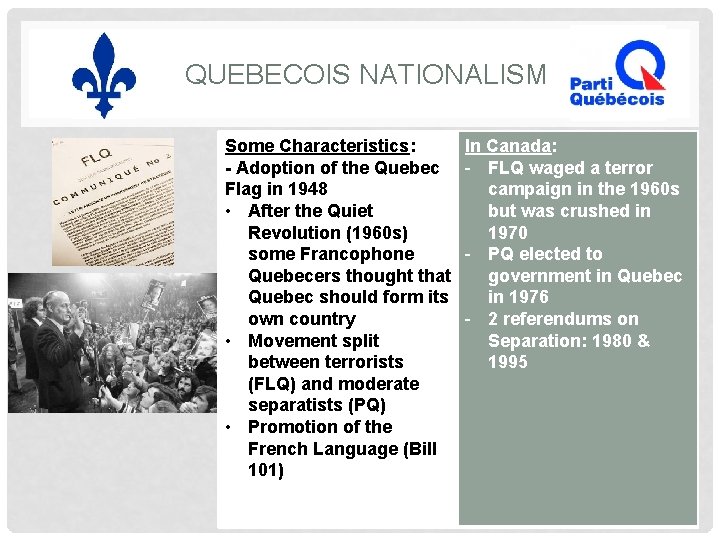
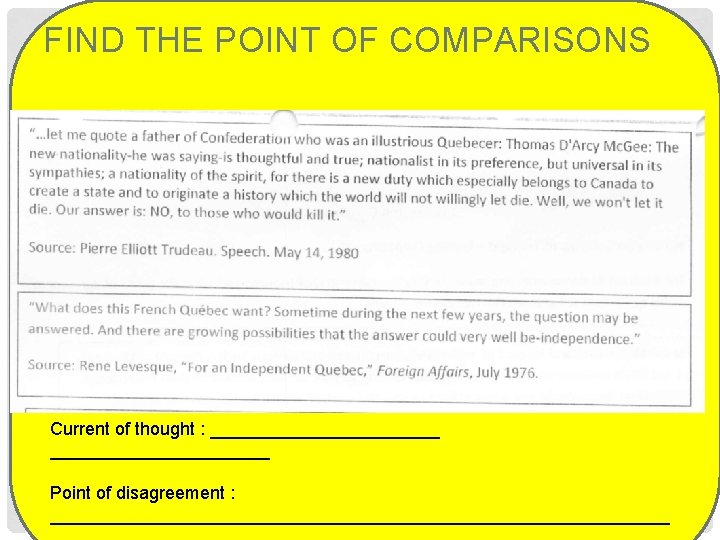
QUEBECOIS NATIONALISM Some Characteristics: - Adoption of the Quebec Flag in 1948 • After the Quiet Revolution (1960 s) some Francophone Quebecers thought that Quebec should form its own country • Movement split between terrorists (FLQ) and moderate separatists (PQ). • Promotion of the French Language (Bill 101) In Canada: - FLQ waged a terror campaign in the 1960 s but was crushed in 1970 - PQ elected to government in Quebec in 1976 - 2 referendums on Separation: 1980 & 1995
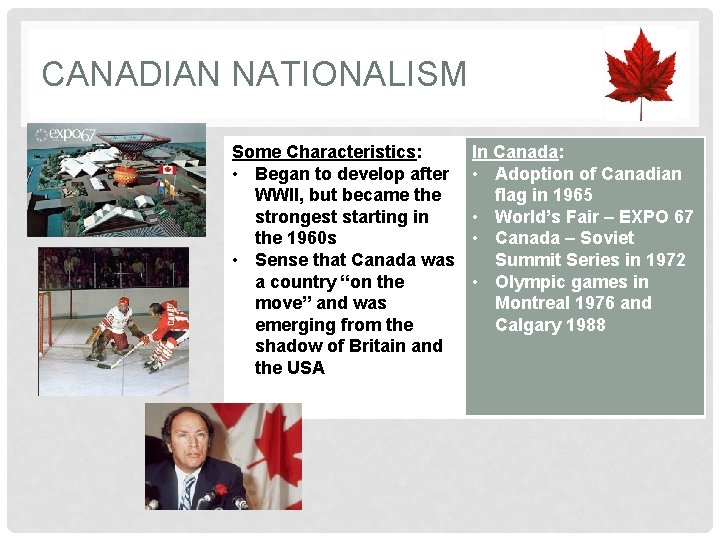
CANADIAN NATIONALISM Some Characteristics: • Began to develop after WWII, but became the strongest starting in the 1960 s • Sense that Canada was a country “on the move” and was emerging from the shadow of Britain and the USA. In Canada: • Adoption of Canadian flag in 1965 • World’s Fair – EXPO 67 • Canada – Soviet Summit Series in 1972 • Olympic games in Montreal 1976 and Calgary 1988
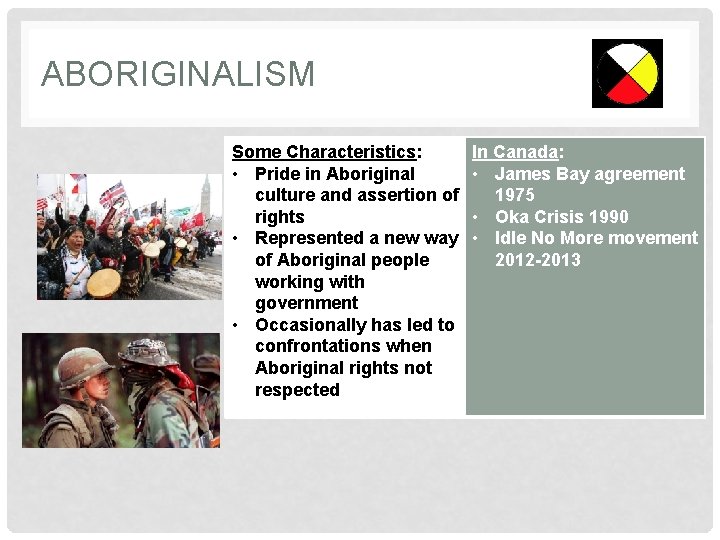
ABORIGINALISM Some Characteristics: • Pride in Aboriginal culture and assertion of rights • Represented a new way of Aboriginal people working with government • Occasionally has led to confrontations when Aboriginal rights not respected In Canada: • James Bay agreement 1975 • Oka Crisis 1990 • Idle No More movement 2012 -2013
NEO-LIBERALISM Some Characteristics: -1980 s-Present - Promotion of capitalism across the world and greater globalization - Greater role for the private sector in governmental affairs - Use of international organizations like the International Monetary Fund - Willingness to use military force for economic purposes In Canada: • Less government spending on social programs • Free trade agreements (FTA & NAFTA) • Participation in G 8 and G 20 summits
• • Liberalism British rule imperialism Socialism ( communism) Canadian nationalism 1900’s
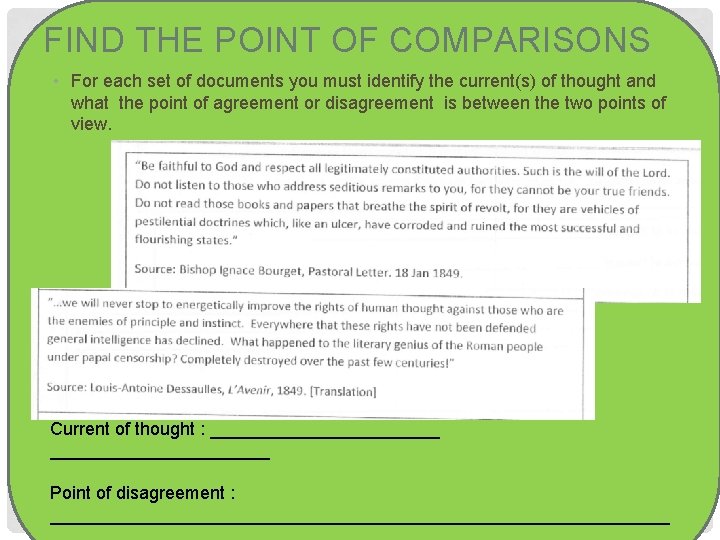
FIND THE POINT OF COMPARISONS • For each set of documents you must identify the current(s) of thought and what the point of agreement or disagreement is between the two points of view. Current of thought : ____________ Point of disagreement : _______________________________
FIND THE POINT OF COMPARISONS Current of thought : ____________ Point of disagreement : _______________________________
FIND THE POINT OF COMPARISONS Current of thought : ____________ Point of disagreement : _______________________________
FIND THE POINT OF COMPARISONS Current of thought : ____________ Point of disagreement : _______________________________