
Animation Creating the Bouncing Ball Arcs Easing and
Animation Creating the Bouncing Ball: Arcs, Easing, and Squash and Stretch
Copyright © Texas Education Agency, 2017. These Materials are copyrighted © and trademarked ™ as the property of the Texas Education Agency (TEA) and may not be reproduced without the express written permission of TEA, except under the following conditions: 1) Texas public school districts, charter schools, and Education Service Centers may reproduce and use copies of the Materials and Related Materials for the districts’ and schools’ educational use without obtaining permission from TEA. 2) Residents of the state of Texas may reproduce and use copies of the Materials and Related Materials for individual personal use only, without obtaining written permission of TEA. 3) Any portion reproduced must be reproduced in its entirety and remain unedited, unaltered and unchanged in any way. 4) No monetary charge can be made for the reproduced materials or any document containing them; however, a reasonable charge to cover only the cost of reproduction and distribution may be charged. Private entities or persons located in Texas that are not Texas public school districts, Texas Education Service Centers, or Texas charter schools or any entity, whether public or private, educational or non-educational, located outside the state of Texas MUST obtain written approval from TEA and will be required to enter into a license agreement that may involve the payment of a licensing fee or a royalty. For information contact: Office of Copyrights, Trademarks, License Agreements, and Royalties, Texas Education Agency, 1701 N. Congress Ave. , Austin, TX 78701 -1494; phone 512 -463 -7004; email: copyrights@tea. state. tx. us. Copyright © Texas Education Agency, 2017. All rights reserved. 2
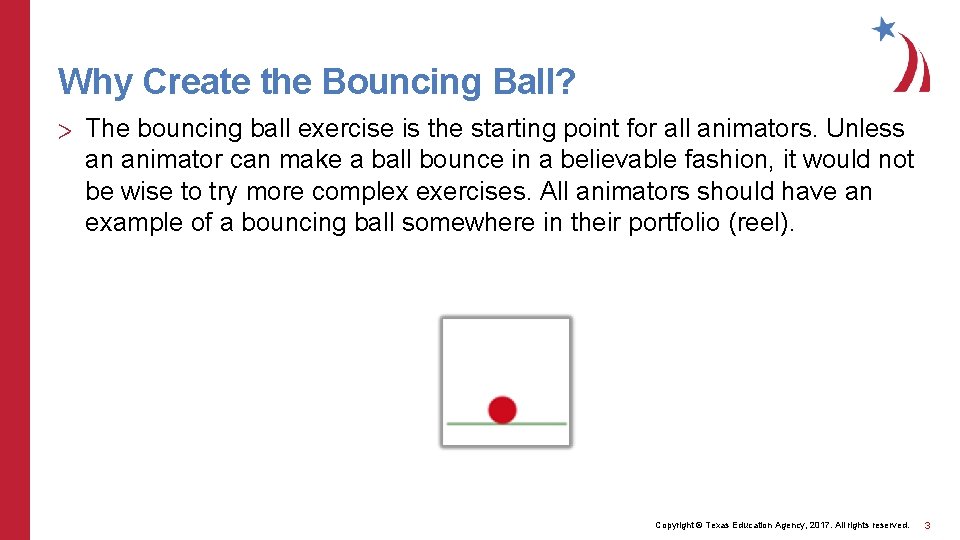
Why Create the Bouncing Ball? > The bouncing ball exercise is the starting point for all animators. Unless an animator can make a ball bounce in a believable fashion, it would not be wise to try more complex exercises. All animators should have an example of a bouncing ball somewhere in their portfolio (reel). Copyright © Texas Education Agency, 2017. All rights reserved. 3
Three Principles of Animation > The bouncing ball covers three of the basic principles of animation: • motion in arcs • slow in/slow out (easing) • squash and stretch > All components are necessary to give the motion the correct look Copyright © Texas Education Agency, 2017. All rights reserved. 4
Motion in Arcs > The ball falls in an elliptical arc through space. Most objects move in some sort of arc. If the ball was to move in a straight line between the top and bottom points of the bounce, then the action would look very unnatural. Copyright © Texas Education Agency, 2017. All rights reserved. 5
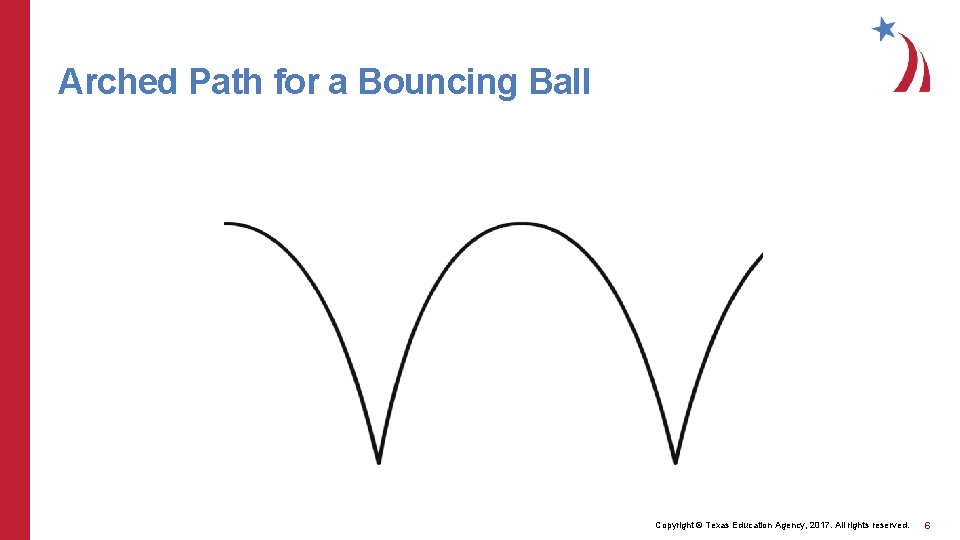
Arched Path for a Bouncing Ball Copyright © Texas Education Agency, 2017. All rights reserved. 6
Linear Motion > When objects move at an even pace, the motion is referred to as linear. When most objects are in motion, they are slowing down or speeding up. A common mistake of animators is to not change this linear motion. Linear motion is not appropriate for a bouncing ball. Copyright © Texas Education Agency, 2017. All rights reserved. 7
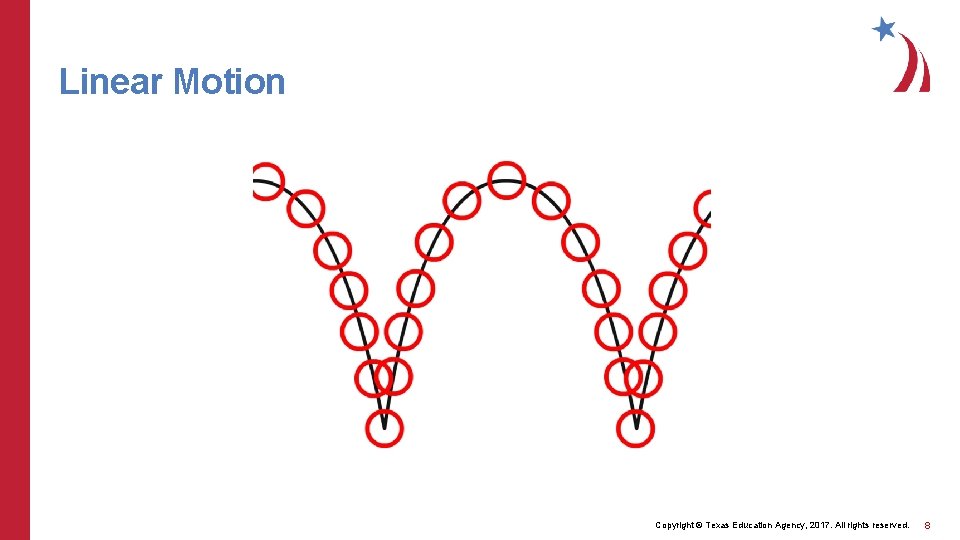
Linear Motion Copyright © Texas Education Agency, 2017. All rights reserved. 8
Slow In / Slow Out (Easing) > As the ball falls it is accelerated by gravity, the gap between each frame grows all the time until the ball hits the ground. As the ball bounces, the ball moves very fast at first, then slows down by gravity at the high point of its bounce. At the high point of the bounce, the ball is weightless. This speeding up and slowing down of the motion is called “easing. ” Copyright © Texas Education Agency, 2017. All rights reserved. 9
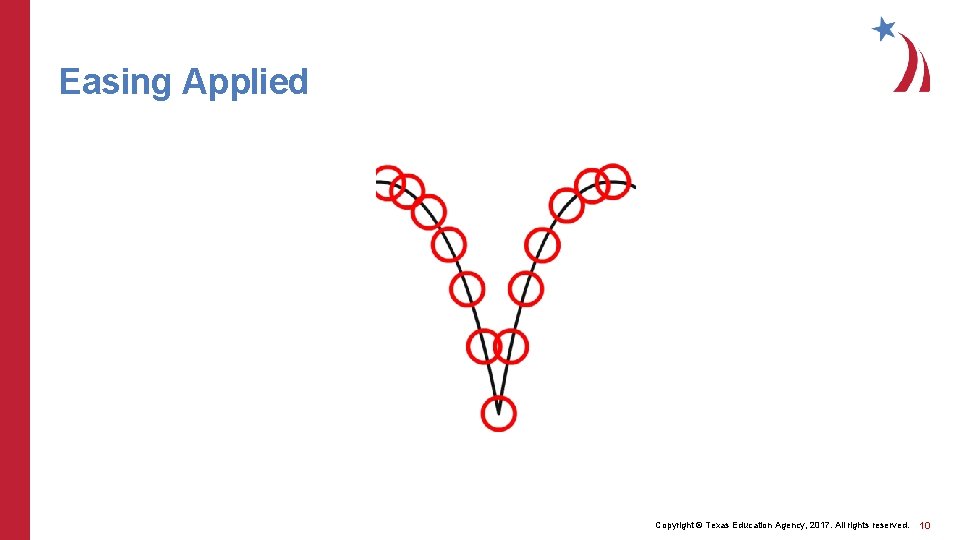
Easing Applied Copyright © Texas Education Agency, 2017. All rights reserved. 10
Squash > When it impacts the ground, it squashes. The volume must remain the same. If an object becomes wider (squashed) it must also become shorter. Squeezing a balloon illustrates the concept of constant volume while squashing and stretching. Copyright © Texas Education Agency, 2017. All rights reserved. 11
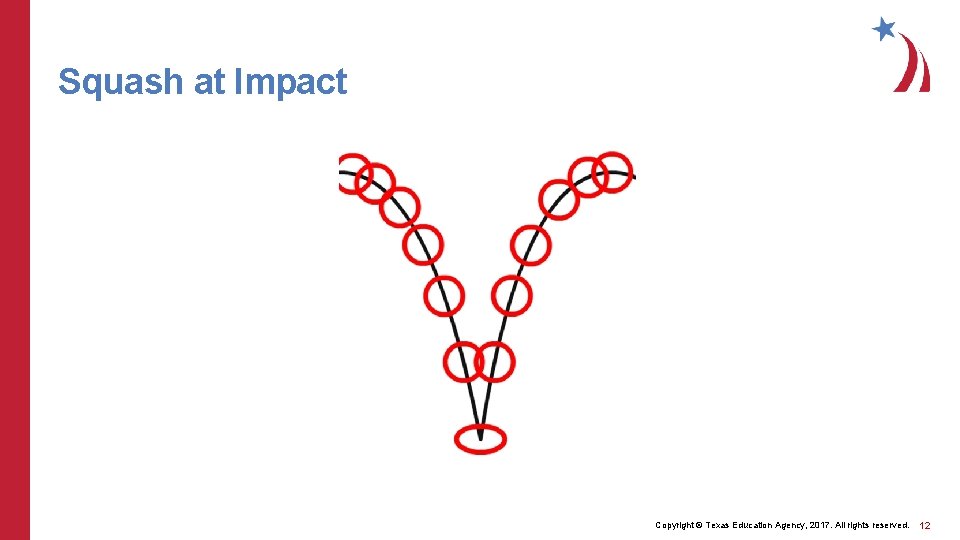
Squash at Impact Copyright © Texas Education Agency, 2017. All rights reserved. 12
Stretch > At some point as the ball falls, it stretches. When it impacts the ground, it squashes. When it bounces off the ground, it stretches again. Note how quickly the ball regains its circular shape. Copyright © Texas Education Agency, 2017. All rights reserved. 13
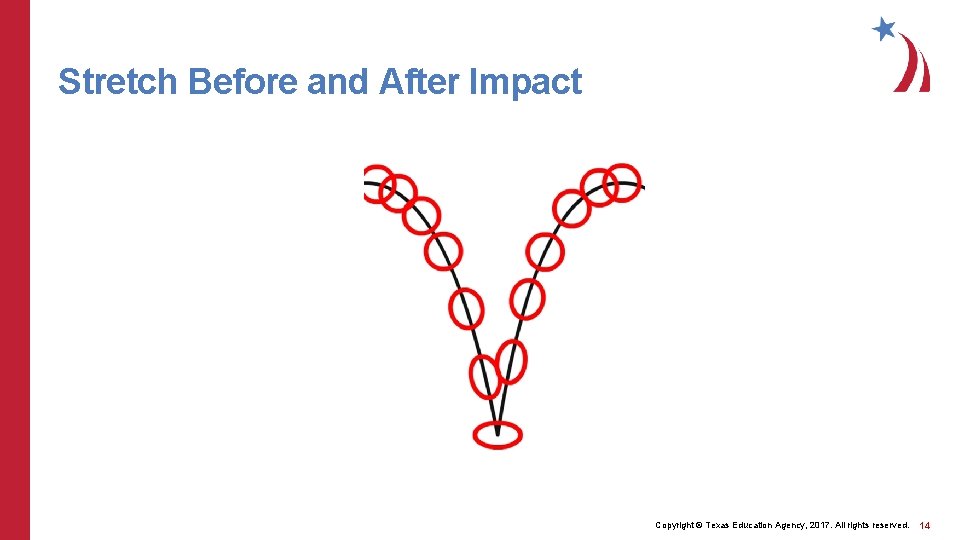
Stretch Before and After Impact Copyright © Texas Education Agency, 2017. All rights reserved. 14
- Slides: 14