
Animals have physical features which make them well
- Slides: 8
Animals have physical features which make them well suited to their environment (survival of the fittest). This includes animals which are camouflaged to their habitat, features which allow animals to survive in their climate, and features and which allow animals to get food and defend themselves. www. lessonplanspage. com/scienceanimaladaptations 58. htm
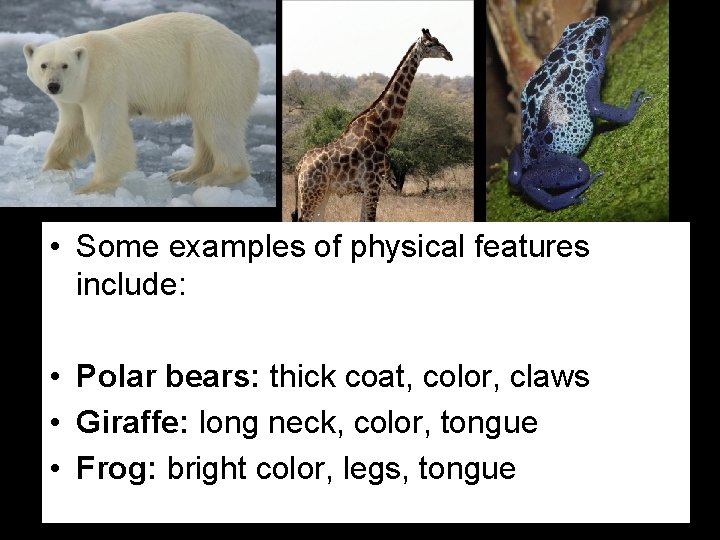
• Some examples of physical features include: • Polar bears: thick coat, color, claws • Giraffe: long neck, color, tongue • Frog: bright color, legs, tongue
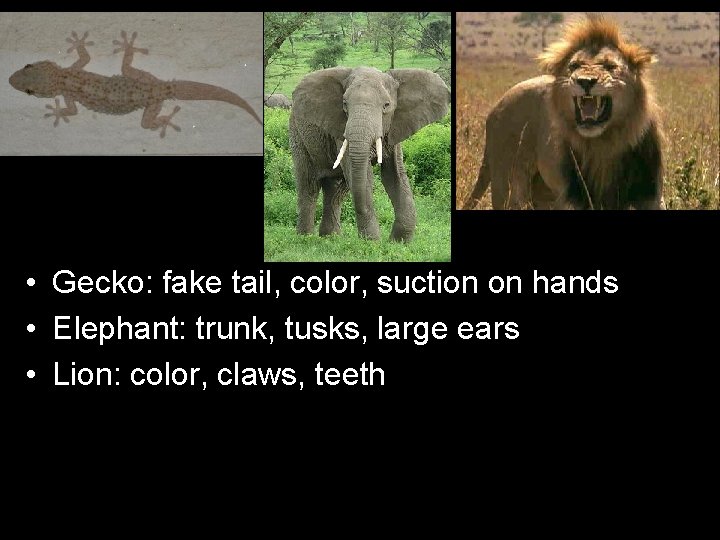
• Gecko: fake tail, color, suction on hands • Elephant: trunk, tusks, large ears • Lion: color, claws, teeth
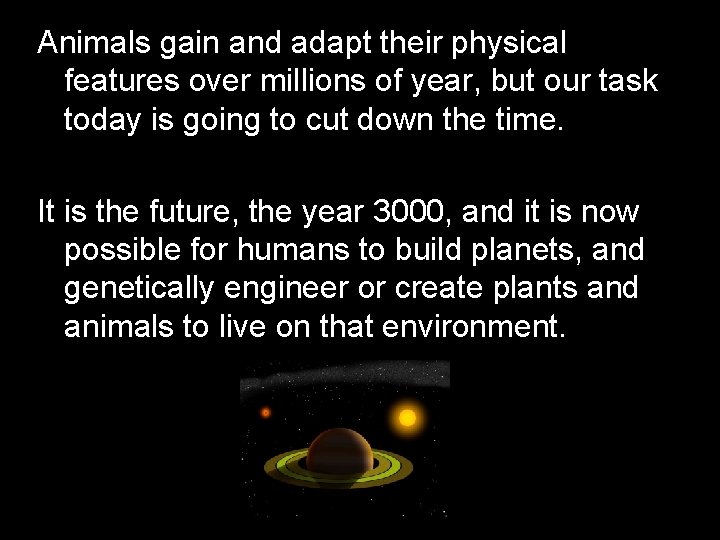
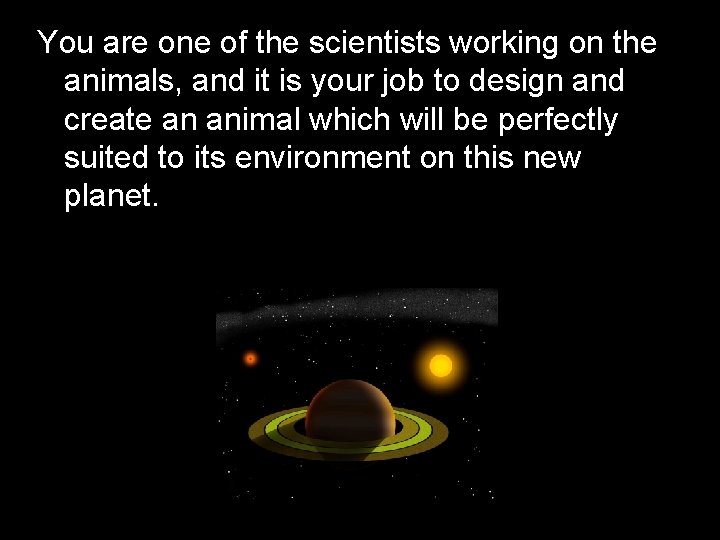
Animals gain and adapt their physical features over millions of year, but our task today is going to cut down the time. It is the future, the year 3000, and it is now possible for humans to build planets, and genetically engineer or create plants and animals to live on that environment.
You are one of the scientists working on the animals, and it is your job to design and create an animal which will be perfectly suited to its environment on this new planet.
1. Pick one of the environments listed on your sheet. 2. “Design” an animal to fit that environment. You need to consider how this animal is going to stay warm or cool, what it is going to eat, how it is going to get its food and water, and how it is going to care for its young to make sure they survive. Your animal must fit into the existing food chain. It cannot be the ultimate predator.
Must be written in paragraph form. You are writing for National Geographic about the new animal. • • Name of animal and planet Size What does it look like? What color is it? What does it eat? How does it catch its food? How will it catch/get food and water? How will it keep warm/cool? Where will it shelter (live)? How will it protect/defend itself from attackers?
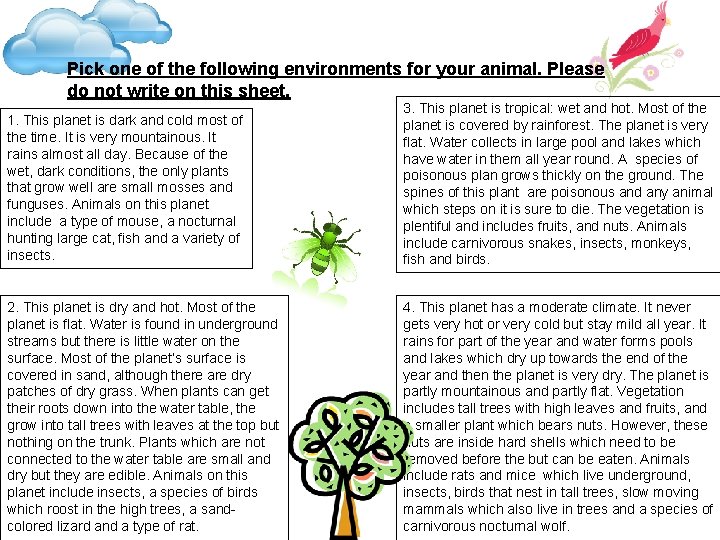
Pick one of the following environments for your animal. Please do not write on this sheet. 1. This planet is dark and cold most of the time. It is very mountainous. It rains almost all day. Because of the wet, dark conditions, the only plants that grow well are small mosses and funguses. Animals on this planet include a type of mouse, a nocturnal hunting large cat, fish and a variety of insects. 3. This planet is tropical: wet and hot. Most of the planet is covered by rainforest. The planet is very flat. Water collects in large pool and lakes which have water in them all year round. A species of poisonous plan grows thickly on the ground. The spines of this plant are poisonous and any animal which steps on it is sure to die. The vegetation is plentiful and includes fruits, and nuts. Animals include carnivorous snakes, insects, monkeys, fish and birds. 2. This planet is dry and hot. Most of the planet is flat. Water is found in underground streams but there is little water on the surface. Most of the planet’s surface is covered in sand, although there are dry patches of dry grass. When plants can get their roots down into the water table, the grow into tall trees with leaves at the top but nothing on the trunk. Plants which are not connected to the water table are small and dry but they are edible. Animals on this planet include insects, a species of birds which roost in the high trees, a sandcolored lizard and a type of rat. 4. This planet has a moderate climate. It never gets very hot or very cold but stay mild all year. It rains for part of the year and water forms pools and lakes which dry up towards the end of the year and then the planet is very dry. The planet is partly mountainous and partly flat. Vegetation includes tall trees with high leaves and fruits, and a smaller plant which bears nuts. However, these nuts are inside hard shells which need to be removed before the but can be eaten. Animals include rats and mice which live underground, insects, birds that nest in tall trees, slow moving mammals which also live in trees and a species of carnivorous nocturnal wolf.