
Animals Behavior Chapter 13 Section 1 The Animal
Animals & Behavior Chapter 13
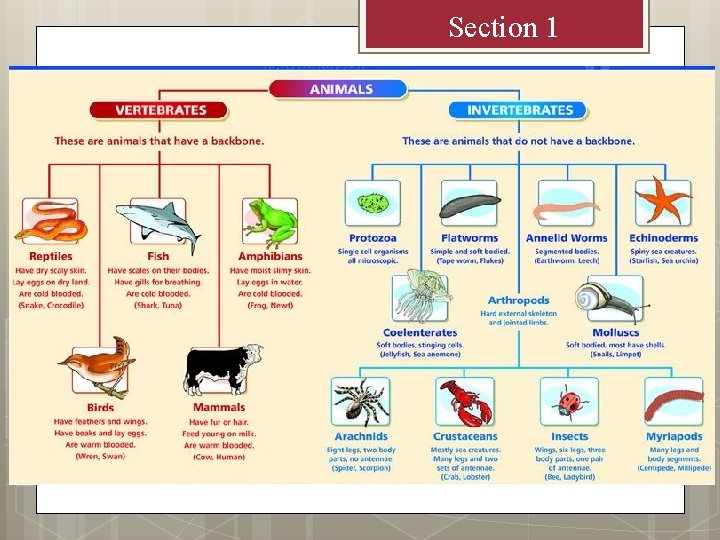
Section 1 The Animal Kingdom Over 1 million species of animals v Vertebrate = any animal with a skull and a backbone. • Fish, amphibians, reptiles, birds, & mammals (less than 5% of known animal species are vertebrates) v Invertebrate = animals without back bones • Insects, snails, jellyfish, worms
Section 1
Section 1 That’s an Animal? There is no single answer to what is an animal? But all animals share characteristics that set them apart from all other living things. v Animals have many cells • Multicellular = made of many cells (we have trillions of cells in our bodies) • Animal cells are eukaryotic and they don’t have cell walls (they are only surrounded by cell walls)
Section 1 That’s an Animal? Cont. Animals usually reproduce by sexual reproduction Animals usually make sex cells: eggs or sperm v When an egg & sperm come together fertilization! They form the first cell of a new individual Some animals (like sponges & starfish) can also reproduce asexually v Budding & division
Section 1 That’s an Animal? Cont. Animals develop from embryos The fertilized egg cell divides into many different cells to form an embryo v Embryo = an organism in the earliest stage of development.
Section 1 That’s an Animal? Cont. Animals have many specialized parts v have distinct parts that do different things • These parts begin to differentiate soon after fertilization. v Tissues = collections of similar cells • Muscle, nervous, etc. v Organs = the combination of two or more tissues • Heart, lungs & kidneys • Your different organs preform different jobs
Section 1 That’s an Animal? Cont. Animals Move Most animals move – they fly, run, swim, & jump v They move quickly and in a single direction Some animals do not move much – attach to rocks & wait for food to come to them. (Sea anemones & clams)
Section 1 That’s an Animal? Cont. Animals are Consumers Animals cannot make their own food. All animals survive by eating other organisms, parts of other organisms, or the products of other organisms. v Consumers organisms. = an organism that eats other
Section 2 Animal Behavior They move for a reason v Run from enemies v Climb for food v Build homes v Battle for territory v Migrate
Section 2 Survival Behavior Looking for Lunch v Whatever the meal of choice, animals have adapted to their surroundings so that they can obtain the most food using the least amount of energy How to Avoid Being Eaten v Predators = animals that eat other animals v Prey = the animal being eaten v Animals will pass up a good meal if it’s too dangerous to get
Section 2 Survival Behavior: Cont. Hiding Out One way to avoid being eaten is to be hard to see. v Camouflage = blending in with the background In Your Face v Physical features: send a clear signal of trouble to any potential predators (bull’s horns) v Chemicals: irritating to deadly (Skunk; Poisondart frog) • Warning coloration – bright design used to advertise chemical weapons
Section 2 Why Do They Behave That Way? How do animals know when a situation is dangerous? How do predators know which warning coloration to avoid? It’s in the Genes v Innate Behavior = behavior that doesn’t depend on learning or experience but is instead influenced by genes (Not all of these are present at birth)
Section 2 Why Do They Behave That Way? Cont. Animal School Just because a behavior is innate doesn’t mean that it cannot be modified v Learn Behavior = behavior that has been learned from experience or from observing other animals. (humans inherently speak but the language that we speak is learned) • Nearly all animals can learn
Section 2 Seasonal Behavior Animals often must deal with the hardships of little food and/or bitter cold. How do they do this? World Travelers v Migrate = to travel for one place to another and back again. • Animals migrate to find food, water, or safe nesting ground
Section 2 Seasonal Behavior: Cont. Slowing Down v Hibernation = a period of inactivity & decreased body temperature the some animals experience in winter (they survive off of body fat) • Mice, squirrels, skunks & bears v Estivation = a hibernation that some animals do during the summer.
Section 2 The Rhythms of Life v Biological clock = the internal control of natural cycles (internal clock that tells animals when to do certain things) v Circadian rhythms = biological clock that controls daily life (when to wake up & when to sleep/eat/etc. )
Section 2 How do Animals Find Their Way? Navigate = find their way from one place to another. Take a Left at the Post Office v. Landmarks = fixed objects that an animal uses to find its way. Compass Anyone? Some animals use Earth’s magnetic field to navigate
Section 3 Living Together Social behavior = the interaction between animals of the same species v Can be friendly or hostile v Requires communication v Can be in large groups or one on one
Section 3 Communication = a signal must travel from one animal to another, & the receiver of the signal must respond in some way v Helps animals live together, find food, avoid enemies, protect their homes, warn others of danger, identify family members, frighten predators, & to find mates. Territory = an area that is occupied by one animal or a group of animals & other members of the species are excluded from
Section 3 How Do Animals Communicate? v They communicate through smell, sound, vision, & touch Do You Sell Trouble? v Pheromones = chemicals animals give off to communicate with one another. • Trail substances, recognition odors, & attract mates Do You Hear What I Hear? v Sound is an signal that can reach a large number of animals over a large area
Section 3 How Do Animals Communicate? Cont. Showing Off v Body language – the process of communicating nonverbally through conscious or unconscious gestures & movement Getting in Touch v An animal may also use touch to communicate
Section 3 Part of the Family v Why do some animals live in groups, while others live apart? The Benefits of Living in a Group v It is much safer than living alone v It helps animals find food The Downside of Living in a Group v Groups attract predators, need more food v There is competition for food and mates v Diseases spread through groups more easily
- Slides: 23