
ANIMALS BASIC LAYOUT ANIMAL CHARACTERISTICS 1 Heterotrophic 2
ANIMALS

BASIC LAYOUT
ANIMAL CHARACTERISTICS 1. Heterotrophic 2. Multicellular 3. Eukaryotic 4. Store carbohydrates as glycogen 5. Lack cell walls
6. Have muscle and nervous tissue 7. Reproduce sexually with diploid phase being dominant. 8. Life cycles may include a larva phase. 9. Contain Hox genes that control development and gene expression, the more Hox genes, the more complex the animal.
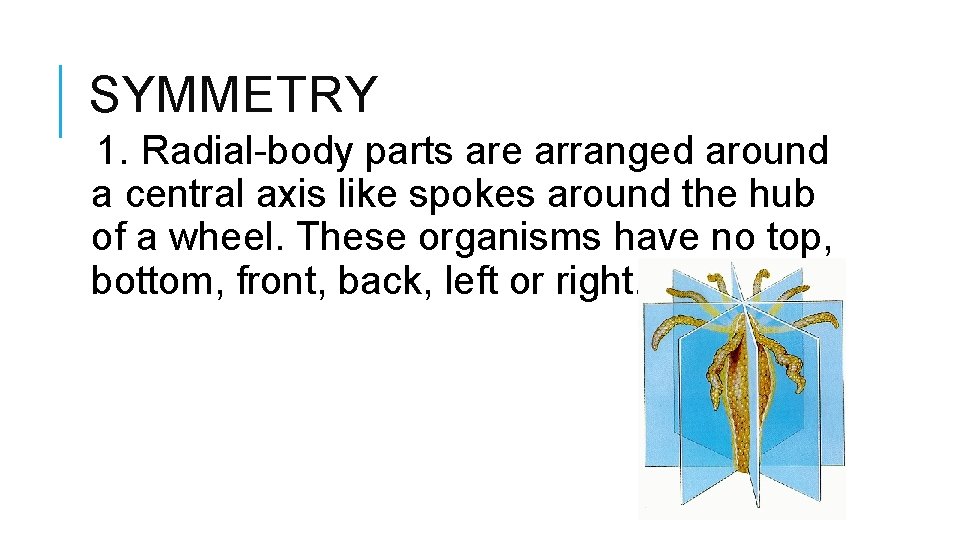
SYMMETRY 1. Radial-body parts are arranged around a central axis like spokes around the hub of a wheel. These organisms have no top, bottom, front, back, left or right.
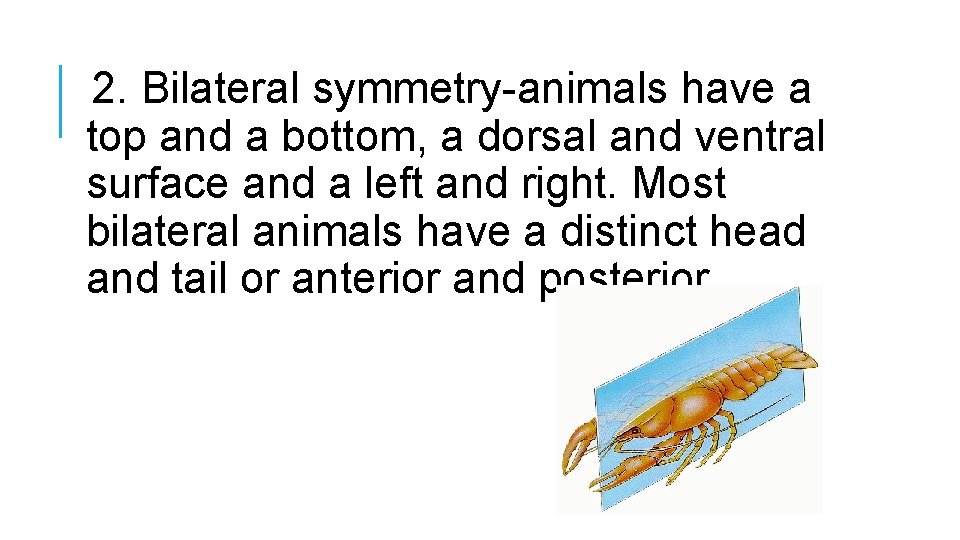
2. Bilateral symmetry-animals have a top and a bottom, a dorsal and ventral surface and a left and right. Most bilateral animals have a distinct head and tail or anterior and posterior.
ANIMAL PHYLA
TERMS Cephalization: Increased mass of nerve cells towards the anterior end of the organism that can form the brain of the organism if it grows large enough Cold-blooded (Ectotherm): organism that cannot maintain a body temperature through metabolic activity Warm-blooded (Endotherm): organism that can maintain a body temperature through metabolic activity
TERMS Endoskeleton: having an internal skeleton made of bones Exoskeleton: having a hard outer covering typically made of chitin
INVERTEBRATES Organisms that do not have a backbone or dorsal nerve chord Category 1: Diploblastic-a body cavity consisting of 2 layers. The endoderm is the digestive system, the ectoderm is the outer covering. 2 Phlya in this category: Porifera and Cnidaria
PHYLUM PORIFERA AKA THE SPONGES -Not organized into tissues and have no nervous or muscular system. -Sessile as adults. -Have primitive radial symmetry -Filter feeders -Reproduction. Sexual-choanocytes (collar cells that line the main cavity) can function as a sperm and amebocytes (found between endo and ectoderm) can function as egg. Asexual-use budding
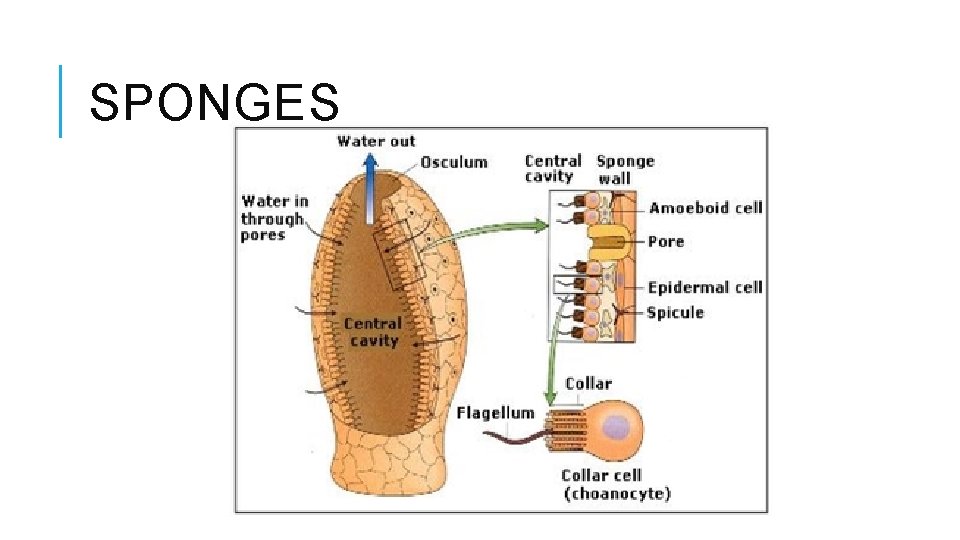
SPONGES
PHYLUM CNIDARIA (COELENTERATA) Include jellyfish, coral and sea anemones -3 classes Hydrozoa-hydra & portuguese man-of- war Scyphozoa-jelly fish Anthozoa-flower animals such as Anemones and coral radial symmetry Have cnidocytes (stinging cells) Only one opening for digestion Have a gastrovascular cavity (which is a big evolutionary step. )
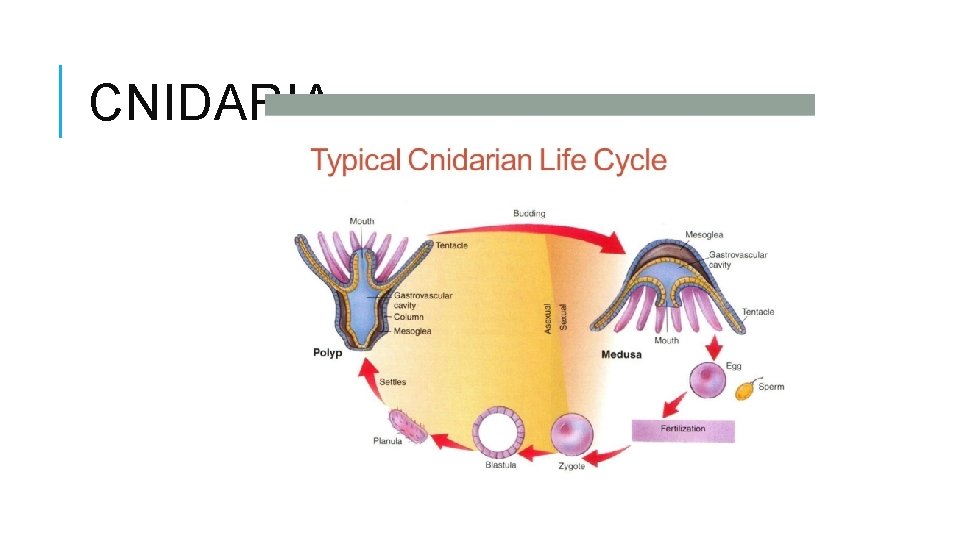
Reproduction Sexual-with fertilization occurring in the gastrointestinal cavity and then a ciliated larva is formed. Asexual-through budding; polyp form almost always reproduces asexually. Portuguese man-of-war is not a single jellyfish but a community of polyps with a shared gastrovascular cavity.
CNIDARIAN LIFE FORMS Cnidarians have two forms: Polyp Form: form where they are sessile and attached to the ocean floor. They reproduce by peeling layers off the top. Their mouth faces up Ex: anemone, hydra, coral Medusa Form: form in which they are free floating with their mouth down. Ex: jellyfish
CNIDARIA
Category 2: Triploblasts-have 3 embryonic layers 1. endoderm-becomes inner layer and digestive system. 2. Mesoderm-middle layer which becomes bones, muscle and connective tissue. 3. Ectoderm-outer layer which becomes skin and nervous tissue.
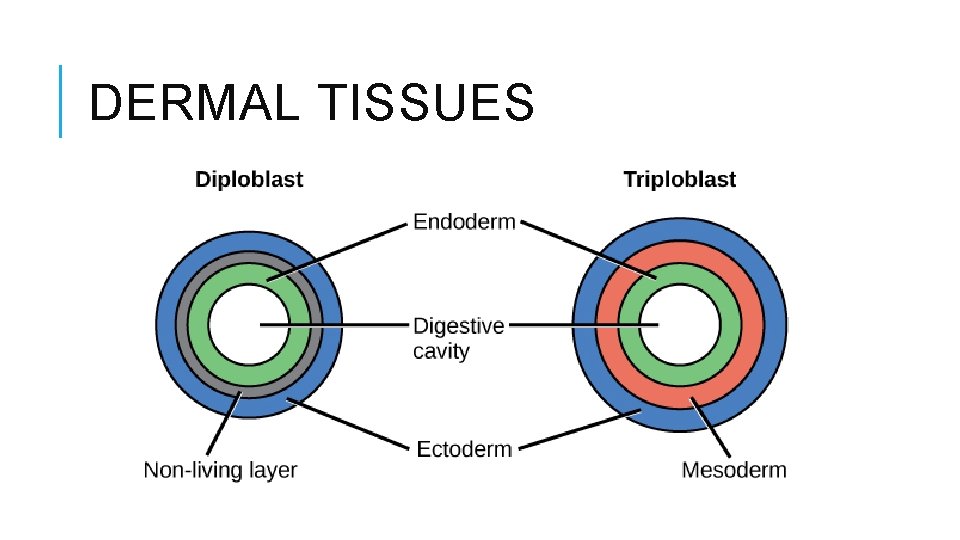
DERMAL TISSUES
Triploblastic animals are grouped into 3 categories: 1. Coelomates-have a coelom which means that they have a fluid filled cavity that contains digestive tract and other internal organs lined with epithelial tissue. 2. Pseudocoelomates-an additional cavity but does not have an epithelial lining. 3. Acoelomates-simplest arrangement; no body cavity between the gut and outer body wall.
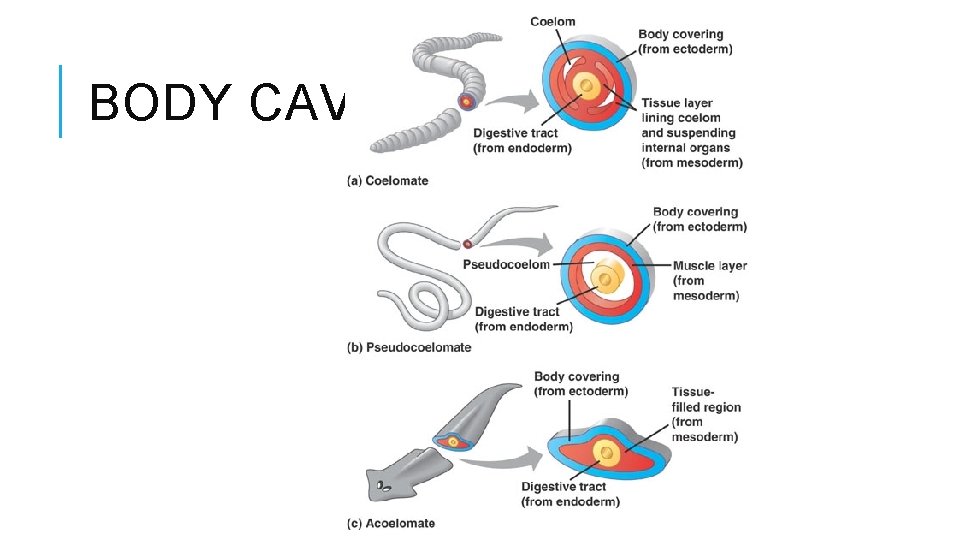
BODY CAVITIES
PHYLUM PLATYHELMINTHES: FLATWORMS -bilateral symmetry -acoelomate -Digestive system-one opening, two way traffic -Exchange gas through skin -2 main nerves with a ganglion in the head -Many are parasitic -Includes planaria, tapeworms and flukes
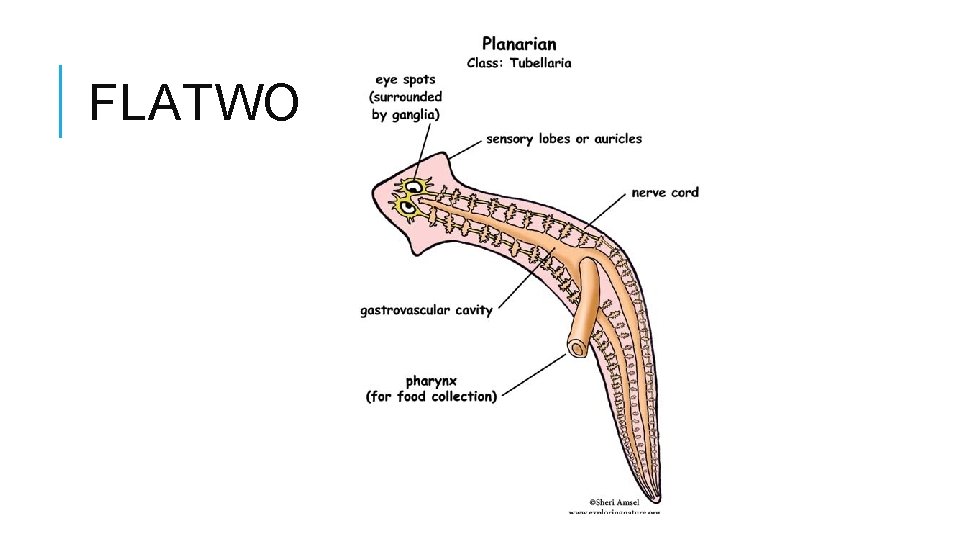
FLATWORM
PHYLUM NEMATODA: ROUNDWORMS -pseudocoelom -bilateral symmetry -free-living or parasitic -lack a circulatory system, use muscles to move fluid. -Digestive system-one way system with 2 openings. -Examples Ascaris, Hookworm, Trichina and
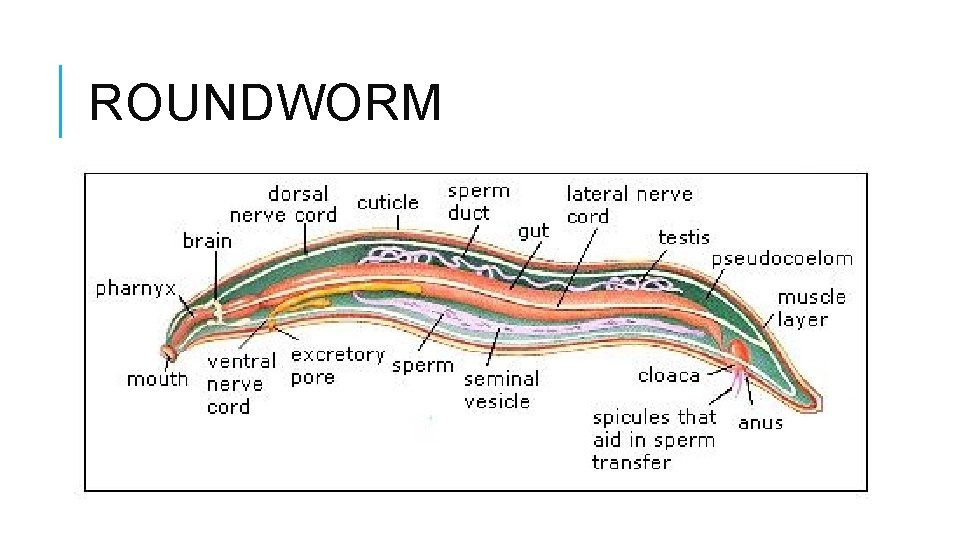
ROUNDWORM
PHYLUM ANNELIDA: SEGMENTED WORMS -bilateral -coelomates -have seperated segments that allow them to have more specialized functions -closed circulatory system -centralized nervous system -examples: earthworms, marine worms and leeches
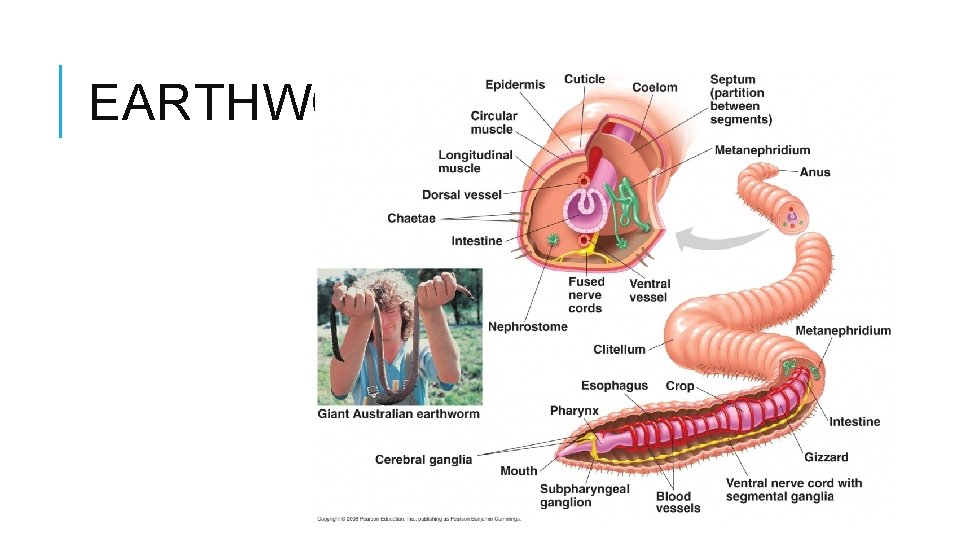
EARTHWORM
PHYLUM MOLLUSCA: SOFTBODIED -bilateral -coelomates -Have a muscular foot, mantle, gills and a shell made of calcium carbonate. -closed circulatory system -Highly ciliated digestive tract -Examples: clams, mussels, oysters, snails, octopus, squid, nautilus
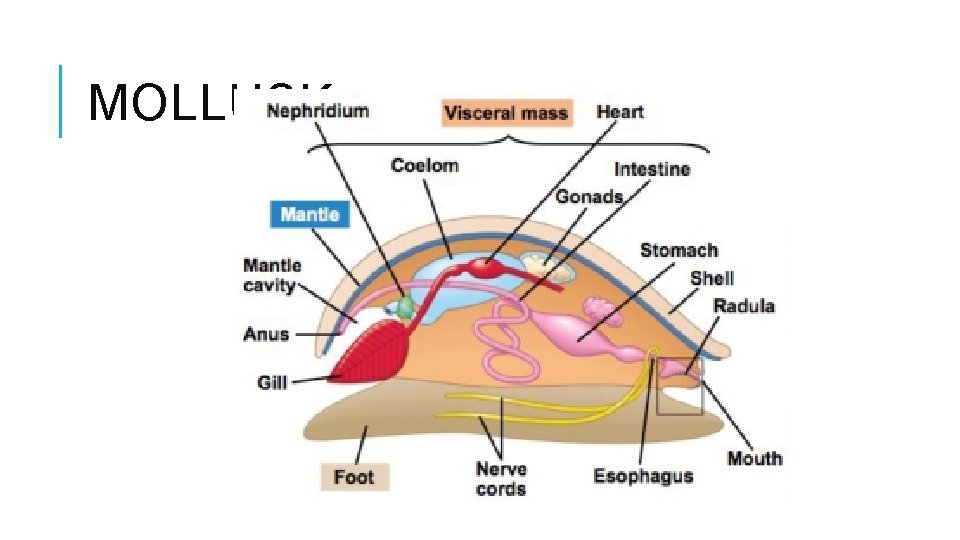
MOLLUSK
PHYLUM ARTHROPODA: JOINTED APPENDAGES -largest animal grouping -bilateral symmetry -exoskeleton made of a waxy coating of chitin and proteins. -open circulatory system -sexual reproduction -nervous system-brain and ventral nerve cords and ganglia that run down the length of the body. -have 5 senses
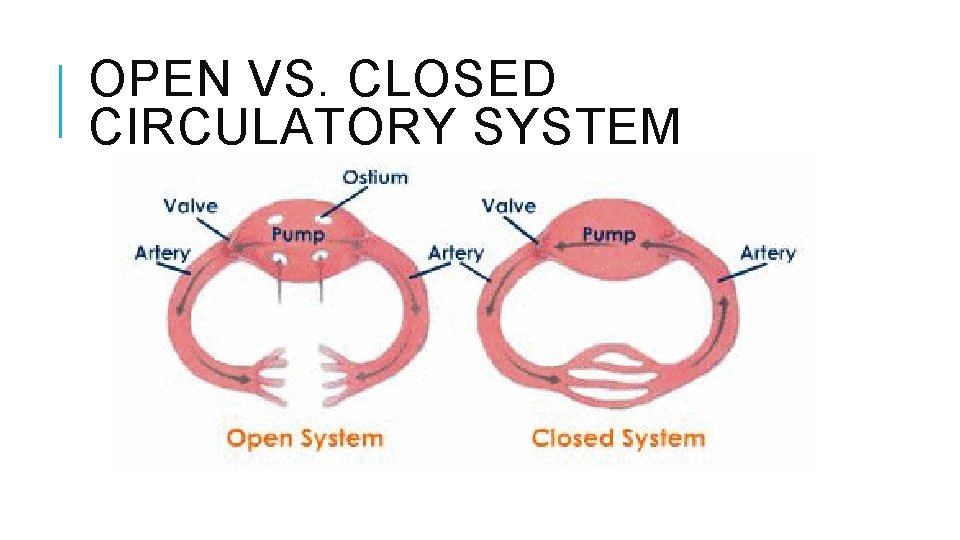
OPEN VS. CLOSED CIRCULATORY SYSTEM
4 types of arthropods: 1. chelicerates-horseshoe crab, sea spiders, mites and scorpions. 2. crustaceans-crabs, lobsters, shrimp and barnacles. 3. uniramians-insects 4. Trilobites-totally extinct
PHYLUM ECHINODERMS: SPINY-SKINNED -bilateral as larva, radial as adults -coelomates -gas exchange through skin -no circulatory system -includes: sea lilies, feather stars, starfish, sea cucumbers, brittle stars, sea urchins and sand dollars

VERTEBRATES
CHARACTERISTICS Belong to the Phylum Chordata All have bilateral symmetry 4 anatomical structures that appear during the animal's lifetime. Often these structures are only present during embryonic development. Birds, reptiles, and mammals are amniotes. They lay eggs on land have a membrane surrounding the fetus
4 STRUCTURES 1. Notochord-longitudinal, flexible rod located between the gut and the nerve chord. Composed of large fluid, filled cells encased in a stiff fibrous tissue. Extends almost the entire length of the animal and acts as a simple skeleton. In animals that develop a more complex, jointed skeleton this becomes the disks between the vertebrae. 2. Dorsal, hollow nerve chord-this forms the central nervous system.
3. Pharyngeal slits-digestive tube of almost all chordates opens to the outside with slits and has been modified for gas exchange and other functions. 4. Muscular tail-most chordates have a tail that contains skeletal and muscular elements.
ORGANIZATION OF CHORDATES 1. Phylum Chaetognatha-arrow worms-60 species; all hermaphroditic. 2. Phylum Hemichordata-proboscis and pharayngeal gill slits.
Phylum Chordata a. Subphylum Urochordata-include tunicates and sea squirts; are chordates because they have a notochord; hollow, dorsal nerve chord and tail for a few days of development. Filter feeders and secrete cellulose (rare in animals) b. Subphylum Cephalachordata-resemble fish and are filter feeders. c. Subphylum vertebrata-further divided into 8 classes
8 TRAITS COMMON TO ALL CLASSES OF SUBPHYLA VERTEBRATA 1. Backbone or vetebral column 2. Cranial brain development 3. Closed circulatory system 4. Gas exchange in lungs and gills
5. Two pairs of limbs 6. One pair of image forming eyes 7. Excretory system consolidated in a pair of kidneys 8. Separate genders
CLASSES OF VERTEBRATA 1. Super class Agnatha: Jawless fish 60 modern species Some suck up nutrients from sediments long cylindrical bodies, simple fins 2 heart chambers ectothermic (aka cold-blooded) oviparous (aka external fertilization) Ex. Lampreys and hagfish
2. Superclass Gnathostomata: extinct jawed fish -became extinct 150 million years ago -armored group with hinged jaws -could swim better than aganathans -predators -ancestors to chondrichthyes and osteichthyes
3. Class Chondrichthyes (sharks, skates and rays) -Stiff caudal tail, dorsal fin stabilizer, pectoral and hind fins -cartilaginous fish -tough skin -skin and teeth of sharks consist of placoid scales and are made continuously
-store oil in liver for buoyancy -can smell prey up to 400 meters away and have a lateral line organ to pick up vibrations. -must keep moving to move water through gills -internal fertilization but then either oviparous (egg laying) or ovoviviparous (soft eggs that hatch inside female) -2 heart chambers
4. Class Osteichthyes-bony fish -more maneuvarable fins than chondrichthyes -air bladder to help fish remain stationary at any depth -body covered with flattened scales -numerous mucous glands to make fish slimy -taste buds but unmovable tongues -2 chambered heart -ectotherms -oviparous but some are ovoviviparous
5. Class Amphibia (toads, frogs and salamanders) -ectothermic -most frogs and toads are external fertilizers; salamanders are internal fertilizers -Born in water; live adult life on land. -mainly breathe through skin -3 chambered heart
Frogs: Need to live near water Have smooth, moist skin that makes them look “slimy”. Have a narrow body Have higher, rounder, bulgier eyes Have longer hind legs Take long high jumps Have many predators
Toads: Do not need to live near water to survive Have rough, dry, bumpy skin Have a wider body Have lower, football shaped eyes Have shorter, less powerful hind legs Will run or take small hops rather than jump
6. Class Reptilia (turtles, snakes, lizards and crocodiles -ectothermic -internal fertilization and oviparous, ovoviviparous and viviparous -dry skin with protective scales to reduce water loss -most have a 3 or four chambered heart
7. Class Aves: birds -skeleton made of hollow bones -beaks, long flexible necks, bones of the trunk are fused together, breastbone is enlarged to act like a keel for flight muscles, small tail, legs adapted for perching and grasping -feathers -complicated respiratory system and four-chambered heart. -no urinary bladder; solid and liquid wastes are added together
8. Class mammalia -furry or hairy animals -produce milk using modified sweat glands -endothermic -four heart chambers
ANIMAL BEHAVIOR
Innate Behavior-Behavior patterns an animal is born knowing how to do. 2 types: 1. Reflex-quick automatic response with no conscious control. 2. Instinct-longer more complex pattern of behavior. ex. flying south for the winter
INSTINCTS Estivation-Occurs during the summer; a state of reduced metabolism which occurs in animals living in intense heat. Hibernation-Occurs during the winter; state of reduced body temperature, decreased oxygen consumption, and decrease breathing rates.
INSTINCTS Circadian Rhythm-the natural hormone cycles that result in your most alert/active times and less alert/active time. Mimicry: superficially matching phenotypes with that of another species
INSTINCTS Imprinting-When an organism forms a social attachment during early childhood. Ex. geese thinking first thing they see is their mother. Heirarchy: Social ranking system that helps reduce fighting among members of the group
INSTINCTS Fight or Flight Response-Response controlled by hormones that prepares the body for danger. Territorial behavior-Defending of a physical space or mate from one organism to another. Dominance hierarchy-Social ranking within a group in which some individuals are subordinate than others. . also known as pecking order. Actually seems to reduce
INSTINCTS Mating Behaviors: Pheromones-Chemical signals given off by animals that signal others to engage in specific behaviors. Courtship behaviors-Behaviors carried about by partners prior to mating.
LEARNED BEHAVIORS Learned behaviors have a basis in genetics as organisms need to be able to learn but they are skills/actions that organisms pick up from observing others or determining themselves Habituation: Occurs when an animal is repeatedly given a stimulus with no punishment or reward so they begin to ignore stimulus.
LEARNED BEHAVIORS Classical Conditioning: Learning by association. Animals are rewarded or punished for their response to an arbitrary stimulus Ex. Pavlov's dogs Operant Conditioning: Learning by reward and punishment through trial and error
ANIMAL BODY SYSTEMS
ENDOCRINE
Hormones: are chemical messengers that are formed by endocrine glands in one part of the body and travel to other parts of the body and cause chemical changes.
There are 50 known hormones. Hormones are a specific shape that will only bind with their target cell. Many hormones have an antagonistic hormone that will reverse their action. Ex. insulin removes glucose while glucagon adds glucose to the blood.
THERE ARE 3 GROUPS OF HORMONES Steroids four-ring structure, each ring with a different side group derived from cholesterol includes: sex hormones progesterone, testosterone, estrogen, aldosterone, corticosterone, and cortisol.
Peptides composed of amino acid chains includes ADH and oxytocin-each made of 9 amino acids, as well as insulin that has 51 amino acids. Modified amino acids Only a few of these includes epinephrine, norepinephrine and tyrosine
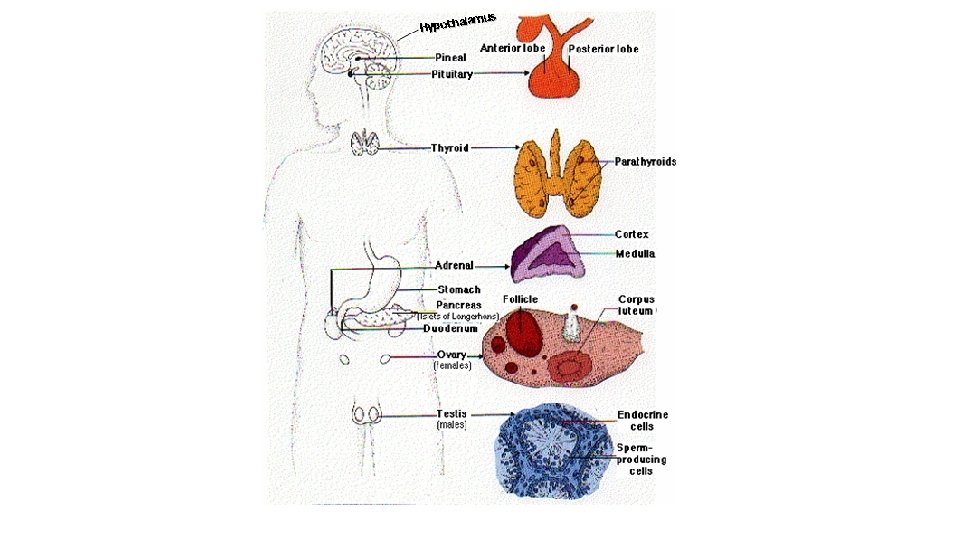
ORGANS OF THE ENDOCRINE SYSTEM Hypothalamus: Manufactures hormones such as oxytocin and ADH for the pituitary and releasing factors which control the release of hormone from the pituitary gland.
ORGANS OF THE ENDOCRINE SYSTEM Pituitary gland-Called the master gland, divided into anterior (produces 7 important hormones) and posterior hormones that does not manufacture hormones but stores oxytocin and ADH. Anterior pituitary produces growth hormone, prolactin, follicle stimulating hormone, luteinizing hormone and others.
ORGANS OF THE ENDOCRINE SYSTEM Thyroid gland-Plays a huge role in the development and maturation. Maintains normal blood pressure, heart rate, muscle tone, digestion and reproduction. It can increase oxygen consumption and metabolism. An overactive thyroid-hyperthyroidism-causes symptons such as nervousness, hyperactivity, insomnia and weight loss. An underactive thyroid-hypothyroidism causes fatigue, weight gain, irritability and depression.
ORGANS OF THE ENDOCRINE SYSTEM Parathyroid-4 pea-sized bodies embedded in the thyroid that release parathyroid hormone that increases calcium concentration.
ORGANS OF THE ENDOCRINE SYSTEM Pancreas-produces digestive enzymes for the small intestine and insulin and glucagon. hypoglycemia-abnormally low blood sugar diabetes-abnormally high blood sugar type 1 -autoimmune disorder where pancreatic cells are attacked requiring daily injects of insulin. type 2 -caused by target cell responding less to insulin or the production of less insulin. Can be treated through diet.
ORGANS OF THE ENDOCRINE SYSTEM Adrenal glands-located on top of the kidney and releases adrenaline, aldosterone to increase electrolyte uptake and cortisol that increases glucose, protein and fat metabolism.
ORGANS OF THE ENDOCRINE SYSTEM Ovaries and Testes- Ovary-releases estrogen and progesterone. Testes-releases testosterone Important in reproduction and bone lengthening.
ORGANS OF THE ENDOCRINE SYSTEM Pineal body-located above brain stem and secretes melatonin and is tied to our biological clock. Thymus-At puberty the thymus begins to diminish and almost disappears by adulthood. Secretes thymosin which place a role in making lymphocytes.
FEEDBACK REGULATION OF THE ENDOCRINE SYSTEM
A negative feedback loop reduces the response of the target cell. A positive feedback loop increases the response of the target cell. For example, in mammals oxytocin causes the release of milk. This triggers a greater suckling response in offspring. The suckling of offspring increases the release of oxytocin.
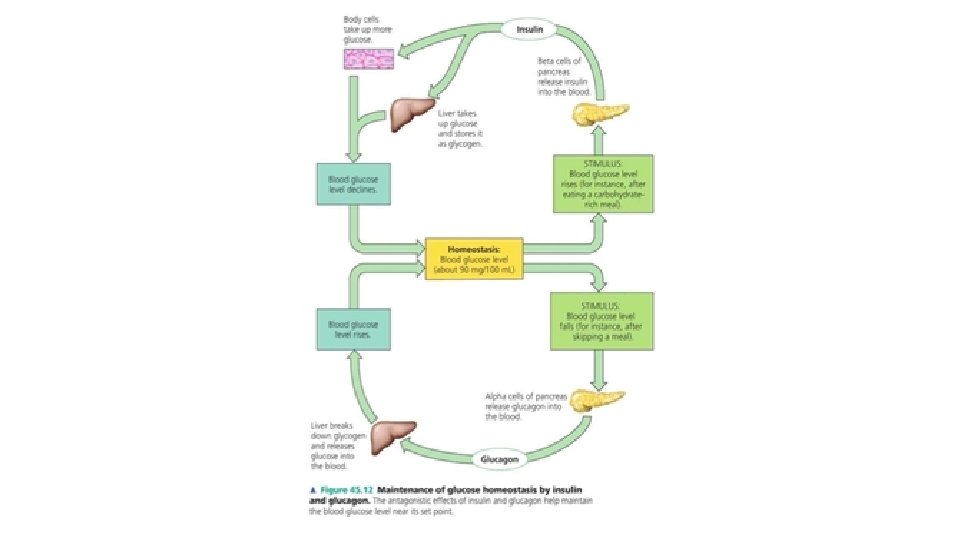
TARGET TISSUES FOR INSULIN & GLUCAGON Insulin reduced blood glucose levels by Promoting the uptake of glucose by the liver. Promoting the body cells to take up more gluocose. Causing a conversion of glucose to glycogen where energy can be stored for later use.
TARGET TISSUES FOR INSULIN & GLUCAGON Glucagon increases glucose levels by stimulating the conversion of glycogen to glucose.
TARGET TISSUES FOR INSULIN & GLUCAGON Diabetes mellitus is perhaps the best known endocrine disorder. It is caused by a deficiency of insulin or a decreased response to insulin in target tissues. It is marked by elevated blood glucose levels.
TARGET TISSUES FOR INSULIN & GLUCAGON Type 1 diabetes mellitus (insulin-dependent) generally is found in children and results in an inability to produce insulin causing the body to maintain levels of glucose that are too high. Type 2 diabetes mellitus (non-insulin dependent) the body stops responding to insulin appropriately caused by extreme glucose levels.
IMMUNE
PURPOSE OF THE IMMUNE SYSTEM The purpose of the immune system is to prevent foreign bodies from entering the body and removing them if they do. Antigens: term describing proteins on foreign bodies that will trigger an immune response Your regular cells are protected against immune responses because of a protein that is found on the surface of all your cells called the MHC 1. (Major Histocompatability Complex 1)
LAYERS OF DEFENSES 1 st line of defense-external barriers 2 nd line of defense-non-specific internal defenses such as phagocytes that engulf foreign matter. Natural Killer Cells!
LAYERS OF DEFENSES 3 rd line of defense-inflammationincrease blood flow and allows healing to begin. 4 th Fever
RD 3 LAYER OF RESPONSE. ACTIVE IMMUNITY B-cells and T-cells: B-cells attack toxins, free bacteria and free viruses before you are infected. T-cells attack bacteria, viruses, fungi, protist, worms and cancer after you are infected.
IMMUNE SYSTEM DISORDERS Rheumatoid arthritis-attacks joints Insulin dependent diabetes-attack pancreatic cells Rheumatic fever-attacks heart muscles and valves Graves disease-attacks thyroid producing too much of the thyroid hormones. Lupus-systematic autoimmune response
IMMUNE SYSTEM DISORDERS Multiple sclerosis-T cells atack the myelin sheath of neurons that cause the nerves to short circuit. Allergies-hypersensitivity to environmental factors that triggers the release of histamine aht causes dilatin of blood vesselsm, sneezing, runny nose, smooth muscle contracts, and difficulty breathing. Immunodeficiency-deficiency of immune system Hodkin's disease-damages lymph system.
REPRODUCTIVE SYSTEM
Male Reproductive system: -Testes produce sperm and sex hormones. Sperm develop at about 2 degrees Celsius (approx 36 degrees Fahrenheit). Testes move closer to the body as external temperature drops to preserve the ideal temperature. -Inside the testes are 2 highly coiled seminiferous tubules. These coils make up the epididymis that stores sperm. The sperm mature, become mobile and fertile here. The cells that make up the tubules produce the sperm.
PARTS OF THE TESTES One vas deferens (tube for sperm transport) leaves each testis, goes over the pubic bone and then join together under the bladder. They are joined at the seminal vesicle duct. The seminal vesicle produces 60% of semen which contains fructose, amino acids, and proteins. Semen also contains buffering materials and prostaglandins which signal the uterus to contract.
Leaving the seminal vesicle the sperm enter the urethra which is surrounded by the prostate gland. The prostate gland increases the p. H of the semen. This increase activates sperm and protects them from the acid environment of the female body. Below the prostate is the bulbourethral gland that adds mucus to lubricate sperm. The urethra takes sperm out of the body.
SPERM STRUCTURE Each male ejaculation contains 50 -130 million sperm in 2 to 5 ml of semen. The head of the sperm is an acrosome, an enzyme cap topped with bindin receptors to bind to egg. the middle part of the sperm has numerous mitochondria to provide energy for the sperm's travel.
FEMALE REPRODUCTIVE SYSTEM: Outer genitalia: collectively known as the vulva surround the clitoris, urethral opening and vaginal opening. Inner genitalia: vagina-muscular tube about 7 -8 cm long. Usually contains "good" bacteria which are responsible for keeping the environment acidic and preventing growth of harmful bacteria nd yeast. Uterus-about 7 cm long and 4 -5 cm wide in a female who has never been pregnant. The cervix surround the opening between vagina and uterus.
INNER GENITALIA, CONT Oviducts-twice the diameter of a human hair, emerge from each side at the upper end of the uterus. The oviducts are ciliated to help move the egg to the uterus. Eggs are fertilized in the oviduct and implant in the uterus. If the egg implants in the oviduct it is an ectopic pregnancy and can lead to sterilization or death from internal bleeding. Oviduct ends in fimbriae. Ovaries at the end of each oviduct. Eggs are stored in prophase I, undergo meiosis 1 while traveling to uterus. After fertilization go through meiosis 2.
MENSTRUAL CYCLE Day 1 -3 to 4: uterine lining is shed AKA menstruation Days 1 -14 one follicle (pre-egg) grows steadily for 14 days. During the 14 th day the ovum bursts and the ovary travels down the oviduct. This is ovulation. This is the phase where the uterine lining is stimulated to thicken and the cervix creates an alkaline fluid which makes the female system more hospitable to sperm. Day 14 -25/26 - Lutenizing horomones causes lining to thicken preparing a hospitable environment for a fertilized egg. Uterus is receptive to allowing an egg to attach until around day 25 or 26, after this the lining is sloughed off along with any unattached eggs.
If a sperm reaches an egg the bindin helps to bind to egg and acrosome helps bore into the egg. Once the happens the egg: 1. produces a barrier to prevent polyspermy 2. Egg cytoplasm surrounds sperm detaching head and neck from middle section. Mitosis begins to produce the child.

NERVOUS
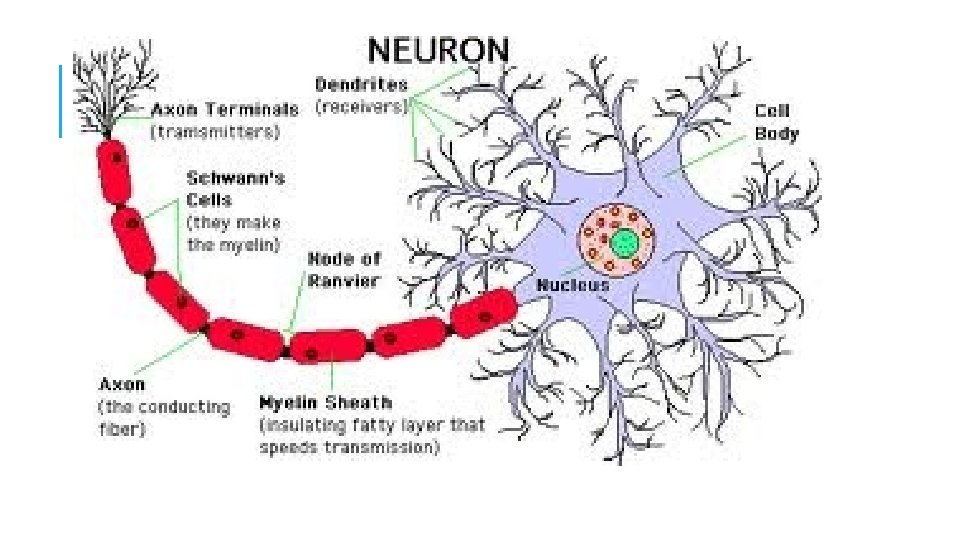
NEURON STRUCTURE -neuron=nerve cell -dendrite-area receives stimuli from the environment or another neuron. Signal travels from dendrite to the cell body and the down the axons may be very long; up to 3 feet in humans and transmits impulses away from the cell body. axons are often surrounded by Schwann cells that form an insulating layer made from the myelin sheath.
3 TYPES OF NEURONS 1. sensory neurons-communicate information towards the CNS 2. Interneurons-integrate sensory and motor output. 3. Motor Neurons-carry impulses away from the CNS to effector cells (such as muscles)
NEURONS SEND ELECTRICAL IMPULSES Neurons at rest are more negative inside then outside the cell. Inside the cell is a cation-potassium, and a group of negative ions that are treated as a group. Outside the cell is a high concentration of cation sodium, some potassium and an anion chloride.
These ions can move through ion channels or by transport proteins. When a neuron is triggered the channels open. The stronger the impulse the more channels that open. When enough ions move through to exceed a threshold an action potential is produced and sends the message to the next neuron.
Speed of action potential being transferred from one neuron to the next is affected by: 1. diameter of the axon-the larger the diameter, the faster the transmission. 2. myelin sheaths-myelin sheets increase the speed of action potential.
NERVOUS SYSTEM Divided into DIVISIONS: 1. Peripheral nervous systems-consists of all nerves except brain and spinal cord. Is divided into: a. somatic nervous system-carries signals to skeletal muscles; is voluntary. b. autonomic nervous system-carries signals to smooth and cardiac muscles; is involuntary. Divided into: i. sympathetic-prepares a person for an energy expenditure. ii. parasympathetic-gains and conserves energy.
HUMAN BRAIN -Medulla oblongata controls breathing, heart, swallowing, vomiting and digestion. -Pons regulates breathingsystem in medulla -Cerebellum-control balance, equilibrium and coordination as well as learning motor response and responsible for hand-eye coordination. -Cerebrum-is the center of intelligence and is divided into left and right halves.
- Slides: 107